

Single-electron operations in a foundry-fabricated array of quantum dots
Open accessThe DOI matches its Crossref record; 44 of the 44 references it cites were found in a registry or an index.
Abstract
Silicon quantum dots are attractive for the implementation of large spin-based quantum processors in part due to prospects of industrial foundry fabrication. However, the large effective mass associated with electrons in silicon traditionally limits single-electron operations to devices fabricated in customized academic clean rooms. Here, we demonstrate single-electron occupations in all four quantum dots of a 2 x 2 split-gate silicon device fabricated entirely by 300-mm-wafer foundry processes. By applying gate-voltage pulses while performing high-frequency reflectometry off one gate electrode, we perform single-electron operations within the array that demonstrate single-shot detection of electron tunneling and an overall adjustability of tunneling times by a global top gate electrode. Lastly, we use the two-dimensional aspect of the quantum dot array to exchange two electrons by spatial permutation, which may find applications in permutation-based quantum algorithms.
Overview
The claims and statistics of this paper haven’t been checked yet.
Free: it reads the open-access text and checks the first 5 claims that cite a source we can check. Create a free account to check every claim.
Integrity signals
Registry
Cites
Statistics
Figures
Verification
Claims the paper makes
The claims and statistics of this paper haven’t been checked yet.
Free: it reads the open-access text and checks the first 5 claims that cite a source we can check. Create a free account to check every claim.
Claims other papers make about this one
Each is checked against this paper’s own text: does it say what the citing paper says it does?
The source backs part of the claim, not all of it — or backs it for a different population, condition or comparison.
In the citing paper
“More fully industry-compatible devices in Si-MOS have also been demonstrated25,26 but are at present limited by high levels of disorder owing to the qubits being formed directly at the Si/SiO2 interface.”
From Probing single electrons across 300-mm spin qubit wafers (2024) · cites this paper as [25]
Experimental — accuracy not yet measured
Self-check
Percentages, sums and reported differences re-computed from the paper’s own numbers.
The self-check needs the paper’s full text.
Citations
Cites
Single-shot read-out of an individual electron spin in a quantum dot
Elzerman, J. M., Hanson, R., Willems van Beveren, L. H., Witkamp, B., Vandersypen, L. M. K., & Kouwenhoven, L. P. (2004) · Nature · doi:10.1038/nature02693 · Cited by 1,679 · cited 1×
“In future experiments, a faster execution of C combined with spin-selective readout 28 may allow a more direct con fi rma-tion of the electrons ’ shuttling paths within the array.”
MethodA two-qubit logic gate in silicon
Veldhorst, M., Yang, C. H., Hwang, J. C. C., Huang, W., Dehollain, J. P., Muhonen, J. T., Simmons, S., Laucht, A., Hudson, F. E., Itoh, K. M., et al. (2015) · Nature · doi:10.1038/nature15263 · Cited by 919
A quantum-dot spin qubit with coherence limited by charge noise and fidelity higher than 99.9%
Yoneda, J., Takeda, K., Otsuka, T., Nakajima, T., Delbecq, M. R., Allison, G., Honda, T., Kodera, T., Oda, S., Hoshi, Y., et al. (2018) · Nature Nanotechnology · doi:10.1038/s41565-017-0014-x · Cited by 900
A programmable two-qubit quantum processor in silicon
Watson, T. F., Philips, S. G. J., Kawakami, E., Ward, D. R., Scarlino, P., Veldhorst, M., Savage, D. E., Lagally, M. G., Friesen, M., Coppersmith, S. N., et al. (2018) · Nature · doi:10.1038/nature25766 · Cited by 741
Storing quantum information for 30 seconds in a nanoelectronic device
Muhonen, J. T., Dehollain, J. P., Laucht, A., Hudson, F. E., Kalra, R., Sekiguchi, T., Itoh, K. M., Jamieson, D. N., McCallum, J. C., Dzurak, A. S., et al. (2014) · Nature Nanotechnology · doi:10.1038/nnano.2014.211 · Cited by 661
Interfacing spin qubits in quantum dots and donors—hot, dense, and coherent
Vandersypen, L. M. K., Bluhm, H., Clarke, J. S., Dzurak, A. S., Ishihara, R., Morello, A., Reilly, D. J., Schreiber, L. R., & Veldhorst, M. (2017) · npj Quantum Information · doi:10.1038/s41534-017-0038-y · Cited by 624
Maurand, R., Jehl, X., Kotekar-Patil, D., Corna, A., Bohuslavskyi, H., Laviéville, R., Hutin, L., Barraud, S., Vinet, M., Sanquer, M., et al. (2016) · Nature Communications · doi:10.1038/ncomms13575 · Cited by 604 · cited 4×
“The compact form factor of such arrays, whose foundry fabrication can be extended to larger 2 × N arrays, along with the recent demonstration of spin control 10 – 12 and spin readout 13,14 , paves the way for dense qubit arrays for quantum computation and simulation 15 .”
BackgroundMethodInfluentialSelf-citationResonantly driven CNOT gate for electron spins
Zajac, D. M., Sigillito, A. J., Russ, M., Borjans, F., Taylor, J. M., Burkard, G., & Petta, J. R. (2018) · Science · doi:10.1126/science.aao5965 · Cited by 552 · cited 1×
“ilicon spin qubits have achieved high-fi delity one-and two-qubit gates 1 – 5 , above error-correction thresholds 6 , promising an industrial route to fault-tolerant quantum computation.”
BackgroundCoherent singlet-triplet oscillations in a silicon-based double quantum dot
Maune, B. M., Borselli, M. G., Huang, B., Ladd, T. D., Deelman, P. W., Holabird, K. S., Kiselev, A. A., Alvarado-Rodriguez, I., Ross, R. S., Schmitz, A. E., et al. (2012) · Nature · doi:10.1038/nature10707 · Cited by 528 · cited 1×
“In fact, a two-dimensional triple dot, as in our device, is the smallest array that allows the exchange of two isolated electrons (Heisenberg spin exchange, as demonstrated in linear arrays 25 , requires precisely timed wavefunction overlap).”
BackgroundElectrical control of a long-lived spin qubit in a Si/SiGe quantum dot
Kawakami, E., Scarlino, P., Ward, D. R., Braakman, F. R., Savage, D. E., Lagally, M. G., Friesen, M., Coppersmith, S. N., Eriksson, M. A., & Vandersypen, L. M. K. (2014) · Nature Nanotechnology · doi:10.1038/nnano.2014.153 · Cited by 504 · cited 1×
“…of single-electron charge control is impressive for a recon fi gurable, silicon-based multi-dot circuit, it is not obvious how coherent single-spin control (e.g., via micromagnetic fi eld gradients 20 or spin – orbit coupling 12 ) can most easily be implemented in these foundry-fabricated structures.”
BackgroundA two-qubit gate between phosphorus donor electrons in silicon
He, Y., Gorman, S. K., Keith, D., Kranz, L., Keizer, J. G., & Simmons, M. Y. (2019) · Nature · doi:10.1038/s41586-019-1381-2 · Cited by 322
Shuttling a single charge across a one-dimensional array of silicon quantum dots
Mills, A. R., Zajac, D. M., Gullans, M. J., Schupp, F. J., Hazard, T. M., & Petta, J. R. (2019) · Nature Communications · doi:10.1038/s41467-019-08970-z · Cited by 283 · cited 2×
“The systematic loading of such extended arrays with individual electrons, as well as the controlled movement of electrons along the array, can be facilitated by virtual control channels similar to those used in linear arrays 24,33 .”
BackgroundSelf-consistent measurement and state tomography of an exchange-only spin qubit
Medford, J., Beil, J., Taylor, J. M., Bartlett, S. D., Doherty, A. C., Rashba, E. I., DiVincenzo, D. P., Lu, H., Gossard, A. C., & Marcus, C. M. (2013) · Nature Nanotechnology · doi:10.1038/nnano.2013.168 · Cited by 243 · cited 1×
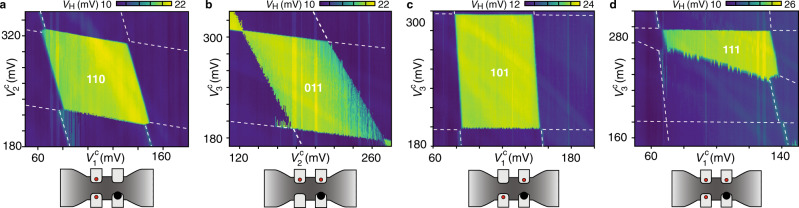
“One option is to encode qubits in suitable spin states of 111 triple dots, and operate these as voltage-controlled exchange-only qubits 21,22 .”
BackgroundIsotopically enhanced triple-quantum-dot qubit
Eng, K., Ladd, T. D., Smith, A., Borselli, M. G., Kiselev, A. A., Fong, B. H., Holabird, K. S., Hazard, T. M., Huang, B., Deelman, P. W., et al. (2015) · Science Advances · doi:10.1126/sciadv.1500214 · Cited by 242 · cited 1×
“One option is to encode qubits in suitable spin states of 111 triple dots, and operate these as voltage-controlled exchange-only qubits 21,22 .”
BackgroundNagaoka ferromagnetism observed in a quantum dot plaquette
Dehollain, J. P., Mukhopadhyay, U., Michal, V. P., Wang, Y., Wunsch, B., Reichl, C., Wegscheider, W., Rudner, M. S., Demler, E., & Vandersypen, L. M. K. (2020) · Nature · doi:10.1038/s41586-020-2051-0 · Cited by 178 · cited 1×
“In gallium arsenide, 2D arrays recently allowed coherent spin operations and quantum simulations 7,8 .”
BackgroundProbing the limits of gate-based charge sensing
Gonzalez-Zalba, M. F., Barraud, S., Ferguson, A. J., & Betz, A. C. (2015) · Nature Communications · doi:10.1038/ncomms7084 · Cited by 174 · cited 1×
“1d with a clear visibility of dot-4 and dot-1 transitions is unusual for gate-based dispersive sensing in the few-electron regime, where small tunneling rates typically limit the visibility of dot-to-lead or interdot transitions 29 .”
BackgroundGate-based high fidelity spin readout in a CMOS device
Urdampilleta, M., Niegemann, D. J., Chanrion, E., Jadot, B., Spence, C., Mortemousque, P.-A., Bäuerle, C., Hutin, L., Bertrand, B., Barraud, S., et al. (2019) · Nature Nanotechnology · doi:10.1038/s41565-019-0443-9 · Cited by 158 · cited 2×
“The compact form factor of such arrays, whose foundry fabrication can be extended to larger 2 × N arrays, along with the recent demonstration of spin control 10 – 12 and spin readout 13,14 , paves the way for dense qubit arrays for quantum computation and simulation 15 .”
BackgroundMethodSelf-citationLow-frequency charge noise in Si/SiGe quantum dots
Connors, E. J., Nelson, J., Qiao, H., Edge, L. F., & Nichol, J. M. (2019) · Physical Review B · doi:10.1103/physrevb.100.165305 · Cited by 149
Gate-reflectometry dispersive readout and coherent control of a spin qubit in silicon
Crippa, A., Ezzouch, R., Aprá, A., Amisse, A., Laviéville, R., Hutin, L., Bertrand, B., Vinet, M., Urdampilleta, M., Meunier, T., et al. (2019) · Nature Communications · doi:10.1038/s41467-019-10848-z · Cited by 148 · cited 5×
“Readout of spin using re fl ectometry has been demonstrated both for holes 10,12 and electrons 13,14 .”
BackgroundMethodInfluentialSelf-citationLoading a quantum-dot based “Qubyte” register
Volk, C., Zwerver, A. M. J., Mukhopadhyay, U., Eendebak, P. T., van Diepen, C. J., Dehollain, J. P., Hensgens, T., Fujita, T., Reichl, C., Wegscheider, W., et al. (2019) · npj Quantum Information · doi:10.1038/s41534-019-0146-y · Cited by 115 · cited 2×
“Further development of a spin-qubit architecture employing this platform will rely on array initialization 33 , coherent spin manipulation 36 , and high-fi delity operations 37 , as well as readout protocols 14,38 .”
MethodLogical Qubit in a Linear Array of Semiconductor Quantum Dots
Jones, C., Fogarty, M. A., Morello, A., Gyure, M. F., Dzurak, A. S., & Ladd, T. D. (2018) · Physical Review X · doi:10.1103/physrevx.8.021058 · Cited by 115 · cited 1×
“Unlike linear arrays of qubits 31 , which do not tolerate defective qubit sites, the development of 2 × N qubit arrays may prove useful for the realization of fault-tolerant spin-qubit quantum computers, trading topological constraints against lower error thresholds 32 .”
BackgroundCorna, A., Bourdet, L., Maurand, R., Crippa, A., Kotekar‐Patil, D., Bohuslavskyi, H., Laviéville, R., Hutin, L., Barraud, S., Jehl, X., et al. (2018) · npj Quantum Information · doi:10.1038/s41534-018-0059-1 · Cited by 111
Self-citationNagaoka ferromagnetism observed in a quantum dot plaquette
Dehollain, J., Mukhopadhyay, U., Michal, V., Wang, Y., Wunsch, B., Reichl, C., Wegscheider, W., Rudner, M. S., Demler, E., & Vandersypen, L. (n.d.) · UTS ePRESS (University of Technology Sydney) · Cited by 100
Coherent control of individual electron spins in a two-dimensional quantum dot array
Mortemousque, P.-A., Chanrion, E., Jadot, B., Flentje, H., Ludwig, A., Wieck, A. D., Urdampilleta, M., Bäuerle, C., & Meunier, T. (2021) · Nature Nanotechnology · doi:10.1038/s41565-020-00816-w · Cited by 85
Rent’s rule and extensibility in quantum computing
Franke, D. P., Clarke, J. S., Vandersypen, L. M. K., & Veldhorst, M. (2019) · Microprocessors and Microsystems · doi:10.1016/j.micpro.2019.02.006 · Cited by 80 · cited 1×
“While the compact one-gate-per-qubit architecture in accurately dimensioned silicon devices 10,12 may ultimately facilitate the wiring fanout of a large-scale quantum computer 23 , an overall tunability of certain array parameters may initially be essential.”
BackgroundQuantifying error and leakage in an encoded Si/SiGe triple-dot qubit
Andrews, R. W., Jones, C., Reed, M. D., Jones, A. M., Ha, S. D., Jura, M. P., Kerckhoff, J., Levendorf, M., Meenehan, S., Merkel, S. T., et al. (2019) · Nature Nanotechnology · doi:10.1038/s41565-019-0500-4 · Cited by 80 · cited 1×
“Further development of a spin-qubit architecture employing this platform will rely on array initialization 33 , coherent spin manipulation 36 , and high-fi delity operations 37 , as well as readout protocols 14,38 .”
MethodSpin Readout of a CMOS Quantum Dot by Gate Reflectometry and Spin-Dependent Tunneling
Ciriano-Tejel, V. N., Fogarty, M. A., Schaal, S., Hutin, L., Bertrand, B., Ibberson, L. A., González-Zalba, M. F., Li, J., Niquet, Y., Vinet, M., et al. (2021) · PRX Quantum · doi:10.1103/prxquantum.2.010353 · Cited by 73
Self-citationSite-Selective Quantum Control in an Isotopically Enriched Si28/Si0.7Ge0.3 Quadruple Quantum Dot
Sigillito, A. J., Loy, J. C., Zajac, D. M., Gullans, M. J., Edge, L. F., & Petta, J. R. (2019) · Physical Review Applied · doi:10.1103/physrevapplied.11.061006 · Cited by 66 · cited 1×
“Further development of a spin-qubit architecture employing this platform will rely on array initialization 33 , coherent spin manipulation 36 , and high-fi delity operations 37 , as well as readout protocols 14,38 .”
MethodCharge Detection in an Array of CMOS Quantum Dots
Chanrion, E., Niegemann, D. J., Bertrand, B., Spence, C., Jadot, B., Li, J., Mortemousque, P.-A., Hutin, L., Maurand, R., Jehl, X., et al. (2020) · Physical Review Applied · doi:10.1103/physrevapplied.14.024066 · Cited by 62 · cited 3×
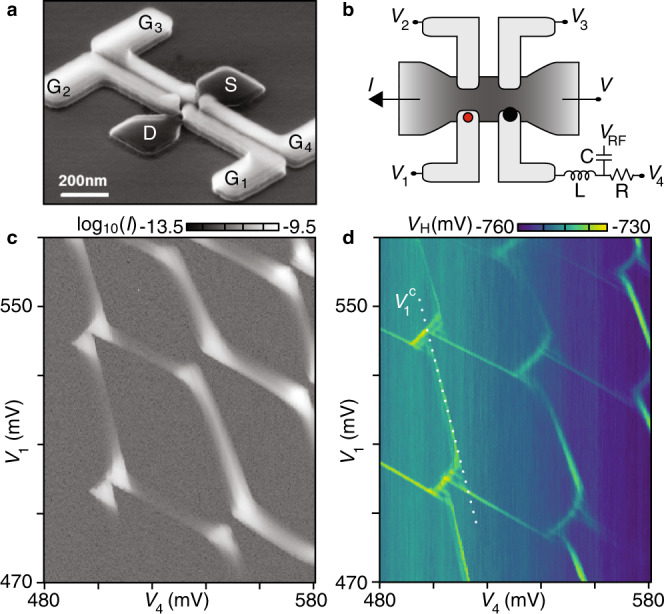
“17,18 ), we focus on a 2 × 2 quantum-dot array as the smallest two-dimensional unit cell in this architecture, that is, a device with two pairs of split-gate electrodes, labeled G i with corresponding control voltages V i .”
BackgroundMethodSelf-citationComputer-automated tuning of semiconductor double quantum dots into the single-electron regime
Baart, T. A., Eendebak, P. T., Reichl, C., Wegscheider, W., & Vandersypen, L. M. K. (2016) · Applied Physics Letters · doi:10.1063/1.4952624 · Cited by 61 · cited 1×
“2) may also simplify the algorithmic tuning of qubit arrays 30 .”
BackgroundSingle-Electron Operation of a Silicon-CMOS 2 × 2 Quantum Dot Array with Integrated Charge Sensing
Gilbert, W., Saraiva, A., Lim, W. H., Yang, C. H., Laucht, A., Bertrand, B., Rambal, N., Hutin, L., Escott, C. C., Vinet, M., et al. (2020) · Nano Letters · doi:10.1021/acs.nanolett.0c02397 · Cited by 47 · cited 2×
“In conjunction with complementary experiments in various other laboratories using similar LETI devices from the same fabrication run 14,18,34,35 , these results constitute key steps towards fault-tolerant quantum computing based on scalable, gate-de fi ned quantum dots.”
BackgroundSelf-citationPermutational quantum computing
Jordan, S. P. (2010) · Quantum Information and Computation · doi:10.26421/qic10.5-6-7 · Cited by 42 · cited 1×
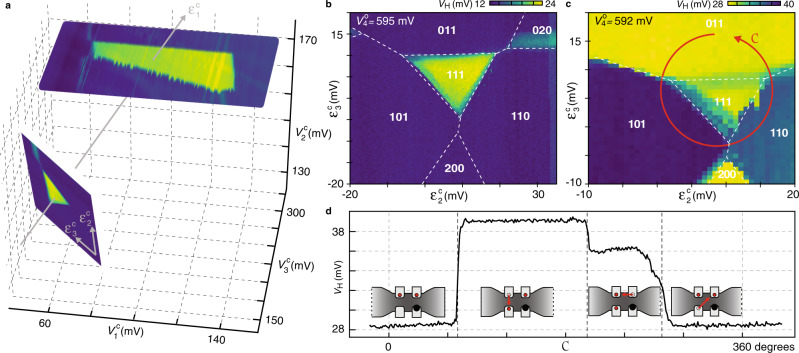
“In principle, any closed control loop traversing 011 → 101 → 110 → 011 should exchange the two electrons, which are isolated at all times by Coulomb blockade, making this a topological operation that may fi nd use in permutational quantum computing 26 .”
BackgroundFast Charge Sensing of Si/SiGe Quantum Dots via a High-Frequency Accumulation Gate
Volk, C., Chatterjee, A., Ansaloni, F., Marcus, C. M., & Kuemmeth, F. (2019) · Nano Letters · doi:10.1021/acs.nanolett.9b02149 · Cited by 33
Self-citationComputer-automated tuning of semiconductor double quantum dots into the single-electron regime
Baart, T. A., Eendebak, P. T., Reichl, C., Wegscheider, W., & Vandersypen, L. M. K. (2016) · TNO Repository · Cited by 30
Remote Capacitive Sensing in Two-Dimensional Quantum-Dot Arrays
Duan, J., Fogarty, M. A., Williams, J., Hutin, L., Vinet, M., & Morton, J. J. L. (2020) · Nano Letters · doi:10.1021/acs.nanolett.0c02393 · Cited by 26 · cited 2×
“In conjunction with complementary experiments in various other laboratories using similar LETI devices from the same fabrication run 14,18,34,35 , these results constitute key steps towards fault-tolerant quantum computing based on scalable, gate-de fi ned quantum dots.”
BackgroundSelf-citationCoherent control of individual electron spins in a two dimensional array of quantum dotsPreprint
Mortemousque, P.-A., Chanrion, E., Jadot, B., Flentje, H., Ludwig, A., Wieck, A. D., Urdampilleta, M., Bäuerle, C., & Meunier, T. (2018) · arXiv (Cornell University) · doi:10.48550/arxiv.1808.06180 · Cited by 25
Gate reflectometry for probing charge and spin states in linear Si MOS split-gate arrays
Hutin, L., Lundberg, T., Chatterjee, A., Crippa, A., Li, J., Maurand, R., Jehl, X., Sanquer, M., González-Zalba, M. F., Kuemmeth, F., et al. (2019) · Technical digest - International Electron Devices Meeting/Technical digest · doi:10.1109/iedm19573.2019.8993580 · Cited by 24 · cited 3×
“17,18 ), we focus on a 2 × 2 quantum-dot array as the smallest two-dimensional unit cell in this architecture, that is, a device with two pairs of split-gate electrodes, labeled G i with corresponding control voltages V i .”
BackgroundMethodSelf-citationOne-dimensional quantum computing with a ‘segmented chain’ is feasible with today’s gate fidelities
Li, Y., & Benjamin, S. C. (2018) · npj Quantum Information · doi:10.1038/s41534-018-0074-2 · Cited by 22
Reconfigurable quadruple quantum dots in a silicon nanowire transistor
Betz, A. C., Tagliaferri, M. L. V., Vinet, M., Broström, M., Sanquer, M., Ferguson, A. J., & González-Zalba, M. F. (2016) · Applied Physics Letters · doi:10.1063/1.4950976 · Cited by 19 · cited 2×
“In silicon, 2D arrays have been limited to transport measurements in the many-electron regime 9 .”
BackgroundSelf-citationIntrinsic Metastabilities in the Charge Configuration of a Double Quantum Dot
Biesinger, D. E. F., Scheller, C. P., Braunecker, B., Zimmerman, J. D., Gossard, A. C., & Zumbühl, D. M. (2015) · Physical Review Letters · doi:10.1103/physrevlett.115.106804 · Cited by 16 · cited 1×
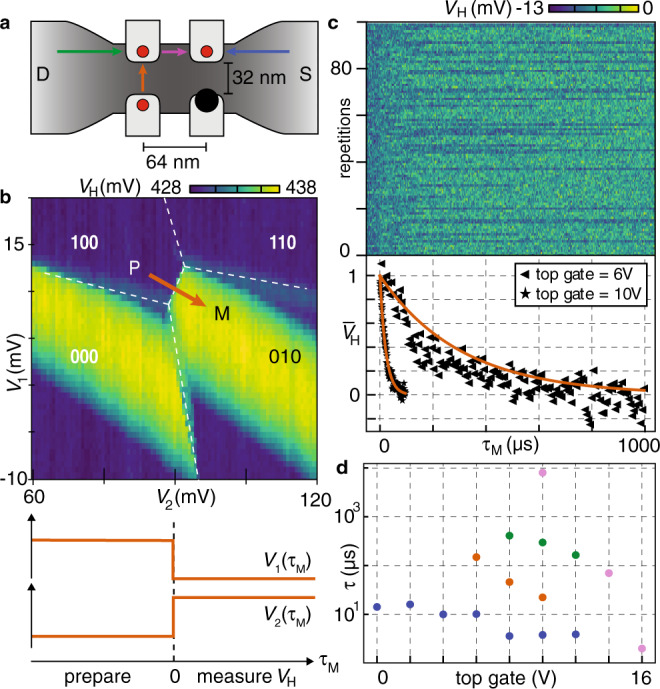
“We did not observe any effects indicating alternative tunneling channels 27 , but veri fi ed by intentionally changing the radius of C and inspecting V H ( C ) that leakage into undesired charge con fi gurations does indeed now occur.”
BackgroundDevelopment of a CMOS Route for Electron Pumps to Be Used in Quantum Metrology
Barraud, S., Laviéville, R., Hutin, L., Bohuslavskyi, H., Vinet, M., Corna, A., Clapera, P., Sanquer, M., & Jehl, X. (2016) · Technologies · doi:10.3390/technologies4010010 · Cited by 8 · cited 3×
“Our quantum-dot arrays are fabricated at CEA-LETI using a top-down fabrication process on 300-mm silicon-on-insulator (SOI) wafers, adapted from a commercial fully-depleted SOI (FD-SOI) transistor technology 16 .”
BackgroundMethodSelf-citationGate reflectometry for probing charge and spin states in linear Si MOS split-gate arraysPreprint
Hutin, L., Bertrand, B., Chanrion, E., et al. (2019) · arXiv (Cornell University) · doi:10.48550/arxiv.1912.10884 · Cited by 4 · cited 3×
“17,18 ), we focus on a 2 × 2 quantum-dot array as the smallest two-dimensional unit cell in this architecture, that is, a device with two pairs of split-gate electrodes, labeled G i with corresponding control voltages V i .”
BackgroundMethodSelf-citationElectron cascade for spin readout
van Diepen, C. J., Hsiao, T. K., Mukhopadhyay, U., Reichl, C., Wegscheider, W., & Vandersypen, L. M. K. (2020) · arXiv · doi:10.48550/arxiv.2002.08925
Spin readout of a CMOS quantum dot by gate reflectometry and spin-dependent tunnelling
Ciriano-Tejel, V. N., Fogarty, M. A., Schaal, S., Hutin, L., Bertrand, B., Ibberson, L., Gonzalez-Zalba, M. F., Li, J., Niquet, Y. M., Vinet, M., et al. (2020) · arXiv · doi:10.48550/arxiv.2005.07764
Self-citation
Cited by
Burkard, G., Ladd, T. D., Pan, A., Nichol, J. M., & Petta, J. R. (2023) · Reviews of Modern Physics · doi:10.1103/revmodphys.95.025003 · Cited by 715
Materials challenges and opportunities for quantum computing hardware
de Leon, N. P., Itoh, K. M., Kim, D., Mehta, K. K., Northup, T. E., Paik, H., Palmer, B. S., Samarth, N., Sangtawesin, S., & Steuerman, D. W. (2021) · Science · doi:10.1126/science.abb2823 · Cited by 710
Semiconductor qubits in practice
Chatterjee, A., Stevenson, P., De Franceschi, S., Morello, A., de Leon, N. P., & Kuemmeth, F. (2021) · Nature Reviews Physics · doi:10.1038/s42254-021-00283-9 · Cited by 359
Self-citationQubits made by advanced semiconductor manufacturing
Zwerver, A. M. J., Krähenmann, T., Watson, T. F., Lampert, L., George, H. C., Pillarisetty, R., Bojarski, S. A., Amin, P., Amitonov, S. V., Boter, J. M., et al. (2022) · Nature Electronics · doi:10.1038/s41928-022-00727-9 · Cited by 364
Scaling silicon-based quantum computing using CMOS technology
Gonzalez-Zalba, M. F., de Franceschi, S., Charbon, E., Meunier, T., Vinet, M., & Dzurak, A. S. (2021) · Nature Electronics · doi:10.1038/s41928-021-00681-y · Cited by 272
Self-citation
Metadata
- Authors
- Ansaloni, F., Chatterjee, A., Bohuslavskyi, H., Bertrand, B., Hutin, L., Vinet, M., & Kuemmeth, F.
- Affiliations
- University of Copenhagen (DK)
- Commissariat à l'Énergie Atomique et aux Énergies Alternatives (FR)
- Corresponding author
- Kuemmeth, Ferdinand
- ORCID
- Venue
- Nature Communications
- Published
- 2020-12-16
- Volume
- 11
- Issue
- 1
- Pages
- 6399-6399
- ISSN
- 2041-1723 (ISSN-L)
- PMC
- PMC7744547
- OpenAlex
- W3112135735
- Cited by
- 86
- References
- 43
- Citations by year
- 2026: 4 · 2025: 14 · 2024: 9 · 2023: 23 · 2022: 15 · 2021: 20 · 2020: 1
- FWCI
- 6.00
- Type
- journal article
- Language
- en
- Open access
- gold
- doi.org
- Licence
- cc-by
- creativecommons.org/licenses/by/4.0 (tdm)
- creativecommons.org/licenses/by/4.0 (vor)
- Locations
- Nature Communications (publishedVersion, cc-by)
- PubMed Central (publishedVersion, cc-by)
- PubMed (publishedVersion)
- Research at the University of Copenhagen (University of Copenhagen) (publishedVersion, cc-by)
- arXiv (Cornell University) (submittedVersion)
- University of Regensburg Publication Server (University of Regensburg) (submittedVersion, cc-by)
- HAL (submittedVersion, cc-by)
- RePEc: Research Papers in Economics (submittedVersion)
- DOAJ (DOAJ: Directory of Open Access Journals) (submittedVersion, cc-by-sa)
- University of Regensburg Publication Server (University of Regensburg)
- Funders
- Det Frie Forskningsråd (8073-00018B)
- Topics
- Physical Sciences › Physics and Astronomy › Condensed Matter Physics › Quantum and electron transport phenomena
- Physical Sciences › Physics and Astronomy › Atomic and Molecular Physics, and Optics › Semiconductor Quantum Structures and Devices
- Physical Sciences › Engineering › Electrical and Electronic Engineering › Advancements in Semiconductor Devices and Circuit Design
- Keywords
- silicon quantum dots, foundry fabrication, split-gate devices, electron tunneling, single-shot detection, electron exchange, spin qubits, 300 mm wafers
About these checks
Registry, retraction, Cites and statistics results are computed, not judged, with one exception: a printed reference that no index lists is read once by a model before it counts as a citation error. Claims are extracted by a model and kept only when their quote appears verbatim in the text; each cited source is then checked, with a model’s help, for whether it says what the claim relies on. Those verdicts can be wrong — read the claim’s quote and the cited source before relying on one.
Statistics and arithmetic are recomputed, not judged.
Confidence bands are shown only for fields calibrated on our annotated test set. None is calibrated yet, so no band is shown.
What counts as a claim ›How we measure confidence ›How we check this ›
Are you an author, or do you see a problem with this page? Request a review
Data sources
Bibliographic data: Semantic Scholar, OpenAlex, Crossref.
Contains information from the Semantic Scholar Academic Graph Datasets, made available under the ODC Attribution License (ODC-BY 1.0).
Semantic Scholar’s data is described in: Kinney, R., et al. (2023). The Semantic Scholar Open Data Platform. arXiv:2301.10140.
