

Bayesian genome scale modelling identifies thermal determinants of yeast metabolism
Open accessPublished version of a preprint
The DOI matches its Crossref record; 66 of the 66 references it cites were found in a registry or an index.
Abstract
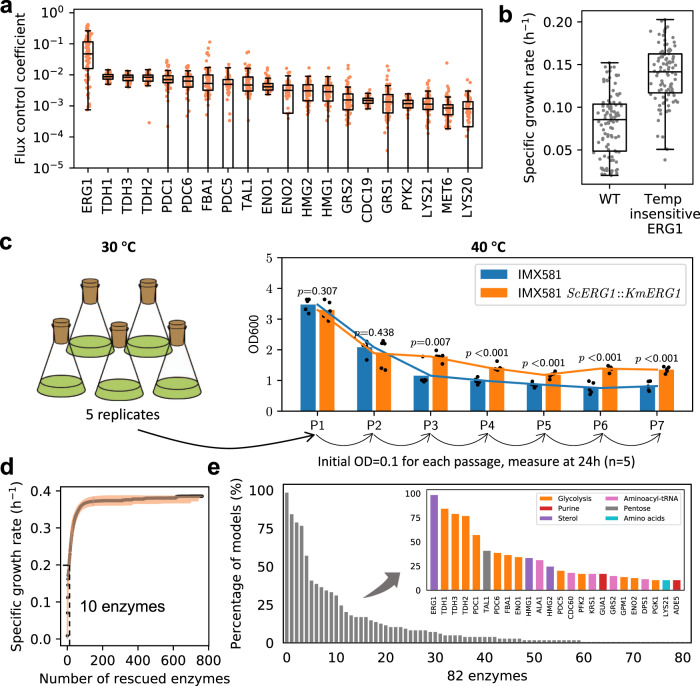
The molecular basis of how temperature affects cell metabolism has been a long-standing question in biology, where the main obstacles are the lack of high-quality data and methods to associate temperature effects on the function of individual proteins as well as to combine them at a systems level. Here we develop and apply a Bayesian modeling approach to resolve the temperature effects in genome scale metabolic models (GEM). The approach minimizes uncertainties in enzymatic thermal parameters and greatly improves the predictive strength of the GEMs. The resulting temperature constrained yeast GEM uncovers enzymes that limit growth at superoptimal temperatures, and squalene epoxidase (ERG1) is predicted to be the most rate limiting. By replacing this single key enzyme with an ortholog from a thermotolerant yeast strain, we obtain a thermotolerant strain that outgrows the wild type, demonstrating the critical role of sterol metabolism in yeast thermosensitivity. Therefore, apart from identifying thermal determinants of cell metabolism and enabling the design of thermotolerant strains, our Bayesian GEM approach facilitates modelling of complex biological systems in the absence of high-quality data and therefore shows promise for becoming a standard tool for genome scale modeling.
Overview
The claims and statistics of this paper haven’t been checked yet.
Free: it reads the open-access text and checks the first 5 claims that cite a source we can check. Create a free account to check every claim.
Integrity signals
Registry
Cites
Statistics
Figures
Verification
Claims the paper makes
The claims and statistics of this paper haven’t been checked yet.
Free: it reads the open-access text and checks the first 5 claims that cite a source we can check. Create a free account to check every claim.
Self-check
Percentages, sums and reported differences re-computed from the paper’s own numbers.
The self-check needs the paper’s full text.
Citations
Cites
Auto-Encoding Variational Bayes
Kingma, D. P., & Welling, M. (2013) · arXiv · doi:10.48550/arxiv.1312.6114 · Cited by 20,067
THE GENERALIZATION OF ‘STUDENT'S’ PROBLEM WHEN SEVERAL DIFFERENT POPULATION VARLANCES ARE INVOLVED
WELCH, B. L. (1947) · Biometrika · doi:10.1093/biomet/34.1-2.28 · Cited by 4,135
Rectangular Confidence Regions for the Means of Multivariate Normal Distributions
Šidák, Z. (1967) · Journal of the American Statistical Association · doi:10.1080/01621459.1967.10482935 · Cited by 2,639
Genome-Scale Reconstruction of the Saccharomyces cerevisiae Metabolic Network
Förster, J., Famili, I., Fu, P., Palsson, B. Ø., & Nielsen, J. (2003) · Genome Research · doi:10.1101/gr.234503 · Cited by 1,069
Self-citationGenome-scale models of microbial cells: evaluating the consequences of constraints
Price, N. D., Reed, J. L., & Palsson, B. Ø. (2004) · Nature Reviews Microbiology · doi:10.1038/nrmicro1023 · Cited by 1,023
Yeasts in sustainable bioethanol production: A review
Mohd Azhar, S. H., Abdulla, R., Jambo, S. A., Marbawi, H., Gansau, J. A., Mohd Faik, A. A., & Rodrigues, K. F. (2017) · Biochemistry and Biophysics Reports · doi:10.1016/j.bbrep.2017.03.003 · Cited by 922
Bioreaction Engineering Principles
Nielsen, J., & Villadsen, J. (1994) · Springer eBooks · doi:10.1007/978-1-4757-4645-7 · Cited by 696
Self-citationProtein Structure and the Energetics of Protein Stability
Robertson, A. D., & Murphy, K. P. (1997) · Chemical Reviews · doi:10.1021/cr960383c · Cited by 679
Approximate Bayesian Computation
Sunnåker, M., Busetto, A. G., Numminen, E., Corander, J., Foll, M., & Dessimoz, C. (2013) · PLoS Computational Biology · doi:10.1371/journal.pcbi.1002803 · Cited by 623
Global analysis of protein folding using massively parallel design, synthesis, and testing
Rocklin, G. J., Chidyausiku, T. M., Goreshnik, I., Ford, A., Houliston, S., Lemak, A., Carter, L., Ravichandran, R., Mulligan, V. K., Chevalier, A., et al. (2017) · Science · doi:10.1126/science.aan0693 · Cited by 501
Protein Folding and Unfolding at Atomic Resolution
Fersht, A. R., & Daggett, V. (2002) · Cell · doi:10.1016/s0092-8674(02)00620-7 · Cited by 495
Mans, R., van Rossum, H. M., Wijsman, M., Backx, A., Kuijpers, N. G. A., van den Broek, M., Daran-Lapujade, P., Pronk, J. T., van Maris, A. J. A., & Daran, J.-M. G. (2015) · FEMS Yeast Research · doi:10.1093/femsyr/fov004 · Cited by 485
How do thermophilic proteins deal with heat?
Kumar, S., & Nussinov, R. (2001) · Cellular and Molecular Life Sciences · doi:10.1007/pl00000935 · Cited by 478
The 3-hydroxy-3-methylglutaryl coenzyme-A (HMG-CoA) reductases.
Friesen, J. A., & Rodwell, V. W. (2004) · Genome biology · doi:10.1186/gb-2004-5-11-248 · Cited by 474
Sánchez, B. J., Zhang, C., Nilsson, A., Lahtvee, P., Kerkhoven, E. J., & Nielsen, J. (2017) · Molecular Systems Biology · doi:10.15252/msb.20167411 · Cited by 466
Self-citationAltered sterol composition renders yeast thermotolerant
Caspeta, L., Chen, Y., Ghiaci, P., Feizi, A., Buskov, S., Hallström, B. M., Petranovic, D., & Nielsen, J. (2014) · Science · doi:10.1126/science.1258137 · Cited by 433
Self-citationBioreaction Engineering Principles
Villadsen, J., Nielsen, J., & Lidén, G. (2011) · Springer eBooks · doi:10.1007/978-1-4419-9688-6 · Cited by 432
Self-citationCell-wide analysis of protein thermal unfolding reveals determinants of thermostability
Leuenberger, P., Ganscha, S., Kahraman, A., Cappelletti, V., Boersema, P. J., von Mering, C., Claassen, M., & Picotti, P. (2017) · Science · doi:10.1126/science.aai7825 · Cited by 411
BRENDA in 2019: a European ELIXIR core data resource
Jeske, L., Placzek, S., Schomburg, I., Chang, A., & Schomburg, D. (2019) · Nucleic Acids Research · doi:10.1093/nar/gky1048 · Cited by 385
Lu, H., Li, F., Sánchez, B. J., Zhu, Z., Li, G., Domenzain, I., Marcišauskas, S., Anton, P. M., Lappa, D., Lieven, C., et al. (2019) · Nature Communications · doi:10.1038/s41467-019-11581-3 · Cited by 361
Self-citationOn the Temperature Dependence of Enzyme-Catalyzed Rates
Arcus, V. L., Prentice, E. J., Hobbs, J. K., Mulholland, A. J., Van der Kamp, M. W., Pudney, C. R., Parker, E. J., & Schipper, L. A. (2016) · Biochemistry · doi:10.1021/acs.biochem.5b01094 · Cited by 312
Physical limits of cells and proteomes
Dill, K. A., Ghosh, K., & Schmit, J. D. (2011) · Proceedings of the National Academy of Sciences · doi:10.1073/pnas.1114477108 · Cited by 298
Solid model compounds and the thermodynamics of protein unfolding
Murphy, K. P., & Gill, S. J. (1991) · Journal of Molecular Biology · doi:10.1016/0022-2836(91)90506-2 · Cited by 271
Temperature Matters! And Why It Should Matter to Tumor Immunologists
Repasky, E. A., Evans, S. S., & Dewhirst, M. W. (2013) · Cancer Immunology Research · doi:10.1158/2326-6066.cir-13-0118 · Cited by 243
Parallel adaptations to high temperatures in the Archaean eon
Boussau, B., Blanquart, S., Necsulea, A., Lartillot, N., & Gouy, M. (2008) · Nature · doi:10.1038/nature07393 · Cited by 242
Hobbs, J. K., Jiao, W., Easter, A. D., Parker, E. J., Schipper, L. A., & Arcus, V. L. (2013) · ACS Chemical Biology · doi:10.1021/cb4005029 · Cited by 234
Evolutionary drivers of thermoadaptation in enzyme catalysis
Nguyen, V., Wilson, C., Hoemberger, M., Stiller, J. B., Agafonov, R. V., Kutter, S., English, J., Theobald, D. L., & Kern, D. (2017) · Science · doi:10.1126/science.aah3717 · Cited by 204
Lahtvee, P.-J., Sánchez, B. J., Smialowska, A., Kasvandik, S., Elsemman, I. E., Gatto, F., & Nielsen, J. (2017) · Cell Systems · doi:10.1016/j.cels.2017.03.003 · Cited by 193
Self-citationThermal proteome profiling in bacteria: probing protein state in vivo
Mateus, A., Bobonis, J., Kurzawa, N., Stein, F., Helm, D., Hevler, J., Typas, A., & Savitski, M. M. (2018) · Molecular Systems Biology · doi:10.15252/msb.20188242 · Cited by 189
Genomic and proteomic adaptations to growth at high temperature.
Hickey, D. A., & Singer, G. A. C. (2004) · Genome biology · doi:10.1186/gb-2004-5-10-117 · Cited by 184
Machine Learning Applied to Predicting Microorganism Growth Temperatures and Enzyme Catalytic Optima
Li, G., Rabe, K. S., Nielsen, J., & Engqvist, M. K. M. (2019) · ACS Synthetic Biology · doi:10.1021/acssynbio.9b00099 · Cited by 180
Self-citationMalina, C., Larsson, C., & Nielsen, J. (2018) · FEMS Yeast Research · doi:10.1093/femsyr/foy040 · Cited by 178
Self-citationDecreasing human body temperature in the United States since the Industrial Revolution
Protsiv, M., Ley, C., Lankester, J., Hastie, T., & Parsonnet, J. (2020) · eLife · doi:10.7554/elife.49555 · Cited by 169
Pastore, A., Martin, S. R., Politou, A., Kondapalli, K. C., Stemmler, T., & Temussi, P. A. (2007) · Journal of the American Chemical Society · doi:10.1021/ja0714538 · Cited by 168
How Do Thermophilic Proteins and Proteomes Withstand High Temperature?
Sawle, L., & Ghosh, K. (2011) · Biophysical Journal · doi:10.1016/j.bpj.2011.05.059 · Cited by 156
Bayesian inference for differential equations
Girolami, M. (2008) · Theoretical Computer Science · doi:10.1016/j.tcs.2008.07.005 · Cited by 154
Caspeta, L., & Nielsen, J. (2015) · mBio · doi:10.1128/mbio.00431-15 · Cited by 142
Self-citationArora, R., Behera, S., & Kumar, S. (2015) · Renewable and Sustainable Energy Reviews · doi:10.1016/j.rser.2015.06.050 · Cited by 139
Metabolic Trade-offs in Yeast are Caused by F1F0-ATP synthase
Nilsson, A., & Nielsen, J. (2016) · Scientific Reports · doi:10.1038/srep22264 · Cited by 137
Self-citationTemperature dependence of protein folding kinetics in living cells
Guo, M., Xu, Y., & Gruebele, M. (2012) · Proceedings of the National Academy of Sciences · doi:10.1073/pnas.1201797109 · Cited by 132
DeLong, J. P., Gibert, J. P., Luhring, T. M., Bachman, G. C., Reed, B., Neyer, A. A., & Montooth, K. L. (2017) · Ecology and Evolution · doi:10.1002/ece3.2955 · Cited by 132
Cellular Proteomes Have Broad Distributions of Protein Stability
Ghosh, K., & Dill, K. A. (2010) · Biophysical Journal · doi:10.1016/j.bpj.2010.10.036 · Cited by 128
l(+)-Lactic acid production from non-food carbohydrates by thermotolerant Bacillus coagulans
Ou, M. S., Ingram, L. O., & Shanmugam, K. T. (2011) · Journal of Industrial Microbiology & Biotechnology · doi:10.1007/s10295-010-0796-4 · Cited by 126
Stress tolerance in a yeast sterol auxotroph: role of ergosterol, heat shock proteins and trehalose
Swan, T. (1998) · FEMS Microbiology Letters · doi:10.1016/s0378-1097(98)00483-2 · Cited by 125
Structural Systems Biology Evaluation of Metabolic Thermotolerance in Escherichia coli
Chang, R. L., Andrews, K., Kim, D., Li, Z., Godzik, A., & Palsson, B. O. (2013) · Science · doi:10.1126/science.1234012 · Cited by 116
Baracos, V. E., Whitmore, W. T., & Gale, R. (1987) · Canadian Journal of Physiology and Pharmacology · doi:10.1139/y87-199 · Cited by 106
Modeling the temperature effect on the specific growth rate of phytoplankton: A review
Grimaud, G. M., Mairet, F., Sciandra, A., & Bernard, O. (2017) · Reviews in Environmental Science and Bio/Technology · doi:10.1007/s11157-017-9443-0 · Cited by 103
Thermosensitivity of growth is determined by chaperone-mediated proteome reallocation
Chen, K., Gao, Y., Mih, N., O’Brien, E. J., Yang, L., & Palsson, B. O. (2017) · Proceedings of the National Academy of Sciences · doi:10.1073/pnas.1705524114 · Cited by 95
Mitochondrial DNA and temperature tolerance in lager yeasts
Baker, E. P., Peris, D., Moriarty, R. V., Li, X., Fay, J. C., & Hittinger, C. T. (2019) · Science Advances · doi:10.1126/sciadv.aav1869 · Cited by 95
Dynamical origins of heat capacity changes in enzyme-catalysed reactions
van der Kamp, M. W., Prentice, E. J., Kraakman, K. L., Connolly, M., Mulholland, A. J., & Arcus, V. L. (2018) · Nature Communications · doi:10.1038/s41467-018-03597-y · Cited by 90
Engqvist, M. K. M. (2018) · BMC Microbiology · doi:10.1186/s12866-018-1320-7 · Cited by 89
Postmus, J., Canelas, A. B., Bouwman, J., Bakker, B. M., van Gulik, W. M., de Mattos, M. J. T., Brul, S., & Smits, G. J. (2008) · Journal of Biological Chemistry · doi:10.1074/jbc.m802908200 · Cited by 81
Genomic analyses of thermotolerant microorganisms used for high-temperature fermentations
Matsushita, K., Azuma, Y., Kosaka, T., Yakushi, T., Hoshida, H., Akada, R., & Yamada, M. (2016) · Bioscience, Biotechnology, and Biochemistry · doi:10.1080/09168451.2015.1104235 · Cited by 81
Genome scale models of yeast: towards standardized evaluation and consistent omic integration
Sánchez, B. J., & Nielsen, J. (2015) · Integrative Biology · doi:10.1039/c5ib00083a · Cited by 75
Self-citationAdaptation to different types of stress converge on mitochondrial metabolism
Lahtvee, P.-J., Kumar, R., Hallström, B. M., & Nielsen, J. (2016) · Molecular Biology of the Cell · doi:10.1091/mbc.e16-03-0187 · Cited by 71
Self-citationPaliwal, S., Fiumera, A. C., & Fiumera, H. L. (2014) · Genetics · doi:10.1534/genetics.114.168575 · Cited by 71
Zakhartsev, M. V., Yang, X., Reuß, M., & Pörtner, H. (2015) · Journal of Thermal Biology · doi:10.1016/j.jtherbio.2015.05.008 · Cited by 51
Moro, F., & Muga, A. (2006) · Journal of Molecular Biology · doi:10.1016/j.jmb.2006.03.027 · Cited by 44
Mitochondrial Recombination Reveals Mito–Mito Epistasis in Yeast
Wolters, J. F., Charron, G., Gaspary, A., Landry, C. R., Fiumera, A. C., & Fiumera, H. L. (2018) · Genetics · doi:10.1534/genetics.117.300660 · Cited by 38
Dynamic regulation of mitochondrial respiratory chain efficiency in Saccharomyces cerevisiae
Postmus, J., Tüzün, I., Bekker, M., Müller, W. H., de Mattos, M. J. T., Brul, S., & Smits, G. J. (2011) · Microbiology · doi:10.1099/mic.0.050039-0 · Cited by 35
Ma, B.-X., Ke, X., Tang, X., Zheng, R., & Zheng, Y. (2018) · World Journal of Microbiology and Biotechnology · doi:10.1007/s11274-018-2440-9 · Cited by 33
Uncertainty reduction in biochemical kinetic models: Enforcing desired model properties
Mišković, L., Béal, J., Moret, M., & Hatzimanikatis, V. (2019) · PLoS Computational Biology · doi:10.1371/journal.pcbi.1007242 · Cited by 33
Bayesian statistical learning for big data biology
Yau, C., & Campbell, K. R. (2019) · Biophysical Reviews · doi:10.1007/s12551-019-00499-1 · Cited by 28
The pan-genome of Saccharomyces cerevisiae
Li, G., Ji, B., & Nielsen, J. (2019) · FEMS Yeast Research · doi:10.1093/femsyr/foz064 · Cited by 23
Self-citationChen, Y., Li, G., & Nielsen, J. (2019) · Methods in molecular biology · doi:10.1007/978-1-4939-9736-7_19 · Cited by 19
Self-citationHobbs, J. K., Jiao, W., Easter, A., Parker, E. J., Schipper, L. A., & Arcus, V. L. (2017) · ACS Chemical Biology · doi:10.1021/acschembio.7b00065 · Cited by 10
Cited by
Deep learning-based kcat prediction enables improved enzyme-constrained model reconstruction
Li, F., Yuan, L., Lu, H., Li, G., Chen, Y., Engqvist, M. K. M., Kerkhoven, E. J., & Nielsen, J. (2022) · Nature Catalysis · doi:10.1038/s41929-022-00798-z · Cited by 466
“To resolve these uncertainties, we adopted a Bayesian genome-scale modelling approach 32 .”
BackgroundMethodInfluentialSelf-citationDomenzain, I., Sánchez, B., Anton, M., Kerkhoven, E. J., Millán-Oropeza, A., Henry, C., Siewers, V., Morrissey, J. P., Sonnenschein, N., & Nielsen, J. (2021) · doi:10.1101/2021.03.05.433259 · Cited by 158
Self-citationYeast metabolic innovations emerged via expanded metabolic network and gene positive selection
Lu, H., Li, F., Yuan, L., Domenzain, I., Yu, R., Wang, H., Li, G., Chen, Y., Ji, B., Kerkhoven, E. J., et al. (2021) · Molecular Systems Biology · doi:10.15252/msb.202110427 · Cited by 44
Self-citation(2022) · doi:10.1016/j.ymben.2022.09.002 · Cited by 13
Metadata
- Authors
- Li, G., Hu, Y., Zrimec, J., Luo, H., Wang, H., Zelezniak, A., Ji, B., & Nielsen, J.
- Affiliations
- Chalmers University of Technology (SE)
- Science for Life Laboratory (SE)
- Novo Nordisk Foundation (DK)
- Corresponding author
- Nielsen, Jens
- Venue
- Nature Communications
- Published
- 2021-01-08
- Volume
- 12
- Issue
- 1
- Pages
- 190-190
- ISSN
- 2041-1723 (ISSN-L)
- PMC
- PMC7794507
- OpenAlex
- W3121123436
- Cited by
- 57
- References
- 66
- Citations by year
- 2026: 9 · 2025: 8 · 2024: 11 · 2023: 7 · 2022: 11 · 2021: 10
- FWCI
- 3.06
- Type
- journal article
- Language
- en
- Open access
- gold
- doi.org
- Licence
- cc-by
- creativecommons.org/licenses/by/4.0 (tdm)
- creativecommons.org/licenses/by/4.0 (vor)
- Locations
- Nature Communications (publishedVersion, cc-by)
- bioRxiv (Cold Spring Harbor Laboratory) (acceptedVersion, cc-by-nc-nd)
- Europe PMC (PubMed Central) (publishedVersion, other-oa)
- PubMed Central (publishedVersion, cc-by)
- PubMed (publishedVersion)
- Technical University of Denmark, DTU Orbit (Technical University of Denmark, DTU) (submittedVersion, other-oa)
- RePEc: Research Papers in Economics (submittedVersion)
- DOAJ (DOAJ: Directory of Open Access Journals) (submittedVersion, cc-by-sa)
- Chalmers Research (Chalmers University of Technology) (submittedVersion)
- Funders
- European Commission (HORIZON2020, 722287)
- Chalmers Tekniska Högskola
- Knut och Alice Wallenbergs Stiftelse (NNF10CC1016517)
- Novo Nordisk (NNF10CC1016517)
- Science for Life Laboratory
- Novo Nordisk Fonden (NNF17SA0032514, NNF10CC1016517)
- Topics
- Life Sciences › Biochemistry, Genetics and Molecular Biology › Molecular Biology › Microbial Metabolic Engineering and Bioproduction
- Life Sciences › Biochemistry, Genetics and Molecular Biology › Molecular Biology › Gene Regulatory Network Analysis
- Life Sciences › Biochemistry, Genetics and Molecular Biology › Molecular Biology › Fungal and yeast genetics research
- Keywords
- temperature effects on metabolism, yeast metabolism, genome-scale metabolic models, Bayesian parameter estimation, squalene epoxidase, ERG1, sterol metabolism, heat tolerance, growth prediction
- MeSH terms
- Machine Learning, Bayes Theorem, Models, Biological, Saccharomyces cerevisiae, Temperature, Yeasts, Genome, Fungal, Squalene Monooxygenase
About these checks
Registry, retraction, Cites and statistics results are computed, not judged, with one exception: a printed reference that no index lists is read once by a model before it counts as a citation error. Claims are extracted by a model and kept only when their quote appears verbatim in the text; each cited source is then checked, with a model’s help, for whether it says what the claim relies on. Those verdicts can be wrong — read the claim’s quote and the cited source before relying on one.
Statistics and arithmetic are recomputed, not judged.
Confidence bands are shown only for fields calibrated on our annotated test set. None is calibrated yet, so no band is shown.
What counts as a claim ›How we measure confidence ›How we check this ›
Are you an author, or do you see a problem with this page? Request a review
Data sources
Bibliographic data: Semantic Scholar, OpenAlex, Crossref.
Contains information from the Semantic Scholar Academic Graph Datasets, made available under the ODC Attribution License (ODC-BY 1.0).
Semantic Scholar’s data is described in: Kinney, R., et al. (2023). The Semantic Scholar Open Data Platform. arXiv:2301.10140.
