

The DOI matches its Crossref record; 43 of the 43 references it cites were found in a registry or an index.
Genetic predictors of participation in optional components of UK Biobank
Open accessPublished version of a preprint
Abstract
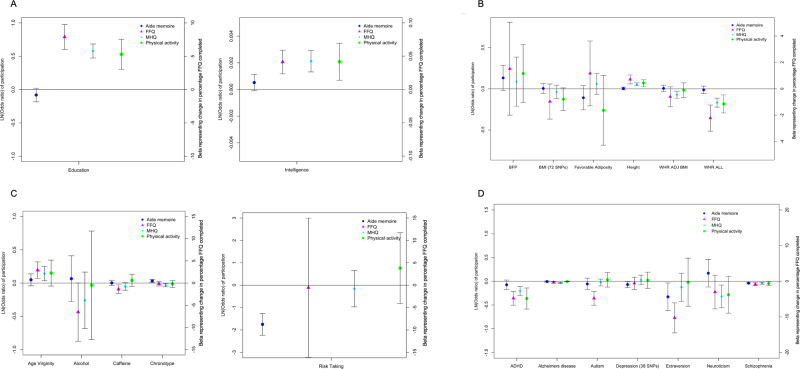
Large studies such as UK Biobank are increasingly used for GWAS and Mendelian randomization (MR) studies. However, selection into and dropout from studies may bias genetic and phenotypic associations. We examine genetic factors affecting participation in four optional components in up to 451,306 UK Biobank participants. We used GWAS to identify genetic variants associated with participation, MR to estimate effects of phenotypes on participation, and genetic correlations to compare participation bias across different studies. 32 variants were associated with participation in one of the optional components ( P < 6 × 10 −9 ), including loci with links to intelligence and Alzheimer’s disease. Genetic correlations demonstrated that participation bias was common across studies. MR showed that longer educational duration, older menarche and taller stature increased participation, whilst higher levels of adiposity, dyslipidaemia, neuroticism, Alzheimer’s and schizophrenia reduced participation. Our effect estimates can be used for sensitivity analysis to account for selective participation biases in genetic or non-genetic analyses.
Overview
The claims and statistics of this paper haven’t been checked yet.
Run the check — free, no account needed. It reads the open-access text and checks the sources it cites.
Integrity signals
Registry
Cites
Statistics
Figures
Verification
Claims the paper makes
The claims and statistics of this paper haven’t been checked yet.
Run the check — free, no account needed. It reads the open-access text and checks the sources it cites.
Claims other papers make about this one
Each is checked against this paper’s own text: does it say what the citing paper says it does?
In the citing paper
“With individual level data and a continuous exposure, non-linear MR can be applied to estimate whether the causal effect of the exposure on the outcome varies across different levels of the exposure.30,108”
From Mendelian randomization (2022) · cites this paper as [30]
Self-check
Percentages, sums and reported differences re-computed from the paper’s own numbers.
The self-check needs the paper’s full text.
Citations
Cites
Sudlow, C., Gallacher, J., Allen, N., Beral, V., Burton, P., Danesh, J., Downey, P., Elliott, P., Green, J., Landray, M., et al. (2015) · PLOS Medicine · doi:10.1371/journal.pmed.1001779 · Cited by 12,728
Bowden, J., Davey Smith, G., & Burgess, S. (2015) · International Journal of Epidemiology · doi:10.1093/ije/dyv080 · Cited by 9,816
Bowden, J., Davey Smith, G., Haycock, P. C., & Burgess, S. (2016) · Genetic Epidemiology · doi:10.1002/gepi.21965 · Cited by 8,922
The UK Biobank resource with deep phenotyping and genomic data
Bycroft, C., Freeman, C., Petkova, D., Band, G., Elliott, L. T., Sharp, K., Motyer, A., Vukcevic, D., Delaneau, O., O’Connell, J., et al. (2018) · Nature · doi:10.1038/s41586-018-0579-z · Cited by 8,876
Davey Smith, G., & Ebrahim, S. (2003) · International Journal of Epidemiology · doi:10.1093/ije/dyg070 · Cited by 5,882
An atlas of genetic correlations across human diseases and traits
ReproGen Consortium, Bulik-Sullivan, B., Psychiatric Genomics Consortium, Genetic Consortium for Anorexia Nervosa of the Wellcome Trust Case Control Consortium 3, Finucane, H. K., Anttila, V., Gusev, A., Day, F. R., Loh, P.-R., Duncan, L., et al. (2015) · Nature Genetics · doi:10.1038/ng.3406 · Cited by 4,255
Fry, A., Littlejohns, T. J., Sudlow, C., Doherty, N., Adamska, L., Sprosen, T., Collins, R., & Allen, N. E. (2017) · American Journal of Epidemiology · doi:10.1093/aje/kwx246 · Cited by 3,979
23andMe Research Team, Lee, J. J., COGENT (Cognitive Genomics Consortium), Social Science Genetic Association Consortium, Wedow, R., Okbay, A., Kong, E., Maghzian, O., Zacher, M., Nguyen-Viet, T. A., et al. (2018) · Nature Genetics · doi:10.1038/s41588-018-0147-3 · Cited by 2,470
Review of inverse probability weighting for dealing with missing data
Seaman, S. R., & White, I. R. (2011) · Statistical Methods in Medical Research · doi:10.1177/0962280210395740 · Cited by 1,696
Efficient Bayesian mixed-model analysis increases association power in large cohorts
Loh, P.-R., Tucker, G., Bulik-Sullivan, B. K., Vilhjálmsson, B. J., Finucane, H. K., Salem, R. M., Chasman, D. I., Ridker, P. M., Neale, B. M., Berger, B., et al. (2015) · Nature Genetics · doi:10.1038/ng.3190 · Cited by 1,507
Cited by
Sorted by citations
Sanderson, E., Glymour, M. M., Holmes, M. V., Kang, H., Morrison, J., Munafò, M. R., Palmer, T., Schooling, C. M., Wallace, C., Zhao, Q., et al. (2022) · Nature Reviews Methods Primers · doi:10.1038/s43586-021-00092-5 · Cited by 2,229
Collider bias undermines our understanding of COVID-19 disease risk and severity
Griffith, G. J., Morris, T. T., Tudball, M. J., Herbert, A., Mancano, G., Pike, L., Sharp, G. C., Sterne, J., Palmer, T. M., Davey Smith, G., et al. (2020) · Nature Communications · doi:10.1038/s41467-020-19478-2 · Cited by 826
Self-citationParticipation bias in the UK Biobank distorts genetic associations and downstream analyses
Schoeler, T., Speed, D., Porcu, E., Pirastu, N., Pingault, J., & Kutalik, Z. (2023) · Nature Human Behaviour · doi:10.1038/s41562-023-01579-9 · Cited by 437
Davey Smith, G., Holmes, M. V., Davies, N. M., & Ebrahim, S. (2020) · European Journal of Epidemiology · doi:10.1007/s10654-020-00622-7 · Cited by 287
Prospective study design and data analysis in UK Biobank
Allen, N. E., Lacey, B., Lawlor, D. A., Pell, J. P., Gallacher, J., Smeeth, L. L., Elliott, P., Matthews, P. M., Lyons, R. A., Whetton, A. D., et al. (2024) · Science Translational Medicine · doi:10.1126/scitranslmed.adf4428 · Cited by 312
Metadata
- Authors
- Tyrrell, J., Zheng, J., Beaumont, R., Hinton, K., Richardson, T. G., Wood, A. R., Davey Smith, G., Frayling, T. M., & Tilling, K.
- Affiliations
- University of Exeter (GB)
- University of Bristol (GB)
- Corresponding author
- Tyrrell, Jessica
- Tilling, Kate
- ORCID
- Venue
- Nature Communications
- Published
- 2021-02-09
- Volume
- 12
- Issue
- 1
- Pages
- 886-886
- ISSN
- 2041-1723 (ISSN-L)
- PMC
- PMC7873270
- OpenAlex
- W3119247746
- Cited by
- 162
- References
- 43
- Citations by year
- 2026: 14 · 2025: 16 · 2024: 30 · 2023: 36 · 2022: 43 · 2021: 15
- FWCI
- 17.65
- Type
- journal article
- Language
- en
- Open access
- gold
- doi.org
- Locations
- Nature Communications (publishedVersion, cc-by)
- bioRxiv (Cold Spring Harbor Laboratory) (acceptedVersion, other-oa)
- PubMed Central (publishedVersion, cc-by)
- PubMed (publishedVersion)
- Explore Bristol Research (acceptedVersion, cc-by)
- Bristol Research (University of Bristol) (acceptedVersion, cc-by)
- RePEc: Research Papers in Economics (submittedVersion)
- DOAJ (DOAJ: Directory of Open Access Journals) (submittedVersion, cc-by-sa)
- Figshare (submittedVersion, cc-by)
- Open Research Exeter (University of Exeter) (submittedVersion, cc-by)
- Funders
- Academy of Medical Sciences (SBF004\1079)
- Topics
- Life Sciences › Biochemistry, Genetics and Molecular Biology › Genetics › Genetic Associations and Epidemiology
- Health Sciences › Medicine › Public Health, Environmental and Occupational Health › Ethics in Clinical Research
- Life Sciences › Biochemistry, Genetics and Molecular Biology › Genetics › Genetics and Physical Performance
- Keywords
- research participation, UK Biobank, genetic correlation, Mendelian randomization, educational attainment, age at menarche, height, adiposity, dyslipidemia, neuroticism, Alzheimer's disease, schizophrenia
- MeSH terms
- Community Participation, Female, United Kingdom, Humans, Male, Middle Aged, Risk Factors, Genetic Variation, Selection Bias, Biological Specimen Banks, Genetic Predisposition to Disease, Genome-Wide Association Study, Genetic Loci, Mendelian Randomization Analysis
About these checks
Registry, retraction, Cites and statistics results are computed, not judged, with one exception: a printed reference that no index lists is read once by a model before it counts as a citation error. Claims are extracted by a model and kept only when their quote appears verbatim in the text; each cited source is then checked, with a model’s help, for whether it says what the claim relies on. Those verdicts can be wrong — read the claim’s quote and the cited source before relying on one.
Statistics and arithmetic are recomputed, not judged.
Confidence bands are shown only for fields calibrated on our annotated test set. None is calibrated yet, so no band is shown.
What counts as a claim ›How we measure confidence ›How we check this ›
Are you an author, or do you see a problem with this page? Request a review
