

New material platform for superconducting transmon qubits with coherence times exceeding 0.3 milliseconds
Open accessThe DOI matches its Crossref record; 54 of the 54 references it cites were found in a registry or an index.
Abstract
The superconducting transmon qubit is a leading platform for quantum computing and quantum science. Building large, useful quantum systems based on transmon qubits will require significant improvements in qubit relaxation and coherence times, which are orders of magnitude shorter than limits imposed by bulk properties of the constituent materials. This indicates that relaxation likely originates from uncontrolled surfaces, interfaces, and contaminants. Previous efforts to improve qubit lifetimes have focused primarily on designs that minimize contributions from surfaces. However, significant improvements in the lifetime of two-dimensional transmon qubits have remained elusive for several years. Here, we fabricate two-dimensional transmon qubits that have both lifetimes and coherence times with dynamical decoupling exceeding 0.3 milliseconds by replacing niobium with tantalum in the device. We have observed increased lifetimes for seventeen devices, indicating that these material improvements are robust, paving the way for higher gate fidelities in multi-qubit processors.
Overview
The claims and statistics of this paper haven’t been checked yet.
Free: it reads the open-access text and checks the first 5 claims that cite a source we can check. Create a free account to check every claim.
Integrity signals
Registry
Cites
Statistics
Figures
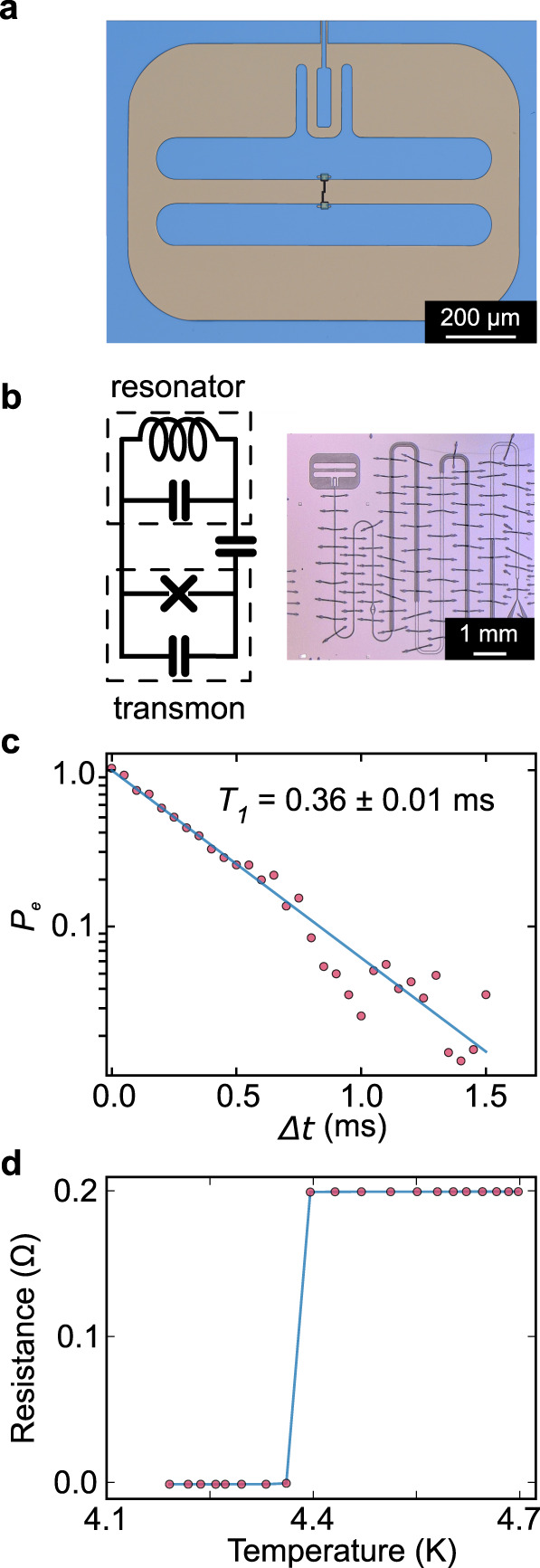
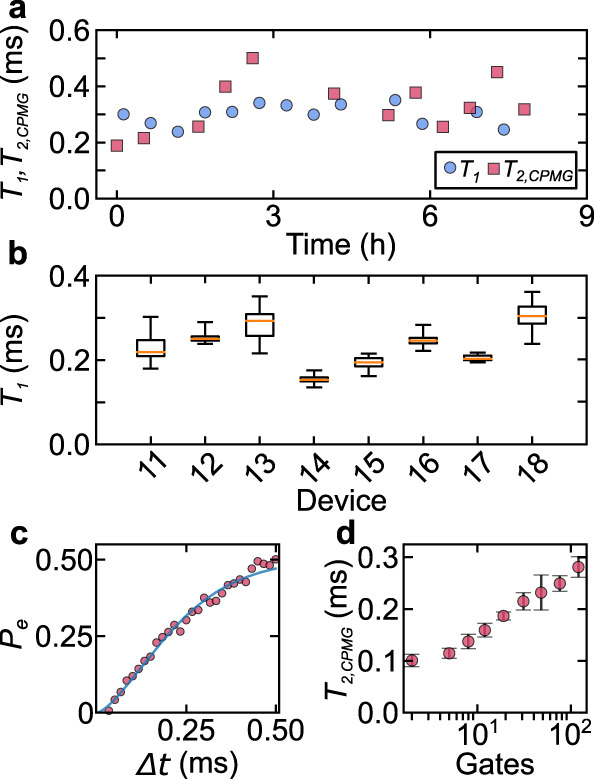
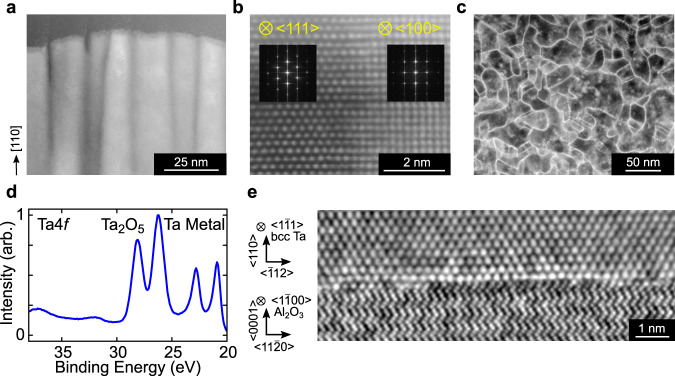
Verification
Claims the paper makes
The claims and statistics of this paper haven’t been checked yet.
Free: it reads the open-access text and checks the first 5 claims that cite a source we can check. Create a free account to check every claim.
Claims other papers make about this one
Each is checked against this paper’s own text: does it say what the citing paper says it does?
The source backs part of the claim, not all of it — or backs it for a different population, condition or comparison.
In the citing paper
“The advantage of this fabrication technique is the possibility for in situ fabrication of the JJ and minimal etch damage to achieve high-coherence qubits of up to hundreds of microseconds19–22.”
From Advanced CMOS manufacturing of superconducting qubits on 300 mm wafers (2024) · cites this paper as [19]
Experimental — accuracy not yet measured
Self-check
Percentages, sums and reported differences re-computed from the paper’s own numbers.
The self-check needs the paper’s full text.
Citations
Cites
Quantum supremacy using a programmable superconducting processor
Arute, F., Arya, K., Babbush, R., Bacon, D., Bardin, J. C., Barends, R., Biswas, R., Boixo, S., Brandao, F. G. S. L., Buell, D. A., et al. (2019) · Nature · doi:10.1038/s41586-019-1666-5 · Cited by 7,720
Hardware-efficient variational quantum eigensolver for small molecules and quantum magnets
Kandala, A., Mezzacapo, A., Temme, K., Takita, M., Brink, M., Chow, J. M., & Gambetta, J. M. (2017) · Nature · doi:10.1038/nature23879 · Cited by 2,982
Superconducting Circuits for Quantum Information: An Outlook
Devoret, M. H., & Schoelkopf, R. J. (2013) · Science · doi:10.1126/science.1231930 · Cited by 2,114
Superconducting quantum circuits at the surface code threshold for fault tolerance
Barends, R., Kelly, J., Megrant, A., Veitia, A., Sank, D., Jeffrey, E., White, T. C., Mutus, J., Fowler, A. G., Campbell, B., et al. (2014) · Nature · doi:10.1038/nature13171 · Cited by 1,733
Quantum algorithms: an overview
Montanaro, A. (2016) · npj Quantum Information · doi:10.1038/npjqi.2015.23 · Cited by 1,071
Scalable Quantum Simulation of Molecular Energies
O’Malley, P. J. J., Babbush, R., Kivlichan, I. D., Romero, J., McClean, J. R., Barends, R., Kelly, J., Roushan, P., Tranter, A., Ding, N., et al. (2016) · Physical Review X · doi:10.1103/physrevx.6.031007 · Cited by 1,059 · cited 1×
“We developed our sapphire etch recipe by (1) looking for crystal formation in an optical microscope, (2) ensuring that zinc was removed in XPS, and (3) checking that we preserved smooth surface morphology in AFM.”
MethodPaik, H., Schuster, D. I., Bishop, L. S., Kirchmair, G., Catelani, G., Sears, A. P., Johnson, B. R., Reagor, M. J., Frunzio, L., Glazman, L. I., et al. (2011) · Physical Review Letters · doi:10.1103/physrevlett.107.240501 · Cited by 1,054
Extending the lifetime of a quantum bit with error correction in superconducting circuits
Ofek, N., Petrenko, A., Heeres, R., Reinhold, P., Leghtas, Z., Vlastakis, B., Liu, Y., Frunzio, L., Girvin, S. M., Jiang, L., et al. (2016) · Nature · doi:10.1038/nature18949 · Cited by 941
State preservation by repetitive error detection in a superconducting quantum circuit
Kelly, J., Barends, R., Fowler, A. G., Megrant, A., Jeffrey, E., White, T. C., Sank, D., Mutus, J. Y., Campbell, B., Chen, Y., et al. (2015) · Nature · doi:10.1038/nature14270 · Cited by 916
A quantum-dot spin qubit with coherence limited by charge noise and fidelity higher than 99.9%
Yoneda, J., Takeda, K., Otsuka, T., Nakajima, T., Delbecq, M. R., Allison, G., Honda, T., Kodera, T., Oda, S., Hoshi, Y., et al. (2018) · Nature Nanotechnology · doi:10.1038/s41565-017-0014-x · Cited by 900
Noise spectroscopy through dynamical decoupling with a superconducting flux qubit
Bylander, J., Gustavsson, S., Yan, F., Yoshihara, F., Harrabi, K., Fitch, G., Cory, D. G., Nakamura, Y., Tsai, J.-S., & Oliver, W. D. (2011) · Nature Physics · doi:10.1038/nphys1994 · Cited by 864
Realization of three-qubit quantum error correction with superconducting circuits
Reed, M. D., DiCarlo, L., Nigg, S. E., Sun, L., Frunzio, L., Girvin, S. M., & Schoelkopf, R. J. (2012) · Nature · doi:10.1038/nature10786 · Cited by 585
Qubit Architecture with High Coherence and Fast Tunable Coupling
Chen, Y., Neill, C., Roushan, P., Leung, N., Fang, M., Barends, R., Kelly, J., Campbell, B., Chen, Z., Chiaro, B., et al. (2014) · Physical Review Letters · doi:10.1103/physrevlett.113.220502 · Cited by 584
Niobium oxides and niobates physical properties: Review and prospects
Nico, C., Monteiro, T., & Graça, M. P. F. (2016) · Progress in Materials Science · doi:10.1016/j.pmatsci.2016.02.001 · Cited by 581
Plastic deformation of single crystals of sapphire: Basal slip and twinning
Kronberg, M. L. (1957) · Acta Metallurgica · doi:10.1016/0001-6160(57)90090-1 · Cited by 577
Approaching Unit Visibility for Control of a Superconducting Qubit with Dispersive Readout
Wallraff, A., Schuster, D. I., Blais, A., Frunzio, L., Majer, J., Devoret, M. H., Girvin, S. M., & Schoelkopf, R. J. (2005) · Physical Review Letters · doi:10.1103/physrevlett.95.060501 · Cited by 573
Core electron binding energies in some Group IIIA, VB, and VIB compounds
McGuire, G. E., Schweitzer, G. K., & Carlson, T. A. (1973) · Inorganic Chemistry · doi:10.1021/ic50128a045 · Cited by 479
Surface participation and dielectric loss in superconducting qubits
Wang, C., Axline, C., Gao, Y. Y., Brecht, T., Chu, Y., Frunzio, L., Devoret, M. H., & Schoelkopf, R. J. (2015) · Applied Physics Letters · doi:10.1063/1.4934486 · Cited by 340
Fluctuations of Energy-Relaxation Times in Superconducting Qubits
Klimov, P. V., Kelly, J., Chen, Z., Neeley, M., Megrant, A., Burkett, B., Barends, R., Arya, K., Chiaro, B., Chen, Y., et al. (2018) · Physical Review Letters · doi:10.1103/physrevlett.121.090502 · Cited by 328
Materials in superconducting quantum bits
Oliver, W. D., & Welander, P. B. (2013) · MRS Bulletin · doi:10.1557/mrs.2013.229 · Cited by 318
Quantum error correction and universal gate set operation on a binomial bosonic logical qubit
Hu, L., Ma, Y., Cai, W., Mu, X., Xu, Y., Wang, W., Wu, Y., Wang, H., Song, Y. P., Zou, C.-L., et al. (2019) · Nature Physics · doi:10.1038/s41567-018-0414-3 · Cited by 286
Fast reset and suppressing spontaneous emission of a superconducting qubit
Reed, M. D., Johnson, B. R., Houck, A. A., DiCarlo, L., Chow, J. M., Schuster, D. I., Frunzio, L., & Schoelkopf, R. J. (2010) · Applied Physics Letters · doi:10.1063/1.3435463 · Cited by 285
Self-citationExperimental observation of fundamental microwave absorption in high-quality dielectric crystals
Braginsky, V. B., Ilchenko, V. S., & Bagdassarov, K. S. (1987) · Physics Letters A · doi:10.1016/0375-9601(87)90676-1 · Cited by 255
Suppression of Qubit Crosstalk in a Tunable Coupling Superconducting Circuit
Mundada, P., Zhang, G., Hazard, T., & Houck, A. (2019) · Physical Review Applied · doi:10.1103/physrevapplied.12.054023 · Cited by 239
Self-citationMeasurement and control of quasiparticle dynamics in a superconducting qubit
Wang, C., Gao, Y. Y., Pop, I. M., Vool, U., Axline, C., Brecht, T., Heeres, R. W., Frunzio, L., Devoret, M. H., Catelani, G., et al. (2014) · Nature Communications · doi:10.1038/ncomms6836 · Cited by 230
Ion trap in a semiconductor chip
Stick, D., Hensinger, W. K., Olmschenk, S., Madsen, M. J., Schwab, K., & Monroe, C. (2006) · Nature Physics · doi:10.1038/nphys171 · Cited by 230
A NEW STRUCTURE IN TANTALUM THIN FILMS
Read, M. H., & Altman, C. (1965) · Applied Physics Letters · doi:10.1063/1.1754294 · Cited by 226
Hot Nonequilibrium Quasiparticles in Transmon Qubits
Serniak, K., Hays, M., de Lange, G., Diamond, S., Shankar, S., Burkhart, L. D., Frunzio, L., Houzet, M., & Devoret, M. H. (2018) · Physical Review Letters · doi:10.1103/physrevlett.121.157701 · Cited by 225
Sangtawesin, S., Dwyer, B., Srinivasan, S. J., Allred, J. J., Rodgers, L. V. H., Greve, K. D., Stacey, A. D., Dontschuk, N., O'Donnell, K. M., Hu, D., et al. (2024) · Figshare · Cited by 221
Self-citationProtecting superconducting qubits from radiation
Córcoles, A. D., Chow, J. M., Gambetta, J. M., Rigetti, C., Rozen, J. R., Keefe, G. A., Beth Rothwell, M., Ketchen, M. B., & Steffen, M. (2011) · Applied Physics Letters · doi:10.1063/1.3658630 · Cited by 193
Electric field spectroscopy of material defects in transmon qubits
Lisenfeld, J., Bilmes, A., Megrant, A., Barends, R., Kelly, J., Klimov, P., Weiss, G., Martinis, J. M., & Ustinov, A. V. (2019) · npj Quantum Information · doi:10.1038/s41534-019-0224-1 · Cited by 160
Suppressing relaxation in superconducting qubits by quasiparticle pumping
Gustavsson, S., Yan, F., Catelani, G., Bylander, J., Kamal, A., Birenbaum, J., Hover, D., Rosenberg, D., Samach, G., Sears, A. P., et al. (2016) · Science · doi:10.1126/science.aah5844 · Cited by 145
Tantalum films for protective coatings of steel
Gładczuk, L., Patel, A., Paur, C. S., & Sosnowski, M. (2004) · Thin Solid Films · doi:10.1016/j.tsf.2004.04.041 · Cited by 142
Gated Conditional Displacement Readout of Superconducting Qubits
Touzard, S., Kou, A., Frattini, N. E., Sivak, V. V., Puri, S., Grimm, A., Frunzio, L., Shankar, S., & Devoret, M. H. (2019) · Physical Review Letters · doi:10.1103/physrevlett.122.080502 · Cited by 130
Dunsworth, A., Megrant, A., Quintana, C., Chen, Z., Barends, R., Burkett, B., Foxen, B., Chen, Y., Chiaro, B., Fowler, A., et al. (2017) · Applied Physics Letters · doi:10.1063/1.4993577 · Cited by 125
Nucleation of body-centered-cubic tantalum films with a thin niobium underlayer
Face, D. W., & Prober, D. E. (1987) · Journal of Vacuum Science & Technology A: Vacuum, Surfaces, and Films · doi:10.1116/1.574203 · Cited by 116
Cavity Attenuators for Superconducting Qubits
Wang, Z., Shankar, S., Minev, Z. K., Campagne-Ibarcq, P., Narla, A., & Devoret, M. H. (2019) · Physical Review Applied · doi:10.1103/physrevapplied.11.014031 · Cited by 110
Himpsel, F. J., Morar, J. F., McFeely, F. R., Pollak, R. A., & Hollinger, G. (1984) · Physical review. B, Condensed matter · doi:10.1103/physrevb.30.7236 · Cited by 108
Two-level systems in superconducting quantum devices due to trapped quasiparticles
de Graaf, S. E., Faoro, L., Ioffe, L. B., Mahashabde, S., Burnett, J. J., Lindström, T., Kubatkin, S. E., Danilov, A. V., & Tzalenchuk, A. Y. (2020) · Science Advances · doi:10.1126/sciadv.abc5055 · Cited by 108
Electrical and magnetic properties of Nb2 O5−δ crystallographic shear structures
Cava, R. J., Batlogg, B. J., Krajewski, J. J., Poulsen, H. F., Gammel, P. L., PECK, W. F. J., & RUPP, L. W. J. (1991) · Physical review. B, Condensed matter · doi:10.1103/physrevb.44.6973 · Cited by 107
Self-citationDirect Dispersive Monitoring of Charge Parity in Offset-Charge-Sensitive Transmons
Serniak, K., Diamond, S., Hays, M., Fatemi, V., Shankar, S., Frunzio, L., Schoelkopf, R. J., & Devoret, M. H. (2019) · Physical Review Applied · doi:10.1103/physrevapplied.12.014052 · Cited by 100
Investigating Surface Loss Effects in Superconducting Transmon Qubits
Gambetta, J. M., Murray, C. E., Fung, Y.-K.-K., McClure, D. T., Dial, O., Shanks, W., Sleight, J. W., & Steffen, M. (2017) · IEEE Transactions on Applied Superconductivity · doi:10.1109/tasc.2016.2629670 · Cited by 97
Manufacturing low dissipation superconducting quantum processors
Nersisyan, A., Poletto, S., Alidoust, N., Manenti, R., Renzas, R., Bui, C.-V., Vu, K., Whyland, T., Mohan, Y., Sete, E. A., et al. (2019) · 2019 IEEE International Electron Devices Meeting (IEDM) · doi:10.1109/iedm19573.2019.8993458 · Cited by 87
Bulk and surface loss in superconducting transmon qubits
Dial, O., McClure, D. T., Poletto, S., Keefe, G. A., Rothwell, M. B., Gambetta, J. M., Abraham, D. W., Chow, J. M., & Steffen, M. (2016) · Superconductor Science and Technology · doi:10.1088/0953-2048/29/4/044001 · Cited by 81
Study on Sapphire Surface Preparation for III-Nitride Heteroepitaxial Growth by Chemical Treatments
Dwikusuma, F., Saulys, D. A., & Kuech, T. F. (2002) · Journal of The Electrochemical Society · doi:10.1149/1.1509072 · Cited by 78
Electrical activation and electron spin coherence of ultralow dose antimony implants in silicon
Schenkel, T., Liddle, J. A., Persaud, A., Tyryshkin, A. M., Lyon, S. A., de Sousa, R., Whaley, K. B., Jeffrey Bokor, A., Shangkuan, J., & Chakarov, I. R. (2006) · Applied Physics Letters · doi:10.1063/1.2182068 · Cited by 77
Ultrahigh Q-factor cryogenic sapphire resonator
Luiten, A. N., Mann, A. G., & Blair, D. G. (1993) · Electronics Letters · doi:10.1049/el:19930587 · Cited by 62
Surface science for improved ion traps
Hite, D. A., Colombe, Y., Wilson, A. C., Allcock, D. T. C., Leibfried, D., Wineland, D. J., & Pappas, D. P. (2013) · MRS Bulletin · doi:10.1557/mrs.2013.207 · Cited by 61
Paik, S., Lee, S., Baker, W., McCamey, D. R., & Boehme, C. (2010) · Physical Review B · doi:10.1103/physrevb.81.075214 · Cited by 59
Kreikebaum, J. M., Dove, A., Livingston, W., Kim, E., & Siddiqi, I. (2016) · Superconductor Science and Technology · doi:10.1088/0953-2048/29/10/104002 · Cited by 51
High quality tantalum superconducting tunnel junctions for microwave mixing in the quantum limit
Face, D. W., Prober, D. E., McGrath, W. R., & Richards, P. L. (1986) · Applied Physics Letters · doi:10.1063/1.96610 · Cited by 50
CMOS compatible fabrication methodsfor submicron Josephson junction qubits
Potts, A., Parker, G. J., Baumberg, J. J., & de Groot, P. A. J. (2001) · IEE Proceedings - Science, Measurement and Technology · doi:10.1049/ip-smt:20010395 · Cited by 38
Improved superconducting qubit coherence with high-temperature substrate annealingPreprint
Kamal, A., Yoder, J., Yan, F., Gudmundsen, T., Hover, D. J., Sears, A., Welander, P. B., Orlando, T. P., Gustavsson, S., & Oliver, W. D. (2016) · arXiv (Cornell University) · doi:10.48550/arxiv.1606.09262 · Cited by 26
Verifying Multipartite Entangled GHZ States via Multiple Quantum CoherencesPreprint
Wei, K. X., Lauer, I., Srinivasan, S., et al. (2019) · arXiv (Cornell University) · doi:10.48550/arxiv.1905.05720
Research works printed but not linked: 5
- Kjaergaard, M. et al. Superconducting Qubits: current state of play. https://arxiv.org/abs/1905.13641 (2019). · arXiv
- Premkumar, A. et al. Microscopic relaxation channels in materials for superconducting Qubits. https://arxiv.org/abs/2004.02908 (2020). · arXiv
- Reese, M. Superconducting Hot Electron Bolometers for Terahertz Sensing. PhD thesis. Yale (2006).
- Face D Prober D Nucleation of body-centered-cubic tantalum films with a thin niobium underlayer J. Vac. Sci. Technol. A: Vac.,Surf., Films 1987 5 3408 3411 10.1116/1.574203 · DOI · Paper page
- Huang, Z. et al. Engineering dynamical sweet spots to protect Qubits from 1/f noise. https://arxiv.org/abs/2004.12458 (2020). · arXiv
Cited by
Materials challenges and opportunities for quantum computing hardware
de Leon, N. P., Itoh, K. M., Kim, D., Mehta, K. K., Northup, T. E., Paik, H., Palmer, B. S., Samarth, N., Sangtawesin, S., & Steuerman, D. W. (2021) · Science · doi:10.1126/science.abb2823 · Cited by 710
“The coherence times can drift or change suddenly over hours and days, even while the device is held at cryogenic temperatures (89, 95, 126, 127).”
BackgroundReal-time quantum error correction beyond break-even
Sivak, V. V., Eickbusch, A., Royer, B., Singh, S., Tsioutsios, I., Ganjam, S., Miano, A., Brock, B. L., Ding, A. Z., Frunzio, L., et al. (2023) · Nature · doi:10.1038/s41586-023-05782-6 · Cited by 407
Towards practical quantum computers: transmon qubit with a lifetime approaching 0.5 milliseconds
Wang, C., Li, X., Xu, H., Li, Z., Wang, J., Yang, Z., Mi, Z., Liang, X., Su, T., Yang, C., et al. (2022) · npj Quantum Information · doi:10.1038/s41534-021-00510-2 · Cited by 377
The future of quantum computing with superconducting qubits
Bravyi, S., Dial, O., Gambetta, J. M., Gil, D., & Nazario, Z. (2022) · Journal of Applied Physics · doi:10.1063/5.0082975 · Cited by 334
Engineering high-coherence superconducting qubits
Siddiqi, I. (2021) · Nature Reviews Materials · doi:10.1038/s41578-021-00370-4 · Cited by 311
Metadata
- Authors
- Place, A. P. M., Rodgers, L. V. H., Mundada, P., Smitham, B. M., Fitzpatrick, M., Leng, Z., Premkumar, A., Bryon, J., Vrajitoarea, A., Sussman, S., Cheng, G., Madhavan, T., Babla, H. K., Le, X. H., Gang, Y., Jäck, B., Gyenis, A., Yao, N., Cava, R. J., de Leon, N. P., & Houck, A. A.
- Affiliations
- Princeton University (US)
- Corresponding author
- Houck, Andrew A.
- ORCID
- Venue
- Nature Communications
- Published
- 2021-03-19
- Volume
- 12
- Issue
- 1
- Pages
- 1779-1779
- ISSN
- 2041-1723 (ISSN-L)
- PMC
- PMC7979772
- OpenAlex
- W3006932841
- Semantic Scholar
- fe6a5ecce382e9484fc68e2549d682a760d5293c
- Cited by
- 563
- References
- 52
- Citations by year
- 2026: 87 · 2025: 124 · 2024: 117 · 2023: 95 · 2022: 85 · 2021: 43
- FWCI
- 30.01
- Type
- journal article
- Language
- en
- Open access
- gold
- doi.org
- Licence
- cc-by
- creativecommons.org/licenses/by/4.0 (tdm)
- creativecommons.org/licenses/by/4.0 (vor)
- Locations
- Nature Communications (publishedVersion, cc-by)
- PubMed Central (publishedVersion, cc-by)
- PubMed (publishedVersion)
- arXiv (Cornell University) (submittedVersion)
- OSTI OAI (U.S. Department of Energy Office of Scientific and Technical Information) (submittedVersion)
- RePEc: Research Papers in Economics (submittedVersion)
- DOAJ (DOAJ: Directory of Open Access Journals) (submittedVersion, cc-by-sa)
- Rare & Special e-Zone (The Hong Kong University of Science and Technology) (submittedVersion)
- arXiv (Cornell University)
- Bulletin of the American Physical Society
- Funders
- United States Department of Defense | United States Army | U.S. Army Research, Development and Engineering Command | Army Research Office (W911NF1910016, HIPS W911NF1910016)
- ODNI | Intelligence Community Postdoctoral Research Fellowship Program
- National Science Foundation (MRSEC DMR-1420541)
- Topics
- Physical Sciences › Physics and Astronomy › Atomic and Molecular Physics, and Optics › Quantum Information and Cryptography
- Physical Sciences › Computer Science › Artificial Intelligence › Quantum Computing Algorithms and Architecture
- Physical Sciences › Engineering › Electrical and Electronic Engineering › Superconducting and THz Device Technology
- Keywords
- transmon qubits, superconducting qubits, qubit coherence time, qubit relaxation, tantalum, niobium, dynamical decoupling, superconducting quantum computing
About these checks
Registry, retraction, Cites and statistics results are computed, not judged, with one exception: a printed reference that no index lists is read once by a model before it counts as a citation error. Claims are extracted by a model and kept only when their quote appears verbatim in the text; each cited source is then checked, with a model’s help, for whether it says what the claim relies on. Those verdicts can be wrong — read the claim’s quote and the cited source before relying on one.
Statistics and arithmetic are recomputed, not judged.
Confidence bands are shown only for fields calibrated on our annotated test set. None is calibrated yet, so no band is shown.
What counts as a claim ›How we measure confidence ›How we check this ›
Are you an author, or do you see a problem with this page? Request a review
Data sources
Bibliographic data: Semantic Scholar, OpenAlex, Crossref.
Contains information from the Semantic Scholar Academic Graph Datasets, made available under the ODC Attribution License (ODC-BY 1.0).
Semantic Scholar’s data is described in: Kinney, R., et al. (2023). The Semantic Scholar Open Data Platform. arXiv:2301.10140.
