

New material platform for superconducting transmon qubits with coherence times exceeding 0.3 milliseconds
Open accessThe DOI matches its Crossref record; 54 of the 54 references it cites were found in a registry or an index.
Abstract
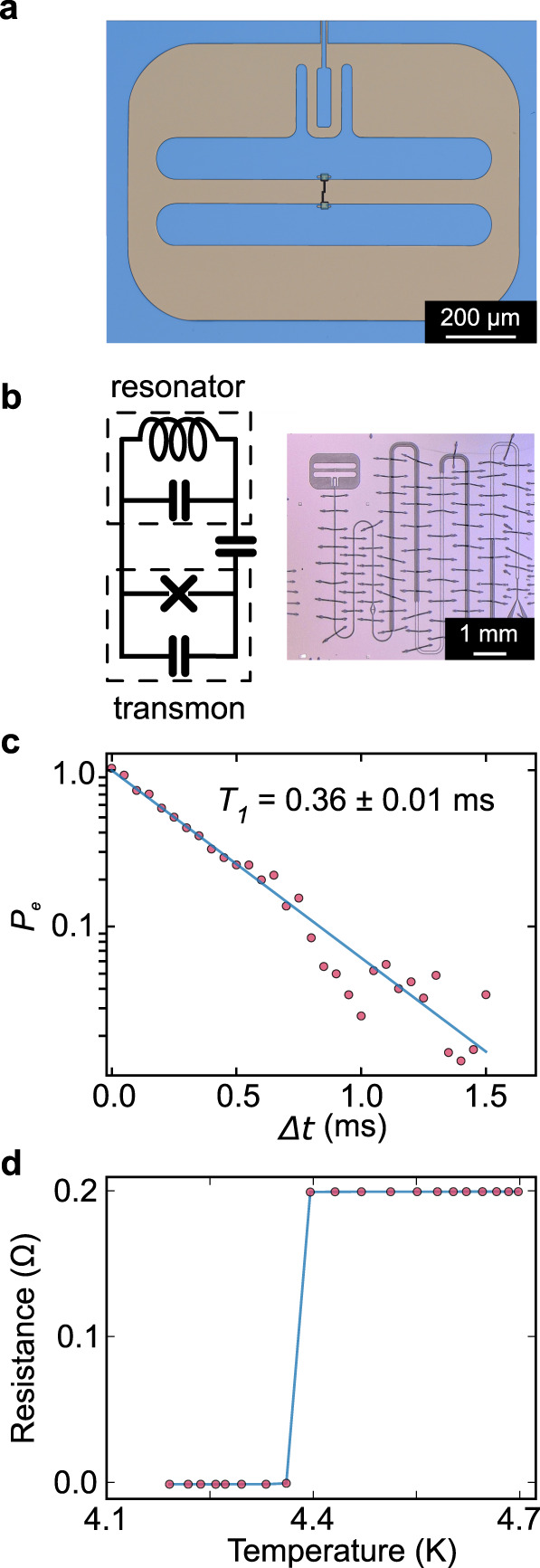
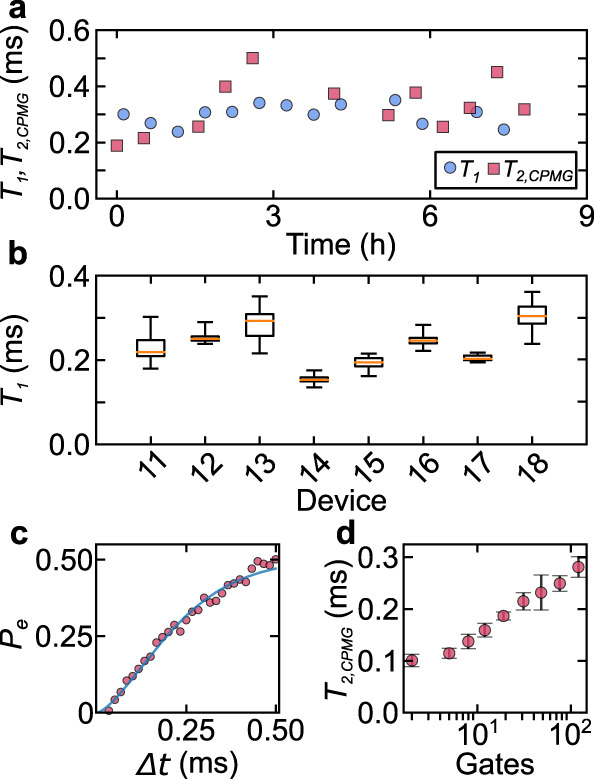
The superconducting transmon qubit is a leading platform for quantum computing and quantum science. Building large, useful quantum systems based on transmon qubits will require significant improvements in qubit relaxation and coherence times, which are orders of magnitude shorter than limits imposed by bulk properties of the constituent materials. This indicates that relaxation likely originates from uncontrolled surfaces, interfaces, and contaminants. Previous efforts to improve qubit lifetimes have focused primarily on designs that minimize contributions from surfaces. However, significant improvements in the lifetime of two-dimensional transmon qubits have remained elusive for several years. Here, we fabricate two-dimensional transmon qubits that have both lifetimes and coherence times with dynamical decoupling exceeding 0.3 milliseconds by replacing niobium with tantalum in the device. We have observed increased lifetimes for seventeen devices, indicating that these material improvements are robust, paving the way for higher gate fidelities in multi-qubit processors.
Overview
The claims and statistics of this paper haven’t been checked yet.
Free: it reads the open-access text and checks the first 5 claims that cite a source we can check. Create a free account to check every claim.
Integrity signals
Registry
Cites
Statistics
Figures
Verification
Claims the paper makes
The claims and statistics of this paper haven’t been checked yet.
Free: it reads the open-access text and checks the first 5 claims that cite a source we can check. Create a free account to check every claim.
Claims other papers make about this one
Each is checked against this paper’s own text: does it say what the citing paper says it does?
The source backs part of the claim, not all of it — or backs it for a different population, condition or comparison.
In the citing paper
“The advantage of this fabrication technique is the possibility for in situ fabrication of the JJ and minimal etch damage to achieve high-coherence qubits of up to hundreds of microseconds19–22.”
From Advanced CMOS manufacturing of superconducting qubits on 300 mm wafers (2024) · cites this paper as [19]
Experimental — accuracy not yet measured
Self-check
Percentages, sums and reported differences re-computed from the paper’s own numbers.
The self-check needs the paper’s full text.
Citations
Cites
Quantum supremacy using a programmable superconducting processor
Arute, F., Arya, K., Babbush, R., Bacon, D., Bardin, J. C., Barends, R., Biswas, R., Boixo, S., Brandao, F. G. S. L., Buell, D. A., et al. (2019) · Nature · doi:10.1038/s41586-019-1666-5 · Cited by 7,720
Hardware-efficient variational quantum eigensolver for small molecules and quantum magnets
Kandala, A., Mezzacapo, A., Temme, K., Takita, M., Brink, M., Chow, J. M., & Gambetta, J. M. (2017) · Nature · doi:10.1038/nature23879 · Cited by 2,982
Superconducting Circuits for Quantum Information: An Outlook
Devoret, M. H., & Schoelkopf, R. J. (2013) · Science · doi:10.1126/science.1231930 · Cited by 2,114
Superconducting quantum circuits at the surface code threshold for fault tolerance
Barends, R., Kelly, J., Megrant, A., Veitia, A., Sank, D., Jeffrey, E., White, T. C., Mutus, J., Fowler, A. G., Campbell, B., et al. (2014) · Nature · doi:10.1038/nature13171 · Cited by 1,733
Quantum algorithms: an overview
Montanaro, A. (2016) · npj Quantum Information · doi:10.1038/npjqi.2015.23 · Cited by 1,071
Scalable Quantum Simulation of Molecular Energies
O’Malley, P. J. J., Babbush, R., Kivlichan, I. D., Romero, J., McClean, J. R., Barends, R., Kelly, J., Roushan, P., Tranter, A., Ding, N., et al. (2016) · Physical Review X · doi:10.1103/physrevx.6.031007 · Cited by 1,059 · cited 1×
“We developed our sapphire etch recipe by (1) looking for crystal formation in an optical microscope, (2) ensuring that zinc was removed in XPS, and (3) checking that we preserved smooth surface morphology in AFM.”
MethodPaik, H., Schuster, D. I., Bishop, L. S., Kirchmair, G., Catelani, G., Sears, A. P., Johnson, B. R., Reagor, M. J., Frunzio, L., Glazman, L. I., et al. (2011) · Physical Review Letters · doi:10.1103/physrevlett.107.240501 · Cited by 1,054
Extending the lifetime of a quantum bit with error correction in superconducting circuits
Ofek, N., Petrenko, A., Heeres, R., Reinhold, P., Leghtas, Z., Vlastakis, B., Liu, Y., Frunzio, L., Girvin, S. M., Jiang, L., et al. (2016) · Nature · doi:10.1038/nature18949 · Cited by 941
State preservation by repetitive error detection in a superconducting quantum circuit
Kelly, J., Barends, R., Fowler, A. G., Megrant, A., Jeffrey, E., White, T. C., Sank, D., Mutus, J. Y., Campbell, B., Chen, Y., et al. (2015) · Nature · doi:10.1038/nature14270 · Cited by 916
A quantum-dot spin qubit with coherence limited by charge noise and fidelity higher than 99.9%
Yoneda, J., Takeda, K., Otsuka, T., Nakajima, T., Delbecq, M. R., Allison, G., Honda, T., Kodera, T., Oda, S., Hoshi, Y., et al. (2018) · Nature Nanotechnology · doi:10.1038/s41565-017-0014-x · Cited by 900
Research works printed but not linked: 5
- Kjaergaard, M. et al. Superconducting Qubits: current state of play. https://arxiv.org/abs/1905.13641 (2019). · arXiv
- Premkumar, A. et al. Microscopic relaxation channels in materials for superconducting Qubits. https://arxiv.org/abs/2004.02908 (2020). · arXiv
- Reese, M. Superconducting Hot Electron Bolometers for Terahertz Sensing. PhD thesis. Yale (2006).
- Face D Prober D Nucleation of body-centered-cubic tantalum films with a thin niobium underlayer J. Vac. Sci. Technol. A: Vac.,Surf., Films 1987 5 3408 3411 10.1116/1.574203 · DOI · Paper page
- Huang, Z. et al. Engineering dynamical sweet spots to protect Qubits from 1/f noise. https://arxiv.org/abs/2004.12458 (2020). · arXiv
Cited by
Materials challenges and opportunities for quantum computing hardware
de Leon, N. P., Itoh, K. M., Kim, D., Mehta, K. K., Northup, T. E., Paik, H., Palmer, B. S., Samarth, N., Sangtawesin, S., & Steuerman, D. W. (2021) · Science · doi:10.1126/science.abb2823 · Cited by 710
“The coherence times can drift or change suddenly over hours and days, even while the device is held at cryogenic temperatures (89, 95, 126, 127).”
BackgroundReal-time quantum error correction beyond break-even
Sivak, V. V., Eickbusch, A., Royer, B., Singh, S., Tsioutsios, I., Ganjam, S., Miano, A., Brock, B. L., Ding, A. Z., Frunzio, L., et al. (2023) · Nature · doi:10.1038/s41586-023-05782-6 · Cited by 407
Towards practical quantum computers: transmon qubit with a lifetime approaching 0.5 milliseconds
Wang, C., Li, X., Xu, H., Li, Z., Wang, J., Yang, Z., Mi, Z., Liang, X., Su, T., Yang, C., et al. (2022) · npj Quantum Information · doi:10.1038/s41534-021-00510-2 · Cited by 377
The future of quantum computing with superconducting qubits
Bravyi, S., Dial, O., Gambetta, J. M., Gil, D., & Nazario, Z. (2022) · Journal of Applied Physics · doi:10.1063/5.0082975 · Cited by 334
Engineering high-coherence superconducting qubits
Siddiqi, I. (2021) · Nature Reviews Materials · doi:10.1038/s41578-021-00370-4 · Cited by 311
Colloquium : Quantum batteries
Campaioli, F., Gherardini, S., Quach, J. Q., Polini, M., & Andolina, G. M. (2024) · Reviews of Modern Physics · doi:10.1103/revmodphys.96.031001 · Cited by 268
Materials loss measurements using superconducting microwave resonators
McRae, C. R. H., Wang, H., Gao, J., Vissers, M. R., Brecht, T., Dunsworth, A., Pappas, D. P., & Mutus, J. (2020) · Review of Scientific Instruments · doi:10.1063/5.0017378 · Cited by 245
“Place et al. (2020) have shown promising results with epi-Ta electrodes in a qubit, but resonator loss measurements have not been reported.”
ResultMillisecond Coherence in a Superconducting Qubit
Somoroff, A., Ficheux, Q., Mencia, R. A., Xiong, H., Kuzmin, R., & Manucharyan, V. E. (2023) · Physical Review Letters · doi:10.1103/physrevlett.130.267001 · Cited by 233
The QICK (Quantum Instrumentation Control Kit): Readout and control for qubits and detectors
Stefanazzi, L., Treptow, K., Wilcer, N., Stoughton, C., Bradford, C., Uemura, S., Zorzetti, S., Montella, S., Cancelo, G. I., Sussman, S., et al. (2022) · Review of Scientific Instruments · doi:10.1063/5.0076249 · Cited by 234
Self-citationQuantum information processing with bosonic qubits in circuit QED
Joshi, A., Noh, K., & Gao, Y. Y. (2021) · Quantum Science and Technology · doi:10.1088/2058-9565/abe989 · Cited by 152
“5D devices, as their performance improves with further developments in materials engineering and new fabrication techniques [158].”
BackgroundSystematic improvements in transmon qubit coherence enabled by niobium surface encapsulation
Bal, M., Murthy, A. A., Zhu, S., Crisa, F., You, X., Huang, Z., Roy, T., Lee, J., Zanten, D. V., Pilipenko, R., et al. (2024) · npj Quantum Information · doi:10.1038/s41534-024-00840-x · Cited by 128
“Therefore, our fi ndings help explain why previous experimental studies with qubits prepared from Ta metal exhibited improved T 1 values 13,14 .”
Microwaves in Quantum Computing
Bardin, J. C., Slichter, D. H., & Reilly, D. J. (2021) · IEEE Journal of Microwaves · doi:10.1109/jmw.2020.3034071 · Cited by 213
“T1 as high as 300 μs for isolated planar qubits fabricated on a sapphire substrate [41].”
BackgroundFluxonium: An Alternative Qubit Platform for High-Fidelity Operations
Bao, F., Deng, H., Ding, D., Gao, R., Gao, X., Huang, C., Xun, J., Ku, H., Li, Z., Ma, X., et al. (2022) · Physical Review Letters · doi:10.1103/physrevlett.129.010502 · Cited by 213
Millisecond lifetimes and coherence times in 2D transmon qubits
Bland, M. P., Bahrami, F., Martinez, J. G. C., Prestegaard, P. H., Smitham, B. M., Joshi, A., Hedrick, E., Kumar, S., Yang, A., Pakpour‐Tabrizi, A. C., et al. (2025) · Nature · doi:10.1038/s41586-025-09687-4 · Cited by 214
Self-citationThe 2021 quantum materials roadmap
Giustino, F., Lee, J. H., Trier, F., Bibès, M., Winter, S. M., Valentí, R., Son, Y., Taillefer, L., Heil, C., Figueroa, A. I., et al. (2020) · Journal of Physics Materials · doi:10.1088/2515-7639/abb74e · Cited by 204
“Recently [154], a team at Princeton has demonstrated qubits with record coherence times T1 = 362 μs and T2, Ramsey = 105 μs using tantalum and in-depth surface cleaning procedures.”
High-Fidelity, High-Scalability Two-Qubit Gate Scheme for Superconducting Qubits
Xu, Y., Chu, J., Yuan, J., Qiu, J., Zhou, Y., Zhang, L., Tan, X., Yu, Y., Liu, S., Li, J., et al. (2020) · Physical Review Letters · doi:10.1103/physrevlett.125.240503 · Cited by 196
“The gate performance may further benefit from optimized pulse shape for faster adiabatic process [38] and from coherence improvement with new material platform [39].”
BackgroundNoisy intermediate-scale quantum computers
Cheng, B., Deng, X., Gu, X. Q., He, Y., Hu, G., Huang, P., Li, J., Lin, B., Lu, D., Lu, Y., et al. (2023) · Frontiers of Physics · doi:10.1007/s11467-022-1249-z · Cited by 182
Searching for Dark Matter with a Superconducting Qubit
Dixit, A. V., Chakram, S., He, K., Agrawal, A., Naik, R. K., Schuster, D. I., & Chou, A. (2021) · Physical Review Letters · doi:10.1103/physrevlett.126.141302 · Cited by 181
Beating the break-even point with a discrete-variable-encoded logical qubit
Ni, Z., Li, S., Deng, X., Cai, Y., Zhang, L., Wang, W., Yang, Z.-B., Yu, H., Yan, F., Liu, S., et al. (2023) · Nature · doi:10.1038/s41586-023-05784-4 · Cited by 176
“The Josephson junction of the qubit is an Al−Al2O3 −Al trilayer tunnel junction formed by a double angle evaporation technique, and the antenna pads and readout striplines are grown using tantalum films in BCC alpha-phase to improve the coherence time of the transmon qubit [14, 15].”
MethodNISQ computing: where are we and where do we go?
Lau, J. W. Z., Lim, K. H., Shrotriya, H., & Kwek, L. C. (2022) · AAPPS Bulletin · doi:10.1007/s43673-022-00058-z · Cited by 173
“The best superconducting devices are now able to achieve coherence times nearing a millisecond [162], while gate types are typically in the order of tens of nanoseconds [149] and gate fideli-ties usually around 99.5 − 99.9 % [ 163, 164].”
BackgroundInfluentialMaterial matters in superconducting qubits
Murray, C. E. (2021) · Materials Science and Engineering R Reports · doi:10.1016/j.mser.2021.100646 · Cited by 173
Superconducting Cavity Qubit with Tens of Milliseconds Single-Photon Coherence Time
Milul, O., Guttel, B., Goldblatt, U., Hazanov, S., Joshi, L. M., Chausovsky, D., Kahn, N., Çiftyürek, E., Lafont, F., & Rosenblum, S. (2023) · PRX Quantum · doi:10.1103/prxquantum.4.030336 · Cited by 171
Experimental quantum adversarial learning with programmable superconducting qubits
Ren, W., Li, W., Xu, S., Wang, K., Jiang, W., Jin, F., Zhu, X., Chen, J., Song, Z., Zhang, P., et al. (2022) · Nature Computational Science · doi:10.1038/s43588-022-00351-9 · Cited by 167
Moving beyond the Transmon: Noise-Protected Superconducting Quantum Circuits
Gyenis, A., Paolo, A. D., Koch, J., Blais, A., Houck, A., & Schuster, D. (2021) · PRX Quantum · doi:10.1103/prxquantum.2.030101 · Cited by 166
“In practice, with typical values of EJ /EC ∼ 50, transmon qubits feature dephasing times as large as T2 = 100–200 μs with energy relaxation times of T1 = 200–500 μs [20,71].”
BackgroundSelf-citationHigh fidelity two-qubit gates on fluxoniums using a tunable coupler
Moskalenko, I. N., Simakov, I. A., Abramov, N. N., Grigorev, A. A., Moskalev, D. O., Pishchimova, A. A., Smirnov, N. S., Zikiy, E. V., Rodionov, I. A., & Besedin, I. S. (2022) · npj Quantum Information · doi:10.1038/s41534-022-00644-x · Cited by 166
“If a target gate is inserted after each single-qubit operation, the average fidelity of the gate is determined by the formula (5) with p= p2/p1, where p2 and p1 are the depolarizing parameters corresponding to the gate sequences with and without (reference sequences) the interleaved gate.”
MethodReducing the impact of radioactivity on quantum circuits in a deep-underground facility
Cardani, L., Valenti, F., Casali, N., Catelani, G., Charpentier, T., Clemenza, M., Colantoni, I., Cruciani, A., D’Imperio, G., Gironi, L., et al. (2021) · Nature Communications · doi:10.1038/s41467-021-23032-z · Cited by 163
“Moreover, as dielectric losses are steadily decreased [20, 21], further improving the coherence of solid-state devices will soon hinge on the reduction of QPs, and more generally on ionizing radiation abatement.”
BackgroundInvestigation of Microwave Loss Induced by Oxide Regrowth in High- Q Niobium Resonators
Verjauw, J., Potočnik, A., Mongillo, M., Acharya, R., Mohiyaddin, F., Simion, G., Pacco, A., Ivanov, T., Wan, D., Vanleenhove, A., et al. (2021) · Physical Review Applied · doi:10.1103/physrevapplied.16.014018 · Cited by 105
“By device design, fabrication process optimization and by using high quality materials, microwave loss in superconducting devices has been significantly reduced over the last decade [1], [8], [9].”
BackgroundSuperconducting-qubit readout via low-backaction electro-optic transduction
Delaney, R. D., Urmey, M. D., Mittal, S., Brubaker, B., Kindem, J. M., Burns, P. S., Regal, C. A., & Lehnert, K. W. (2022) · Nature · doi:10.1038/s41586-022-04720-2 · Cited by 159
Disentangling Losses in Tantalum Superconducting Circuits
Crowley, K. D., McLellan, R. A., Dutta, A., Shumiya, N., Place, A. P. M., Le, X. H., Gang, Y., Madhavan, T., Bland, M. P., Chang, R., et al. (2023) · Physical Review X · doi:10.1103/physrevx.13.041005 · Cited by 87
Self-citationHigh-performance superconducting quantum processors via laser annealing of transmon qubits
Zhang, E. J., Srinivasan, S., Sundaresan, N., Bogorin, D. F., Martin, Y., Hertzberg, J. B., Timmerwilke, J., Pritchett, E. J., Yau, J.-B., Wang, C., et al. (2022) · Science Advances · doi:10.1126/sciadv.abi6690 · Cited by 83
“Among the major classes of superconducting qubits, fixed frequency transmons (3, 7) operating in the EJ >> EC regime are attractive for their low charge dispersion, yielding relatively noise immune qubits with coherence times (T1, T2) exceeding 100 s (19).”
BackgroundQuantum-enhanced metrology with large Fock states
Deng, X., Li, S., Chen, Z.-J., Ni, Z., Cai, Y., Mai, J., Zhang, L., Zheng, P., Yu, H., Zou, C., et al. (2024) · Nature Physics · doi:10.1038/s41567-024-02619-5 · Cited by 149
Towards scalable bosonic quantum error correction
Terhal, B. M., Conrad, J., & Vuillot, C. (2020) · Quantum Science and Technology · doi:10.1088/2058-9565/ab98a5 · Cited by 146
“The use of different superconducting materials [91] can provide new opportunities to lengthen T2 and T1 times.”
Tuokkola, M., Sunada, Y., Kivijärvi, H., Albanese, J., Grönberg, L., Kaikkonen, J.-P., Vesterinen, V., Govenius, J., & Möttönen, M. (2025) · Nature Communications · doi:10.1038/s41467-025-61126-0 · Cited by 132
“Although I still believe this work deserves publication, it may be better suited to a more specialized journal.”
Practical Guide for Building Superconducting Quantum Devices
Gao, Y. Y., Rol, M. A., Touzard, S., & Wang, C. (2021) · PRX Quantum · doi:10.1103/prxquantum.2.040202 · Cited by 130
Microscopic relaxation channels in materials for superconducting qubits
Premkumar, A., Weiland, C. R., Hwang, S., Jäck, B., Place, A. P. M., Waluyo, I., Hunt, A. H., Bisogni, V., Pelliciari, J., Barbour, A., et al. (2021) · Communications Materials · doi:10.1038/s43246-021-00174-7 · Cited by 125
Self-citationRapid and unconditional parametric reset protocol for tunable superconducting qubits
Zhou, Y., Zhang, Z., Yin, Z., Huai, S., Gu, X. Q., Xu, X., Allcock, J., Liu, F., Xi, G., Yu, Q., et al. (2021) · Nature Communications · doi:10.1038/s41467-021-26205-y · Cited by 128
ARQUIN: Architectures for Multinode Superconducting Quantum Computers
Ang, J., Carini, G. A., Chen, Y., Chuang, I. L., Demarco, M., Economou, S. E., Eickbusch, A., Faraon, A., Fu, K. C., Girvin, S. M., et al. (2024) · ACM Transactions on Quantum Computing · doi:10.1145/3674151 · Cited by 124
Self-citationThe Transmon Qubit for Electromagnetics Engineers: An introduction
Roth, T. E., Ma, R., & Chew, W. C. (2022) · IEEE Antennas and Propagation Magazine · doi:10.1109/map.2022.3176593 · Cited by 123
“As a result of the transmon’s resilience to charge noise (and other manufacturing and experimental advances), the coherence times of modern transmons are able to achieve values in the hundreds of microseconds range, representing an orders of magnitude improvement over the best CPB qubits [33], [34].”
BackgroundCollapse and Revival of an Artificial Atom Coupled to a Structured Photonic Reservoir
Ferreira, V. S., Banker, J., Sipahigil, A., Matheny, M. H., Keller, A. J., Kim, E., Mirhosseini, M., & Painter, O. J. (2021) · Physical Review X · doi:10.1103/physrevx.11.041043 · Cited by 118
Engineering superconducting qubits to reduce quasiparticles and charge noise
Pan, X., Zhou, Y., Yuan, H., Nie, L., Wei, W., Zhang, L., Li, J., Liu, S., Jiang, Z. H., Catelani, G., et al. (2022) · Nature Communications · doi:10.1038/s41467-022-34727-2 · Cited by 69
Scaling Superconducting Quantum Computers with Chiplet Architectures
Smith, K. N., Ravi, G. S., Baker, J. M., & Chong, F. T. (2022) · IEEE/ACM International Symposium on Microarchitecture (MICRO) · doi:10.1109/micro56248.2022.00078 · Cited by 114
“Methods to better characterize and reduce quantum defects that impact coherence [60], [67], [84] are also relevant as they aim to”
BackgroundRealization of High-Fidelity CZ Gate Based on a Double-Transmon Coupler
Li, R., Kubo, K., Ho, Y., Yan, Z., Nakamura, Y., & Goto, H. (2024) · Physical Review X · doi:10.1103/physrevx.14.041050 · Cited by 113
“The fabricated sample chips are based on tantalum-film-based superconducting circuits [31, 32], which has been demonstrated to showcase an extended coherence time.”
Hardware-efficient quantum error correction via concatenated bosonic qubits
Putterman, H., Noh, K., Hann, C. T., MacCabe, G. S., Aghaeimeibodi, S., Patel, R. N., Lee, M., Jones, W. M., Moradinejad, H., Rodriguez, R., et al. (2025) · Nature · doi:10.1038/s41586-025-08642-7 · Cited by 108
“Control lines are present on both the bottom tantalum-based die and the top aluminum-based die.”
Error per single-qubit gate below 10−4 in a superconducting qubit
Li, Z., Liu, P., Zhao, P., Mi, Z., Xu, H., Liang, X., Su, T., Sun, W., Xue, G., Zhang, J.-N., et al. (2023) · npj Quantum Information · doi:10.1038/s41534-023-00781-x · Cited by 105
Tunable Inductive Coupler for High-Fidelity Gates Between Fluxonium Qubits
Zhang, H., Ding, C., Weiss, D., Huang, Z., Ma, Y., Guinn, C. R., Sussman, S., Chitta, S. P., Chen, D., Houck, A., et al. (2024) · PRX Quantum · doi:10.1103/prxquantum.5.020326 · Cited by 105
“We use a tantalum base layer for increased qubit coherence [7, 28], and use double-angle aluminum evaporation [29] to fabricate the Josephson junctions (see Appendix F).”
BackgroundMethodSelf-citationEntanglement Purification and Protection in a Superconducting Quantum Network
Yan, H., Zhong, Y., Chang, H.-S., Bienfait, A., Chou, M.-H., Conner, C. R., Dumur, É., Grebel, J., Povey, R. G., & Cleland, A. N. (2022) · Physical Review Letters · doi:10.1103/physrevlett.128.080504 · Cited by 100
Deterministic generation of multidimensional photonic cluster states with a single quantum emitter
Ferreira, V. S., Kim, G., Butler, A., Pichler, H., & Painter, O. J. (2024) · Nature Physics · doi:10.1038/s41567-024-02408-0 · Cited by 100
Universal Qudit Gate Synthesis for Transmons
Fischer, L. E., Chiesa, A., Tacchino, F., Egger, D. J., Carretta, S., & Tavernelli, I. (2023) · PRX Quantum · doi:10.1103/prxquantum.4.030327 · Cited by 95
“They have fast gates and measurement repetition rates [58] with comparatively long coherence times [59].”
BackgroundSpring, P., Milanovic, L., Sunada, Y., Wang, S., van Loo, A. F., Tamate, S., & Nakamura, Y. (2025) · PRX Quantum · doi:10.1103/prxquantum.6.020345 · Cited by 94
“…effective external linewidths are explored [18] and as energy relaxation times of superconducting qubits continue to improve well beyond 100 µ s [19–25], the Purcell filtering in circuits employing filter resonators may be insufficient to ensure that the Purcell relaxation channel remains…”
Ganjam, S., Wang, Y., Lu, Y., Banerjee, A., Lei, C. U., Krayzman, L., Kisslinger, K., Zhou, C., Li, R., Jia, Y., et al. (2024) · Nature Communications · doi:10.1038/s41467-024-47857-6 · Cited by 93
“All substrates were initially cleaned in a piranha solution (2:1 H 2 SO 4 :H 2 O 2 ) for 20min 36 , followed by a thorough rinse in DI water for 20 min.”
MethodResultInfluentialEnhanced coherence of all-nitride superconducting qubits epitaxially grown on silicon substrate
Kim, S., Terai, H., Yamashita, T., Qiu, W., Fuse, T., Yoshihara, F., Ashhab, S., Inomata, K., & Semba, K. (2021) · Communications Materials · doi:10.1038/s43246-021-00204-4 · Cited by 92
Two-Qutrit Quantum Algorithms on a Programmable Superconducting Processor
Roy, T., Li, Z., Kapit, E., & Schuster, D. (2023) · Physical Review Applied · doi:10.1103/physrevapplied.19.064024 · Cited by 92
Brady, A. J., Eickbusch, A., Singh, S., Wu, J., & Zhuang, Q. (2024) · Progress in Quantum Electronics · doi:10.1016/j.pquantelec.2023.100496 · Cited by 91
Zhou, C., Lu, P., Praquin, M., Chien, T.-C., Kaufman, R., Cao, X., Xia, M., Mong, R. S. K., Pfaff, W., Pekker, D., et al. (2023) · npj Quantum Information · doi:10.1038/s41534-023-00723-7 · Cited by 90
Autonomous Quantum Error Correction of Gottesman-Kitaev-Preskill States
Lachance-Quirion, D., Lemonde, M.-A., Simoneau, J. O., St-Jean, L., Lemieux, P., Turcotte, S., Wright, W., Lacroix, A., Fréchette-Viens, J., Shillito, R., et al. (2024) · Physical Review Letters · doi:10.1103/physrevlett.132.150607 · Cited by 92
Building blocks of a flip-chip integrated superconducting quantum processor
Kosen, S., Li, H.-X., Rommel, M., Shiri, D., Warren, C., Grönberg, L., Salonen, J., Abad, T., Biznárová, J., Caputo, M., et al. (2022) · Quantum Science and Technology · doi:10.1088/2058-9565/ac734b · Cited by 88
Advancements in superconducting quantum computing
Jiang, Y.-Y., Deng, C., Fan, H., Li, B.-Y., Sun, L., Tan, X., Wang, W., Xue, G., Yan, F., Yu, H., et al. (2025) · National Science Review · doi:10.1093/nsr/nwaf246 · Cited by 85
“Recently, tantalum (Ta) has been identified as a material that can enhance coherence times [27 ,28 ].”
Titanium Nitride Film on Sapphire Substrate with Low Dielectric Loss for Superconducting Qubits
Deng, H., Song, Z., Gao, R., Xia, T., Bao, F., Jiang, X., Ku, H.-S., Li, Z., Ma, X., Qin, J., et al. (2023) · Physical Review Applied · doi:10.1103/physrevapplied.19.024013 · Cited by 66
Quantum control of a cat qubit with bit-flip times exceeding ten seconds
Réglade, U., Bocquet, A., Gautier, R., Cohen, J., Marquet, A., Albertinale, E., Pankratova, N., Hallén, M., Rautschke, F., Sellem, L.-A., et al. (2024) · Nature · doi:10.1038/s41586-024-07294-3 · Cited by 80
“Therefore the observation of quantum superpositions of metastable states with macroscopic bit-flip times requires that the decoherence rate verifies We implemented the dynamics of equation (1) in a two-dimensional-circuit quantum electrodynamics architecture 27 (Fig.”
BackgroundMethodExperimental Realization of Two Qutrits Gate with Tunable Coupling in Superconducting Circuits
Luo, K., Huang, W., Tao, Z., Zhang, L., Zhou, Y., Chu, J., Liu, W., Wang, B.-Y., Cui, J., Liu, S., et al. (2023) · Physical Review Letters · doi:10.1103/physrevlett.130.030603 · Cited by 79
Superconducting microwave cavities and qubits for quantum information systems
Krasnok, A., Dhakal, P., Fedorov, A., Frigola, P., Kelly, M., & Kutsaev, S. (2024) · Applied Physics Reviews · doi:10.1063/5.0155213 · Cited by 79
Mitigation of interfacial dielectric loss in aluminum-on-silicon superconducting qubits
Biznárová, J., Osman, A., Rehnman, E., Chayanun, L., Križan, C., Malmberg, P., Rommel, M., Warren, C., Delsing, P., Yurgens, A., et al. (2024) · npj Quantum Information · doi:10.1038/s41534-024-00868-z · Cited by 77
“However, recent years have seen an impressive improvement for transmon qubits with wiring layers made of tantalum, a less explored material for quantum devices, showing average T 1 in the range of 300 – 480 μ s 23,24 .”
Surpassing the Resistance Quantum with a Geometric Superinductor
Peruzzo, M., Trioni, A., Hassani, F., Žemlička, M., & Fink, J. M. (2020) · Physical Review Applied · doi:10.1103/physrevapplied.14.044055 · Cited by 73
“Potential challenges include increased flux noise due to the large perimeter of the coil [50], which can be addressed with new materials [51] or improved surface fabrication techniques.”
BackgroundPhonon engineering of atomic-scale defects in superconducting quantum circuits
Chen, M., Owens, J. C., Putterman, H., Schäfer, M., & Painter, O. J. (2024) · Science Advances · doi:10.1126/sciadv.ado6240 · Cited by 72
“Along the way, these high-energy phonons would dissipate energy, leading to the generation of ne QPs [29, 34 ?”
Gui, X., Lv, B., & Xie, W. (2021) · Chemical Reviews · doi:10.1021/acs.chemrev.0c00934 · Cited by 72
Read, A. P., Chapman, B. J., Lei, C. U., Curtis, J. C., Ganjam, S., Krayzman, L., Frunzio, L., & Schoelkopf, R. J. (2023) · Physical Review Applied · doi:10.1103/physrevapplied.19.034064 · Cited by 72
“[2] APM Place, LVH Rodgers, P Mundada, BM Smitham, M Fitzpatrick, Z Leng, A Premkumar, J Bryon, A Vrajitoarea, S Sussman, et al.”
BackgroundMethodResultInfluentialDeep quantum neural networks on a superconducting processor
Pan, X., Lu, Z., Wang, W., Hua, Z., Xu, Y., Li, W., Cai, W., Li, X., Wang, H., Song, Y., et al. (2023) · Nature Communications · doi:10.1038/s41467-023-39785-8 · Cited by 72
“These experimental imperfections can be suppressed after introducing advanced technologies in the design and fabrication of better superconducting quantum circuits, such as tunable couplers 47 – 49 and tantalum-based qubits 50,51 .”
Electron charge qubit with 0.1 millisecond coherence time
Zhou, X., Li, X., Chen, Q., Koolstra, G., Yang, G., Dizdar, B., Huang, Y., Wang, C. S., Han, X., Zhang, X., et al. (2023) · Nature Physics · doi:10.1038/s41567-023-02247-5 · Cited by 69
NAPA: Intermediate-Level Variational Native-Pulse Ansatz for Variational Quantum Algorithms
Liang, Z., Cheng, J., Ren, H., Wang, H., Hua, F., Song, Z., Ding, Y., Chong, F. T., Han, S., Qian, X., et al. (2024) · IEEE Transactions on Computer-Aided Design of Integrated Circuits and Systems · doi:10.1109/tcad.2024.3355277 · Cited by 71
“Finally, the circuits are dispatched to quantum backends, where they are “translated” into control signals on physical qubits such as transmons [44], trapped ions [10] and photons [33].”
BackgroundComparison of dielectric loss in titanium nitride and aluminum superconducting resonators
Melville, A., Calusine, G., Woods, W., Serniak, K., Golden, E., Niedzielski, B. M., Kim, D. K., Sevi, A., Yoder, J. L., Dauler, E. A., et al. (2020) · Applied Physics Letters · doi:10.1063/5.0021950 · Cited by 69
Granular aluminium nanojunction fluxonium qubit
Rieger, D., Günzler, S., Spiecker, M., Paluch, P., Winkel, P., Hahn, L., Hohmann, J., Bacher, A., Wernsdorfer, W., & Pop, I. M. (2022) · Nature Materials · doi:10.1038/s41563-022-01417-9 · Cited by 68
Chemical Profiles of the Oxides on Tantalum in State of the Art Superconducting Circuits
McLellan, R. A., Dutta, A., Zhou, C., Jia, Y., Weiland, C. R., Gui, X., Place, A. P. M., Crowley, K. D., Le, X. H., Madhavan, T., et al. (2023) · Advanced Science · doi:10.1002/advs.202300921 · Cited by 68
Self-citationDistinguishing Parity-Switching Mechanisms in a Superconducting Qubit
Diamond, S., Fatemi, V., Hays, M., Nho, H., Kurilovich, P. D., Connolly, T., Joshi, V., Serniak, K., Frunzio, L., Glazman, L. I., et al. (2022) · PRX Quantum · doi:10.1103/prxquantum.3.040304 · Cited by 67
Non-Markovian dynamics of a superconducting qubit in a phononic bandgap
Odeh, M., Godeneli, K., Li, E., Tangirala, R., Zhou, H., Zhang, X., Zhang, Z.-H., & Sipahigil, A. (2025) · Nature Physics · doi:10.1038/s41567-024-02740-5 · Cited by 66
Marxer, F., Mrożek, J., Andersson, J., Abdurakhimov, L. V., Ádám, J., Bergholm, V., Beriwal, R., Chan, C. F., Dahl, S., Das, S. R., et al. (2026) · PRX Quantum · doi:10.1103/n86s-2b88 · Cited by 69
Quantum error correction of qudits beyond break-even
Brock, B. L., Singh, S., Eickbusch, A., Sivak, V. V., Ding, A. Z., Frunzio, L., Girvin, S. M., & Devoret, M. H. (2025) · Nature · doi:10.1038/s41586-025-08899-y · Cited by 64
“22 and consists of a tantalum transmon 38,39 dispersively coupled to a three-dimensional superconducting microwave cavity 40 , as shown in Fig.”
High-Fidelity Software-Defined Quantum Logic on a Superconducting Qudit
Wu, X., Tomarken, S., Petersson, N. A., Martinez, L. A., Rosen, Y. J., & DuBois, J. L. (2020) · Physical Review Letters · doi:10.1103/physrevlett.125.170502 · Cited by 64
Advanced CMOS manufacturing of superconducting qubits on 300 mm wafers
Van Damme, J., Massar, S., Acharya, R., Ivanov, T., Perez Lozano, D., Canvel, Y., Demarets, M., Vangoidsenhoven, D., Hermans, Y., Lai, J. G., et al. (2024) · Nature · doi:10.1038/s41586-024-07941-9 · Cited by 63
“The advantage of this fabrication technique is the possibility for in situ fabrication of the JJ and minimal etch damage to achieve high-coherence qubits of up to hundreds of microseconds 19–22 .”
MethodCoupler-Assisted Controlled-Phase Gate with Enhanced Adiabaticity
Chu, J., & Yan, F. (2021) · Physical Review Applied · doi:10.1103/physrevapplied.16.054020 · Cited by 63
Ancilla-free implementation of generalized measurements for qubits embedded in a qudit space
Fischer, L. E., Miller, D., Tacchino, F., Barkoutsos, P. K., Egger, D. J., & Tavernelli, I. (2022) · Physical Review Research · doi:10.1103/physrevresearch.4.033027 · Cited by 62
“Transmons are a popular qubit architecture as they enjoy long coherence times relative to the duration of their gates [4] and can gather measurements at elevated trigger rates, typically around 1 – 100 kHz [26].”
BackgroundQuantum computation with cat qubits
Guillaud, J., Cohen, J., & Mirrahimi, M. (2023) · SciPost Physics Lecture Notes · doi:10.21468/scipostphyslectnotes.72 · Cited by 62
CMOS Integrated Circuits for the Quantum Information Sciences
Anders, J., Babaie, M., Bardin, J. C., Bashir, I., Billiot, G., Blokhina, E., Bonen, S., Charbon, E., Chiaverini, J., Chuang, I. L., et al. (2023) · IEEE Transactions on Quantum Engineering · doi:10.1109/tqe.2023.3290593 · Cited by 63
“directly related to the qubit’s relaxation time constant T1, and significant work has gone into the optimization of superconducting qubits over the past decade, with isolated devices achieving T1 >300 μs [99] and those within moderate-size QPs achieving T1 >100 μs [100].”
BackgroundHyyppä, E., Kundu, S., Chan, C. F., Gunyhó, A., Hotari, J., Janzso, D., Júlíusson, K., Kiuru, O., Kotilahti, J., Landra, A., et al. (2022) · Nature Communications · doi:10.1038/s41467-022-34614-w · Cited by 60
“…the following future improvements: (i) redesign of the geometry to minimize dielectric losses 61 currently dominating the energy relaxation,(ii)useofrecentlyfoundlow-lossmaterials 26 ,and(iii)reductionof the gate duration to values well below 10 ns allowed even by the anharmonicities achieved here.”
Goto, H. (2022) · Physical Review Applied · doi:10.1103/physrevapplied.18.034038 · Cited by 60
Wang, C., Gonin, I., Grassellino, A., Kazakov, S., Romanenko, A., Yakovlev, V. P., & Zorzetti, S. (2022) · npj Quantum Information · doi:10.1038/s41534-022-00664-7 · Cited by 58
Superconducting quantum computers: who is leading the future?
AbuGhanem, M. (2025) · EPJ Quantum Technology · doi:10.1140/epjqt/s40507-025-00405-7 · Cited by 61
Number-Resolved Photocounter for Propagating Microwave Mode
Dassonneville, R., Assouly, R., Peronnin, T., Rouchon, P., & Huard, B. (2020) · Physical Review Applied · doi:10.1103/physrevapplied.14.044022 · Cited by 58
Merged-Element Transmons: Design and Qubit Performance
Mamin, H. J., Huang, E., Carnevale, S., Rettner, C. T., Arellano, N., Sherwood, M. H., Kurter, C., Trimm, B., Sandberg, M., Shelby, R. M., et al. (2021) · Physical Review Applied · doi:10.1103/physrevapplied.16.024023 · Cited by 57
“Property MET Conventional Transmon [6, 10, 11]”
BackgroundInfluentialDetecting Hidden Photon Dark Matter Using the Direct Excitation of Transmon Qubits
Chen, S., Fukuda, H., Inada, T., Moroi, T., Nitta, T., & Sichanugrist, T. (2023) · Physical Review Letters · doi:10.1103/physrevlett.131.211001 · Cited by 57
Quasiparticles in Superconducting Qubits with Asymmetric Junctions
Marchegiani, G., Amico, L., & Catelani, G. (2022) · PRX Quantum · doi:10.1103/prxquantum.3.040338 · Cited by 56
Two-Fluxonium Cross-Resonance Gate
Dogan, E., Rosenstock, D., Guevel, L. L., Xiong, H., Mencia, R., Somoroff, A., Nesterov, K., Vavilov, M., Manucharyan, V., & Wang, C. (2023) · Physical Review Applied · doi:10.1103/physrevapplied.20.024011 · Cited by 57
Quantum control of an oscillator with a Kerr-cat qubit
Ding, A. Z., Brock, B. L., Eickbusch, A., Koottandavida, A., Frattini, N., Cortiñas, R. G., Joshi, V. R., de Graaf, S. J., Chapman, B. J., Ganjam, S., et al. (2025) · Nature Communications · doi:10.1038/s41467-025-60352-w · Cited by 57
“On the sapphire substrate we fabricated tantalum-based superconducting circuits 48,49 , which capacitively couple to the 3D cavities via waveguide tunnels.”
Resisting High-Energy Impact Events through Gap Engineering in Superconducting Qubit Arrays
McEwen, M., Miao, K. C., Atalaya, J., Bilmes, A., Crook, A., Bovaird, J., Kreikebaum, J. M., Zobrist, N., Jeffrey, E., Ying, B., et al. (2024) · Physical Review Letters · doi:10.1103/physrevlett.133.240601 · Cited by 55
“[14, 39].”
High-Coherence Kerr-Cat Qubit in 2D Architecture
Hajr, A., Qing, B., Wang, K., Koolstra, G., Pedramrazi, Z., Kang, Z., Chen, L., Nguyen, L. B., Jünger, C., Goss, N., et al. (2024) · Physical Review X · doi:10.1103/physrevx.14.041049 · Cited by 56
Eliminating Surface Oxides of Superconducting Circuits with Noble Metal Encapsulation
Chang, R., Shumiya, N., McLellan, R. A., Zhang, Y., Bland, M. P., Bahrami, F., Mun, J., Zhou, C., Kisslinger, K., Cheng, G., et al. (2025) · Physical Review Letters · doi:10.1103/physrevlett.134.097001 · Cited by 54
“We take values of n N and ( v F ) N from [15] and take values of n S and ( v F ) S from [16].”
Self-citationFloquet-Engineered Enhancement of Coherence Times in a Driven Fluxonium Qubit
Mundada, P., Gyenis, A., Huang, Z., Koch, J., & Houck, A. (2020) · Physical Review Applied · doi:10.1103/physrevapplied.14.054033 · Cited by 54
Self-citationCharacterizing Crosstalk of Superconducting Transmon Processors
Ketterer, A., & Wellens, T. (2023) · Physical Review Applied · doi:10.1103/physrevapplied.20.034065 · Cited by 52
Miniaturizing Transmon Qubits Using van der Waals Materials
Antony, A., Gustafsson, M., Ribeill, G. J., Ware, M., Rajendran, A., Govia, L. C. G., Ohki, T., Taniguchi, T., Watanabe, K., Hone, J., et al. (2021) · Nano Letters · doi:10.1021/acs.nanolett.1c04160 · Cited by 51
Cyclically Operated Microwave Single-Photon Counter with Sensitivity of 10−22W/Hz
Balembois, L., Travesedo, J., Pallegoix, L., May, A., Billaud, E., Villiers, M., Estève, D., Vion, D., Bertet, P., & Flurin, E. (2024) · Physical Review Applied · doi:10.1103/physrevapplied.21.014043 · Cited by 51
Protecting entanglement between logical qubits via quantum error correction
Cai, W., Mu, X., Wang, W., Zhou, J., Ma, Y., Pan, X., Hua, Z., Liu, X., Xue, G., Yu, H., et al. (2024) · Nature Physics · doi:10.1038/s41567-024-02446-8 · Cited by 52
“Tantalum has been recently demonstrated to be a promising material for superconducting qubits [5].”
Metadata
- Authors
- Place, A. P. M., Rodgers, L. V. H., Mundada, P., Smitham, B. M., Fitzpatrick, M., Leng, Z., Premkumar, A., Bryon, J., Vrajitoarea, A., Sussman, S., Cheng, G., Madhavan, T., Babla, H. K., Le, X. H., Gang, Y., Jäck, B., Gyenis, A., Yao, N., Cava, R. J., de Leon, N. P., & Houck, A. A.
- Affiliations
- Princeton University (US)
- Corresponding author
- Houck, Andrew A.
- ORCID
- Venue
- Nature Communications
- Published
- 2021-03-19
- Volume
- 12
- Issue
- 1
- Pages
- 1779-1779
- ISSN
- 2041-1723 (ISSN-L)
- PMC
- PMC7979772
- OpenAlex
- W3006932841
- Semantic Scholar
- fe6a5ecce382e9484fc68e2549d682a760d5293c
- Cited by
- 563
- References
- 52
- Citations by year
- 2026: 87 · 2025: 124 · 2024: 117 · 2023: 95 · 2022: 85 · 2021: 43
- FWCI
- 30.01
- Type
- journal article
- Language
- en
- Open access
- gold
- doi.org
- Licence
- cc-by
- creativecommons.org/licenses/by/4.0 (tdm)
- creativecommons.org/licenses/by/4.0 (vor)
- Locations
- Nature Communications (publishedVersion, cc-by)
- PubMed Central (publishedVersion, cc-by)
- PubMed (publishedVersion)
- arXiv (Cornell University) (submittedVersion)
- OSTI OAI (U.S. Department of Energy Office of Scientific and Technical Information) (submittedVersion)
- RePEc: Research Papers in Economics (submittedVersion)
- DOAJ (DOAJ: Directory of Open Access Journals) (submittedVersion, cc-by-sa)
- Rare & Special e-Zone (The Hong Kong University of Science and Technology) (submittedVersion)
- arXiv (Cornell University)
- Bulletin of the American Physical Society
- Funders
- United States Department of Defense | United States Army | U.S. Army Research, Development and Engineering Command | Army Research Office (W911NF1910016, HIPS W911NF1910016)
- ODNI | Intelligence Community Postdoctoral Research Fellowship Program
- National Science Foundation (MRSEC DMR-1420541)
- Topics
- Physical Sciences › Physics and Astronomy › Atomic and Molecular Physics, and Optics › Quantum Information and Cryptography
- Physical Sciences › Computer Science › Artificial Intelligence › Quantum Computing Algorithms and Architecture
- Physical Sciences › Engineering › Electrical and Electronic Engineering › Superconducting and THz Device Technology
- Keywords
- transmon qubits, superconducting qubits, qubit coherence time, qubit relaxation, tantalum, niobium, dynamical decoupling, superconducting quantum computing
About these checks
Registry, retraction, Cites and statistics results are computed, not judged, with one exception: a printed reference that no index lists is read once by a model before it counts as a citation error. Claims are extracted by a model and kept only when their quote appears verbatim in the text; each cited source is then checked, with a model’s help, for whether it says what the claim relies on. Those verdicts can be wrong — read the claim’s quote and the cited source before relying on one.
Statistics and arithmetic are recomputed, not judged.
Confidence bands are shown only for fields calibrated on our annotated test set. None is calibrated yet, so no band is shown.
What counts as a claim ›How we measure confidence ›How we check this ›
Are you an author, or do you see a problem with this page? Request a review
Data sources
Bibliographic data: Semantic Scholar, OpenAlex, Crossref.
Contains information from the Semantic Scholar Academic Graph Datasets, made available under the ODC Attribution License (ODC-BY 1.0).
Semantic Scholar’s data is described in: Kinney, R., et al. (2023). The Semantic Scholar Open Data Platform. arXiv:2301.10140.
