

Self-powered ultraflexible photonic skin for continuous bio-signal detection via air-operation-stable polymer light-emitting diodes
Open accessPublished version of a preprint
The DOI matches its Crossref record; 62 of the 63 references it cites were found in a registry or an index.
Abstract
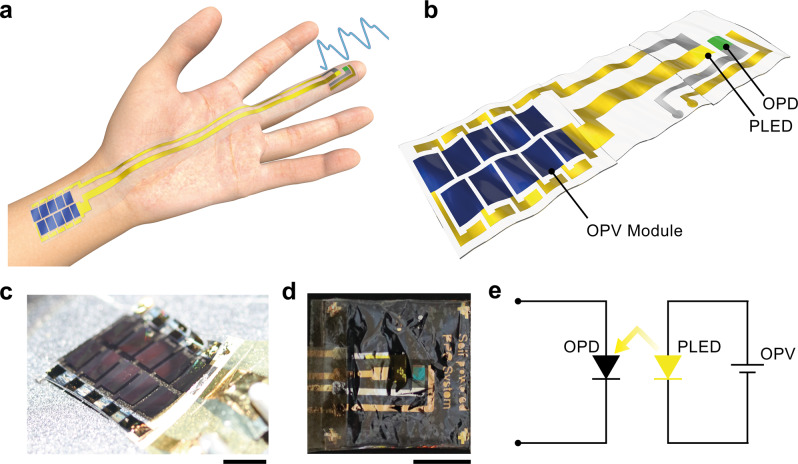
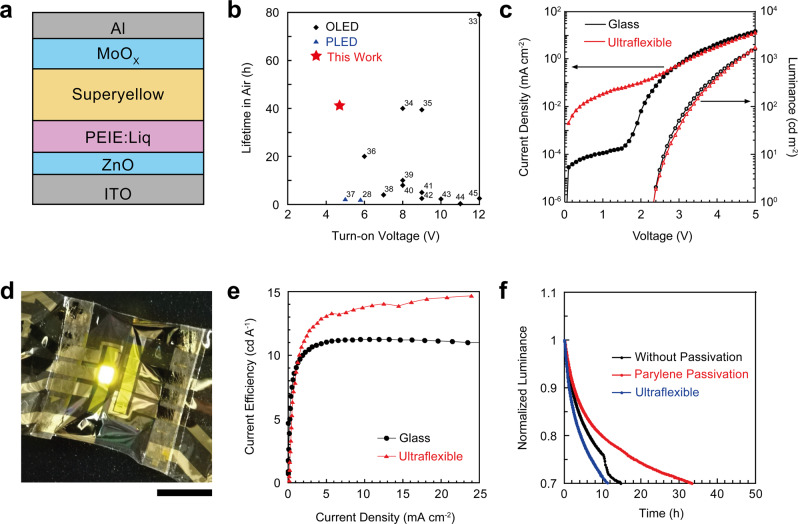
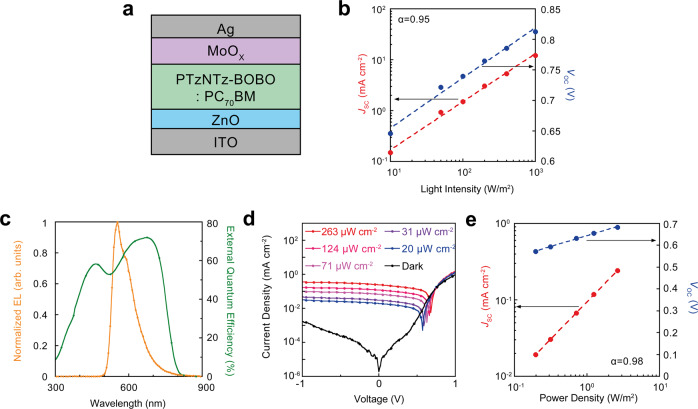
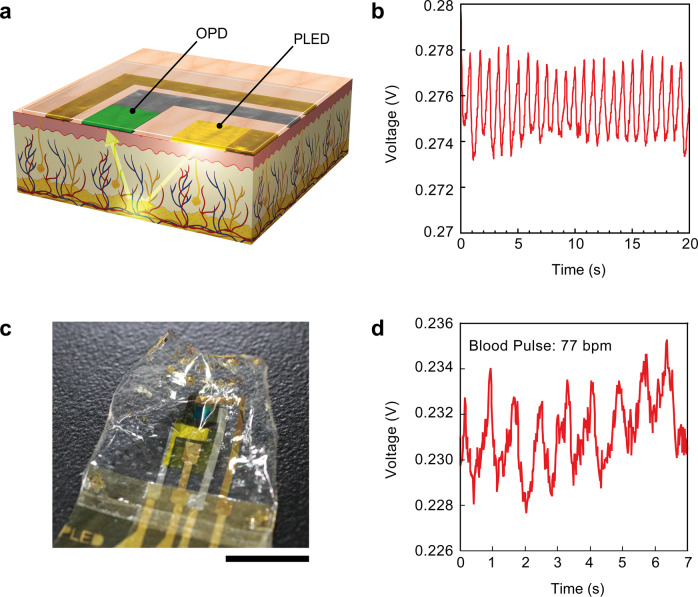
Ultraflexible optical devices have been used extensively in next-generation wearable electronics owing to their excellent conformability to human skins. Long-term health monitoring also requires the integration of ultraflexible optical devices with an energy-harvesting power source; to make devices self-powered. However, system-level integration of ultraflexible optical sensors with power sources is challenging because of insufficient air operational stability of ultraflexible polymer light-emitting diodes. Here we develop an ultraflexible self-powered organic optical system for photoplethysmogram monitoring by combining air-operation-stable polymer light-emitting diodes, organic solar cells, and organic photodetectors. Adopting an inverted structure and a doped polyethylenimine ethoxylated layer, ultraflexible polymer light-emitting diodes retain 70% of the initial luminance even after 11.3 h of operation under air. Also, integrated optical sensors exhibit a high linearity with the light intensity exponent of 0.98 by polymer light-emitting diode. Such self-powered, ultraflexible photoplethysmogram sensors perform monitoring of blood pulse signals as 77 beats per minute.
Overview
The claims and statistics of this paper haven’t been checked yet.
Free: it reads the open-access text and checks the first 5 claims that cite a source we can check. Create a free account to check every claim.
Integrity signals
Registry
Cites
Statistics
Figures
Verification
Claims the paper makes
The claims and statistics of this paper haven’t been checked yet.
Free: it reads the open-access text and checks the first 5 claims that cite a source we can check. Create a free account to check every claim.
Claims other papers make about this one
Each is checked against this paper’s own text: does it say what the citing paper says it does?
The source backs part of the claim, not all of it — or backs it for a different population, condition or comparison.
In the citing paper
“PPG uses optical differences between the vascular and other tissues or oxygenated and deoxygenated hemoglobin to measure heart rate,[263] blood oxygen,[267] and other in-depth cardiovascular information.[268]”
From Flexible Electronics and Devices as Human–Machine Interfaces for Medical Robotics (2022) · cites this paper as [263]
Experimental — accuracy not yet measuredThe source backs part of the claim, not all of it — or backs it for a different population, condition or comparison.
In the citing paper
“Other mechanisms of flexible health monitoring in rehabilitation, like optoelectronic[263,264] and ultrasound[265,266] devices, can also be applied to heartbeat, pulse oximetry, blood pressure, and other on-body measurements.”
From Flexible Electronics and Devices as Human–Machine Interfaces for Medical Robotics (2022) · cites this paper as [263]
Experimental — accuracy not yet measuredThe source backs part of the claim, not all of it — or backs it for a different population, condition or comparison.
In the citing paper
“Recently, wearable perovskite sensors have undergone rapid expansion due to their advantages, including flexibility, stretchability, and lightweight characteristics [22].”
From Design Strategies and Emerging Applications of Perovskite-Based Sensors (2025) · cites this paper as [22]
Experimental — accuracy not yet measuredThe check wasn’t confident either way, so it gives no verdict — never disputed.
In the citing paper
“However, the practical deployment of perovskite sensors in emerging technological fields still confronts significant challenges, including enhancing sensing performance, ensuring longterm stability, and achieving large-scale production [22].”
From Design Strategies and Emerging Applications of Perovskite-Based Sensors (2025) · cites this paper as [22]
Experimental — accuracy not yet measured
Self-check
Percentages, sums and reported differences re-computed from the paper’s own numbers.
The self-check needs the paper’s full text.
Citations
Cites
Kim, D.-H., Lu, N., Ma, R., Kim, Y.-S., Kim, R.-H., Wang, S., Wu, J., Won, S. M., Tao, H., Islam, A., et al. (2011) · Science · doi:10.1126/science.1206157 · Cited by 4,836
An ultra-lightweight design for imperceptible plastic electronics
Kaltenbrunner, M., Sekitani, T., Reeder, J., Yokota, T., Kuribara, K., Tokuhara, T., Drack, M., Schwödiauer, R., Graz, I., Bauer-Gogonea, S., et al. (2013) · Nature · doi:10.1038/nature12314 · Cited by 2,485
Self-citationSkin electronics from scalable fabrication of an intrinsically stretchable transistor array
Wang, S., Xu, J., Wang, W., Wang, G.-J. N., Rastak, R., Molina-Lopez, F., Chung, J. W., Niu, S., Feig, V. R., Lopez, J., et al. (2018) · Nature · doi:10.1038/nature25494 · Cited by 2,198
Ultrathin and lightweight organic solar cells with high flexibility
Kaltenbrunner, M., White, M. S., Głowacki, E. D., Sekitani, T., Someya, T., Sariciftci, N. S., & Bauer, S. (2012) · Nature Communications · doi:10.1038/ncomms1772 · Cited by 1,757
Self-citationDissolvable films of silk fibroin for ultrathin conformal bio-integrated electronics
Kim, D.-H., Viventi, J., Amsden, J. J., Xiao, J., Vigeland, L., Kim, Y.-S., Blanco, J. A., Panilaitis, B., Frechette, E. S., Contreras, D., et al. (2010) · Nature Materials · doi:10.1038/nmat2745 · Cited by 1,721
Self-powered ultra-flexible electronics via nano-grating-patterned organic photovoltaics
Park, S., Heo, S. W., Lee, W., Inoue, D., Jiang, Z., Yu, K., Jinno, H., Hashizume, D., Sekino, M., Yokota, T., et al. (2018) · Nature · doi:10.1038/s41586-018-0536-x · Cited by 1,068
Self-citationUltraflexible organic photonic skin
Yokota, T., Zalar, P., Kaltenbrunner, M., Jinno, H., Matsuhisa, N., Kitanosako, H., Tachibana, Y., Yukita, W., Koizumi, M., & Someya, T. (2016) · Science Advances · doi:10.1126/sciadv.1501856 · Cited by 1,024
Self-citationWearable smart sensor systems integrated on soft contact lenses for wireless ocular diagnostics
Kim, J., Kim, M., Lee, M.-S., Kim, K., Ji, S., Kim, Y.-T., Park, J., Na, K., Bae, K.-H., Kyun Kim, H., et al. (2017) · Nature Communications · doi:10.1038/ncomms14997 · Cited by 951
Ultrathin, highly flexible and stretchable PLEDs
White, M. S., Kaltenbrunner, M., Głowacki, E. D., Gutnichenko, K., Kettlgruber, G., Graz, I., Aazou, S., Ulbricht, C., Egbe, D. A. M., Miron, M. C., et al. (2013) · Nature Photonics · doi:10.1038/nphoton.2013.188 · Cited by 938
Self-citationContinuous Mesoporous Silica Films with Highly Ordered Large Pore Structures
Zhao, D., Yang, P., Melosh, N., Feng, J., Chmelka, B. F., & Stucky, G. D. (1998) · Advanced Materials · doi:10.1002/(sici)1521-4095(199811)10:16<1380::aid-adma1380>3.0.co;2-8 · Cited by 886
Cited by
Items 201–251 of 251
Direct Conductive Bonding of Silver Electrodes on Ultrathin Polymer Films
Miyake, T., Takakuwa, M., Inoue, D., Hashizume, D., Yokota, T., Umezu, S., Fukuda, K., & Someya, T. (2024) · ACS Applied Electronic Materials · doi:10.1021/acsaelm.4c01197 · Cited by 5
Self-citationBae, L. K., Son, S. G., Park, S. C., Park, W. G., Kim, K., Lee, H.-J., Bang, D., Cho, S., Kang, I., & Ahn, J. (2024) · ACS Omega · doi:10.1021/acsomega.4c09156 · Cited by 4
A Low-Power PPG Readout With an Automatic Switching Between Ambient Light and OLED Driver
Pandey, R. K., Pribadi, E. F., & Chao, P. C.-P. (2024) · IEEE Sensors Journal · doi:10.1109/jsen.2024.3462890 · Cited by 4
Brunetta, M., Qiao, Z., Nodari, D., Sasaki, K., Furlan, F., Rimmele, M., Kim, H. W., Chen, H., Tagawa, Y., Marsh, A. V., et al. (2026) · Advanced Energy Materials · doi:10.1002/aenm.202506776 · Cited by 3
“…of few emerging quantum dots technologies [6–8], most inorganic materials present major drawbacks such as expensive fabrication processes and mechanical rigidity [9], making traditional PDs unsuitable for future generation applications such as bioelectronics and skin-grafted sensors [10, 11].”
Self-citationUltra-Flexible Organic Electronics
Yokota, T. (2024) · Springer eBooks · doi:10.1007/978-4-431-56936-7_5 · Cited by 3
Self-citationHou, H., Wu, X., Lu, Y. Q., Lan, B., & Yin, S. (2022) · Dyes and Pigments · doi:10.1016/j.dyepig.2022.110906 · Cited by 3
Supercooled water induced hysteretic transition in H 2 SO 4 -treated PEDOT:PSS
Song, X., Liu, Y., Zhang, Y., Zhang, B., & Wang, S. (2023) · Journal of Materials Chemistry C · doi:10.1039/d3tc00659j · Cited by 3
Flexible Optical Tactile Sensor With CNN-Based Calibration for Robust Pressure Estimation
Ando, K., Kawaguchi, H., & Izumi, S. (2025) · IEEE Sensors Journal · doi:10.1109/jsen.2025.3644368 · Cited by 2
“Structurally, the device is analogous to photoplethysmography (PPG) and oxygen-saturation (SpO 2 ) sensors, allowing the concurrent acquisition of pulse–wave information [17], [18], [19], [20], [21].”
Photoplethysmography for Measuring Cognitive Load in XR Environments: A Systematic Review
Alshehhi, A., Abbasi, Q. H., & Ghannam, R. (2026) · Advanced Sensor Research · doi:10.1002/adsr.202500142 · Cited by 3
Muthuraman, A., Pandiyan, A., Veeramuthu, L., Jawaharlal, H., Babu, S., Fan, C.-W., Chao, T.-H., Chiang, W., Zhou, Y., & Kuo, C. (2026) · Progress in Materials Science · doi:10.1016/j.pmatsci.2026.101751 · Cited by 3
Na, Y., Jeong, S. Y., Oh, S. J., Cho, H., Choi, S., Kang, K. S., Jeon, Y., Kim, T., & Choi, K. C. (2025) · ACS Applied Electronic Materials · doi:10.1021/acsaelm.5c01199 · Cited by 2
Ultra-flexible organic photovoltaics for powering wearable electronics
Xiong, S., Fukuda, K., & Someya, T. (2023) · IEEE International Conference on ASIC (ASICON) · doi:10.1109/asicon58565.2023.10396389 · Cited by 2
“The flexibility of OPVs enables their integration into various wearable items, including clothing, accessories, and even direct attachment to the human body [8, 9].”
BackgroundSelf-citation3PTZ and 3PXZ small molecular hole-transporting materials in polymer light-emitting diodes
Shin, D. S., Park, Y. J., Lee, J., Kim, J., Lee, H., Kim, K., Yi, Y., Kwon, J. E., Lee, K., Park, S. Y., et al. (2023) · Journal of Materials Chemistry C · doi:10.1039/d3tc01163a · Cited by 1
Recent Advances in Organic Photodetectors with Biomedical Applications
Jiménez, M. Á.-P., Herrera‐May, A. L., Delgado‐Alvarado, E., Nolasco, J. C., Mabil-Espinosa, P., Mendoza-Barrón, G., Alarcón, Y. K., Tello-Fomperosa, C., & Martínez-Castillo, J. (2024) · IEEE International Conference on Engineering Veracruz (ICEV) · doi:10.1109/icev63254.2024.10766037 · Cited by 1
“Its advantage is that it can be attached directly to curved surfaces of the body for continuous hight-precision measurement [11].”
Zhang, M., Zhang, Z., Shang, Y., Shi, N., Li, Z., Mao, J., & Zhang, Q. (2024) · ACS Sensors · doi:10.1021/acssensors.4c02224 · Cited by 1
Junior, A. G. L., Nedoma, J., & Martinek, R. (2025) · IEEE Internet of Things Journal · doi:10.1109/jiot.2025.3622344 · Cited by 1
Liu, N., Song, L., Yin, X., Du, P., & Xiong, J. (2025) · Materials Today Chemistry · doi:10.1016/j.mtchem.2025.103267 · Cited by 1
Latest trends and future prospects for ultrathin flexible organic photovoltaics
Fukuda, K., Wang, J., & Nakajima, K. (2026) · Applied Physics Express · doi:10.35848/1882-0786/ae2ce2 · Cited by 2
Self-citationScreen-printed CuO electrodes for applications in photoelectrochemistry
Velasco, J., Lozano, H. J., Villamarin-Barriga, E., Saiz, A., Ateka, A., Rosales, M., Ruiz‐Rubio, L., & del Campo, F. J. (2026) · Electrochimica Acta · doi:10.1016/j.electacta.2026.148185 · Cited by 1
Ultra‐Flexible Dual‐Band Organic Photodetectors for Visible and Near‐Infrared Sensing
Awakura, S., Jinno, H., Tagawa, Y., Fukuzawa, R., Takakuwa, M., Someya, T., & Yokota, T. (2026) · Advanced Optical Materials · doi:10.1002/adom.202503746 · Cited by 2
Self-citationZhang, S., Dai, M., & Lang, J.-P. (2026) · Science China Chemistry · doi:10.1007/s11426-025-3229-5 · Cited by 1
Battery-less luminance sensor biomimicking human sensory nervous system
Yamada, S., & Toshiyoshi, H. (2023) · Applied Physics Letters · doi:10.1063/5.0181949 · Cited by 1
Waterproof and Wearable Power Sources
Xiong, S., Fukuda, K., & Someya, T. (2024) · IEEE International Conference on Solid-State and Integrated Circuit Technology · doi:10.1109/icsict62049.2024.10831890 · Cited by 1
Self-citationKim, J., Kim, H., & Yoon, H. (2025) · Korean Journal of Chemical Engineering · doi:10.1007/s11814-025-00436-x · Cited by 1
“6B) [28].”
Hu, R., Xie, D., Jin, Y., Ren, X., Huang, X., Ji, Y., Liu, X., Yang, X., & Huang, W. (2025) · Materials · doi:10.3390/ma18122675 · Cited by 1
Strain-ultrasensitive surface wrinkles for visual wearable optical sensorPreprint
Ma, T., Chen, S., Li, J., Yin, J., & Jiang, X. (2022) · Research Square · doi:10.21203/rs.3.rs-1357096/v1 · Cited by 1
Ultra-flexible organic photonic system for detecting the bio signals
Yokota, T., & Someya, T. (2022) · IEEE International Conference on Solid-State and Integrated Circuit Technology · doi:10.1109/icsict55466.2022.9963358
Self-citation3D Stretchable Devices: Laser‐Patterned Electronic and Photonic Structures
Thekkekara, L. V., Cheong, Y. Z., Rahman, M. A., Sriram, S., & Bhaskaran, M. C. (2023) · Advanced Electronic Materials · doi:10.1002/aelm.202300705
Li, J., Wang, P., Dong, J., Xie, Z., Tan, X., Lu, Z., Ai, L., Li, B., Wang, Y., & Dong, H. (2024) · Angewandte Chemie · doi:10.1002/ange.202400803
3. Ultra-Flexible OLEDs and Sensor Applications
Yokota, T. (2022) · The Journal of The Institute of Image Information and Television Engineers · doi:10.3169/itej.76.668
Self-citationSmart Optoelectronics in Health Monitoring and Human‐Machine Interactions
Gu, L., Lin, Y., & Zhang, Q. (2025) · Wiley eBooks · doi:10.1002/9783527845507.ch8
Progress in Organic Photovoltaics for Flexible and Low-Cost Devices
Sharada, D. S., Premkumar, M., Jayapratha, J., & Balambiga, B. (2025) · Progress in optical science and photonics · doi:10.1007/978-981-96-5914-2_10
Introduction to Nano-Bioelectronics for Precision Health Monitoring
Tripathi, A., & Bonilla‐Cruz, J. (2025) · Springer eBooks · doi:10.1007/978-981-95-2117-3_2
Solution-Processed Perovskite/Polymer Nanocomposites for Advanced Optoelectronic Devices
Park, M. (2026) · ACS Applied Electronic Materials · doi:10.1021/acsaelm.5c02693 · Cited by 1
Bai, P. (2026) · AIP conference proceedings · doi:10.1063/12.0043536
Wang, Z. (2026) · AIP conference proceedings · doi:10.1063/12.0043540
Socol, M., Preda, N., Breazu, C., Lörinczi, A., Costas, A., Stavarache, I., & Stanculescu, A. I. (2026) · Optical Materials · doi:10.1016/j.optmat.2026.118144
Ding, J., Xia, J., Lian, H., Liu, X., Lan, G., Cao, J., Dong, S., Liu, H., & Dong, Q. (2026) · Nanoscale · doi:10.1039/d6nr00884d
Yin, Z., Ren, J., Peng, X., Zhang, X., Liao, B., Zhu, J., Li, Y., Dai, S., Zhang, X., Zhang, Y., et al. (2026) · SmartMat · doi:10.1002/smm2.70079
Highly robust anode interlayer for water-proof and stretchable organic solar cells
Liu, H., Gong, S., Han, D., Ye, L., Tong, Y., Li, Q., Tong, Y., Wang, X., & Xu, B. (2026) · Science China Materials · doi:10.1007/s40843-025-4060-5
“Wearable electronic technologies—including smart electronic devices, health-monitoring systems, and positioning equipment —are among the most appealing products, with their advancement facing strong demand for portable energy solutions [1–7].”
Lim, J., Park, H., Jang, W., Jeong, J. H., & Wang, D. H. (2026) · Carbon Energy · doi:10.1002/cey2.70276
Multiaxis Force and Moment Estimation Using Spatially Distributed Optical Sensing on the Finger Back
Honda, Y., Ikejima, R., Himeda, S., Kawaguchi, H., & Izumi, S. (2026) · IEEE Sensors Letters · doi:10.1109/lsens.2026.3705741
Stretchable Organic Photoelectric Conversion Systems: From Molecular Design to Device Applications
Zhang, Y.-Y., Wang, Y., Liu, Y.-Q., & Guo, Y.-L. (2026) · Chinese Journal of Polymer Science · doi:10.1007/s10118-026-3652-3
Chen, S., Kang, Q., Yang, X., Zhang, H., Li, J., Lu, W., Yang, L., Liu, T., Yuan, D., Zheng, Z., et al. (2026) · Nano-Micro Letters · doi:10.1007/s40820-026-02250-4
“…only for hole-selective contacts in c-Si solar cells, but also for broader applications across various optoelectronic devices, for instance, organic photo-voltaics (OPV) as an anode buffer layer, organic light-emitting diodes (OLEDs) and quantum dot LEDs (QLED) as a hole-injection layer [18–21].”
Silk fibroin-based wearable bioelectronics for self-powered healthcare
Ansari, A. I., & Dekhtyar, Y. (2026) · International Journal on Interactive Design and Manufacturing (IJIDeM) · doi:10.1007/s12008-026-02669-4
Yin, Y., Yu, Y., Jia, X., Zhao, Y., Gai, S., Ding, H., & Yang, P. (2026) · Coordination Chemistry Reviews · doi:10.1016/j.ccr.2026.218417
Hu, C., Jiao, S., Xi, R., Wang, S., Wang, M., Li, F., Hao, Y., Wu, C., Sun, Z., & Cheng, Z. (2026) · Advanced Functional Materials · doi:10.1002/adfm.77845
Ju, C., Zhu, J., Jiang, L., Zhang, T., Li, H., Chen, W., Chen, H., & Li, Y. (2026) · Science China Materials · doi:10.1007/s40843-026-4269-4
Kazanskiy, N. L., Golovastikov, N. V., & Khonina, S. N. (2026) · Sensors · doi:10.3390/s26196277
From organic photodetectors to monolithic skin-conformal photoplethysmography systems
Kim, J.-H., Chae, S., Yokota, T., Sun, L., Jeong, J., Lee, S., Lee, J., Lee, J., Heo, J. H., Lee, S., et al. (2026) · Materials Science and Engineering R Reports · doi:10.1016/j.mser.2026.101313
Self-citationTailoring Optoelectronic Properties of Optical Hybrid Materials via Print-Enabled Doping
Paul, N., Hridoy, A. H., Wang, X., Salas, J. P. P., Abrasonis, R., Yeo, J., Wang, Q., Lan, S., & Zeng, M. (2026) · ACS Applied Electronic Materials · doi:10.1021/acsaelm.6c01626
Metadata
- Authors
- Jinno, H., Yokota, T., Koizumi, M., Yukita, W., Saito, M., Osaka, I., Fukuda, K., & Someya, T.
- Affiliations
- ETH Zurich (CH)
- The University of Tokyo (JP)
- Hiroshima University (JP)
- RIKEN (JP)
- Corresponding author
- Someya, Takao
- ORCID
- Venue
- Nature Communications
- Published
- 2021-04-14
- Volume
- 12
- Issue
- 1
- Pages
- 2234-2234
- ISSN
- 2041-1723 (ISSN-L)
- PMC
- PMC8047008
- OpenAlex
- W3117206779
- Semantic Scholar
- 367957eb16c243853d530da1cb49c4144be49170
- Cited by
- 253
- References
- 63
- Citations by year
- 2026: 33 · 2025: 55 · 2024: 57 · 2023: 55 · 2022: 38 · 2021: 15
- FWCI
- 12.48
- Type
- journal article
- Language
- en
- Open access
- gold
- doi.org
- Licence
- cc-by
- creativecommons.org/licenses/by/4.0 (tdm)
- creativecommons.org/licenses/by/4.0 (vor)
- Locations
- Nature Communications (publishedVersion, cc-by)
- Research Square (acceptedVersion, cc-by)
- PubMed Central (publishedVersion, cc-by)
- PubMed (publishedVersion)
- RePEc: Research Papers in Economics (submittedVersion)
- DOAJ (DOAJ: Directory of Open Access Journals) (submittedVersion, cc-by-sa)
- Repository for Publications and Research Data (ETH Zurich) (submittedVersion, cc-by)
- ETH Zürich Research Collection (cc-by)
- Funders
- MEXT | JST | Accelerated Innovation Research Initiative Turning Top Science and Ideas into High-Impact Values (JPMJMI17F1)
- Topics
- Physical Sciences › Engineering › Biomedical Engineering › Non-Invasive Vital Sign Monitoring
- Physical Sciences › Engineering › Biomedical Engineering › Advanced Sensor and Energy Harvesting Materials
- Physical Sciences › Engineering › Electrical and Electronic Engineering › Organic Electronics and Photovoltaics
- Keywords
- self-powered devices, polymer light-emitting diodes, wearable electronics, organic solar cells, organic photodetectors, energy harvesting
- MeSH terms
- Wearable Electronic Devices, Equipment Design, Heart Rate, Humans, Light, Monitoring, Physiologic, Polymers, Electric Power Supplies, Solar Energy, Photons, Optical Devices
About these checks
Registry, retraction, Cites and statistics results are computed, not judged, with one exception: a printed reference that no index lists is read once by a model before it counts as a citation error. Claims are extracted by a model and kept only when their quote appears verbatim in the text; each cited source is then checked, with a model’s help, for whether it says what the claim relies on. Those verdicts can be wrong — read the claim’s quote and the cited source before relying on one.
Statistics and arithmetic are recomputed, not judged.
Confidence bands are shown only for fields calibrated on our annotated test set. None is calibrated yet, so no band is shown.
What counts as a claim ›How we measure confidence ›How we check this ›
Are you an author, or do you see a problem with this page? Request a review
Data sources
Bibliographic data: Semantic Scholar, OpenAlex, Crossref.
Contains information from the Semantic Scholar Academic Graph Datasets, made available under the ODC Attribution License (ODC-BY 1.0).
Semantic Scholar’s data is described in: Kinney, R., et al. (2023). The Semantic Scholar Open Data Platform. arXiv:2301.10140.
