

Clone-structured graph representations enable flexible learning and vicarious evaluation of cognitive maps
Open accessThe DOI matches its Crossref record; 78 of the 78 references it cites were found in a registry or an index.
Abstract
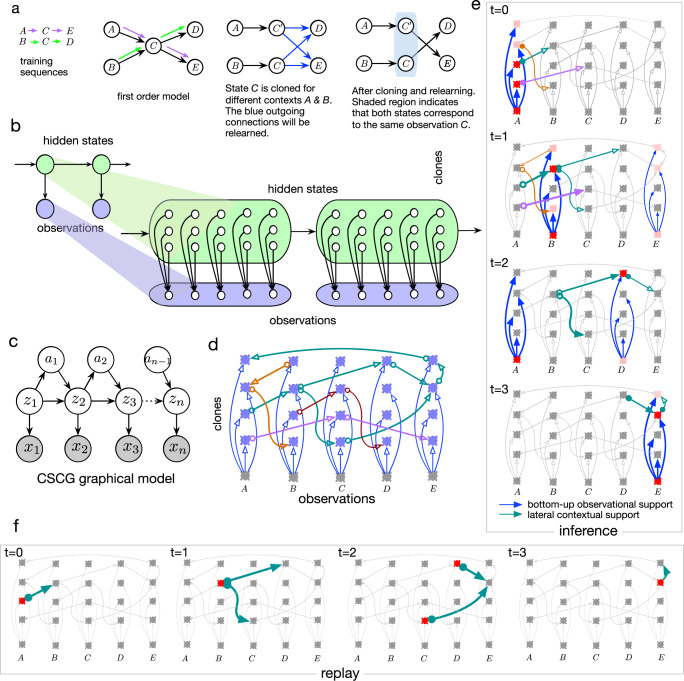
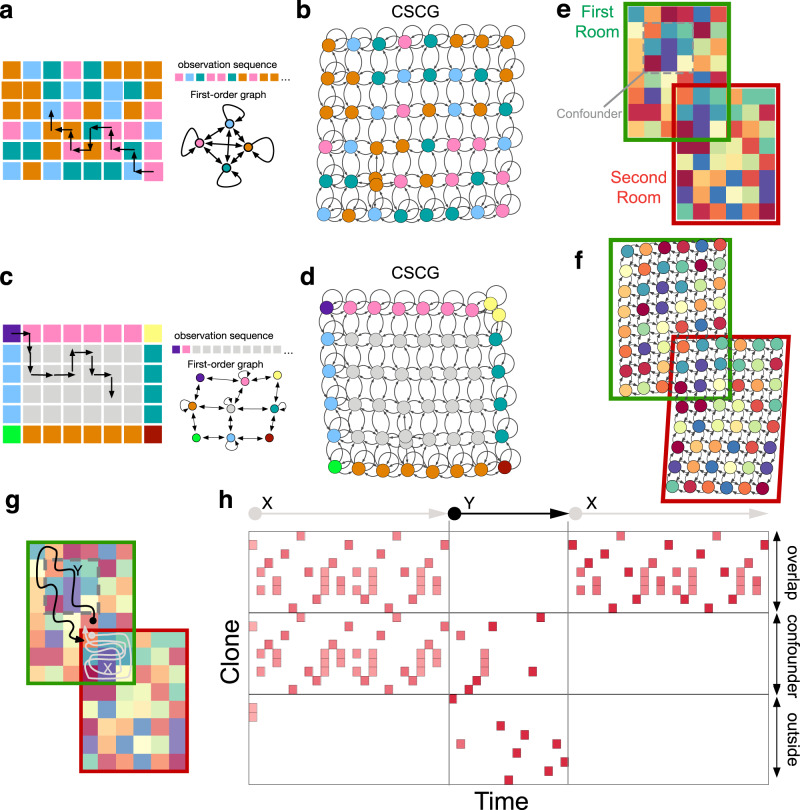
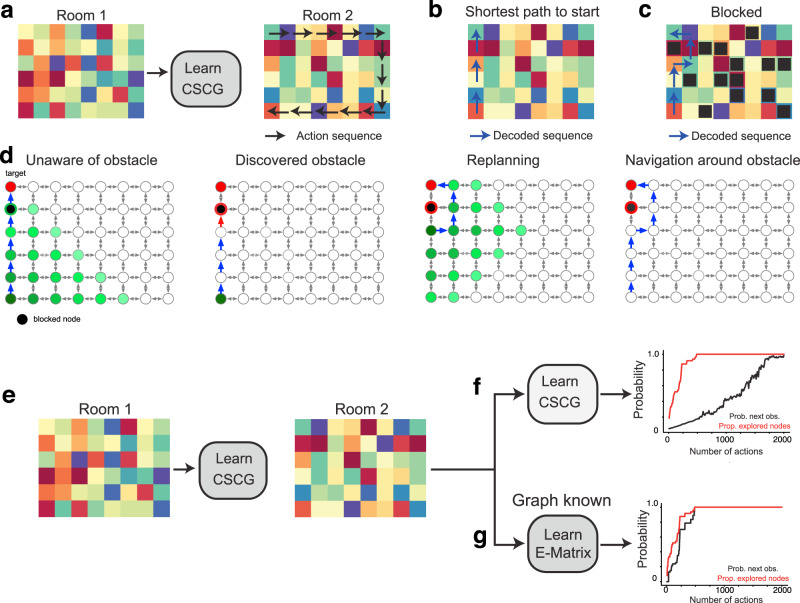
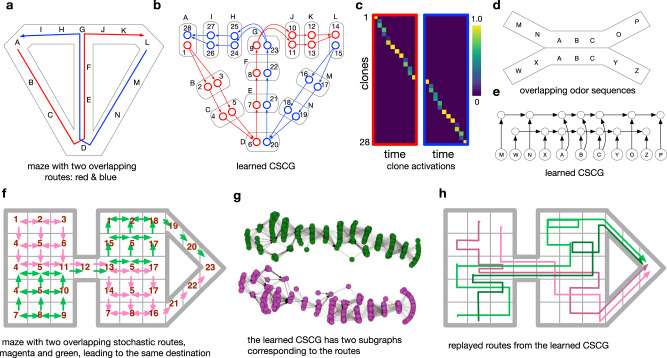
Cognitive maps are mental representations of spatial and conceptual relationships in an environment, and are critical for flexible behavior. To form these abstract maps, the hippocampus has to learn to separate or merge aliased observations appropriately in different contexts in a manner that enables generalization and efficient planning. Here we propose a specific higher-order graph structure, clone-structured cognitive graph (CSCG), which forms clones of an observation for different contexts as a representation that addresses these problems. CSCGs can be learned efficiently using a probabilistic sequence model that is inherently robust to uncertainty. We show that CSCGs can explain a variety of cognitive map phenomena such as discovering spatial relations from aliased sensations, transitive inference between disjoint episodes, and formation of transferable schemas. Learning different clones for different contexts explains the emergence of splitter cells observed in maze navigation and event-specific responses in lap-running experiments. Moreover, learning and inference dynamics of CSCGs offer a coherent explanation for disparate place cell remapping phenomena. By lifting aliased observations into a hidden space, CSCGs reveal latent modularity useful for hierarchical abstraction and planning. Altogether, CSCG provides a simple unifying framework for understanding hippocampal function, and could be a pathway for forming relational abstractions in artificial intelligence.
Overview
The claims and statistics of this paper haven’t been checked yet.
Free: it reads the open-access text and checks the first 5 claims that cite a source we can check. Create a free account to check every claim.
Integrity signals
Registry
Cites
Statistics
Figures
Verification
Claims the paper makes
The claims and statistics of this paper haven’t been checked yet.
Free: it reads the open-access text and checks the first 5 claims that cite a source we can check. Create a free account to check every claim.
Claims other papers make about this one
Each is checked against this paper’s own text: does it say what the citing paper says it does?
The cited source doesn’t support the claim as written.
In the citing paper
“The previous work was entirely in an allocentric setting that hardcoded action semantics in a global coordinate system, which is insufficient to address how spatial representations emerge from egocentric actions and sensations.”
From Space is a latent sequence: A theory of the hippocampus (2024) · cites this paper as [15]
Checked by a reasoning model — may be wrong.
Experimental — accuracy not yet measuredThe source backs part of the claim, not all of it — or backs it for a different population, condition or comparison.
In the citing paper
“When a previously passable route is blocked, the corresponding structural modification can be made in the latent graph, and message passing–based inference will use this updated information about the environment to navigate around obstacles (15).”
From Space is a latent sequence: A theory of the hippocampus (2024) · cites this paper as [15]
Experimental — accuracy not yet measuredThe source backs part of the claim, not all of it — or backs it for a different population, condition or comparison.
In the citing paper
“Moreover, George et al. (15) dealt only with idealized environments with discrete ordinal sensations.”
From Space is a latent sequence: A theory of the hippocampus (2024) · cites this paper as [15]
Experimental — accuracy not yet measuredThe source backs part of the claim, not all of it — or backs it for a different population, condition or comparison.
In the citing paper
“When the observations are discrete, the observation model becomes deterministic and we can set y = x. This exactly recovers the discrete CSCG from (15).”
From Space is a latent sequence: A theory of the hippocampus (2024) · cites this paper as [15]
Experimental — accuracy not yet measuredThe cited source says what the claim attributes to it.
In the citing paper
“However, we do believe that inference and learning in CSCG can be achieved using biologically plausible mechanisms (15, 22).”
From Space is a latent sequence: A theory of the hippocampus (2024) · cites this paper as [15]
6 more claims about this paper
Create a free account to see every claim other papers make about this one.
Self-check
Percentages, sums and reported differences re-computed from the paper’s own numbers.
The self-check needs the paper’s full text.
Citations
Cites
Introduction to information retrieval
(2009) · Choice Reviews Online · doi:10.5860/choice.46-2715 · Cited by 12,278
Introduction to Information Retrieval
Manning, C. D., Raghavan, P., & Schütze, H. (2008) · doi:10.1017/cbo9780511809071 · Cited by 11,288
Cognitive maps in rats and men
Tolman, E. C. (1948) · Psychological Review · doi:10.1037/h0061626 · Cited by 6,641 · cited 2×
“As such, a computational theory for cognitive maps should: (1) propose mechanisms for how context and location-specific representations emerge from aliased sensory or cognitive events, and (2) describe how the representational structure enables consolidation, knowledge transfer, and flexible and hierarchical planning.”
BackgroundMaps of random walks on complex networks reveal community structure
Rosvall, M., & Bergstrom, C. T. (2008) · Proceedings of the National Academy of Sciences · doi:10.1073/pnas.0706851105 · Cited by 4,583
On the Convergence Properties of the EM Algorithm
Wu, C. F. J. (1983) · The Annals of Statistics · doi:10.1214/aos/1176346060 · Cited by 3,269
Place Cells, Grid Cells, and the Brain's Spatial Representation System
Moser, E. I., Kropff, E., & Moser, M.-B. (2008) · Annual Review of Neuroscience · doi:10.1146/annurev.neuro.31.061307.090723 · Cited by 1,934
Replay of neuronal firing sequences in rat hippocampus during sleep following spatial experience
Skaggs, W. E., & McNaughton, B. L. (1996) · Science · doi:10.1126/science.271.5257.1870 · Cited by 1,173
The Hippocampus, Memory, and Place Cells
Eichenbaum, H., Dudchenko, P., Wood, E., Shapiro, M., & Tanila, H. (1999) · Neuron · doi:10.1016/s0896-6273(00)80773-4 · Cited by 1,064
What Is a Cognitive Map? Organizing Knowledge for Flexible Behavior
Behrens, T. E. J., Muller, T. H., Whittington, J. C. R., Mark, S., Baram, A. B., Stachenfeld, K. L., & Kurth-Nelson, Z. (2018) · Neuron · doi:10.1016/j.neuron.2018.10.002 · Cited by 1,055
The hippocampus as a predictive map
Stachenfeld, K. L., Botvinick, M. M., & Gershman, S. J. (2017) · Nature Neuroscience · doi:10.1038/nn.4650 · Cited by 1,000
Research works printed but not linked: 2
- Whittington, J., Muller, T., Mark, S., Barry, C. & Behrens, T. Generalisation of structural knowledge in the hippocampal-entorhinal system. In Advances in Neural Information Processing Systems (eds Bengio, S. et al.) 8484–8495 (Curran Associates, Inc., 2018b).
- Bishop, C. M. Pattern Recognition and Machine Learning (Springer, 2006).
Cited by
Whittington, J. C. R., McCaffary, D., Bakermans, J. J. W., & Behrens, T. E. J. (2022) · Nature Neuroscience · doi:10.1038/s41593-022-01153-y · Cited by 231
Mesolimbic dopamine release conveys causal associations
Jeong, H., Taylor, A., Floeder, J. R., Lohmann, M., Mihalas, S., Wu, B., Zhou, M., Burke, D. A., & Namboodiri, V. M. K. (2022) · Science · doi:10.1126/science.abq6740 · Cited by 231
Fields, C., & Levin, M. (2022) · Entropy · doi:10.3390/e24060819 · Cited by 121
Preconfigured dynamics in the hippocampus are guided by embryonic birthdate and rate of neurogenesis
Huszár, R., Zhang, Y., Blockus, H., & Buzsáki, G. (2022) · Nature Neuroscience · doi:10.1038/s41593-022-01138-x · Cited by 104
“Furthermore, learning 492 to generate sequences over latent states has recently been shown to capture an impressive range 493 of cognitive map and remapping phenomena.(77) 494 495 Same birthdate pyramidal neurons with shared spatial properties were often nearby neighbors.”
BackgroundNeuroscience Needs Network Science
Barabási, D. L., Bianconi, G., Bullmore, E. T., Burgess, M., Chung, S., Eliassi‐Rad, T., George, D., Kovács, I. A., Makse, H. A., Nichols, T. E., et al. (2023) · Journal of Neuroscience · doi:10.1523/jneurosci.1014-23.2023 · Cited by 135
“…behavioral state can be a node, and possible transitions between states are edges (Muller, 1996; Eichenbaum and Cohen, 2004; Stachenfeld et al., 2017; George et al., 2021), a representation that can be extended to the challenge of inducing latent networks from sequential inputs (Raju et al., 2022).”
BackgroundGenerating meaning: active inference and the scope and limits of passive AI
Pezzulo, G., Parr, T., Cisek, P., Clark, A., & Friston, K. (2024) · Trends in Cognitive Sciences · doi:10.1016/j.tics.2023.10.002 · Cited by 80
“In the brain, the generative models for spatial navigation entail distributed cortical and subcortical (e.g., hippocampal) networks, and achieving advanced machine autonomy might bene fi t from reproducing the functional properties of these networks [40,143 – 147]. statistical structure [55].”
A cellular basis for mapping behavioural structure
El-Gaby, M., Harris, A. L., Whittington, J. C. R., Dorrell, W., Bhomick, A., Walton, M. E., Akam, T., & Behrens, T. E. J. (2024) · Nature · doi:10.1038/s41586-024-08145-x · Cited by 114
Episodic and associative memory from spatial scaffolds in the hippocampus
Chandra, S., Sharma, S., Chaudhuri, R., & Fiete, I. (2025) · Nature · doi:10.1038/s41586-024-08392-y · Cited by 133
A sensory–motor theory of the neocortex
Rao, R. P. N. (2024) · Nature Neuroscience · doi:10.1038/s41593-024-01673-9 · Cited by 105
Neural learning rules for generating flexible predictions and computing the successor representation
Fang, C., Aronov, D., Abbott, L. F., & Mackevicius, E. L. (2023) · eLife · doi:10.7554/elife.80680 · Cited by 73
“Furthermore, theoretical work has Preprint May 18, 2022 found that models endowed with predictive objectives tend to resemble hippocampal activity [16, 17, 18, 19, 20, 21, 6, 22].”
A model of egocentric to allocentric understanding in mammalian brains
Uria, B., Ibarz, B., Banino, A., Zambaldi, V., Kumaran, D., Hassabis, D., Barry, C., & Blundell, C. (2020) · doi:10.1101/2020.11.11.378141 · Cited by 48
Temporal context and latent state inference in the hippocampal splitter signal
Duvelle, É., Grieves, R. M., & van der Meer, M. A. A. (2023) · eLife · doi:10.7554/elife.82357 · Cited by 61
Constructing future behavior in the hippocampal formation through composition and replay
Bakermans, J. J. W., Warren, J., Whittington, J. C. R., & Behrens, T. E. J. (2025) · Nature Neuroscience · doi:10.1038/s41593-025-01908-3 · Cited by 91
“Additionally, they account for latent state representations in RL tasks that require nonspatial behavior, such as splitter cells 9,10 in spatial alternation tasks or lap cells 11 in tasks that require counting 3,4 .”
InfluentialLearning produces an orthogonalized state machine in the hippocampus
Sun, W., Winnubst, J., Natrajan, M., Lai, C., Kajikawa, K., Bast, A., Michaelos, M., Gattoni, R., Stringer, C., Flickinger, D., et al. (2025) · Nature · doi:10.1038/s41586-024-08548-w · Cited by 94
“…response types rather than discrete categories, challenging traditional cell-type classifications and demonstrating that single-cell tuning, when properly interpreted in the context of a latent state inference 20,21,23,54 , can provide valuable insights into learning dynamics at a fine granularity.”
InfluentialGoal-oriented representations in the human hippocampus during planning and navigation
Crivelli-Decker, J. E., Clarke, A., Park, S. A., Huffman, D. J., Boorman, E. D., & Ranganath, C. (2023) · Nature Communications · doi:10.1038/s41467-023-35967-6 · Cited by 53
Sequential predictive learning is a unifying theory for hippocampal representation and replayPreprint
Levenstein, D., Efremov, A., Eyono, R. H., Peyrache, A., & Richards, B. A. (2024) · bioRxiv (Cold Spring Harbor Laboratory) · doi:10.1101/2024.04.28.591528 · Cited by 48
Safron, A., Çatal, O., & Verbelen, T. (2022) · Frontiers in Systems Neuroscience · doi:10.3389/fnsys.2022.787659 · Cited by 35
Space is a latent sequence: A theory of the hippocampus
Raju, R. V., Guntupalli, J. S., Zhou, G., Wendelken, C., Lázaro-Gredilla, M., & George, D. (2024) · Science Advances · doi:10.1126/sciadv.adm8470 · Cited by 25
Self-citationGrid Cells in Cognition: Mechanisms and Function
Dong, L. L., & Fiete, I. (2024) · Annual Review of Neuroscience · doi:10.1146/annurev-neuro-101323-112047 · Cited by 35
Schøyen (2022) · doi:10.1101/2022.08.18.504379 · Cited by 27
Schøyen, V., Pettersen, M. B., Holzhausen, K., Fyhn, M., Malthe-Sørenssen, A., & Lepperød, M. E. (2023) · iScience · doi:10.1016/j.isci.2023.108102 · Cited by 28
Predictive sequence learning in the hippocampal formation
Chen, Y., Zhang, H., Cameron, M., & B, T. J. S. A. (2024) · Neuron · doi:10.1016/j.neuron.2024.05.024 · Cited by 48
Learning produces a hippocampal cognitive map in the form of an orthogonalized state machinePreprint
Sun, W., Winnubst, J., Natrajan, M., Lai, C., Kajikawa, K., Michaelos, M., Gattoni, R., Stringer, C., Flickinger, D., Fitzgerald, J. E., et al. (2023) · bioRxiv (Cold Spring Harbor Laboratory) · doi:10.1101/2023.08.03.551900 · Cited by 24
Mok, R. M., & Love, B. C. (2023) · Science Advances · doi:10.1126/sciadv.ade6903 · Cited by 25
Cone, I., & Clopath, C. (2024) · Nature Communications · doi:10.1038/s41467-024-44871-6 · Cited by 27
“Some recent example models of the cognitive map include the Tolman-Eichenbaum Machine (TEM) and the Clone Struc-turedCognitiveGraph(CSCG) 20,21 .”
Pezzulo, G., D’Amato, L., Mannella, F., Priorelli, M., de Maele, T. V., Stoianov, I. P., & Friston, K. J. (2024) · Annals of the New York Academy of Sciences · doi:10.1111/nyas.15118 · Cited by 32
“To create it, statistical dependencies between states (corridor endpoints)—where rewards are encountered during navigation—are learned using a separate CSCG.”
MethodFriston, K. J., Costa, L. D., Tschantz, A., Kiefer, A. B., Salvatori, T., Neacsu, V., Koudahl, M., Heins, C., Sajid, N., Marković, D., et al. (2024) · Biological Psychology · doi:10.1016/j.biopsycho.2024.108891 · Cited by 46
de Maele, T. V., Dhoedt, B., Verbelen, T., & Pezzulo, G. (2024) · Nature Communications · doi:10.1038/s41467-024-54257-3 · Cited by 29
Constructing future behaviour in the hippocampal formation through composition and replayPreprint
Bakermans, J. J. W., Warren, J., Whittington, J. C. R., & Behrens, T. E. J. (2023) · bioRxiv (Cold Spring Harbor Laboratory) · doi:10.1101/2023.04.07.536053 · Cited by 14
“While these symptoms can be alleviated, for example by offline replay that performs credit assignment when new rewards or barriers are observed (Mattar & Daw, 2018; Sutton & Barto, 2018), the diagnosis remains the same.”
BackgroundMethodResultInfluentialBeyond Markov: Transformers, memory, and attention
Parr, T., Pezzulo, G., & Friston, K. J. (2025) · Cognitive Neuroscience · doi:10.1080/17588928.2025.2484485 · Cited by 18
“For example, the clone-structured cognitive graph (CSCG) is an extension of Hidden Markov Models that is capable of learning context-dependent latent representations, using a variant of variational inference (i.e., expectation-maximization) (George et al., 2021).”
General pre-trained inertial signal feature extraction based on temporal memory fusion
Wang, Y., & Zhao, Y. (2025) · Information Fusion · doi:10.1016/j.inffus.2025.103274 · Cited by 22
Sleep targets highly connected global and local nodes to aid consolidation of learned graph networks
Feld, G. B., Bernard, M., Rawson, A. B., & Spiers, H. J. (2022) · Scientific Reports · doi:10.1038/s41598-022-17747-2 · Cited by 22
Decomposing dynamical subprocesses for compositional generalization
Luettgau, L., Erdmann, T., Veselič, S., Stachenfeld, K., Kurth-Nelson, Z. L., Moran, R., & Dolan, R. J. (2024) · Proceedings of the National Academy of Sciences · doi:10.1073/pnas.2408134121 · Cited by 15
Learning to predict future locations with internally generated theta sequences
Parra-Barrero, E., & Cheng, S. (2023) · PLoS Computational Biology · doi:10.1371/journal.pcbi.1011101 · Cited by 14
“In such a case, different sequences would have to be stitched together to form a coherent representation of space, perhaps similar to how it is done in clone-structured graphs [105].”
BackgroundA Neuro-Symbolic Reasoning Model on Raven's Progressive Matrices
Zhao, S., You, H., Zhang, R., Si, B., Zhen, Z., Wan, X., & Wang, D.-H. (2022) · Cognitive Computation · doi:10.1007/s12559-023-10154-3 · Cited by 13
“Compared to traditional cognitive map experiments that generalize in sequential problems with spatial relations [2, 34], the proposed model was an instantiation of the cognitive map concept at the conceptual level, where the generalizable relations can be numerical.”
Backgroundde Tinguy, D., de Maele, T. V., Verbelen, T., & Dhoedt, B. (2024) · Entropy · doi:10.3390/e26010083 · Cited by 19
“This has led to the exploration of various approaches, including taking inspiration from animal navigation strategies (e.g., building cognitive maps [4]), as well as state-of-the-art techniques using neural networks [5].”
BackgroundA generative model of the hippocampal formation trained with theta driven local learning rules
George, T. M., Barry, C., Stachenfeld, K., Clopath, C., & Fukai, T. (2023) · neural information processing systems · doi:10.52202/075280-0082 · Cited by 19
Piray, P., & Daw, N. D. (2025) · Nature Communications · doi:10.1038/s41467-025-62733-7 · Cited by 22
“The experimentalists report that grid cells were relatively unaffected by these suddenly much closer ends/turn-points, which they interpreted as favoring a path-integration mechanism (basically like counting steps from the last turn) -- but surely this poses a problem for the Piray and Daw theory,…”
Accounting for multiscale processing in adaptive real-world decision-making via the hippocampus
Mehrotra, D., & Dubé, L. (2023) · Frontiers in Neuroscience · doi:10.3389/fnins.2023.1200842 · Cited by 11
Generating Meaning: Active Inference and the Scope and Limits of Passive AI
Pezzulo, G., Parr, T., Cisek, P., Clark, A., & Friston, K. (2023) · doi:10.31234/osf.io/8xgzv · Cited by 8
A unified neural representation model for spatial and conceptual computations
Haga, T., Oseki, Y., & Fukai, T. (2025) · Proceedings of the National Academy of Sciences · doi:10.1073/pnas.2413449122 · Cited by 11
“Therefore, our DSI model should be extended to process context dependence, hopefully by combination with other models for learning context - dependent latent cognitive states ( 55 , 97 , 98 ).”
Cognitive graphs: Representational substrates for planning.
Yoo, J., Chrastil, E. R., & Bornstein, A. M. (2024) · Decision · doi:10.1037/dec0000249 · Cited by 10
“Clone-structured cognitive graphs have been able to capture phenomena thought to be important to structure learning in both spatial (George et al., 2021) and non-spatial (Swaminathan et al., 2023) domains: splitting , the ability to recover the ground-truth space from aliased observations, as well…”
InfluentialLearning graph networks: sleep targets highly connected global and local nodes for consolidationPreprint
Feld, G. B., Bernard, M., Rawson, A., & Spiers, H. J. (2021) · bioRxiv (Cold Spring Harbor Laboratory) · doi:10.1101/2021.08.04.455038 · Cited by 7
“…support spatial memory and navigation may have evolved in humans to support the learning of knowledge networks more broadly (Behrens et al., 2018; Bellmund, Gardenfors, Moser, & Doeller, 2018; Epstein, Patai, Julian, & Spiers, 2017; George et al., 2021; Spiers, 2020; Whittington et al., 2020).”
BackgroundA mechanistic theory of planning in prefrontal cortex
Jensen, K. T., Doohan, P. T., Sablé-Meyer, M., Reinert, S., Baram, A. B., Sahani, M., Akam, T., & Behrens, T. E. J. (2026) · eLife · doi:10.7554/elife.109757.3 · Cited by 8
The successor representation subserves hierarchical abstraction for goal-directed behavior
Wientjes, S., & Holroyd, C. B. (2024) · PLoS Computational Biology · doi:10.1371/journal.pcbi.1011312 · Cited by 13
“…representation, our data could be explained by alternative sequence learning mechanisms, for example “free energy minimiza-tion” [29] or (cloned) hidden Markov models [91], in so far as these can implement a mechanism that is isomorphic to the discount factor of the successor representation.”
MethodAn abstract relational map emerges in the human medial prefrontal cortex with consolidation
Baram, A. B., Nili, H., Barreiros, I. V., Samborska, V., Behrens, T. E. J., & Garvert, M. M. (2026) · Current Biology · doi:10.1016/j.cub.2026.05.068 · Cited by 12
Bio-inspired cognitive navigation for robots
Hao, Z., Guo, B., Ding, Y., Li, L., Liu, S., Gao, T., Liu, S., & Yu, Z. (2026) · Nature Reviews Electrical Engineering · doi:10.1038/s44287-026-00294-7 · Cited by 7
“Mammalian cognitive maps are far more than spatial relationships; they also integrate predictions of future events and abstract non-spatial knowledge such as social hierarchies 57 , conceptual structures 126 and language 9 into a unified representation for flexible behaviour.”
Transitive inference as probabilistic preference learning
Mannella, F., & Pezzulo, G. (2024) · Psychonomic Bulletin & Review · doi:10.3758/s13423-024-02600-6 · Cited by 6
“Other cognitive tasks, such as spatial navigation, may demand more complex and higher-dimensional structures akin to cognitive maps (Behrens et al., 2018; Bellmund et al., 2018; George et al., 2021; Stoianov et al., 2022).”
Structural knowledge: from brain to artificial intelligence
Yu, Y., Yan, Y., & Jin, Y. (2025) · Artificial Intelligence Review · doi:10.1007/s10462-025-11270-2 · Cited by 12
“CSCG (George et al. 2021) addresses state ambiguity using a higher-order graph structure that replicates observation features across different contexts, enabling adaptive reason - ing, as shown in Fig.”
InfluentialIntegrating Cognitive Map Learning and Active Inference for Planning in Ambiguous Environments
de Maele, T. V., Dhoedt, B., Verbelen, T., & Pezzulo, G. (2023) · Communications in computer and information science · doi:10.1007/978-3-031-47958-8_13 · Cited by 9
Goal-centered representations in the human hippocampusPreprint
Crivelli-Decker, J. E., Clarke, A., Park, S. A., Huffman, D. J., Boorman, E. D., & Ranganath, C. (2021) · bioRxiv (Cold Spring Harbor Laboratory) · doi:10.1101/2021.08.18.456881 · Cited by 5
Integrating cognitive map learning and active inference for planning in ambiguous environments
Van de Maele, T., Dhoedt, B., Verbelen, T., & Pezzulo, G. (2023) · arXiv · doi:10.48550/arxiv.2308.08307 · Cited by 5
Hippocampus supports multi-task reinforcement learning under partial observability
Pedamonti, D., Mohinta, S., Dimitrov, M. V., Malagon‐Vina, H., Ciocchi, S., & Costa, R. P. (2025) · Nature Communications · doi:10.1038/s41467-025-64591-9 · Cited by 9
“A limited number of models in neuroscience have considered environments with partial observability 72,73 .”
Inferential planning in the frontal cortex
Donnarumma, F., Parr, T., Friston, K. J., Whittington, J. C. R., & Pezzulo, G. (2026) · Cell Reports · doi:10.1016/j.celrep.2026.117905 · Cited by 7
Exploring and Learning Structure: Active Inference Approach in Navigational Agents
de Tinguy, D., Verbelen, T., & Dhoedt, B. (2024) · Communications in computer and information science · doi:10.1007/978-3-031-77138-5_7 · Cited by 7
“Initially, CSCG gathers a dataset through maze exploration to learn the spatial structure [9].”
BackgroundMethodResultInfluentialLearning dynamic cognitive map with autonomous navigation
de Tinguy, D., Verbelen, T., & Dhoedt, B. (2024) · Frontiers in Computational Neuroscience · doi:10.3389/fncom.2024.1498160 · Cited by 9
Kappel, D., & Cheng, S. (2025) · Frontiers in Computational Neuroscience · doi:10.3389/fncom.2024.1462110 · Cited by 5
A detailed theory of thalamic and cortical microcircuits for predictive visual inference
George, D., Lázaro-Gredilla, M., Lehrach, W. P., Dedieu, A., Zhou, G., & Marino, J. (2025) · Science Advances · doi:10.1126/sciadv.adr6698 · Cited by 13
Self-citationFragmented Spatial Maps from Surprisal: State Abstraction and Efficient PlanningPreprint
Klukas, M., Sharma, S., Du, Y., Lozano‐Pérez, T., Kaelbling, L. P., & Fiete, I. (2021) · bioRxiv (Cold Spring Harbor Laboratory) · doi:10.1101/2021.10.29.466499 · Cited by 3
“In contrast to the approach taken in [57, 58] there is no need to generate entirely new neural codes and representations to fit the local statistics of the explored space.”
BackgroundEditorial: Bio A.I. - from embodied cognition to enactive robotics
Safron, A., Hipólito, I., & Clark, A. (2023) · Frontiers in Neurorobotics · doi:10.3389/fnbot.2023.1301993 · Cited by 10
Cognitive Graphs of Latent Structure in Rostral Anterior Cingulate CortexPreprint
Manakov, M., Proskurin, M., Wang, H., Кулешова, Е. П., Lustig, A., Behnam, R., Druckmann, S., Tervo, D. G. R., & Karpova, A. Y. (2025) · bioRxiv (Cold Spring Harbor Laboratory) · doi:10.1101/2025.04.18.649507 · Cited by 3
Theoretical frameworks for credit assignment via behavioral timescale synaptic plasticity
Cone, I., Clopath, C., & Costa, R. P. (2026) · Nature Communications · doi:10.1101/2025.06.12.659336 · Cited by 4
“Recent experimental work which recorded hippocampal activity over the course of learning observed an orthogonalization of the latent map 61 – a feature they found was best described by networks which learned HMMs 60,62 , including a version of the STDP-recurrent network.”
Stability through plasticity: Finding robust memories through representational drift
Natrajan, M., & Fitzgerald, J. E. (2025) · Proceedings of the National Academy of Sciences · doi:10.1073/pnas.2500077122 · Cited by 9
GENESIS: A Generative model of Episodic–Semantic Interaction
D’Alessandro, M., D’Amato, L., Elkano, M., Uriz, M., & Pezzulo, G. (2026) · Neuroscience & Biobehavioral Reviews · doi:10.1016/j.neubiorev.2026.106627 · Cited by 7
Neural sampling from cognitive maps enables goal-directed imagination and planning
Lin, H., Yang, Y., Zhao, R. J., Pezzulo, G., & Maass, W. (2026) · Nature Machine Intelligence · doi:10.1038/s42256-026-01254-4 · Cited by 7
“5,65,66 discuss other approaches).”
Cognitive map formation under uncertainty via local prediction learning
Yeung, C., Zou, Z., Bastian, N. D., & Imani, M. (2025) · Intelligent Systems with Applications · doi:10.1016/j.iswa.2025.200551 · Cited by 3
Free Energy Projective Simulation (FEPS): Active inference with interpretability
Pazem, J., Krumm, M., Vining, A. Q., Fiderer, L. J., & Briegel, H. J. (2025) · PLoS ONE · doi:10.1371/journal.pone.0331047 · Cited by 6
“This approach works remarkably well for navigation problems [69,70].”
Dzhivelikian, E., Kuderov, P., & Panov, A. I. (2024) · Studies in computational intelligence · doi:10.1007/978-3-031-50381-8_33 · Cited by 2
Decomposing dynamical subprocesses for compositional generalizationPreprint
Luettgau, L., Erdmann, T., Veselič, S., Stachenfeld, K., Moran, R., Kurth-Nelson, Z. L., & Dolan, R. J. (2023) · PsyArXiv (OSF Preprints) · doi:10.31234/osf.io/sxn4a · Cited by 4
Decomposing dynamical subprocesses for compositional generalizationPreprint
Luettgau, L., Erdmann, T., Veselič, S., Stachenfeld, K., Moran, R., Kurth-Nelson, Z. L., & Dolan, R. J. (2023) · Research Square · doi:10.21203/rs.3.rs-3358736/v1 · Cited by 2
A mechanistic theory of planning in prefrontal cortexPreprint
Jensen, K. T., Doohan, P. T., Sablé-Meyer, M., Reinert, S., Baram, A. B., Akam, T., & Behrens, T. E. J. (2026) · eLife · doi:10.7554/elife.109757.1 · Cited by 2
Dedieu, A., Lehrach, W., Zhou, G., George, D., & Lázaro-Gredilla, M. (2024) · arXiv · doi:10.48550/arxiv.2401.05946 · Cited by 2
“The latent space of a CSCG is partitioned, such that all the latent variables in one set of the partition deterministically emit the same observation.”
BackgroundMethodInfluentialSelf-citationUnsupervised Neural Architecture for Sensorimotor Mapping in Perceptually Aliased Environments
Carvalho, L., & Starkey, A. J. (2024) · IEEE International Conference on Omni-layer Intelligent Systems (COINS) · doi:10.1109/coins61597.2024.10622113 · Cited by 1
“Then CSCG is trained following the methods noted in [6].”
BackgroundMethodInfluentialA brain-inspired neurodynamic model for efficient sequence memory
Lai, R., Li, Y., Yang, F., Li, Y., Yao, N., Su, C.-W., Zhang, S., Mi, Y., Grebogi, C., & Huang, Z. (2025) · Neurocomputing · doi:10.1016/j.neucom.2025.131849 · Cited by 2
Pecirno, S. A., & Keinath, A. T. (2025) · Current Biology · doi:10.1016/j.cub.2025.11.010 · Cited by 2
Episodic-like memory in a simulation of cuttlefish behavior
Kandimalla, S., Wong, Q. Y., Zheng, K., & Krichmar, J. L. (2025) · Scientific Reports · doi:10.1038/s41598-025-31950-x · Cited by 2
“CSCG focuses on sequential learning with a graphical model that ties together observations with hidden states.”
InfluentialSoft Adaptive Segments for Bio-Inspired Temporal Memory
Prokhorenko, A., Dzhivelikian, E., Kuderov, P., & Panov, A. I. (2024) · Lecture notes in computer science · doi:10.1007/978-3-031-74183-8_17 · Cited by 1
Modeling flexible behavior with remapping-based hippocampal sequence learningPreprint
Ito, Y., & Toyoizumi, T. (2026) · eLife · doi:10.7554/elife.106506 · Cited by 2
Neural representations supporting generalization under continual learningPreprint
Kimmel, D. L., Stachenfeld, K., Kriegeskorte, N., Fusi, S., Salzman, C. D., & Shohamy, D. (2026) · bioRxiv (Cold Spring Harbor Laboratory) · doi:10.64898/2026.01.07.698044 · Cited by 2
“A recent variant of an HMM abstracts the latent structure away from the observable states by allowing a single observation to map to multiple latent states, or “clones”, thereby retaining information not only about a given observation, but also the context—or contexts—in which it was observed [36].”
The hippocampus as a small-world cognitive mapPreprint
Kim, J. Z., Sethna, J. P., Cohen, I., & Sun, W. (2026) · bioRxiv (Cold Spring Harbor Laboratory) · doi:10.64898/2026.02.07.704615 · Cited by 1
“How the underlying state structure itself is acquired is addressed by CSCG, which models the formation of an orthogonalized, aliasing-resolved state graph from experience [13,95].”
Attribution Interpretation of Urban Marathon Events Based on Random Matrix Model
Li, X. (2022) · Mathematical Problems in Engineering · doi:10.1155/2022/7908516 · Cited by 1
“*e marathon is not only a single sporting event, but also has multiple functions [7].”
BackgroundA unified neural representation model for spatial and semantic computationsPreprint
Haga, T., Oseki, Y., & Fukai, T. (2023) · bioRxiv (Cold Spring Harbor Laboratory) · doi:10.1101/2023.05.11.540307
“Therefore, our DSI model should be extended to process context-dependence, hopefully by combination with other models for learning context-dependent latent cognitive states (49, 83, 84).”
MethodRelative Representations for Cognitive Graphs
Kiefer, A. B., & Buckley, C. L. (2023) · Communications in computer and information science · doi:10.1007/978-3-031-47958-8_14 · Cited by 2
“This field of research has given rise to models like the Tolman-Eichenbaum machine [25] and Clone-Structured Cognitive Graph [5, 16].”
MethodResearch on the Construction of a Multimodal Cognitive Graph of Textile and Clothing
Ye, P., Lan, X., Chen, Y., Wang, Z., & Ye, W. (2023) · IEEE International Conference on Software Quality, Reliability and Security Companion (QRS-C) · doi:10.1109/qrs-c60940.2023.00109
Pecirno, S. A., & Keinath, A. T. (2024) · bioRxiv (Cold Spring Harbor Laboratory) · doi:10.1101/2024.11.25.625265
“Additionally, we note that the successor representation is not the only theory consistent with a predictive determinant of CA1 representational structure 20–22,66, 67 .”
Modeling flexible behavior with remapping-based hippocampal sequence learning
Ito, Y., & Toyoizumi, T. (2026) · eLife · doi:10.7554/elife.106506.4
Computational Models of Hippocampal Cognitive Function
Bush, D., & Burgess, N. (2025) · Oxford University Press eBooks · doi:10.1093/med/9780190065324.003.0016
Nishida, K., & Motoyoshi, I. (2025) · bioRxiv (Cold Spring Harbor Laboratory) · doi:10.1101/2025.05.02.651866
“The Clone Structured Causal Graph model (George et al., 2021), a prominent model of the hippocampal-entorhinal system, naturally incorporates the contextual considerations— which first-order Markov models generally fail to account for— in spatial navigation by allowing “clones” for each latent…”
Temporal Predictive Coding as World Model for Reinforcement Learning
Prokhorenko, A., Kuderov, P., Dzhivelikian, E., & Panov, A. I. (2025) · Lecture notes in computer science · doi:10.1007/978-3-032-00800-8_13
The Relative Contributions of Traits and Contexts on Social Network Learning
Ghouse, A., & Kaplan, R. (2025) · Open Mind · doi:10.1162/opmi.a.31
Representations in the hippocampal-entorhinal system emerge from learning sensory predictionsPreprint
Gomez, D., Bowling, M., Lee, J. Q., & Machado, M. C. (2025) · bioRxiv (Cold Spring Harbor Laboratory) · doi:10.1101/2025.10.03.680189 · Cited by 4
Qiu, Y., Zheng, S., Li, H., Lin, S. T., & Huang, R. (2025) · bioRxiv (Cold Spring Harbor Laboratory) · doi:10.1101/2025.10.20.683540
The Primate Hippocampus Constructs a Temporal Scaffold Anchored to Behavioral EventsPreprint
Rueckemann, J. W., Browning, Y., Mallory, A. J., Kim, B., Fairhall, A. L., & Buffalo, E. A. (2025) · Research Square · doi:10.1101/2025.11.12.687961 · Cited by 45
“More recent frameworks emphasize the process by which these representations evolve over time to structure experience 28,29 .”
Modeling Spatial and Conceptual Representations in Hippocampus
Haga, T. (2025) · The Brain & Neural Networks · doi:10.3902/jnns.32.161
Qiu, Y., Zheng, S., Li, H., Lin, S. T., & Huang, R. (2025) · eLife · doi:10.7554/elife.107265
Qiu, Y., Zheng, S., Li, H., Lin, S. T., & Huang, R. (2025) · eLife · doi:10.7554/elife.107265.1
Bio-Inspired Topological Autonomous Navigation with Active Inference in Robotics
de Tinguy, D., Verbelen, T., Gamba, E., & Dhoedt, B. (2025) · International Conference on Control, Automation and Systems (ICCAS) · doi:10.23919/iccas66577.2025.11301261 · Cited by 1
“A cognitive map refers to an internal representation of spatial knowledge, enabling agents to navigate and interpret their surroundings [20], [21], [22], [23].”
Ex Vivo Assay for Organ-Specific Cancer Cell InvasionPreprint
Tyckaert, F., Göddertz, P. F., Reichhold, M., Sarg, B., Faserl, K., González, P. P., Eichin, F., Villunger, A., Ormanns, S., Redl, S., et al. (2026) · bioRxiv (Cold Spring Harbor Laboratory) · doi:10.64898/2026.01.08.698145
Composing egocentric and allocentric maps for flexible navigation
Shani, D., & Dayan, P. (2026) · PLoS Computational Biology · doi:10.1371/journal.pcbi.1013905 · Cited by 1
“There have also been suggestions that the hippocampal formation performs latent allocentric structure learning on egocentric inputs [20,21] with grid cell and place cell properties being explained by various functions including path-integration [32,34,35] and probabilistic message-passing [36].”
Unsupervised Hierarchical Growing Neural Architecture for Sensorimotor Map Learning
Abu, A. E., & Starkey, A. J. (2026) · Communications in computer and information science · doi:10.1007/978-3-032-15638-9_20
Metadata
- Authors
- George, D., Rikhye, R. V., Gothoskar, N., Guntupalli, J. S., Dedieu, A., & Lázaro-Gredilla, M.
- Affiliations
- Google (United States) (US)
- Massachusetts Institute of Technology (US)
- Venue
- Nature Communications
- Published
- 2021-04-22
- Volume
- 12
- Issue
- 1
- Pages
- 2392-2392
- ISSN
- 2041-1723 (ISSN-L)
- PMC
- PMC8062558
- OpenAlex
- W3154239738
- Cited by
- 109
- References
- 77
- Citations by year
- 2026: 25 · 2025: 31 · 2024: 21 · 2023: 18 · 2022: 10 · 2021: 3
- FWCI
- 6.84
- Type
- journal article
- Language
- en
- Open access
- gold
- doi.org
- Licence
- cc-by
- creativecommons.org/licenses/by/4.0 (tdm)
- creativecommons.org/licenses/by/4.0 (vor)
- Locations
- Nature Communications (publishedVersion, cc-by)
- PubMed Central (publishedVersion, cc-by)
- PubMed (publishedVersion)
- RePEc: Research Papers in Economics (submittedVersion)
- DOAJ (DOAJ: Directory of Open Access Journals) (submittedVersion, cc-by-sa)
- Funders
- United States Department of Defense | United States Navy | Office of Naval Research (N00014-19-1-2368)
- Vicarious AI is a startup company and that is where the research was conducted.
- Topics
- Life Sciences › Neuroscience › Cognitive Neuroscience › Memory and Neural Mechanisms
- Social Sciences › Psychology › Experimental and Cognitive Psychology › Spatial Cognition and Navigation
- Life Sciences › Neuroscience › Cognitive Neuroscience › Neural dynamics and brain function
- Keywords
- cognitive maps, hippocampus, spatial learning, transitive inference, probabilistic sequence models, hierarchical abstraction, relational abstraction, maze navigation
- MeSH terms
- Cognition, Hippocampus, Humans, Learning, Markov Chains, Models, Neurological, Neural Networks, Computer
About these checks
Registry, retraction, Cites and statistics results are computed, not judged, with one exception: a printed reference that no index lists is read once by a model before it counts as a citation error. Claims are extracted by a model and kept only when their quote appears verbatim in the text; each cited source is then checked, with a model’s help, for whether it says what the claim relies on. Those verdicts can be wrong — read the claim’s quote and the cited source before relying on one.
Statistics and arithmetic are recomputed, not judged.
Confidence bands are shown only for fields calibrated on our annotated test set. None is calibrated yet, so no band is shown.
What counts as a claim ›How we measure confidence ›How we check this ›
Are you an author, or do you see a problem with this page? Request a review
Data sources
Bibliographic data: Semantic Scholar, OpenAlex, Crossref.
Contains information from the Semantic Scholar Academic Graph Datasets, made available under the ODC Attribution License (ODC-BY 1.0).
Semantic Scholar’s data is described in: Kinney, R., et al. (2023). The Semantic Scholar Open Data Platform. arXiv:2301.10140.
