

Lung cancer organoids analyzed on microwell arrays predict drug responses of patients within a week
Open accessThe DOI matches its Crossref record; 57 of the 57 references it cites were found in a registry or an index.
Abstract
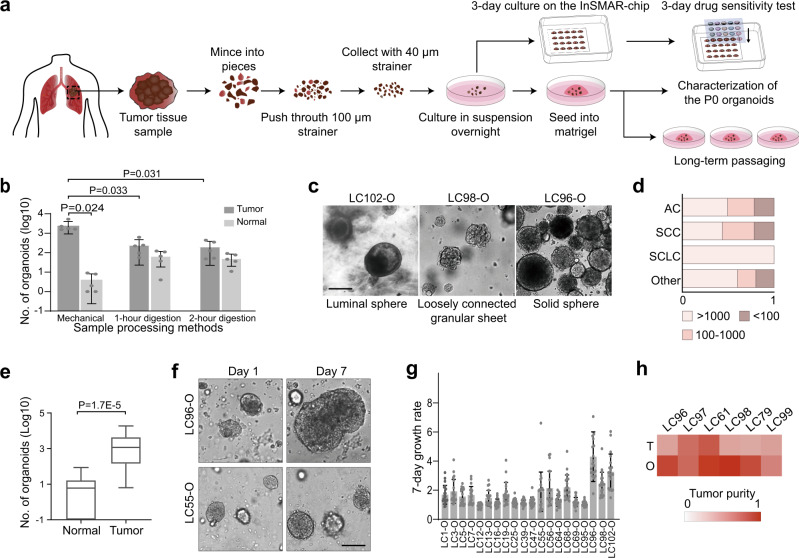
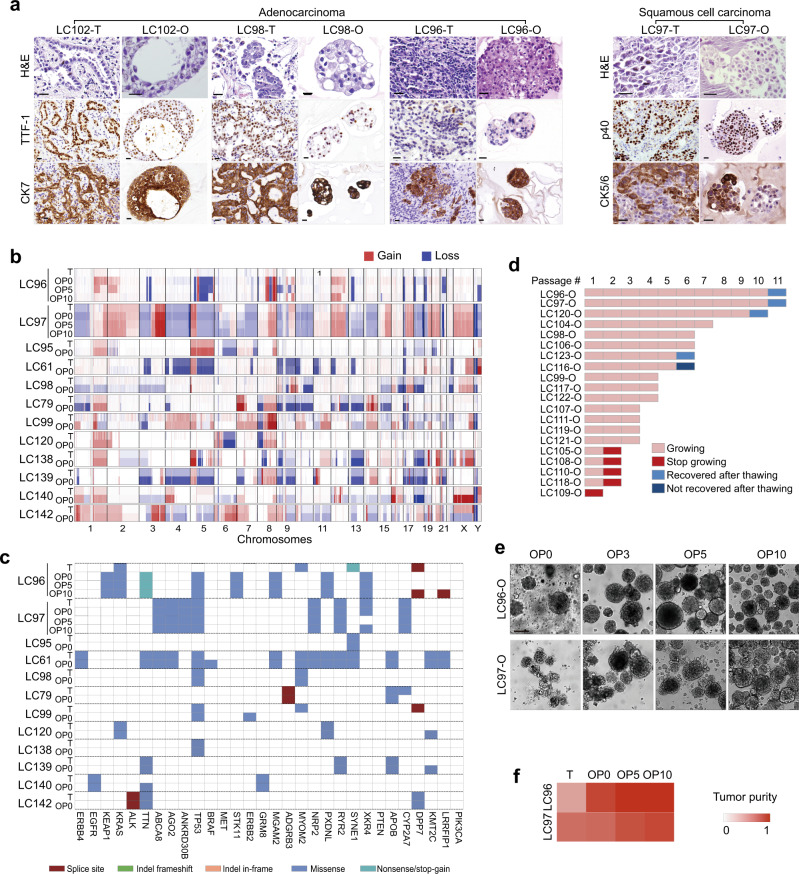
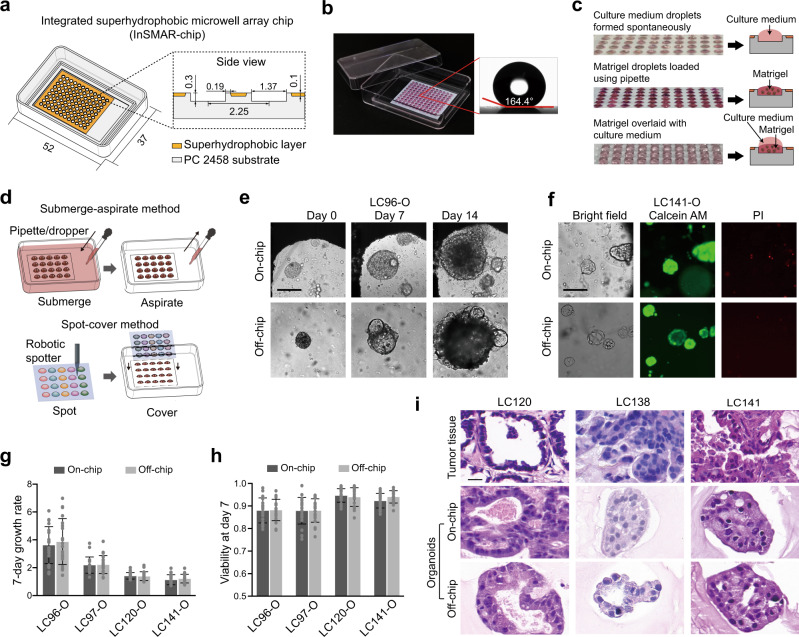
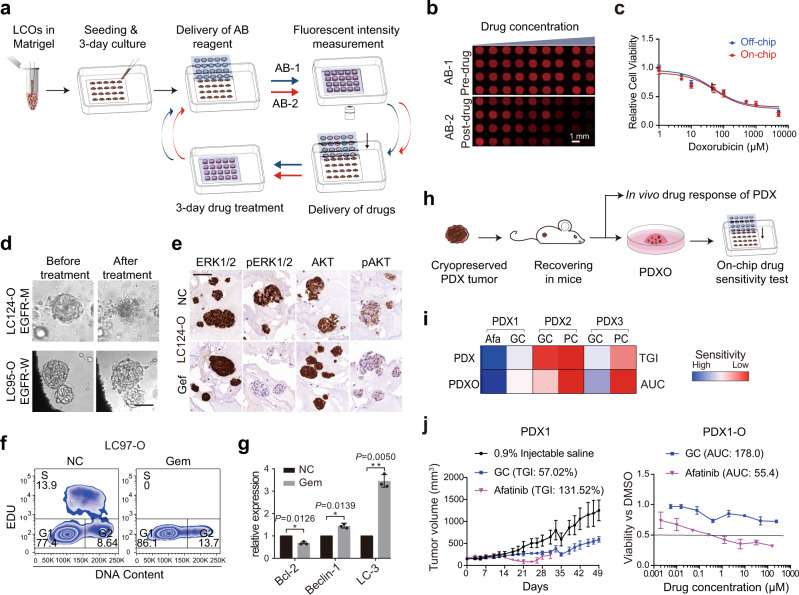
While the potential of patient-derived organoids (PDOs) to predict patients’ responses to anti-cancer treatments has been well recognized, the lengthy time and the low efficiency in establishing PDOs hamper the implementation of PDO-based drug sensitivity tests in clinics. We first adapt a mechanical sample processing method to generate lung cancer organoids (LCOs) from surgically resected and biopsy tumor tissues. The LCOs recapitulate the histological and genetic features of the parental tumors and have the potential to expand indefinitely. By employing an integrated superhydrophobic microwell array chip (InSMAR-chip), we demonstrate hundreds of LCOs, a number that can be generated from most of the samples at passage 0, are sufficient to produce clinically meaningful drug responses within a week. The results prove our one-week drug tests are in good agreement with patient-derived xenografts, genetic mutations of tumors, and clinical outcomes. The LCO model coupled with the microwell device provides a technically feasible means for predicting patient-specific drug responses in clinical settings.
Overview
The claims and statistics of this paper haven’t been checked yet.
Free: it reads the open-access text and checks the first 5 claims that cite a source we can check. Create a free account to check every claim.
Integrity signals
Registry
Cites
Statistics
Figures
Verification
Claims the paper makes
The claims and statistics of this paper haven’t been checked yet.
Free: it reads the open-access text and checks the first 5 claims that cite a source we can check. Create a free account to check every claim.
Claims other papers make about this one
Each is checked against this paper’s own text: does it say what the citing paper says it does?
The cited source says what the claim attributes to it.
In the citing paper
“microfabricated array devices using organoids at passage 0 provide drug screening results within a week without compromising the predictivity of patient responses to anticancer drugs152”
From Human disease models in drug development (2023) · cites this paper as [152]
Self-check
Percentages, sums and reported differences re-computed from the paper’s own numbers.
The self-check needs the paper’s full text.
Citations
Cites
The Sequence Alignment/Map format and SAMtools
Li, H., Handsaker, B., Wysoker, A., Fennell, T., Ruan, J., Homer, N., Marth, G., Abecasis, G., Durbin, R., & 1000 Genome Project Data Processing Subgroup (2009) · Bioinformatics · doi:10.1093/bioinformatics/btp352 · Cited by 62,041
Fast and accurate short read alignment with Burrows-Wheeler transform
Li, H., & Durbin, R. (2009) · Bioinformatics · doi:10.1093/bioinformatics/btp324 · Cited by 58,607
STAR: ultrafast universal RNA-seq aligner
Dobin, A., Davis, C. A., Schlesinger, F., Drenkow, J., Zaleski, C., Jha, S., Batut, P., Chaisson, M., & Gingeras, T. R. (2013) · Bioinformatics · doi:10.1093/bioinformatics/bts635 · Cited by 51,709
Robinson, M. D., McCarthy, D. J., & Smyth, G. K. (2010) · Bioinformatics · doi:10.1093/bioinformatics/btp616 · Cited by 41,364
Cutadapt removes adapter sequences from high-throughput sequencing reads
Martin, M. (2011) · EMBnet.journal · doi:10.14806/ej.17.1.200 · Cited by 33,889
New response evaluation criteria in solid tumours: revised RECIST guideline (version 1.1)
Eisenhauer, E. A., Therasse, P., Bogaerts, J., Schwartz, L. H., Sargent, D., Ford, R., Dancey, J., Arbuck, S., Gwyther, S., Mooney, M., et al. (2009) · European Journal of Cancer · doi:10.1016/j.ejca.2008.10.026 · Cited by 29,534
Cancer incidence and mortality worldwide: Sources, methods and major patterns in GLOBOCAN 2012
Ferlay, J., Soerjomataram, I., Dikshit, R., Eser, S., Mathers, C., Rebelo, M., Parkin, D. M., Forman, D., & Bray, F. (2015) · International Journal of Cancer · doi:10.1002/ijc.29210 · Cited by 28,766
The Genome Analysis Toolkit: A MapReduce framework for analyzing next-generation DNA sequencing data
McKenna, A., Hanna, M., Banks, E., Sivachenko, A., Cibulskis, K., Kernytsky, A., Garimella, K., Altshuler, D., Gabriel, S., Daly, M., et al. (2010) · Genome Research · doi:10.1101/gr.107524.110 · Cited by 27,895
Sensitive detection of somatic point mutations in impure and heterogeneous cancer samples
Cibulskis, K., Lawrence, M. S., Carter, S. L., Sivachenko, A., Jaffe, D., Sougnez, C., Gabriel, S., Meyerson, M., Lander, E. S., & Getz, G. (2013) · Nature Biotechnology · doi:10.1038/nbt.2514 · Cited by 4,981
Autophagy as a Regulated Pathway of Cellular Degradation
Klionsky, D. J., & Emr, S. D. (2000) · Science · doi:10.1126/science.290.5497.1717 · Cited by 3,608
Prospective Derivation of a Living Organoid Biobank of Colorectal Cancer Patients
van de Wetering, M., Francies, H. E., Francis, J. M., Bounova, G., Iorio, F., Pronk, A., van Houdt, W., van Gorp, J., Taylor-Weiner, A., Kester, L., et al. (2015) · Cell · doi:10.1016/j.cell.2015.03.053 · Cited by 2,408
Organoid models of human and mouse ductal pancreatic cancer
Boj, S. F., Hwang, C.-I., Baker, L. A., Chio, I. I. C., Engle, D. D., Corbo, V., Jager, M., Ponz-Sarvise, M., Tiriac, H., Spector, M. S., et al. (2015) · Cell · doi:10.1016/j.cell.2014.12.021 · Cited by 2,150
Patient-derived organoids model treatment response of metastatic gastrointestinal cancers
Vlachogiannis, G., Hedayat, S., Vatsiou, A., Jamin, Y., Fernández-Mateos, J., Khan, K., Lampis, A., Eason, K., Huntingford, I., Burke, R., et al. (2018) · Science · doi:10.1126/science.aao2774 · Cited by 2,096
CNVkit: Genome-Wide Copy Number Detection and Visualization from Targeted DNA Sequencing
Talevich, E., Shain, A. H., Botton, T., & Bastian, B. C. (2016) · PLOS Computational Biology · doi:10.1371/journal.pcbi.1004873 · Cited by 2,094
A living biobank of breast cancer organoids captures disease heterogeneity
Sachs, N., de Ligt, J., Kopper, O., Gogola, E., Bounova, G., Weeber, F., Balgobind, A. V., Wind, K., Gracanin, A., Begthel, H., et al. (2018) · Cell · doi:10.1016/j.cell.2017.11.010 · Cited by 1,973
Robust self-cleaning surfaces that function when exposed to either air or oil
Lu, Y., Sathasivam, S., Song, J., Crick, C. R., Carmalt, C. J., & Parkin, I. P. (2015) · Science · doi:10.1126/science.aaa0946 · Cited by 1,808
Patient-Derived Xenograft Models: An Emerging Platform for Translational Cancer Research
Hidalgo, M., Amant, F., Biankin, A. V., Budinská, E., Byrne, A. T., Caldas, C., Clarke, R. B., de Jong, S., Jonkers, J., Mælandsmo, G. M., et al. (2014) · Cancer Discovery · doi:10.1158/2159-8290.cd-14-0001 · Cited by 1,742
Long-Term Culture of Genome-Stable Bipotent Stem Cells from Adult Human Liver
Huch, M., Gehart, H., van Boxtel, R., Hamer, K., Blokzijl, F., Verstegen, M. M. A., Ellis, E., van Wenum, M., Fuchs, S. A., de Ligt, J., et al. (2015) · Cell · doi:10.1016/j.cell.2014.11.050 · Cited by 1,619
Organoid Cultures Derived from Patients with Advanced Prostate Cancer
Gao, D., Vela, I., Sboner, A., Iaquinta, P. J., Karthaus, W. R., Gopalan, A., Dowling, C., Wanjala, J. N., Undvall, E. A., Arora, V. K., et al. (2014) · Cell · doi:10.1016/j.cell.2014.08.016 · Cited by 1,559
Organoid modeling of the tumor immune microenvironment
Neal, J. T., Li, X., Zhu, J., Giangarra, V., Grzeskowiak, C. L., Ju, J., Liu, I. H., Chiou, S.-H., Salahudeen, A. A., Smith, A. R., et al. (2018) · Cell · doi:10.1016/j.cell.2018.11.021 · Cited by 1,556
Human primary liver cancer–derived organoid cultures for disease modeling and drug screening
Broutier, L., Mastrogiovanni, G., Verstegen, M. M., Francies, H. E., Gavarró, L. M., Bradshaw, C. R., Allen, G. E., Arnes-Benito, R., Sidorova, O., Gaspersz, M. P., et al. (2017) · Nature Medicine · doi:10.1038/nm.4438 · Cited by 1,471
Long‐term expanding human airway organoids for disease modeling
Sachs, N., Papaspyropoulos, A., Zomer‐van Ommen, D. D., Heo, I., Böttinger, L., Klay, D., Weeber, F., Huelsz‐Prince, G., Iakobachvili, N., Amatngalim, G. D., et al. (2019) · The EMBO Journal · doi:10.15252/embj.2018100300 · Cited by 1,082
Cancer modeling meets human organoid technology
Tuveson, D., & Clevers, H. (2019) · Science · doi:10.1126/science.aaw6985 · Cited by 935
SAMBLASTER: fast duplicate marking and structural variant read extraction
Faust, G. G., & Hall, I. M. (2014) · Bioinformatics · doi:10.1093/bioinformatics/btu314 · Cited by 909
Tumor Evolution and Drug Response in Patient-Derived Organoid Models of Bladder Cancer
Lee, S. H., Hu, W., Matulay, J. T., Silva, M. V., Owczarek, T. B., Kim, K., Chua, C. W., Barlow, L. J., Kandoth, C., Williams, A. B., et al. (2018) · Cell · doi:10.1016/j.cell.2018.03.017 · Cited by 873
Acquired resistance to TKIs in solid tumours: learning from lung cancer
Camidge, D. R., Pao, W., & Sequist, L. V. (2014) · Nature Reviews Clinical Oncology · doi:10.1038/nrclinonc.2014.104 · Cited by 862
Fujii, M., Shimokawa, M., Date, S., Takano, A., Matano, M., Nanki, K., Ohta, Y., Toshimitsu, K., Nakazato, Y., Kawasaki, K., et al. (2016) · Cell Stem Cell · doi:10.1016/j.stem.2016.04.003 · Cited by 852
Masters, G. A., Temin, S., Azzoli, C. G., Giaccone, G., Baker, S., Brahmer, J. R., Ellis, P. M., Gajra, A., Rackear, N., Schiller, J. H., et al. (2015) · Journal of Clinical Oncology · doi:10.1200/jco.2015.62.1342 · Cited by 850
Ooft, S. N., Weeber, F., Dijkstra, K. K., McLean, C. M., Kaing, S., van Werkhoven, E., Schipper, L., Hoes, L., Vis, D. J., van de Haar, J., et al. (2019) · Science Translational Medicine · doi:10.1126/scitranslmed.aay2574 · Cited by 813
Patient-derived lung cancer organoids as in vitro cancer models for therapeutic screening
Kim, M., Mun, H., Sung, C. O., Cho, E. J., Jeon, H.-J., Chun, S.-M., Jung, D. J., Shin, T. H., Jeong, G. S., Kim, D. K., et al. (2019) · Nature Communications · doi:10.1038/s41467-019-11867-6 · Cited by 812
Patient-Derived Organoids Predict Chemoradiation Responses of Locally Advanced Rectal Cancer
Yao, Y., Xu, X., Yang, L., Zhu, J., Wan, J., Shen, L., Xia, F., Fu, G., Deng, Y., Pan, M., et al. (2020) · Cell Stem Cell · doi:10.1016/j.stem.2019.10.010 · Cited by 755
Self-citationSeino, T., Kawasaki, S., Shimokawa, M., Tamagawa, H., Toshimitsu, K., Fujii, M., Ohta, Y., Matano, M., Nanki, K., Kawasaki, K., et al. (2018) · Cell Stem Cell · doi:10.1016/j.stem.2017.12.009 · Cited by 631
A three-dimensional model of human lung development and disease from pluripotent stem cells
Chen, Y.-W., Huang, S. X., de Carvalho, A. L. R. T., Ho, S.-H., Islam, M. N., Volpi, S., Notarangelo, L. D., Ciancanelli, M., Casanova, J.-L., Bhattacharya, J., et al. (2017) · Nature Cell Biology · doi:10.1038/ncb3510 · Cited by 608
FDA Drug Approval Summary: Gefitinib (ZD1839) (Iressa®) Tablets
Cohen, M. H., Williams, G. A., Sridhara, R., Chen, G., & Pazdur, R. (2003) · The Oncologist · doi:10.1634/theoncologist.8-4-303 · Cited by 581
Emerging Concepts for Immune Checkpoint Blockade-Based Combination Therapies
Zappasodi, R., Merghoub, T., & Wolchok, J. D. (2018) · Cancer Cell · doi:10.1016/j.ccell.2018.03.005 · Cited by 525
Dual SMAD Signaling Inhibition Enables Long-Term Expansion of Diverse Epithelial Basal Cells
Mou, H., Vinarsky, V., Tata, P. R., Brazauskas, K., Choi, S. H., Crooke, A. K., Zhang, B., Solomon, G. M., Turner, B., Bihler, H., et al. (2016) · Cell Stem Cell · doi:10.1016/j.stem.2016.05.012 · Cited by 382
Kris, M. G., Gaspar, L. E., Chaft, J. E., Kennedy, E. B., Azzoli, C. G., Ellis, P. M., Lin, S. H., Pass, H. I., Seth, R., Shepherd, F. A., et al. (2017) · Journal of Clinical Oncology · doi:10.1200/jco.2017.72.4401 · Cited by 368
Kondo, J., Endo, H., Okuyama, H., Ishikawa, O., Iishi, H., Tsujii, M., Ohue, M., & Inoue, M. (2011) · Proceedings of the National Academy of Sciences · doi:10.1073/pnas.1015938108 · Cited by 322
Molecularly targeted cancer therapy: some lessons from the past decade
Huang, M., Shen, A., Ding, J., & Geng, M. (2014) · Trends in Pharmacological Sciences · doi:10.1016/j.tips.2013.11.004 · Cited by 291
Biomarkers for the Clinical Use of PD-1/PD-L1 Inhibitors in Non–Small-Cell Lung Cancer: A Review
Sacher, A. G., & Gandhi, L. (2016) · JAMA Oncology · doi:10.1001/jamaoncol.2016.0639 · Cited by 255
Perioperative Dynamic Changes in Circulating Tumor DNA in Patients with Lung Cancer (DYNAMIC)
Chen, K., Zhao, H., Shi, Y., Yang, F., Wang, L. T., Kang, G., Nie, Y., & Wang, J. (2019) · Clinical Cancer Research · doi:10.1158/1078-0432.ccr-19-1213 · Cited by 239
Self-citationSomatic EGFR mutations and efficacy of tyrosine kinase inhibitors in NSCLC
Linardou, H., Dahabreh, I. J., Bafaloukos, D., Kosmidis, P., & Murray, S. (2009) · Nature Reviews Clinical Oncology · doi:10.1038/nrclinonc.2009.62 · Cited by 234
Yu, H., Steeghs, N., Nijenhuis, C. M., Schellens, J. H. M., Beijnen, J. H., & Huitema, A. D. R. (2014) · Clinical Pharmacokinetics · doi:10.1007/s40262-014-0137-2 · Cited by 231
Organoid models of gastrointestinal cancers in basic and translational research
Lau, H. C. H., Kranenburg, O., Xiao, H., & Yu, J. (2020) · Nature Reviews Gastroenterology & Hepatology · doi:10.1038/s41575-019-0255-2 · Cited by 194
The Influence of Rapid Onsite Evaluation on the Adequacy Rate of Fine-Needle Aspiration Cytology
Schmidt, R. L., Witt, B. L., Lopez-Calderon, L. E., & Layfield, L. J. (2013) · American Journal of Clinical Pathology · doi:10.1309/ajcpegzmjkc42vup · Cited by 149
Bepler, G., Williams, C. C., Schell, M. J., Chen, W., Zheng, Z., Simon, G. R., Gadgeel, S. M., Zhao, X., Schreiber, F. J., Brahmer, J. R., et al. (2013) · Journal of Clinical Oncology · doi:10.1200/jco.2012.46.9783 · Cited by 149
Gemcitabine-Induced Activation of Checkpoint Signaling Pathways That Affect Tumor Cell Survival
Karnitz, L. M., Flatten, K. S., Wagner, J. M., Loegering, D. A., Hackbarth, J. S., Arlander, S. J. H., Vroman, B. T., Thomas, M. B., Baek, Y.-U., Hopkins, K. M., et al. (2005) · Molecular Pharmacology · doi:10.1124/mol.105.012716 · Cited by 148
Emerging Concepts for Immune Checkpoint Blockade-Based Combination Therapies
Zappasodi, R., Merghoub, T., & Wolchok, J. D. (2018) · Cancer Cell · doi:10.1016/j.ccell.2018.09.008 · Cited by 106
Copy-number analysis and inference of subclonal populations in cancer genomes using Sclust
Cun, Y., Yang, T.-P., Achter, V., Lang, U., & Peifer, M. (2018) · Nature Protocols · doi:10.1038/nprot.2018.033 · Cited by 83
Drug Sensitivity Assays of Human Cancer Organoid Cultures
Francies, H. E., Barthorpe, A., McLaren-Douglas, A., Barendt, W. J., & Garnett, M. J. (2016) · Methods in Molecular Biology · doi:10.1007/7651_2016_10 · Cited by 81
Granat, L. M., Kambhampati, O., Klosek, S., Niedzwecki, B., Parsa, K., & Zhang, D. (2019) · Animal Models and Experimental Medicine · doi:10.1002/ame2.12077 · Cited by 62
High-throughput superhydrophobic microwell arrays for investigating multifactorial stem cell niches
Zhang, P., Zhang, J., Bian, S., Chen, Z., Hu, Y., Hu, R., Li, J., Cheng, Y., Zhang, X., Zhou, Y., et al. (2016) · Lab on a Chip · doi:10.1039/c6lc00331a · Cited by 45
Self-citationAndrés‐León, E., & Rojas, A. M. (2018) · Methods · doi:10.1016/j.ymeth.2018.09.002 · Cited by 45
Bian, S., Zhou, Y., Hu, Y., Cheng, J., Chen, X., Xu, Y., & Liu, P. (2017) · Scientific Reports · doi:10.1038/srep42512 · Cited by 37
Self-citationXin, S., Zhao, Y., Wang, X., Huang, Y., Zhang, J., Guo, Y. Q., Li, J., Li, H.-L., Ma, Y., Chen, L., et al. (2015) · Scientific Reports · doi:10.1038/srep12675 · Cited by 21
Self-citationHashimi, H., Cooke, D. T., David, E. A., & Brown, L. M. (2018) · Journal of Visualized Surgery · doi:10.21037/jovs.2018.01.11 · Cited by 4
Erratum to: Drug Sensitivity Assays of Human Cancer Organoid Cultures
Francies, H. E., Barthorpe, A. S., McLaren-Douglas, A., Barendt, W. J., & Garnett, M. J. (2018) · Methods in molecular biology · doi:10.1007/7651_2018_138 · Cited by 4
Cited by
Human disease models in drug development
Loewa, A., Feng, J. J., & Hedtrich, S. (2023) · Nature Reviews Bioengineering · doi:10.1038/s44222-023-00063-3 · Cited by 331
Tumor organoids: applications in cancer modeling and potentials in precision medicine
Xu, H., Jiao, D., Liu, A., & Wu, K. (2022) · Journal of Hematology & Oncology · doi:10.1186/s13045-022-01278-4 · Cited by 286
Thorel, L., Perréard, M., Florent, R., Divoux, J., Coffy, S., Vincent, A., Gaggioli, C., Guasch, G., Gidrol, X., Weiswald, L.-B., et al. (2024) · Experimental & Molecular Medicine · doi:10.1038/s12276-024-01272-5 · Cited by 236
Wang, H.-M., Zhang, C.-Y., Peng, K.-C., Chen, Z.-X., Su, J.-W., Li, Y.-F., Li, W.-F., Gao, Q.-Y., Zhang, S.-L., Chen, Y.-Q., et al. (2023) · Cell Reports Medicine · doi:10.1016/j.xcrm.2022.100911 · Cited by 192
“LCOs predict a personalized response to chemotherapy A correlation between the LCO drug screening test results with the real clinical response to chemotherapy has been previously reported.(40) Here, we reported the data of nine patients in whom chemotherapy was recommended as the next-line course of action.”
ResultSelf-citationWang, P., Li, C., & Zhang, D. (2022) · Journal of Materials Science & Technology · doi:10.1016/j.jmst.2022.01.045 · Cited by 181
Self-citation
Metadata
- Authors
- Hu, Y., Sui, X., Song, F., Li, Y., Li, K., Chen, Z., Yang, F., Chen, X., Zhang, Y., Wang, X., Liu, Q., Li, C., Zou, B., Chen, X., Wang, J., & Liu, P.
- Affiliations
- Tsinghua University (CN)
- Peking University (CN)
- Beihang University (CN)
- Corresponding author
- Chen, Xiuyuan
- Chen, Xiaofang
- Wang, Jun
- Liu, Peng
- ORCID
- Venue
- Nature Communications
- Published
- 2021-05-10
- Volume
- 12
- Issue
- 1
- Pages
- 2581-2581
- ISSN
- 2041-1723 (ISSN-L)
- PMC
- PMC8110811
- OpenAlex
- W3162182217
- Cited by
- 272
- References
- 57
- Citations by year
- 2026: 35 · 2025: 60 · 2024: 74 · 2023: 54 · 2022: 35 · 2021: 13
- FWCI
- 13.37
- Type
- journal article
- Language
- en
- Open access
- gold
- doi.org
- Licence
- cc-by
- creativecommons.org/licenses/by/4.0 (tdm)
- creativecommons.org/licenses/by/4.0 (vor)
- Locations
- Nature Communications (publishedVersion, cc-by)
- PubMed Central (publishedVersion, cc-by)
- PubMed (publishedVersion)
- RePEc: Research Papers in Economics (submittedVersion)
- DOAJ (DOAJ: Directory of Open Access Journals) (submittedVersion, cc-by-sa)
- Greater South Information System
- Funders
- National Natural Science Foundation of China (81771931, 31971325)
- Topics
- Physical Sciences › Engineering › Biomedical Engineering › 3D Printing in Biomedical Research
- Health Sciences › Medicine › Oncology › Cancer Cells and Metastasis
- Physical Sciences › Engineering › Biomedical Engineering › Microfluidic and Capillary Electrophoresis Applications
- Keywords
- lung cancer organoids, patient-derived organoids, microwell arrays, drug susceptibility testing, predictive oncology, patient-derived xenografts, tumor biopsy, precision oncology
- MeSH terms
- Gefitinib, Adenocarcinoma, Animals, Antineoplastic Agents, Carcinoma, Squamous Cell, Cell Cycle, Drug Screening Assays, Antitumor, Pharmaceutical Preparations, Humans, Immunohistochemistry, Lung Neoplasms, Male, Organoids, Mice, Inbred NOD, Cell Culture Techniques, Xenograft Model Antitumor Assays, Cell Line, Tumor, Cell Proliferation, Mice
About these checks
Registry, retraction, Cites and statistics results are computed, not judged, with one exception: a printed reference that no index lists is read once by a model before it counts as a citation error. Claims are extracted by a model and kept only when their quote appears verbatim in the text; each cited source is then checked, with a model’s help, for whether it says what the claim relies on. Those verdicts can be wrong — read the claim’s quote and the cited source before relying on one.
Statistics and arithmetic are recomputed, not judged.
Confidence bands are shown only for fields calibrated on our annotated test set. None is calibrated yet, so no band is shown.
What counts as a claim ›How we measure confidence ›How we check this ›
Are you an author, or do you see a problem with this page? Request a review
Data sources
Bibliographic data: Semantic Scholar, OpenAlex, Crossref.
Contains information from the Semantic Scholar Academic Graph Datasets, made available under the ODC Attribution License (ODC-BY 1.0).
Semantic Scholar’s data is described in: Kinney, R., et al. (2023). The Semantic Scholar Open Data Platform. arXiv:2301.10140.
