

Evaluating the climate impact of aviation emission scenarios towards the Paris agreement including COVID-19 effects
Open accessThe DOI matches its Crossref record; 35 of the 35 references it cites were found in a registry or an index.
Abstract
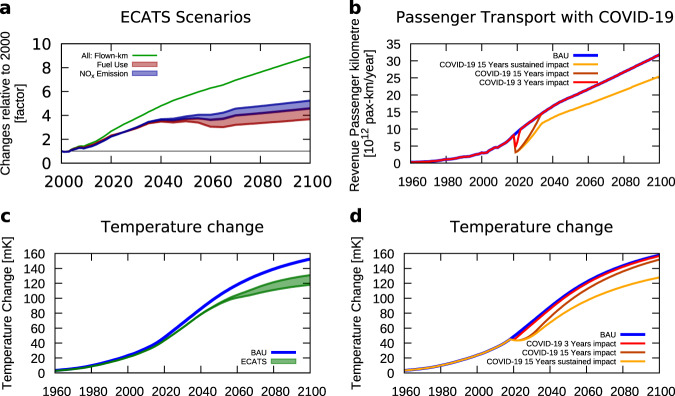
Aviation is an important contributor to the global economy, satisfying society’s mobility needs. It contributes to climate change through CO 2 and non-CO 2 effects, including contrail-cirrus and ozone formation. There is currently significant interest in policies, regulations and research aiming to reduce aviation’s climate impact. Here we model the effect of these measures on global warming and perform a bottom-up analysis of potential technical improvements, challenging the assumptions of the targets for the sector with a number of scenarios up to 2100. We show that although the emissions targets for aviation are in line with the overall goals of the Paris Agreement, there is a high likelihood that the climate impact of aviation will not meet these goals. Our assessment includes feasible technological advancements and the availability of sustainable aviation fuels. This conclusion is robust for several COVID-19 recovery scenarios, including changes in travel behaviour.
Overview
The claims and statistics of this paper haven’t been checked yet.
Free: it reads the open-access text and checks the first 5 claims that cite a source we can check. Create a free account to check every claim.
Integrity signals
Registry
Cites
Statistics
Figures
Verification
Claims the paper makes
The claims and statistics of this paper haven’t been checked yet.
Free: it reads the open-access text and checks the first 5 claims that cite a source we can check. Create a free account to check every claim.
Claims other papers make about this one
Each is checked against this paper’s own text: does it say what the citing paper says it does?
The source backs part of the claim, not all of it — or backs it for a different population, condition or comparison.
In the citing paper
“As demand growth has outpaced efficiency gains in the past, emissions from the sector will continue to rise unless new technologies, including sustainable aviation fuels (SAF), become available at scale8,9,10.”
From Large carbon dioxide emissions avoidance potential in improved commercial air transport efficiency (2026) · cites this paper as [10]
Experimental — accuracy not yet measured
Self-check
Percentages, sums and reported differences re-computed from the paper’s own numbers.
The self-check needs the paper’s full text.
Citations
Cites
Aviation and global climate change in the 21st century
Lee, D. S., Fahey, D. W., Forster, P. M., Newton, P. J., Wit, R. C. N., Lim, L. L., Owen, B., & Sausen, R. (2009) · Atmospheric Environment · doi:10.1016/j.atmosenv.2009.04.024 · Cited by 1,072
Transport impacts on atmosphere and climate: Aviation
Lee, D. S., Pitari, G., Grewe, V., Gierens, K., Penner, J. E., Petzold, A., Prather, M. J., Schumann, U., Bais, A., & Berntsen, T. (2010) · Atmospheric Environment · doi:10.1016/j.atmosenv.2009.06.005 · Cited by 765
Self-citationÜber Bedingungen zur Bildung von Kondensstreifen aus Flugzeugabgasen
Schumann, U. (1996) · Meteorologische Zeitschrift · doi:10.1127/metz/5/1996/4 · Cited by 476
Biofuel blending reduces particle emissions from aircraft engines at cruise conditions
Moore, R. H., Thornhill, K. L., Weinzierl, B., Sauer, D., D’Ascoli, E., Kim, J., Lichtenstern, M., Scheibe, M., Beaton, B., Beyersdorf, A. J., et al. (2017) · Nature · doi:10.1038/nature21420 · Cited by 414
The Formation of Exhaust Condensation Trails by Jet Aircraft
Appleman, H. (1953) · Bulletin of the American Meteorological Society · doi:10.1175/1520-0477-34.1.14 · Cited by 368
Turboelectric Distributed Propulsion Engine Cycle Analysis for Hybrid-Wing-Body Aircraft
Felder, J., Kim, H., & Brown, G. (2009) · 47th AIAA Aerospace Sciences Meeting including The New Horizons Forum and Aerospace Exposition · doi:10.2514/6.2009-1132 · Cited by 260
Transport impacts on atmosphere and climate
Sausen, R. (2010) · Atmospheric Environment · doi:10.1016/j.atmosenv.2010.02.033 · Cited by 248
Mitigating the contrail cirrus climate impact by reducing aircraft soot number emissions
Burkhardt, U., Bock, L., & Bier, A. (2018) · npj Climate and Atmospheric Science · doi:10.1038/s41612-018-0046-4 · Cited by 203
The contribution of carbon dioxide emissions from the aviation sector to future climate change
Terrenoire, E., Hauglustaine, D. A., Gasser, T., & Penanhoat, O. (2019) · Environmental Research Letters · doi:10.1088/1748-9326/ab3086 · Cited by 171
AirClim: an efficient tool for climate evaluation of aircraft technology
Grewe, V., & Stenke, A. (2008) · Atmospheric Chemistry and Physics · doi:10.5194/acp-8-4621-2008 · Cited by 161
Self-citation
Research works printed but not linked: 7
- IPCC, Intergovernmental Panel on Climate Change: Special report on aviation and the global atmosphere (eds Penner, J. E., et al.) (Cambridge University Press, New York, NY, USA, 1999).
- Sausen, R., Matthes, S., Gierens, K. et al. The EU project ACACIA (Advancing Science for Aviation and Climate), in: Making Aviation Environmentally Sustainable, Book of Abstracts of the 3rd ECATS conference (eds Matthes, S: and Blum, A.) Vol. 1 ISBN: 978-1-910029-58-9, page 98 (2020).
- European Commission, Flightpath 2050, Europe’s vision for aviation, report of the high level group on aviation research, Luxembourg: Publications Office of the European Union, ISBN 978-92-79-19724-6, 10.2777/50266 (2011). · doi:10.2777/50266
- ICAO, Annex 16 to the Convention on International Civil Aviation, Environmental Protection, Vol. IV Carbon Offsetting Scheme for International Aviation (CORSIA), First Edition, October 2018, ISBN 978-92-9258-611-9 (2018).
- United Nations, UN Framework Convention on Climate Change, Adoption of the Paris Agreement, Conference of Parties, Twenty-first session Paris, FCCC/CP/2015/L.9/Rev.1, 30 November to 11 December 2015 (2015).
- ACARE, Strategic Research & Innovation Agenda. Vol. 1 (ACARE, 2012).
- IATA, Technology Roadmap, 4th edition July 2013, (2013).
Cited by
Pathways to net-zero emissions from aviation
Bergero, C., Gosnell, G., Gielen, D., Kang, S., Bazilian, M., & Davis, S. J. (2023) · Nature Sustainability · doi:10.1038/s41893-022-01046-9 · Cited by 430
Drop-in fuels from sunlight and air
Schäppi, R., Rutz, D., Dähler, F., Muroyama, A., Haueter, P., Lilliestam, J., Patt, A., Furler, P., & Steinfeld, A. (2022) · Nature · doi:10.1038/s41586-021-04174-y · Cited by 411
Gössling, S., Balas, M., Mayer, M., & Sun, Y.-Y. (2023) · Tourism Management · doi:10.1016/j.tourman.2022.104681 · Cited by 259
Quantifying aviation’s contribution to global warming
Klöwer, M., Allen, M. R., Lee, D. S., Proud, S. R., Gallagher, L., & Skowron, A. (2021) · Environmental Research Letters · doi:10.1088/1748-9326/ac286e · Cited by 256
Strategies towards a more sustainable aviation: A systematic review
Afonso, F., Sohst, M., Diogo, C. M. A., Rodrigues, S. S., Ferreira, A., Ribeiro, I., Marques, R., Rego, F. F. C., Sohouli, A., Portugal-Pereira, J., et al. (2023) · Progress in Aerospace Sciences · doi:10.1016/j.paerosci.2022.100878 · Cited by 209
Cost and emissions pathways towards net-zero climate impacts in aviation
Dray, L., Schäfer, A. W., Grobler, C., Falter, C., Allroggen, F., Stettler, M. E. J., & Barrett, S. R. H. (2022) · Nature Climate Change · doi:10.1038/s41558-022-01485-4 · Cited by 238
Combustion, Chemistry, and Carbon Neutrality
Kohse-Höinghaus, K. (2023) · Chemical Reviews · doi:10.1021/acs.chemrev.2c00828 · Cited by 222
Su-ungkavatin, P., Tiruta-Barna, L., & Hamelin, L. (2023) · Progress in Energy and Combustion Science · doi:10.1016/j.pecs.2023.101073 · Cited by 189
A solar tower fuel plant for the thermochemical production of kerosene from H2O and CO2
Zoller, S., Koepf, E., Nizamian, D., Stephan, M., Patané, A., Haueter, P., Romero, M., González-Aguilar, J., Lieftink, D., de Wit, E., et al. (2022) · Joule · doi:10.1016/j.joule.2022.06.012 · Cited by 210
“genic emissions causing climate change are attributed to global aviation, and this number is expected to increase.(1) An alternative to conventional kerosene derived from petroleum is kerosene synthesized from syngas—a specific mixture of H2 and CO—via the established Fischer-Tropsch (FT) synthesis process.”
How to make climate-neutral aviation fly
Sacchi, R., Becattini, V., Gabrielli, P., Cox, B., Dirnaichner, A., Bauer, C., & Mazzotti, M. (2023) · Nature Communications · doi:10.1038/s41467-023-39749-y · Cited by 161
“Over the 2018–2100 period, our results agree on two points with the recent findings of Grewe et al.29 and Klöwer et al.8.”
MethodResultInfluentialBube, S., Bullerdiek, N., Voß, S., & Kaltschmitt, M. (2024) · Fuel · doi:10.1016/j.fuel.2024.131269 · Cited by 144
“On the other hand, demand for air transportation increases continuously worldwide, resulting in increasing aviation-related CO 2 emissions if no appropriate measures are implemented [3].”
BackgroundYuan, H., Wang, X., Gao, L., Wang, T., Liu, B., Fang, D., & Gao, Y. F. (2023) · Communications Earth & Environment · doi:10.1038/s43247-023-00846-x · Cited by 132
Lai, Y. Y., Christley, E., Kulanovic, A., Teng, C. C., Björklund, A., Nordensvärd, J., Karakaya, E., & Urban, F. (2021) · Renewable and Sustainable Energy Reviews · doi:10.1016/j.rser.2021.111972 · Cited by 117
Powering aircraft with 100 % sustainable aviation fuel reduces ice crystals in contrails
Märkl, R. S., Voigt, C., Sauer, D., Dischl, R. K., Kaufmann, S., Harlaß, T., Hahn, V., Roiger, A., Weiß-Rehm, C., Burkhardt, U., et al. (2024) · Atmospheric Chemistry and Physics · doi:10.5194/acp-24-3813-2024 · Cited by 103
Sun, X., Wandelt, S., & Zhang, A. (2022) · Transportation Research Interdisciplinary Perspectives · doi:10.1016/j.trip.2022.100718 · Cited by 99
“On the other hand, (Grewe et al., 2021) reports that simulations until the year 2100 reveals a high likelihood of missing Paris agreement goals, even when considering various technical expectable improvements; see also (Ringbeck and Koenig, 2021) for the results of a recent survey among 220 aviation experts and how to…”
Delbecq, S., Fontane, J., Gourdain, N., Planès, T., & Simatos, F. (2023) · Progress in Aerospace Sciences · doi:10.1016/j.paerosci.2023.100920 · Cited by 109
Definitions and implications of climate-neutral aviation
Brazzola, N., Patt, A., & Wohland, J. (2022) · Nature Climate Change · doi:10.1038/s41558-022-01404-7 · Cited by 102
Hu, Y., Yang, L., Cui, H., Wang, H., Li, C., & Tang, B.-J. (2022) · Sustainable Production and Consumption · doi:10.1016/j.spc.2022.08.009 · Cited by 112
Designing high aspect ratio wings: A review of concepts and approaches
Ma, Y., & Elham, A. (2024) · Progress in Aerospace Sciences · doi:10.1016/j.paerosci.2024.100983 · Cited by 87
Almena, A., Siu, R., Chong, K., Thornley, P., & Röder, M. (2024) · Energy Conversion and Management · doi:10.1016/j.enconman.2024.118186 · Cited by 82
Song, Z., Li, Z., & Liu, Z. (2024) · Applied Sciences · doi:10.3390/app14135484 · Cited by 93
“NO x emissions cause warming through short-term ozone increase and cooling through long-term reductions in ozone, methane, and stratospheric water vapor [31].”
BackgroundGlobal Civil Aviation Emissions Estimates for 2017–2020 Using ADS-B Data
Quadros, F. D. A., Snellen, M., Sun, J., & Dedoussi, I. C. (2022) · Journal of Aircraft · doi:10.2514/1.c036763 · Cited by 72
Net-zero aviation: Time for a new business model?
Gößling, S., & Humpe, A. (2022) · Journal of Air Transport Management · doi:10.1016/j.jairtraman.2022.102353 · Cited by 76
H2-powered aviation at airports – Design and economics of LH2 refueling systems
Hoelzen, J., Flohr, M., Silberhorn, D., Mangold, J., Bensmann, A., & Hanke‐Rauschenbach, R. (2022) · Energy Conversion and Management X · doi:10.1016/j.ecmx.2022.100206 · Cited by 98
How socially just are taxes on air travel and ‘frequent flyer levies’?
Büchs, M., & Mattioli, G. (2022) · Journal of Sustainable Tourism · doi:10.1080/09669582.2022.2115050 · Cited by 84
“While globally the fuel efficiency of air travel has improved by around 1.3% per year since 1960 (Grewe, Gangoli Rao et al. 2021), the decarbonisation of air travel remains challenging (Åkerman, Kamb et al. 2021, G € ossling & Lyle 2021, Lai, Christley et al. 2022).”
BackgroundInfluentialQuante, G., Bullerdiek, N., Bube, S., Neuling, U., & Kaltschmitt, M. (2022) · Fuel · doi:10.1016/j.fuel.2022.126269 · Cited by 65
Assortment of Airports’ Sustainability Strategy: A Comprehensiveness Analysis Framework
Dimitriou, D., & Karagkouni, A. G. (2022) · Sustainability · doi:10.3390/su14074217 · Cited by 57
“Climate change is the most essential concern for long-term aviation industry development, according to the literature [5,12,14,42,43], and the most important issue for airport sustainable development.”
BackgroundYin, F., Grewe, V., Castino, F., Rao, P., Matthes, S., Dahlmann, K., Dietmüller, S., Frömming, C., Yamashita, H., Peter, P., et al. (2023) · Geoscientific model development · doi:10.5194/gmd-16-3313-2023 · Cited by 65
Self-citationFontanet-Pérez, P., Vázquez, X. H., & Carou, D. (2022) · Case Studies on Transport Policy · doi:10.1016/j.cstp.2022.01.025 · Cited by 57
“Thus, considering that the airline sector has traditionally had low profitability margins (Grewe et al., 2021; Macilree and Duval, 2020) and has historically shown to be very vulnerable to external factors (Brown and Kline, 2020; Raynes and Tsui, 2019; Rose, 2021), a careful reflection on the…”
BackgroundUrban, F., Nurdiawati, A., Harahap, F., & Morozovska, K. (2024) · Environmental Innovation and Societal Transitions · doi:10.1016/j.eist.2024.100854 · Cited by 77
Understanding the role of contrails and contrail cirrus in climate change: a global perspective
Singh, D. K., Sanyal, S., & Wuebbles, D. J. (2024) · Atmospheric chemistry and physics · doi:10.5194/acp-24-9219-2024 · Cited by 61
“Integral contrail properties involve parameters such as contrail cirrus volume, total number of ice particles, overall ice water content, and total extinction (area integral of extinction) per contrail length”
BackgroundThe role of direct air capture in achieving climate-neutral aviation
Brazzola, N., Meskaldji, A., Patt, A., Tröndle, T., & Moretti, C. (2025) · Nature Communications · doi:10.1038/s41467-024-55482-6 · Cited by 60
Charging Technology for Electric Aircraft: State of the Art, Trends, and Challenges
Liang, Y., Mouli, G. R. C., & Bauer, P. (2023) · IEEE Transactions on Transportation Electrification · doi:10.1109/tte.2023.3333536 · Cited by 53
“Due to the temporary reduction caused by the COVID-19 epidemic, CO 2 emissions from international aviation in 2020 decreased significantly to 495 million metric tons [3].”
BackgroundSilberhorn, D., Dahlmann, K., Görtz, A., Linke, F., Zanger, J., Rauch, B., Methling, T., Janzer, C., & Hartmann, J. (2022) · Applied Sciences · doi:10.3390/app12125950 · Cited by 51
Self-citationLow‐carbon tourism for island destinations: A crucial alternative for sustainable development
Fakfare, P., & Wattanacharoensil, W. (2022) · Sustainable Development · doi:10.1002/sd.2382 · Cited by 57
Huang, X., Li, Y., Ma, H., Huang, P., Zheng, J., & Song, K. (2024) · Journal of Power Sources · doi:10.1016/j.jpowsour.2024.234860 · Cited by 48
Song, K., Guo, K., Lv, Y., Ma, D., Cheng, Y., & Shi, J. (2023) · ACS Applied Materials & Interfaces · doi:10.1021/acsami.2c20545 · Cited by 49
Megill, L., Deck, K., & Grewe, V. (2024) · Communications Earth & Environment · doi:10.1038/s43247-024-01423-6 · Cited by 50
“49 .”
InfluentialSelf-citationMahmoud, K., Astero, P., Peltoniemi, P., & Lehtonen, M. (2022) · IEEE Access · doi:10.1109/access.2022.3228742 · Cited by 53
Private aviation is making a growing contribution to climate change
Gößling, S., Humpe, A., & Leitão, J. C. (2024) · Communications Earth & Environment · doi:10.1038/s43247-024-01775-z · Cited by 56
“As demand growth has outpaced ef fi ciency gains in the past, emissions from the sector will continue to rise unless sustainable aviation fuels can be made available at scale 8 – 10 .”
Emerging from the COVID-19 Pandemic: Aviation Recovery, Challenges and Opportunities
Dube, K. (2022) · Aerospace · doi:10.3390/aerospace10010019 · Cited by 52
The Water-Enhanced Turbofan as Enabler for Climate-Neutral Aviation
Kaiser, S., Schmitz, O., Ziegler, P., & Klingels, H. (2022) · Applied Sciences · doi:10.3390/app122312431 · Cited by 59
Uncertainty quantification of CO2 emissions from China's civil aviation industry to 2050
Yang, L., Hu, Y., Wang, H., Li, C., Tang, B.-J., Wang, B., & Cui, H. (2023) · Journal of Environmental Management · doi:10.1016/j.jenvman.2023.117624 · Cited by 47
Li, Y., Mahnke, C., Rohs, S., Bundke, U., Spelten, N., Dekoutsidis, G., Groß, S., Voigt, C., Schumann, U., Petzold, A., et al. (2023) · Atmospheric chemistry and physics · doi:10.5194/acp-23-2251-2023 · Cited by 47
Alabaş, H. A., & Çeper, B. A. (2023) · International Journal of Hydrogen Energy · doi:10.1016/j.ijhydene.2023.05.146 · Cited by 43
Net-zero aviation: Transition barriers and radical climate policy design implications
Gössling, S., & Humpe, A. (2024) · Science of The Total Environment · doi:10.1016/j.scitotenv.2023.169107 · Cited by 41
Abedi, H., Xisto, C. M., Jonsson, I., Grönstedt, T., & Rolt, A. M. (2022) · Aerospace · doi:10.3390/aerospace9040216 · Cited by 41
Self-citationHigh-resolution modeling of aviation emissions in Norway
Klenner, J., Muri, H., & Strømman, A. H. (2022) · Transportation Research Part D Transport and Environment · doi:10.1016/j.trd.2022.103379 · Cited by 41
Decision mechanism between fuel cell types: A case study for small aircraft
Ayar, M., & Karakoç, T. H. (2023) · International Journal of Hydrogen Energy · doi:10.1016/j.ijhydene.2022.12.020 · Cited by 37
Stabilized Bismuth Nanoplasmonics for Selective Co2 Reduction to Methanol at a Heterointerface
Lu, H., Uddin, N. M., Sun, Z., Chen, Z., Mahfoud, Z., Wu, Y., Wibowo, A. A., Su, Z., Yin, X., Tang, C. S., et al. (2022) · Nano Energy · doi:10.1016/j.nanoen.2023.108684 · Cited by 35
From carbon-neutral to climate-neutral supply chains: a multidisciplinary review and research agenda
Guntuka, L., Mukandwal, P. S., Aktaş, E., & Paluvadi, V. S. K. (2024) · The International Journal of Logistics Management · doi:10.1108/ijlm-03-2023-0116 · Cited by 37
Airports' Sustainability Strategy: Evaluation Framework Upon Environmental Awareness
Dimitriou, D., & Karagkouni, A. G. (2022) · Frontiers in Sustainability · doi:10.3389/frsus.2022.880718 · Cited by 34
“For example, the sector recognizes climate change as one of the major current issues, and in most cases, the airport’s applied environmental strategy has been adapted to include not only measures and actions focused on carbon management, but also to support the sector’s long-term sustainable transition (European Envir…”
BackgroundExploring the equity in allocating carbon offsetting responsibility for international aviation
Liao, W., Fan, Y., & Wang, C. (2022) · Transportation Research Part D Transport and Environment · doi:10.1016/j.trd.2022.103566 · Cited by 36
Wang, K., Zhang, Y., & Wei, Y. (2023) · One Earth · doi:10.1016/j.oneear.2023.07.003 · Cited by 35
Cost-benefit analysis of using sustainable aviation fuels in South America
Cui, Q., & Chen, B. (2024) · Journal of Cleaner Production · doi:10.1016/j.jclepro.2024.140556 · Cited by 35
Substantial aircraft contrail formation at low soot emission levels
Voigt, C., Märkl, R., Sauer, D. N., Dischl, R., Renard, C., Seeliger, K., Yu, F., Kaufmann, S., Bräuer, T., Jurkat, T., et al. (2026) · Nature · doi:10.1038/s41586-026-10286-0 · Cited by 41
“If the authors have other versions of these figures that actually demonstrate these correlations, they need to present them to make these claims.”
Contrail Cirrus Climate Impact: From Radiative Forcing to Surface Temperature Change
Bickel, M., Ponater, M., Burkhardt, U., Righi, M., Hendricks, J., & Jöckel, P. (2025) · Journal of Climate · doi:10.1175/jcli-d-24-0245.1 · Cited by 35
A “greenhouse gas balance” for aviation in line with the Paris Agreement
Fuglestvedt, J. S., Lund, M. T., Kallbekken, S., Samset, B. H., & Lee, D. S. (2023) · Wiley Interdisciplinary Reviews Climate Change · doi:10.1002/wcc.839 · Cited by 36
The importance of an informed choice of CO 2 -equivalence metrics for contrail avoidance
Borella, A., Boucher, O., Shine, K. P., Stettler, M. E. J., Tanaka, K., Teoh, R., & Bellouin, N. (2024) · Atmospheric chemistry and physics · doi:10.5194/acp-24-9401-2024 · Cited by 38
“Corresponding integrated metrics have been proposed that measure global surface temperature change averaged over H : the integrated GTP (Peters et al., 2011), mean GTP (Gillett and Matthews, 2010), or average temperature response (ATR; Grewe et al., 2021).”
Fiorini, A. C. O., Angelkorte, G. B., Maia, P. L., Bergman-Fonte, C., Vicente, C. D. S., Morais, T. N., Carvalho, L. S., Zanon-Zotin, M., Szklo, A. S., Schaeffer, R., et al. (2022) · Environmental Research Letters · doi:10.1088/1748-9326/acaee1 · Cited by 36
Khalifa, R., Alherbawi, M., Biçer, Y., & Al‐Ansari, T. A. (2024) · Resources Conservation & Recycling Advances · doi:10.1016/j.rcradv.2024.200223 · Cited by 51
Impact of Aviation Electrification on Airports: Flight Scheduling and Charging
Hou, B., Bose, S., Marla, L., & Haran, K. S. (2023) · IEEE Transactions on Intelligent Transportation Systems · doi:10.1109/tits.2023.3324310 · Cited by 30
The climate impact of hydrogen-powered hypersonic transport
Pletzer, J., Hauglustaine, D. A., Cohen, Y., Jöckel, P., & Grewe, V. (2022) · Atmospheric chemistry and physics · doi:10.5194/acp-22-14323-2022 · Cited by 33
Self-citationAlabaş, H. A., & Çeper, B. A. (2023) · Journal of the Energy Institute · doi:10.1016/j.joei.2023.101420 · Cited by 28
Kumar, B., Kumar, J., Amjad, A. Q., Kumar, L., & Sassanelli, C. (2025) · Research in Transportation Business & Management · doi:10.1016/j.rtbm.2025.101410 · Cited by 46
Accounting for the carbon emissions from domestic air routes in China
Cui, Q., Li, X., & Li, Y. (2022) · Heliyon · doi:10.1016/j.heliyon.2022.e08716 · Cited by 27
Köhler, J. K., Kreil, A. S., Wenger, A., Darmandieu, A., Graves, C., Haugestad, C. A. P., Holzen, V., Keller, E., Lloyd, S., Marczak, M., et al. (2022) · Frontiers in Psychology · doi:10.3389/fpsyg.2022.906108 · Cited by 27
“As technological advancements will likely not sufficiently reduce the aviation industry’s emissions (Grewe et al., 2021), additional behavior change is required to meet global emission reduction targets.”
BackgroundFramework for Life Cycle Assessment of Sustainable Aviation (Sa) Systems
Su-Ungkavatin, P., Tiruta-Barna, L., & Hamelin, L. (2022) · The Science of The Total Environment · doi:10.1016/j.scitotenv.2023.163881 · Cited by 28
Carbon footprint effects of shifting from flights to night trains for Swedish tourism
Morfeldt, J., Curtale, R., Kamb, A., Larsson, J., & Nässén, J. (2023) · Journal of Cleaner Production · doi:10.1016/j.jclepro.2023.138321 · Cited by 27
Klenner, J., Lund, M. T., Muri, H., & Strømman, A. H. (2024) · Environmental Science & Technology · doi:10.1021/acs.est.3c08592 · Cited by 26
Lauer, A., de Castro, C., & Carpintero, Ó. (2024) · Futures · doi:10.1016/j.futures.2024.103460 · Cited by 26
Road to Carbon-Neutral Aviation: One-Step Conversion of CO2 to Sustainable Aviation Fuels
Feng, L., Li, L., Yu, Y., Tian, G., Xiong, H. D., Miao, J., Wei, F., & Zhang, C. (2025) · Industrial & Engineering Chemistry Research · doi:10.1021/acs.iecr.4c04209 · Cited by 27
Kinene, A., Birolini, S., Cattaneo, M., & Granberg, T. A. (2023) · European Journal of Operational Research · doi:10.1016/j.ejor.2023.02.006 · Cited by 26
Sustainable propulsion alternatives in regional aviation: The case of the Canary Islands
Pintos, P. B., Sande, C. U., & Álvarez, Ó. C. (2023) · Transportation Research Part D Transport and Environment · doi:10.1016/j.trd.2023.103779 · Cited by 25
Chassang, I., Rohmer, O., & Chauvin, B. (2024) · Risk Analysis · doi:10.1111/risa.17636 · Cited by 26
“For example, egalitarians may assess transport by plane by thinking about the growing (and increasingly salient) climate impact of aviation (Grewe et al., 2021), the massive energy consumption of trains (rail-roads as a sector is the biggest industrial consumer of electrical energy in France), or…”
Simorgh, A., & Soler, M. (2025) · Communications Earth & Environment · doi:10.1038/s43247-025-02031-8 · Cited by 25
“5 °C 5 7 .”
Martínez-Valencia, L., Peterson, S., Brandt, K. L., King, A. B., Garcìa-Pèrez, M., & Wolcott, M. P. (2023) · Journal of Cleaner Production · doi:10.1016/j.jclepro.2023.136934 · Cited by 26
A reliable predict-then-optimize approach for minimizing aircraft fuel consumption
Wang, Z., Xue, D., Wu, L., & Yan, R. (2025) · Transportation Research Part D: Transport and Environment · doi:10.1016/j.trd.2025.104693 · Cited by 22
The critical role of hydrogen in the development of new biofuels
Martinez-Villarreal, S., Kammoun, M., & Richel, A. (2022) · Current Opinion in Green and Sustainable Chemistry · doi:10.1016/j.cogsc.2022.100716 · Cited by 22
H2-powered aviation – Design and economics of green LH2 supply for airports
Hoelzen, J., Koenemann, L., Kistner, L., Schenke, F., Bensmann, A., & Hanke‐Rauschenbach, R. (2023) · Energy Conversion and Management X · doi:10.1016/j.ecmx.2023.100442 · Cited by 42
Voß, S., Bube, S., & Kaltschmitt, M. (2023) · Fuel Communications · doi:10.1016/j.jfueco.2023.100093 · Cited by 26
Analysing transitions in-the-making: A case study of aviation in Sweden
Christley, E., Karakaya, E., & Urban, F. (2023) · Environmental Innovation and Societal Transitions · doi:10.1016/j.eist.2023.100790 · Cited by 23
“Reliant on fossil-based jet fuel, the sector today contributes up to three percent of global carbon dioxide (CO 2 ) emissions (Grewe et al., 2021; Lee et al., 2021).”
BackgroundPrussi, M., Noussan, M., Laveneziana, L., & Chiaramonti, D. (2024) · Transport Policy · doi:10.1016/j.tranpol.2024.11.007 · Cited by 22
Gouveia, J. R., Gonçalves, M., Rocha, R. J. B., Baptista, A. J., & Monteiro, H. (2022) · Sustainable Production and Consumption · doi:10.1016/j.spc.2022.03.007 · Cited by 24
Maruhashi, J., Grewe, V., Frömming, C., Jöckel, P., & Dedoussi, I. C. (2022) · Atmospheric chemistry and physics · doi:10.5194/acp-22-14253-2022 · Cited by 22
“The resilient growth of air traffic is ergo set to induce a growing climate impact in the upcoming years (Grewe et al., 2021).”
BackgroundSelf-citationH2-powered aviation – Optimized aircraft and green LH2 supply in air transport networks
Hoelzen, J., Silberhorn, D., Schenke, F., Stabenow, E., Zill, T., Bensmann, A., & Hanke-Rauschenbach, R. (2025) · Applied Energy · doi:10.1016/j.apenergy.2024.124999 · Cited by 19
Vaquerizo, L., & Rego-Fernández, D. (2025) · Journal of CO2 Utilization · doi:10.1016/j.jcou.2025.103225 · Cited by 25
Ponsonby, J., Teoh, R., Kärcher, B., & Stettler, M. E. J. (2025) · Atmospheric chemistry and physics · doi:10.5194/acp-25-18617-2025 · Cited by 23
“Aircraft mode particles that evapo-rate (above) below 350 °C (623 K) (Saffaripour et al., 2020) are defined as (non-)volatile particulate matter, (n)vPM.”
Rao, P., Yin, F., Grewe, V., Yamashita, H., Jöckel, P., Matthes, S., Mertens, M., & Frömming, C. (2022) · Aerospace · doi:10.3390/aerospace9050231 · Cited by 22
Self-citationPlanès, T., Delbecq, S., & Salgas, A. (2023) · Journal of Open Aviation Science · doi:10.59490/joas.2023.7147 · Cited by 26
Most long-lived contrails form within cirrus clouds with uncertain climate impact
Petzold, A., Khan, N. F., Li, Y., Spichtinger, P., Rohs, S., Crewell, S., Wahner, A., & Krämer, M. (2025) · Nature Communications · doi:10.1038/s41467-025-65532-2 · Cited by 21
“There are several measures discussed for reducing aviation ’ s climate impact, including technological advancements for reducing the emissions of short-lived climate forcers such as NO x and aerosols, and the availability of sustainable aviation fuels for reducing long-lived greenhouse gases 40 .”
Ramm, J., Rahn, A., Silberhorn, D., Wicke, K., Wende, G., Papantoni, V., Linke, F., Kühlen, M., & Dahlmann, K. (2024) · Journal of Aircraft · doi:10.2514/1.c037463 · Cited by 19
Self-citationA comprehensive well-to-wake climate impact assessment of sustainable aviation fuel
Boerboom, L. G. J., Rao, A. G., Grewe, V., & Yin, F. (2025) · Scientific Reports · doi:10.1038/s41598-025-13445-x · Cited by 21
“Furthermore, the change in contrail RF for SAF in Table 1 is due to the reduction of soot number particles and is derived using the methodology from Grewe et al. (2021) 25 .”
Self-citationContinued global warming from aviation even under high-ambition mitigation scenarios
Aamaas, B., Lund, M. T., Fuglestvedt, J. S., Totterdill, A., Owen, B., Skowron, A., & Lee, D. S. (2025) · One Earth · doi:10.1016/j.oneear.2025.101451 · Cited by 19
Near-zero environmental impact aircraft
Prashanth, P., Elmourad, J., Grobler, C., Isaacs, S. A., Zahid, S. S., Abel, J., Falter, C. P., Fritz, T. M., Allroggen, F., Sabnis, J. S., et al. (2024) · Sustainable Energy & Fuels · doi:10.1039/d4se00419a · Cited by 18
Cui, Q., Lei, Y., & Li, Y. (2023) · Environmental Impact Assessment Review · doi:10.1016/j.eiar.2023.107318 · Cited by 17
Asyraf, M. R. M., Ng, L. F., Khoo, P. S., Yahya, M. Y., Hassan, S. A., Madenci, E., & Khan, T. (2024) · Cellulose · doi:10.1007/s10570-024-05921-w · Cited by 18
“The pollutants from aircraft are composed of carbon dioxide (CO2), nitrogen oxides, sulfate aerosols, compounds, particulates, and water vapour, which contribute to radiative forcing and global warming (Grewe et al. 2021; Lee et al. 2021).”
Villette, S., Adam, D., Alexiou, A., Aretakis, N., & Mathioudakis, K. (2023) · Aerospace · doi:10.3390/aerospace11010022 · Cited by 15
Carbon leakage from aviation under the European Union Fit for 55 policies
Wei, T., & Kallbekken, S. (2024) · Transportation Research Part D Transport and Environment · doi:10.1016/j.trd.2024.104269 · Cited by 17
Taking stock of the climate impact of the hydrogen pathways for the aviation sector by 2050
Rostami, S., Javadi, K., & Maleki, A. (2024) · Energy Conversion and Management · doi:10.1016/j.enconman.2024.119369 · Cited by 16
Metadata
- Authors
- Grewe, V., Gangoli Rao, A., Grönstedt, T., Xisto, C., Linke, F., Melkert, J., Middel, J., Ohlenforst, B., Blakey, S., Christie, S., Matthes, S., & Dahlmann, K.
- Affiliations
- Deutsches Zentrum für Luft- und Raumfahrt e. V. (DLR) (DE)
- Chalmers University of Technology (SE)
- Delft University of Technology (NL)
- Netherlands Aerospace Centre (NL)
- University of Birmingham (GB)
- Manchester Metropolitan University (GB)
- Corresponding author
- Grewe, Volker
- ORCID
- Venue
- Nature Communications
- Published
- 2021-06-22
- Volume
- 12
- Issue
- 1
- Pages
- 3841-3841
- ISSN
- 2041-1723 (ISSN-L)
- PMC
- PMC8219675
- OpenAlex
- W3176713037
- Semantic Scholar
- bcf512f84d210b8aa157529b700f949a2971a68b
- Cited by
- 325
- References
- 35
- Citations by year
- 2026: 49 · 2025: 67 · 2024: 71 · 2023: 73 · 2022: 60 · 2021: 5
- FWCI
- 21.52
- Type
- journal article
- Language
- en
- Open access
- gold
- doi.org
- Licence
- cc-by
- creativecommons.org/licenses/by/4.0 (tdm)
- creativecommons.org/licenses/by/4.0 (vor)
- Locations
- Nature Communications (publishedVersion, cc-by)
- PubMed Central (publishedVersion, cc-by)
- PubMed (publishedVersion)
- e-space (Manchester Metropolitan University) (acceptedVersion)
- elib (German Aerospace Center) (acceptedVersion)
- Chalmers Research (Chalmers University of Technology) (submittedVersion, other-oa)
- Research Repository (Delft University of Technology) (submittedVersion, other-oa)
- RePEc: Research Papers in Economics (submittedVersion)
- DOAJ (DOAJ: Directory of Open Access Journals) (submittedVersion, cc-by-sa)
- University of Birmingham Research Portal (University of Birmingham) (submittedVersion, cc-by)
- Data Archiving and Networked Services (DANS) (submittedVersion, cc-by)
- Topics
- Physical Sciences › Engineering › Aerospace Engineering › Advanced Aircraft Design and Technologies
- Social Sciences › Economics, Econometrics and Finance › Economics and Econometrics › Climate Change Policy and Economics
- Physical Sciences › Environmental Science › Global and Planetary Change › COVID-19 impact on air quality
- Keywords
- aviation emissions, aviation climate impact, Paris Agreement, sustainable aviation fuel, contrail cirrus, ozone formation, global warming, travel behavior
- MeSH terms
- COVID-19, SARS-CoV-2, Air Pollution, Vehicle Emissions, Aviation, Carbon Dioxide, Humans, Ozone, Paris, Climate Change, Global Warming
About these checks
Registry, retraction, Cites and statistics results are computed, not judged, with one exception: a printed reference that no index lists is read once by a model before it counts as a citation error. Claims are extracted by a model and kept only when their quote appears verbatim in the text; each cited source is then checked, with a model’s help, for whether it says what the claim relies on. Those verdicts can be wrong — read the claim’s quote and the cited source before relying on one.
Statistics and arithmetic are recomputed, not judged.
Confidence bands are shown only for fields calibrated on our annotated test set. None is calibrated yet, so no band is shown.
What counts as a claim ›How we measure confidence ›How we check this ›
Are you an author, or do you see a problem with this page? Request a review
Data sources
Bibliographic data: Semantic Scholar, OpenAlex, Crossref.
Contains information from the Semantic Scholar Academic Graph Datasets, made available under the ODC Attribution License (ODC-BY 1.0).
Semantic Scholar’s data is described in: Kinney, R., et al. (2023). The Semantic Scholar Open Data Platform. arXiv:2301.10140.
