

The DOI matches its Crossref record; 76 of the 77 references it cites were found in a registry or an index, and 1 are not checked yet.
Mapping mutations to the SARS-CoV-2 RBD that escape binding by different classes of antibodies
Open accessPublished version of a preprint
Abstract
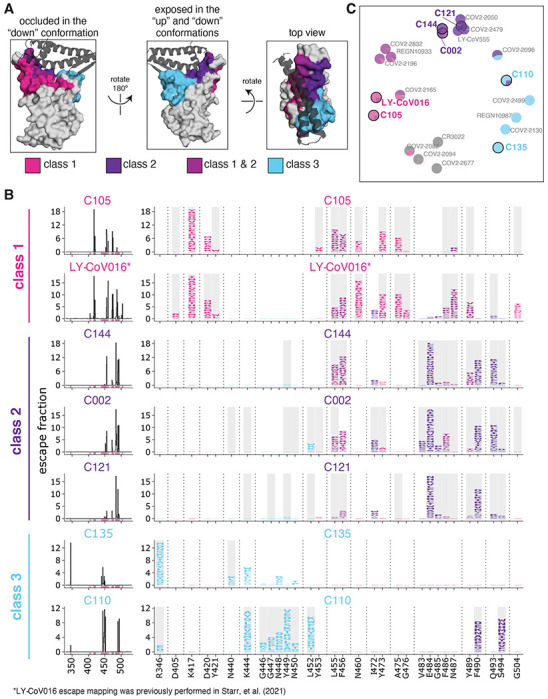
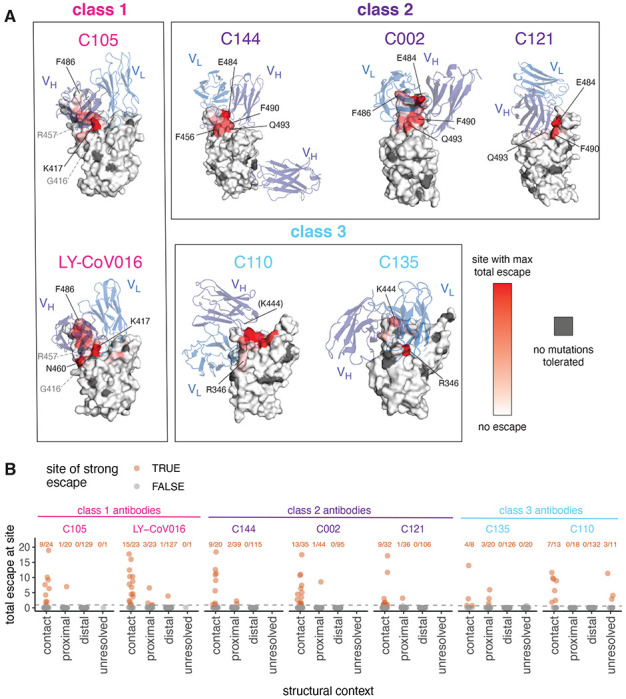
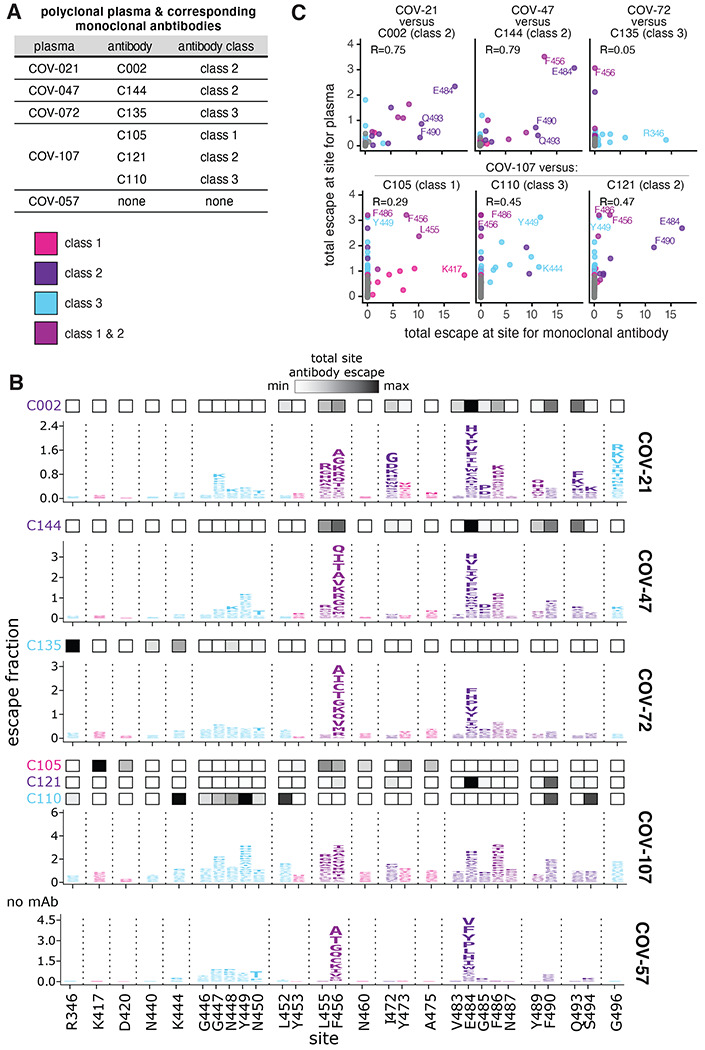
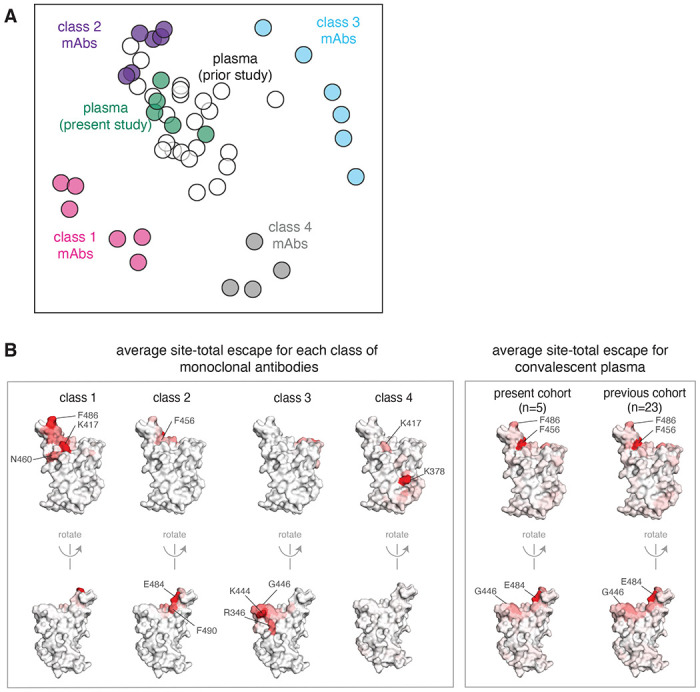
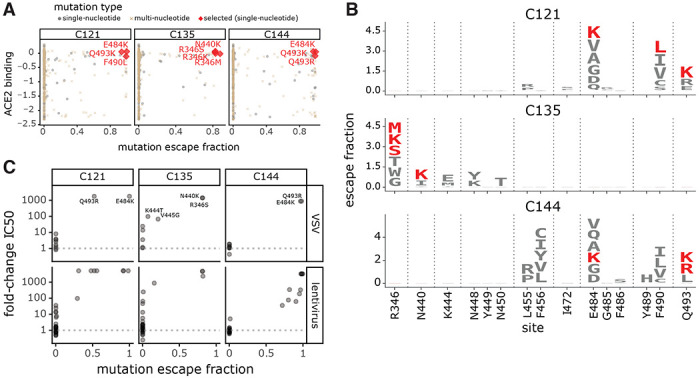
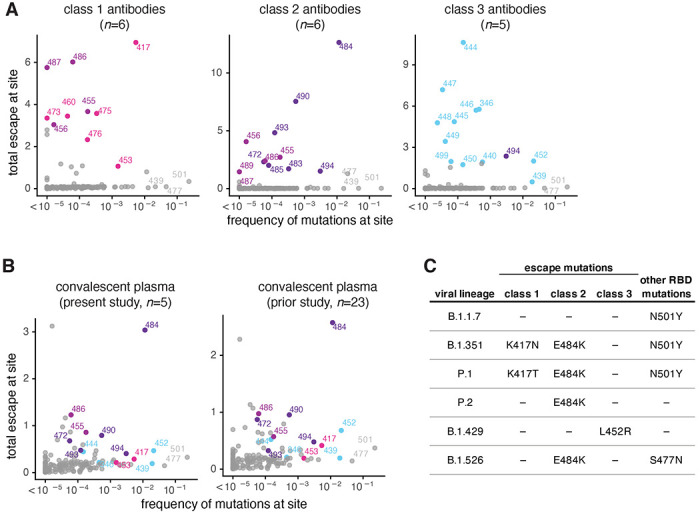
Monoclonal antibodies targeting a variety of epitopes have been isolated from individuals previously infected with SARS-CoV-2, but the relative contributions of these different antibody classes to the polyclonal response remains unclear. Here we use a yeast-display system to map all mutations to the viral spike receptor-binding domain (RBD) that escape binding by representatives of three potently neutralizing classes of anti-RBD antibodies with high-resolution structures. We compare the antibody-escape maps to similar maps for convalescent polyclonal plasmas, including plasmas from individuals from whom some of the antibodies were isolated. While the binding of polyclonal plasma antibodies are affected by mutations across multiple RBD epitopes, the plasma-escape maps most resemble those of a single class of antibodies that target an epitope on the RBD that includes site E484. Therefore, although the human immune system can produce antibodies that target diverse RBD epitopes, in practice the polyclonal response to infection is skewed towards a single class of antibodies targeting an epitope that is already undergoing rapid evolution.
Overview
The claims and statistics of this paper haven’t been checked yet.
Run the check — free, no account needed. It reads the open-access text and checks the sources it cites.
Integrity signals
Registry
Cites
Statistics
Figures
Verification
Claims the paper makes
The claims and statistics of this paper haven’t been checked yet.
Run the check — free, no account needed. It reads the open-access text and checks the sources it cites.
Claims other papers make about this one
Each is checked against this paper’s own text: does it say what the citing paper says it does?
The source backs part of the claim, not all of it — or backs it for a different population, condition or comparison.
In the citing paper
“Mutations at F486 are associated with a reduction in neutralizing activity by class 1 (and some class 2) neutralizing antibodies and by polyclonal sera9–11.”
From Emergence of SARS-CoV-2 Omicron lineages BA.4 and BA.5 in South Africa (2022) · cites this paper as [9]
Experimental — accuracy not yet measuredIn the citing paper
“mutations at this position have been associated with a reduction in neutralization by monoclonal antibodies (particularly class 2 antibodies) and polyclonal sera9–11.”
From Emergence of SARS-CoV-2 Omicron lineages BA.4 and BA.5 in South Africa (2022) · cites this paper as [9]
Self-check
Percentages, sums and reported differences re-computed from the paper’s own numbers.
The self-check needs the paper’s full text.
Citations
Cites
MAFFT Multiple Sequence Alignment Software Version 7: Improvements in Performance and Usability
Katoh, K., & Standley, D. M. (2013) · Molecular Biology and Evolution · doi:10.1093/molbev/mst010 · Cited by 46,209
Structure of the SARS-CoV-2 spike receptor-binding domain bound to the ACE2 receptor
Lan, J., Ge, J., Yu, J., Shan, S., Zhou, H., Fan, S., Zhang, Q., Shi, X., Wang, Q., Zhang, L., et al. (2020) · Nature · doi:10.1038/s41586-020-2180-5 · Cited by 5,983
Letko, M., Marzi, A., & Munster, V. (2020) · Nature Microbiology · doi:10.1038/s41564-020-0688-y · Cited by 3,109
Detection of a SARS-CoV-2 variant of concern in South Africa
Tegally, H., Wilkinson, E., Giovanetti, M., Iranzadeh, A., Fonseca, V., Giandhari, J., Doolabh, D., Pillay, S., San, E. J., Msomi, N., et al. (2021) · Nature · doi:10.1038/s41586-021-03402-9 · Cited by 2,510
Antibody Resistance of SARS-CoV-2 Variants B.1.351 and B.1.1.7
Wang, P., Nair, M. S., Liu, L., Iketani, S., Luo, Y., Guo, Y., Wang, M., Yu, J., Zhang, B., Kwong, P. D., et al. (2021) · doi:10.1101/2021.01.25.428137 · Cited by 2,328
Antibody resistance of SARS-CoV-2 variants B.1.351 and B.1.1.7
Wang, P., Nair, M. S., Liu, L., Iketani, S., Luo, Y., Guo, Y., Wang, M., Yu, J., Zhang, B., Kwong, P. D., et al. (2021) · Nature · doi:10.1038/s41586-021-03398-2 · Cited by 2,312
Bio3d: an R package for the comparative analysis of protein structures
Grant, B. J., Rodrigues, A. P. C., ElSawy, K. M., McCammon, J. A., & Caves, L. S. D. (2006) · Bioinformatics · doi:10.1093/bioinformatics/btl461 · Cited by 2,005
Starr, T. N., Greaney, A. J., Hilton, S. K., Ellis, D., Crawford, K. H. D., Dingens, A. S., Navarro, M. J., Bowen, J. E., Tortorici, M. A., Walls, A. C., et al. (2020) · Cell · doi:10.1016/j.cell.2020.08.012 · Cited by 1,956
Self-citationData, disease and diplomacy: GISAID's innovative contribution to global health
Elbe, S., & Buckland‐Merrett, G. (2017) · Global Challenges · doi:10.1002/gch2.1018 · Cited by 1,928
Mapping the Antigenic and Genetic Evolution of Influenza Virus
Smith, D. J., Lapedes, A. S., de Jong, J. C., Bestebroer, T. M., Rimmelzwaan, G. F., Osterhaus, A. D. M. E., & Fouchier, R. A. M. (2004) · Science · doi:10.1126/science.1097211 · Cited by 1,868
Research works printed but not linked: 1
- Chen, R. E. et al. Resistance of SARS-CoV-2 variants to neutralization by monoclonal and serum-derived polyclonal antibodies. Nat. Med. https://doi.org/10.1038/s41591-021-01294-w (2021). · DOI · Paper page
Cited by
Sorted by citations
SARS-CoV-2 variants, spike mutations and immune escape
Harvey, W. T., Carabelli, A. M., Jackson, B., Gupta, R. K., Thomson, E. C., Harrison, E. M., Ludden, C., Reeve, R., Rambaut, A., COVID-19 Genomics UK (COG-UK) Consortium, et al. (2021) · Nature Reviews Microbiology · doi:10.1038/s41579-021-00573-0 · Cited by 3,528
Rapid epidemic expansion of the SARS-CoV-2 Omicron variant in southern Africa
Viana, R. P. E. S., Moyo, S. M., Amoako, D. G., Tegally, H., Scheepers, C., Althaus, C. L., Anyaneji, U. J., Bester, P. A., Boni, M. F., Chand, M., et al. (2022) · Nature · doi:10.1038/s41586-022-04411-y · Cited by 1,678
BA.2.12.1, BA.4 and BA.5 escape antibodies elicited by Omicron infection
Cao, Y., Yisimayi, A., Jian, F., Song, W., Xiao, T., Wang, L., Du, S., Wang, J., Li, Q., Chen, X., et al. (2022) · Nature · doi:10.1038/s41586-022-04980-y · Cited by 1,306
Markov, P. V., Ghafari, M., Beer, M., Lythgoe, K., Simmonds, P., Stilianakis, N. I., & Katzourakis, A. (2023) · Nature Reviews Microbiology · doi:10.1038/s41579-023-00878-2 · Cited by 1,179
mRNA-based COVID-19 vaccine boosters induce neutralizing immunity against SARS-CoV-2 Omicron variant
Garcia-Beltran, W. F., St. Denis, K. J., Hoelzemer, A., Lam, E. C., Nitido, A. D., Sheehan, M. L., Berrios, C., Ofoman, O., Chang, C. C., Hauser, B. M., et al. (2022) · Cell · doi:10.1016/j.cell.2021.12.033 · Cited by 1,045
Metadata
- Authors
- Greaney, A. J., Starr, T. N., Barnes, C. O., Weisblum, Y., Schmidt, F., Caskey, M., Gaebler, C., Cho, A., Agudelo, M., Finkin, S., Wang, Z., Poston, D., Muecksch, F., Hatziioannou, T., Bieniasz, P. D., Robbiani, D. F., Nussenzweig, M. C., Bjorkman, P. J., & Bloom, J. D.
- Affiliations
- University of Washington (US)
- Howard Hughes Medical Institute (US)
- California Institute of Technology (US)
- Rockefeller University (US)
- Institute for Research in Biomedicine (CH)
- Corresponding author
- Bloom, Jesse D.
- ORCID
- Greaney, Allison J.
- Starr, Tyler N.
- Barnes, Christopher O.
- Weisblum, Yiska
- Schmidt, Fabian
- Caskey, Marina
- Gaebler, Christian
- Cho, Alice
- Agudelo, Marianna
- Finkin, Shlomo
- Wang, Zijun
- Poston, Daniel
- Muecksch, Frauke
- Hatziioannou, Theodora
- Bieniasz, Paul D.
- Robbiani, Davide F.
- Nussenzweig, Michel C.
- Bjorkman, Pamela J.
- Bloom, Jesse D.
- Venue
- Nature Communications
- Published
- 2021-07-07
- Volume
- 12
- Issue
- 1
- Pages
- 4196-4196
- ISSN
- 2041-1723 (ISSN-L)
- PMC
- PMC7987015
- OpenAlex
- W3179259355
- Cited by
- 433
- References
- 64
- Citations by year
- 2026: 34 · 2025: 39 · 2024: 56 · 2023: 83 · 2022: 157 · 2021: 64
- FWCI
- 29.43
- Type
- journal article
- Language
- en
- Open access
- gold
- doi.org
- Locations
- Nature Communications (publishedVersion, cc-by)
- bioRxiv (Cold Spring Harbor Laboratory) (acceptedVersion, cc-by)
- PubMed Central (publishedVersion, cc-by)
- PubMed (publishedVersion)
- PubMed Central (submittedVersion, cc-by)
- CaltechAUTHORS (California Institute of Technology) (submittedVersion, cc-by)
- RePEc: Research Papers in Economics (submittedVersion)
- DOAJ (DOAJ: Directory of Open Access Journals) (submittedVersion, cc-by-sa)
- Funders
- Howard Hughes Medical Institute
- Burroughs Wellcome Fund
- Bill and Melinda Gates Foundation (INV-004949)
- Damon Runyon Cancer Research Foundation (DRG-2381-19)
- Washington Research Foundation
- Fred Hutchinson Cancer Research Center
- George Mason University
- California Institute of Technology
- University of Washington
- National Institutes of Health (1s10od028685-01, P01-AI138398-S1, AI111825)
- Beckman Institute, California Institute of Technology
- National Institute of Allergy and Infectious Diseases (U01AI151698, P01 AI138398-S1, R01AI127893, T32AI083203, U19AI111825, R01AI141707, AI151698, F30AI157898)
- Office of Research Infrastructure Programs, National Institutes of Health (S10OD028685)
- Topics
- Health Sciences › Medicine › Infectious Diseases › SARS-CoV-2 and COVID-19 Research
- Life Sciences › Biochemistry, Genetics and Molecular Biology › Molecular Biology › vaccines and immunoinformatics approaches
- Life Sciences › Immunology and Microbiology › Immunology › Monoclonal and Polyclonal Antibodies Research
- Keywords
- SARS-CoV-2, spike protein receptor-binding domain, antibody escape mutations, neutralizing antibodies, monoclonal antibodies, convalescent plasma, antibody-antigen binding, epitope evolution
About these checks
Registry, retraction, Cites and statistics results are computed, not judged, with one exception: a printed reference that no index lists is read once by a model before it counts as a citation error. Claims are extracted by a model and kept only when their quote appears verbatim in the text; each cited source is then checked, with a model’s help, for whether it says what the claim relies on. Those verdicts can be wrong — read the claim’s quote and the cited source before relying on one.
Statistics and arithmetic are recomputed, not judged.
Confidence bands are shown only for fields calibrated on our annotated test set. None is calibrated yet, so no band is shown.
What counts as a claim ›How we measure confidence ›How we check this ›
Are you an author, or do you see a problem with this page? Request a review
