

The DOI matches its Crossref record; 76 of the 77 references it cites were found in a registry or an index, and 1 are not checked yet.
Mapping mutations to the SARS-CoV-2 RBD that escape binding by different classes of antibodies
Open accessPublished version of a preprint
Abstract
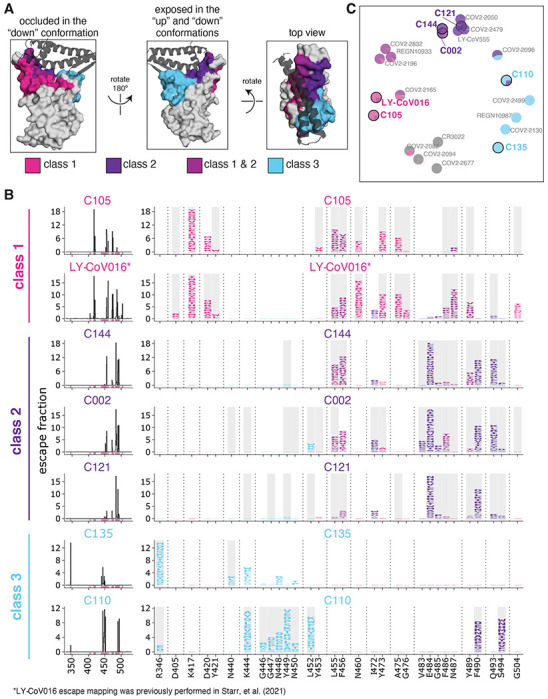
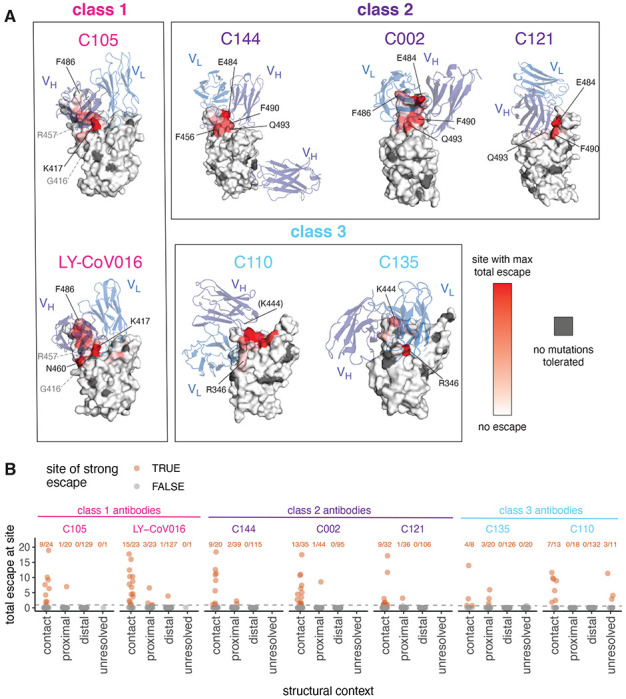
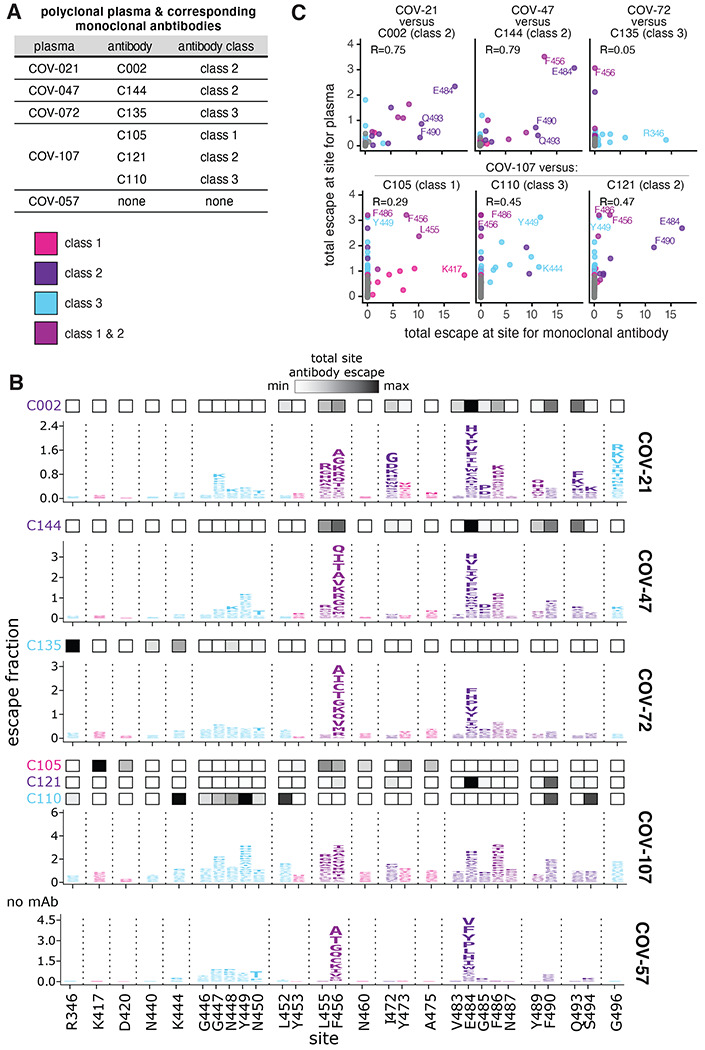
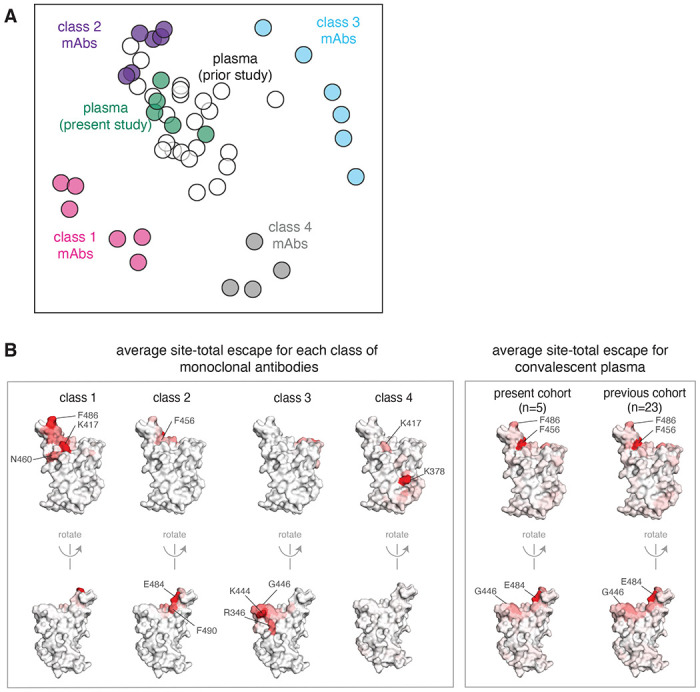
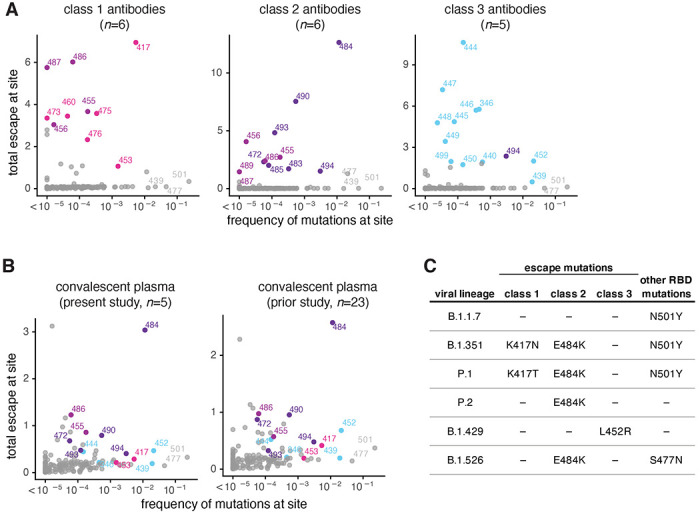
Monoclonal antibodies targeting a variety of epitopes have been isolated from individuals previously infected with SARS-CoV-2, but the relative contributions of these different antibody classes to the polyclonal response remains unclear. Here we use a yeast-display system to map all mutations to the viral spike receptor-binding domain (RBD) that escape binding by representatives of three potently neutralizing classes of anti-RBD antibodies with high-resolution structures. We compare the antibody-escape maps to similar maps for convalescent polyclonal plasmas, including plasmas from individuals from whom some of the antibodies were isolated. While the binding of polyclonal plasma antibodies are affected by mutations across multiple RBD epitopes, the plasma-escape maps most resemble those of a single class of antibodies that target an epitope on the RBD that includes site E484. Therefore, although the human immune system can produce antibodies that target diverse RBD epitopes, in practice the polyclonal response to infection is skewed towards a single class of antibodies targeting an epitope that is already undergoing rapid evolution.
Overview
The claims and statistics of this paper haven’t been checked yet.
Run the check — free, no account needed. It reads the open-access text and checks the sources it cites.
Integrity signals
Registry
Cites
Statistics
Figures
Verification
Claims the paper makes
The claims and statistics of this paper haven’t been checked yet.
Run the check — free, no account needed. It reads the open-access text and checks the sources it cites.
Claims other papers make about this one
Each is checked against this paper’s own text: does it say what the citing paper says it does?
The source backs part of the claim, not all of it — or backs it for a different population, condition or comparison.
In the citing paper
“Mutations at F486 are associated with a reduction in neutralizing activity by class 1 (and some class 2) neutralizing antibodies and by polyclonal sera9–11.”
From Emergence of SARS-CoV-2 Omicron lineages BA.4 and BA.5 in South Africa (2022) · cites this paper as [9]
Experimental — accuracy not yet measuredIn the citing paper
“mutations at this position have been associated with a reduction in neutralization by monoclonal antibodies (particularly class 2 antibodies) and polyclonal sera9–11.”
From Emergence of SARS-CoV-2 Omicron lineages BA.4 and BA.5 in South Africa (2022) · cites this paper as [9]
Self-check
Percentages, sums and reported differences re-computed from the paper’s own numbers.
The self-check needs the paper’s full text.
Citations
Cites
MAFFT Multiple Sequence Alignment Software Version 7: Improvements in Performance and Usability
Katoh, K., & Standley, D. M. (2013) · Molecular Biology and Evolution · doi:10.1093/molbev/mst010 · Cited by 46,209
Structure of the SARS-CoV-2 spike receptor-binding domain bound to the ACE2 receptor
Lan, J., Ge, J., Yu, J., Shan, S., Zhou, H., Fan, S., Zhang, Q., Shi, X., Wang, Q., Zhang, L., et al. (2020) · Nature · doi:10.1038/s41586-020-2180-5 · Cited by 5,983
Letko, M., Marzi, A., & Munster, V. (2020) · Nature Microbiology · doi:10.1038/s41564-020-0688-y · Cited by 3,109
Detection of a SARS-CoV-2 variant of concern in South Africa
Tegally, H., Wilkinson, E., Giovanetti, M., Iranzadeh, A., Fonseca, V., Giandhari, J., Doolabh, D., Pillay, S., San, E. J., Msomi, N., et al. (2021) · Nature · doi:10.1038/s41586-021-03402-9 · Cited by 2,510
Antibody Resistance of SARS-CoV-2 Variants B.1.351 and B.1.1.7
Wang, P., Nair, M. S., Liu, L., Iketani, S., Luo, Y., Guo, Y., Wang, M., Yu, J., Zhang, B., Kwong, P. D., et al. (2021) · doi:10.1101/2021.01.25.428137 · Cited by 2,328
Antibody resistance of SARS-CoV-2 variants B.1.351 and B.1.1.7
Wang, P., Nair, M. S., Liu, L., Iketani, S., Luo, Y., Guo, Y., Wang, M., Yu, J., Zhang, B., Kwong, P. D., et al. (2021) · Nature · doi:10.1038/s41586-021-03398-2 · Cited by 2,312
Bio3d: an R package for the comparative analysis of protein structures
Grant, B. J., Rodrigues, A. P. C., ElSawy, K. M., McCammon, J. A., & Caves, L. S. D. (2006) · Bioinformatics · doi:10.1093/bioinformatics/btl461 · Cited by 2,005
Starr, T. N., Greaney, A. J., Hilton, S. K., Ellis, D., Crawford, K. H. D., Dingens, A. S., Navarro, M. J., Bowen, J. E., Tortorici, M. A., Walls, A. C., et al. (2020) · Cell · doi:10.1016/j.cell.2020.08.012 · Cited by 1,956
Self-citationData, disease and diplomacy: GISAID's innovative contribution to global health
Elbe, S., & Buckland‐Merrett, G. (2017) · Global Challenges · doi:10.1002/gch2.1018 · Cited by 1,928
Mapping the Antigenic and Genetic Evolution of Influenza Virus
Smith, D. J., Lapedes, A. S., de Jong, J. C., Bestebroer, T. M., Rimmelzwaan, G. F., Osterhaus, A. D. M. E., & Fouchier, R. A. M. (2004) · Science · doi:10.1126/science.1097211 · Cited by 1,868
Research works printed but not linked: 1
- Chen, R. E. et al. Resistance of SARS-CoV-2 variants to neutralization by monoclonal and serum-derived polyclonal antibodies. Nat. Med. https://doi.org/10.1038/s41591-021-01294-w (2021). · DOI · Paper page
Cited by
Sorted by citations
SARS-CoV-2 variants, spike mutations and immune escape
Harvey, W. T., Carabelli, A. M., Jackson, B., Gupta, R. K., Thomson, E. C., Harrison, E. M., Ludden, C., Reeve, R., Rambaut, A., COVID-19 Genomics UK (COG-UK) Consortium, et al. (2021) · Nature Reviews Microbiology · doi:10.1038/s41579-021-00573-0 · Cited by 3,528
Rapid epidemic expansion of the SARS-CoV-2 Omicron variant in southern Africa
Viana, R. P. E. S., Moyo, S. M., Amoako, D. G., Tegally, H., Scheepers, C., Althaus, C. L., Anyaneji, U. J., Bester, P. A., Boni, M. F., Chand, M., et al. (2022) · Nature · doi:10.1038/s41586-022-04411-y · Cited by 1,678
BA.2.12.1, BA.4 and BA.5 escape antibodies elicited by Omicron infection
Cao, Y., Yisimayi, A., Jian, F., Song, W., Xiao, T., Wang, L., Du, S., Wang, J., Li, Q., Chen, X., et al. (2022) · Nature · doi:10.1038/s41586-022-04980-y · Cited by 1,306
Markov, P. V., Ghafari, M., Beer, M., Lythgoe, K., Simmonds, P., Stilianakis, N. I., & Katzourakis, A. (2023) · Nature Reviews Microbiology · doi:10.1038/s41579-023-00878-2 · Cited by 1,179
mRNA-based COVID-19 vaccine boosters induce neutralizing immunity against SARS-CoV-2 Omicron variant
Garcia-Beltran, W. F., St. Denis, K. J., Hoelzemer, A., Lam, E. C., Nitido, A. D., Sheehan, M. L., Berrios, C., Ofoman, O., Chang, C. C., Hauser, B. M., et al. (2022) · Cell · doi:10.1016/j.cell.2021.12.033 · Cited by 1,045
Imprinted SARS-CoV-2 humoral immunity induces convergent Omicron RBD evolution
Cao, Y., Jian, F., Wang, J., Yu, Y., Song, W., Yisimayi, A., Wang, J., An, R., Chen, X., Zhang, N., et al. (2022) · Nature · doi:10.1038/s41586-022-05644-7 · Cited by 850
Naturally enhanced neutralizing breadth against SARS-CoV-2 one year after infection
Wang, Z., Muecksch, F., Schaefer-Babajew, D., Finkin, S., Viant, C., Gaebler, C., Hoffmann, H. H., Barnes, C. O., Cipolla, M., Ramos, V., et al. (2021) · Nature · doi:10.1038/s41586-021-03696-9 · Cited by 721
Self-citationSARS-CoV-2 Omicron is an immune escape variant with an altered cell entry pathway
Willett, B. J., Grove, J., MacLean, O. A., Wilkie, C., De Lorenzo, G., Furnon, W., Cantoni, D., Scott, S., Logan, N., Ashraf, S., et al. (2022) · Nature Microbiology · doi:10.1038/s41564-022-01143-7 · Cited by 785
Emergence of SARS-CoV-2 Omicron lineages BA.4 and BA.5 in South Africa
Tegally, H., Moir, M., Everatt, J., Giovanetti, M., Scheepers, C., Wilkinson, E., Subramoney, K., Makatini, Z., Moyo, S., Amoako, D. G., et al. (2022) · Nature Medicine · doi:10.1038/s41591-022-01911-2 · Cited by 707
VanBlargan, L. A., Errico, J. M., Halfmann, P., Zost, S. J., Crowe, J. E., Purcell, L. A., Kawaoka, Y., Corti, D., Fremont, D. H., & Diamond, M. (2022) · Nature Medicine · doi:10.1038/s41591-021-01678-y · Cited by 690
Starr, T. N., Greaney, A. J., Dingens, A. S., & Bloom, J. D. (2021) · Cell Reports Medicine · doi:10.1016/j.xcrm.2021.100255 · Cited by 470
Self-citationShifting mutational constraints in the SARS-CoV-2 receptor-binding domain during viral evolution
Starr, T. N., Greaney, A. J., Hannon, W. W., Loes, A. N., Hauser, K., Dillen, J. R., Ferri, E., Farrell, A. G., Dadonaite, B., McCallum, M., et al. (2022) · Science · doi:10.1126/science.abo7896 · Cited by 298
Self-citationGenetic and structural basis for SARS-CoV-2 variant neutralization by a two-antibody cocktail
Dong, J., Zost, S. J., Greaney, A. J., Starr, T. N., Dingens, A. S., Chen, E. C., Chen, R. E., Case, J. B., Sutton, R. E., Gilchuk, P., et al. (2021) · Nature Microbiology · doi:10.1038/s41564-021-00972-2 · Cited by 285
Self-citationMosaic RBD nanoparticles protect against challenge by diverse sarbecoviruses in animal models
Cohen, A. A., van Doremalen, N., Greaney, A. J., Andersen, H., Sharma, A., Starr, T. N., Keeffe, J. R., Fan, C., Schulz, J. E., Gnanapragasam, P. N. P., et al. (2022) · Science · doi:10.1126/science.abq0839 · Cited by 264
Self-citationQu, P., Evans, J. P., Faraone, J. N., Zheng, Y.-M., Carlin, C., Anghelina, M. I., Stevens, P., Fernández, S., Jones, D. M., Lozanski, G., et al. (2022) · Cell Host & Microbe · doi:10.1016/j.chom.2022.11.012 · Cited by 303
“Neutralizing antibodies targeting the SARS-CoV-2 S protein can largely be divided into four classes based on the region of the receptor-binding domain (RBD) targeted by the antibodies.(39,40) Specifically, class I antibodies target RBDs in the ‘‘up’’ conformation, class II and class III antibodies target RBDs in eithe…”
Rapid epidemic expansion of the SARS-CoV-2 Omicron variant in southern Africa
Viana, R. P. E. S., Moyo, S. M., Amoako, D. G., Tegally, H., Scheepers, C., Althaus, C. L., Anyaneji, U. J., Bester, P. A., Boni, M. F., Chand, M., et al. (2022) · Nature · doi:10.1101/2021.12.19.21268028 · Cited by 253
Greaney, A. J., Loes, A. N., Gentles, L. E., Crawford, K. H. D., Starr, T. N., Malone, K. D., Chu, H. Y., & Bloom, J. D. (2021) · Science Translational Medicine · doi:10.1126/scitranslmed.abi9915 · Cited by 244
Self-citationCopin, R., Baum, A., Wloga, E., Pascal, K. E., Giordano, S., Fulton, B. O., Zhou, A., Negron, N., Lanza, K., Chan, N., et al. (2021) · Cell · doi:10.1016/j.cell.2021.06.002 · Cited by 212
SARS-CoV-2 prolonged infection during advanced HIV disease evolves extensive immune escape
Cele, S., Karim, F., Lustig, G., San, J. E., Hermanus, T., Tegally, H., Snyman, J., Moyo-Gwete, T., Wilkinson, E., Bernstein, M. P., et al. (2022) · Cell Host & Microbe · doi:10.1016/j.chom.2022.01.005 · Cited by 237
“RBD mutations for the Beta variant include the K417N, E484K, and N501Y (see https://covdb.stanford.edu/page/mutation-viewer/ ).”
InfluentialOmicron BA.4/BA.5 escape neutralizing immunity elicited by BA.1 infection
Khan, K., Karim, F., Ganga, Y., Bernstein, M. P., Jule, Z., Reedoy, K., Cele, S., Lustig, G., Amoako, D. G., Wolter, N., et al. (2022) · Nature Communications · doi:10.1038/s41467-022-32396-9 · Cited by 225
Rapid in silico directed evolution by a protein language model with EVOLVEpro
Jiang, K., Yan, Z., Bernardo, M. D., Sgrizzi, S. R., Villiger, L., Kayabölen, A., Kim, B., Carscadden, J. K., Hiraizumi, M., Nishimasu, H., et al. (2024) · Science · doi:10.1126/science.adr6006 · Cited by 234
Learning from prepandemic data to forecast viral escape
Thadani, N. N., Gurev, S. F., Notin, P., Youssef, N., Rollins, N. J., Ritter, D., Sander, C., Gal, Y., & Marks, D. S. (2023) · Nature · doi:10.1038/s41586-023-06617-0 · Cited by 233
Efficient recall of Omicron-reactive B cell memory after a third dose of SARS-CoV-2 mRNA vaccine
Goel, R. R., Painter, M. M., Lundgreen, K. A., Apostolidis, S. A., Baxter, A. E., Giles, J. R., Mathew, D., Pattekar, A., Reynaldi, A., Khoury, D. S., et al. (2022) · Cell · doi:10.1016/j.cell.2022.04.009 · Cited by 207
“Mutations found in SARS-CoV-2 variants, particularly those in the spike glycoprotein, can alter viral transmission and immune recognition (Garcia-Beltran et al., 2021; Greaney et al., 2021a, 2021b).”
A pseudovirus system enables deep mutational scanning of the full SARS-CoV-2 spike
Dadonaite, B., Crawford, K. H. D., Radford, C. E., Farrell, A. G., Yu, T. C., Hannon, W. W., Zhou, P.-P., Andrabi, R., Burton, D. R., Liu, L., et al. (2023) · Cell · doi:10.1016/j.cell.2023.02.001 · Cited by 186
Self-citationAn antibody-escape estimator for mutations to the SARS-CoV-2 receptor-binding domain
Greaney, A. J., Starr, T. N., & Bloom, J. D. (2022) · Virus Evolution · doi:10.1093/ve/veac021 · Cited by 147
Self-citationStructural basis for potent antibody neutralization of SARS-CoV-2 variants including B.1.1.529
Zhou, T., Wang, L., Misasi, J., Pegu, A., Zhang, Y., Harris, D. R., Olia, A. S., Talana, C. A., Yang, E. S., Chen, M., et al. (2022) · Science · doi:10.1126/science.abn8897 · Cited by 163
Compensatory epistasis maintains ACE2 affinity in SARS-CoV-2 Omicron BA.1
Moulana, A., Dupic, T., Phillips, A. M., Chang, J., Nieves, S., Roffler, A. A., Greaney, A. J., Starr, T. N., Bloom, J. D., & Desai, M. M. (2022) · Nature Communications · doi:10.1038/s41467-022-34506-z · Cited by 156
Self-citationChakraborty, C., Sharma, A. R., Bhattacharya, M., & Lee, S. (2022) · Frontiers in Immunology · doi:10.3389/fimmu.2022.801522 · Cited by 154
Antibody-mediated neutralization of SARS-CoV-2
Gruell, H., Vanshylla, K., Weber, T., Barnes, C. O., Kreer, C., & Klein, F. (2022) · Immunity · doi:10.1016/j.immuni.2022.05.005 · Cited by 150
“Deep mutational scanning demonstrated that, compared to antibodies inducedby infection, mRNA vaccine-induced serum activity shows a stronger RBDdirected focus with higher epitope breadth (Greaney et al., 2021b).”
Self-citationMapping SARS-CoV-2 antigenic relationships and serological responses
Wilks, S. H., Mühlemann, B., Shen, X., Türeli, S., LeGresley, E. B., Netzl, A., Caniza, M. A., Chacaltana-Huarcaya, J. N., Corman, V. M., Daniell, X. G., et al. (2023) · Science · doi:10.1126/science.adj0070 · Cited by 134
“Theimpactofsubstitutionsat position484,417,and501agreewithother workbasedondeepmutationalscanning(DMS) ( 37 – 39 ) and neutralization data from vesicular stomatitis virus pseudotyped particles ( 40 , 41 ).”
BackgroundWang, Z., Muecksch, F., Cho, A., Gaebler, C., Hoffmann, H.-H., Ramos, V., Zong, S., Cipolla, M., Johnson, B., Schmidt, F., et al. (2022) · Immunity · doi:10.1016/j.immuni.2022.04.003 · Cited by 145
“The most frequently occurring anti-RBD antibodies select forresistancemutationsin invitro experimentsthatarealsofound in variants of concern (Baum et al., 2020; Greaney et al., 2021; Wang et al., 2021c; Weisblum et al., 2020).”
Self-citationNanotechnology-based strategies against SARS-CoV-2 variants
Huang, X., Kon, E., Han, X., Zhang, X., Kong, N., Mitchell, M. J., Peer, D., & Tao, W. (2022) · Nature Nanotechnology · doi:10.1038/s41565-022-01174-5 · Cited by 146
SARS-CoV-2 neutralizing antibodies: Longevity, breadth, and evasion by emerging viral variants
Tea, F., Stella, A. O., Aggarwal, A., Darley, D. R., Pilli, D., Vitale, D., Merheb, V., Lee, F. X. Z., Cunningham, P., Walker, G. J., et al. (2021) · PLoS Medicine · doi:10.1371/journal.pmed.1003656 · Cited by 135
Sokal, A., Spaeth, G. B., Fernández, I., Broketa, M., Azzaoui, I., Selle, A. D. L., Vandenberghe, A., Fourati, S., Roeser, A., Meola, A., et al. (2021) · Immunity · doi:10.1016/j.immuni.2021.09.011 · Cited by 135
Tzou, P. L., Tao, K., Pond, S. L. K., & Shafer, R. W. (2022) · PLoS ONE · doi:10.1371/journal.pone.0261045 · Cited by 126
Structural and antigenic variations in the spike protein of emerging SARS-CoV-2 variants
Mittal, A., Khattri, A., & Verma, V. (2022) · PLoS Pathogens · doi:10.1371/journal.ppat.1010260 · Cited by 124
“Greaney and colleagues used a yeast display system to gain a broad picture of viral escape by comprehensively mapping 22 different nAbs and polyclonal plasma targeting the RBD epitopes as discussed in the previous section [28].”
BackgroundMethodInfluentialAntigenic characterization of the SARS-CoV-2 Omicron subvariant BA.2.75
Wang, Q., Iketani, S., Li, Z., Guo, Y., Yeh, A. Y., Liu, M., Yu, J., Sheng, Z., Huang, Y., Liu, L., et al. (2022) · Cell Host & Microbe · doi:10.1016/j.chom.2022.09.002 · Cited by 108
Taft, J. M., Weber, C. R., Gao, B., Ehling, R. A., Han, J., Frei, L., Metcalfe, S. W., Overath, M. D., Yermanos, A., Kelton, W., et al. (2022) · Cell · doi:10.1016/j.cell.2022.08.024 · Cited by 119
“Initially, DMS data consisting of single point mutations (ED 1 ) were used to train baseline models, with binding/non-binding labels assigned based on minimum affinity required to retain ACE2 binding as previously defined in Starr et al. (2020).”
Influentialvan Gils, M. J., Lavell, A. H. A., van der Straten, K., Appelman, B., Bontjer, I., Poniman, M., Burger, J. A., Oomen, M., Bouhuijs, J. H., van Vught, L. A., et al. (2022) · PLoS Medicine · doi:10.1371/journal.pmed.1003991 · Cited by 104
“E484K/A (present in Beta, Gamma and Omicron) abrogates sensitivity to a number of RBD antibodies, while L452R (present in Delta) and K417N/T (present in Beta, Gamma and Omicron) affect other subsets of RBD antibodies [59,60,78].”
BackgroundEvasion of neutralizing antibody responses by the SARS-CoV-2 BA.2.75 variant
Qu, P., Evans, J. P., Zheng, Y.-M., Carlin, C., Saif, L. J., Oltz, E. M., Xu, K. Y., Gumina, R. J., & Liu, S. (2022) · Cell Host & Microbe · doi:10.1016/j.chom.2022.09.015 · Cited by 97
Persistent SARS-CoV-2 infection and intra-host evolution in association with advanced HIV infectionPreprint
Karim, F., Moosa, M.-Y. S., Gosnell, B., Cele, S., Giandhari, J., Pillay, S., Tegally, H., Wilkinson, E., San, J., Msomi, N., et al. (2021) · medRxiv · doi:10.1101/2021.06.03.21258228 · Cited by 105
Silva, R. P., Huang, Y., Nguyen, A. W., Hsieh, C., Olaluwoye, O. S., Kaoud, T. S., Wilen, R. E., Qerqez, A. N., Park, J., Khalil, A. M., et al. (2023) · eLife · doi:10.7554/elife.83710 · Cited by 86
Sequential intrahost evolution and onward transmission of SARS-CoV-2 variants
Gonzalez-Reiche, A. S., Alshammary, H., Schaefer, S. H., Patel, G., Polanco, J., Carreño, J. M., Amoako, A. A., Rooker, A., Cognigni, C., Floda, D. L., et al. (2023) · Nature Communications · doi:10.1038/s41467-023-38867-x · Cited by 99
“The amino acid substitutions or positions at which changes accumulated have been associated with neutralization escape (e.g., R346T, E484V, S477) 16,17 , increased angiotensin converting enzyme 2 (ACE2) binding avidity (e.g., R346T, L455W) 38 , improved viral fusogenicity (e.g., P681R/Y) 18 , or a…”
Newman, J., Thakur, N., Peacock, T. P., Bialy, D., Elrefaey, A. M. E., Bogaardt, C., Horton, D. L., Ho, S., Kankeyan, T., Carr, C., et al. (2022) · Nature Microbiology · doi:10.1038/s41564-022-01163-3 · Cited by 85
“Focusing on the RBD, the amino acid changes K417N and E484K are well associated with antigenic escape from monoclonal antibodies and the polyclonal B-cell response 18,19,34 .”
Emerging SARS-CoV-2 Variants: Genetic Variability and Clinical Implications
Dubey, A., Choudhary, S., Kumar, P., & Tomar, S. (2021) · Current Microbiology · doi:10.1007/s00284-021-02724-1 · Cited by 79
Emergence and phenotypic characterization of the global SARS-CoV-2 C.1.2 lineage
Scheepers, C., Everatt, J., Amoako, D. G., Tegally, H., Wibmer, C. K., Mnguni, A., Ismail, A., Mahlangu, B., Lambson, B. E., Richardson, S. I., et al. (2022) · Nature Communications · doi:10.1038/s41467-022-29579-9 · Cited by 76
An early warning system for emerging SARS-CoV-2 variants
Subissi, L., von Gottberg, A., Thukral, L., Worp, N., Munnink, B. B. O., Rathore, S., Abu-Raddad, L. J., Aguilera, X., Alm, E., Archer, B. N., et al. (2022) · Nature Medicine · doi:10.1038/s41591-022-01836-w · Cited by 79
Broad anti–SARS-CoV-2 antibody immunity induced by heterologous ChAdOx1/mRNA-1273 vaccination
Kaku, C. I., Champney, E. R., Normark, J., García, M., Johnson, C. E., Ahlm, C., Christ, W., Sakharkar, M., Ackerman, M. E., Klingström, J., et al. (2022) · Science · doi:10.1126/science.abn2688 · Cited by 75
SARS-CoV-2 Omicron sublineages exhibit distinct antibody escape patterns
Gruell, H., Vanshylla, K., Korenkov, M., Tober‐Lau, P., Zehner, M., Münn, F., Janicki, H., Augustin, M., Schommers, P., Sander, L. E., et al. (2022) · Cell Host & Microbe · doi:10.1016/j.chom.2022.07.002 · Cited by 77
“For example, the BA.1.1 spike protein contains an R346K substitution in the receptor-binding domain (RBD) that was also observed in the SARS-CoV-2 Mu variant and associated with escape from neutralizing antibodies (Figure 1A) (Greaney et al., 2021).”
InfluentialGregory, D. A., Trujillo, M., Rushford, C., Flury, A. G., Kannoly, S., San, K. M., Lyfoung, D. T., Wiseman, R. W., Bromert, K. H., Zhou, M.-Y., et al. (2022) · PLoS Pathogens · doi:10.1371/journal.ppat.1010636 · Cited by 72
Wang, H., Jean, S., Eltringham, R., Madison, J., Snyder, P. J., Tu, H., Jones, D. M., & Leber, A. L. (2021) · Journal of Clinical Microbiology · doi:10.1128/jcm.00926-21 · Cited by 72
Chakraborty, C., Bhattacharya, M., Sharma, A. R., & Mallik, B. (2022) · International Journal of Biological Macromolecules · doi:10.1016/j.ijbiomac.2022.07.254 · Cited by 74
Xue, S., Han, Y., Wu, F., & Wang, Q. (2024) · Protein & Cell · doi:10.1093/procel/pwae007 · Cited by 81
“Moreover, DMS techniques exhibit reliable reproductiv-ity and consistent output results as the same as conventional affinity and neutralization assays (Greaney et al., 2021b; Tan et al., 2023).”
BackgroundMethodInfluentialInsights on the mutational landscape of the SARS-CoV-2 Omicron variant receptor-binding domain
Miller, N. L., Clark, T., Raman, R., & Sasisekharan, R. (2022) · Cell Reports Medicine · doi:10.1016/j.xcrm.2022.100527 · Cited by 80
“RBD-RBD interface stability While Omicron’s mutations at sites 371, 373, and 375 may contribute to escape from class 3 and 4 antibodies, evolution of such a triplet mutation toward this escape function is not parsimonious given that other single mutations have previously been identified as conferring greater class 3 a…”
Instructing durable humoral immunity for COVID-19 and other vaccinable diseases
Bhattacharya, D. (2022) · Immunity · doi:10.1016/j.immuni.2022.05.004 · Cited by 64
“First, SARS-CoV-2 is evolving, with variants such as Omicron containing escape mutations in most known neutralizing antibody epitopes (Cele et al., 2022; Greaney et al., 2020, 2021a; Viana et al., 2022).”
Genomic Perspectives on the Emerging SARS-CoV-2 Omicron Variant
Ma, W., Yang, J., Fu, H., Su, C., Yu, C., Wang, Q., de Vasconcelos, A. T. R., Bazykin, G. A., Bào, Y., & Li, M. (2022) · Genomics Proteomics & Bioinformatics · doi:10.1016/j.gpb.2022.01.001 · Cited by 59
“Moreover, we found that these mutations could potentially 187 impact the binding of different classes of antibodies (by analyzing the deep mutational 188 scanning data [22], Figure 3B), which was classified by the location and conformation 189 of antibody binding [23], suggesting that the therapeutic strategy of antib…”
BackgroundPredicting the antigenic evolution of SARS-COV-2 with deep learning
Han, W., Chen, N., Xu, X., Sahil, A., Zhou, J., Li, Z., Zhong, H., Gao, E., Zhang, R., Wang, Y., et al. (2023) · Nature Communications · doi:10.1038/s41467-023-39199-6 · Cited by 66
Landscape of human antibody recognition of the SARS-CoV-2 receptor binding domain
Wheatley, A. K., Pymm, P., Esterbauer, R., Dietrich, M. H., Lee, W. S., Drew, D. R., Kelly, H. G., Chan, L., Mordant, F. L., Black, K. A., et al. (2021) · Cell Reports · doi:10.1016/j.celrep.2021.109822 · Cited by 62
A SARS-CoV-2 variant elicits an antibody response with a shifted immunodominance hierarchy
Greaney, A. J., Starr, T. N., Eguia, R. T., Loes, A. N., Khan, K., Karim, F., Cele, S., Bowen, J. E., Logue, J. K., Corti, D., et al. (2022) · PLoS Pathogens · doi:10.1371/journal.ppat.1010248 · Cited by 58
Self-citationThe antibody response to SARS-CoV-2 Beta underscores the antigenic distance to other variants
Liu, C., Zhou, D.-M., Nutalai, R., Duyvesteyn, H., Tuekprakhon, A., Ginn, H., Dejnirattisai, W., Supasa, P., Mentzer, A., Wang, B.-B., et al. (2021) · Cell Host and Microbe · doi:10.1016/j.chom.2021.11.013 · Cited by 65
“Following Beta infection, there is a marked shift in the profile of the antibody response compared with infection with early pandemic strains (Figures 3H and 3I), with many potent mAbs picking out the three RBD amino acid changes found in Beta; K417N (3/27 mAbs), E484K (6/27 mAbs), and especially N501Y (11/27 mAbs) (G…”
BackgroundDeep mutational scanning: A versatile tool in systematically mapping genotypes to phenotypes
Wei, H., & Li, X. (2023) · Frontiers in Genetics · doi:10.3389/fgene.2023.1087267 · Cited by 77
The landscape of antibody binding affinity in SARS-CoV-2 Omicron BA.1 evolution
Moulana, A., Dupic, T., Phillips, A. M., Chang, J., Roffler, A. A., Greaney, A. J., Starr, T. N., Bloom, J. D., & Desai, M. M. (2023) · eLife · doi:10.7554/elife.83442 · Cited by 62
Self-citationAn atlas of continuous adaptive evolution in endemic human viruses
Kistler, K. E., & Bedford, T. (2023) · Cell Host & Microbe · doi:10.1016/j.chom.2023.09.012 · Cited by 65
“That SARS-CoV-2 is able to evolve antigenically has become readily apparent over the three years since the beginning of the pandemic 15,14,13,25 .”
Evolution of antibody immunity following Omicron BA.1 breakthrough infection
Kaku, C. I., Starr, T. N., Zhou, P.-P., Dugan, H. L., Khalifé, P., Song, G., Champney, E. R., Mielcarz, D. W., Geoghegan, J. C., Burton, D. R., et al. (2023) · Nature Communications · doi:10.1038/s41467-023-38345-4 · Cited by 70
Self-citationRochman, N. D., Faure, G., Wolf, Y. I., Freddolino, L., Zhang, F., & Koonin, E. V. (2022) · mBio · doi:10.1128/mbio.00135-22 · Cited by 59
“Although NAb that bind epitopes that do not overlap the RBD have been identified (8), at the time of writing, the antibodies most critical for assessing the risk of vaccine escape appear to overlap the RBD (9) and are well represented by CV30.”
Clinical grade ACE2 as a universal agent to block SARS‐CoV‐2 variants
Monteil, V., Eaton, B., Postnikova, E. N., Murphy, M. J., Braunsfeld, B., Crozier, I., Kricek, F., Niederhöfer, J., Schwarzböck, A., Breid, H., et al. (2022) · EMBO Molecular Medicine · doi:10.15252/emmm.202115230 · Cited by 54
“…loss of neutralization potency of many currently marketed or developed monoclonal antibodies (Cele et al, 2021; Garcia-Beltran et al, 2021; Greaney et al, 2021; Harvey et al, 2021; Jangra et al, 2021; Lopez Bernal et al, 2021; Planas et al, 2021; Peng et al, 2022; Takashita et al, 2022;…”
BackgroundFan, C., Cohen, A. A., Park, M., Hung, A. F.-H., Keeffe, J. R., Gnanapragasam, P. N. P., Lee, Y. E., Gao, H., Kakutani, L. M., Wu, Z., et al. (2022) · Immunity · doi:10.1016/j.immuni.2022.10.019 · Cited by 56
“26,31,32 By contrast, the only two mAbs isolated from homotypic SARS-CoV-2 nanoparticle-immunized mice that were identified as binding R 2 RBDs during screening targeted different epitopes and were only weakly-or non-neutralizing.”
Frank, F., Keen, M. M., Rao, A., Bassit, L., Liu, X., Bowers, H. B., Patel, A. B., Cato, M. L., Sullivan, J. A., Greenleaf, M. N., et al. (2022) · Cell · doi:10.1016/j.cell.2022.08.010 · Cited by 57
Understanding the Secret of SARS-CoV-2 Variants of Concern/Interest and Immune Escape
Lou, F., Li, M., Pang, Z., Jiang, L., Guan, L., Tian, L., Hu, J., Fan, J., & Fan, H. (2021) · Frontiers in Immunology · doi:10.3389/fimmu.2021.744242 · Cited by 54
“L452R has also been confirmed to reduce the neutralizing activity of some antibodies, which do not directly bind to the ACE2-binding epitopes, and it is considered to be a moderate immune escape site for these antibodies (64).”
BackgroundDu, W., Hurdiss, D. L., Drabek, D., Mykytyn, A. Z., Kaiser, F. K., González-Hernández, M., Muñoz‐Santos, D., Lamers, M. M., van Haperen, R., Li, W., et al. (2022) · Science Immunology · doi:10.1126/sciimmunol.abp9312 · Cited by 56
“Hybridoma supernatants with S ectodomain ELISA-reactivity were screened for neutralizing activity against SARS-CoV-2 S pseudovirus with the S E484K mutation, a residue that is at variance in several SARS-CoV-2 VOIs and VOCs playing a key role in resistance to neutralizing antibodies (5, 14, 15, 17)(Fig.”
MethodMaponga, T. G., Jeffries, M., Tegally, H., Sutherland, A. D., Wilkinson, E., Lessells, R. J., Msomi, N., van Zyl, G. U., de Oliveira, T., & Preiser, W. (2022) · Clinical Infectious Diseases · doi:10.1093/cid/ciac548 · Cited by 53
“7 The additional mutations in the receptor-binding domain of the spike glycoprotein (S371F, 1 N450D, A475V, F490Y, S494P and Q498R) in the later genomes are at sites associated with 2 escape from all four classes of neutralizing antibodies [11].”
BackgroundJoshi, M. N., Kumar, M., Srivastava, V., Kumar, D., Rathore, D. S., Pandit, R. J., Graham, D. W., & Joshi, C. G. (2022) · Environmental Pollution · doi:10.1016/j.envpol.2022.119757 · Cited by 52
Rapid characterization of spike variants via mammalian cell surface display
Javanmardi, K., Chou, C., Terrace, C. I., Annapareddy, A., Kaoud, T. S., Guo, Q., Lutgens, J., Zorkic, H., Horton, A. P., Gardner, E. C., et al. (2021) · Molecular Cell · doi:10.1016/j.molcel.2021.11.024 · Cited by 54
Mosaic sarbecovirus nanoparticles elicit cross-reactive responses in pre-vaccinated animals
Cohen, A. A., Keeffe, J. R., Schiepers, A., Dross, S., Greaney, A. J., Rorick, A. V., Gao, H., Gnanapragasam, P. N. P., Fan, C., West, A. P., et al. (2024) · Cell · doi:10.1016/j.cell.2024.07.052 · Cited by 51
“35,67,68 Here, DMS analyses of recall anti-RBD Abs from molecular fate-mapping studies demonstrated that mosaic-8b immunization boosted class 3 and 4 anti-RBD Abs originally elicited by primary vaccination with mRNA-LNP.”
Self-citationEllis, D., Brunette, N., Crawford, K. H. D., Walls, A. C., Pham, M. N., Chen, C., Herpoldt, K., Fiala, B., Murphy, M., Pettie, D., et al. (2021) · Frontiers in Immunology · doi:10.3389/fimmu.2021.710263 · Cited by 45
Self-citationLaurini, E., Marson, D., Aulić, S., Fermeglia, A., & Pricl, S. (2021) · Scientific Reports · doi:10.1038/s41598-021-99827-3 · Cited by 45
Cheng, M. H., Krieger, J., Banerjee, A., Xiang, Y., Kaynak, B., Shi, Y., Arditi, M., & Bahar, İ. (2022) · iScience · doi:10.1016/j.isci.2022.103939 · Cited by 50
Chatterjee, D., Tauzin, A., Marchitto, L., Gong, S. Y., Boutin, M., Bourassa, C., Beaudoin-Bussières, G., Bo, Y., Ding, S., Laumaea, A., et al. (2022) · Cell Reports · doi:10.1016/j.celrep.2022.110429 · Cited by 46
“…(Gong et al., 2021; Saito et al., 2021) or immune evasion (K417N, N440K, G446S, S477N, E484A/K, Q493R) (Baum et al., 2020; Clark et al., 2021; Greaney et al., 2021a; Greaney et al., 2021b; Greaney et al., 2021c; Liu et al., 2020; Rappazzo et al., 2021; Starr et al., 2021; Weisblum et al., 2020).”
A biophysical model of viral escape from polyclonal antibodies
Yu, T. C., Thornton, Z., Hannon, W. W., DeWitt, W. S., Radford, C. E., Matsen, F. A., IV, & Bloom, J. D. (2022) · Virus Evolution · doi:10.1093/ve/veac110 · Cited by 42
Self-citationYang, L., Beek, M. V., Wang, Z., Muecksch, F., Canis, M., Hatziioannou, T., Bieniasz, P. D., Nussenzweig, M. C., & Chakraborty, A. K. (2023) · Cell Reports · doi:10.1016/j.celrep.2023.112256 · Cited by 50
“Many immunodominant epitopes on the SARS-CoV-2 spike protein lie in the ACE2 binding interface region.(8,9,13,14) Several human germline heavy chain genes exhibit high affinities for these epitopes.”
Self-citationChakraborty, C., Bhattacharya, M., & Sharma, A. R. (2021) · Current Opinion in Pharmacology · doi:10.1016/j.coph.2021.11.006 · Cited by 45
Laurie, M. T., Liu, J., Sunshine, S., Peng, J., Black, D., Mitchell, A. M., Mann, S. A., Pilarowski, G. O. W., Zorn, K. C., Rubio, L., et al. (2022) · The Journal of Infectious Diseases · doi:10.1093/infdis/jiab635 · Cited by 46
“Together, these results demonstrate that serum neutralization specificity is strongest against variants fully homologous to the exposure, but even single shared spike mutations, particularly those in highly antigenic regions such as the RBD, can enhance cross-neutralization as supported in other studies [3, 6, 13].”
Emergence of a recurrent insertion in the N-terminal domain of the SARS-CoV-2 spike glycoprotein
Gerdol, M., Dishnica, K., & Giorgetti, A. (2022) · Virus Research · doi:10.1016/j.virusres.2022.198674 · Cited by 47
Rossotti, M. A., van Faassen, H., Tran, A., Sheff, J. G., Sandhu, J. K., Duque, D., Hewitt, M., Wen, X., Bavananthasivam, J., Beitari, S., et al. (2022) · Communications Biology · doi:10.1038/s42003-022-03866-z · Cited by 45
SARS-CoV-2 journey: from alpha variant to omicron and its sub-variants
Hattab, D., Amer, M. F. A., Al‐Alami, Z. M., & Bakhtiar, A. (2024) · Infection · doi:10.1007/s15010-024-02223-y · Cited by 48
“Additionally, casirivimab (REGN10933), imdevimab (REGN10987), bamlanivimab (LY-CoV555), etesevimab (LY-CoV016), sotrovimab (VIR-7831), and bebtelovimab (LY-CoV2-1404) have been approved for the treatment of mild to moderate COVID-19 cases [76].”
BackgroundInfluentialVoss, W. N., Mallory, M. L., Byrne, P. O., Marchioni, J., Knudson, S. A., Powers, J. M., Leist, S. R., Dadonaite, B., Townsend, D. R., Kain, J., et al. (2024) · Cell Reports Medicine · doi:10.1016/j.xcrm.2024.101668 · Cited by 44
“For neutralization assays, cells were plated at 2 x 10 4 cells per well the day prior to use in the above media.”
Self-citationEvolutionary analysis of Omicron variant BF.7 and BA.5.2 pandemic in China
Sun, Y., Wang, M., Lin, W., Dong, W., & Xu, J. (2023) · Journal of Biosafety and Biosecurity · doi:10.1016/j.jobb.2023.01.002 · Cited by 43
Liu, Y., Wang, Z., Zhuang, X., Zhang, S., Chen, Z., Zou, Y., Sheng, J., Li, T., Tai, W., Yu, J., et al. (2023) · Nature Communications · doi:10.1038/s41467-023-37926-7 · Cited by 43
“This fi nding was consistent with prior reports showing that the E484K mutation was associated with resistance to class 2 mAbs 66,67 .”
Self-citationGuenthoer, J., Lilly, M., Starr, T. N., Dadonaite, B., Lovendahl, K. N., Croft, J. T., Stoddard, C. I., Chohan, V., Ding, S., Ruiz, F., et al. (2023) · Proceedings of the National Academy of Sciences · doi:10.1073/pnas.2220948120 · Cited by 39
“To further refine the epitopes of the three mAbs that bound to RBD, we performed competition ELISAs using several commercial mAbs representing the RBD classes that have been defined for RBD antibodies on the basis of structural analyses (27) and DMS (28).”
InfluentialSelf-citationKumar, S., Patel, A. B., Lai, L., Chennareddy, C., Valanparambil, R. M., Reddy, E. S., Gottimukkala, K. P., Davis-Gardner, M. E., Edara, V. V., Linderman, S. L., et al. (2022) · Science Advances · doi:10.1126/sciadv.add2032 · Cited by 41
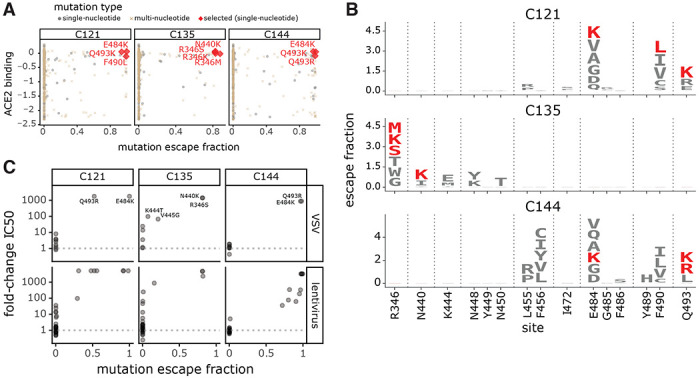
“In support of this, RBD deep mutational scanning shows that an N440K mutation (present in Omicron sublineages) disrupts the RBD-C135 interaction ( 20 ).”
IgM antibodies derived from memory B cells are potent cross-variant neutralizers of SARS-CoV-2
Hale, M. R., Netland, J., Chen, Y., Thouvenel, C. D., Smith, K. N., Rich, L. M., Vanderwall, E. R., Miranda, M. C., Eggenberger, J., Hao, L., et al. (2022) · The Journal of Experimental Medicine · doi:10.1084/jem.20220849 · Cited by 43
Multiplexed assays of variant effect for clinical variant interpretation
McEwen, A. E., Tejura, M., Fayer, S., Starita, L. M., & Fowler, D. M. (2025) · Nature Reviews Genetics · doi:10.1038/s41576-025-00870-x · Cited by 52
“Additionally, the authors repeated the RBD MAVEs in the presence of antibodies from multiple sources and identified spike RBD mutations that abrogated binding and rendered the therapeutic antibodies ineffective 167–169 .”
Simultaneous evaluation of antibodies that inhibit SARS-CoV-2 variants via multiplex assay
López, E., Haycroft, E. R., Adair, A., Mordant, F. L., O’Neill, M. T., Pymm, P., Redmond, S. J., Lee, W. S., Gherardin, N. A., Wheatley, A. K., et al. (2021) · JCI Insight · doi:10.1172/jci.insight.150012 · Cited by 38
Design of a mutation-integrated trimeric RBD with broad protection against SARS-CoV-2
Liang, Y., Zhang, J., Yuan, R. Y., Wang, M. Y., He, P., Su, J. G., Han, Z. B., Jin, Y. Q., Hou, J. W., Zhang, H., et al. (2022) · Cell Discovery · doi:10.1038/s41421-022-00383-5 · Cited by 42
Changrob, S., Fu, Y., Guthmiller, J. J., Halfmann, P., Li, L., Stamper, C. T., Dugan, H. L., Accola, M., Rehrauer, W., Zheng, N.-Y., et al. (2021) · mBio · doi:10.1128/mbio.02975-21 · Cited by 40
“Our study also showed that anti-RBD mAbs are primarily class 2 mAbs, consistent with other reports (30, 37, 42, 50).”
ResultAntibody escape and cryptic cross-domain stabilization in the SARS-CoV-2 Omicron spike protein
Javanmardi, K., Segall-Shapiro, T. H., Chou, C., Boutz, D. R., Olsen, R. J., Xie, X., Xia, H., Shi, P., Johnson, C. D., Annapareddy, A., et al. (2022) · Cell Host & Microbe · doi:10.1016/j.chom.2022.07.016 · Cited by 39
Strohl, W. R., Ku, Z., An, Z., Carroll, S. F., Keyt, B. A., & Strohl, L. M. (2022) · BioDrugs · doi:10.1007/s40259-022-00529-7 · Cited by 35
Gopinath, S., Ishak, A., Dhawan, N., Poudel, S., Shrestha, P. S., Singh, P., Xie, E., Tahir, P., Marzaban, S., Michel, J., et al. (2022) · Tropical Medicine and Infectious Disease · doi:10.3390/tropicalmed7050081 · Cited by 39
Uraki, R., Kiso, M., Imai, M., Yamayoshi, S., Ito, M., Fujisaki, S., Takashita, E., Ujie, M., Furusawa, Y., Yasuhara, A., et al. (2022) · Nature Microbiology · doi:10.1038/s41564-022-01170-4 · Cited by 38
Using big sequencing data to identify chronic SARS-Coronavirus-2 infections
Harari, S., Miller, D., Fleishon, S., Burstein, D., & Stern, A. (2024) · Nature Communications · doi:10.1038/s41467-024-44803-4 · Cited by 37
Metadata
- Authors
- Greaney, A. J., Starr, T. N., Barnes, C. O., Weisblum, Y., Schmidt, F., Caskey, M., Gaebler, C., Cho, A., Agudelo, M., Finkin, S., Wang, Z., Poston, D., Muecksch, F., Hatziioannou, T., Bieniasz, P. D., Robbiani, D. F., Nussenzweig, M. C., Bjorkman, P. J., & Bloom, J. D.
- Affiliations
- University of Washington (US)
- Howard Hughes Medical Institute (US)
- California Institute of Technology (US)
- Rockefeller University (US)
- Institute for Research in Biomedicine (CH)
- Corresponding author
- Bloom, Jesse D.
- ORCID
- Greaney, Allison J.
- Starr, Tyler N.
- Barnes, Christopher O.
- Weisblum, Yiska
- Schmidt, Fabian
- Caskey, Marina
- Gaebler, Christian
- Cho, Alice
- Agudelo, Marianna
- Finkin, Shlomo
- Wang, Zijun
- Poston, Daniel
- Muecksch, Frauke
- Hatziioannou, Theodora
- Bieniasz, Paul D.
- Robbiani, Davide F.
- Nussenzweig, Michel C.
- Bjorkman, Pamela J.
- Bloom, Jesse D.
- Venue
- Nature Communications
- Published
- 2021-07-07
- Volume
- 12
- Issue
- 1
- Pages
- 4196-4196
- ISSN
- 2041-1723 (ISSN-L)
- PMC
- PMC7987015
- OpenAlex
- W3179259355
- Cited by
- 433
- References
- 64
- Citations by year
- 2026: 34 · 2025: 39 · 2024: 56 · 2023: 83 · 2022: 157 · 2021: 64
- FWCI
- 29.43
- Type
- journal article
- Language
- en
- Open access
- gold
- doi.org
- Locations
- Nature Communications (publishedVersion, cc-by)
- bioRxiv (Cold Spring Harbor Laboratory) (acceptedVersion, cc-by)
- PubMed Central (publishedVersion, cc-by)
- PubMed (publishedVersion)
- PubMed Central (submittedVersion, cc-by)
- CaltechAUTHORS (California Institute of Technology) (submittedVersion, cc-by)
- RePEc: Research Papers in Economics (submittedVersion)
- DOAJ (DOAJ: Directory of Open Access Journals) (submittedVersion, cc-by-sa)
- Funders
- Howard Hughes Medical Institute
- Burroughs Wellcome Fund
- Bill and Melinda Gates Foundation (INV-004949)
- Damon Runyon Cancer Research Foundation (DRG-2381-19)
- Washington Research Foundation
- Fred Hutchinson Cancer Research Center
- George Mason University
- California Institute of Technology
- University of Washington
- National Institutes of Health (1s10od028685-01, P01-AI138398-S1, AI111825)
- Beckman Institute, California Institute of Technology
- National Institute of Allergy and Infectious Diseases (U01AI151698, P01 AI138398-S1, R01AI127893, T32AI083203, U19AI111825, R01AI141707, AI151698, F30AI157898)
- Office of Research Infrastructure Programs, National Institutes of Health (S10OD028685)
- Topics
- Health Sciences › Medicine › Infectious Diseases › SARS-CoV-2 and COVID-19 Research
- Life Sciences › Biochemistry, Genetics and Molecular Biology › Molecular Biology › vaccines and immunoinformatics approaches
- Life Sciences › Immunology and Microbiology › Immunology › Monoclonal and Polyclonal Antibodies Research
- Keywords
- SARS-CoV-2, spike protein receptor-binding domain, antibody escape mutations, neutralizing antibodies, monoclonal antibodies, convalescent plasma, antibody-antigen binding, epitope evolution
About these checks
Registry, retraction, Cites and statistics results are computed, not judged, with one exception: a printed reference that no index lists is read once by a model before it counts as a citation error. Claims are extracted by a model and kept only when their quote appears verbatim in the text; each cited source is then checked, with a model’s help, for whether it says what the claim relies on. Those verdicts can be wrong — read the claim’s quote and the cited source before relying on one.
Statistics and arithmetic are recomputed, not judged.
Confidence bands are shown only for fields calibrated on our annotated test set. None is calibrated yet, so no band is shown.
What counts as a claim ›How we measure confidence ›How we check this ›
Are you an author, or do you see a problem with this page? Request a review
