

4K-memristor analog-grade passive crossbar circuit
Open accessThe DOI matches its Crossref record; 58 of the 58 references it cites were found in a registry or an index; 9 of the 23 sources its claims cite were checked for support.
Abstract
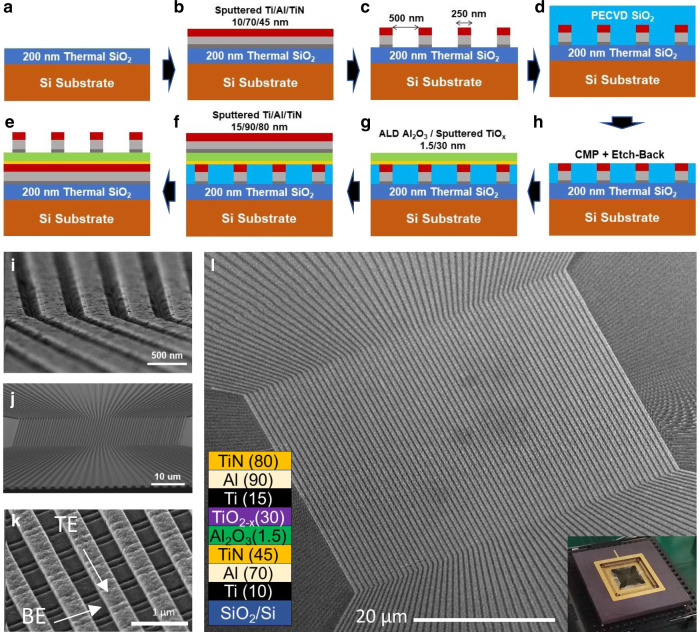
The superior density of passive analog-grade memristive crossbar circuits enables storing large neural network models directly on specialized neuromorphic chips to avoid costly off-chip communication. To ensure efficient use of such circuits in neuromorphic systems, memristor variations must be substantially lower than those of active memory devices. Here we report a 64 × 64 passive crossbar circuit with ~99% functional nonvolatile metal-oxide memristors. The fabrication technology is based on a foundry-compatible process with etch-down patterning and a low-temperature budget. The achieved <26% coefficient of variance in memristor switching voltages is sufficient for programming a 4K-pixel gray-scale pattern with a <4% relative tuning error on average. Analog properties are also successfully verified via experimental demonstration of a 64 × 10 vector-by-matrix multiplication with an average 1% relative conductance import accuracy to model the MNIST image classification by ex-situ trained single-layer perceptron, and modeling of a large-scale multilayer perceptron classifier based on more advanced conductance tuning algorithm.
Overview
CoChat Summary
## TL;DR
This paper reports a foundry-compatible 64 × 64 passive metal-oxide memristor crossbar with ~99% functional devices and low enough variation to support analog tuning and in-memory vector-by-matrix multiplication. The authors demonstrate 4K gray-scale pattern programming with <4% average relative error, a 64 × 10 MNIST classifier with ~1% average relative conductance import accuracy, and simulations showing algorithmic gains against device variation.
## Key findings
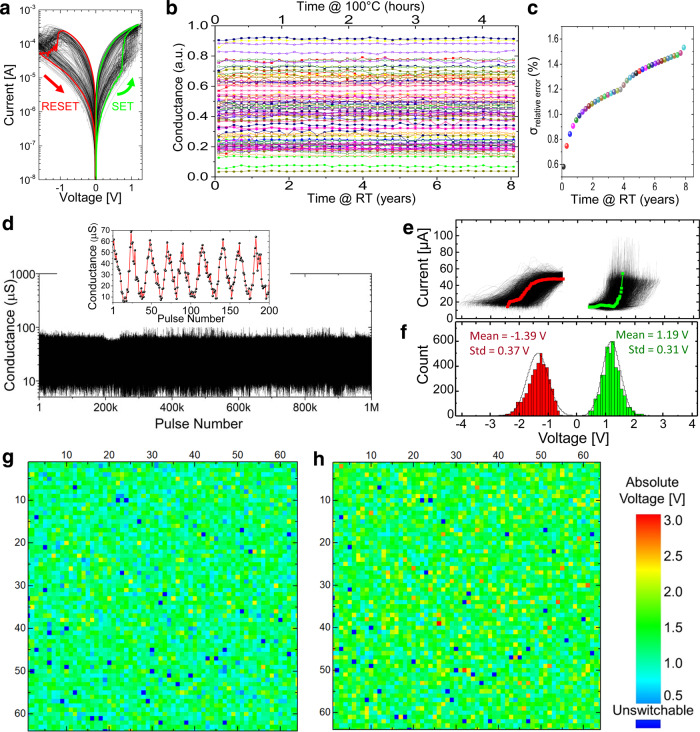
- The fabricated 64 × 64 passive crossbar had ~99% functional nonvolatile memristors, and only 45 devices were unswitchable, i.e. ~1.125% of the array.
- Device switching thresholds averaged 1.19 V for set and –1.39 V for reset, with standard deviations of 0.31 V and 0.37 V; the device-to-device switching-voltage coefficient of variance was <26%.
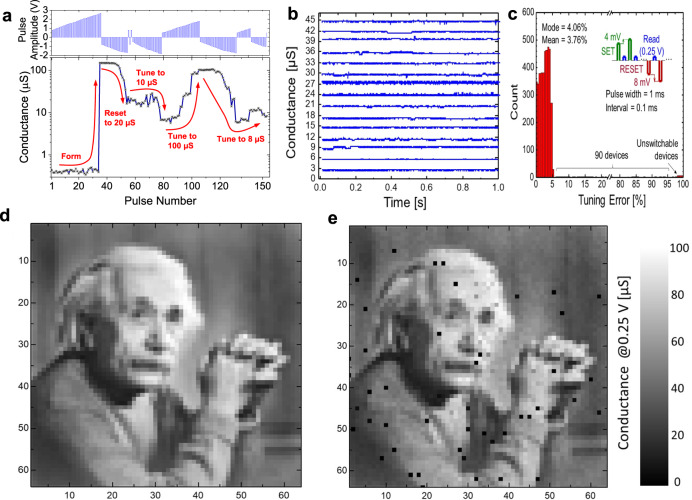
- The tuning algorithm programmed an Einstein gray-scale image on the full array: excluding unswitchable devices, ~98% of devices were tuned within 5% relative error, with an average relative error of ~3.76%; the abstract also states <4% average relative tuning error for a 4K-pixel gray-scale pattern.
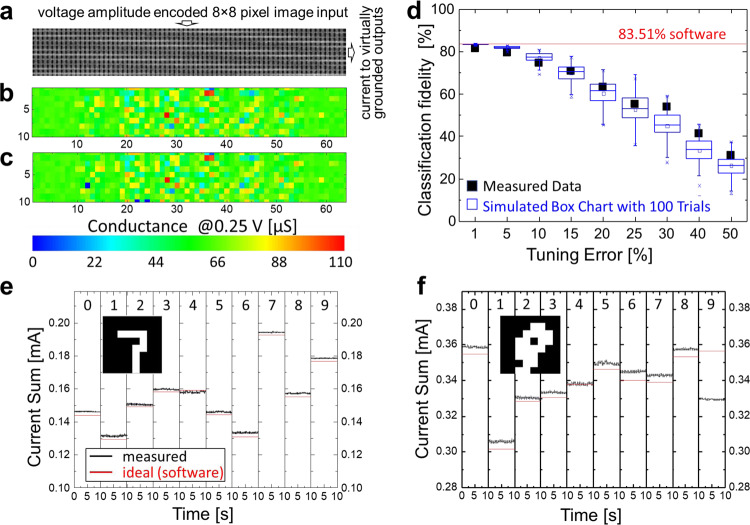
- In the 64 × 10 MNIST single-layer perceptron demo, the average relative conductance import accuracy was ~1%; the measured classifier accuracy was 1.87% lower than the ideal software model for the most accurate weight import.
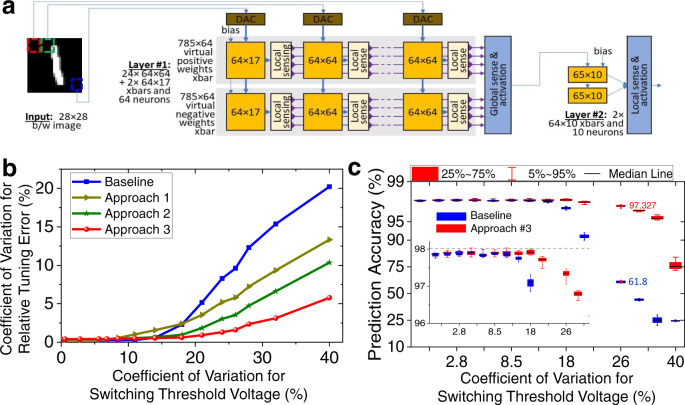
- For the modeled multilayer perceptron, the advanced tuning approach improved tuning accuracy by 9% versus baseline at 26% device variation, and increased the tolerable variation for no classification loss from ~14% to ~20%; the baseline classifier accuracy at 26% variation improved to ~97.3%.
## Methods
- The paper combines fabrication, electrical characterization, conductance tuning experiments, and modeling of ex-situ-trained neural-network inference circuits.
- The device sample is a 64 × 64 passive crossbar on a 4-inch Si wafer, built from Ti/Al/TiN electrodes and an Al2O3/TiO2−x switching stack, with 500 devices used for retention testing and 500 crossbar-integrated memristors used to fit the conductance-change model.
- Electrical measurements used a Keysight B1500A analyzer and switching matrix; the MNIST hardware demo used a 64 × 10 single-layer perceptron trained on 60,000 training and 10,000 8 × 8 down-sampled test images, and the modeling study used an ex-situ-trained 784-64-10 multilayer perceptron with differential conductance mapping and simulated tuning algorithms.
## Limitations
- The authors state that the demonstrated MNIST classifier was “quite low” in accuracy compared to state-of-the-art, because it used a single-layer network and down-sampled black/white images.
- The paper explicitly notes that the experiment demonstrating classifier fidelity was aimed at conductance tuning capability rather than high classification accuracy.
- Evident from the text: 45 unswitchable devices remained in the array, and these devices contributed to tuning error and one misclassified MNIST example.
- Evident from the text: retention is reported via accelerated tests at 100 °C with extrapolation to room temperature, so the room-temperature lifetime claims are inferred rather than directly measured.
Model-written summary. Check it against the paper before relying on it.
Integrity signals
Registry
Cites
Statistics
Figures
Verification
Claims the paper makes
7 Valid · 1 Not valid · 10 Not checked · 60 Own results and interpretations
Every source the paper cites for this claim was checked and supports it.
In the paper
“The developed circuits have ten times more devices and excellent uniformity allowing for significantly better array-scale conductance tuning precision as compared to the previous work24 that reported the largest passive analog-grade memristive crossbar circuits with detailed characterization statistics.”
§ 4K-memristor analog-grade passive crossbar circuit > Introduction
What the sources say
- Supportedcites [24] Merrikh Bayat F Implementation of multilayer perceptron network with highly uniform passive memristive crossbar circuits Nat. Commun. 2018 9 2331 10.1038/s41467-018-04482-4 29899421 PMC5998062 source
In Results > Integrated memristors (page not provided), the paper reports uniform devices whose narrow switching-voltage distributions allow precise conductance tuning across the whole array. It also says earlier passive-memristor demonstrations achieved analog tuning with much cruder precision. (LLM, conf=0.91)
plainstates a cause- Asserted: passes — The authors put it forward as true.
- Checkable: passes — It can be checked against evidence.
- Load-bearing: passes — The paper’s conclusions depend on it.
- Based: passes — The paper gives a reason why it holds.
- Supported
The cited sources support only part of this claim — read each source’s verdict below.
In the paper
“The developed circuits have ten times more devices and excellent uniformity allowing for significantly better array-scale conductance tuning precision as compared to the previous work24 that reported the largest passive analog-grade memristive crossbar circuits with detailed characterization statistics.”
§ 4K-memristor analog-grade passive crossbar circuit > Introduction
What the sources say
- Partly supportedcites [24] Merrikh Bayat F Implementation of multilayer perceptron network with highly uniform passive memristive crossbar circuits Nat. Commun. 2018 9 2331 10.1038/s41467-018-04482-4 29899421 PMC5998062 sourceExperimental — accuracy not yet measured
The Results (Integrated memristors; page unavailable) identify the cited paper’s arrays as 20 × 20 crossbars, or 400 devices each. That establishes the size of the previous work, but this paper cannot verify how many devices the citing authors’ later circuits have, so the tenfold comparison is not established by this source alone. (LLM, conf=0.80)
plain- Asserted: passes — The authors put it forward as true.
- Checkable: passes — It can be checked against evidence.
- Load-bearing: passes — The paper’s conclusions depend on it.
- Based: passes — The paper gives a reason why it holds.
- Partly supported
The cited sources support only part of this claim — read each source’s verdict below.
In the paper
“The progress in the most prospective, passive analog-grade ReRAM circuits13,17,21,22,24, however, has been much slower, mainly because of much stricter requirements for the uniformity of memory cells’ I–V characteristics (Supplementary Fig. 1).”
§ 4K-memristor analog-grade passive crossbar circuit > Introduction
What the sources say
- Not checked — no full text of the sourcecites [13] Yeon H Alloying conducting channels for reliable neuromorphic computing Nat. Nanotechnol. 2020 15 574 579 10.1038/s41565-020-0694-5 32514010 source
- Partly supportedcites [17] Prezioso M Training and operation of an integrated neuromorphic network based on metal-oxide memristors Nature 2015 521 61 64 10.1038/nature14441 25951284 sourceExperimental — accuracy not yet measured
The introduction (p. 2) says device variability was the main reason earlier memristive neuromorphic networks needed external wires or a transistor at each crosspoint. The fabrication section (p. 3) identifies reduced variability as key to this paper’s transistor-free crossbar. These passages support uniformity as a barrier, but do not establish that progress in passive analog-grade ReRAM circuits was slower than progress elsewhere or that their uniformity requirements were comparatively stricter. (LLM, conf=0.83)
- Not checked — no full text of the sourcecites [21] Sheridan PM Sparse coding with memristor networks Nat. Nanotechnol. 2017 12 784 789 10.1038/nnano.2017.83 28530717 source
- Not checked — no full text of the sourcecites [22] Adam GC 3-D memristor crossbars for analog and neuromorphic computing applications IEEE Trans. Electron Devices 2017 64 312 318 10.1109/TED.2016.2630925 source
- Partly supportedcites [24] Merrikh Bayat F Implementation of multilayer perceptron network with highly uniform passive memristive crossbar circuits Nat. Commun. 2018 9 2331 10.1038/s41467-018-04482-4 29899421 PMC5998062 sourceExperimental — accuracy not yet measured
The Introduction says reports of neuromorphic functionality using passive 0T1R or 1D1R circuits have been very limited, in part because successful operation requires much stricter memristor I–V uniformity. This supports the slower-progress comparison and the role of uniformity, but not the claim that uniformity was mainly responsible. (LLM, conf=0.87)
plainstates a cause- Asserted: passes — The authors put it forward as true.
- Checkable: passes — It can be checked against evidence.
- Load-bearing: unclear — It is unclear whether the paper’s conclusions depend on it.
- Based: passes — The paper gives a reason why it holds.
The cited sources support only part of this claim — read each source’s verdict below.
In the paper
“the former can be achieved by reducing leakages within the device and between neighboring lines, e.g., by patterning the active switching layer and scaling down device feature sizes24, and making higher-aspect ratio electrodes”
§ 4K-memristor analog-grade passive crossbar circuit > Discussion
What the sources say
- Partly supportedcites [24] Merrikh Bayat F Implementation of multilayer perceptron network with highly uniform passive memristive crossbar circuits Nat. Commun. 2018 9 2331 10.1038/s41467-018-04482-4 29899421 PMC5998062 sourceExperimental — accuracy not yet measured
The Introduction says memristor footprints may be scaled below 10 nm, and Results > Integrated memristors describes limiting crossbar leakage currents and reducing electrode resistance. Neither passage says that scaling down devices or patterning the active switching layer reduces leakage within devices or between neighboring lines. The paper also does not link higher-aspect-ratio electrodes to the claimed conductance ratio. (LLM, conf=0.82)
plainstates a cause- Asserted: passes — The authors put it forward as true.
- Checkable: passes — It can be checked against evidence.
- Load-bearing: unclear — It is unclear whether the paper’s conclusions depend on it.
- Based: passes — The paper gives a reason why it holds.
- Partly supported
A result the paper reports from its own data — it cites no other source for it, so there is none to check. The quote shows it is in the paper.
In the paper
“Excluding unswitchable devices, for which the error is more than 95%, ~98% of the devices are tuned within 5% relative error, while the average relative error is ~3.76%.”
§ 4K-memristor analog-grade passive crossbar circuit > Results > Conductance tuning experiments
plain- Asserted: passes — The authors put it forward as true.
- Checkable: passes — It can be checked against evidence.
- Load-bearing: passes — The paper’s conclusions depend on it.
- Based: passes — The paper gives a reason why it holds.
44 more claims
Create a free account to see all 78 claims and to verify the 1 reference still open.
- Probably not a substantial claim. 13
- It may state two separate claims as one. 20
Claims other papers make about this one
Each is checked against this paper’s own text: does it say what the citing paper says it does?
The source backs part of the claim, not all of it — or backs it for a different population, condition or comparison.
In the citing paper
“For instance, given the MNIST dataset in which images have a resolution of 28 × 28 pixels one option is to implement the synaptic layer using multiple crossbars to fit the 784 inputs (e.g., 13 64 × 64 or 4 256 × 256 crossbars would be needed93).”
From Hardware implementation of memristor-based artificial neural networks (2024) · cites this paper as [93]
Experimental — accuracy not yet measuredThe source backs part of the claim, not all of it — or backs it for a different population, condition or comparison.
In the citing paper
“Ex situ training has the advantage of requiring little/no circuit overhead to perform quick tests of the classification performance of the network”
From Hardware implementation of memristor-based artificial neural networks (2024) · cites this paper as [93]
Experimental — accuracy not yet measuredThe source backs part of the claim, not all of it — or backs it for a different population, condition or comparison.
In the citing paper
“Crossbar arrays of two-terminal metal/insulator/metal (MIM) memristive devices can be fabricated easily using standard lithography and deposition techniques; this has been readily achieved by multiple groups57,64,68–70,85,93,105,216,217.”
From Hardware implementation of memristor-based artificial neural networks (2024) · cites this paper as [93]
Experimental — accuracy not yet measuredThe source backs part of the claim, not all of it — or backs it for a different population, condition or comparison.
In the citing paper
“A cost-effective recurrent solution has been to use a smaller number of DACs and share them among different rows by adding a layer of analogue multiplexors between the DACs and the wordline inputs93,95,221. With this approach (which we could refer to as On-chip time-multiplexed analogue input – Analogue/Multilevel weights), a given VMM operation is divided in n different sub-VMM operations and the”
From Hardware implementation of memristor-based artificial neural networks (2024) · cites this paper as [93]
Experimental — accuracy not yet measuredThe cited source says what the claim attributes to it.
In the citing paper
“and has made possible to evaluate the performance of home-made memristive crossbar-arrays93,188.”
From Hardware implementation of memristor-based artificial neural networks (2024) · cites this paper as [93]
Citations
Cites
Training and operation of an integrated neuromorphic network based on metal-oxide memristors
Prezioso, M., Merrikh-Bayat, F., Hoskins, B. D., Adam, G. C., Likharev, K. K., & Strukov, D. B. (2015) · Nature · doi:10.1038/nature14441 · Cited by 3,001 · cited 7×
“However, the progress in the most prospective, passive analog-grade ReRAM circuits has been much slower [14, 15, 17, 21], mainly because of much harsher requirements for the uniformity of memory cells’ I-V characteristics [39].”
BackgroundMethodInfluentialSelf-citationFully hardware-implemented memristor convolutional neural network
Yao, P., Wu, H., Gao, B., Tang, J., Zhang, Q., Zhang, W., Yang, J. J., & Qian, H. (2020) · Nature · doi:10.1038/s41586-020-1942-4 · Cited by 2,179 · cited 1×
“…demonstrations from academia and industry of using such active memories in neuromorphic computing circuits — see e.g. refs., 18 – 20, 23 , 25 – 27 , The progress in the most prospective, passive analog-grade ReRAM circuits 13,17,21,22,24 , however, has been much slower, mainly because of much…”
BackgroundMemristive crossbar arrays for brain-inspired computing
Xia, Q., & Yang, J. J. (2019) · Nature Materials · doi:10.1038/s41563-019-0291-x · Cited by 1,800
Google’s Multilingual Neural Machine Translation System: Enabling Zero-Shot Translation
Johnson, M., Schuster, M., Le, Q. V., Krikun, M., Wu, Y., Chen, Z., Thorat, N., Viégas, F., Wattenberg, M., Corrado, G., et al. (2017) · Transactions of the Association for Computational Linguistics · doi:10.1162/tacl_a_00065 · Cited by 1,747
Neuro-Inspired Computing With Emerging Nonvolatile Memorys
Yu, S. (2018) · Proceedings of the IEEE · doi:10.1109/jproc.2018.2790840 · Cited by 1,170
Neuromorphic computing using non-volatile memory
Burr, G. W., Shelby, R. M., Sebastian, A., Kim, S., Kim, S., Sidler, S., Virwani, K., Ishii, M., Narayanan, P., Fumarola, A., et al. (2017) · Advances in Physics: X · doi:10.1080/23746149.2016.1259585 · Cited by 1,107
Burr, G. W., Shelby, R. M., Sidler, S., di Nolfo, C., Jang, J., Boybat, I., Shenoy, R. S., Narayanan, P., Virwani, K., Giacometti, E. U., et al. (2015) · IEEE Transactions on Electron Devices · doi:10.1109/ted.2015.2439635 · Cited by 936 · cited 1×
“Analog-grade nonvoltaile memories, such as those based on floating-gate transistor [13], and phase-change [4-6], ferroelectric [7, 8], magnetic [9], solid-state electrolyte [10, 11], organic [12], and metal-oxide [13-21] materials, are enabling components for mixed-signal circuits implementing vector-by-martix multipl…”
BackgroundOutrageously Large Neural Networks: The Sparsely-Gated Mixture-of-Experts Layer
Shazeer, N., Mirhoseini, A., Maziarz, K., Davis, A., Le, Q., Hinton, G., & Dean, J. (2017) · arXiv · doi:10.48550/arxiv.1701.06538 · Cited by 933 · cited 1×
“V uniformity results with very tight variations were reported for stand-alone devices based on organic 15 and epitaxial 11 materials.”
BackgroundKim, K.-H., Gaba, S., Wheeler, D., Cruz-Albrecht, J. M., Hussain, T., Srinivasa, N., & Lu, W. (2012) · Nano Letters · doi:10.1021/nl203687n · Cited by 924 · cited 1×
“12 .”
Face classification using electronic synapses
Yao, P., Wu, H., Gao, B., Eryilmaz, S. B., Huang, X., Zhang, W., Zhang, Q., Deng, N., Shi, L., Wong, H.-S. P., et al. (2017) · Nature Communications · doi:10.1038/ncomms15199 · Cited by 909 · cited 2×
“…(1T), and numerous demonstrations from academia and industry of using such active memories in neuromorphic computing circuits — see e.g. refs., 18 – 20, 23 , 25 – 27 , The progress in the most prospective, passive analog-grade ReRAM circuits 13,17,21,22,24 , however, has been much slower, mainly…”
BackgroundMethod
Research works printed but not linked: 1
- Burr GW Neuromorphic computing using nonvolatile memory Adv. Phys. 2017 2 89 124
Cited by
Items 101–200 of 252
Dong, Z., Qian, L., Li, Q., Liu, Z., Guo, J., Wang, L., Wu, S., Xiong, R., Liu, Y., & He, C. (2025) · Applied Surface Science · doi:10.1016/j.apsusc.2025.162295 · Cited by 12
Implementation of Kalman Filtering with Spiking Neural Networks
Juárez-Lora, J. A., García-Sebastián, L. M., Ponce-Ponce, V. H., Rubio-Espino, E., Molina-Lozano, H., & Sossa, H. (2022) · Sensors · doi:10.3390/s22228845 · Cited by 15
True random number generator using stochastic noise signal of memristor with variation tolerance
Yu, D., Ahn, S., Youn, S., Park, J., & Kim, H. (2024) · Chaos Solitons & Fractals · doi:10.1016/j.chaos.2024.115708 · Cited by 16
Self-citationConfigurable Kernel Map Implementation in Memristor Crossbar for Convolution Neural Network
Kim, G., Youn, S., Park, J., & Kim, H. (2025) · Advanced Intelligent Systems · doi:10.1002/aisy.202500032 · Cited by 14
Self-citationIn-sensor neuromorphic computing using perovskites and transition metal dichalcogenides
Li, S.-Y., Li, J.-T., Zhou, K., Yan, Y., Ding, G., Han, S., & Zhou, Y. (2024) · Journal of Physics Materials · doi:10.1088/2515-7639/ad5251 · Cited by 15
Memristor-Based Cryogenic Programmable DC Sources for Scalable In Situ Quantum-Dot Control
Mouny, P.-A., Beilliard, Y., Graveline, S., Roux, M.-A., Mesoudy, A. E., Dawant, R., Gliech, P., Ecoffey, S., Alibart, F., Pioro-Ladrière, M., et al. (2023) · IEEE Transactions on Electron Devices · doi:10.1109/ted.2023.3244133 · Cited by 15
Oxide Memristors for ReRAM: Approaches, Characteristics, and Structures
Isaev, A. G., Permyakova, O. O., & Rogozhin, A. E. (2023) · Russian Microelectronics · doi:10.1134/s1063739723700257 · Cited by 12
Mouny, P.-A., Dawant, R., Galaup, B., Ecoffey, S., Pioro-Ladrière, M., Beilliard, Y., & Drouin, D. (2023) · Applied Physics Letters · doi:10.1063/5.0170058 · Cited by 11
Efficient Hybrid Training Method for Neuromorphic Hardware Using Analog Nonvolatile Memory
Kwon, D., Woo, S. Y., Hwang, J., Kim, H., Bae, J., Shin, W., Park, B., & Lee, J. (2023) · IEEE Transactions on Neural Networks and Learning Systems · doi:10.1109/tnnls.2023.3327906 · Cited by 10
Self-citationCao, T., Yu, W., Gao, Y., Liu, C., Yan, S., & Goh, W. L. (2023) · IEEE International Symposium on Circuits and Systems proceedings · doi:10.1109/iscas46773.2023.10181612 · Cited by 13
Mechanism Analysis and Highly Scaled Aluminum Nitride‐Based Self‐Rectifying Memristors
Zhang, K., Zhao, X., Han, Y., Hu, K., Zhang, Y., Li, L., Zhou, Q., Shan, X., Lin, X., Shan, K., et al. (2022) · Advanced Electronic Materials · doi:10.1002/aelm.202200702 · Cited by 8
Actor–critic networks with analogue memristors mimicking reward-based learning
Portner, K., Zellweger, T., Martinelli, F., Bégon‐Lours, L., Bragaglia, V., Weilenmann, C., Jubin, D., Falcone, D. F., Hermann, F., Hrynkevych, O., et al. (2025) · Nature Machine Intelligence · doi:10.1038/s42256-025-01149-w · Cited by 21
Emerging memory devices for neuromorphic computing in the Internet of Medical Things
Cao, T., Shen, C., Wang, D., Zhao, H.-N., Tan, R., Zhou, Z., Li, H., Li, B., Zhao, M., & Huang, H. (2025) · Cell Reports Physical Science · doi:10.1016/j.xcrp.2025.102735 · Cited by 15
Ion Migration Control in Lead‐Free Halide Perovskite Transistors for Logic and Neuromorphic Circuits
Fernandes, J. M., & Dutta, S. (2025) · Small · doi:10.1002/smll.202509737 · Cited by 13
Passive LiNbO₃ Memristor With Multilevel States for Neuromorphic Computing
Xie, Q., Pan, X., Wang, Y., Luo, W., Zhao, Z., Tong, J., Yang, X., Shuai, Y., Wu, C., & Zhang, W. (2024) · IEEE Transactions on Electron Devices · doi:10.1109/ted.2024.3450437 · Cited by 8
Rafiq, M., Chauhan, Y. S., & Sahay, S. (2024) · IEEE Journal of the Electron Devices Society · doi:10.1109/jeds.2024.3416441 · Cited by 10
Towards Energy-Efficient Computing Hardware Based on Memristive Nanodevices
Huang, Y., Ravichandran, V., Zhao, W., & Xia, Q. (2023) · IEEE Nanotechnology Magazine · doi:10.1109/mnano.2023.3297106 · Cited by 9
Effect of Hydrogen Migration in SiO2/Al2O3 Stacked Gate Insulator of InGaZnO Thin-Film Transistors
Park, S., Youn, S., Jang, J. T., Kim, H., & Kim, D. H. (2022) · Crystals · doi:10.3390/cryst12050594 · Cited by 9
Self-citationZhang, W., Xu, J., Wang, Y., Zhang, Y., Wang, Y., Li, P., Jia, Y., Zhao, Z., Li, C., Yang, B., et al. (2025) · Journal of Materiomics · doi:10.1016/j.jmat.2025.101051 · Cited by 11
Energy Efficient Memristive Transiently Chaotic Neural Network for Combinatorial Optimization
Bao, H., Ren, P., Xu, K., Yang, L., Zhou, H., Li, J., Li, Y., & Miao, X. (2024) · IEEE Transactions on Circuits and Systems I Regular Papers · doi:10.1109/tcsi.2024.3406167 · Cited by 10
LRS retention fail based on joule heating effect in InGaZnO resistive-switching random access memory
Jang, J. T., Ahn, G., Choi, S., Kim, D. M., Kim, H., & Kim, D. H. (2020) · Applied Physics Express · doi:10.35848/1882-0786/ab88c1 · Cited by 8
Self-citationLiu, Z., Gao, C., Yang, J., Chen, Z., Li, E., Li, J., Li, M., & Zhang, J. (2025) · International Journal of Extreme Manufacturing · doi:10.1088/2631-7990/ae053a · Cited by 18
Spatiotemporal Reservoir Computing with a Reconfigurable Multifunctional Memristor Array
Kim, S., Shin, D. H., Choi, W., Cheong, S., Shim, S. K., Lee, S. H., Han, J., Jang, Y. H., Son, K., Ghenzi, N., et al. (2025) · Advanced Materials · doi:10.1002/adma.202510635 · Cited by 13
Randrıanantenaına, J. L., Baran, A. Y., Korkmaz, N., & Kılıç, R. (2023) · Journal of Circuits Systems and Computers · doi:10.1142/s0218126624501135 · Cited by 9
Damascene versus subtractive line CMP process for resistive memory crossbars BEOL integration
Dawant, R., Gaudreau, M., Roy, M.-A., Mouny, P.-A., Valdenaire, M., Gliech, P., Arias‐Zapata, J., Zegaoui, M., Alibart, F., Drouin, D., et al. (2024) · Micro and Nano Engineering · doi:10.1016/j.mne.2024.100251 · Cited by 8
CBRAM based on CVD-grown MoSe2 with the coexistence of volatile and non-volatile resistive switching
Wu, S., Singh, J. V., Schalip, R., Nibhanupudi, S. S. T., Roy, A., & Banerjee, S. K. (2025) · Journal of Applied Physics · doi:10.1063/5.0248966 · Cited by 8
Strategies of high-accuracy memristor-based analogue computing in memory for artificial intelligence
Jiang, Z., Zhao, H., Tang, J., Lu, Y., Qin, Q., Wang, Z., Hu, R., Yu, R., He, Y., Zhang, J., et al. (2026) · Nature Materials · doi:10.1038/s41563-026-02600-y · Cited by 12
Cryogenic Evaluation of Resistive Random Access Memory With Enhanced Endurance at 14 K
Ram, M. S., Ram, M. K., & Wernersson, L. (2024) · IEEE Transactions on Electron Devices · doi:10.1109/ted.2024.3520948 · Cited by 11
Coupling-Free Readout Scheme for Memcapacitors With NAND Flash Structure
Ahn, S., Yu, J., Hwang, H., Song, M. S., Yu, D., Hwang, S., Chung, I.-Y., Choi, W. Y., & Kim, H. (2024) · IEEE Transactions on Electron Devices · doi:10.1109/ted.2024.3418289 · Cited by 6
Self-citationNext-generation reservoir computing based on memristor array
Ren, K., Zhang, W., Wang, F., Guo, Z., & Shang, D. (2022) · Acta Physica Sinica · doi:10.7498/aps.71.20220082 · Cited by 8
Bhardwaj, K., Paasio, E., & Majumdar, S. (2025) · Advanced Intelligent Discovery · doi:10.1002/aidi.202500143 · Cited by 7
Kumar, S., Yadav, D., Stathopoulos, S., & Prodromakis, T. (2025) · Frontiers in Nanotechnology · doi:10.3389/fnano.2025.1621554 · Cited by 6
Jang, J., & Gi, S.-G. (2025) · Advanced Materials Technologies · doi:10.1002/admt.202500588 · Cited by 13
Dawant, R., Ecoffey, S., & Drouin, D. (2022) · Journal of Vacuum Science & Technology B Nanotechnology and Microelectronics Materials Processing Measurement and Phenomena · doi:10.1116/6.0002116 · Cited by 6
Fuse Devices for Pruning in Memristive Neural Network
Kim, T., Hong, K., Kim, S., Park, J., Youn, S., Lee, J., Park, B., Kim, H., & Choi, W. Y. (2023) · IEEE Electron Device Letters · doi:10.1109/led.2023.3237651 · Cited by 5
Self-citationCai, Y., Yu, W., Zhu, Q., Liu, X., Guo, X., & Liang, W. (2025) · Nanoscale · doi:10.1039/d5nr01019e · Cited by 7
Conductance‐Dependent Photoresponse in a Dynamic SrTiO 3 Memristor for Biorealistic Computing
Weilenmann, C., He, H., Mladenović, M., Zellweger, T., Portner, K., Bauer, K., Bellec, G., Luisier, M., & Emboras, A. (2026) · Advanced Functional Materials · doi:10.1002/adfm.202526153 · Cited by 6
Dynamics of neural motifs realized with a minimal memristive neurosynaptic unit
Wu, J., d’Hollande, A., Du, H., & Rozenberg, M. J. (2025) · Physical Review Applied · doi:10.1103/physrevapplied.23.034030 · Cited by 7
Kwon, D., Park, M., Kang, W.-M., Hwang, J., Koo, R., Bae, J., & Lee, J. (2023) · IEEE Transactions on Electron Devices · doi:10.1109/ted.2023.3287824 · Cited by 6
Youn, S., Kim, K., Park, J., & Kim, H. (2025) · Nano Energy · doi:10.1016/j.nanoen.2025.111633 · Cited by 9
Self-citationWang, X., Valov, I., & Li, H. (2024) · Advanced Electronic Materials · doi:10.1002/aelm.202300850 · Cited by 8
Woo, J. S., Jung, C. L., Chang, J. H., Ryu, M., & Choi, W. Y. (2024) · Advanced Electronic Materials · doi:10.1002/aelm.202400606 · Cited by 5
Dynamics of Analog Switching Behavior in Thin Polycrystalline Barium Titanate
Andreeva, N. V., Ryndin, E. A., Petukhov, A. E., Vilkov, O. Y., & Al‐Saman, A. A. (2024) · Advanced Electronic Materials · doi:10.1002/aelm.202300806 · Cited by 5
Huang, M., Jiang, P., Wang, C., Wang, M., Ma, Y., Gan, Z., Yang, Y., Miao, X., & Wang, X. (2024) · IEEE Transactions on Electron Devices · doi:10.1109/ted.2024.3406310 · Cited by 5
Reservoir computing with a random memristor crossbar array
Wang, X., & Li, H. (2024) · Nanotechnology · doi:10.1088/1361-6528/ad61ee · Cited by 6
Lei, Y., Zhang, T., Qian, F., Chen, L., He, Y., Ma, W., Wu, Y., & Li, S. (2025) · Laser & Photonics Review · doi:10.1002/lpor.202502338 · Cited by 15
Non-volatile resistive switching characteristics in Cu 2− x S-based memristor
Lee, S., Byeon, J., Park, S., et al. (2025) · Nanoscale · doi:10.1039/d5nr02524a · Cited by 4
SDEX: Monte Carlo Simulation of Stochastic Differential Equations on Memristor Crossbars
Primeau, L., Amirsoleimani, A., & Genov, R. (2022) · IEEE International Symposium on Circuits and Systems proceedings · doi:10.1109/iscas48785.2022.9937861 · Cited by 4
Maldonado, D., Cantudo, A., Reddy, K. D. S., Pechmann, S., Uhlmann, M., Wenger, C., Roldán, J. B., & Pérez, E. (2024) · Materials Science in Semiconductor Processing · doi:10.1016/j.mssp.2024.108726 · Cited by 5
Jiang, N., Jiang, M., Huang, H., Yang, L., Huang, Y., & Zeng, Z. (2025) · IEEE Transactions on Circuits and Systems I Regular Papers · doi:10.1109/tcsi.2025.3544554 · Cited by 7
Woo, J. S., Jung, C. L., Nam, K. R., & Choi, W. Y. (2023) · Advanced Intelligent Systems · doi:10.1002/aisy.202300242 · Cited by 4
Possibilities and Limitations of Memristor Crossbars for Neuromorphic Computing
Telminov, O. A., & Gornev, E. (2022) · Scientific School Dynamics of Complex Networks and their Applications (DCNA) · doi:10.1109/dcna56428.2022.9923302 · Cited by 4
Double Dielectric Layer Metal-oxide Memristor: Design and Applications
Junqi, Y. O. U., Li, C., Yang, D., & Sun, L. (2023) · Journal of Inorganic Materials · doi:10.15541/jim20220760 · Cited by 4
Dynamic memristor array with multiple reservoir states for training efficient neuromorphic computing
Noh, M., Ju, D., & Kim, S. (2024) · Journal of Materials Chemistry C · doi:10.1039/d4tc02324b · Cited by 4
Jang, J., Song, Y., & Park, S. (2024) · Advanced Intelligent Systems · doi:10.1002/aisy.202400710 · Cited by 5
Park, J., Lee, J., Youn, S., & Kim, H. (2025) · Advanced Intelligent Systems · doi:10.1002/aisy.202501001 · Cited by 7
Self-citationYoun, S., Hwang, H., & Kim, H. (2025) · Advanced Intelligent Systems · doi:10.1002/aisy.202500817 · Cited by 8
Self-citationKernel Mapping Methods of Convolutional Neural Network in 3D NAND Flash Architecture
Song, M. S., Hwang, H., Lee, G. H., Ahn, S., Hwang, S., & Kim, H. (2023) · Electronics · doi:10.3390/electronics12234796 · Cited by 3
Self-citationThermal Crosstalk Analysis in ReRAM Passive Crossbar Arrays
Pande, S. R., Chakrabarti, B., & Chakravorty, A. (2024) · International Conference on VLSI Design · doi:10.1109/vlsid60093.2024.00071 · Cited by 6
Lee, D. H., Ko, K., So, M., Jung, Y., Gasparini, N., Yoo, H., Oh, S., Choi, J., & Kim, D. C. (2026) · Synthetic Metals · doi:10.1016/j.synthmet.2026.118120 · Cited by 4
Brain-inspired neural networks: neuromorphic devices and their practical applications
Wang, Y., Yan, T., Li, Y., Cai, Y.-B., Zhang, P., Cao, M., Wang, F., Zhan, X., & Wang, Z. (2025) · Nanotechnology · doi:10.1088/1361-6528/ae1840 · Cited by 4
In-Memory Computing with Crosspoint Resistive Memory Arrays for Machine Learning
Ricci, S., Mannocci, P., Farronato, M., & Ielmini, D. (2023) · Lecture notes in electrical engineering · doi:10.1007/978-3-031-26066-7_6 · Cited by 5
Bit slicing approaches for variability aware ReRAM CIM macros
Bengel, C., Dixius, L., Waser, R. M., Wouters, D. J., & Menzel, S. (2023) · it - Information Technology · doi:10.1515/itit-2023-0018 · Cited by 4
Wang, L., Li, Y., Mou, H., Chen, Z., Li, C., & Wang, W. J. (2025) · Journal of Physics D Applied Physics · doi:10.1088/1361-6463/add0c2 · Cited by 4
Ternary Neural Networks Based on on/off Memristors: Set-Up and Training
Morell, A., Machado, E. D., Miranda, E. A., Boquet, G., & Vicario, J. L. (2022) · Electronics · doi:10.3390/electronics11101526 · Cited by 3
Laser writing of memristive logic gates and crossbar arrays
Jones, J., Mao, N., & Peng, P. (2024) · Journal of Laser Applications · doi:10.2351/7.0001345 · Cited by 3
Baek, M.-H., & Kim, H. (2023) · Biomimetics · doi:10.3390/biomimetics8040368 · Cited by 3
Self-citationOrganic neuromorphic electronics powering intelligent sensory and edge computing systems
Woo, S., Chung, M., Song, H. W., Kim, S., Lee, E. K., & Oh, J. H. (2026) · InfoMat · doi:10.1002/inf2.70118 · Cited by 7
Power efficient MoS2 synaptic devices based on Maxwell–Wagner interfacial charging in binary oxides
Zou, J., Lin, S., Huang, T., Liu, H., Liu, Y., Zhong, Y., Lin, Y. C., Wang, H., Shen, S., Xu, M., et al. (2023) · 2D Materials · doi:10.1088/2053-1583/ad015f · Cited by 3
Youn, S., Hwang, H., & Kim, H. (2025) · Journal of Alloys and Compounds · doi:10.1016/j.jallcom.2025.185701 · Cited by 6
Self-citationBrain-inspired neuromorphic electronics of 2D materials: synapses to hardware systems
Elahi, E., Khan, M. F., Asim, M., Assiri, M. A., Aziz, J., Jamil, M., & Sofer, Z. (2026) · Coordination Chemistry Reviews · doi:10.1016/j.ccr.2026.218310 · Cited by 2
Architecture and Technology of Neuromorphic Memristive Chips
Andreeva, N. V., Luchinin, V. V., Ryndin, E. A., Anchkov, M. G., Romanov, A. A., Чигирев, Д. А., Mazing, D. S., Gerasimova, M. I., Sevost’yanov, E. N., Trushlyakova, V. V., et al. (2022) · Nanobiotechnology Reports · doi:10.1134/s2635167622070035 · Cited by 2
Weaving Intelligence: Thermally Drawn Multimaterial Fibers Toward AI‐Enabled Smart Textiles
Trung, V. D., Yi, J., Nguyen-Duc, H., Lo, T. N. H., Zhao, W., Dong, C., Sorin, F., Çağlar, B., Wei, L., & Nguyen-Dang, T. (2026) · Advanced Materials · doi:10.1002/adma.73574 · Cited by 5
A memristive neural decoder for cryogenic fault-tolerant quantum error correction
Yon, V., Marcotte, F., Mouny, P.-A., Dagnew, G. A., Kulchytskyy, B., Rochette, S., Beilliard, Y., Drouin, D., & Ronagh, P. (2025) · Quantum Science and Technology · doi:10.1088/2058-9565/adc3ba · Cited by 11
Xie, Q., Pan, X., Luo, W., Shuai, Y., Wang, Y., Tong, J., Zhao, Z., Wu, C., & Zhang, W. (2024) · Advanced Electronic Materials · doi:10.1002/aelm.202400651 · Cited by 2
Moazzeni, A., Madvar, H. R., Hamedi, S., & Kordrostami, Z. (2025) · Scientific Reports · doi:10.1038/s41598-025-32232-2 · Cited by 4
A Trivial Implementation of an Analog Spiking Neuron Using a Memristor, for Less than $1
Wu, J., & Rozenberg, M. J. (2024) · IntechOpen eBooks · doi:10.5772/intechopen.1004909 · Cited by 3
Biomimetic halide perovskite synapses for neuromorphic computing
Sun, Z., Zhao, X., Si, H., Liao, Q., & Zhang, Y. (2026) · eScience · doi:10.1016/j.esci.2026.100558 · Cited by 6
Wei, W., Wang, C., Pan, C., Yangdong, X.-J., Yang, Z.-Z., Yang, Y., Cheng, B., Liang, S., & Miao, F. (2024) · APL Machine Learning · doi:10.1063/5.0195190 · Cited by 2
Controlling ReRAM’s Switching Characteristics with Shadow Memory for Continual Learning
Bezugam, S. S., Bhattacharya, T., Petschenig, H., Choi, S., Hutchinson, G. A., Pedretti, G., Sheng, X., Ignowski, J., Vaerenbergh, T. V., Beausoleil, R. G., et al. (2025) · IEEE International Memory Workshop (IMW) · doi:10.1109/imw61990.2025.11026884 · Cited by 2
Self-citationAn FPGA-Based Training System for a 1T1R Memristor Array With 500 nS Conductance Resolution Limit
Li, L., Cheng, C., Huang, B., Ding, K., Li, Y., & Guo, G. (2023) · IEEE Access · doi:10.1109/access.2023.3322034 · Cited by 1
Dahiya, A., Rani, S., Kumar, S., & Prodromakis, T. (2025) · Frontiers in Nanotechnology · doi:10.3389/fnano.2025.1723433 · Cited by 2
Assessing the Performance of Reinforcement Learning on Passive RRAM Crossbar ArrayPreprint
Tyagi, A., & Sahay, S. (2023) · doi:10.36227/techrxiv.22347277 · Cited by 1
Improving the analog switching behavior in HfO2-based RRAM with simple 1T1R structure configuration
Xia, J. G., He, H., Shen, D., Jiang, X., & Yang, J. (2025) · Solid-State Electronics · doi:10.1016/j.sse.2025.109314 · Cited by 1
Feng, Z., Wu, Z., Wang, X., Fang, X., Zhang, X., Zou, J., Lü, J., Guo, W., Li, X., Shi, T., et al. (2024) · Advanced Electronic Materials · doi:10.1002/aelm.202400106 · Cited by 1
Lee, M. K., Jeong, J.-S., Jung, J., Seo, H. K., Shin, C., Kim, G. H., & Yang, M. K. (2026) · Advanced Composites and Hybrid Materials · doi:10.1007/s42114-026-01695-w · Cited by 2
River: Sneak Path Aware READ-based In-Memory Computing for 1T1M Memristive Crossbars
Schnittka, T., Jha, C. K., Ahmadi-Pour, S., & Drechsler, R. (2025) · IEEE International Symposium on Design and Diagnostics of Electronic Circuits & Systems (DDECS) · doi:10.1109/ddecs63720.2025.11006811 · Cited by 1
Quiñonez, W., Sánchez, M. J., & Rubi, D. (2026) · APL Electronic Devices · doi:10.1063/5.0310714 · Cited by 1
Meng, J., Shi, N., Yan, T., Wan, Y., & Li, L. (2025) · Materials Today Physics · doi:10.1016/j.mtphys.2025.102000 · Cited by 5
Dahiya, A., Kumar, S., & Rani, S. (2025) · IEEE Transactions on Electron Devices · doi:10.1109/ted.2025.3635115 · Cited by 3
Woo, J. S., Choi, K. M., Park, G. T., Chang, J. H., & Choi, W. Y. (2025) · Advanced Intelligent Systems · doi:10.1002/aisy.202500547 · Cited by 2
Modeling the Functional Features of a Memristive Crossbar Array in Neuromorphic Electronic Modules
Dudkin, A. P., Ryndin, E. A., & Andreeva, N. V. (2024) · Russian Microelectronics · doi:10.1134/s1063739724600675 · Cited by 1
Hur, J., Hwang, J., Won, J., & Hong, W. (2026) · Applied Physics Letters · doi:10.1063/5.0332589 · Cited by 1
Nonideality-aware training makes memristive networks more robust to adversarial attacks
Joksas, D., Muñoz-González, L., Lupu, E., & Mehonić, A. (2025) · APL Machine Learning · doi:10.1063/5.0241202 · Cited by 2
Energy-Efficient Implementation of Generative Adversarial Networks on Passive RRAM Crossbar ArraysPreprint
Sahay, S., Nikam, H., & Satyam, S. (2022) · doi:10.36227/techrxiv.19590667.v1 · Cited by 1
Ju, S., & Kim, S. (2026) · Journal of Materials Chemistry C · doi:10.1039/d6tc00138f · Cited by 1
A Quantized-Weight-Splitting Method of RRAM Arrays for Neuromorphic Applications
Park, K., Kim, S., Park, J.-H., & Choi, W. Y. (2024) · IEEE Access · doi:10.1109/access.2024.3394253 · Cited by 2
Metadata
- Authors
- Kim, H., Mahmoodi, M. R., Nili, H., & Strukov, D. B.
- Affiliations
- University of California, Santa Barbara (US)
- Corresponding author
- Strukov, D. B.
- Venue
- Nature Communications
- Published
- 2021-08-31
- Volume
- 12
- Issue
- 1
- Pages
- 5198-5198
- ISSN
- 2041-1723 (ISSN-L)
- PMC
- PMC8408216
- OpenAlex
- W3197387328
- Semantic Scholar
- cb6422198227909f32bf26fbac9521c4eb76f158
- Cited by
- 265
- References
- 58
- Citations by year
- 2026: 40 · 2025: 59 · 2024: 55 · 2023: 47 · 2022: 47 · 2021: 11
- FWCI
- 11.76
- Type
- journal article
- Language
- en
- Open access
- gold
- doi.org
- Licence
- cc-by
- creativecommons.org/licenses/by/4.0 (tdm)
- creativecommons.org/licenses/by/4.0 (vor)
- Locations
- Nature Communications (publishedVersion, cc-by)
- Europe PMC (PubMed Central) (publishedVersion, other-oa)
- PubMed Central (publishedVersion, cc-by)
- PubMed (publishedVersion)
- arXiv (Cornell University) (submittedVersion)
- RePEc: Research Papers in Economics (submittedVersion)
- DOAJ (DOAJ: Directory of Open Access Journals) (submittedVersion, cc-by-sa)
- eScholarship (California Digital Library) (submittedVersion)
- eScholarship (California Digital Library) (submittedVersion, cc-by)
- arXiv (Cornell University)
- Funders
- National Science Foundation (1740352)
- Semiconductor Research Corporation (JUMP CRISP)
- Topics
- Physical Sciences › Engineering › Electrical and Electronic Engineering › Advanced Memory and Neural Computing
- Physical Sciences › Engineering › Electrical and Electronic Engineering › Ferroelectric and Negative Capacitance Devices
- Physical Sciences › Computer Science › Artificial Intelligence › Neural Networks and Applications
- Keywords
- memristors, metal-oxide memristors, non-volatile memory, neuromorphic computing, in-memory computing, multilayer perceptron, MNIST classification, conductance tuning, foundry-compatible fabrication
About these checks
Registry, retraction, Cites and statistics results are computed, not judged, with one exception: a printed reference that no index lists is read once by a model before it counts as a citation error. Claims are extracted by a model and kept only when their quote appears verbatim in the text; each cited source is then checked, with a model’s help, for whether it says what the claim relies on. Those verdicts can be wrong — read the claim’s quote and the cited source before relying on one.
The claim verdicts this report counts are experimental: their accuracy is not yet measured.
A language model drew the claims from the paper on 2026-09-30, under version 3 of the claim definition (model deepseek-v4.1-flash, prompt extract-v3).
A second model labelled each claim on 2026-09-30 (model jev-1.13-20260917, definition revision gold-guideline-v0.2).
Cited sources are checked with a language model’s help (gpt-6-sol).
Statistics and arithmetic are recomputed, not judged.
Confidence bands are shown only for fields calibrated on our annotated test set. None is calibrated yet, so no band is shown.
What counts as a claim ›How we measure confidence ›How we check this ›
Are you an author, or do you see a problem with this page? Request a review
Data sources
Bibliographic data: Semantic Scholar, OpenAlex, Crossref.
Contains information from the Semantic Scholar Academic Graph Datasets, made available under the ODC Attribution License (ODC-BY 1.0).
Semantic Scholar’s data is described in: Kinney, R., et al. (2023). The Semantic Scholar Open Data Platform. arXiv:2301.10140.
