

4K-memristor analog-grade passive crossbar circuit
Open accessThe DOI matches its Crossref record; 58 of the 58 references it cites were found in a registry or an index; 9 of the 23 sources its claims cite were checked for support.
Abstract
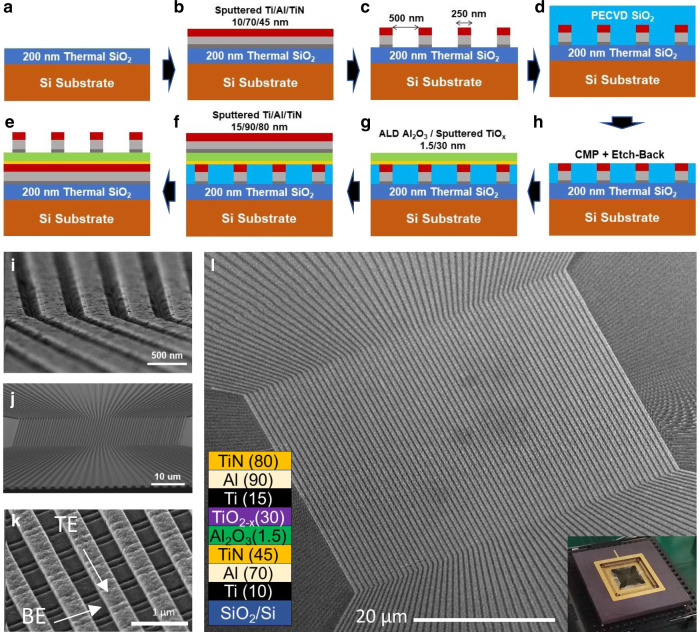
The superior density of passive analog-grade memristive crossbar circuits enables storing large neural network models directly on specialized neuromorphic chips to avoid costly off-chip communication. To ensure efficient use of such circuits in neuromorphic systems, memristor variations must be substantially lower than those of active memory devices. Here we report a 64 × 64 passive crossbar circuit with ~99% functional nonvolatile metal-oxide memristors. The fabrication technology is based on a foundry-compatible process with etch-down patterning and a low-temperature budget. The achieved <26% coefficient of variance in memristor switching voltages is sufficient for programming a 4K-pixel gray-scale pattern with a <4% relative tuning error on average. Analog properties are also successfully verified via experimental demonstration of a 64 × 10 vector-by-matrix multiplication with an average 1% relative conductance import accuracy to model the MNIST image classification by ex-situ trained single-layer perceptron, and modeling of a large-scale multilayer perceptron classifier based on more advanced conductance tuning algorithm.
Overview
CoChat Summary
## TL;DR
This paper reports a foundry-compatible 64 × 64 passive metal-oxide memristor crossbar with ~99% functional devices and low enough variation to support analog tuning and in-memory vector-by-matrix multiplication. The authors demonstrate 4K gray-scale pattern programming with <4% average relative error, a 64 × 10 MNIST classifier with ~1% average relative conductance import accuracy, and simulations showing algorithmic gains against device variation.
## Key findings
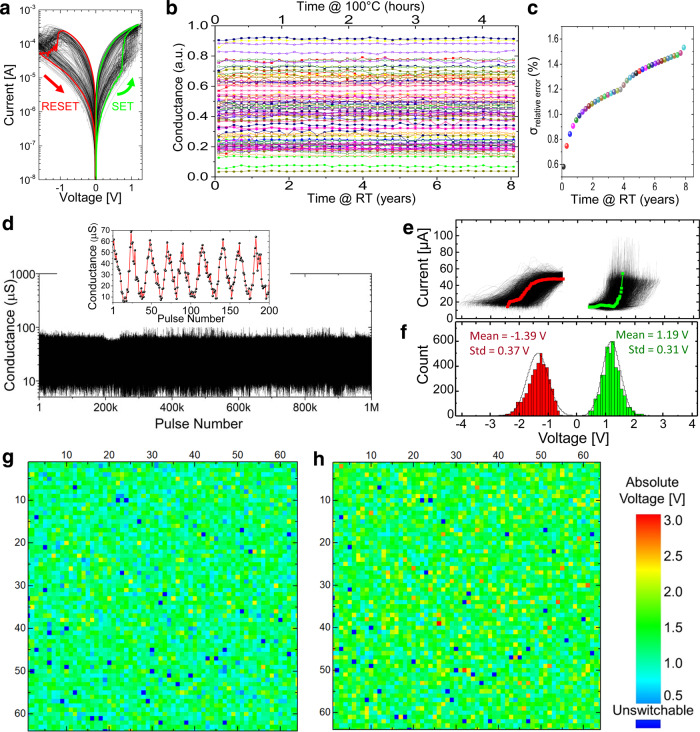
- The fabricated 64 × 64 passive crossbar had ~99% functional nonvolatile memristors, and only 45 devices were unswitchable, i.e. ~1.125% of the array.
- Device switching thresholds averaged 1.19 V for set and –1.39 V for reset, with standard deviations of 0.31 V and 0.37 V; the device-to-device switching-voltage coefficient of variance was <26%.
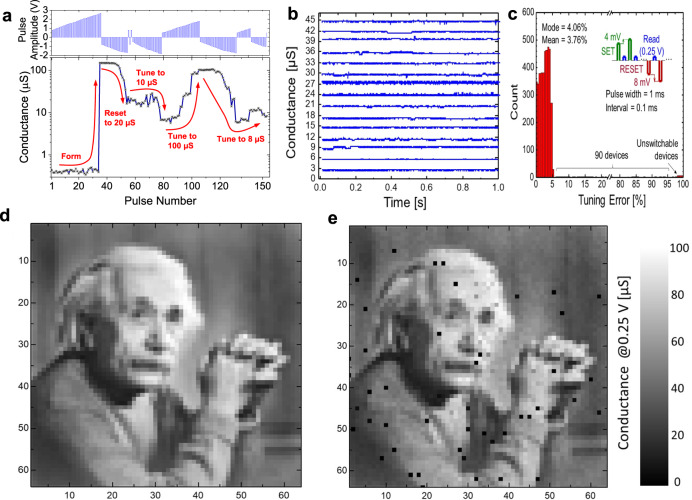
- The tuning algorithm programmed an Einstein gray-scale image on the full array: excluding unswitchable devices, ~98% of devices were tuned within 5% relative error, with an average relative error of ~3.76%; the abstract also states <4% average relative tuning error for a 4K-pixel gray-scale pattern.
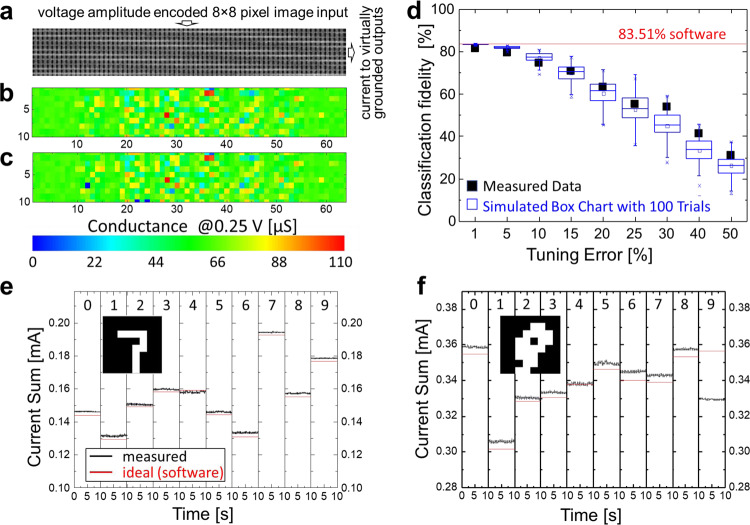
- In the 64 × 10 MNIST single-layer perceptron demo, the average relative conductance import accuracy was ~1%; the measured classifier accuracy was 1.87% lower than the ideal software model for the most accurate weight import.
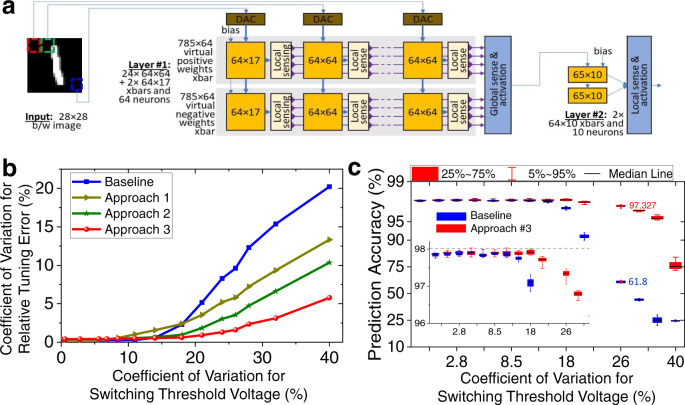
- For the modeled multilayer perceptron, the advanced tuning approach improved tuning accuracy by 9% versus baseline at 26% device variation, and increased the tolerable variation for no classification loss from ~14% to ~20%; the baseline classifier accuracy at 26% variation improved to ~97.3%.
## Methods
- The paper combines fabrication, electrical characterization, conductance tuning experiments, and modeling of ex-situ-trained neural-network inference circuits.
- The device sample is a 64 × 64 passive crossbar on a 4-inch Si wafer, built from Ti/Al/TiN electrodes and an Al2O3/TiO2−x switching stack, with 500 devices used for retention testing and 500 crossbar-integrated memristors used to fit the conductance-change model.
- Electrical measurements used a Keysight B1500A analyzer and switching matrix; the MNIST hardware demo used a 64 × 10 single-layer perceptron trained on 60,000 training and 10,000 8 × 8 down-sampled test images, and the modeling study used an ex-situ-trained 784-64-10 multilayer perceptron with differential conductance mapping and simulated tuning algorithms.
## Limitations
- The authors state that the demonstrated MNIST classifier was “quite low” in accuracy compared to state-of-the-art, because it used a single-layer network and down-sampled black/white images.
- The paper explicitly notes that the experiment demonstrating classifier fidelity was aimed at conductance tuning capability rather than high classification accuracy.
- Evident from the text: 45 unswitchable devices remained in the array, and these devices contributed to tuning error and one misclassified MNIST example.
- Evident from the text: retention is reported via accelerated tests at 100 °C with extrapolation to room temperature, so the room-temperature lifetime claims are inferred rather than directly measured.
Model-written summary. Check it against the paper before relying on it.
Integrity signals
Registry
Cites
Statistics
Figures
Verification
Claims the paper makes
7 Valid · 1 Not valid · 10 Not checked · 60 Own results and interpretations
Every source the paper cites for this claim was checked and supports it.
In the paper
“The developed circuits have ten times more devices and excellent uniformity allowing for significantly better array-scale conductance tuning precision as compared to the previous work24 that reported the largest passive analog-grade memristive crossbar circuits with detailed characterization statistics.”
§ 4K-memristor analog-grade passive crossbar circuit > Introduction
What the sources say
- Supportedcites [24] Merrikh Bayat F Implementation of multilayer perceptron network with highly uniform passive memristive crossbar circuits Nat. Commun. 2018 9 2331 10.1038/s41467-018-04482-4 29899421 PMC5998062 source
In Results > Integrated memristors (page not provided), the paper reports uniform devices whose narrow switching-voltage distributions allow precise conductance tuning across the whole array. It also says earlier passive-memristor demonstrations achieved analog tuning with much cruder precision. (LLM, conf=0.91)
plainstates a cause- Asserted: passes — The authors put it forward as true.
- Checkable: passes — It can be checked against evidence.
- Load-bearing: passes — The paper’s conclusions depend on it.
- Based: passes — The paper gives a reason why it holds.
- Supported
The cited sources support only part of this claim — read each source’s verdict below.
In the paper
“The developed circuits have ten times more devices and excellent uniformity allowing for significantly better array-scale conductance tuning precision as compared to the previous work24 that reported the largest passive analog-grade memristive crossbar circuits with detailed characterization statistics.”
§ 4K-memristor analog-grade passive crossbar circuit > Introduction
What the sources say
- Partly supportedcites [24] Merrikh Bayat F Implementation of multilayer perceptron network with highly uniform passive memristive crossbar circuits Nat. Commun. 2018 9 2331 10.1038/s41467-018-04482-4 29899421 PMC5998062 sourceExperimental — accuracy not yet measured
The Results (Integrated memristors; page unavailable) identify the cited paper’s arrays as 20 × 20 crossbars, or 400 devices each. That establishes the size of the previous work, but this paper cannot verify how many devices the citing authors’ later circuits have, so the tenfold comparison is not established by this source alone. (LLM, conf=0.80)
plain- Asserted: passes — The authors put it forward as true.
- Checkable: passes — It can be checked against evidence.
- Load-bearing: passes — The paper’s conclusions depend on it.
- Based: passes — The paper gives a reason why it holds.
- Partly supported
The cited sources support only part of this claim — read each source’s verdict below.
In the paper
“The progress in the most prospective, passive analog-grade ReRAM circuits13,17,21,22,24, however, has been much slower, mainly because of much stricter requirements for the uniformity of memory cells’ I–V characteristics (Supplementary Fig. 1).”
§ 4K-memristor analog-grade passive crossbar circuit > Introduction
What the sources say
- Not checked — no full text of the sourcecites [13] Yeon H Alloying conducting channels for reliable neuromorphic computing Nat. Nanotechnol. 2020 15 574 579 10.1038/s41565-020-0694-5 32514010 source
- Partly supportedcites [17] Prezioso M Training and operation of an integrated neuromorphic network based on metal-oxide memristors Nature 2015 521 61 64 10.1038/nature14441 25951284 sourceExperimental — accuracy not yet measured
The introduction (p. 2) says device variability was the main reason earlier memristive neuromorphic networks needed external wires or a transistor at each crosspoint. The fabrication section (p. 3) identifies reduced variability as key to this paper’s transistor-free crossbar. These passages support uniformity as a barrier, but do not establish that progress in passive analog-grade ReRAM circuits was slower than progress elsewhere or that their uniformity requirements were comparatively stricter. (LLM, conf=0.83)
- Not checked — no full text of the sourcecites [21] Sheridan PM Sparse coding with memristor networks Nat. Nanotechnol. 2017 12 784 789 10.1038/nnano.2017.83 28530717 source
- Not checked — no full text of the sourcecites [22] Adam GC 3-D memristor crossbars for analog and neuromorphic computing applications IEEE Trans. Electron Devices 2017 64 312 318 10.1109/TED.2016.2630925 source
- Partly supportedcites [24] Merrikh Bayat F Implementation of multilayer perceptron network with highly uniform passive memristive crossbar circuits Nat. Commun. 2018 9 2331 10.1038/s41467-018-04482-4 29899421 PMC5998062 sourceExperimental — accuracy not yet measured
The Introduction says reports of neuromorphic functionality using passive 0T1R or 1D1R circuits have been very limited, in part because successful operation requires much stricter memristor I–V uniformity. This supports the slower-progress comparison and the role of uniformity, but not the claim that uniformity was mainly responsible. (LLM, conf=0.87)
plainstates a cause- Asserted: passes — The authors put it forward as true.
- Checkable: passes — It can be checked against evidence.
- Load-bearing: unclear — It is unclear whether the paper’s conclusions depend on it.
- Based: passes — The paper gives a reason why it holds.
The cited sources support only part of this claim — read each source’s verdict below.
In the paper
“the former can be achieved by reducing leakages within the device and between neighboring lines, e.g., by patterning the active switching layer and scaling down device feature sizes24, and making higher-aspect ratio electrodes”
§ 4K-memristor analog-grade passive crossbar circuit > Discussion
What the sources say
- Partly supportedcites [24] Merrikh Bayat F Implementation of multilayer perceptron network with highly uniform passive memristive crossbar circuits Nat. Commun. 2018 9 2331 10.1038/s41467-018-04482-4 29899421 PMC5998062 sourceExperimental — accuracy not yet measured
The Introduction says memristor footprints may be scaled below 10 nm, and Results > Integrated memristors describes limiting crossbar leakage currents and reducing electrode resistance. Neither passage says that scaling down devices or patterning the active switching layer reduces leakage within devices or between neighboring lines. The paper also does not link higher-aspect-ratio electrodes to the claimed conductance ratio. (LLM, conf=0.82)
plainstates a cause- Asserted: passes — The authors put it forward as true.
- Checkable: passes — It can be checked against evidence.
- Load-bearing: unclear — It is unclear whether the paper’s conclusions depend on it.
- Based: passes — The paper gives a reason why it holds.
- Partly supported
A result the paper reports from its own data — it cites no other source for it, so there is none to check. The quote shows it is in the paper.
In the paper
“Excluding unswitchable devices, for which the error is more than 95%, ~98% of the devices are tuned within 5% relative error, while the average relative error is ~3.76%.”
§ 4K-memristor analog-grade passive crossbar circuit > Results > Conductance tuning experiments
plain- Asserted: passes — The authors put it forward as true.
- Checkable: passes — It can be checked against evidence.
- Load-bearing: passes — The paper’s conclusions depend on it.
- Based: passes — The paper gives a reason why it holds.
44 more claims
Create a free account to see all 78 claims and to verify the 1 reference still open.
- Probably not a substantial claim. 13
- It may state two separate claims as one. 20
Claims other papers make about this one
Each is checked against this paper’s own text: does it say what the citing paper says it does?
The source backs part of the claim, not all of it — or backs it for a different population, condition or comparison.
In the citing paper
“For instance, given the MNIST dataset in which images have a resolution of 28 × 28 pixels one option is to implement the synaptic layer using multiple crossbars to fit the 784 inputs (e.g., 13 64 × 64 or 4 256 × 256 crossbars would be needed93).”
From Hardware implementation of memristor-based artificial neural networks (2024) · cites this paper as [93]
Experimental — accuracy not yet measuredThe source backs part of the claim, not all of it — or backs it for a different population, condition or comparison.
In the citing paper
“Ex situ training has the advantage of requiring little/no circuit overhead to perform quick tests of the classification performance of the network”
From Hardware implementation of memristor-based artificial neural networks (2024) · cites this paper as [93]
Experimental — accuracy not yet measuredThe source backs part of the claim, not all of it — or backs it for a different population, condition or comparison.
In the citing paper
“Crossbar arrays of two-terminal metal/insulator/metal (MIM) memristive devices can be fabricated easily using standard lithography and deposition techniques; this has been readily achieved by multiple groups57,64,68–70,85,93,105,216,217.”
From Hardware implementation of memristor-based artificial neural networks (2024) · cites this paper as [93]
Experimental — accuracy not yet measuredThe source backs part of the claim, not all of it — or backs it for a different population, condition or comparison.
In the citing paper
“A cost-effective recurrent solution has been to use a smaller number of DACs and share them among different rows by adding a layer of analogue multiplexors between the DACs and the wordline inputs93,95,221. With this approach (which we could refer to as On-chip time-multiplexed analogue input – Analogue/Multilevel weights), a given VMM operation is divided in n different sub-VMM operations and the”
From Hardware implementation of memristor-based artificial neural networks (2024) · cites this paper as [93]
Experimental — accuracy not yet measuredThe cited source says what the claim attributes to it.
In the citing paper
“and has made possible to evaluate the performance of home-made memristive crossbar-arrays93,188.”
From Hardware implementation of memristor-based artificial neural networks (2024) · cites this paper as [93]
Citations
Cites
Training and operation of an integrated neuromorphic network based on metal-oxide memristors
Prezioso, M., Merrikh-Bayat, F., Hoskins, B. D., Adam, G. C., Likharev, K. K., & Strukov, D. B. (2015) · Nature · doi:10.1038/nature14441 · Cited by 3,001 · cited 7×
“However, the progress in the most prospective, passive analog-grade ReRAM circuits has been much slower [14, 15, 17, 21], mainly because of much harsher requirements for the uniformity of memory cells’ I-V characteristics [39].”
BackgroundMethodInfluentialSelf-citationFully hardware-implemented memristor convolutional neural network
Yao, P., Wu, H., Gao, B., Tang, J., Zhang, Q., Zhang, W., Yang, J. J., & Qian, H. (2020) · Nature · doi:10.1038/s41586-020-1942-4 · Cited by 2,179 · cited 1×
“…demonstrations from academia and industry of using such active memories in neuromorphic computing circuits — see e.g. refs., 18 – 20, 23 , 25 – 27 , The progress in the most prospective, passive analog-grade ReRAM circuits 13,17,21,22,24 , however, has been much slower, mainly because of much…”
BackgroundMemristive crossbar arrays for brain-inspired computing
Xia, Q., & Yang, J. J. (2019) · Nature Materials · doi:10.1038/s41563-019-0291-x · Cited by 1,800
Google’s Multilingual Neural Machine Translation System: Enabling Zero-Shot Translation
Johnson, M., Schuster, M., Le, Q. V., Krikun, M., Wu, Y., Chen, Z., Thorat, N., Viégas, F., Wattenberg, M., Corrado, G., et al. (2017) · Transactions of the Association for Computational Linguistics · doi:10.1162/tacl_a_00065 · Cited by 1,747
Neuro-Inspired Computing With Emerging Nonvolatile Memorys
Yu, S. (2018) · Proceedings of the IEEE · doi:10.1109/jproc.2018.2790840 · Cited by 1,170
Neuromorphic computing using non-volatile memory
Burr, G. W., Shelby, R. M., Sebastian, A., Kim, S., Kim, S., Sidler, S., Virwani, K., Ishii, M., Narayanan, P., Fumarola, A., et al. (2017) · Advances in Physics: X · doi:10.1080/23746149.2016.1259585 · Cited by 1,107
Burr, G. W., Shelby, R. M., Sidler, S., di Nolfo, C., Jang, J., Boybat, I., Shenoy, R. S., Narayanan, P., Virwani, K., Giacometti, E. U., et al. (2015) · IEEE Transactions on Electron Devices · doi:10.1109/ted.2015.2439635 · Cited by 936 · cited 1×
“Analog-grade nonvoltaile memories, such as those based on floating-gate transistor [13], and phase-change [4-6], ferroelectric [7, 8], magnetic [9], solid-state electrolyte [10, 11], organic [12], and metal-oxide [13-21] materials, are enabling components for mixed-signal circuits implementing vector-by-martix multipl…”
BackgroundOutrageously Large Neural Networks: The Sparsely-Gated Mixture-of-Experts Layer
Shazeer, N., Mirhoseini, A., Maziarz, K., Davis, A., Le, Q., Hinton, G., & Dean, J. (2017) · arXiv · doi:10.48550/arxiv.1701.06538 · Cited by 933 · cited 1×
“V uniformity results with very tight variations were reported for stand-alone devices based on organic 15 and epitaxial 11 materials.”
BackgroundKim, K.-H., Gaba, S., Wheeler, D., Cruz-Albrecht, J. M., Hussain, T., Srinivasa, N., & Lu, W. (2012) · Nano Letters · doi:10.1021/nl203687n · Cited by 924 · cited 1×
“12 .”
Face classification using electronic synapses
Yao, P., Wu, H., Gao, B., Eryilmaz, S. B., Huang, X., Zhang, W., Zhang, Q., Deng, N., Shi, L., Wong, H.-S. P., et al. (2017) · Nature Communications · doi:10.1038/ncomms15199 · Cited by 909 · cited 2×
“…(1T), and numerous demonstrations from academia and industry of using such active memories in neuromorphic computing circuits — see e.g. refs., 18 – 20, 23 , 25 – 27 , The progress in the most prospective, passive analog-grade ReRAM circuits 13,17,21,22,24 , however, has been much slower, mainly…”
BackgroundMethodNeuromorphic computing with multi-memristive synapses
Boybat, I., Le Gallo, M., Nandakumar, S. R., Moraitis, T., Parnell, T., Tuma, T., Rajendran, B., Leblebici, Y., Sebastian, A., & Eleftheriou, E. (2018) · Nature Communications · doi:10.1038/s41467-018-04933-y · Cited by 899 · cited 1×
“Analog-grade nonvoltaile memories, such as those based on floating-gate transistor [13], and phase-change [4-6], ferroelectric [7, 8], magnetic [9], solid-state electrolyte [10, 11], organic [12], and metal-oxide [13-21] materials, are enabling components for mixed-signal circuits implementing vector-by-martix multipl…”
BackgroundParallel programming of an ionic floating-gate memory array for scalable neuromorphic computing
Fuller, E. J., Keene, S. T., Melianas, A., Wang, Z., Agarwal, S., Li, Y., Tuchman, Y., James, C. D., Marinella, M. J., Yang, J. J., et al. (2019) · Science · doi:10.1126/science.aaw5581 · Cited by 756 · cited 1×
“…as those based on fl oating-gate transistor 1 – 3 , phase-change 4 – 6 , ferroelectric 7,8 , magnetic 9 , solid-state electrolyte 10 – 13 , organic 14,15 , and metal-oxide 16 – 28 materials, are enabling components for mixed-signal circuits implementing vector-by-matrix multiplication (VMM),…”
Memristor‐Based Analog Computation and Neural Network Classification with a Dot Product Engine
Hu, M., Graves, C. E., Li, C., Li, Y., Ge, N., Montgomery, E., Davila, N., Jiang, H., Williams, R. S., Yang, J. J., et al. (2018) · Advanced Materials · doi:10.1002/adma.201705914 · Cited by 751 · cited 2×
“Moreover, the demonstrated arti fi cial neural network is close in complexity to the state-of-the-art neuromorphic prototypes based on (>10,000 sparser and 10× more conductive) 1T1R ReRAM devices 23,33 .”
BackgroundA fully integrated reprogrammable memristor–CMOS system for efficient multiply–accumulate operations
Cai, F., Correll, J. M., Lee, S. H., Lim, Y., Bothra, V., Zhang, Z., Flynn, M. P., & Lu, W. D. (2019) · Nature Electronics · doi:10.1038/s41928-019-0270-x · Cited by 728 · cited 4×
“A similar device technology was recently used by the same group to demonstrate large-scale fully integrated complementary metal-oxide-semiconductor (CMOS)/memristor circuits 25 .”
BackgroundMethodInfluentialChoi, S., Tan, S. H., Li, Z., Kim, Y., Choi, C., Chen, P.-Y., Yeon, H., Yu, S., & Kim, J. (2018) · Nature Materials · doi:10.1038/s41563-017-0001-5 · Cited by 690 · cited 1×
“3 epitaxial [41] and organic [42] materials, though the main concern is compatibility of the utilized fabrication flows with conventional semiconductor processes.”
BackgroundA review of emerging non-volatile memory (NVM) technologies and applications
Chen, A. (2016) · Solid-State Electronics · doi:10.1016/j.sse.2016.07.006 · Cited by 668 · cited 2×
“The main advantage of using passively integrated metal-oxide memristors [22], which are also commonly referred as RRAMs or ReRAMs [2325], in such circuits are their superior density and lower fabrication cost [25].”
BackgroundSparse coding with memristor networks
Sheridan, P. M., Cai, F., Du, C., Ma, W., Zhang, Z., & Lu, W. D. (2017) · Nature Nanotechnology · doi:10.1038/nnano.2017.83 · Cited by 619
Integration of nanoscale memristor synapses in neuromorphic computing architectures
Indiveri, G., Linares-Barranco, B., Legenstein, R., Deligeorgis, G., & Prodromakis, T. (2013) · Nanotechnology · doi:10.1088/0957-4484/24/38/384010 · Cited by 613
Learning through ferroelectric domain dynamics in solid-state synapses
Boyn, S., Grollier, J., Lecerf, G., Xu, B., Locatelli, N., Fusil, S., Girod, S., Carrétéro, C., Garcia, K., Xavier, S., et al. (2017) · Nature Communications · doi:10.1038/ncomms14736 · Cited by 600
Vowel recognition with four coupled spin-torque nano-oscillators
Romera, M., Talatchian, P., Tsunegi, S., Abreu Araujo, F., Cros, V., Bortolotti, P., Trastoy, J., Yakushiji, K., Fukushima, A., Kubota, H., et al. (2018) · Nature · doi:10.1038/s41586-018-0632-y · Cited by 572
High precision tuning of state for memristive devices by adaptable variation-tolerant algorithm
Alibart, F., Gao, L., Hoskins, B. D., & Strukov, D. B. (2012) · Nanotechnology · doi:10.1088/0957-4484/23/7/075201 · Cited by 557 · cited 1×
“The analog properties of the memristive crossbar were tested by tuning device conductances using fine-tuning algorithm [48].”
MethodSelf-citationExponential ionic drift: fast switching and low volatility of thin-film memristors
Strukov, D. B., & Williams, R. S. (2009) · Applied Physics A · doi:10.1007/s00339-008-4975-3 · Cited by 494
Self-citationBayat, F. M., Prezioso, M., Chakrabarti, B., Nili, H., Kataeva, I., & Strukov, D. (2018) · Nature Communications · doi:10.1038/s41467-018-04482-4 · Cited by 377 · cited 7×
“Bottom left and bottom right insets show, correspondingly, material layers at the device cross-section with corresponding thicknesses in nanometers, and the packaged chip. memristors 17,24 .”
BackgroundMethodResultInfluentialSelf-citationThree-dimensional memristor circuits as complex neural networks
Lin, P., Li, C., Wang, Z., Li, Y., Jiang, H., Song, W., Rao, M., Zhuo, Y., Upadhyay, N. K., Barnell, M., et al. (2020) · Nature Electronics · doi:10.1038/s41928-020-0397-9 · Cited by 375 · cited 4×
“28 was due to using a very high complexity network in the simulations, while the experimental results for the 0T1R circuit were only performed for 3 × 3 fi lters — see, e.g., largest working demo complexity column in the Supplementary Table 1.”
BackgroundMethodInfluentialRobust resistive memory devices using solution-processable metal-coordinated azo aromatics
Goswami, S., Matula, A. J., Rath, S. P., Hedström, S., Saha, S., Annamalai, M., Sengupta, D., Patra, A., Ghosh, S., Jani, H., et al. (2017) · Nature Materials · doi:10.1038/nmat5009 · Cited by 337
CARPENTER, M. B. (1976) · Cited by 293
A stackable cross point Phase Change Memory
Kau, D., Tang, S., Karpov, I. V., Dodge, R., Klehn, B., Kalb, J. A., Strand, J., Diaz, A., Leung, N., Wu, J., et al. (2009) · 2009 IEEE International Electron Devices Meeting (IEDM) · doi:10.1109/iedm.2009.5424263 · Cited by 291
Alloying conducting channels for reliable neuromorphic computing
Yeon, H., Lin, P., Choi, C., Tan, S. H., Park, Y., Lee, D., Lee, J., Xu, F., Gao, B., Wu, H., et al. (2020) · Nature Nanotechnology · doi:10.1038/s41565-020-0694-5 · Cited by 262 · cited 3×
“…memories in neuromorphic computing circuits — see e.g. refs., 18 – 20, 23 , 25 – 27 , The progress in the most prospective, passive analog-grade ReRAM circuits 13,17,21,22,24 , however, has been much slower, mainly because of much stricter requirements for the uniformity of memory cells ’ I –”
BackgroundAmbrogio, S., Balatti, S., Milo, V., Carboni, R., Wang, Z.-Q., Calderoni, A., Ramaswamy, N., & Ielmini, D. (2016) · IEEE Transactions on Electron Devices · doi:10.1109/ted.2016.2526647 · Cited by 256
3-D Memristor Crossbars for Analog and Neuromorphic Computing Applications
Adam, G. C., Hoskins, B. D., Prezioso, M., Merrikh-Bayat, F., Chakrabarti, B., & Strukov, D. B. (2017) · IEEE Transactions on Electron Devices · doi:10.1109/ted.2016.2630925 · Cited by 234 · cited 1×
“(Note that though ion milling and CMP techniques have been previously used to fabricate 2×10×10 crossbar circuits [47], the main purpose of these techniques in that work was to enable vertical monolithic integration, and, e.”
MethodSelf-citationXue, C.-X., Huang, T.-Y., Liu, J.-S., Chang, T.-W., Kao, H.-Y., Wang, J.-H., Liu, T.-W., Wei, S.-Y., Huang, S.-P., Wei, W.-C., et al. (2020) · 2020 IEEE International Solid- State Circuits Conference - (ISSCC) · doi:10.1109/isscc19947.2020.9063078 · Cited by 230
WRPN: Wide Reduced-Precision Networks
Mishra, A., Nurvitadhi, E., Cook, J. J., & Marr, D. (2017) · arXiv · doi:10.48550/arxiv.1709.01134 · Cited by 227 · cited 1×
“A related observation is that the accuracy loss can often be recovered by increasing the network depth and/or width 50,51 , which, however, naturally results in decreased physical performance.”
BackgroundBinary neural network with 16 Mb RRAM macro chip for classification and online training
Yu, S., Li, Z., Chen, P.-Y., Wu, H., Gao, B., Wang, D., Wu, W., & Qian, H. (2016) · 2016 IEEE International Electron Devices Meeting (IEDM) · doi:10.1109/iedm.2016.7838429 · Cited by 219 · cited 1×
“While this paper is focused explicitly on analog-grade (i.e., multi-bit) devices, low-precision (e.g., binary weight and/or binary activation) neural network models have also received signi fi cant attention 19,20,25,28,48 .”
MethodAmirsoleimani, A., Alibart, F., Yon, V., Xu, J., Pazhouhandeh, M. R., Ecoffey, S., Beilliard, Y., Genov, R., & Drouin, D. (2020) · Advanced Intelligent Systems · doi:10.1002/aisy.202000115 · Cited by 216
Brain-like associative learning using a nanoscale non-volatile phase change synaptic device array
Eryilmaz, S. B., Kuzum, D., Jeyasingh, R., Kim, S., BrightSky, M., Lam, C., & Wong, H.-S. P. (2014) · Frontiers in Neuroscience · doi:10.3389/fnins.2014.00205 · Cited by 205
Xue, C.-X., Hung, J.-M., Kao, H.-Y., Huang, Y.-H., Huang, S.-P., Chang, F.-C., Chen, P., Liu, T.-W., Jhang, C.-J., Su, C.-I., et al. (2021) · 2021 IEEE International Solid- State Circuits Conference (ISSCC) · doi:10.1109/isscc42613.2021.9365769 · Cited by 182
Xue, C.-X., Chiu, Y.-C., Liu, T.-W., Huang, T.-Y., Liu, J.-S., Chang, T.-W., Kao, H.-Y., Wang, J.-H., Wei, S.-Y., Lee, C.-Y., et al. (2020) · Nature Electronics · doi:10.1038/s41928-020-00505-5 · Cited by 181 · cited 1×
“Higher precision weight can also be implemented using multiple lower-precision memory devices 52 .”
MethodHigh-Performance Mixed-Signal Neurocomputing With Nanoscale Floating-Gate Memory Cell Arrays
Merrikh-Bayat, F., Guo, X., Klachko, M., Prezioso, M., Likharev, K. K., & Strukov, D. B. (2018) · IEEE Transactions on Neural Networks and Learning Systems · doi:10.1109/tnnls.2017.2778940 · Cited by 167 · cited 1×
“A nalog-grade nonvolatile memories, such as those based on fl oating-gate transistor 1 – 3 , phase-change 4 – 6 , ferroelectric 7,8 , magnetic 9 , solid-state electrolyte 10 – 13 , organic 14,15 , and metal-oxide 16 – 28 materials, are enabling components for mixed-signal circuits implementing…”
Self-citationMilano, G., Luebben, M., Ma, Z., Dunin-Borkowski, R., Boarino, L., Pirri, C. F., Waser, R., Ricciardi, C., & Valov, I. (2018) · Nature Communications · doi:10.1038/s41467-018-07330-7 · Cited by 159
Neuromorphic Computing Based on Emerging Memory Technologies
Rajendran, B., & Alibart, F. (2016) · IEEE Journal on Emerging and Selected Topics in Circuits and Systems · doi:10.1109/jetcas.2016.2533298 · Cited by 149
Ferroelectric Artificial Synapses for Recognition of a Multishaded Image
Kaneko, Y., Nishitani, Y., & Ueda, M. (2014) · IEEE Transactions on Electron Devices · doi:10.1109/ted.2014.2331707 · Cited by 149
Sub-Microwatt Analog VLSI Trainable Pattern Classifier
Chakrabartty, S., & Cauwenberghs, G. (2007) · IEEE Journal of Solid-State Circuits · doi:10.1109/jssc.2007.894803 · Cited by 122
Diffusion mechanisms of native point defects in rutileTiO2:Ab initio total-energy calculations
Iddir, H., Öğüt, S., Zapol, P., & Browning, N. D. (2007) · Physical Review B · doi:10.1103/physrevb.75.073203 · Cited by 121
(2018) · Cited by 95
Resistive switching characteristics and mechanism of thermally grown WOx thin films
Biju, K. P., Liu, X., Siddik, M., Kim, S., Shin, J., Kim, I., Ignatiev, A., & Hwang, H. (2011) · Journal of Applied Physics · doi:10.1063/1.3633227 · Cited by 78
2-Bit-Per-Cell RRAM-Based In-Memory Computing for Area-/Energy-Efficient Deep Learning
He, W., Yin, S., Kim, Y., Sun, X., Kim, J.-J., Yu, S., & Seo, J.-S. (2020) · IEEE Solid-State Circuits Letters · doi:10.1109/lssc.2020.3010795 · Cited by 67
Design Considerations for Efficient Deep Neural Networks on Processing-in-Memory Accelerators
Yang, T.-J., & Sze, V. (2019) · 2019 IEEE International Electron Devices Meeting (IEDM) · doi:10.1109/iedm19573.2019.8993662 · Cited by 55 · cited 1×
“…though little or no loss in accuracy can be achieved when using binary weights for some of the earlier (very redundant) deep convolutional networks, such as AlexNet or VGG, 4 to 8 bits of precision for both weights and activations might be necessary for the most advanced image classi fi ers 49 .”
BackgroundVector-Matrix Multiply and Winner-Take-All as an Analog Classifier
Ramakrishnan, S., & Hasler, J. (2013) · IEEE Transactions on Very Large Scale Integration (VLSI) Systems · doi:10.1109/tvlsi.2013.2245351 · Cited by 49
Mixed-Signal Neuromorphic Inference Accelerators: Recent Results and Future Prospects
Bavandpour, M., Mahmoodi, M. R., Nili, H., Bayat, F. M., Prezioso, M., Vincent, A., Strukov, D. B., & Likharev, K. K. (2018) · 2018 IEEE International Electron Devices Meeting (IEDM) · doi:10.1109/iedm.2018.8614659 · Cited by 39 · cited 3×
“However, such overhead can be reduced via efficient sharing of peripheral resources, at the cost of decreasing computational throughput [27, 28], which should be acceptable given the very high speed of memristor-based VMMs [29].”
BackgroundInfluentialSelf-citationComprehensive Compact Phenomenological Modeling of Integrated Metal-Oxide Memristors
Nili, H., Vincent, A. F., Prezesio, M., Mahmoodi, M. R., Kataeva, I., & Strukov, D. B. (2020) · IEEE Transactions on Nanotechnology · doi:10.1109/tnano.2020.2982128 · Cited by 38 · cited 1×
“Similar to the previous work 41 , dynamic phenomenological model capturing device-to-device variations is derived by fi tting experimentally observed conductance changes for 500 crossbar integrated memristors upon application of write voltage pulses with variable amplitude — see Supplementary Note 1…”
ResultSelf-citationRegularized Binary Network Training
Darabi, S., Belbahri, M., Courbariaux, M., & Nia, V. P. (2018) · arXiv · doi:10.48550/arxiv.1812.11800 · Cited by 20 · cited 1×
“A related observation is that the accuracy loss can often be recovered by increasing the network depth and/or width 50,51 , which, however, naturally results in decreased physical performance.”
BackgroundaCortex: An Energy-Efficient Multipurpose Mixed-Signal Inference Accelerator
Bavandpour, M., Mahmoodi, M. R., & Strukov, D. B. (2020) · IEEE Journal on Exploratory Solid-State Computational Devices and Circuits · doi:10.1109/jxcdc.2020.2999581 · Cited by 17
Self-citationMaximizing stoichiometry control in reactive sputter deposition of TiO2
(2017) · doi:10.1116/1.4974140 · Cited by 16
Self-citationWRPN: Training and Inference using Wide Reduced-Precision NetworksPreprint
Mishra, A., Cook, J. J., Nurvitadhi, E., & Marr, D. (2017) · arXiv (Cornell University) · doi:10.48550/arxiv.1704.03079 · Cited by 13
Can in-memory/analog accelerators be a silver bullet for energy-efficient inference?
Deguchi, J., Miyashita, D., Maki, A., Sasaki, S., Nakata, K., & Tachibana, F. (2019) · Technical digest - International Electron Devices Meeting/Technical digest · doi:10.1109/iedm19573.2019.8993500 · Cited by 3
Research works printed but not linked: 1
- Burr GW Neuromorphic computing using nonvolatile memory Adv. Phys. 2017 2 89 124
Cited by
Thousands of conductance levels in memristors monolithically integrated on CMOS
Yang, J., Rao, M., Tang, H., Wu, J.-B., Song, W., Zhang, M., Yin, W., Zhuo, Y., Kiani, F., Chen, B., et al. (2022) · doi:10.21203/rs.3.rs-1939455/v1 · Cited by 504
Hardware implementation of memristor-based artificial neural networks
Aguirre, F., Sebastian, A., Le Gallo, M., Song, W., Wang, T., Yang, J. J., Lu, W., Chang, M.-F., Ielmini, D., Yang, Y., et al. (2024) · Nature Communications · doi:10.1038/s41467-024-45670-9 · Cited by 564
“Crossbar arrays of two-terminal metal/insulator/metal (MIM) memristive devices can be fabricated easily using standard lithography and deposition techniques; this has been readily achieved by multiple groups 57,64,68 – 70 ,85 ,93, The crossbar (block 5 in Fig.”
Thousands of conductance levels in memristors integrated on CMOS
(2023) · doi:10.1038/s41586-023-05759-5 · Cited by 503
Recent Advances and Future Prospects for Memristive Materials, Devices, and Systems
Song, M.-K., Kang, J.-H., Zhang, X., Ji, W., Ascoli, A., Messaris, I., Demirkol, A. S., Dong, B., Aggarwal, S., Wan, W., et al. (2023) · ACS Nano · doi:10.1021/acsnano.3c03505 · Cited by 300
Self-citationA review of memristor: material and structure design, device performance, applications and prospects
Xiao, Y., Jiang, B., Zhang, Z., Ke, S., Jin, Y., Wen, X., & Ye, C. (2023) · Science and Technology of Advanced Materials · doi:10.1080/14686996.2022.2162323 · Cited by 295
Metadata
- Authors
- Kim, H., Mahmoodi, M. R., Nili, H., & Strukov, D. B.
- Affiliations
- University of California, Santa Barbara (US)
- Corresponding author
- Strukov, D. B.
- Venue
- Nature Communications
- Published
- 2021-08-31
- Volume
- 12
- Issue
- 1
- Pages
- 5198-5198
- ISSN
- 2041-1723 (ISSN-L)
- PMC
- PMC8408216
- OpenAlex
- W3197387328
- Semantic Scholar
- cb6422198227909f32bf26fbac9521c4eb76f158
- Cited by
- 265
- References
- 58
- Citations by year
- 2026: 40 · 2025: 59 · 2024: 55 · 2023: 47 · 2022: 47 · 2021: 11
- FWCI
- 11.76
- Type
- journal article
- Language
- en
- Open access
- gold
- doi.org
- Licence
- cc-by
- creativecommons.org/licenses/by/4.0 (tdm)
- creativecommons.org/licenses/by/4.0 (vor)
- Locations
- Nature Communications (publishedVersion, cc-by)
- Europe PMC (PubMed Central) (publishedVersion, other-oa)
- PubMed Central (publishedVersion, cc-by)
- PubMed (publishedVersion)
- arXiv (Cornell University) (submittedVersion)
- RePEc: Research Papers in Economics (submittedVersion)
- DOAJ (DOAJ: Directory of Open Access Journals) (submittedVersion, cc-by-sa)
- eScholarship (California Digital Library) (submittedVersion)
- eScholarship (California Digital Library) (submittedVersion, cc-by)
- arXiv (Cornell University)
- Funders
- National Science Foundation (1740352)
- Semiconductor Research Corporation (JUMP CRISP)
- Topics
- Physical Sciences › Engineering › Electrical and Electronic Engineering › Advanced Memory and Neural Computing
- Physical Sciences › Engineering › Electrical and Electronic Engineering › Ferroelectric and Negative Capacitance Devices
- Physical Sciences › Computer Science › Artificial Intelligence › Neural Networks and Applications
- Keywords
- memristors, metal-oxide memristors, non-volatile memory, neuromorphic computing, in-memory computing, multilayer perceptron, MNIST classification, conductance tuning, foundry-compatible fabrication
About these checks
Registry, retraction, Cites and statistics results are computed, not judged, with one exception: a printed reference that no index lists is read once by a model before it counts as a citation error. Claims are extracted by a model and kept only when their quote appears verbatim in the text; each cited source is then checked, with a model’s help, for whether it says what the claim relies on. Those verdicts can be wrong — read the claim’s quote and the cited source before relying on one.
The claim verdicts this report counts are experimental: their accuracy is not yet measured.
A language model drew the claims from the paper on 2026-09-30, under version 3 of the claim definition (model deepseek-v4.1-flash, prompt extract-v3).
A second model labelled each claim on 2026-09-30 (model jev-1.13-20260917, definition revision gold-guideline-v0.2).
Cited sources are checked with a language model’s help (gpt-6-sol).
Statistics and arithmetic are recomputed, not judged.
Confidence bands are shown only for fields calibrated on our annotated test set. None is calibrated yet, so no band is shown.
What counts as a claim ›How we measure confidence ›How we check this ›
Are you an author, or do you see a problem with this page? Request a review
Data sources
Bibliographic data: Semantic Scholar, OpenAlex, Crossref.
Contains information from the Semantic Scholar Academic Graph Datasets, made available under the ODC Attribution License (ODC-BY 1.0).
Semantic Scholar’s data is described in: Kinney, R., et al. (2023). The Semantic Scholar Open Data Platform. arXiv:2301.10140.
