

Embodied intelligence via learning and evolution
Open accessThe DOI matches its Crossref record; 71 of the 71 references it cites were found in a registry or an index.
Abstract
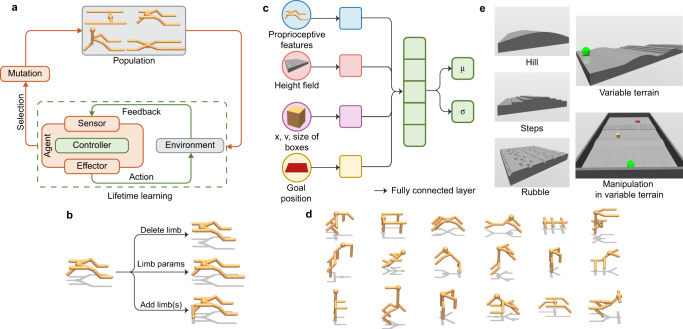
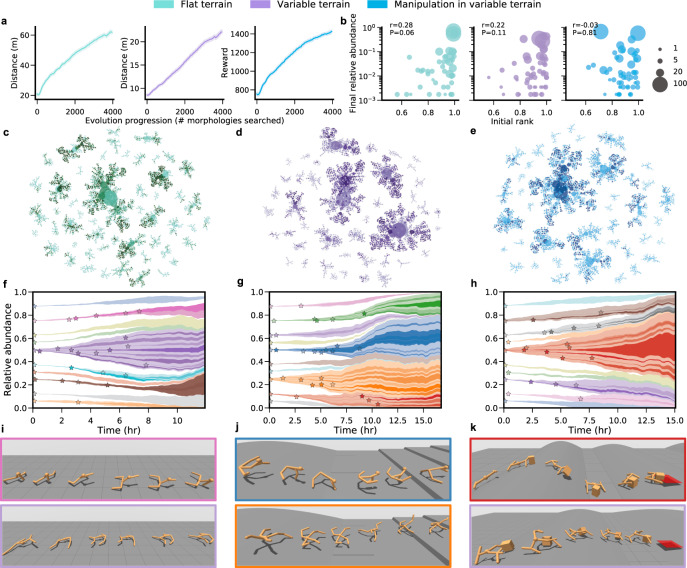
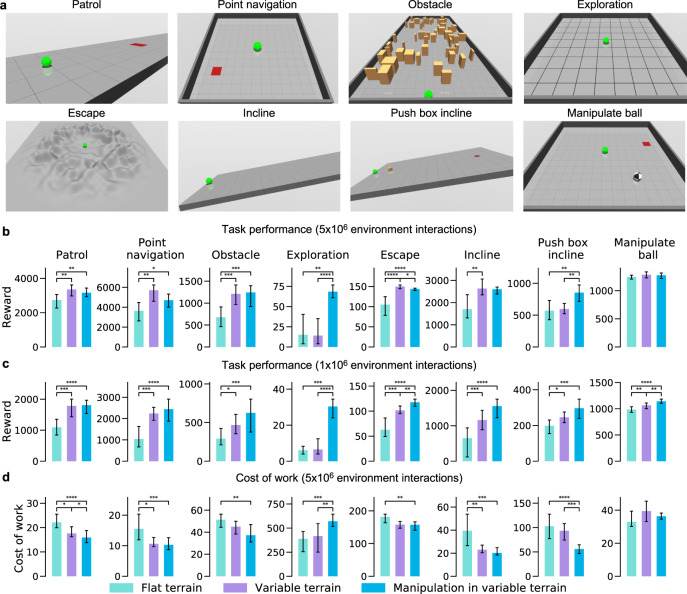
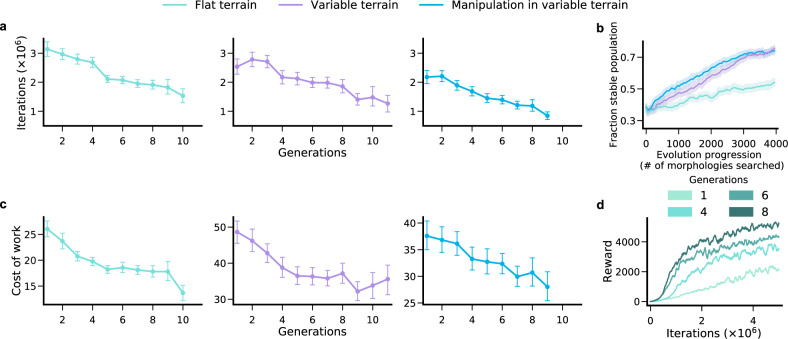
The intertwined processes of learning and evolution in complex environmental niches have resulted in a remarkable diversity of morphological forms. Moreover, many aspects of animal intelligence are deeply embodied in these evolved morphologies. However, the principles governing relations between environmental complexity, evolved morphology, and the learnability of intelligent control, remain elusive, because performing large-scale in silico experiments on evolution and learning is challenging. Here, we introduce Deep Evolutionary Reinforcement Learning (DERL): a computational framework which can evolve diverse agent morphologies to learn challenging locomotion and manipulation tasks in complex environments. Leveraging DERL we demonstrate several relations between environmental complexity, morphological intelligence and the learnability of control. First, environmental complexity fosters the evolution of morphological intelligence as quantified by the ability of a morphology to facilitate the learning of novel tasks. Second, we demonstrate a morphological Baldwin effect i.e., in our simulations evolution rapidly selects morphologies that learn faster, thereby enabling behaviors learned late in the lifetime of early ancestors to be expressed early in the descendants lifetime. Third, we suggest a mechanistic basis for the above relationships through the evolution of morphologies that are more physically stable and energy efficient, and can therefore facilitate learning and control.
Overview
The claims and statistics of this paper haven’t been checked yet.
Free: it reads the open-access text and checks the first 5 claims that cite a source we can check. Create a free account to check every claim.
Integrity signals
Registry
Cites
Statistics
Figures
Verification
Claims the paper makes
The claims and statistics of this paper haven’t been checked yet.
Free: it reads the open-access text and checks the first 5 claims that cite a source we can check. Create a free account to check every claim.
Claims other papers make about this one
Each is checked against this paper’s own text: does it say what the citing paper says it does?
The source backs part of the claim, not all of it — or backs it for a different population, condition or comparison.
In the citing paper
“our approach uniquely evolves embodied agents with both eyes and behaviors together”
From What if eye...? Computationally recreating vision evolution (2025) · cites this paper as [40]
Experimental — accuracy not yet measuredThe source backs part of the claim, not all of it — or backs it for a different population, condition or comparison.
In the citing paper
“Spatial cognition, the ability to acquire, organize, exploit, and update knowledge about external space, is fundamental to both human beings and artificial intelligence (AI)1,2.”
From Brain-inspired spatial intelligence for embodied agents (2026) · cites this paper as [1]
Experimental — accuracy not yet measured
Self-check
Percentages, sums and reported differences re-computed from the paper’s own numbers.
The self-check needs the paper’s full text.
Citations
Cites
Deep Residual Learning for Image Recognition
He, K., Zhang, X., Ren, S., & Sun, J. (2016) · 2016 IEEE Conference on Computer Vision and Pattern Recognition (CVPR) · doi:10.1109/cvpr.2016.90 · Cited by 235,474
Proximal Policy Optimization Algorithms
Schulman, J., Wolski, F., Dhariwal, P., Radford, A., & Klimov, O. (2017) · arXiv · doi:10.48550/arxiv.1707.06347 · Cited by 40,403 · cited 4×
“1b) that are learned via proximal policy optimization (PPO) 28 .”
BackgroundMethodInfluentialLanguage Models are Few-Shot Learners
Brown, T. B., Mann, B., Ryder, N., Subbiah, M., Kaplan, J., Dhariwal, P., Neelakantan, A., Shyam, P., Sastry, G., Askell, A., et al. (2020) · arXiv · doi:10.48550/arxiv.2005.14165 · Cited by 23,372 · cited 2×
“In contrast, the field of artificial intelligence (AI) has focused primarily on disembodied cognition, for example in domains of language 6 , vision 7 or games 8 .”
BackgroundMastering the game of Go with deep neural networks and tree search
Silver, D., Huang, A., Maddison, C. J., Guez, A., Sifre, L., van den Driessche, G., Schrittwieser, J., Antonoglou, I., Panneershelvam, V., Lanctot, M., et al. (2016) · Nature · doi:10.1038/nature16961 · Cited by 15,612 · cited 2×
“2i-k, 7, 8).”
BackgroundMomentum Contrast for Unsupervised Visual Representation Learning
He, K., Fan, H., Wu, Y., Xie, S., & Girshick, R. (2020) · 2020 IEEE/CVF Conference on Computer Vision and Pattern Recognition (CVPR) · doi:10.1109/cvpr42600.2020.00975 · Cited by 13,347
A simple framework for contrastive learning of visual representations
Chen, T., Kornblith, S., Norouzi, M., & Hinton, G. (2020) · arXiv · doi:10.48550/arxiv.2002.05709 · Cited by 10,857
Scaling Laws for Neural Language Models
Kaplan, J., McCandlish, S., Henighan, T., Brown, T. B., Chess, B., Child, R., Gray, S., Radford, A., Wu, J., & Amodei, D. (2020) · arXiv · doi:10.48550/arxiv.2001.08361 · Cited by 9,550
Design, fabrication and control of soft robots
Rus, D., & Tolley, M. T. (2015) · Nature · doi:10.1038/nature14543 · Cited by 5,825
MuJoCo: A physics engine for model-based control
Todorov, E., Erez, T., & Tassa, Y. (2012) · 2012 IEEE/RSJ International Conference on Intelligent Robots and Systems · doi:10.1109/iros.2012.6386109 · Cited by 4,767
Neural Architecture Search with Reinforcement Learning
Zoph, B., & Le, Q. V. (2016) · arXiv (Cornell University) · doi:10.48550/arxiv.1611.01578 · Cited by 3,974
Research works printed but not linked: 15
- Darwin, C. On the Origin of Species by Means of Natural Selection, Vol. 167 (John Murray, London, 1859).
- Wang, T., Zhou, Y., Fidler, S. & Ba, J. In International Conference on Learning Representations (2019).
- Luck, K. S., Amor, H. B. & Calandra, R. Data-efficient co-adaptation of morphology and behaviour with deep reinforcement learning. in Conference on Robot Learning, 854–869 (PMLR, 2020).
- Zoph, B. & Le, Q. V. In International Conference on Learning Representations (2017).
- Sutton, R. S. & Barto, A. G. Reinforcement Learning: An Introduction (MIT Press, 2018).
- Turney, P. D. In ICML Workshop on Evolutionary Computation and Machine Learning, 135–142 (1996).
- Hinton GE Nowlan SJ How learning can guide evolution Complex Syst. 1987 1 495 502
- Ackley D Littman M Interactions between learning and evolution Artif. life II 1991 10 487 509
- Bongard, J. C. & Paul, C. in From Animals to Animats: The Sixth International Conference on the Simulation of Adaptive Behaviour (Citeseer, 2000).
- Wang, T., Liao, R., Ba, J. & Fidler, S. In International Conference on Learning Representations (2018).
- Pathak, D., Lu, C., Darrell, T., Isola, P. & Efros, A. A. In Advances in Neural Information Processing Systems (eds Wallach, H. et al.) Vol. 32 (Curran Associates, Inc., 2019).
- Huang, W., Mordatch, I. & Pathak, D. One policy to control them all: shared modular policies for agent-agnostic control. In International Conference on Machine Learning, 4455–4464 (PMLR, 2020).
- Schulman, J., Moritz, P., Levine, S., Jordan, M. & Abbeel, P. In Proceedings of the International Conference on Learning Representations (ICLR) (2016).
- Henderson, P. et al. In Thirty-Second AAAI Conference on Artificial Intelligence (2018).
- Siciliano, B. & Khatib, O. In Springer Handbooks (2016).
Cited by
Items 201–300 of 350
AI for Innovation Design of Tensegrity Mobile Robot
Shi, X., Yang, Q., Lian, B., & Sun, T. (2023) · Mechanisms and machine science · doi:10.1007/978-3-031-45770-8_28 · Cited by 1
Evolving Physical Instinct for Morphology and Control Co-Adaption
Chen, X., Huang, D., Li, M., Cai, Y., Wen, Z., Cai, Z., & Yang, W. (2023) · IEEE/RSJ International Conference on Intelligent Robots and Systems (IROS) · doi:10.1109/iros55552.2023.10342243 · Cited by 5
“A large-scale experiment for co-adaption performed by Gupta et al. [6] takes 16h using 1152 CPUs.”
BackgroundMethodInfluentialThe Emerging Intelligent Vehicles and Intelligent Vehicle Carriers Collaborative Systems
Shen, Z., Huang, C., Huang, H., Wang, Y., Wang, F., Jamalipour, A., Pham, D. T., Vlacic, L., & Savkin, A. V. (2024) · IEEE Intelligent Vehicles Symposium · doi:10.1109/iv55156.2024.10588476 · Cited by 1
“Embodied intelligence merges physical sensing, actuation, and cognitive processing to boost IVs and IVCs’ capability in challenging environments [50].”
BackgroundMobile Cooperative Robot Safe Interaction Method Based on Embodied Perception
Wang, S., Xu, C., Lam, T. L., & Zhang, T. (2024) · International Conference on Control and Automation · doi:10.1109/icca62789.2024.10591817 · Cited by 1
“Our system first predicts a suitable grasp for the human hand, then based on the human hand tracking and reconstruction, it delivers the object to the human and can adapt to the scene of the human hand moving. texts [3].”
MethodA multi-step on-policy deep reinforcement learning method assisted by off-policy policy evaluation
Zhang, H., Ma, H., Mersha, B. W., & Jin, Y. (2024) · Applied Intelligence · doi:10.1007/s10489-024-05508-9 · Cited by 1
Large Models Defining a New Era in Intelligence Testing: A Short Discussion and Exploration
Zhou, R., Ge, J., Yang, J., Ye, P., Li, Y., & Kovács, L. (2024) · IEEE Transactions on Intelligent Vehicles · doi:10.1109/tiv.2024.3476326 · Cited by 1
“Theycanperformcomplexlanguagetasks suchaslanguagetranslation,textsummarization,andsentiment analysis,showingthinkingandunderstandingabilitiessimilarto humans[13],[14].”
Xiao, X., & Feng, Y. (2024) · Information Sciences · doi:10.1016/j.ins.2024.121664 · Cited by 1
Eco-Evo-Devo in the Adaptive Evolution of Artificial Creatures Within a 3D Physical Environment
Jaafar, S. A. B., Suzuki, R., & Arita, T. (2025) · Electronics · doi:10.3390/electronics14020354 · Cited by 1
Bio-Inspired Neural Network Architecture of Embodied Intelligence
Nurutdinov, A. R. (2024) · Lobachevskii Journal of Mathematics · doi:10.1134/s1995080224606027 · Cited by 1
“As a result, embodied intelligence made organisms control the complex set of their body parts, ensuring adequate intelligent behavior in the real world around them [31].”
A Digital Twin Framework for Robot Grasp and Motion Generation
Dong, J., Jia, Z., Wang, Y., & Ren, L. (2024) · IEEE Smart World Congress (SWC) · doi:10.1109/swc62898.2024.00314 · Cited by 2
“As robots become more integrated into various sectors, the need for precise and versatile grasping capabilities continues to grow [8].”
Luo, W., Ling, M., Feng, F., Guo, P., & Li, B. (2025) · Actuators · doi:10.3390/act14050234 · Cited by 1
“Unlike most studies on modular robots that focus on modules with straightforward functions [21,22], this study investigates a modular robot with various practical module functions.”
InfluentialSun, Y., Shan, X., Miao, X., & Xu, L. (2025) · Journal of Mechanisms and Robotics · doi:10.1115/1.4068798 · Cited by 1
Xu, S., Feng, X., Li, Y., & Liu, J. (2025) · British Journal of Psychology · doi:10.1111/bjop.12800 · Cited by 2
Thermodynamic overfitting and generalization: energetics of predictive intelligence
Boyd, A. B., Crutchfield, J. P., Gu, M., & Binder, F. C. (2025) · New Journal of Physics · doi:10.1088/1367-2630/addf71 · Cited by 8
“Finally, information is ultimately quantum-mechanical-leading to recurrent quantum models and quantum reservoir computers [8, 84, 85].”
Bioinspired morphology and task curricula for learning locomotion in bipedal muscle-actuated systems
Badie, N., Al-Hafez, F., Schumacher, P., Haeufle, D. F. B., Peters, J., & Schmitt, S. (2025) · Communications Engineering · doi:10.1038/s44172-025-00443-0 · Cited by 4
Task-Specific Embodied Tactile Sensing for Dexterous Hand
Wei, Q., Xiong, P., Song, A., & Li, Q. (2025) · Proceedings - IEEE International Conference on Robotics and Automation/Proceedings · doi:10.1109/icra55743.2025.11127318 · Cited by 1
“Li et al [6] proposed a computational framework that can evolve the morphology of an intelligent body during interaction and learning in complex environments by introducing deep evolutionary reinforcement learning.”
Collective motion model inspired by fish school based on deep attention mechanism
Liu, L., Liu, Z., Lin, J., Yu, T., Ge, Z., & Meng, F. (2025) · Bioinspiration & Biomimetics · doi:10.1088/1748-3190/ae05a2 · Cited by 1
“With the recent surge in deep learning, research in embodied intelligence has reached a new epoch [16].”
Neuromorphic visuotactile slip perception for robotic manipulation
Qiao, Y., Zhang, C., Cui, S., Cao, L., Wang, Z., Wang, P., & Wang, S. (2025) · Robotics and Autonomous Systems · doi:10.1016/j.robot.2025.105191 · Cited by 1
DebateNav: Structured Multi-VLM Expert Debate for Robust Zero-Shot Object Navigation
Sun, H., Tan, W., Liu, L., Yan, Z., Lu, X., & Dai, H. (2025) · IEEE International Conference on High Performance Computing and Communications; IEEE International Conference on Smart City; IEEE International Conference on Data Science and Systems (HPCC/SmartCity/DSS) · doi:10.1109/hpcc67675.2025.00068 · Cited by 1
“This places extremely high demands on perception, reasoning, and control capabilities [1].”
Liu, Z., Lü, Q., Luo, J., & Wang, Z. (2025) · Applied Soft Computing · doi:10.1016/j.asoc.2025.114182 · Cited by 1
Omnidirectional tele-perception enabled by nano-architectured electret skin
Du, Y., Zhang, Z., Wang, Z. L., & Wei, D. (2025) · iScience · doi:10.1016/j.isci.2025.114584 · Cited by 1
Evolution of Physical Intelligence Across Scales
Liu, K., Huang, T., Li, A., Lv, P., Qin, T., Chen, W., Wei, H., & Duan, H. (2026) · Advanced Intelligent Discovery · doi:10.1002/aidi.202500178 · Cited by 3
Rehberg, W., Kulkarni, M., Weiss, P., & Alexis, K. (2026) · IEEE Robotics and Automation Letters · doi:10.1109/lra.2026.3668585 · Cited by 1
“An emerging paradigm frames autonomous multirotor design as a computational co-design problem, jointly optimizing airframe and control policy [5], [6], [7].”
Chen, S., Xiong, L., Chow, M., & Tang, Y. (2026) · Cyber-Physical Energy Systems · doi:10.1016/j.cpes.2026.04.003 · Cited by 2
Embodied Intelligence Security with Vision-language Models: A Survey
Duan, J., Zhu, H., Liu, C., Li, S. Y., Tang, X., & Wang, Y. (2026) · Machine Intelligence Research · doi:10.1007/s11633-025-1626-x · Cited by 2
Toward provably safe AI-driven perception and motion planning for robotic manufacturing: A review
Lee, H., Sim, Y., Jang, J., Yoon, B., Lee, H. G., Park, H., Kim, C.-J., & Jun, M. B. (2026) · Journal of Manufacturing Systems · doi:10.1016/j.jmsy.2026.07.014 · Cited by 1
Adversarial Body Shape Search for Legged Robots
Azakami, T., Kera, H., & Kawamoto, K. (2022) · Conference proceedings/Conference proceedings - IEEE International Conference on Systems, Man, and Cybernetics · doi:10.1109/smc53654.2022.9945257 · Cited by 2
“[13] mutated the robot’s morphology using the UNIMAL technique and trained it in flat, hill, and step environments.”
MethodLearning: An Evolutionary Perspective
Petitat, A. (2023) · Education Quarterly Reviews · doi:10.31014/aior.1993.06.01.729 · Cited by 1
Heritability of morphological and behavioural traits in evolving robots
Carlo, M. D., Ferrante, E., Zeeuwe, D., Ellers, J., & Eiben, A. E. (2023) · Evolutionary Intelligence · doi:10.1007/s12065-023-00860-0 · Cited by 4
“In [50, 51] we find efforts to introduce learning systems that enable individuals to adapt to their environment during their lifetime.”
Reinforcement learning for freeform robot design
Li, M., Matthews, D., & Kriegman, S. (2024) · Proceedings - IEEE International Conference on Robotics and Automation/Proceedings · doi:10.1109/icra57147.2024.10610048 · Cited by 1
“Inspired by the evolution of animals, the automatic design of robots has been primarily achieved using evolutionary algorithms [4, 7, 11, 12, 17, 21, 30].”
BackgroundMethodКаково это — быть рассуждающей языковой моделью?
Д.В., З. (2024) · Логико-философские штудии · doi:10.52119/lphs.2024.51.82.003 · Cited by 1
CAD-Driven Co-Design for Flight-Ready Jet-Powered Humanoids
Vanteddu, P. R., Gorbani, D., L’Erario, G., Mohamed, H. A. O., Bergonti, F., & Pucci, D. (2025) · IEEE-RAS International Conference on Humanoid Robots (Humanoids) · doi:10.1109/humanoids65713.2025.11203060 · Cited by 1
“As such, the design and control of aerial humanoids are tightly coupled problems that require coordinated exploration of both structural and control spaces [1], [2].”
Cognitive Agentic AI: Probabilistic Novelty Detection for Continual Adaptation in HRI
Ghamati, K., Amirabdollahian, F., Faria, D. R., & Zaraki, A. (2025) · IEEE RO-MAN · doi:10.1109/ro-man63969.2025.11217818 · Cited by 1
“Thus, the development of resilient methodologies for continual adaptation represents a significant open research challenge, necessitating innovative approaches to facilitate autonomous learning within dynamic real-world settings [15].”
Body size as a metric for the affordable worldPreprint
Feng, X., Xu, S., Li, Y., & Jia Liu, B. (2023) · bioRxiv (Cold Spring Harbor Laboratory) · doi:10.1101/2023.03.20.533336 · Cited by 1
Liu, Y., Shen, R., Zhou, L., Xiao, Q., Yuan, J., & Li, Y. (2024) · bioRxiv (Cold Spring Harbor Laboratory) · doi:10.1101/2024.05.19.594895 · Cited by 1
Brain-inspired spatial intelligence for embodied agents
Ruan, S., Wang, L., Kang, C., Zhu, Q., Liu, S., Wei, X., & Su, H. (2026) · Nature Communications · doi:10.1038/s41467-026-74358-5 · Cited by 1
“Spatial cognition, the ability to acquire, organize, exploit, and update knowledgeaboutexternalspace,isfundamentaltobothhumanbeings andarti fi cialintelligence(AI) 1,2 .”
Parallel Asynchronous Memetic Optimization for Freeform Optical Design
Sakharov, M., Houllier, T., & Lépine, T. (2021) · Lecture notes in computer science · doi:10.1007/978-3-030-90425-8_8
Collaborative Diffusion Based on Value Measurement in Social–Physical Networks
Yi, Y., Wu, X., Zou, M., Cheng, K., Wu, Y. C., & Zhang, Z. (2023) · IEEE Internet of Things Journal · doi:10.1109/jiot.2023.3282813
“To better alleviate the prominent contra-diction, it is necessary to find the intrinsic value from the massive information and diverse interactive demand [2], [23].”
BackgroundKe, X., Chai, Z., Yong, H., Ding, H., & Wu, Z. (2023) · Zhongguo kexue. Wulixue Lixue Tianwenxue · doi:10.1360/sspma-2023-0149
Deep Reinforcement Learning for Robust Control of 6-DOF Robotic Manipulators
Harib, M. (2023) · Carleton University's Institutional Repository (MacOdrum Library, Carleton University) · doi:10.22215/etd/2023-15476
de Lima, E. G. (2023) · Research Square · doi:10.21203/rs.3.rs-3240050/v1
Body size as a metric for the affordable worldPreprint
Feng, X., Xu, S., Li, Y., & Jia Liu, B. (2023) · eLife · doi:10.7554/elife.90583.1
From Disembodiment to Embodiment in Artificial Intelligence and Psychology - Parallels in Thinking
Macrine, S. L., & Fugate, J. M. B. (2023) · IOP Conference Series Materials Science and Engineering · doi:10.1088/1757-899x/1292/1/012018
Pietrosanti, G. M., Nadizar, G., Pigozzi, F., & Medvet, E. (2023) · IEEE Access · doi:10.1109/access.2023.3342912 · Cited by 1
“Some works tackle this issue by embedding an inner optimization loop (e.g., for the controller) inside an outer loop (e.g., for the morphology) [8], [9], to the cost of higher computational requirements [4].”
BackgroundCo-imagination of Behaviour and Morphology of Agents
Sliacka, M., Mistry, M., Calandra, R., Kyrki, V., & Luck, K. S. (2024) · Lecture notes in computer science · doi:10.1007/978-3-031-53969-5_24
Let’s Evolve Intelligence, Not Solutions
Hussain, T. S. (2024) · Genetic and evolutionary computation · doi:10.1007/978-981-99-8413-8_16
Co-Designing Body and Behavior via Planning-based Hierarchical Grammatical Evolution
Chen, X., Huang, D., Li, M., Cai, Y., Cai, Z., & Yang, W. (2023) · International Conference on Robotics, Automation and Intelligent Control (ICRAIC) · doi:10.1109/icraic61978.2023.00026
“To solve that problem, prior works often use search-based [3] or learning-based [4] heuristics to traverse the morphological space, and optimize a behavior policy for each morphology to evaluate their joint fitness.”
MethodEnhancing Robot Learning with Transformer-based Morphology Modeling
Wang, Y. (2024) · Journal of Physics Conference Series · doi:10.1088/1742-6596/2816/1/012100
“However, current reinforcement learning methods often require policy customization for a specific task, obtaining data and training policy networks from scratch, which is a huge challenge for many tasks, especially robot control tasks, which are both time-consuming and expensive [3].”
Automated Planning and Scheduling with Swarm Intelligence
Cheng, S., Lu, H., & Lei, X. (2024) · Lecture notes in computer science · doi:10.1007/978-981-97-7184-4_3
Guest Editorial: Special Issue on Social Manufacturing After ChatGPT
Wang, F., Jiang, P., Xiong, G., Zhou, M., Kuhlenkötter, B., Helo, P., & Shen, Z. (2024) · IEEE Transactions on Computational Social Systems · doi:10.1109/tcss.2024.3496032
A Scalable Platform for Robot Learning and Physical Skill Data Collection
Schneider, S., Wu, Y., Johannsmeier, L., Wu, F., & Haddadin, S. (2024) · IEEE/RSJ International Conference on Intelligent Robots and Systems (IROS) · doi:10.1109/iros58592.2024.10801516 · Cited by 3
“In this paradigm, the ability of embodied agents to learn from their interactions with the physical world, including manipulating their own morphology [5], is of pivotal importance.”
The Evolution and Convergence of Artificial Intelligence and Intelligent Robotics
Hong, M. (2025) · Applied and Computational Engineering · doi:10.54254/2755-2721/2025.22708
Pre-Training of a Large Robotic Design Model
Li, G., Song, Z., Huo, X., & Sun, T. (2025) · Journal of Computing and Information Science in Engineering · doi:10.1115/1.4068730
Zhang, Q., & Zhou, Y. (2025) · Communications in computer and information science · doi:10.1007/978-3-031-94156-6_26
Transferable Hierarchical Skill Learning with Diffusion Models for Robot Manipulation
Shi, L., Lan, Y., Shi, Y., & Xu, X. (2024) · Asian Conference on Artificial Intelligence Technology (ACAIT) · doi:10.1109/acait63902.2024.11021708 · Cited by 1
“Embodied intelligence in robotics, particularly in the domain of mechanical arms, encapsulates the integration of sensory perceptions, motor capabilities, and cognitive processes to execute complex tasks in dynamic environments [1][2][3].”
Gradient Descent Emerges via Natural Selection
Shen, A. (2025) · IEEE Congress on Evolutionary Computation (CEC) · doi:10.1109/cec65147.2025.11043088
Li, Y., Chen, H., Fu, H., & Guo, W. (2025) · Chinese Journal of Mechanical Engineering · doi:10.1186/s10033-025-01318-3 · Cited by 1
“Furthermore, several studies [20– 22] have formulated organized policy training methodologies that adjust to untrained configurations.”
Zhao, J., Peng, W., Wang, H., & Yao, W. (2025) · Complex & Intelligent Systems · doi:10.1007/s40747-025-02045-x · Cited by 1
“…stems from two factors: (1) the robot design space necessitates exploration of numerous potential morphologies by design algorithms, and (2) the complex interactions between various components of the serially connected robot make it exponentially hard to learn effective control policies [7, 8].”
Zhao, Y., & Wang, H. (2025) · ACM Joint European Software Engineering Conference and Symposium on the Foundations of Software Engineering (ESEC/FSE) · doi:10.1145/3696630.3730571
Informed Repurposing of Quadruped Legs for New Tasks
Chen, F., & Aukes, D. M. (2025) · Proceedings - IEEE International Conference on Robotics and Automation/Proceedings · doi:10.1109/icra55743.2025.11128237
“Interestingly, some simulation-based works deal with co-designing or evolving robots or creatures for both loco-motion [12], [13] and manipulation tasks such as carrying, pushing, and throwing objects [14], [15].”
Wang, Y., Jing, H., Liao, Y., Ma, Y., & Zheng, N. (2025) · Proceedings - IEEE International Conference on Robotics and Automation/Proceedings · doi:10.1109/icra55743.2025.11127326
“Hand-eye calibration has a wide application prospect in autonomous driving, human-robot collaboration and other cutting-edge fields, which strongly promotes the robot system towards the development of embodied intelligence [3].”
Learning Optimal Design Manifolds to Design More Practical Robotic Systems
Baumgärtner, J., Puchta, A., & Fleischer, J. (2025) · Proceedings - IEEE International Conference on Robotics and Automation/Proceedings · doi:10.1109/icra55743.2025.11128579
“Task-specific optimization involves tailoring a robot’s design for a particular task, such as moving within an environment [1] or following a specified trajectory [5].”
The Impact of Inequity Aversion on the Evolution of Cooperation
Mao, X., Li, X., Meng, M., Wang, Q., & Deng, F. (2025) · Chinese Control Conference (CCC) · doi:10.23919/ccc64809.2025.11179750 · Cited by 1
“For instance, deep evolutionary reinforcement learning frameworks have demonstrated how embodied agents evolve diverse morphologies to cooperate and adapt in complex environments, showcasing the significance of co-operative learning in embodied cognition [5].”
FoodWeight1.4M: A Large-scale Multi-modal Dataset for Weight Estimation
Lü, Y., Xu, Z., Ma, D., Yang, J., Xiang, L., Wu, H., & He, Z. (2025) · IEEE International Conference on Multimedia and Expo (ICME) · doi:10.1109/icme59968.2025.11209123
“The weakness in weight estimation severely limit the development of fields such as embodied intelligence [2].”
KrisshnaKumar, P., Paul, S., & Chowdhury, S. (2025) · Springer proceedings in advanced robotics · doi:10.1007/978-3-032-04584-3_13
Developing the robotic space-force boundary of physical interaction perception in an infant way
Yan, Z., Zhou, Y., Wang, C., Luan, F., Li, X., Jiang, Y., & He, B. (2025) · Neurocomputing · doi:10.1016/j.neucom.2025.132014 · Cited by 1
The body is not there to compute
Hoffmann, M. (2025) · Physics of Life Reviews · doi:10.1016/j.plrev.2025.11.003
“McGeer [3] has successfully employed dynamical systems to explain the operation and stability of the PDW. Designing optimal robot bodies can draw on modeling and control [9, 10] or deep evolutionary learning [11].”
Plant Characteristics and Activities
Bianchi, M. (2025) · Philosophical studies series · doi:10.1007/978-3-032-01328-6_3
Qu, H., Fang, L., & Tan, J. (2025) · Journal of Industrial Information Integration · doi:10.1016/j.jii.2025.101009
Wang, L. Y., Tan, J., Gong, H., Shiju, E., & Zhou, C. (2025) · Drones · doi:10.3390/drones9110805
“Finally, the hybrid learning-evolutionary framework DERL [61] is included to contextualize AMB-TD3 within the landscape of contemporary approaches that synergistically combine reinforcement learning with evolutionary algorithms.”
Co-Adaptation of Embodiment and Control with Self-Imitation Learning
Hernández-Gutiérrez, S., Kyrki, V., & Luck, K. S. (2025) · IEEE/RSJ International Conference on Intelligent Robots and Systems (IROS) · doi:10.1109/iros60139.2025.11246530
“Another recent work [22] employed deep reinforcement learning with mass-parallelization of agent populations in simulation, hence ignoring data-efficiency, using evolutionary techniques to investigate the Baldwin effect and Lamarckian evolution, for example.”
Han, G., Sun, Z., Liu, Q., Cui, Y., Chen, A., Chen, H., Xiong, R., Chen, J., & Ye, Q. (2025) · IEEE/RSJ International Conference on Intelligent Robots and Systems (IROS) · doi:10.1109/iros60139.2025.11247201
“–[4] is one of the most important technologies for embodied intelligence [5].”
Wu, B.-H., Sayette, P. D. L., Fei-Fei, L., & Martín-Martín, R. (2025) · IEEE/RSJ International Conference on Intelligent Robots and Systems (IROS) · doi:10.1109/iros60139.2025.11245978
“Several methods learned to use tools purely in simulation [16–18].”
Self-citationA swarm control framework integrating embodied intelligence and multi-behavior coordination
Hu, Y., Minghui, Q. I. N., Wu, Y., Wang, H., Hanbing, Q. I., Jianan, J. U., Li, Y., & Xu, M. (2026) · Scientia Sinica Informationis · doi:10.1360/ssi-2025-0308
MS4MS: LLMs-driven Multi-agent System for Small-molecule Identification via LC-MS/MSPreprint
Guo, N., Guo, J., Liu, Y., Wei, S., Dong, L., Du, H., Bai, Y., Zhao, Y., Wang, X., Zeng, D. D., et al. (2025) · bioRxiv (Cold Spring Harbor Laboratory) · doi:10.64898/2025.12.02.691830
“The first objective is to achieve embodied intelligence 40 , integrating the experimental instruments with the small molecule identification agent to realize an end-to-end, intelligent closed loop from sample analysis to data interpretation, enabling the agent to dynamically adjust instrument…”
Villeneuve, A., & Dessureault, J.-S. (2025) · Enjeux et société Approches transdisciplinaires · doi:10.7202/1122024ar
Behavior Tree and Action Primitive (BTAP) Enabled Low-Code/No-Code Program for Robot Task Execution
Chen, B., Tong, X., Xiang, F., Wan, J., Wang, L., Yan, X., Wang, Z., & Xia, X. (2025) · IEEE Transactions on Industrial Informatics · doi:10.1109/tii.2025.3641958
Robots with a Sense of Self: Exploring Embodied Intelligence
Akerkar, R. A. (2026) · Springer eBooks · doi:10.1007/978-3-031-91084-5_11 · Cited by 2
Innovation Design of Multilocomotion Planar Tensegrity Mobile Robot Driven by Machine Learning
Shi, X., Yang, Q., Hu, K., Kang, R., & Sun, T. (2026) · Journal of Mechanical Design · doi:10.1115/1.4070861
TerrFlat: Physics-Driven Geometry Representation for Structure-Aware Freespace Detection
Yang, J., Wang, L., Shen, M., Du, J., Liu, C., & Chen, Q. J. (2026) · IEEE Robotics and Automation Letters · doi:10.1109/lra.2026.3655205
“T HE rapid development of embodied intelligence has accelerated the deployment of autonomous systems across various industries, including self-driving vehicles, augmented reality, smart homes, and logistics delivery [1], [2], [3], [4].”
Automated surface damage detection with an embodied intelligence robotic platform
Altinay, K., Ye, Z., Mitoulis, S.-A., & Ninić, J. (2026) · Data-Centric Engineering · doi:10.1017/dce.2025.10033
“The concept of “ embodied intelligence, ” which enables robots to interact with their environment in real-time using perception and algorithms, allows them to perform tasks in complex real-world conditions (Gupta et al., 2021).”
Pretraining-Finetuning Framework for Efficient Codesign of Legged Robots
Chen, C., Yu, Y., Han, H., Wang, Y., Xiong, R., & Wang, H. (2026) · IEEE Transactions on Industrial Electronics · doi:10.1109/tie.2026.3654778
“For instance, Gupta et al. [13] used a tournament algorithm at the upper level, employing the fitness of each candidate morphology as input to derive the optimal morphology.”
A Novel Expert-Assisted Anomaly-Aware Embodied Learning Framework for UAV Active Target Tracking
Li, J., Zhou, F., & Wu, Q. (2026) · IEEE Transactions on Mobile Computing · doi:10.1109/tmc.2026.3666656
LCMF: Lightweight Cross-Modality Mambaformer for Embodied Robotics VQA
Kang, Z., He, L., Zhang, Y., Ming, Z., & Zhao, K. (2025) · IEEE Smart World Congress (SWC) · doi:10.1109/swc65939.2025.00115
“However, embodied intelligence [10] still faces numerous challenges that limit learning capabilities in visual-language decision tasks.”
VAR-Turbo: Unlocking the Potential of Visual Autoregressive Models Through Dual Redundancy
Xiang, X., & Tu, F. (2026) · IEEE International Symposium on High-Performance Computer Architecture (HPCA) · doi:10.1109/hpca68181.2026.11408607 · Cited by 1
“VAR models can be seamlessly integrated with LLMs to facilitate multi-modal applications [20], [29], [83] due to their shared autoregression mechanism and unified main architecture.”
Toward End-to-End Fault Diagnosis: An Adaptive Masked Modeling Framework With Retrieval Augmentation
Cheng, Q., He, W., Wen, Z., Tao, Y., & Feng, C. (2026) · IEEE Sensors Journal · doi:10.1109/jsen.2026.3668793 · Cited by 1
“Similarly, in embodied intelligence (EI) [20], robots that once depended on manually designed path planning are now being succeeded by context-aware agents capable of adaptive decision-making.”
Guo, S., Zhu, Z., Wei, W., Tan, G., Zhou, Q., & Cao, D. (2026) · Vehicle System Dynamics · doi:10.1080/00423114.2026.2639596
The Application of Artificial Intelligence in the Field of Additive Manufacturing
Yu, Q., Tang, Z., Wang, M., Gao, Z., Wu, Y., Li, Y., Wang, H., & Wang, H. (2026) · 中国科学基金 · doi:10.3724/bnsfc-2025-0018
EgoFusion: unified semantic and scale-aware prompt fusion for egocentric action recognition
Fan, H.-X., Lyu, H., & Chen, C. (2026) · Multimedia Systems · doi:10.1007/s00530-026-02282-1
Wu, S., Sun, Q., Liu, Z., & Yang, Q. (2026) · Results in Engineering · doi:10.1016/j.rineng.2026.110179
Single-step decision reinforcement learning for wavefront shaping in scattering media
Zhang, X., Cai, J., & Xie, M. (2026) · Optics and Lasers in Engineering · doi:10.1016/j.optlaseng.2026.109740
Real-Time Embodied Experience Shapes High-Level Reasoning Under Altered GravityPreprint
Raux, H. G. D., Ghilardi, T., Ferrè, E. R., & Ossmy, O. (2026) · bioRxiv (Cold Spring Harbor Laboratory) · doi:10.64898/2026.03.16.712090
Merchant, C., Xu, X., & Fumiya Iida, A. (2026) · IOP Conference Series Materials Science and Engineering · doi:10.1088/1757-899x/1343/1/012026
“As Gupta et al. (2021) argue, distributed intelligence arises precisely in such systems where many simple units interact without centralized coordination.”
Embodied Autonomous Intelligence: A Historical Perspective
Yoshida, N. (2026) · IOP Conference Series Materials Science and Engineering · doi:10.1088/1757-899x/1343/1/012011
Free Your Hands: Human-Demonstration-Free Diffusion Policy Adaptation for Robotic Manipulation
Yuan, G., Yang, M., Zhang, J., Pang, J., & Xu, D. (2026) · IEEE Transactions on Circuits and Systems for Video Technology · doi:10.1109/tcsvt.2026.3686290
“For transfer learning and domain adaptation in embodied AI, compared to cross-embodiment [18] and cross-skill transfer [19], cross-environment adaptation [4], [38] is the most widely studied setting and is particularly important for real-world applications [15], [39], [40], [41].”
Magnetic-Tunnel-Junction-Based Probabilistic Processor for Efficient Embodied Evolution
Bao, Y., Yang, S., Humianto, E., & Yang, H. (2026) · Nano Letters · doi:10.1021/acs.nanolett.6c00275 · Cited by 1
From autonomy to alliance: Robotic foundation models must learn with us, not just for us
Dey, S., Riener, R., Dosen, S. S., & Albrecht, S. V. (2026) · Science Robotics · doi:10.1126/scirobotics.aea1822 · Cited by 2
A retrieval-augmented framework enabling VLM spatial awareness for object-centric robot manipulation
Chen, K., Li, C., Tu, C., Pan, J., Ma, Y., Chen, W., Zhou, Z., Xu, X., James, S., Fu, C., et al. (2026) · Science Robotics · doi:10.1126/scirobotics.aea2092 · Cited by 6
Yuh, W. T., Ryu, S., Kim, T., & Choi, I. (2026) · Journal of Korean Neurosurgical Society · doi:10.3340/jkns.2026.0029 · Cited by 1
“Bridging this gap demands two capabilities : physical AI for real-world interaction through sensory input and motor output 31,101) , and world models for tracking and predicting the states of all objects and entities in an environment 32,54) .”
Multi-level cognitive control and terrain adaptive quadruped robot simulation in MATLAB
Prem Sankar, N., J, S. P., Harish, T., & Nair, N. S. (2026) · EPJ Web of Conferences · doi:10.1051/epjconf/202636701007
Metadata
- Authors
- Gupta, A., Savarese, S., Ganguli, S., & Fei-Fei, L.
- Affiliations
- Stanford University (US)
- Corresponding author
- Gupta, Agrim
- Fei-Fei, Li
- Venue
- Nature Communications
- Published
- 2021-10-06
- Volume
- 12
- Issue
- 1
- Pages
- 5721-5721
- ISSN
- 2041-1723 (ISSN-L)
- PMC
- PMC8494941
- OpenAlex
- W3127203205
- Semantic Scholar
- 3234d2810eb2d7cfd7ef2d3646de4581a78e42a8
- Cited by
- 352
- References
- 70
- Citations by year
- 2026: 97 · 2025: 111 · 2024: 65 · 2023: 47 · 2022: 26 · 2021: 6
- FWCI
- 12.61
- Type
- journal article
- Language
- en
- Open access
- gold
- doi.org
- Licence
- cc-by
- creativecommons.org/licenses/by/4.0 (tdm)
- creativecommons.org/licenses/by/4.0 (vor)
- Locations
- Nature Communications (publishedVersion, cc-by)
- Europe PMC (PubMed Central) (publishedVersion, other-oa)
- PubMed Central (publishedVersion, cc-by)
- PubMed (publishedVersion)
- arXiv (Cornell University) (submittedVersion)
- RePEc: Research Papers in Economics (submittedVersion)
- DOAJ (DOAJ: Directory of Open Access Journals) (submittedVersion, cc-by-sa)
- arXiv (Cornell University) (cc-by)
- Funders
- United States Department of Defense | United States Navy | Office of Naval Research (N00014-16-1-2127)
- Topics
- Physical Sciences › Computer Science › Artificial Intelligence › Reinforcement Learning in Robotics
- Physical Sciences › Computer Science › Artificial Intelligence › Evolutionary Algorithms and Applications
- Life Sciences › Biochemistry, Genetics and Molecular Biology › Genetics › Evolution and Genetic Dynamics
- Keywords
- embodied AI, morphological evolution, environmental complexity, locomotion, manipulation tasks, morphological stability, energy efficiency
- MeSH terms
- Deep Learning, Animals, Computer Simulation, Biological Evolution, Reward
About these checks
Registry, retraction, Cites and statistics results are computed, not judged, with one exception: a printed reference that no index lists is read once by a model before it counts as a citation error. Claims are extracted by a model and kept only when their quote appears verbatim in the text; each cited source is then checked, with a model’s help, for whether it says what the claim relies on. Those verdicts can be wrong — read the claim’s quote and the cited source before relying on one.
Statistics and arithmetic are recomputed, not judged.
Confidence bands are shown only for fields calibrated on our annotated test set. None is calibrated yet, so no band is shown.
What counts as a claim ›How we measure confidence ›How we check this ›
Are you an author, or do you see a problem with this page? Request a review
Data sources
Bibliographic data: Semantic Scholar, OpenAlex, Crossref.
Contains information from the Semantic Scholar Academic Graph Datasets, made available under the ODC Attribution License (ODC-BY 1.0).
Semantic Scholar’s data is described in: Kinney, R., et al. (2023). The Semantic Scholar Open Data Platform. arXiv:2301.10140.
