

Embodied intelligence via learning and evolution
Open accessThe DOI matches its Crossref record; 71 of the 71 references it cites were found in a registry or an index.
Abstract
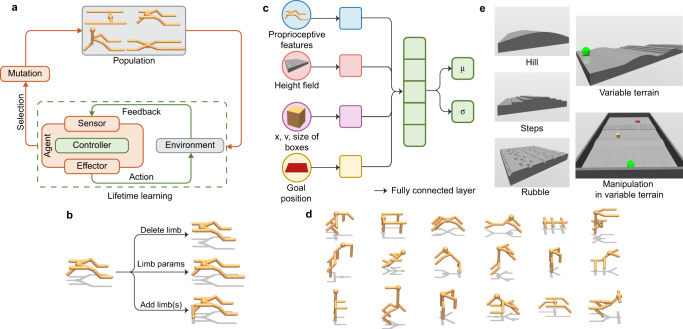
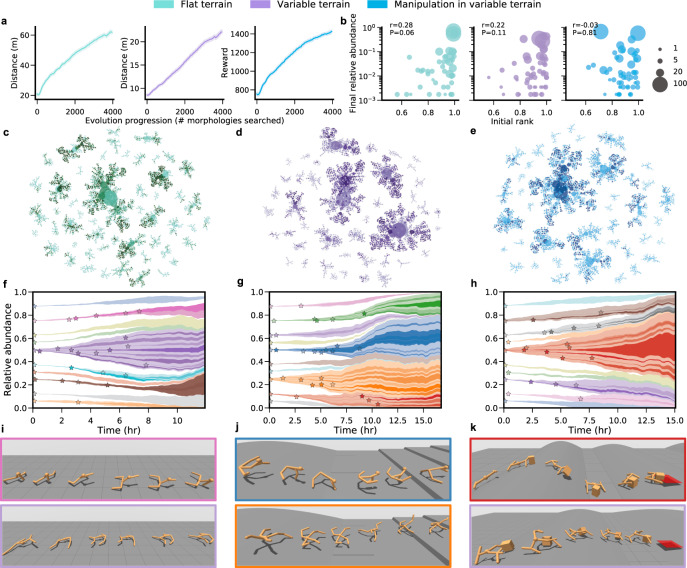
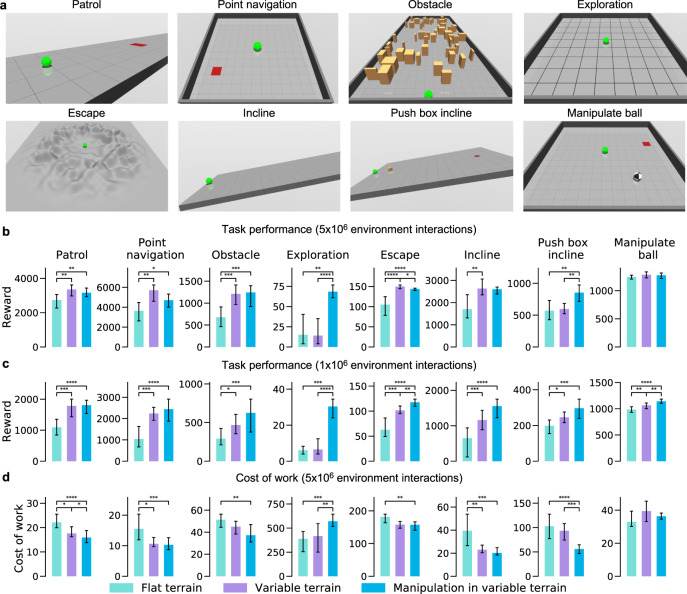
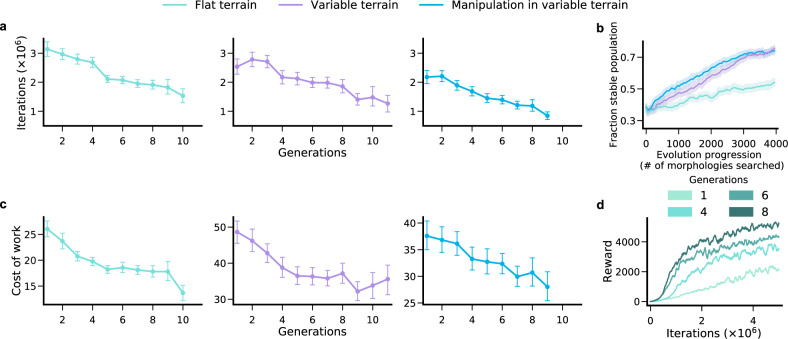
The intertwined processes of learning and evolution in complex environmental niches have resulted in a remarkable diversity of morphological forms. Moreover, many aspects of animal intelligence are deeply embodied in these evolved morphologies. However, the principles governing relations between environmental complexity, evolved morphology, and the learnability of intelligent control, remain elusive, because performing large-scale in silico experiments on evolution and learning is challenging. Here, we introduce Deep Evolutionary Reinforcement Learning (DERL): a computational framework which can evolve diverse agent morphologies to learn challenging locomotion and manipulation tasks in complex environments. Leveraging DERL we demonstrate several relations between environmental complexity, morphological intelligence and the learnability of control. First, environmental complexity fosters the evolution of morphological intelligence as quantified by the ability of a morphology to facilitate the learning of novel tasks. Second, we demonstrate a morphological Baldwin effect i.e., in our simulations evolution rapidly selects morphologies that learn faster, thereby enabling behaviors learned late in the lifetime of early ancestors to be expressed early in the descendants lifetime. Third, we suggest a mechanistic basis for the above relationships through the evolution of morphologies that are more physically stable and energy efficient, and can therefore facilitate learning and control.
Overview
The claims and statistics of this paper haven’t been checked yet.
Free: it reads the open-access text and checks the first 5 claims that cite a source we can check. Create a free account to check every claim.
Integrity signals
Registry
Cites
Statistics
Figures
Verification
Claims the paper makes
The claims and statistics of this paper haven’t been checked yet.
Free: it reads the open-access text and checks the first 5 claims that cite a source we can check. Create a free account to check every claim.
Claims other papers make about this one
Each is checked against this paper’s own text: does it say what the citing paper says it does?
The source backs part of the claim, not all of it — or backs it for a different population, condition or comparison.
In the citing paper
“our approach uniquely evolves embodied agents with both eyes and behaviors together”
From What if eye...? Computationally recreating vision evolution (2025) · cites this paper as [40]
Experimental — accuracy not yet measuredThe source backs part of the claim, not all of it — or backs it for a different population, condition or comparison.
In the citing paper
“Spatial cognition, the ability to acquire, organize, exploit, and update knowledge about external space, is fundamental to both human beings and artificial intelligence (AI)1,2.”
From Brain-inspired spatial intelligence for embodied agents (2026) · cites this paper as [1]
Experimental — accuracy not yet measured
Self-check
Percentages, sums and reported differences re-computed from the paper’s own numbers.
The self-check needs the paper’s full text.
Citations
Cites
Deep Residual Learning for Image Recognition
He, K., Zhang, X., Ren, S., & Sun, J. (2016) · 2016 IEEE Conference on Computer Vision and Pattern Recognition (CVPR) · doi:10.1109/cvpr.2016.90 · Cited by 235,474
Proximal Policy Optimization Algorithms
Schulman, J., Wolski, F., Dhariwal, P., Radford, A., & Klimov, O. (2017) · arXiv · doi:10.48550/arxiv.1707.06347 · Cited by 40,403 · cited 4×
“1b) that are learned via proximal policy optimization (PPO) 28 .”
BackgroundMethodInfluentialLanguage Models are Few-Shot Learners
Brown, T. B., Mann, B., Ryder, N., Subbiah, M., Kaplan, J., Dhariwal, P., Neelakantan, A., Shyam, P., Sastry, G., Askell, A., et al. (2020) · arXiv · doi:10.48550/arxiv.2005.14165 · Cited by 23,372 · cited 2×
“In contrast, the field of artificial intelligence (AI) has focused primarily on disembodied cognition, for example in domains of language 6 , vision 7 or games 8 .”
BackgroundMastering the game of Go with deep neural networks and tree search
Silver, D., Huang, A., Maddison, C. J., Guez, A., Sifre, L., van den Driessche, G., Schrittwieser, J., Antonoglou, I., Panneershelvam, V., Lanctot, M., et al. (2016) · Nature · doi:10.1038/nature16961 · Cited by 15,612 · cited 2×
“2i-k, 7, 8).”
BackgroundMomentum Contrast for Unsupervised Visual Representation Learning
He, K., Fan, H., Wu, Y., Xie, S., & Girshick, R. (2020) · 2020 IEEE/CVF Conference on Computer Vision and Pattern Recognition (CVPR) · doi:10.1109/cvpr42600.2020.00975 · Cited by 13,347
A simple framework for contrastive learning of visual representations
Chen, T., Kornblith, S., Norouzi, M., & Hinton, G. (2020) · arXiv · doi:10.48550/arxiv.2002.05709 · Cited by 10,857
Scaling Laws for Neural Language Models
Kaplan, J., McCandlish, S., Henighan, T., Brown, T. B., Chess, B., Child, R., Gray, S., Radford, A., Wu, J., & Amodei, D. (2020) · arXiv · doi:10.48550/arxiv.2001.08361 · Cited by 9,550
Design, fabrication and control of soft robots
Rus, D., & Tolley, M. T. (2015) · Nature · doi:10.1038/nature14543 · Cited by 5,825
MuJoCo: A physics engine for model-based control
Todorov, E., Erez, T., & Tassa, Y. (2012) · 2012 IEEE/RSJ International Conference on Intelligent Robots and Systems · doi:10.1109/iros.2012.6386109 · Cited by 4,767
Neural Architecture Search with Reinforcement Learning
Zoph, B., & Le, Q. V. (2016) · arXiv (Cornell University) · doi:10.48550/arxiv.1611.01578 · Cited by 3,974
Research works printed but not linked: 15
- Darwin, C. On the Origin of Species by Means of Natural Selection, Vol. 167 (John Murray, London, 1859).
- Wang, T., Zhou, Y., Fidler, S. & Ba, J. In International Conference on Learning Representations (2019).
- Luck, K. S., Amor, H. B. & Calandra, R. Data-efficient co-adaptation of morphology and behaviour with deep reinforcement learning. in Conference on Robot Learning, 854–869 (PMLR, 2020).
- Zoph, B. & Le, Q. V. In International Conference on Learning Representations (2017).
- Sutton, R. S. & Barto, A. G. Reinforcement Learning: An Introduction (MIT Press, 2018).
- Turney, P. D. In ICML Workshop on Evolutionary Computation and Machine Learning, 135–142 (1996).
- Hinton GE Nowlan SJ How learning can guide evolution Complex Syst. 1987 1 495 502
- Ackley D Littman M Interactions between learning and evolution Artif. life II 1991 10 487 509
- Bongard, J. C. & Paul, C. in From Animals to Animats: The Sixth International Conference on the Simulation of Adaptive Behaviour (Citeseer, 2000).
- Wang, T., Liao, R., Ba, J. & Fidler, S. In International Conference on Learning Representations (2018).
- Pathak, D., Lu, C., Darrell, T., Isola, P. & Efros, A. A. In Advances in Neural Information Processing Systems (eds Wallach, H. et al.) Vol. 32 (Curran Associates, Inc., 2019).
- Huang, W., Mordatch, I. & Pathak, D. One policy to control them all: shared modular policies for agent-agnostic control. In International Conference on Machine Learning, 4455–4464 (PMLR, 2020).
- Schulman, J., Moritz, P., Levine, S., Jordan, M. & Abbeel, P. In Proceedings of the International Conference on Learning Representations (ICLR) (2016).
- Henderson, P. et al. In Thirty-Second AAAI Conference on Artificial Intelligence (2018).
- Siciliano, B. & Khatib, O. In Springer Handbooks (2016).
Cited by
Items 301–350 of 350
Guo, Y., Shi, F., & Tang, C. (2026) · International Conference on Electronics Technology and Artificial Intelligence (ETAI) · doi:10.1109/etai68332.2026.11485026
“Gupta et al. verified through experiments that the ability development of embodied agents is the result of the synergistic effect of learning mechanisms and evolutionary mechanisms [13] .”
Bajracharya, E. (2026) · Research Square · doi:10.21203/rs.3.rs-9570273/v1
Exploring Human-Machine Coexistence in Symmetrical Reality
Zhang, Z. (2026) · IEEE Conference on Virtual Reality and 3D User Interfaces Abstracts and Workshops (VRW) · doi:10.1109/vrw70859.2026.00188
“Specifically, while humans inhabit the physical space, AI entities reside in the virtual world and can have evolvable embodiments [2].”
Bagavathi, C., Velayutham, C. S., & Narayanabhatla, M. (2026) · International Conference on Innovative Trends in Information Technology (ICITIIT) · doi:10.1109/icitiit68860.2026.11499650
Wang, N., Shao, H., Fu, X., Xie, X., & Liu, H. (2026) · Ocean Engineering · doi:10.1016/j.oceaneng.2026.125879
Alnoori, N. A. J., Neamah, W. Q., Majeed, B. H., Abdulsalam, W. H., Alamiry, Z. A. A., & Faris, I. J. (2026) · International Journal of Engineering Pedagogy (iJEP) · doi:10.3991/ijep.v16i3.61055
Why Large Language Models will Never be Embodied: A Categorical, Not Engineering, Impossibility
Mangalam, M. (2026) · Minds and Machines · doi:10.1007/s11023-026-09804-w
“A system that can perform more sophisticated sensorimotor tasks is described as “more embodied” than its less capable predecessor (Cangelosi & Schlesinger, 2015; Gupta et al., 2021 ; Pfeifer et al., 2007).”
Emulation of Intensity-Dependent Neuronal Firing Latency Using A HfO x -based Volatile Memristor
Fu, X., Gong, Y., Jiang, L., Lin, Y., Zhang, X., Liu, G., Kang, Y., & Yu, B. (2026) · China Semiconductor Technology International Conference (CSTIC) · doi:10.1109/cstic68613.2026.11537953
Gao, P., Wang, P., Wang, F., Fujita, H., & Aljuaid, H. (2026) · Journal of King Saud University - Computer and Information Sciences · doi:10.1007/s44443-026-00549-1
Real-Time Embodied Experience Shapes High-Level Reasoning Under Altered GravityPreprint
Raux, H. G. D., Ghilardi, T., Ferrè, E. R., & Ossmy, O. (2026) · eLife · doi:10.7554/elife.111166.1
Real-Time Embodied Experience Shapes High-Level Reasoning Under Altered GravityPreprint
Raux, H. G. D., Ghilardi, T., Ferrè, E. R., & Ossmy, O. (2026) · eLife · doi:10.7554/elife.111166
Chen, L., Liu, C., Feng, W., Liu, Y., Dong, P., Ma, J., Wang, J., Luo, J., Liu, C., Deng, Z., et al. (2026) · eScience · doi:10.1016/j.esci.2026.100604
Shen, Z., Liao, Z., Shen, S., Fang, C., Tian, F., Yang, J., & Sawan, M. (2026) · IEEE International Symposium on Circuits and Systems proceedings · doi:10.1109/iscas66217.2026.11562936
“Embodied Artificial Intelligence (EAI) has emerged as a prominent research frontier, enabling agents to interact with physical environments [1].”
Fixed-Time Inverse Reinforcement Learning Based Human–Machine Autonomous Game Control
Wang, M., Lv, L., Yan, H., & Wu, H. (2026) · IEEE Transactions on Human-Machine Systems · doi:10.1109/thms.2026.3695135
Brain-Inspired Generative AI Revives Legacy Industrial Robots Toward Sustainable Automation
Liu, Z., Wang, T., Zhong, R., Wang, X. V., Li, M., & Wang, L. (2026) · Engineering · doi:10.1016/j.eng.2026.05.020
Embodied Intelligence Robots: Flexible Task Planning Framework and Multimodal Fusion Perception
Zhu, Z., Zhang, Z., Tang, D., & Ji, Y. (2026) · IEEE Transactions on Human-Machine Systems · doi:10.1109/thms.2026.3703414
“EIintegratesphysical andcognitivesystems[13]andlearnsfromrealenvironments to support perception, comprehension, decision-making and interaction [14], thereby enhancing robotic adaptability.”
Da, X. (2026) · Journal of Economic Surveys · doi:10.1111/joes.70134
Xu, W. Q., Liu, Z., Yang, C.-X., Nie, A., & Zhang, H. (2026) · IEEE Transactions on Automation Science and Engineering · doi:10.1109/tase.2026.3708974
“The rise of embodied intelligence has steered research toward hardware–software integration, emphasizing a robot’s capacity to perceive and respond to real-world dynamics through its morphology and sensor suite [19].”
Optical Generative Models for Novel Image Generation
Chen, S., Li, Y., Wang, Y., Chen, H., & Özcan, A. (2026) · Conference on Lasers and Electro-Optics · doi:10.1364/cleo_si.2026.sm1e.1
Computational Design of Terrestrial Robots with Anisotropic Friction
Hu, H., Lyu, K., Hu, C., Li, Z., Yang, P., Li, M., Li, S., & Du, T. (2026) · ACM SIGGRAPH Conference (SIGGRAPH) · doi:10.1145/3799902.3811103
Anonymous, & Zhang, X. (2026) · Physical Review A · doi:10.1103/93x9-y3y9
Zheng, X., Luo, L., Yu, H., & Luo, H. (2026) · IEEE Transactions on Cognitive Communications and Networking · doi:10.1109/tccn.2026.3716252
“…networks are becoming an important platform for agentic AI services in 6G, where mobile robots, intelligent vehicles, and industrial unmanned aerial vehicles (UAVs) rely on nearby sensing, computing, and communication resources to interact with physical environments [1], [2], [3], [4], [5], [6].”
Chellattoan, R., Mondini, A., Sinibaldi, E., & Mazzolai, B. (2026) · Advanced Intelligent Systems · doi:10.1002/aisy.70498
Control Barrier Function-Based Reinforcement Learning for Safe Microrobot Autonomous Navigation
Zhao, J., Xu, Q., & Yang, L. (2026) · International Conference on Control and Automation · doi:10.1109/icca69928.2026.11618029
“As a major branch of machine learning, RL has demonstrated remarkable capabilities in solving complex robotic control tasks, such as the stable locomotion of quadruped robots over rugged terrain and the dexterous manipulation of robotic arms [7].”
Wen, Y., Fan, P., Mao, Z., Chi, F., Chenxuan, Z., & Lu, Y. (2026) · AI · doi:10.3390/ai7080299
“[15,16] explicitly state that EI is neither purely software-based AI, which inherently lacks physical agency and the capacity to intervene in the real world, nor is it traditional robotics, which typically lacks high-level semantic understanding and relies heavily on rigid pre-programming.”
Tang, T., Lin, Z., Feng, Z., Ma, T., Ong, Y.-S., Tsang, I. W.-H., & Yin, H. (2026) · ACM SIGKDD Conference on Knowledge Discovery and Data Mining (KDD) · doi:10.1145/3770855.3817582 · Cited by 5
“Understanding and reasoning about the physical world lies at the heart of intelligence, enabling agents to act robustly and adaptively in real-world environments [21, 46].”
Ma, W., Zhu, S., Wang, X., Zhu, Q., Fan, M., & Li, Y. (2026) · Information Fusion · doi:10.1016/j.inffus.2026.104707
A New Encoding to Mitigate Representation Biases in Morphological Robot Evolution
Matteo, J. M. D., & Eiben, A. E. (2026) · Lecture notes in computer science · doi:10.1007/978-3-032-36229-2_23
Goff, L. K. L., Smith, S. C., & Hart, E. (2026) · Lecture notes in computer science · doi:10.1007/978-3-032-36229-2_19
Steinseide, M. K., Henriksen, M. R., Gya, R., & Nyléhn, J. (2026) · Journal of Biological Education · doi:10.1080/00219266.2026.2719521
Parlak, İ. H., & Erbaş, M. D. (2026) · Robotic Intelligence and Automation · doi:10.1108/ria-06-2025-0164
Sun, L., Wang, Y., Cha, H., & Sun, F. (2026) · Biomimetics · doi:10.3390/biomimetics11090623
“Reinforcement-learning-based co-design methods further optimized body attributes and policies together, including data-efficient co-adaptation [8], deep reinforcement-learning-based design–control optimization [46], and morphology optimization for embodied agents [47].”
A comparative study of stiffness-matrix-based loss functions for displacement prediction with PINNs
Zhu, H., Shen, X., Li, X., & Song, X. (2026) · Digital engineering. · doi:10.1016/j.dte.2026.100144
Task-Adaptive Morphology Design for Modular Robotic Systems in Dynamic Environments
Liu, X., Wu, L., Guo, B., Ding, Y., & Yu, Z. (2026) · IEEE International Conference on Smart Internet of Things (SmartIoT) · doi:10.1109/smartiot70864.2026.00037
“A line of works in this field focused only on designing the attributes of robots while ignoring skeletal structures [15]–[17], which is limited in designing robot morphology.”
Research Progress on GaN-Based Dual-Mode Devices and their Applications in Embodied Intelligence
Yao, G., Ling, R., Chen, X., Zhang, Y., Li, S., & Gao, F. (2026) · Cybernetics and Intelligence · doi:10.26599/cai.2026.9390019
Stand Up and Move: Benchmarking Interactive Spatial Intelligence in WalkerBench
Ge, Z., Yang, G., Pan, Z., Zhu, J., Gu, Y., Li, J., Wang, Q., Tang, R., Tang, S., Xiao, J., et al. (2026) · Lecture notes in computer science · doi:10.1007/978-3-032-37432-5_22
P‐4.26: The Revolutionary Impact and Outlook of Embodied AI on Metaverse NPCs
张瑞乐, Zhang, C., & Wang, L. (2026) · SID Symposium Digest of Technical Papers · doi:10.1002/sdtp.70003_341
Yu, Q., Zhang, Z., Wang, P., Raab, M., Herold, F., Heath, M. D., Mavilidi, M. F., PAAS, F. G. W. C., & Zou, L. (2026) · Journal of sport and health science/Journal of Sport and Health Science · doi:10.1016/j.jshs.2026.101177
A survey on AI agent security: Reasoning, Acting, and Self-Evolving
Liu, D., Luo, T., Huang, S., Yang, J., Liang, S., Jia, X., Lau, C. P., Dong, J., Liu, Y., Bai, Y., et al. (2026) · AI Plus · doi:10.59717/ipj.aiplus.2026.100004 · Cited by 3
Gao, B., Wang, T., Ning, X., & Pai, Z. (2026) · Manufacturing Letters · doi:10.1016/j.mfglet.2026.07.015
Real-Time Embodied Experience Shapes High-Level Reasoning Under Altered GravityPreprint
Raux, H. G. D., Ghilardi, T., Ferrè, E. R., & Ossmy, O. (2026) · eLife · doi:10.7554/elife.111166.2
Guo, K., Wei, H., Liang, T., Li, L., Song, X., Luo, Y., Sun, S., & 宋焕生 (2026) · Information Processing & Management · doi:10.1016/j.ipm.2026.105259
Deep fitted value iteration: Algorithm and theory
Jiao, Y., Kang, L., Yang, J. Z., & Zhang, P. (2026) · Science China Mathematics · doi:10.1007/s11425-025-2674-4
Evolving embodied intelligence via reinforcement learning: challenges, barriers, and pathways
Ji, T., Sun, F., & Lv, L. (2026) · Science China Information Sciences · doi:10.1007/s11432-024-5010-x
“RL could empower robots to autonomously reconfigure themselves without human intervention, optimizing their body for a wide range of applications by receiving rewards based on successful task completion [20].”
Preference-Guided Diffusion for Embodied Robot Morphology Evolution
Xin, L., Zhang, Y., Sheng, B., & Kong, H. (2026) · International Joint Conference on Neural Networks (IJCNN) · doi:10.1109/ijcnn69854.2026.11729703
“This line of work has been extended to richer morphology spaces and more complex environments [2], [5], [12].”
JAT: Reinforcement Learning with Joint-Aware Transformer for Hexapod Damage Locomotion
Li, J., Yang, Y., Zhou, W., Peng, W., Gao, Y., Yao, W., & Jiang, T. (2026) · International Joint Conference on Neural Networks (IJCNN) · doi:10.1109/ijcnn69854.2026.11729603
“Learning universal and robust robot control remains a core challenge [1, 2].”
Lv, Z., Ou, S. S., He, S., Jiang, Y., Jing, H., & Zhang, C. (2026) · Applied Energy · doi:10.1016/j.apenergy.2026.129151
Liu, C., Tang, D., Zhu, H., Cai, Q., Wang, L., & Nie, Q. (2026) · Journal of Manufacturing Systems · doi:10.1016/j.jmsy.2026.10.011
From Artificial to Embodied and Physical Intelligence in Smart Manufacturing
Wang, K., Lu, X., Liu, T., Fang, J., Li, X., Wu, S., Jin, L., Liao, W., Zhang, S., & Tan, J. (2026) · Advanced Science · doi:10.1002/advs.78384 · Cited by 1
Li, H., Li, X., Gao, L., Liu, Q., & Zhang, C. (2026) · Advanced Engineering Informatics · doi:10.1016/j.aei.2026.105429
Metadata
- Authors
- Gupta, A., Savarese, S., Ganguli, S., & Fei-Fei, L.
- Affiliations
- Stanford University (US)
- Corresponding author
- Gupta, Agrim
- Fei-Fei, Li
- Venue
- Nature Communications
- Published
- 2021-10-06
- Volume
- 12
- Issue
- 1
- Pages
- 5721-5721
- ISSN
- 2041-1723 (ISSN-L)
- PMC
- PMC8494941
- OpenAlex
- W3127203205
- Semantic Scholar
- 3234d2810eb2d7cfd7ef2d3646de4581a78e42a8
- Cited by
- 352
- References
- 70
- Citations by year
- 2026: 97 · 2025: 111 · 2024: 65 · 2023: 47 · 2022: 26 · 2021: 6
- FWCI
- 12.61
- Type
- journal article
- Language
- en
- Open access
- gold
- doi.org
- Licence
- cc-by
- creativecommons.org/licenses/by/4.0 (tdm)
- creativecommons.org/licenses/by/4.0 (vor)
- Locations
- Nature Communications (publishedVersion, cc-by)
- Europe PMC (PubMed Central) (publishedVersion, other-oa)
- PubMed Central (publishedVersion, cc-by)
- PubMed (publishedVersion)
- arXiv (Cornell University) (submittedVersion)
- RePEc: Research Papers in Economics (submittedVersion)
- DOAJ (DOAJ: Directory of Open Access Journals) (submittedVersion, cc-by-sa)
- arXiv (Cornell University) (cc-by)
- Funders
- United States Department of Defense | United States Navy | Office of Naval Research (N00014-16-1-2127)
- Topics
- Physical Sciences › Computer Science › Artificial Intelligence › Reinforcement Learning in Robotics
- Physical Sciences › Computer Science › Artificial Intelligence › Evolutionary Algorithms and Applications
- Life Sciences › Biochemistry, Genetics and Molecular Biology › Genetics › Evolution and Genetic Dynamics
- Keywords
- embodied AI, morphological evolution, environmental complexity, locomotion, manipulation tasks, morphological stability, energy efficiency
- MeSH terms
- Deep Learning, Animals, Computer Simulation, Biological Evolution, Reward
About these checks
Registry, retraction, Cites and statistics results are computed, not judged, with one exception: a printed reference that no index lists is read once by a model before it counts as a citation error. Claims are extracted by a model and kept only when their quote appears verbatim in the text; each cited source is then checked, with a model’s help, for whether it says what the claim relies on. Those verdicts can be wrong — read the claim’s quote and the cited source before relying on one.
Statistics and arithmetic are recomputed, not judged.
Confidence bands are shown only for fields calibrated on our annotated test set. None is calibrated yet, so no band is shown.
What counts as a claim ›How we measure confidence ›How we check this ›
Are you an author, or do you see a problem with this page? Request a review
Data sources
Bibliographic data: Semantic Scholar, OpenAlex, Crossref.
Contains information from the Semantic Scholar Academic Graph Datasets, made available under the ODC Attribution License (ODC-BY 1.0).
Semantic Scholar’s data is described in: Kinney, R., et al. (2023). The Semantic Scholar Open Data Platform. arXiv:2301.10140.
