

Embodied intelligence via learning and evolution
Open accessThe DOI matches its Crossref record; 71 of the 71 references it cites were found in a registry or an index.
Abstract
The intertwined processes of learning and evolution in complex environmental niches have resulted in a remarkable diversity of morphological forms. Moreover, many aspects of animal intelligence are deeply embodied in these evolved morphologies. However, the principles governing relations between environmental complexity, evolved morphology, and the learnability of intelligent control, remain elusive, because performing large-scale in silico experiments on evolution and learning is challenging. Here, we introduce Deep Evolutionary Reinforcement Learning (DERL): a computational framework which can evolve diverse agent morphologies to learn challenging locomotion and manipulation tasks in complex environments. Leveraging DERL we demonstrate several relations between environmental complexity, morphological intelligence and the learnability of control. First, environmental complexity fosters the evolution of morphological intelligence as quantified by the ability of a morphology to facilitate the learning of novel tasks. Second, we demonstrate a morphological Baldwin effect i.e., in our simulations evolution rapidly selects morphologies that learn faster, thereby enabling behaviors learned late in the lifetime of early ancestors to be expressed early in the descendants lifetime. Third, we suggest a mechanistic basis for the above relationships through the evolution of morphologies that are more physically stable and energy efficient, and can therefore facilitate learning and control.
Overview
The claims and statistics of this paper haven’t been checked yet.
Free: it reads the open-access text and checks the first 5 claims that cite a source we can check. Create a free account to check every claim.
Integrity signals
Registry
Cites
Statistics
Figures
Verification
Claims the paper makes
The claims and statistics of this paper haven’t been checked yet.
Free: it reads the open-access text and checks the first 5 claims that cite a source we can check. Create a free account to check every claim.
Claims other papers make about this one
Each is checked against this paper’s own text: does it say what the citing paper says it does?
The source backs part of the claim, not all of it — or backs it for a different population, condition or comparison.
In the citing paper
“our approach uniquely evolves embodied agents with both eyes and behaviors together”
From What if eye...? Computationally recreating vision evolution (2025) · cites this paper as [40]
Experimental — accuracy not yet measuredThe source backs part of the claim, not all of it — or backs it for a different population, condition or comparison.
In the citing paper
“Spatial cognition, the ability to acquire, organize, exploit, and update knowledge about external space, is fundamental to both human beings and artificial intelligence (AI)1,2.”
From Brain-inspired spatial intelligence for embodied agents (2026) · cites this paper as [1]
Experimental — accuracy not yet measured
Self-check
Percentages, sums and reported differences re-computed from the paper’s own numbers.
The self-check needs the paper’s full text.
Citations
Cites
Deep Residual Learning for Image Recognition
He, K., Zhang, X., Ren, S., & Sun, J. (2016) · 2016 IEEE Conference on Computer Vision and Pattern Recognition (CVPR) · doi:10.1109/cvpr.2016.90 · Cited by 235,474
Language Models are Few-Shot Learners
Brown, T. B., Mann, B., Ryder, N., Subbiah, M., Kaplan, J., Dhariwal, P., Neelakantan, A., Shyam, P., Sastry, G., Askell, A., et al. (2020) · arXiv · doi:10.48550/arxiv.2005.14165 · Cited by 23,372 · cited 2×
“In contrast, the field of artificial intelligence (AI) has focused primarily on disembodied cognition, for example in domains of language 6 , vision 7 or games 8 .”
BackgroundMastering the game of Go with deep neural networks and tree search
Silver, D., Huang, A., Maddison, C. J., Guez, A., Sifre, L., van den Driessche, G., Schrittwieser, J., Antonoglou, I., Panneershelvam, V., Lanctot, M., et al. (2016) · Nature · doi:10.1038/nature16961 · Cited by 15,612 · cited 2×
“2i-k, 7, 8).”
BackgroundMomentum Contrast for Unsupervised Visual Representation Learning
He, K., Fan, H., Wu, Y., Xie, S., & Girshick, R. (2020) · 2020 IEEE/CVF Conference on Computer Vision and Pattern Recognition (CVPR) · doi:10.1109/cvpr42600.2020.00975 · Cited by 13,347
A simple framework for contrastive learning of visual representations
Chen, T., Kornblith, S., Norouzi, M., & Hinton, G. (2020) · arXiv · doi:10.48550/arxiv.2002.05709 · Cited by 10,857
Proximal Policy Optimization Algorithms
Schulman, J., Wolski, F., Dhariwal, P., Radford, A., & Klimov, O. (2017) · arXiv · doi:10.48550/arxiv.1707.06347 · Cited by 10,625 · cited 4×
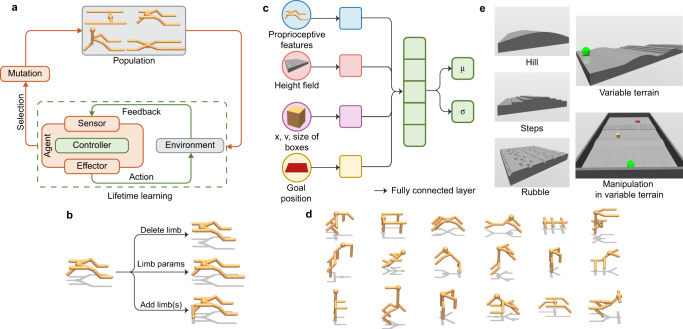
“1b) that are learned via proximal policy optimization (PPO) 28 .”
BackgroundMethodInfluentialScaling Laws for Neural Language Models
Kaplan, J., McCandlish, S., Henighan, T., Brown, T. B., Chess, B., Child, R., Gray, S., Radford, A., Wu, J., & Amodei, D. (2020) · arXiv · doi:10.48550/arxiv.2001.08361 · Cited by 9,550
Design, fabrication and control of soft robots
Rus, D., & Tolley, M. T. (2015) · Nature · doi:10.1038/nature14543 · Cited by 5,825
MuJoCo: A physics engine for model-based control
Todorov, E., Erez, T., & Tassa, Y. (2012) · 2012 IEEE/RSJ International Conference on Intelligent Robots and Systems · doi:10.1109/iros.2012.6386109 · Cited by 4,767
Neural Architecture Search with Reinforcement Learning
Zoph, B., & Le, Q. V. (2016) · arXiv (Cornell University) · doi:10.48550/arxiv.1611.01578 · Cited by 3,974
Simple Statistical Gradient-Following Algorithms for Connectionist Reinforcement Learning
Williams, R. J. (1992) · Machine Learning · doi:10.1007/bf00992696 · Cited by 3,416
CANALIZATION OF DEVELOPMENT AND THE INHERITANCE OF ACQUIRED CHARACTERS
WADDINGTON, C. H. (1942) · Nature · doi:10.1038/150563a0 · Cited by 3,255 · cited 2×
“However, biologists have long conjectured that the Baldwin effect might hold at the level of morphological evolution and sensorimotor learning in complex environments 38,43 .”
BackgroundThe symbolic species: the co-evolution of language and the brain
(1997) · Choice Reviews Online · doi:10.5860/choice.35-1500 · Cited by 2,434
A Comparative Analysis of Selection Schemes Used in Genetic Algorithms
Goldberg, D. E., & Deb, K. (1991) · Foundations of Genetic Algorithms · doi:10.1016/b978-0-08-050684-5.50008-2 · Cited by 2,407
(2016) · Springer Handbooks · doi:10.1007/978-3-319-32552-1 · Cited by 2,122
High-Dimensional Continuous Control Using Generalized Advantage Estimation
Schulman, J., Moritz, P., Levine, S., Jordan, M., & Abbeel, P. (2015) · arXiv · doi:10.48550/arxiv.1506.02438 · Cited by 2,103
Baldwin, J. M. (1896) · The American Naturalist · doi:10.1086/276408 · Cited by 1,781 · cited 14×
“Thus evolutionary processes that only select for the former will implicitly also select for the latter, thereby explaining the stronger form of the evolutionary Baldwin effect that we observe.”
BackgroundInfluentialSim-to-Real Transfer of Robotic Control with Dynamics Randomization
Peng, X. B., Andrychowicz, M., Zaremba, W., & Abbeel, P. (2018) · 2018 IEEE International Conference on Robotics and Automation (ICRA) · doi:10.1109/icra.2018.8460528 · Cited by 1,309
(1991) · Choice Reviews Online · doi:10.5860/choice.29-0605 · Cited by 1,284 · cited 1×
“Indeed the field of embodied cognition posits that intelligent behaviors can be rapidly learned by agents whose morphologies are well adapted to their environment 3–5 .”
BackgroundMuller, H. J. (1932) · The American Naturalist · doi:10.1086/280418 · Cited by 1,264 · cited 1×
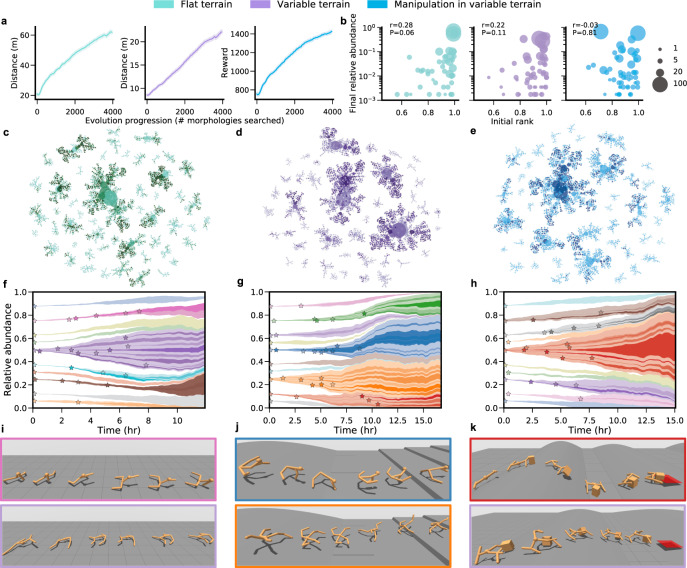
“2c-e) and Muller plots 29 (Fig.”
Pfeifer, R., & Scheier, C. (1999) · The MIT Press eBooks · doi:10.7551/mitpress/6979.001.0001 · Cited by 1,155
Automatic design and manufacture of robotic lifeforms
Lipson, H., & Pollack, J. B. (2000) · Nature · doi:10.1038/35023115 · Cited by 883 · cited 1×
“…scaling of computation and models that has been so successful in other fields of AI 6,18–20 and bring it bear on the field of evolutionary robotics 21 ; (2) the introduction of a UNIMAL, a UNIversal aniMAL morphological design space that is both highly expressive yet also enriched for useful…”
Background2019 International Conference on Robotics and Automation (ICRA)
(2019) · doi:10.1109/icra39644.2019 · Cited by 862
Parallelism and evolutionary algorithms
Alba, E., & Tomassini, M. (2002) · IEEE Transactions on Evolutionary Computation · doi:10.1109/tevc.2002.800880 · Cited by 823
Simple statistical gradient-following algorithms for connectionist reinforcement learning
Williams, R. J. (1992) · Machine Learning · doi:10.1023/a:1022672621406 · Cited by 817
Brooks, R. A. (1991) · Science · doi:10.1126/science.253.5025.1227 · Cited by 752 · cited 1×
“Furthermore, the difficulty of evaluating fitness forced prior work to (1) avoid learning adaptive controllers directly from raw sensory observations9–11,17; (2) learn hand designed controllers with few (≤ 100) parameters9–11; (3) learn to predict the fitness of a morphology13,17; (4) mimic Lamarckian rather than Darw…”
BackgroundCompositional pattern producing networks: A novel abstraction of development
Stanley, K. O. (2007) · Genetic Programming and Evolvable Machines · doi:10.1007/s10710-007-9028-8 · Cited by 713
Emergence of Locomotion Behaviours in Rich Environments
Heess, N., TB, D., Sriram, S., Lemmon, J., Merel, J., Wayne, G., Tassa, Y., Erez, T., Wang, Z., Eslami, S. M. A., et al. (2017) · arXiv · doi:10.48550/arxiv.1707.02286 · Cited by 657
A Study of Reproduction in Generational and Steady-State Genetic Algorithms
Syswerda, G. (1991) · Foundations of Genetic Algorithms · doi:10.1016/b978-0-08-050684-5.50009-4 · Cited by 652
On the stability properties of quadruped creeping gaits
McGhee, R. (1968) · Mathematical Biosciences · doi:10.1016/0025-5564(68)90041-2 · Cited by 604 · cited 1×
“Formally an agent is passively stable, when the centre of mass is inside the support polygon and the polygon’s area is greater than zero 56 .”
BackgroundSolving Rubik's Cube with a Robot Hand
OpenAI, Akkaya, I., Andrychowicz, M., Chociej, M., Litwin, M., McGrew, B., Petron, A., Paino, A., Plappert, M., Powell, G., et al. (2019) · arXiv · doi:10.48550/arxiv.1910.07113 · Cited by 602
Brockman, G., Cheung, V., Pettersson, L., Schneider, J., Schulman, J., Tang, J., & Zaremba, W. (2016) · arXiv · doi:10.48550/arxiv.1606.01540 · Cited by 582
Large-Scale Evolution of Image Classifiers
Real, E., Moore, S., Selle, A. P., Saxena, S., Suematsu, Y. I. L., Tan, J., Le, Q. V., & Kurakin, A. (2017) · arXiv (Cornell University) · doi:10.48550/arxiv.1703.01041 · Cited by 466
Big Self-Supervised Models are Strong Semi-Supervised Learners
Chen, T., Kornblith, S., Swersky, K., Norouzi, M., & Hinton, G. E. (2020) · arXiv (Cornell University) · doi:10.48550/arxiv.2006.10029 · Cited by 421
Parallel Metaheuristics: A New Class of Algorithms
(2005) · Wiley eBooks · doi:10.1002/0471739383 · Cited by 385
Arita, T., & Suzuki, R. (2000) · Artificial Life VII · doi:10.7551/mitpress/1432.003.0027 · Cited by 353
Regularized Evolution for Image Classifier Architecture Search
Real, E., Aggarwal, A., Huang, Y., & Le, Q. V. (2019) · Proceedings of the AAAI Conference on Artificial Intelligence · doi:10.1609/aaai.v33i01.33014780 · Cited by 328
Evolving 3D Morphology and Behavior by Competition
Sims, K. (1994) · Artificial Life · doi:10.1162/artl.1994.1.4.353 · Cited by 284 · cited 3×
“Hence, prior work has either evolved agents in severely limited morphological search spaces 9–13 or focused on finding optimal parameters given a fixed hand designed morphology 14–16 .”
BackgroundA Review of Physics Simulators for Robotic Applications
Collins, J., Chand, S., Vanderkop, A., & Howard, D. (2021) · IEEE Access · doi:10.1109/access.2021.3068769 · Cited by 276
RoboGrammar: graph grammar for terrain-optimized robot design
Zhao, A., Xu, J., Luković, M. K., Hughes, J., Spielberg, A., Rus, D. L., & Matusik, W. (2020) · ACM Transactions on Graphics · doi:10.1145/3414685.3417831 · Cited by 262 · cited 2×
“Furthermore, the difficulty of evaluating fitness forced prior work to (1) avoid learning adaptive controllers directly from raw sensory observations 9–11,17 ; ( 2) learn To overcome these substantial limitations, we propose Deep Evolutionary Reinforcement Learning (DERL), (Fig.”
BackgroundModels and the scaling of energy costs for locomotion
Alexander, R. M. (2005) · Journal of Experimental Biology · doi:10.1242/jeb.01484 · Cited by 233 · cited 1×
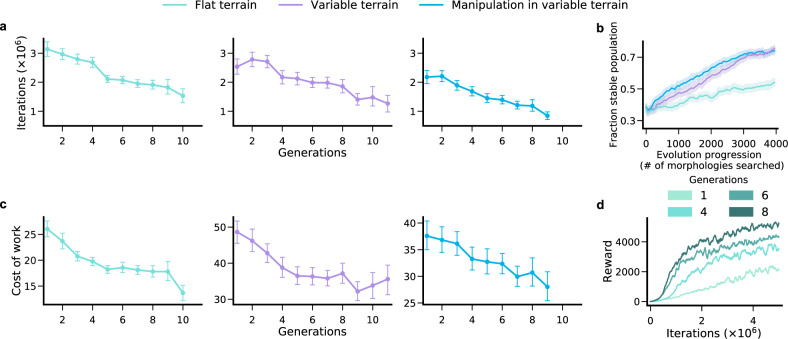
“COT and it’s variants have been used in a wide range of domains to compare energy efficient motion of different robotic systems 53 , vehicles 52 and animals 54 .”
MethodALPS: the age-layered population structure for reducing the problem of premature convergence
Hornby, G. S. (2006) · Proceedings of the 8th annual conference on Genetic and evolutionary computation · doi:10.1145/1143997.1144142 · Cited by 230
Reinforcement Learning for Robust Parameterized Locomotion Control of Bipedal Robots
Li, Z., Cheng, X., Peng, X. B., Abbeel, P., Levine, S., Berseth, G., & Sreenath, K. (2021) · 2021 IEEE International Conference on Robotics and Automation (ICRA) · doi:10.1109/icra48506.2021.9560769 · Cited by 219
The germ-plasm : a theory of heredity /
Weismann, A. (1893) · doi:10.5962/bhl.title.168967 · Cited by 210
dm_control: Software and tasks for continuous control
Tunyasuvunakool, S., Muldal, A., Doron, Y., Liu, S., Bohez, S., Merel, J., Erez, T., Lillicrap, T., Heess, N., & Tassa, Y. (2020) · Software Impacts · doi:10.1016/j.simpa.2020.100022 · Cited by 199
Programmed to learn? The ontogeny of mirror neurons
Giudice, M. D., Manera, V., & Keysers, C. (2009) · Developmental Science · doi:10.1111/j.1467-7687.2008.00783.x · Cited by 193 · cited 1×
“Indeed this Baldwinian transfer of intelligence from phenotype to genotype has been conjectured to free up phenotypic learning resources to learn more complex behaviors in animals 43 , including the emergence of language 44 and imitation 45 in humans.”
BackgroundReinforcement Learning for Improving Agent Design
Ha, D. (2019) · Artificial Life · doi:10.1162/artl_a_00301 · Cited by 188 · cited 1×
“Hence, prior work has either evolved agents in severely limited morphological search spaces 9–13 or focused on finding optimal parameters given a fixed hand designed morphology 14–16 .”
BackgroundDynamic Simulation of Soft Multimaterial 3D-Printed Objects
Hiller, J., & Lipson, H. (2014) · Soft Robotics · doi:10.1089/soro.2013.0010 · Cited by 184
Landscapes, Learning Costs, and Genetic Assimilation
Mayley, G. (1996) · Evolutionary Computation · doi:10.1162/evco.1996.4.3.213 · Cited by 173 · cited 2×
“Thus we actually discover a stronger form of the Baldwin effect than has been previously conjectured in the literature 38,39 by demonstrating that an explicit selection pressure for the speed of skill acquisition is not necessary for the Baldwin effect to hold.”
BackgroundResultJointly Learning to Construct and Control Agents using Deep Reinforcement Learning
Schaff, C., Yunis, D., Chakrabarti, A., & Walter, M. R. (2019) · Proceedings - IEEE International Conference on Robotics and Automation/Proceedings · doi:10.1109/icra.2019.8793537 · Cited by 166
Learning symmetric and low-energy locomotion
Yu, W., Turk, G., & Liu, C. K. (2018) · ACM Transactions on Graphics · doi:10.1145/3197517.3201397 · Cited by 155 · cited 1×
“We measure energy as the absolute sum of all joint torques 55 .”
MethodDirect transfer of learned information among neural networks
Pratt, L., Mostow, J., & Kamm, C. (1991) · Cited by 151
Scalable co-optimization of morphology and control in embodied machines
Cheney, N., Bongard, J., SunSpiral, V., & Lipson, H. (2018) · Journal of The Royal Society Interface · doi:10.1098/rsif.2017.0937 · Cited by 151
Scaling Laws for Autoregressive Generative Modeling
Henighan, T., Kaplan, J., Katz, M., Chen, M., Hesse, C., Jackson, J., Jun, H., Brown, T. B., Dhariwal, P., Gray, S., et al. (2020) · arXiv · doi:10.48550/arxiv.2010.14701 · Cited by 150
Cheney, N., MacCurdy, R., Clune, J., & Lipson, H. (2014) · ACM SIGEVOlution · doi:10.1145/2661735.2661737 · Cited by 149
Environmental Influence on the Evolution of Morphological Complexity in Machines
Auerbach, J. E., & Bongard, J. (2014) · PLoS Computational Biology · doi:10.1371/journal.pcbi.1003399 · Cited by 140
What Price Speed? Specific Power Required for Propulsion of Vehicles
Gabrielli, G. (1950) · Mechanical Engineering · Cited by 123
RoboGen: Robot Generation through Artificial Evolution
Auerbach, J. E., Aydın, D., Maesani, A., Kornatowski, P., Cieslewski, T., Heitz, G., Fernando, P., Loshchilov, I., Daler, L., & Floreano, D. (2014) · Conference on Artificial Life (ALIFE) · doi:10.7551/978-0-262-32621-6-ch022 · Cited by 115
How morphological development can guide evolution
Kriegman, S., Cheney, N., & Bongard, J. (2018) · Scientific Reports · doi:10.1038/s41598-018-31868-7 · Cited by 114
Discovery of the oldest bilaterian from the Ediacaran of South Australia
Evans, S. D., Hughes, I. V., Gehling, J. G., & Droser, M. L. (2020) · Proceedings of the National Academy of Sciences · doi:10.1073/pnas.2001045117 · Cited by 96 · cited 6×
“The creation of artificial embodied agents9,10 with well-adapted morphologies that can learn control tasks in diverse, complex environments is challenging because of the twin difficulties of (1) searching through a combinatorially large number of possible morphologies, and (2) the computational time required to evalua…”
BackgroundInfluentialLearning and evolution: A quantitative genetics approach
Anderson, R. W. (1995) · Journal of Theoretical Biology · doi:10.1006/jtbi.1995.0123 · Cited by 89 · cited 1×
“Previous simulations of learning and evolution have provided toy instantiations of the Baldwin effect in highly simplified scenarios 40–42 .”
BackgroundAutomated Shapeshifting for Function Recovery in Damaged Robots
Kriegman, S., Walker, S., Shah, D., Levin, M. G., Kramer-Bottiglio, R. K., & Bongard, J. (2019) · Robotics: Science and Systems · doi:10.15607/rss.2019.xv.028 · Cited by 74
Embodied artificial evolution: Artificial evolutionary systems in the 21st Century
Eiben, A. E., Kernbach, S., & Haasdijk, E. (2012) · Evolutionary Intelligence · doi:10.1007/s12065-012-0071-x · Cited by 58
Lamarckian Evolution of Simulated Modular Robots
Jelisavcic, M., Glette, K., Haasdijk, E., & Eiben, A. E. (2019) · Frontiers in Robotics and AI · doi:10.3389/frobt.2019.00009 · Cited by 51
2D-VSR-Sim: A simulation tool for the optimization of 2-D voxel-based soft robots
Medvet, E., Bartoli, A., Lorenzo, A. D., & Seriani, S. (2020) · SoftwareX · doi:10.1016/j.softx.2020.100573 · Cited by 51
On the relationship between environmental and morphological complexity in evolved robots
Auerbach, J. E., & Bongard, J. C. (2012) · Proceedings of the 14th annual conference on Genetic and evolutionary computation · doi:10.1145/2330163.2330238 · Cited by 50 · cited 2×
“FT agents are less space filling compared to VT/MVT agents, as measured by the coverage 31,32 of the morphology.”
BackgroundMyths and Legends of the Baldwin Effect
Turney, P. D. (2002) · CogPrints (University of Southampton) · doi:10.48550/arxiv.cs/0212036 · Cited by 48 · cited 3×
“Thus we actually discover a stronger form of the Baldwin effect than has been previously conjectured in the literature 38,39 by demonstrating that an explicit selection pressure for the speed of skill acquisition is not necessary for the Baldwin effect to hold.”
BackgroundResultEnvironmental influences on evolvable robots
Miras, K., Ferrante, E., & Eiben, A. E. (2020) · PLoS ONE · doi:10.1371/journal.pone.0233848 · Cited by 45
Evolving-Controllers Versus Learning-Controllers for Morphologically Evolvable Robots
Miras, K., Carlo, M. D., Akhatou, S., & Eiben, A. E. (2020) · Lecture notes in computer science · doi:10.1007/978-3-030-43722-0_6 · Cited by 37
Bongard, J. (2014) · The MIT Press eBooks · doi:10.7551/mitpress/8493.003.0007 · Cited by 16 · cited 1×
“Indeed the field of embodied cognition posits that intelligent behaviors can be rapidly learned by agents whose morphologies are well adapted to their environment 3–5 .”
BackgroundReinforcement Learning for Robust Parameterized Locomotion Control of Bipedal RobotsPreprint
Li, Z., Cheng, X., Peng, X. B., et al. (2021) · arXiv (Cornell University) · doi:10.48550/arxiv.2103.14295 · Cited by 12
Research works printed but not linked: 15
- Darwin, C. On the Origin of Species by Means of Natural Selection, Vol. 167 (John Murray, London, 1859).
- Wang, T., Zhou, Y., Fidler, S. & Ba, J. In International Conference on Learning Representations (2019).
- Luck, K. S., Amor, H. B. & Calandra, R. Data-efficient co-adaptation of morphology and behaviour with deep reinforcement learning. in Conference on Robot Learning, 854–869 (PMLR, 2020).
- Zoph, B. & Le, Q. V. In International Conference on Learning Representations (2017).
- Sutton, R. S. & Barto, A. G. Reinforcement Learning: An Introduction (MIT Press, 2018).
- Turney, P. D. In ICML Workshop on Evolutionary Computation and Machine Learning, 135–142 (1996).
- Hinton GE Nowlan SJ How learning can guide evolution Complex Syst. 1987 1 495 502
- Ackley D Littman M Interactions between learning and evolution Artif. life II 1991 10 487 509
- Bongard, J. C. & Paul, C. in From Animals to Animats: The Sixth International Conference on the Simulation of Adaptive Behaviour (Citeseer, 2000).
- Wang, T., Liao, R., Ba, J. & Fidler, S. In International Conference on Learning Representations (2018).
- Pathak, D., Lu, C., Darrell, T., Isola, P. & Efros, A. A. In Advances in Neural Information Processing Systems (eds Wallach, H. et al.) Vol. 32 (Curran Associates, Inc., 2019).
- Huang, W., Mordatch, I. & Pathak, D. One policy to control them all: shared modular policies for agent-agnostic control. In International Conference on Machine Learning, 4455–4464 (PMLR, 2020).
- Schulman, J., Moritz, P., Levine, S., Jordan, M. & Abbeel, P. In Proceedings of the International Conference on Learning Representations (ICLR) (2016).
- Henderson, P. et al. In Thirty-Second AAAI Conference on Artificial Intelligence (2018).
- Siciliano, B. & Khatib, O. In Springer Handbooks (2016).
Cited by
Artificial intelligence for geoscience: Progress, challenges, and perspectives
Zhao, T., Wang, S., Ouyang, C., Chen, M., Liu, C., Zhang, J., Yu, L., Wang, F., Xie, Y., Li, J., et al. (2024) · The Innovation · doi:10.1016/j.xinn.2024.100691 · Cited by 360
“165 Moreover, the deep integration of large AI models withdrones,autonomousvehicles,andmobilemonitoringdevicesonthesurface orunderground,coupledwithsatellitedata,isfacilitatingmoreef fi cient andauto-mated complex actions in geoscience, including spatiotemporal data collection, processing, and…”
BackgroundCatalyzing next-generation Artificial Intelligence through NeuroAI
Zador, A., Escola, S., Richards, B., Ölveczky, B., Bengio, Y., Boahen, K., Botvinick, M., Chklovskii, D., Churchland, A., Clopath, C., et al. (2023) · Nature Communications · doi:10.1038/s41467-023-37180-x · Cited by 300
Self-citationDiffusion Models in Low-Level Vision: A Survey
He, C., Shen, Y., Fang, C., Xiao, F., Tang, L., Zhang, Y., Zuo, W., Guo, Z., & Li, X. (2025) · IEEE Transactions on Pattern Analysis and Machine Intelligence · doi:10.1109/tpami.2025.3545047 · Cited by 212
“Noting that GSAD [105] and PyDiff [96] employ the ”gt mean” strategy, which involves fine-tuning the brightness of the generated results using the ground truth, thus producing much more impressive results than others in PSNR and SSIM.”
Embodied Intelligence: A Synergy of Morphology, Action, Perception and Learning
Liu, H., Guo, D., & Cangelosi, A. (2025) · ACM Computing Surveys · doi:10.1145/3717059 · Cited by 205
“Currently, the work in this area mainly includes the optimization of morphological parameters and structure, and the methods used mainly include reinforcement learning [63, 65] and genetic optimization [71].”
Li, P., Hao, J., Tang, H., Fu, X., Zheng, Y., & Tang, K. (2024) · IEEE Transactions on Evolutionary Computation · doi:10.1109/tevc.2024.3443913 · Cited by 155
“The hybrid algorithms in this area include EvoGym (GA) [43], HERD [44], AIEA [45], DERL [46], and TAME [47].”
Metadata
- Authors
- Gupta, A., Savarese, S., Ganguli, S., & Fei-Fei, L.
- Affiliations
- Stanford University (US)
- Corresponding author
- Gupta, Agrim
- Fei-Fei, Li
- Venue
- Nature Communications
- Published
- 2021-10-06
- Volume
- 12
- Issue
- 1
- Pages
- 5721-5721
- ISSN
- 2041-1723 (ISSN-L)
- PMC
- PMC8494941
- OpenAlex
- W3127203205
- Cited by
- 352
- References
- 70
- Citations by year
- 2026: 97 · 2025: 111 · 2024: 65 · 2023: 47 · 2022: 26 · 2021: 6
- FWCI
- 12.61
- Type
- journal article
- Language
- en
- Open access
- gold
- doi.org
- Licence
- cc-by
- creativecommons.org/licenses/by/4.0 (tdm)
- creativecommons.org/licenses/by/4.0 (vor)
- Locations
- Nature Communications (publishedVersion, cc-by)
- Europe PMC (PubMed Central) (publishedVersion, other-oa)
- PubMed Central (publishedVersion, cc-by)
- PubMed (publishedVersion)
- arXiv (Cornell University) (submittedVersion)
- RePEc: Research Papers in Economics (submittedVersion)
- DOAJ (DOAJ: Directory of Open Access Journals) (submittedVersion, cc-by-sa)
- arXiv (Cornell University) (cc-by)
- Funders
- United States Department of Defense | United States Navy | Office of Naval Research (N00014-16-1-2127)
- Topics
- Physical Sciences › Computer Science › Artificial Intelligence › Reinforcement Learning in Robotics
- Physical Sciences › Computer Science › Artificial Intelligence › Evolutionary Algorithms and Applications
- Life Sciences › Biochemistry, Genetics and Molecular Biology › Genetics › Evolution and Genetic Dynamics
- Keywords
- embodied AI, morphological evolution, environmental complexity, locomotion, manipulation tasks, morphological stability, energy efficiency
- MeSH terms
- Deep Learning, Animals, Computer Simulation, Biological Evolution, Reward
About these checks
Registry, retraction, Cites and statistics results are computed, not judged, with one exception: a printed reference that no index lists is read once by a model before it counts as a citation error. Claims are extracted by a model and kept only when their quote appears verbatim in the text; each cited source is then checked, with a model’s help, for whether it says what the claim relies on. Those verdicts can be wrong — read the claim’s quote and the cited source before relying on one.
Statistics and arithmetic are recomputed, not judged.
Confidence bands are shown only for fields calibrated on our annotated test set. None is calibrated yet, so no band is shown.
What counts as a claim ›How we measure confidence ›How we check this ›
Are you an author, or do you see a problem with this page? Request a review
Data sources
Bibliographic data: Semantic Scholar, OpenAlex, Crossref.
Contains information from the Semantic Scholar Academic Graph Datasets, made available under the ODC Attribution License (ODC-BY 1.0).
Semantic Scholar’s data is described in: Kinney, R., et al. (2023). The Semantic Scholar Open Data Platform. arXiv:2301.10140.
