

The Q61H mutation decouples KRAS from upstream regulation and renders cancer cells resistant to SHP2 inhibitors
Open accessThe DOI matches its Crossref record; 84 of the 84 references it cites were found in a registry or an index.
Abstract
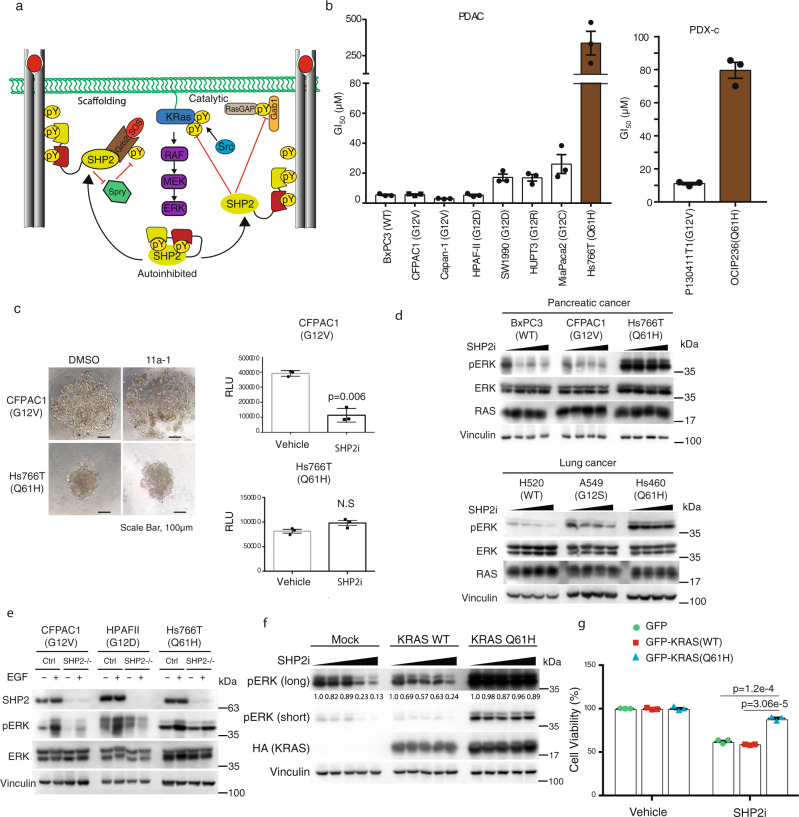
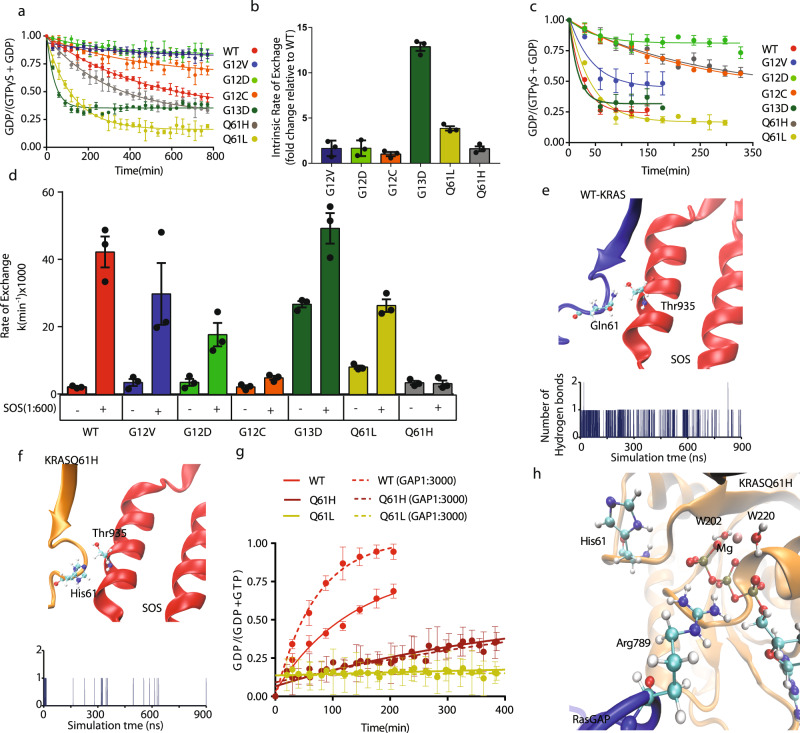
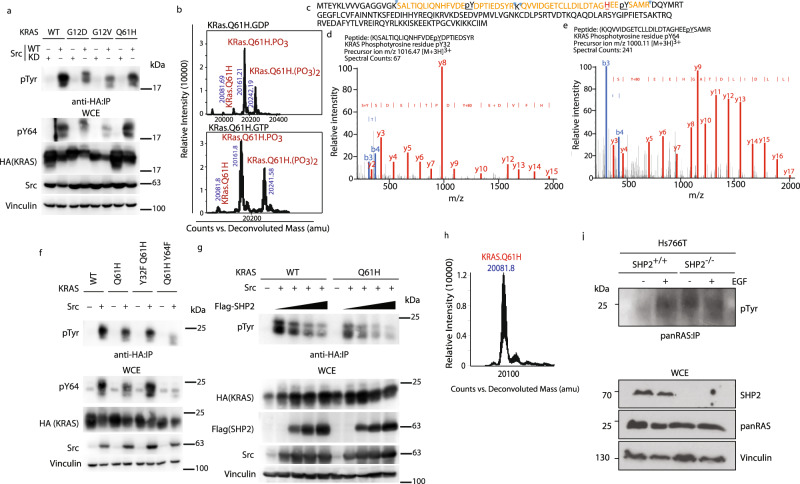
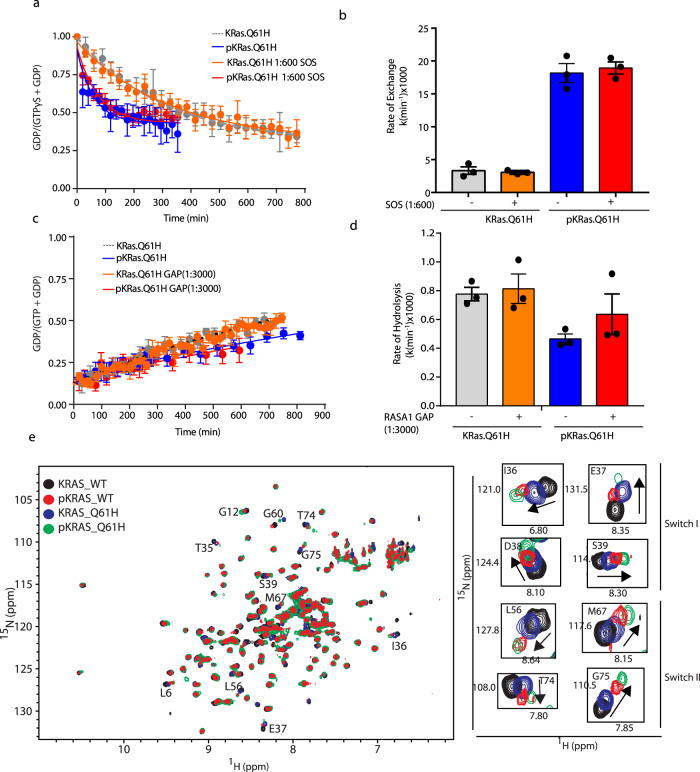
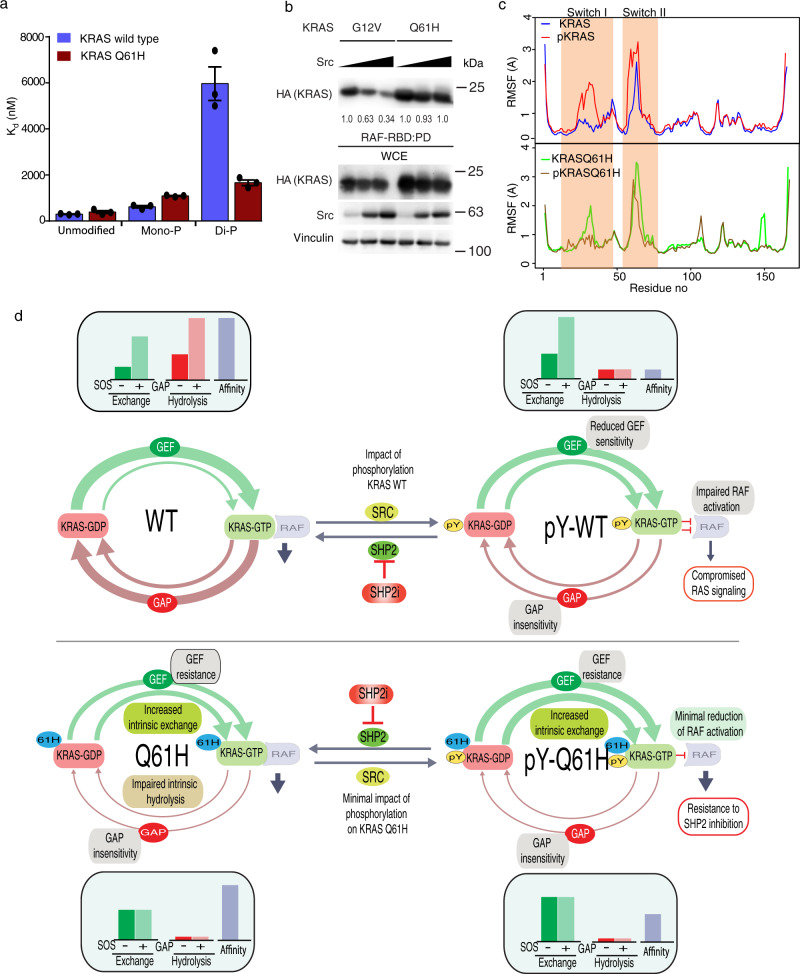
Cancer cells bearing distinct KRAS mutations exhibit variable sensitivity to SHP2 inhibitors (SHP2i). Here we show that cells harboring KRAS Q61H are uniquely resistant to SHP2i, and investigate the underlying mechanisms using biophysics, molecular dynamics, and cell-based approaches. Q61H mutation impairs intrinsic and GAP-mediated GTP hydrolysis, and impedes activation by SOS1, but does not alter tyrosyl phosphorylation. Wild-type and Q61H-mutant KRAS are both phosphorylated by Src on Tyr32 and Tyr64 and dephosphorylated by SHP2, however, SHP2i does not reduce ERK phosphorylation in KRAS Q61H cells. Phosphorylation of wild-type and Gly12-mutant KRAS, which are associated with sensitivity to SHP2i, confers resistance to regulation by GAP and GEF activities and impairs binding to RAF, whereas the near-complete GAP/GEF-resistance of KRAS Q61H remains unaltered, and high-affinity RAF interaction is retained. SHP2 can stimulate KRAS signaling by modulating GEF/GAP activities and dephosphorylating KRAS, processes that fail to regulate signaling of the Q61H mutant.
Overview
The claims and statistics of this paper haven’t been checked yet.
Free: it reads the open-access text and checks the first 5 claims that cite a source we can check. Create a free account to check every claim.
Integrity signals
Registry
Cites
Statistics
Figures
Verification
Claims the paper makes
The claims and statistics of this paper haven’t been checked yet.
Free: it reads the open-access text and checks the first 5 claims that cite a source we can check. Create a free account to check every claim.
Claims other papers make about this one
Each is checked against this paper’s own text: does it say what the citing paper says it does?
The source backs part of the claim, not all of it — or backs it for a different population, condition or comparison.
In the citing paper
“Codon 61 mutations such as Q61H strongly impair intrinsic GTP hydrolysis and exhibit relative independence from upstream SOS1/SHP2 regulation, limiting sensitivity to certain upstream-targeted therapies [13,16].”
From Precision Targeting of KRAS-Mutant Cancers: Beyond G12C Toward G12D and Pan-RAS Therapeutic Strategies (2026) · cites this paper as [13]
Experimental — accuracy not yet measuredThe cited source says what the claim attributes to it.
In the citing paper
“For example, KRAS Q61H exhibits marked resistance to SHP2-mediated regulation, thereby limiting sensitivity to SHP2 inhibition [13,50].”
From Precision Targeting of KRAS-Mutant Cancers: Beyond G12C Toward G12D and Pan-RAS Therapeutic Strategies (2026) · cites this paper as [13]
In the citing paper
“KRASG12C-mediated GTP hydrolysis is, however, refractory to (and might even be inhibited by) RAS-GAPs, whereas some other KRAS variants (G12D, G12A, G12R and G12V) might remain responsive to GAPs50. Even with GAP stimulation, the GTPase activity of KRASQ61L and KRASG61H is limited51.”
From The current state of the art and future trends in RAS-targeted cancer therapies (2022) · cites this paper as [51]
Self-check
Percentages, sums and reported differences re-computed from the paper’s own numbers.
The self-check needs the paper’s full text.
Citations
Cites
VMD: visual molecular dynamics
Humphrey, W., Dalke, A., & Schulten, K. (1996) · Journal of Molecular Graphics · doi:10.1016/0263-7855(96)00018-5 · Cited by 66,952 · cited 1×
“RAS/RAF binding was assessed using the RAS activation assay kit from Millipore (17-218).”
MethodParticle mesh Ewald: An N ⋅log( N ) method for Ewald sums in large systems
Darden, T., York, D., & Pedersen, L. (1993) · The Journal of Chemical Physics · doi:10.1063/1.464397 · Cited by 30,546 · cited 1×
“RAS/RAF binding was assessed using the RAS activation assay kit from Millipore (17-218).”
MethodNMRPipe: A multidimensional spectral processing system based on UNIX pipes
Delaglio, F., Grzesiek, S., Vuister, G., Zhu, G., Pfeifer, J., & Bax, A. (1995) · Journal of Biomolecular NMR · doi:10.1007/bf00197809 · Cited by 15,965 · cited 1×
“RAS/RAF binding was assessed using the RAS activation assay kit from Millipore (17-218).”
MethodAll-Atom Empirical Potential for Molecular Modeling and Dynamics Studies of Proteins
MacKerell, A. D., Bashford, D., Bellott, M., Dunbrack, R. L., Evanseck, J. D., Field, M. J., Fischer, S., Gao, J., Guo, H., Ha, S., et al. (1998) · The Journal of Physical Chemistry B · doi:10.1021/jp973084f · Cited by 14,311 · cited 1×
“RAS/RAF binding was assessed using the RAS activation assay kit from Millipore (17-218).”
MethodCHARMM‐GUI: A web‐based graphical user interface for CHARMM
Jo, S., Kim, T., Iyer, V. G., & Im, W. (2008) · Journal of Computational Chemistry · doi:10.1002/jcc.20945 · Cited by 9,284 · cited 1×
“RAS/RAF binding was assessed using the RAS activation assay kit from Millipore (17-218).”
MethodConstant pressure molecular dynamics algorithms
Martyna, G. J., Tobias, D. J., & Klein, M. L. (1994) · The Journal of Chemical Physics · doi:10.1063/1.467468 · Cited by 5,804 · cited 1×
“RAS/RAF binding was assessed using the RAS activation assay kit from Millipore (17-218).”
MethodBest, R. B., Zhu, X., Shim, J., Lopes, P. E. M., Mittal, J., Feig, M., & MacKerell, A. D. (2012) · Journal of Chemical Theory and Computation · doi:10.1021/ct300400x · Cited by 4,532
Genomic analyses identify molecular subtypes of pancreatic cancer
Bailey, P., Chang, D. K., Nones, K., Johns, A. L., Patch, A.-M., Gingras, M.-C., Miller, D. K., Christ, A. N., Bruxner, T. J. C., Quinn, M. C., et al. (2016) · Nature · doi:10.1038/nature16965 · Cited by 3,621 · cited 1×
“RAS/RAF binding was assessed using the RAS activation assay kit from Millipore (17-218).”
MethodScalable molecular dynamics on CPU and GPU architectures with NAMD
Phillips, J. C., Hardy, D. J., Maia, J. D. C., Stone, J. E., Ribeiro, J. V., Bernardi, R. C., Buch, R., Fiorin, G., Hénin, J., Jiang, W., et al. (2020) · The Journal of Chemical Physics · doi:10.1063/5.0014475 · Cited by 3,144 · cited 1×
“RAS/RAF binding was assessed using the RAS activation assay kit from Millipore (17-218).”
MethodMoffitt, R. A., Marayati, R., Flate, E. L., Volmar, K. E., Loeza, S. G. H., Hoadley, K. A., Rashid, N. U., Williams, L. A., Eaton, S. C., Chung, A. H., et al. (2015) · Nature Genetics · doi:10.1038/ng.3398 · Cited by 2,194 · cited 1×
“RAS/RAF binding was assessed using the RAS activation assay kit from Millipore (17-218).”
MethodSelf-citation
Research works printed but not linked: 2
- Lu, H. et al. SHP2 inhibition overcomes RTK-mediated pathway re-activation in KRAS mutant tumors treated with MEK inhibitors. Mol. Cancer Ther. 10.1158/1535-7163.MCT-18-0852 (2019). 31068384 · DOI · Paper page
- Nichols, R. J. et al. RAS nucleotide cycling underlies the SHP2 phosphatase dependence of mutant BRAF-, NF1- and RAS-driven cancers. Nat. Cell Biol. 10.1038/s41556-018-0169-1 (2018). PMC6115280 30104724 · DOI · Paper page
Cited by
The current state of the art and future trends in RAS-targeted cancer therapies
Punekar, S. R., Velcheti, V., Neel, B. G., & Wong, K.-K. (2022) · Nature Reviews Clinical Oncology · doi:10.1038/s41571-022-00671-9 · Cited by 549
Classification of KRAS -Activating Mutations and the Implications for Therapeutic Intervention
Johnson, C., Burkhart, D. L., & Haigis, K. M. (2022) · Cancer Discovery · doi:10.1158/2159-8290.cd-22-0035 · Cited by 121
SHP2: A Pleiotropic Target at the Interface of Cancer and Its Microenvironment
Sodir, N. M., Pathria, G., Adamkewicz, J. I., Kelley, E. H., Sudhamsu, J., Merchant, M. A., Chiarle, R., & Maddalo, D. (2023) · Cancer Discovery · doi:10.1158/2159-8290.cd-23-0383 · Cited by 110
“As blocking SHP2 disrupts SOS1-mediated RAS-GTP loading, SHP2i are expected to show an antiproliferative activity in tumors where RAS cycling is at least partially intact and to have no effect when RAS is locked in an active state, as in the Q61 mutants (92).”
BackgroundTargeting KRAS mutations in pancreatic cancer: opportunities for future strategies
Linehan, A., O’Reilly, M., McDermott, R., & O'Kane, G. M. (2024) · Frontiers in Medicine · doi:10.3389/fmed.2024.1369136 · Cited by 60
Ricciuti, B., Son, J., Okoro, J. J., Mira, A., Patrucco, E., Eum, Y., Wang, X., Paranal, R., Wang, H., Lin, M., et al. (2022) · Clinical Cancer Research · doi:10.1158/1078-0432.ccr-21-2719 · Cited by 42
Tyrosine phosphatase PTPN11/SHP2 in solid tumors - bull’s eye for targeted therapy?
Chen, X., Keller, S. J., Hafner, P., Alrawashdeh, A. Y., Avery, T. Y., Norona, J., Zhou, J., & Ruess, D. A. (2024) · Frontiers in Immunology · doi:10.3389/fimmu.2024.1340726 · Cited by 52
Mizutani, T., Boretto, M., Lim, S., Drost, J., González, D. M., Oka, R., Geurts, M. H., Begthel, H., Korving, J., van Es, J. H., et al. (2024) · Nature Cancer · doi:10.1038/s43018-024-00841-x · Cited by 39
“Recently, Ras status was reported to correlate with SH2 domain-containing phosphatase 2 (SHP2) inhibitor sensitivity in several cancers; in particular, the NRAS Q61K mutation in neuroblastoma confers resistance to SHP2 inhibitors 43,44 .”
Evaluation of KRAS inhibitor-directed therapies for pancreatic cancer treatment
Long, S.-A., Amparo, A. M., Goodhart, G., Ahmad, S. A., & Waters, A. M. (2024) · Frontiers in Oncology · doi:10.3389/fonc.2024.1402128 · Cited by 31
“Further, KRAS Q61H and KRAS G12R are impaired in SOS1 binding (53, 80), and KRAS G12R is impaired in PI3K a binding (53).”
BackgroundInfluentialQu, X., Hamidi, H., Johnson, R. M., Sokol, E. S., Lin, E., Eng, C., Kim, T.-W., Bendell, J. C., Sivakumar, S., Kaplan, B., et al. (2025) · Nature Communications · doi:10.1038/s41467-025-59588-3 · Cited by 39
“…leads to constitutive activation of the downstream MAPK signaling independent of upstream receptor tyrosine kinase (RTK) activity in cell lines 44,45 Consistently, we found that KRAS Q61H organoids preferentially activate MAPK over PI3K signaling, and KRAS Q61H CRC cell lines are more sensitive…”
Molecular dynamics simulations for the structure-based drug design: targeting small-GTPases proteins
Parise, A., Cresca, S., & Magistrato, A. (2024) · Expert Opinion on Drug Discovery · doi:10.1080/17460441.2024.2387856 · Cited by 28
“Indeed, the most common mutations of KRas display different degrees of exchange and hydrolysis [77,132].”
Liu, Y., Zhang, W., Jang, H., & Nussinov, R. (2023) · Cellular and Molecular Life Sciences · doi:10.1007/s00018-023-05052-8 · Cited by 29
RAS‐targeted cancer therapy: Advances in drugging specific mutations
Liu, C., Ye, D., Yang, H., Chen, X., Su, Z., Li, X., Ding, M., & Liu, Y. (2023) · MedComm · doi:10.1002/mco2.285 · Cited by 31
Direct GDP-KRAS G12C inhibitors and mechanisms of resistance: the tip of the iceberg
Rosen, J. C., Sacher, A. G., & Tsao, M. (2023) · Therapeutic Advances in Medical Oncology · doi:10.1177/17588359231160141 · Cited by 24
Self-citationSzpechciński, A., Szołkowska, M., Winiarski, S., Lechowicz, U., Wiśniewski, P., & Knetki‐Wróblewska, M. (2022) · Cancers · doi:10.3390/cancers14143388 · Cited by 22
Targeting SHP1 and SHP2 to suppress tumors and enhance immunosurveillance
Zhao, Y., & Jiang, L. (2024) · Trends in Cell Biology · doi:10.1016/j.tcb.2024.10.008 · Cited by 22
Roux, Ö. L., Pershing, N. L., Kaltenbrun, E., Newman, N. J., Everitt, J. I., Baldelli, E., Pierobon, M., Petricoin, E. F., & Counter, C. M. (2022) · eLife · doi:10.7554/elife.75715 · Cited by 15
“, 2019), akin to other substitutions at these two positions (Gebregiworgis et al., 2021; Smith et al., 2013).”
BackgroundKhandakar, G. I., Satoh, R., Takasaki, T., Fujitani, K., Tanabe, G., Sakai, K., Nishio, K., & Sugiura, R. (2022) · Cells · doi:10.3390/cells11040702 · Cited by 17
“T3M4 cells harbor the KRAS Q61H mutation, which is found in about 5% of PDAC patients and the most prevalent mutation occurring at codon 61 of KRAS [12].”
BackgroundLi, Y., Han, L., & Zhang, Z. (2022) · Computational and Structural Biotechnology Journal · doi:10.1016/j.csbj.2022.02.018 · Cited by 17
“On the other hand, the intrinsic exchange is unchanged or accelerated during the exchange of GDP for GTP but the sensitivity to GEF activity can be reduced [10,11].”
BackgroundSelf-citationTesticular germ cell tumors: Genomic alternations and RAS-dependent signaling
Nakhaei‐Rad, S., Soleimani, Z., Vahedi, S., & Gorjinia, Z. (2023) · Critical Reviews in Oncology/Hematology · doi:10.1016/j.critrevonc.2023.103928 · Cited by 17
Kishore, P. V. V. N., Dunga, A. K., Allaka, T. R., Kethavarapu, Y., Nechipadappu, S. K., Pothana, P., & Kuppan, C. (2022) · Current Organic Synthesis · doi:10.2174/1570179419666220822125724 · Cited by 9
Protein tyrosine phosphatases: emerging role in cancer therapy resistance
Zhao, M., Shuai, W., Su, Z., Xu, P., Wang, A., Sun, Q., & Wang, G. (2024) · 癌症:英文版 · doi:10.1002/cac2.12548 · Cited by 11
“…programmed death-ligand 1; PI3K, phosphoinositide 3-kinase; SHP2, src homology-2 domain-containing phosphatase 2; STAT1, signal transducer and activator of transcription 1; TCR, T cell receptor; TNF-α , tumor necrosis factor-α ; ZAP70, zeta chain of T cell receptor associated protein kinase 70.”
BackgroundChippalkatti, R., Parisi, B., Kouzi, F., Laurini, C., Fredj, N. B., & Abankwa, D. (2024) · European Journal of Cell Biology · doi:10.1016/j.ejcb.2024.151425 · Cited by 11
Studying early structural changes in SOS1 mediated KRAS activation mechanism
Bhadhadhara, K., Jani, V., Koulgi, S., Sonavane, U., & Joshi, R. (2023) · Current Research in Structural Biology · doi:10.1016/j.crstbi.2023.100115 · Cited by 10
“Targeting the SOS1 and KRAS interface in order to block the KRAS activation is considered one of the useful strategies in KRAS mediated cancer pathways (Ketcham et al., 2022), (Gebregiworgis et al., 2021).”
BackgroundPosttranslational modifications remodel proteome-wide ligandability
Li, W., Wei, Q., Llanos, M. A., Gathmann, C., Governa, P., Chiu, T.-Y., Wozniak, J. M., Jadhav, A. M., Holcomb, M., Cravatt, J. B., et al. (2026) · Nature Chemical Biology · doi:10.1038/s41589-026-02216-y · Cited by 16
CRISPR-Cas9 Screening Identifies Resistance Mechanisms to KRAS Inhibition in Pancreatic Cancer
Lim, S.-A., Todd, H., Goodhart, G., Chang, W.-H., Amparo, A. M., Bridgens, R., Dilly, J., Park, S. J., Beal, R. M., Shehadeh, S. M., et al. (2025) · Cancer Research · doi:10.1158/0008-5472.can-25-1835 · Cited by 13
“First, the SOS1–RAS Q61H interaction is defective, and second, RAS Q61H binds tightly (albeit nonfunctionally) to GAPs such as NF1, acting as an NF1 inhibitor (42, 43).”
InfluentialCrystal structure of NRAS Q61K with a ligand-induced pocket near switch II
Gebregiworgis, T., Chan, J. Y.-L., Kuntz, D. A., Privé, G. G., Marshall, C. B., & Ikura, M. (2024) · European Journal of Cell Biology · doi:10.1016/j.ejcb.2024.151414 · Cited by 10
Self-citationPromising natural products targeting protein tyrosine phosphatase SHP2 for cancer therapy
Lu, J., Yu, D., Li, H., Qin, P., Chen, H., & Chen, L. (2024) · Phytotherapy Research · doi:10.1002/ptr.8185 · Cited by 7
SHP2–EGFR States in Dephosphorylation Can Inform Selective SHP2 Inhibitors, Dampening RasGAP Action
Liu, Y., Jang, H., & Nussinov, R. (2024) · The Journal of Physical Chemistry B · doi:10.1021/acs.jpcb.4c00873 · Cited by 7
Prognostic gene expression profile of colorectal cancer
Saadh, M. J., Allela, O. Q. B., Kareem, R. A., Baldaniya, L., Ballal, S., Vashishth, R., Parmar, M., Sameer, H. N., Hamad, A. K., Athab, Z. H., et al. (2025) · Gene · doi:10.1016/j.gene.2025.149433 · Cited by 6
Zhou, P., Xiao, M., Li, W., Sun, X., Bai, Y., Meng, F., Zhu, Z., Yuan, W., & Sun, K. (2022) · Frontiers in Pharmacology · doi:10.3389/fphar.2022.841308 · Cited by 8
KRAS Q61H Mutation Confers Cancer Cells with Acquired Resistance to SHP2 Inhibition
Song, Y., Yang, X., & Yu, B. (2022) · Pharmaceutical Fronts · doi:10.1055/s-0042-1743411 · Cited by 6
Du, T., Hu, X., Hou, Z., Wang, W., You, S., Wang, M., Ji, M., Xue, N., & Chen, X. (2024) · Cellular and Molecular Life Sciences · doi:10.1007/s00018-023-05034-w · Cited by 7
“However, 61 codon mutations of both KRAS and NRAS confer resistance to SHP2 inhibitors, which limited possible future applications of SHP2-targeted therapy on RAS-mutant lung cancers [15, 16].”
Shan, W., Zhang, S., Assaraf, Y. G., & Tam, K. Y. (2025) · Biochimica et Biophysica Acta (BBA) - Molecular Basis of Disease · doi:10.1016/j.bbadis.2025.167859 · Cited by 4
Systematic and precise interventions for KRAS-mutant cancers
Liang, J., Wu, J., Zhang, Y., Wang, H., Zheng, Y., & He, Q. (2026) · Experimental Hematology and Oncology · doi:10.1186/s40164-026-00763-7 · Cited by 4
“KRAS mutations also disrupt negative feedback loop control, enabling RTK–SOS1/SHP2-mediated reactivation and compensatory enhancement of parallel PI3K/ AKT/mTOR signaling; the degree of dependence on SOS1/2 and SHP2 varies by allele [71, 72].”
Chen, M. Y., Rider, A. B., Ferry, J. A., Hasserjian, R. P., Nardi, V., Louissaint, A., Sohani, A. R., & Yuen, L. (2025) · The American Journal of Surgical Pathology · doi:10.1097/pas.0000000000002421 · Cited by 3
KRAS inhibitors in drug resistance and potential for combination therapy
Rathod, L. S., Sakle, N. S., & Mokale, S. N. (2024) · Tumori Journal · doi:10.1177/03008916241289206 · Cited by 3
Burge, R. A., Bialousow, L., McFall, T. B., Bamonte, L., Johnson, G., Smith, M., Vaena, S. G., Comte‐Walters, S., Ball, L. E., Berto, S., et al. (2025) · Cancer Research Communications · doi:10.1158/2767-9764.crc-25-0281 · Cited by 3
Proteomic Perspectives on KRAS-Driven Cancers and Emerging Therapeutic Approaches
Karki, R., Chen, R., & Pan, S. (2025) · Current Oncology · doi:10.3390/curroncol32110614 · Cited by 3
“Notably, the Q61H mutation reduces phosphorylation-dependent downregulation of KRAS activity, a feature not observed in other mutations like G12D/V [51].”
Popescu, B. O., & Shannon, K. (2023) · The Journal of Experimental Medicine · doi:10.1084/jem.20230082 · Cited by 2
Gray, J. P., Bildik, G., Kim, H.-N., Sutton, M. N., Wang, J., Osuji, A. O., Batistatou, N., Yang, H., Mao, W., Tan, Z., et al. (2025) · iScience · doi:10.1016/j.isci.2025.113686 · Cited by 2
Self-citationThe impact of K-Ras Gly12 mutants on homeostasis and tumorigenesis in the colonic epithelium
Yang, M. H., Sheth, S., Shui, B., Grabski, I. N., Park, S. S., Galán‐Cobo, A., Irizarry, R. A., Heymach, J. V., Dow, L. E., & Haigis, K. M. (2026) · Oncogene · doi:10.1038/s41388-026-03771-3 · Cited by 1
Wang, S., Zhao, X., Dong, J. X., Zhang, J., Wang, Y., Jin, H., Jiang, X., Chen, L., Zhang, M., Ji, L., et al. (2026) · Journal of Translational Medicine · doi:10.1186/s12967-026-08477-4 · Cited by 1
“Cancer cells carrying mutations such as KRAS Q61H, G13D, and Q61X are generally resistant to SHP2 inhibitors [87, 113, 114], while cell lines with mutations at the G12 site (especially G12C) tend to show increased sensitivity to SHP2 inhibitors [115].”
Brønsted-basic small molecules activate GTP hydrolysis in KRAS-Q61 mutants
Wang, Y., Chen, S., Cao, Y., Wu, Y., 施仲达, Wang, C. D., Norinskiy, M. A., Celik, H., & Zhang, Z. (2026) · Nature Chemical Biology · doi:10.1038/s41589-026-02291-1 · Cited by 2
Self-citationBrønsted-basic small molecules activate GTP hydrolysis in Ras Q61 mutantsPreprint
Wang, Y., Chen, S., Wu, Y., Cao, Y., Shi, Z., Norinskiy, M. A., Wang, C. D., Celik, H., & Zhang, Z. (2025) · bioRxiv (Cold Spring Harbor Laboratory) · doi:10.1101/2025.11.04.686643 · Cited by 1
“This defect is most severe for Q61 mutants, as glutamine 61 is an indispensable component of the catalytic machinery for both intrinsic and GTPase-accelerating protein (GAP)-mediated GTP hydrolysis 44–48 .”
Self-citationKano, Y. (2026) · International Journal of Molecular Sciences · doi:10.3390/ijms27135796
“Codon 61 mutations such as Q61H strongly impair intrinsic GTP hydrolysis and exhibit relative independence from upstream SOS1/SHP2 regulation, limiting sensitivity to certain upstream-targeted therapies [13,16].”
InfluentialSelf-citationSerafimidis, I. (2026) · Frontiers in Oncology · doi:10.3389/fonc.2026.1771549
“Because this allele is relatively independent of upstream signaling, SHP2 blockade fails to achieve the degree of pathway suppression observed in KRAS Q61H -driven models (14).”
InfluentialMAPK pathway modulation and its implications in KRAS mutant lung adenocarcinoma
Román, S. D. H. (2023) · theses.fr (ABES) · doi:10.70675/8eaccae1ze96bz4279zb69fzaafa5e50c341
Jin, S., Zhang, Z., Liang, F., Yang, Y., Lü, A., & Liang, C. (2026) · Biomarker Research · doi:10.1186/s40364-026-00981-5
“As a result, Q61-mutant cancers are largely resistant to existing indirect targeting strategies, underscoring the need to develop novel direct targeting mechanisms and innovative therapeutic approaches [212].”
Self-citationHRAS promotes mutant NRAS–driven transformation with codon and allele specificity
Lee, H., Hughes, J. M., LaMorte, J. P., Finniff, B. A., Binette, P., Gunasekara, S. K., Covas, A., Wall, V. E., Esposito, D., Wilkerson, M. D., et al. (2026) · Science Signaling · doi:10.1126/scisignal.aej6209
Uncovering KRAS -mutant allele-specific biology and vulnerabilities in non-small cell lung cancer
d’Arienzo, P. D., McDaid, W. J., Tinsley, K. L., Chen, T., Gasson, E. J., Lindsay, C. R., & Malliri, A. (2026) · Biochemical Journal · doi:10.1042/bcj20250138
“Upon SHP2 inhibition, this unique feature of KRAS Q61H maintained MAPK pathway activation, rendering cells resistant [45].”
Influential
Metadata
- Authors
- Gebregiworgis, T., Kano, Y., St-Germain, J., Radulovich, N., Udaskin, M. L., Mentes, A., Huang, R., Poon, B. P. K., He, W., Valencia-Sama, I., Robinson, C. M., Huestis, M., Miao, J., Yeh, J. J., Zhang, Z.-Y., Irwin, M. S., Lee, J. E., Tsao, M.-S., Raught, B., Marshall, C. B., Ohh, M., & Ikura, M.
- Affiliations
- University Health Network (CA)
- Tokyo Medical and Dental University (JP)
- University of Toronto (CA)
- Purdue University West Lafayette (US)
- University of North Carolina at Chapel Hill (US)
- Corresponding author
- Marshall, Christopher B.
- Ohh, Michael
- Ikura, Mitsuhiko
- ORCID
- Gebregiworgis, Teklab
- Kano, Yoshihito
- Radulovich, Nikolina
- Udaskin, Molly L.
- Huang, Richard
- Poon, Betty P. K.
- He, Wenguang
- Valencia-Sama, Ivette
- Robinson, Claire M.
- Huestis, Melissa
- Miao, Jinmin
- Yeh, Jen Jen
- Zhang, Zhong-Yin
- Irwin, Meredith S.
- Lee, Jeffrey E.
- Tsao, Ming-Sound
- Raught, Brian
- Marshall, Christopher B.
- Ohh, Michael
- Ikura, Mitsuhiko
- Venue
- Nature Communications
- Published
- 2021-11-01
- Volume
- 12
- Issue
- 1
- Pages
- 6274-6274
- ISSN
- 2041-1723 (ISSN-L)
- PMC
- PMC8560773
- OpenAlex
- W3210161753
- Cited by
- 49
- References
- 83
- Citations by year
- 2026: 9 · 2025: 9 · 2024: 13 · 2023: 8 · 2022: 10
- FWCI
- 2.43
- Type
- journal article
- Language
- en
- Open access
- gold
- doi.org
- Licence
- cc-by
- creativecommons.org/licenses/by/4.0 (tdm)
- creativecommons.org/licenses/by/4.0 (vor)
- Locations
- Nature Communications (publishedVersion, cc-by)
- PubMed Central (publishedVersion, cc-by)
- PubMed (publishedVersion)
- RePEc: Research Papers in Economics (submittedVersion)
- DOAJ (DOAJ: Directory of Open Access Journals) (submittedVersion, cc-by-sa)
- Funders
- National Institutes of Health
- Canadian Institutes of Health Research (133694_1, FDN‐1542284, PJT-166005,)
- Canadian Cancer Society Research Institute (703209)
- Japan Society for the Promotion of Science (19K23909, 166005)
- National Cancer Institute (R01CA207288, R01CA069202)
- Topics
- Life Sciences › Biochemistry, Genetics and Molecular Biology › Molecular Biology › Protein Tyrosine Phosphatases
- Life Sciences › Biochemistry, Genetics and Molecular Biology › Molecular Biology › Protein Kinase Regulation and GTPase Signaling
- Life Sciences › Biochemistry, Genetics and Molecular Biology › Molecular Biology › Melanoma and MAPK Pathways
- Keywords
- SHP2 inhibitors, drug resistance, GTP hydrolysis, SOS1, GTPase-activating protein, guanine nucleotide exchange factor, ERK1/2 phosphorylation, Src kinase, KRAS signaling
- MeSH terms
- Enzyme Inhibitors, Guanosine Triphosphate, Humans, Lung Neoplasms, Gene Expression Regulation, Neoplastic, Proto-Oncogene Proteins p21(ras), src-Family Kinases, Mutation, Missense, Cell Line, Tumor, raf Kinases, Protein Tyrosine Phosphatase, Non-Receptor Type 11
About these checks
Registry, retraction, Cites and statistics results are computed, not judged, with one exception: a printed reference that no index lists is read once by a model before it counts as a citation error. Claims are extracted by a model and kept only when their quote appears verbatim in the text; each cited source is then checked, with a model’s help, for whether it says what the claim relies on. Those verdicts can be wrong — read the claim’s quote and the cited source before relying on one.
Statistics and arithmetic are recomputed, not judged.
Confidence bands are shown only for fields calibrated on our annotated test set. None is calibrated yet, so no band is shown.
What counts as a claim ›How we measure confidence ›How we check this ›
Are you an author, or do you see a problem with this page? Request a review
Data sources
Bibliographic data: Semantic Scholar, OpenAlex, Crossref.
Contains information from the Semantic Scholar Academic Graph Datasets, made available under the ODC Attribution License (ODC-BY 1.0).
Semantic Scholar’s data is described in: Kinney, R., et al. (2023). The Semantic Scholar Open Data Platform. arXiv:2301.10140.
