

The DOI matches its Crossref record; 75 of the 75 references it cites were found in a registry or an index.
Evolution of the conductive filament system in HfO2-based memristors observed by direct atomic-scale imaging
Open accessAbstract
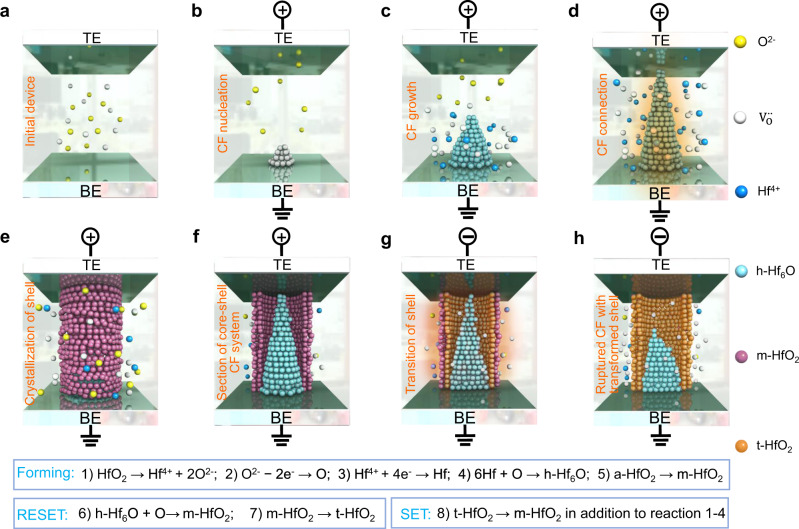
The resistive switching effect in memristors typically stems from the formation and rupture of localized conductive filament paths, and HfO 2 has been accepted as one of the most promising resistive switching materials. However, the dynamic changes in the resistive switching process, including the composition and structure of conductive filaments, and especially the evolution of conductive filament surroundings, remain controversial in HfO 2-based memristors. Here, the conductive filament system in the amorphous HfO 2-based memristors with various top electrodes is revealed to be with a quasi-core-shell structure consisting of metallic hexagonal-Hf 6 O and its crystalline surroundings (monoclinic or tetragonal HfO x). The phase of the HfO x shell varies with the oxygen reservation capability of the top electrode. According to extensive high-resolution transmission electron microscopy observations and ab initio calculations, the phase transition of the conductive filament shell between monoclinic and tetragonal HfO 2 is proposed to depend on the comprehensive effects of Joule heat from the conductive filament current and the concentration of oxygen vacancies. The quasi-core-shell conductive filament system with an intrinsic barrier, which prohibits conductive filament oxidation, ensures the extreme scalability of resistive switching memristors. This study renovates the understanding of the conductive filament evolution in HfO 2-based memristors and provides potential inspirations to improve oxide memristors for nonvolatile storage-class memory applications.
Overview
The claims and statistics of this paper haven’t been checked yet.
Run the check — free, no account needed. It reads the open-access text and checks the sources it cites.
Integrity signals
Registry
Cites
Statistics
Figures
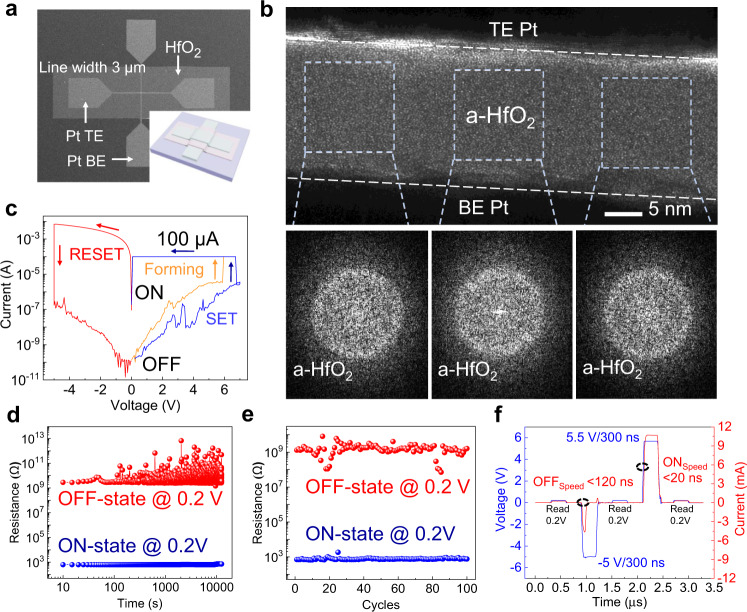
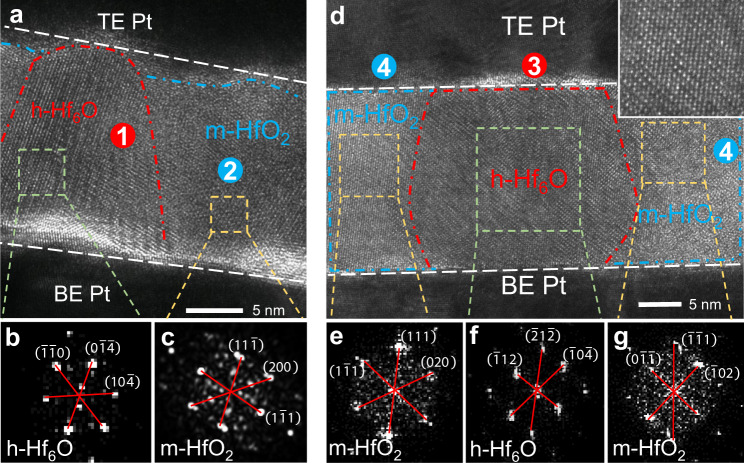
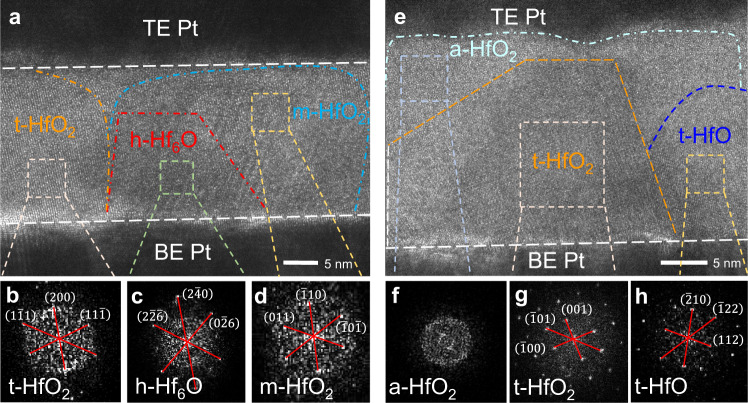
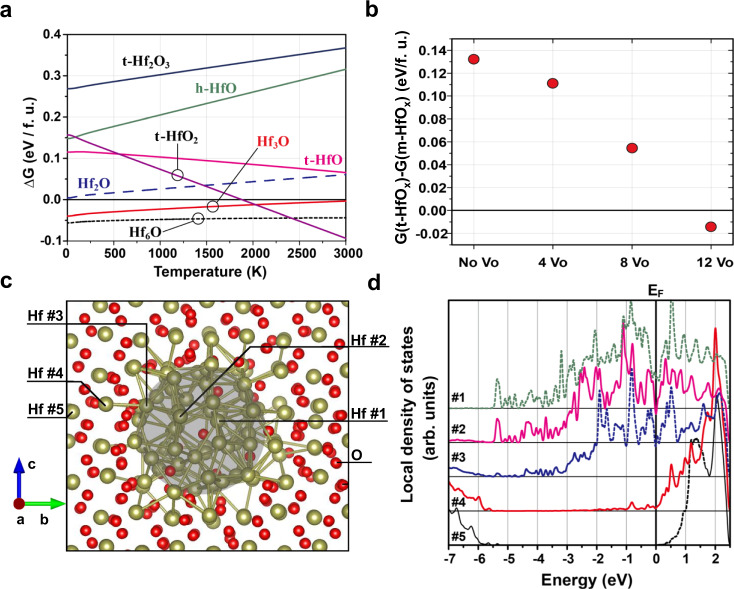
Verification
Claims the paper makes
The claims and statistics of this paper haven’t been checked yet.
Run the check — free, no account needed. It reads the open-access text and checks the sources it cites.
Claims other papers make about this one
Each is checked against this paper’s own text: does it say what the citing paper says it does?
The check wasn’t confident either way, so it gives no verdict — never disputed.
In the citing paper
“Although our device is not ideal yet, the estimated accuracy is comparable to other hardware‐based simulation performances ranging from 70% to 94%.[ 41 , 42 , 43 , 44 , 45 ]”
From Retention Secured Nonlinear and Self-Rectifying Analog Charge Trap Memristor for Energy-Efficient Neuromorphic Hardware (2023) · cites this paper as [43]
Experimental — accuracy not yet measured
Self-check
Percentages, sums and reported differences re-computed from the paper’s own numbers.
The self-check needs the paper’s full text.
Citations
Cites
Generalized Gradient Approximation Made Simple
Perdew, J. P., Burke, K., & Ernzerhof, M. (1996) · Physical Review Letters · doi:10.1103/physrevlett.77.3865 · Cited by 215,824
Efficient iterative schemes for ab initio total-energy calculations using a plane-wave basis set
Kresse, G., & Furthmüller, J. (1996) · Physical Review B · doi:10.1103/physrevb.54.11169 · Cited by 123,652
Kresse, G., & Furthmüller, J. (1996) · Computational Materials Science · doi:10.1016/0927-0256(96)00008-0 · Cited by 76,871
In situ click chemistry generation of cyclooxygenase-2 inhibitors
Bhardwaj, A., Kaur, J., Wuest, M., & Wuest, F. (2017) · Nature Communications · doi:10.1038/s41467-016-0009-6 · Cited by 7,448
Redox‐Based Resistive Switching Memories – Nanoionic Mechanisms, Prospects, and Challenges
Waser, R., Dittmann, R., Staikov, G., & Szot, K. (2009) · Advanced Materials · doi:10.1002/adma.200900375 · Cited by 5,080
Memristive devices for computing
Yang, J. J., Strukov, D. B., & Stewart, D. R. (2013) · Nature Nanotechnology · doi:10.1038/nnano.2012.240 · Cited by 3,885
Wong, H.-S. P., Lee, H.-Y., Yu, S., Chen, Y.-S., Wu, Y., Chen, P.-S., Lee, B., Chen, F. T., & Tsai, M.-J. (2012) · Proceedings of the IEEE · doi:10.1109/jproc.2012.2190369 · Cited by 2,757
In-memory computing with resistive switching devices
Ielmini, D., & Wong, H.-S. P. (2018) · Nature Electronics · doi:10.1038/s41928-018-0092-2 · Cited by 2,298
Fully hardware-implemented memristor convolutional neural network
Yao, P., Wu, H., Gao, B., Tang, J., Zhang, Q., Zhang, W., Yang, J. J., & Qian, H. (2020) · Nature · doi:10.1038/s41586-020-1942-4 · Cited by 2,179
Atomic structure of conducting nanofilaments in TiO2 resistive switching memory
Kwon, D.-H., Kim, K. M., Jang, J. H., Jeon, J. M., Lee, M. H., Kim, G. H., Li, X.-S., Park, G.-S., Lee, B., Han, S., et al. (2010) · Nature Nanotechnology · doi:10.1038/nnano.2009.456 · Cited by 2,092
Cited by
Sorted by citations
Items 301–303 of 303
Kim, Y. B., Kim, S.-H., Kim, D.-M., Gautam, S., & Lee, H. (2026) · ACS Applied Materials & Interfaces · doi:10.1021/acsami.6c14552
Zhang, F., Hui, S., Zhang, S., Sun, T., Chen, Z., Liu, X., Li, H., & Wangyang, P. (2026) · SSRN Electronic Journal · doi:10.2139/ssrn.7649074
Qiu, P., Li, X., Chen, X., Liu, H., Cui, Y., Hu, C., Wu, D., Liu, J., & Fu, C. (2026) · Nanoscale · doi:10.1039/d6nr02720b
Metadata
- Authors
- Zhang, Y., Mao, G.-Q., Zhao, X., Li, Y., Zhang, M., Wu, Z., Wu, W., Sun, H., Guo, Y., Wang, L., Zhang, X., Liu, Q., Lv, H., Xue, K.-H., Xu, G., Miao, X., Long, S., & Liu, M.
- Affiliations
- University of Science and Technology of China (CN)
- Huazhong University of Science and Technology (CN)
- Chinese Academy of Sciences (CN)
- Beijing University of Technology (CN)
- Corresponding author
- Zhao, Xiaolong
- Xue, Kan-Hao
- Long, Shibing
- Liu, Ming
- ORCID
- Venue
- Nature Communications
- Published
- 2021-12-13
- Volume
- 12
- Issue
- 1
- Pages
- 7232-7232
- ISSN
- 2041-1723 (ISSN-L)
- PMC
- PMC8668918
- OpenAlex
- W4200157328
- Cited by
- 300
- References
- 75
- Citations by year
- 2026: 47 · 2025: 72 · 2024: 70 · 2023: 85 · 2022: 26
- FWCI
- 13.31
- Type
- journal article
- Language
- en
- Open access
- gold
- doi.org
- Locations
- Nature Communications (publishedVersion, cc-by)
- PubMed Central (publishedVersion, cc-by)
- PubMed (publishedVersion)
- RePEc: Research Papers in Economics (submittedVersion)
- DOAJ (DOAJ: Directory of Open Access Journals) (submittedVersion, cc-by-sa)
- Funders
- National Natural Science Foundation of China (61925110, 61821091, 51961145110)
- Topics
- Physical Sciences › Engineering › Electrical and Electronic Engineering › Advanced Memory and Neural Computing
- Physical Sciences › Engineering › Electrical and Electronic Engineering › Ferroelectric and Negative Capacitance Devices
- Physical Sciences › Materials Science › Materials Chemistry › Phase-change materials and chalcogenides
- Keywords
- conductive filaments, resistive switching, amorphous HfO2, core-shell structure, tetragonal to monoclinic phase transformation, oxygen vacancies, Joule heating, non-volatile memory
About these checks
Registry, retraction, Cites and statistics results are computed, not judged, with one exception: a printed reference that no index lists is read once by a model before it counts as a citation error. Claims are extracted by a model and kept only when their quote appears verbatim in the text; each cited source is then checked, with a model’s help, for whether it says what the claim relies on. Those verdicts can be wrong — read the claim’s quote and the cited source before relying on one.
Statistics and arithmetic are recomputed, not judged.
Confidence bands are shown only for fields calibrated on our annotated test set. None is calibrated yet, so no band is shown.
What counts as a claim ›How we measure confidence ›How we check this ›
Are you an author, or do you see a problem with this page? Request a review
