

Potential for future reductions of global GHG and air pollutants from circular waste management systems
Open accessPublished version of a preprint
The DOI matches its Crossref record; 58 of the 58 references it cites were found in a registry or an index; 8 of the 52 sources its claims cite were checked for support.
Abstract
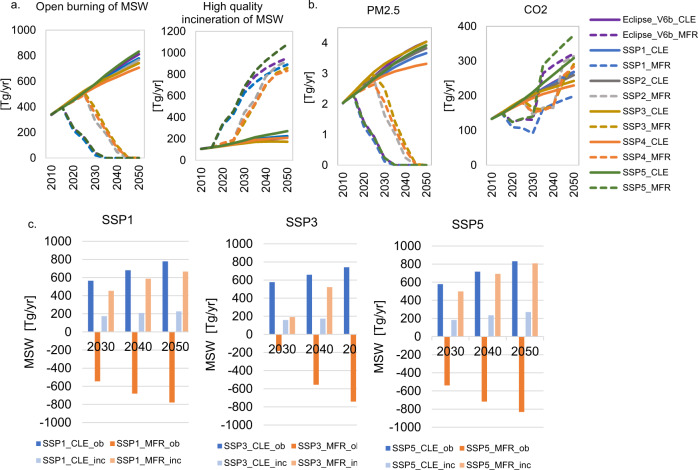
The rapidly rising generation of municipal solid waste jeopardizes the environment and contributes to climate heating. Based on the Shared Socioeconomic Pathways, we here develop a global systematic approach for evaluating the potentials to reduce emissions of greenhouse gases and air pollutants from the implementation of circular municipal waste management systems. We contrast two sets of global scenarios until 2050, namely baseline and mitigation scenarios, and show that mitigation strategies in the sustainability-oriented scenario yields earlier, and major, co-benefits compared to scenarios in which inequalities are reduced but that are focused solely on technical solutions. The sustainability-oriented scenario leaves 386 Tg CO 2eq /yr of GHG (CH 4 and CO 2 ) to be released while air pollutants from open burning can be eliminated, indicating that this source of ambient air pollution can be entirely eradicated before 2050.
Overview
CoChat Summary
## TL;DR
This paper models global municipal solid waste (MSW) generation and related greenhouse gas and air pollutant emissions under six socioeconomic pathways and two waste-management futures: current legislation (CLE) and maximum technically feasible reduction (MFR). It finds that a sustainability-oriented pathway with circular MSW systems can eliminate open-burning air pollutants before 2050 and leave 386 Tg CO2eq/yr of GHGs in 2050.
## Key findings
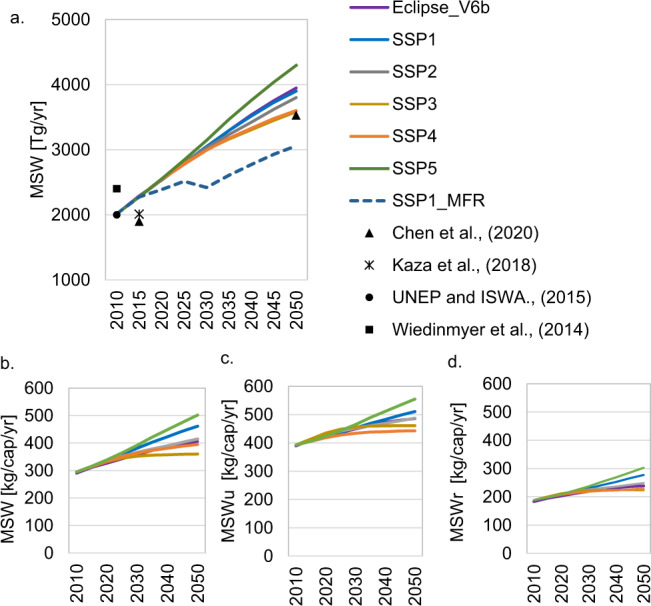
- Global MSW generation is projected to rise from 2,289 Tg/yr in 2015 to 4,296 Tg/yr in 2050 in SSP5; SSP1 is 10% lower than SSP5, and an added food/plastic waste reduction case (SSP1_MFR) lowers 2050 MSW generation by a further 20% compared with SSP5.
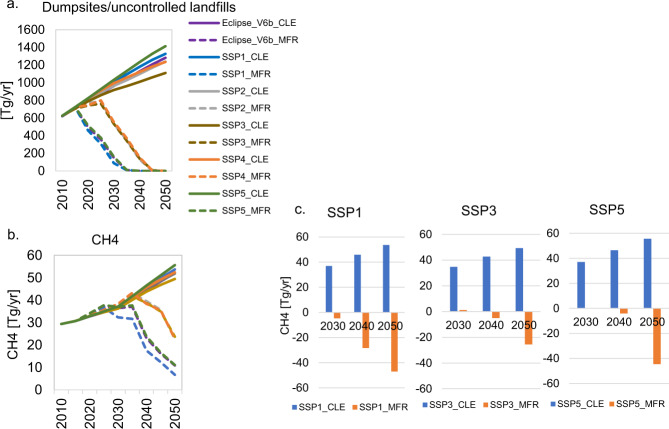
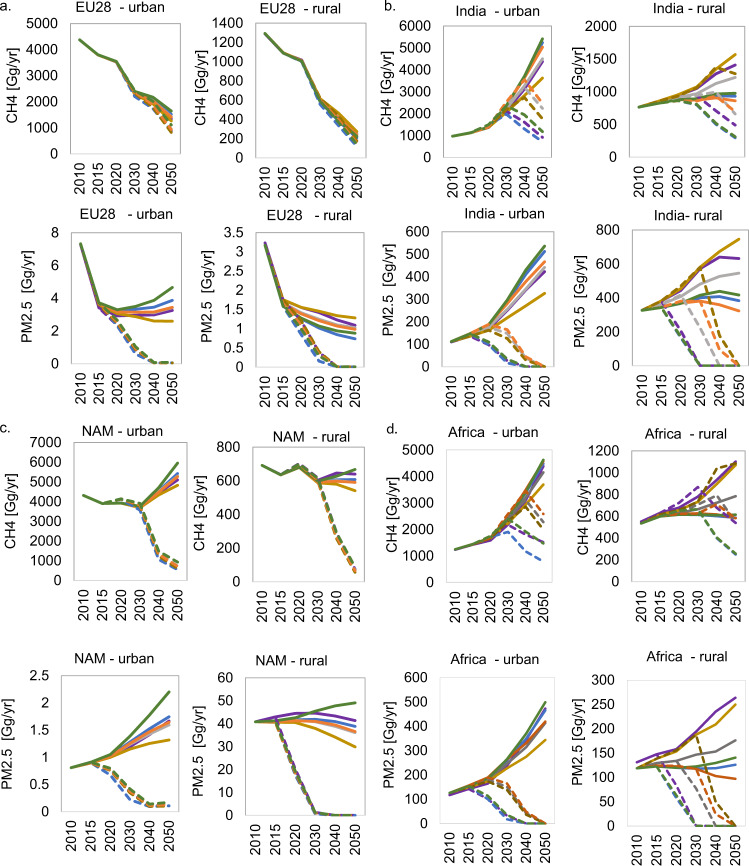
- The study estimates that MSW handling accounted for 8% (30 Tg/yr) of global anthropogenic CH4 emissions in 2015, and if current management persists, CH4 emissions from MSW will rise by 71% to 49–55 Tg CH4 by 2050.
- Under SSP1_MFR, CH4 emissions are projected to fall by 88% versus the baseline, leaving 187 Tg CO2eq/yr of CH4 in 2050; total GHGs (CH4 + CO2) in SSP1_MFR are 386 Tg CO2eq/yr in 2050.
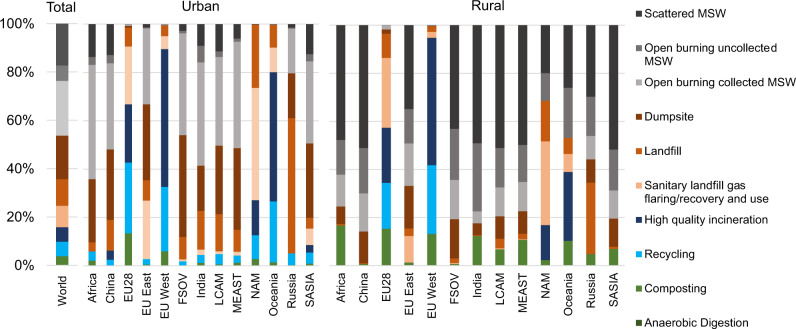
- The paper estimates that about 16% of global MSW generated was openly burned in 2010 and 2015 (380 Tg/yr and 394 Tg/yr, respectively), and that open-burning air pollutants can be virtually eliminated by 2050 in MFR scenarios; SSP1_MFR reaches eradication of littering and open burning in 2035.
## Methods
- Global scenario analysis using the Shared Socioeconomic Pathways (SSP1–SSP5) plus an IEA WEO 2018-based Eclipse_V6b scenario; for each pathway, the authors compare a baseline CLE case with an MFR case that implements circular MSW management globally.
- MSW generation, composition, collection, and management are modeled for urban and rural areas using GDP per capita-driven elasticities, regional income-group assumptions, country-specific activity data, and the IIASA-GAINS model framework.
- Emissions of CH4, CO2, particulate matter, and air pollutants are estimated from waste-management technologies and open-burning assumptions, with atmospheric PM2.5 impacts derived using GAINS transfer coefficients.
## Limitations
- The paper states that quantitative uncertainty estimation is difficult because many inputs vary: activity data, emission factors, and management-type assumptions; it also notes uncertainties from inconsistent MSW definitions and incomplete data, especially in developing countries.
- It does not account for MSW trade or MSW generated from tourism, so unmanaged MSW and related emissions may be under- or overestimated in some countries.
- The authors state that emission savings from energy recovery are not considered at this stage because consistent estimation would require scenario- and region-specific fuel mixes and emission factors.
Model-written summary. Check it against the paper before relying on it.
Integrity signals
Registry
Cites
Statistics
Figures
Verification
Claims the paper makes
8 Valid · 3 Not valid · 34 Not checked · 96 Own results and interpretations
The cited sources support only part of this claim — read each source’s verdict below.
In the paper
“Work focused on GHG and air pollution suggest that landfills contribute about 15% to global anthropogenic CH4 emissions30”
§ Potential for future reductions of global GHG and air pollutants from circular waste management systems > Introduction The quantities of municipal solid waste (MSW) generated globally each year has grown over the last decades, due to population and economic growth, and the consequent changes in production and consumption patterns1,2. Estimates suggest that the world population generated 1.9 Gt/yr of MSW in 2015 and is expected to generate about 3.5 Gt/yr of MSW in 20503. High-income countries (World Bank income classification) generate more waste per capita per year than low-income countries: they are responsible for 34% of the amount of MSW generated each year, even though they account for just 16% of the global population4. The absence of suitable treatment facilities to cope with the large quantities of MSW will result in various environmental and health impacts5. High-income countries can deploy policies and instruments to cope with the rising MSW flows and hence they can potentially have cleaner and better-organized waste management systems. Examples include the EU Waste Framework Directive 2008/98/EC6 and the amendment EU Directive 2018/8517, the EU Landfill Directive 1999/31/EC8 and the amendment EU Directive 2018/8509, the EU Directive on packaging and packaging waste 94/62/EC10 and the amendment EU Directive 2018/85211, the 3 R’s strategy in Japan12 and the Resource Conservation and Recovery Act 197613 in the United States. However, measures focusing solely on increasing re-use and recycling have a marginal impact on reducing waste generation14. Although some countries e.g., Japan and Netherlands, have managed to reduce MSW generation, most of them are still not successful in reducing the per capita amounts of MSW generated each year15. By contrast, low-income countries often lack suitable management systems, resulting from the shortage of funds, poor planning, poor implementation of law, and lack of technology and expertise4,16,17. In addition, the outsourcing of resource-intensive production and waste exports from high-income to low-income countries exacerbates the environmental problems resulting from inadequate waste management systems18. Often, open burning, littering and poorly managed landfills are the main ways of waste disposal in low-income countries4. Open waste burning results in the release of toxic pollutants and greenhouse gases (GHGs)19–21. Litter harms wildlife and ecosystems, especially marine life. Global marine litter is currently recognized as one of the biggest sources of ocean’s pollution22,23. Decomposition of organic matter in landfills can result in the release of methane (CH4)24, a GHG that is 28 times more potent per kg emitted than carbon dioxide (CO2) in a 100 year timeframe25. In addition to the negative impacts on the environment and climate, these unsustainable practices have well-documented adverse effects on human health26–28. Recently, research on waste concentrates on the assessment of the linkages between waste and resource use, climate change, air, and water pollution. Previous work determined that only around 13% of the global MSW generated is recycled and 5.5% composted4. Furthermore, it is estimated that the relative contribution of energy from waste and wastewater to the global primary energy could increase from 2% to 9% by 2040 and deliver 64 EJ of energy per year (1 EJ = 1018 Joules) at the end of this period upon implementation of circular management systems29. Work focused on GHG and air pollution suggest that landfills contribute about 15% to global anthropogenic CH4 emissions30 and show that open burning of MSW is an important contributor to particulate matter and air pollutant emissions20,31,32, specifically, it contributes 11% to total global particulate matter <2.5 µm (PM2.5) emissions and 6–7% to total global black carbon (BC) emissions31,32. BC from open burning of waste amounts to 2–10% of global CO2eq emissions33.
What the sources say
- Partly supportedcites [30] Höglund-Isaksson L Gómez-Sanabria A Klimont Z Rafaj P Schöpp W Technical potentials and costs for reducing global anthropogenic methane emissions in the 2050 timeframe–results from the GAINS model Environ. Res. Commun. 2020 2 025004 10.1088/2515-7620/ab7457 sourceExperimental — accuracy not yet measured
The emissions table reproduced in section 4 lists municipal solid waste at 31.9 Tg CH₄ in 2015 and 60.4 Tg CH₄ in the 2050 baseline. This supports identifying solid waste as a methane source, but the table does not identify landfill emissions separately or state that landfills account for about 15% of global anthropogenic methane emissions. (LLM, conf=0.82)
hedgedstates an association- Asserted: passes — The authors put it forward as true.
- Checkable: passes — It can be checked against evidence.
- Load-bearing: unclear — It is unclear whether the paper’s conclusions depend on it.
- Based: passes — The paper gives a reason why it holds.
- Partly supported
The cited sources support only part of this claim — read each source’s verdict below.
In the paper
“We estimate that MSW handling accounts for 8% (30 Tg/yr) of the global CH4 anthropogenic emissions estimated at 344 Tg/yr in 201530.”
§ Potential for future reductions of global GHG and air pollutants from circular waste management systems > Results > Anthropogenic emissions to air
What the sources say
- Partly supportedcites [30] Höglund-Isaksson L Gómez-Sanabria A Klimont Z Rafaj P Schöpp W Technical potentials and costs for reducing global anthropogenic methane emissions in the 2050 timeframe–results from the GAINS model Environ. Res. Commun. 2020 2 025004 10.1088/2515-7620/ab7457 sourceExperimental — accuracy not yet measured
Table 2 (in the indexed Conclusions section; page unavailable) gives 31.9 Tg CH₄ for municipal solid waste in 2015, broadly consistent with the cited 30 Tg/yr. The retrieved passages do not substantiate the claimed global total of 344 Tg/yr or the 8% share; 31.9 divided by 344 is about 9.3%. (LLM, conf=0.83)
hedged- Asserted: passes — The authors put it forward as true.
- Checkable: passes — It can be checked against evidence.
- Load-bearing: passes — The paper’s conclusions depend on it.
- Based: passes — The paper gives a reason why it holds.
- Partly supported
The cited sources support only part of this claim — read each source’s verdict below.
In the paper
“However, comparing CH4 emissions from MSW in the Eclipse_V5a32 to this study, we can see that the estimate in the latter is 6% higher.”
§ Potential for future reductions of global GHG and air pollutants from circular waste management systems > Results > Anthropogenic emissions to air
What the sources say
- Partly supportedcites [32] Klimont Z Global anthropogenic emissions of particulate matter including black carbon Atmos. Chem. Phys. 2017 17 8681 8723 10.5194/acp-17-8681-2017 sourceExperimental — accuracy not yet measured
The Method section identifies ECLIPSE as a GAINS dataset and says GAINS calculates methane emissions; Section 3.8 discusses municipal solid waste in GAINS. Our copy does not give an ECLIPSE V5a methane-emissions estimate for MSW, so it cannot substantiate the stated 6% comparison. (LLM, conf=0.78)
plain- Asserted: passes — The authors put it forward as true.
- Checkable: passes — It can be checked against evidence.
- Load-bearing: unclear — It is unclear whether the paper’s conclusions depend on it.
- Based: passes — The paper gives a reason why it holds.
- Partly supported
Every source the paper cites for this claim was checked and supports it.
In the paper
“and 57% higher than the estimate of ref. 32”
§ Potential for future reductions of global GHG and air pollutants from circular waste management systems > Results > Anthropogenic emissions to air
What the sources say
- Supportedcites [32] Klimont Z Global anthropogenic emissions of particulate matter including black carbon Atmos. Chem. Phys. 2017 17 8681 8723 10.5194/acp-17-8681-2017 source
Section 3.8 (Waste; page unavailable) estimates that 115–160 Tg of global municipal solid waste was openly burned during 1990–2010, providing the reference estimate cited. The 57% difference is the citing authors’ comparison with their own estimate, not a figure attributed to this source. (LLM, conf=0.87)
plain- Asserted: passes — The authors put it forward as true.
- Checkable: passes — It can be checked against evidence.
- Load-bearing: unclear — It is unclear whether the paper’s conclusions depend on it.
- Based: passes — The paper gives a reason why it holds.
- Supported
Every source the paper cites for this claim was checked and supports it.
In the paper
“In contrast, our results for particulate matter are 60% higher than those from ref. 32.”
§ Potential for future reductions of global GHG and air pollutants from circular waste management systems > Results > Anthropogenic emissions to air
What the sources say
- Supportedcites [32] Klimont Z Global anthropogenic emissions of particulate matter including black carbon Atmos. Chem. Phys. 2017 17 8681 8723 10.5194/acp-17-8681-2017 source
The Results and discussion section reports particulate-matter emission estimates, including global PM₁₀ and PM₂.₅ totals for 2010. The cited paper therefore provides the estimates used as the comparison point; the statement that the citing authors’ results are 60% higher is their own comparison, not a finding attributed to this source. (LLM, conf=0.84)
plain- Asserted: passes — The authors put it forward as true.
- Checkable: passes — It can be checked against evidence.
- Load-bearing: unclear — It is unclear whether the paper’s conclusions depend on it.
- Based: passes — The paper gives a reason why it holds.
- Supported
78 more claims · 1 with their cited sources checked
Create a free account to see all 141 claims and to verify the 18 references still open.
- It may state two separate claims as one. 35
- Probably not a substantial claim. 25
- The quote only partly states this claim. 3
Claims other papers make about this one
Each is checked against this paper’s own text: does it say what the citing paper says it does?
In the citing paper
“Effective waste recycling and disposal help mitigate negative environmental externalities such as waste-carbon emissions and pollutant reduction 1 .”
From Characterizing the polycentricity in waste governance: a comparative study on Shanghai, Tokyo, and Hong Kong (2024) · cites this paper as [1]
Citations
Cites
Plastic waste inputs from land into the ocean
Jambeck, J. R., Geyer, R., Wilcox, C., Siegler, T. R., Perryman, M., Andrady, A., Narayan, R., & Law, K. L. (2015) · Science · doi:10.1126/science.1260352 · Cited by 13,163
Riahi, K., van Vuuren, D. P., Kriegler, E., Edmonds, J., O’Neill, B. C., Fujimori, S., Bauer, N., Calvin, K., Dellink, R., Fricko, O., et al. (2017) · Global Environmental Change · doi:10.1016/j.gloenvcha.2016.05.009 · Cited by 6,607
Self-citationWhat a Waste 2.0: A Global Snapshot of Solid Waste Management to 2050
Kaza, S., Yao, L. C., Bhada-Tata, P., Van Woerden, F., & Levine, D. (2018) · doi:10.1596/978-1-4648-1329-0 · Cited by 6,126 · cited 1×
“(4) Implementation of the current legislation for waste management adopted before 2018.”
BackgroundEnvironmental science and pollution research: International A New Journal — A New Concept
Hutzinger, O. (1993) · Umweltwissenschaften und Schadstoff-Forschung · doi:10.1007/bf02981237 · Cited by 4,492
What a Waste : A Global Review of Solid Waste Management
Hoornweg, D., & Bhada-Tata, P. (2012) · doi:10.1596/17388 · Cited by 3,129
International Energy Agency (2018) · World energy outlook · doi:10.1787/weo-2018-en · Cited by 2,841
A technology‐based global inventory of black and organic carbon emissions from combustion
Bond, T. C., Streets, D. G., Yarber, K. F., Nelson, S. M., Woo, J., & Klimont, Z. (2004) · Journal of Geophysical Research: Atmospheres · doi:10.1029/2003jd003697 · Cited by 2,393
Self-citationHoesly, R. M., Smith, S. J., Feng, L., Klimont, Z., Janssens-Maenhout, G., Pitkanen, T., Seibert, J. J., Vu, L., Andres, R. J., Bolt, R. M., et al. (2018) · Geoscientific Model Development · doi:10.5194/gmd-11-369-2018 · Cited by 2,203
Self-citationEmission factors for open and domestic biomass burning for use in atmospheric models
Akagi, S. K., Yokelson, R. J., Wiedinmyer, C., Alvarado, M. J., Reid, J. S., Karl, T., Crounse, J. D., & Wennberg, P. O. (2011) · Atmospheric Chemistry and Physics · doi:10.5194/acp-11-4039-2011 · Cited by 2,047
Resources, Conservation and Recycling
Nithikul, J., Paramasivam, K., & Visvanathan, C. (2011) · Cited by 1,711
Research works printed but not linked: 1
- EEA. Managing municipal solid waste. A review of achievements in 32 European countries. (2013).
Cited by
Hoang, A. T., Varbanov, P. S., Nižetić, S., Sirohi, R., Pandey, A., Luque, R., Ng, K. H., & Pham, V. V. (2022) · Journal of Cleaner Production · doi:10.1016/j.jclepro.2022.131897 · Cited by 314
Blockchain technology applications in waste management: Overview, challenges and opportunities
Jiang, P., Zhang, L., You, S., Fan, Y. V., Tan, R. R., Klemeš, J. J., & You, F. (2023) · Journal of Cleaner Production · doi:10.1016/j.jclepro.2023.138466 · Cited by 160
“…the rapid increase in urban population , industrial production , and customer consumption, the demand and supply of industriali sed products have increased, generat ing massive human-induced waste and result ing in negative impact s on the environment and society (Gómez - Sanabria et al., 2022) .”
Münch, C., Benz, L. A., & Hartmann, E. (2022) · Journal of Purchasing and Supply Management · doi:10.1016/j.pursup.2022.100793 · Cited by 157
Vinti, G., & Vaccari, M. (2022) · Clean Technologies · doi:10.3390/cleantechnol4040069 · Cited by 171
“[10] highlighted that about 80% of waste burning in rural areas involves the uncollected fraction.”
BackgroundInfluentialCountry-specific net-zero strategies of the pulp and paper industry
Dai, M., Sun, M., Chen, B., Shi, L., Jin, M., Man, Y., Liang, Z., Almeida, C. M. V. B., Li, J., Zhang, P., et al. (2023) · Nature · doi:10.1038/s41586-023-06962-0 · Cited by 112
“End-of-life disposal is another important source of GHG emissions, especially methane emissions from landfills 18,19 .”
Curbing global solid waste emissions toward net-zero warming futures
Hoy, Z. X., Woon, K. S., Chin, W. C., Fan, Y. V., & Yoo, S. J. (2023) · Science · doi:10.1126/science.adg3177 · Cited by 110
Roy, S., Rautela, R., & Kumar, S. (2023) · Journal of Cleaner Production · doi:10.1016/j.jclepro.2023.137865 · Cited by 112
Wilson, D. C. (2023) · Waste Management & Research The Journal for a Sustainable Circular Economy · doi:10.1177/0734242x231178025 · Cited by 134
Velis, C. A., Wilson, D. C., Gavish, Y., Grimes, S. M., & Whiteman, A. D. (2022) · The Science of The Total Environment · doi:10.1016/j.scitotenv.2023.161913 · Cited by 137
Brigida, V., Golik, V. I., Voitovich, E., Кукарцев, В. В., Gozbenko, V. E., Konyukhov, V. Y., & Oparina, T. A. (2024) · Resources · doi:10.3390/resources13020033 · Cited by 113
Vinti, G., Bauza, V., Clasen, T., Tudor, T. L., Zurbrügg, C., & Vaccari, M. (2022) · Environmental Research · doi:10.1016/j.envres.2022.114728 · Cited by 97
Aizudin, M., Goei, R., Ong, A. J., Tan, Y. Z., Lua, S. K., Pottammel, R. P., Geng, H., Wu, X., Tok, A. I. Y., & Ang, E. H. (2022) · Journal of Materials Chemistry A · doi:10.1039/d2ta02092k · Cited by 65
Dou, Z., Dierenfeld, E. S., Wang, X., Chen, X., & Shurson, G. C. (2024) · Resources Conservation and Recycling · doi:10.1016/j.resconrec.2024.107418 · Cited by 85
Bhatti, U. A., Marjan, S., Wahid, A. M. S., et al. (2023) · Journal of Cleaner Production · doi:10.1016/j.jclepro.2023.137969 · Cited by 61
The role of global waste management and circular economy towards carbon neutrality
Oo, P. Z., Prapaspongsa, T., Strezov, V., Huda, N., Oshita, K., Takaoka, M., Ren, J., Halog, A., & Gheewala, S. H. (2024) · Sustainable Production and Consumption · doi:10.1016/j.spc.2024.11.021 · Cited by 100
Solid Waste Management in India: A State-of-the-Art Review
Gour, A. A., Singh, S. K., & Mandal, A. (2022) · Environmental Engineering Research · doi:10.4491/eer.2022.249 · Cited by 91
“GHG Emission Sustainable circular waste management systems may contribute considerably to alleviating climatic heating by reducing the emission of GHGs [67].”
BackgroundVisions for climate neutrality and opportunities for co-learning in European cities
Kılkış, Ş., Ulpiani, G., & Vetters, N. (2024) · Renewable and Sustainable Energy Reviews · doi:10.1016/j.rser.2024.114315 · Cited by 78
“Better infrastructure for circular economy practices [87] can also open new options in municipal waste management systems [88], building retrofitting [89], electronic waste [90], textiles [91], photovoltaic panels [92], electric vehicle batteries [93] and secondary uses [94], and biomass…”
BackgroundGómez-Sanabria, A., & Lindl, F. (2024) · Nature Communications · doi:10.1038/s41467-024-49555-9 · Cited by 59
“Forthisresearch,wecombineourmorerecentmethodtoglobally assess the current and future MSW generation and composition in urban and rural areas 2 with spatial analysis to identify potential global MSW leakage hotspots in aquatic environments and potential reduction strategies.”
BackgroundMethodSelf-citationReuse and Mechanochemical Processing of Ore Dressing Tailings Used for Extracting Pb and Zn
Golik, V. I., Klyuev, R. V., Martyushev, N. V., et al. (2023) · Materials · doi:10.3390/ma16217004 · Cited by 49
Global scenarios of anthropogenic mercury emissions
Brocza, F. M., Rafaj, P., Sander, R., Wagner, F., & Jones, J. M. (2024) · Atmospheric chemistry and physics · doi:10.5194/acp-24-7385-2024 · Cited by 53
“Lastly, there has been a significant update of the representation of emissions from waste in GAINS in recent years (Gómez-Sanabria et al., 2022).”
BackgroundBarriers to compulsory waste sorting for a circular economy in China
Zhang, A., Xie, S., Gong, Y., Li, C., & Liu, Y. (2023) · Journal of Environmental Management · doi:10.1016/j.jenvman.2023.118180 · Cited by 63
Food waste used as a resource can reduce climate and resource burdens in agrifood systems
Wang, Y., Ying, H., Stefanovski, D., Shurson, G. C., Chen, T., Wang, Z., Yin, Y., Zheng, H., Nakaishi, T., Ji, L., et al. (2025) · Nature Food · doi:10.1038/s43016-025-01140-z · Cited by 75
“3b and Extended Data Table 3) because of the relatively small emission factors for the non-landfill (incineration and open-dump) disposal options 33 (Methods).”
InfluentialMandal, M., Roy, A., Das, S., Rakwal, R., Agrawal, G. K., Singh, P., Awasthi, A., & Sarkar, A. (2024) · Chemosphere · doi:10.1016/j.chemosphere.2024.141539 · Cited by 51
Unveiling dioxin dynamics: A whole-process simulation study of municipal solid waste incineration
Xia, H., Tang, J., Aljerf, L., et al. (2024) · The Science of The Total Environment · doi:10.1016/j.scitotenv.2024.176241 · Cited by 40
Lian, T., Zhang, W., Cao, Q., Wang, S., Dong, H., & Yin, F. (2022) · Bioresource Technology · doi:10.1016/j.biortech.2022.127449 · Cited by 39
Ma, L., Ghorbani, Y., Kongar-Syuryun, C. B., Khayrutdinov, M. M., Klyuev, R. V., Petenko, A., & Brigida, V. (2024) · Resources Conservation & Recycling Advances · doi:10.1016/j.rcradv.2024.200224 · Cited by 40
Soni, A., Das, P. K., Yusuf, M., Kamyab, H., & Chelliapan, S. (2022) · Scientific Reports · doi:10.1038/s41598-022-19635-1 · Cited by 53
Opinion: Coordinated development of emission inventories for climate forcers and air pollutants
Smith, S. J., McDuffie, E. E., & Charles, M. (2022) · Atmospheric chemistry and physics · doi:10.5194/acp-22-13201-2022 · Cited by 55
Chowdhury, S. D., Suhaib, K. H., Bhunia, P., & Surampalli, R. Y. (2023) · Environmental Technology · doi:10.1080/09593330.2023.2215458 · Cited by 50
“Sharma & Garg [4] and Gomez-Sanabria et al. [5] reported that China and India will be the frontrunners in solid waste generation among Asian countries in the near future.”
Global trend of methane abatement inventions and widening mismatch with methane emissions
Jiang, J., Yin, D., Sun, Z., Ye, B., & Zhou, N. (2024) · Nature Climate Change · doi:10.1038/s41558-024-01947-x · Cited by 46
“The assistance of negative or low-cost MTATs in agricultural and waste treatment fields, such as technologies relating to improved farming practice and waste recycling 17,20–22 , should be a priority in international technology facilities 65,66 .”
Wang, Z., Wang, S., Li, H., Yang, L., Zhang, B., Zhang, H., & Zhang, S. (2023) · Resources Conservation and Recycling · doi:10.1016/j.resconrec.2023.107262 · Cited by 36
Zhang, Y., Zhu, X., Ma, B., Wang, L., Yan, J., & Tsang, D. C. W. (2024) · Construction and Building Materials · doi:10.1016/j.conbuildmat.2024.136129 · Cited by 37
AI-based tree modeling for multi-point dioxin concentrations in municipal solid waste incineration
Xia, H., Tang, J., Aljerf, L., et al. (2024) · Journal of Hazardous Materials · doi:10.1016/j.jhazmat.2024.135834 · Cited by 34
Tang, J., Wang, T., Xia, H., & Cui, C. (2024) · Sustainability · doi:10.3390/su16052042 · Cited by 47
Aragaw, T. T., Vinti, G., & Vaccari, M. (2022) · Environmental Monitoring and Assessment · doi:10.1007/s10661-022-10217-2 · Cited by 42
“Indeed, the organic fraction of MSW in low- and middle-income countries usually represents more than 50% (Gómez-Sanabria et al., 2022).”
Global biomethane and carbon dioxide removal potential through anaerobic digestion of waste biomass
Feng, Y., & Rosa, L. (2024) · Environmental Research Letters · doi:10.1088/1748-9326/ad1e81 · Cited by 42
Ma, H., Qiao, S., He, Y., et al. (2025) · Optics Express · doi:10.1364/oe.554266 · Cited by 32
Azhar, N. N. H., Ang, D. T., Abdullah, R., Harikrishna, J. A., & Cheng, A. (2022) · Sustainability · doi:10.3390/su14095032 · Cited by 47
“While plastic pollution is regarded as one of the most pressing challenges of the twenty-first century, increasing demand for products made from other synthetic materials, particularly rubber, has also been reported to be weakening ecosystems and biodiversity, owing to ineffective waste management [12].”
BackgroundWilson, D. C., Paul, J., Ramola, A., & Filho, C. S. (2024) · Waste Management & Research The Journal for a Sustainable Circular Economy · doi:10.1177/0734242x241262717 · Cited by 36
“…(UNEP and ISWA, 2015) characterised by a lack of access to MSW collection for 2.7 billion people (UNEP and ISWA 2024; Wilson, 2023) and the alarming statistic that 40% of collected MSW ends up in uncontrolled disposal which often includes open burning (Gomez-Sanabria et al., 2022; Wilson, 2023).”
BackgroundResultInfluentialWang, T., Tang, J., Aljerf, L., Liang, Y., & Qiao, J. (2025) · Chemical Engineering Science · doi:10.1016/j.ces.2025.121358 · Cited by 32
The hidden economic and environmental costs of eliminating kerb-side recycling
Anshassi, M., & Townsend, T. G. (2023) · Nature Sustainability · doi:10.1038/s41893-023-01122-8 · Cited by 26
Agache, I., Annesi‐Maesano, I., Cecchi, L., Biagioni, B., Chung, K. F., Clot, B., D'Amato, G., Damialis, A., del Giacco, S., Dominguez‐Ortega, J., et al. (2024) · Allergy · doi:10.1111/all.16103 · Cited by 29
Castellani, P., Ferronato, N., & Torretta, V. (2022) · Environmental Development · doi:10.1016/j.envdev.2022.100764 · Cited by 30
Tian, H., Tang, J., Aljerf, L., Wang, T., & Qiao, J. (2025) · Expert Systems with Applications · doi:10.1016/j.eswa.2025.127530 · Cited by 31
Lett, J. A., Sagadevan, S., Weldegebrieal, G. K., & Fatimah, I. (2022) · BULLETIN OF CHEMICAL REACTION ENGINEERING AND CATALYSIS · doi:10.9767/bcrec.17.2.13680.340-349 · Cited by 32
“To prevent water and environmental pollution caused by the arrival of polluted industrial effluents, appropriate strategies for their treatment and reuse must be developed [8,9].”
BackgroundTahiru, A.-W., Cobbina, S. J., Asare, W., & Takal, S. U. (2024) · World · doi:10.3390/world5020011 · Cited by 34
A Comprehensive Review of Atmospheric Air Pollutants Assessment Around Landfill Sites
Salami, L., & Popoola, L. T. (2023) · Air Soil and Water Research · doi:10.1177/11786221221145379 · Cited by 39
“The study of Gómez-Sanabria et al. (2022) revealed that burning of MSW resulted in 2.5 Tg/ annum of PM 2.5 in 2015 out of which black carbon was 7% while organic carbon was 60%.”
BackgroundInfluentialLi, X., Lü, F., Liao, N., Zhang, H., Yang, N., & He, P. (2023) · Resources Conservation and Recycling · doi:10.1016/j.resconrec.2023.107321 · Cited by 30
Wang, T., Tang, J., Aljerf, L., Qiao, J., & Alajlani, M. M. (2024) · Fuel · doi:10.1016/j.fuel.2024.133382 · Cited by 31
Zhang, L., Li, H., Hu, T., Du, X., Zhou, Y., Sun, G., & Liu, J. (2024) · Waste Management · doi:10.1016/j.wasman.2024.07.012 · Cited by 29
Qi, Z., & Feng, R. (2024) · Journal of Environmental Management · doi:10.1016/j.jenvman.2024.123568 · Cited by 31
Wang, H., Liu, T., He, X., et al. (2025) · Environmental Impact Assessment Review · doi:10.1016/j.eiar.2025.107931 · Cited by 25
Online Measurement of Dioxin Emission in Solid Waste Incineration Using Fuzzy Broad Learning
Xia, H., Tang, J., Yu, W., & Qiao, J. (2023) · IEEE Transactions on Industrial Informatics · doi:10.1109/tii.2023.3259419 · Cited by 25
Zou, Q., Duan, H., Yang, Z., Wang, X., Tian, Y., Hou, H., & Yang, J. (2025) · Resources Conservation and Recycling · doi:10.1016/j.resconrec.2025.108320 · Cited by 26
Guo, X., Zhu, Z., Song, C., et al. (2023) · The Science of The Total Environment · doi:10.1016/j.scitotenv.2023.164174 · Cited by 24
Luo, L., Mak, K. L., Mal, J., Khanal, S. K., & Pradhan, N. (2023) · Bioresource Technology · doi:10.1016/j.biortech.2023.129578 · Cited by 26
Samouh, H., Kumar, V., Santiago, H.-M., & Garg, N. (2023) · Journal of Hazardous Materials · doi:10.1016/j.jhazmat.2023.132462 · Cited by 28
Munir, M. T., Li, B., Naqvi, M., & Nizami, A. (2023) · Environmental Research · doi:10.1016/j.envres.2023.117786 · Cited by 33
Zuhara, S., & McKay, G. (2024) · Journal of environmental chemical engineering · doi:10.1016/j.jece.2024.112836 · Cited by 24
Kim, J. Y., Ahn, Y., Lee, J. A., & Lee, S. Y. (2023) · Current Opinion in Green and Sustainable Chemistry · doi:10.1016/j.cogsc.2023.100777 · Cited by 25
A Review of Indigenous Knowledge Systems and Their Application in Sustainable Solid Waste Management
Madonsela, B. S., Semenya, K., & Shale, K. (2024) · World · doi:10.3390/world5020012 · Cited by 33
Singh, K., Kumar, S., Singh, S. V., et al. (2024) · Advances in environmental engineering and green technologies book series · doi:10.4018/979-8-3693-8527-2.ch020 · Cited by 22
Expediting co-benefits of tailored municipal solid waste management strategies globally
Cao, Q., Song, J., Liu, C., Yang, W., Yabar, H., Zheng, H., & Mi, Z. (2025) · Nature Sustainability · doi:10.1038/s41893-025-01613-w · Cited by 30
Dagnachew, A. G., & Hof, A. F. (2022) · Journal of Integrative Environmental Sciences · doi:10.1080/1943815x.2022.2146137 · Cited by 25
“Another important source of CH4 emissions, particularly in Europe and South Asia, is waste from landfills (Gomez-Sanabria et al. 2022).”
BackgroundOoi, J. K., Hoy, Z. X., Hossain, M. U., et al. (2023) · Clean Technologies and Environmental Policy · doi:10.1007/s10098-023-02494-3 · Cited by 21
“The effects of an expanding population and economic growth, inadequate infrastructure, and land shortage make managing massive amounts of solid waste a significant challenge in various countries (Gómez-Sanabria et al. 2022).”
Recycled, Contaminated, Crumpled Aluminum Foil‐Driven Triboelectric Nanogenerator
Son, J.-H., Cha, K., Chung, S., Heo, D., Kim, S., Choi, M., Park, I., Hong, J., & Lee, S. (2023) · Advanced Science · doi:10.1002/advs.202301609 · Cited by 23
Wang, T., Tang, J., Xia, H., et al. (2024) · Engineering Applications of Artificial Intelligence · doi:10.1016/j.engappai.2024.109157 · Cited by 21
Xie, S., Gong, Y., Zhang, A., Liu, Y., & Li, C. (2024) · Journal of Cleaner Production · doi:10.1016/j.jclepro.2024.141268 · Cited by 21
Zhou, X.-Y., Zhou, J.-L., Guo, R., Liu, Y.-J., Yu, Y., Zhang, B., Wu, Y., Zhao, L., & Lü, Q. (2023) · Fuel · doi:10.1016/j.fuel.2023.128011 · Cited by 20
Efficient IoT-Assisted Waste Collection for Urban Smart Cities
Khan, S., Ali, B. Q., Alharbi, A. A. K., et al. (2024) · Sensors · doi:10.3390/s24103167 · Cited by 20
Agent-based modeling in solid waste management: Advantages, progress, challenges and prospects
Tian, X., Peng, F., Wei, G., Xiao, C., Ma, Q., Hu, Z., & Liu, Y. (2024) · Environmental Impact Assessment Review · doi:10.1016/j.eiar.2024.107723 · Cited by 25
Deng, Y., Shi, Y., Huang, Y., & Xu, J. (2023) · Journal of Cleaner Production · doi:10.1016/j.jclepro.2023.136254 · Cited by 20
Zhang, J., Qin, Q., Li, G., Tseng, C., & Fang, G. (2023) · Ecological Economics · doi:10.1016/j.ecolecon.2023.107886 · Cited by 27
Li, S., Shuai, P., Wang, A., Zhou, J., & Shi, B. Q. (2023) · Composites Part A Applied Science and Manufacturing · doi:10.1016/j.compositesa.2023.107810 · Cited by 20
Asim, M., Kumar, R., Kanwal, A., Shahzad, A., Ahmad, A., & Farooq, M. (2023) · Energy Reports · doi:10.1016/j.egyr.2023.09.088 · Cited by 25
El‐Sherif, D. M., Abouzid, M., Saber, A. N., & Hassan, G. K. (2024) · Environmental Science and Pollution Research · doi:10.1007/s11356-024-33839-0 · Cited by 21
“Another way of reducing E-waste-related greenhouse gas emissions is through improved collection systems, which ensure that more waste materials are recycled rather than disposed of in landfill sites where they can release harmful pollutants into the atmosphere (Gómez-Sanabria et al. 2022).”
Chaudhary, H., Dinakaran, J., Vikram, K., Notup, T., & Rao, K. S. (2023) · Journal of Material Cycles and Waste Management · doi:10.1007/s10163-023-01719-3 · Cited by 20
Lund, M. T., Myhre, G., Skeie, R. B., Samset, B. H., & Klimont, Z. (2023) · Atmospheric chemistry and physics · doi:10.5194/acp-23-6647-2023 · Cited by 21
“For the latter category, CEDS has originally relied on the rather high estimates of waste generation and share of generated waste that is burnt (using Wiedinmyer et al., 2014), while ECLv6 used independently estimated generation rates (Gómez-Sanabria et al., 2022).”
BackgroundSelf-citationRecycling and repurposing of waste carbon nanofiber polymers: a critical review
Liu, Z., Chen, Z., Wang, Z., Zhang, D., & Ni, B. (2024) · Environmental Science Nano · doi:10.1039/d3en00784g · Cited by 23
High-entropy perovskite oxides for direct solar-driven thermochemical CO2 splitting
Wang, Q., Xuan, Y., Gao, K., Sun, C., Gao, Y., Liu, J., Chang, S.-P., & Liu, X. (2023) · Ceramics International · doi:10.1016/j.ceramint.2023.10.248 · Cited by 18
Zhang, H., Jiang, H., Yin, J., et al. (2025) · Water Research · doi:10.1016/j.watres.2025.124154 · Cited by 16
Improving waste systems in the global south to tackle international environmental impacts
Anshassi, M., & Townsend, T. G. (2025) · Nature Sustainability · doi:10.1038/s41893-025-01607-8 · Cited by 26
“Organized waste collection practices are often very rudimentary (if at all) and, together with inadequate controls at disposal sites, these inadequacies contribute to the main sources of mismanaged plastic waste 13 and waste-related GHG emissions 2,14 .”
Smith, P., Singh, P. K., Ballal, V. P., Cherubini, F., Díaz‐José, J., Duchková, H., Gupta, H., Hori, M., Ito, A., Khan, S., et al. (2025) · Global Change Biology · doi:10.1111/gcb.70444 · Cited by 24
Liu, M., Yan, X., Su, L., Dong, H., Hu, Z., Peng, Y., Guan, L., Zhang, J., Zhou, Z., Zhu, Y., et al. (2022) · Journal of Cleaner Production · doi:10.1016/j.jclepro.2022.133794 · Cited by 16
AI and Machine Learning for Optimizing Waste Management and Reducing Air Pollution
Rautela, K. S., Goyal, M. K., & Surampalli, R. Y. (2025) · Journal of Hazardous Toxic and Radioactive Waste · doi:10.1061/jhtrbp.hzeng-1483 · Cited by 23
Yao, C., Liu, G., Hao, X., & Liu, Y. (2023) · Journal of Environmental Management · doi:10.1016/j.jenvman.2022.117166 · Cited by 18
Chen, Y., Lin, S., Qin, Y., Surawski, N. C., & Huang, X. (2023) · Waste Management · doi:10.1016/j.wasman.2023.05.038 · Cited by 15
Zhang, R. C., Tang, J., Xia, H., Pan, X., Yu, W., & Qiao, J. (2024) · Neural Computing and Applications · doi:10.1007/s00521-023-09329-8 · Cited by 17
Zhou, K., Li, Y., Tang, Y., Yang, Y., Tian, G., Liu, B., Bian, B., & He, C. (2024) · npj Sustainable Agriculture · doi:10.1038/s44264-024-00019-z · Cited by 21
Bayesian Optimization-Based Interval Type-2 Fuzzy Neural Network for Furnace Temperature Control
Tian, H., Tang, J., Xia, H., et al. (2024) · IEEE Transactions on Industrial Informatics · doi:10.1109/tii.2024.3453383 · Cited by 15
“T HE amount of municipal solid waste (MSW) has risen sharply with economic growth and urbanization [1], leading to widespread “garbage siege” problems in many cities [2].”
Ma, J., Wang, A., & Weng, Z. (2024) · Journal of Environmental Management · doi:10.1016/j.jenvman.2024.122685 · Cited by 21
Fózer, D., Nimmegeers, P., Tóth, A. J., Varbanov, P. S., Klemeš, J. J., Mizsey, P., Hauschild, M. Z., & Owsianiak, M. (2023) · Environmental Science & Technology · doi:10.1021/acs.est.3c01892 · Cited by 17
A Review of Model Predictive Control for the Municipal Solid Waste Incineration Process
Tang, J., Tian, H., & Wang, T. (2024) · Sustainability · doi:10.3390/su16177650 · Cited by 20
Greening the city: A holistic assessment of waste management alternatives in India
Mazzoli, E., Parashar, A., D’Odorico, P., & Branca, G. (2024) · The Science of The Total Environment · doi:10.1016/j.scitotenv.2024.176894 · Cited by 19
High‐Entropy Perovskite Oxides for Thermochemical Solar Fuel Production
Betti, L. A., Bosetti, A., & Malavasi, L. (2024) · Energy Technology · doi:10.1002/ente.202401199 · Cited by 13
Feng, X., Liu, L., Ye, M., Mašek, O., Gouda, S. G., Chang, K., Wang, X., & Huang, Q. (2025) · Waste Management · doi:10.1016/j.wasman.2025.115256 · Cited by 17
Influence of Carbonated Bottom Slag Granules in 3D Concrete Printing
Butkutė, K., Vaitkevičius, V., Šinka, M., Augonis, A., & Korjakins, A. (2023) · Materials · doi:10.3390/ma16114045 · Cited by 16
Rossetto, D. (2023) · Carbon Neutrality · doi:10.1007/s43979-023-00063-7 · Cited by 13
“Michaelowa et al. [49] noted that environmental integrity concerns associated with additionality were an important factor behind the definition of a new project-based incentive mechanism – known as the Article 6.4 mechanism (of the Paris Agreement) to eventually replace the CDM.”
BackgroundInfluentialNationally localized strategies for zero-carbon municipal solid waste management
Gu, B., Zhang, M., Zhou, M., Fu, H., Hu, Q., Gu, C., Wang, Y., Fujiwara, T., Liu, L., Zuo, W., et al. (2025) · Nature Sustainability · doi:10.1038/s41893-025-01624-7 · Cited by 19
Feed-shifting strategy for increasing biodiesel production from black soldier fly larvae
Kim, J. Y., Park, W.-K., Park, G., Choi, Y., & Kwon, E. E. (2024) · Bioresource Technology · doi:10.1016/j.biortech.2024.131633 · Cited by 16
Metadata
- Authors
- Gómez-Sanabria, A., Kiesewetter, G., Klimont, Z., Schoepp, W., & Haberl, H.
- Affiliations
- International Institute for Applied Systems Analysis (AT)
- BOKU University (AT)
- Corresponding author
- Gómez-Sanabria, Adriana
- Venue
- Nature Communications
- Published
- 2022-01-10
- Volume
- 13
- Issue
- 1
- Pages
- 106-106
- ISSN
- 2041-1723 (ISSN-L)
- PMC
- PMC8748894
- OpenAlex
- W4206697818
- Cited by
- 306
- References
- 47
- Citations by year
- 2026: 51 · 2025: 85 · 2024: 85 · 2023: 58 · 2022: 27
- FWCI
- 35.75
- Type
- journal article
- Language
- en
- Open access
- gold
- doi.org
- Licence
- cc-by
- creativecommons.org/licenses/by/4.0 (tdm)
- creativecommons.org/licenses/by/4.0 (vor)
- Locations
- Nature Communications (publishedVersion, cc-by)
- Research Square (acceptedVersion, cc-by)
- PubMed Central (publishedVersion, cc-by)
- PubMed (publishedVersion)
- IIASA PURE (International Institute of Applied Systems Analysis) (acceptedVersion)
- RePEc: Research Papers in Economics (submittedVersion)
- DOAJ (DOAJ: Directory of Open Access Journals) (submittedVersion, cc-by-sa)
- Social Science Open Access Repository (GESIS – Leibniz Institute for the Social Sciences) (submittedVersion, cc-by)
- Funders
- European Commission
- Topics
- Physical Sciences › Environmental Science › Waste Management and Disposal › Municipal Solid Waste Management
- Social Sciences › Economics, Econometrics and Finance › Economics and Econometrics › Climate Change Policy and Economics
- Health Sciences › Medicine › Public Health, Environmental and Occupational Health › Healthcare and Environmental Waste Management
- Keywords
- circular economy, municipal solid waste, waste management, greenhouse gas emissions, air pollutants, methane, open burning, Shared Socioeconomic Pathways, climate change mitigation scenarios, co-benefits
About these checks
Registry, retraction, Cites and statistics results are computed, not judged, with one exception: a printed reference that no index lists is read once by a model before it counts as a citation error. Claims are extracted by a model and kept only when their quote appears verbatim in the text; each cited source is then checked, with a model’s help, for whether it says what the claim relies on. Those verdicts can be wrong — read the claim’s quote and the cited source before relying on one.
The claim verdicts this report counts are experimental: their accuracy is not yet measured.
A language model drew the claims from the paper on 2026-10-10, under version 3 of the claim definition (model deepseek-v4.1-flash, prompt extract-v3).
A second model labelled each claim on 2026-10-10 (model jev-1.13-20260917, definition revision gold-guideline-v0.2).
Cited sources are checked with a language model’s help (gpt-6-sol).
Statistics and arithmetic are recomputed, not judged.
Confidence bands are shown only for fields calibrated on our annotated test set. None is calibrated yet, so no band is shown.
What counts as a claim ›How we measure confidence ›How we check this ›
Are you an author, or do you see a problem with this page? Request a review
Data sources
Bibliographic data: Semantic Scholar, OpenAlex, Crossref.
Contains information from the Semantic Scholar Academic Graph Datasets, made available under the ODC Attribution License (ODC-BY 1.0).
Semantic Scholar’s data is described in: Kinney, R., et al. (2023). The Semantic Scholar Open Data Platform. arXiv:2301.10140.
