

Potential for future reductions of global GHG and air pollutants from circular waste management systems
Open accessPublished version of a preprint
The DOI matches its Crossref record; 58 of the 58 references it cites were found in a registry or an index; 8 of the 52 sources its claims cite were checked for support.
Abstract
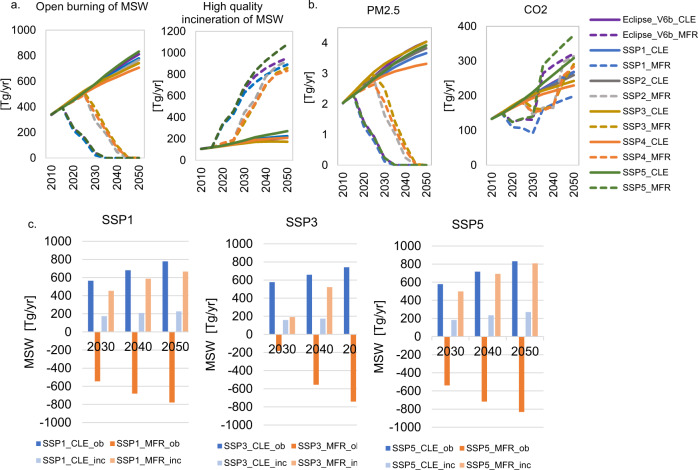
The rapidly rising generation of municipal solid waste jeopardizes the environment and contributes to climate heating. Based on the Shared Socioeconomic Pathways, we here develop a global systematic approach for evaluating the potentials to reduce emissions of greenhouse gases and air pollutants from the implementation of circular municipal waste management systems. We contrast two sets of global scenarios until 2050, namely baseline and mitigation scenarios, and show that mitigation strategies in the sustainability-oriented scenario yields earlier, and major, co-benefits compared to scenarios in which inequalities are reduced but that are focused solely on technical solutions. The sustainability-oriented scenario leaves 386 Tg CO 2eq /yr of GHG (CH 4 and CO 2 ) to be released while air pollutants from open burning can be eliminated, indicating that this source of ambient air pollution can be entirely eradicated before 2050.
Overview
CoChat Summary
## TL;DR
This paper models global municipal solid waste (MSW) generation and related greenhouse gas and air pollutant emissions under six socioeconomic pathways and two waste-management futures: current legislation (CLE) and maximum technically feasible reduction (MFR). It finds that a sustainability-oriented pathway with circular MSW systems can eliminate open-burning air pollutants before 2050 and leave 386 Tg CO2eq/yr of GHGs in 2050.
## Key findings
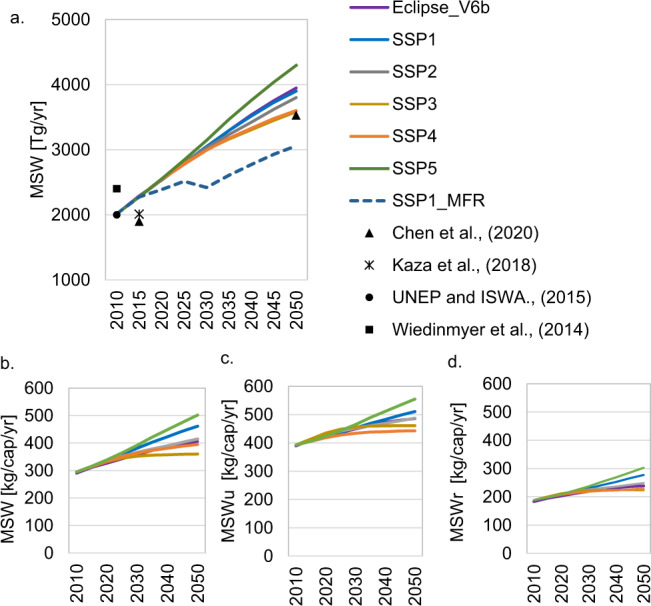
- Global MSW generation is projected to rise from 2,289 Tg/yr in 2015 to 4,296 Tg/yr in 2050 in SSP5; SSP1 is 10% lower than SSP5, and an added food/plastic waste reduction case (SSP1_MFR) lowers 2050 MSW generation by a further 20% compared with SSP5.
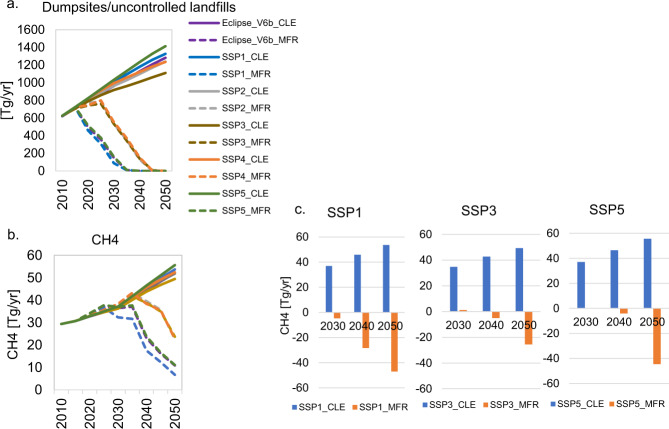
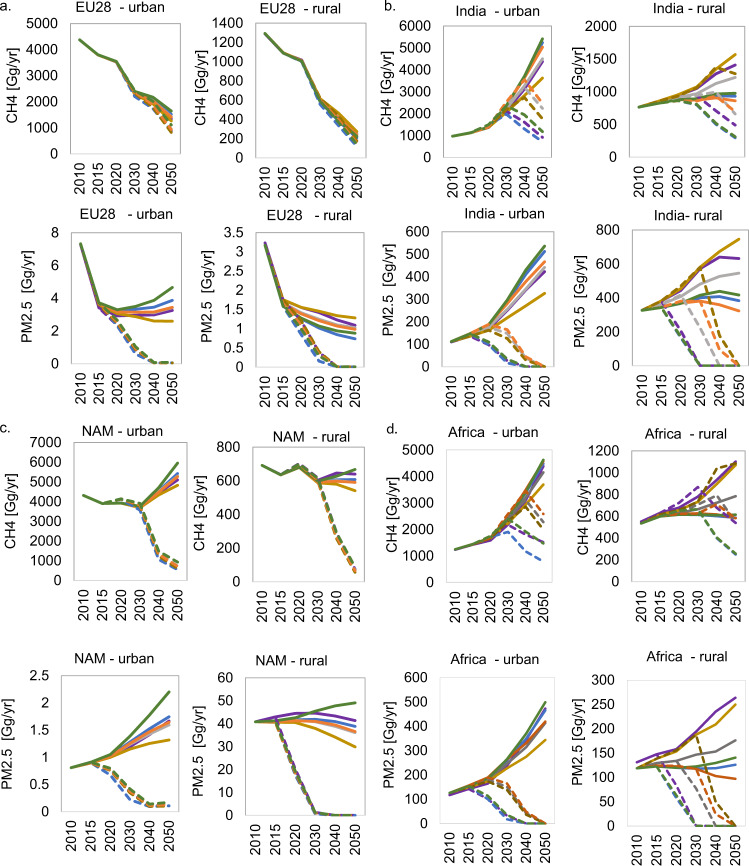
- The study estimates that MSW handling accounted for 8% (30 Tg/yr) of global anthropogenic CH4 emissions in 2015, and if current management persists, CH4 emissions from MSW will rise by 71% to 49–55 Tg CH4 by 2050.
- Under SSP1_MFR, CH4 emissions are projected to fall by 88% versus the baseline, leaving 187 Tg CO2eq/yr of CH4 in 2050; total GHGs (CH4 + CO2) in SSP1_MFR are 386 Tg CO2eq/yr in 2050.
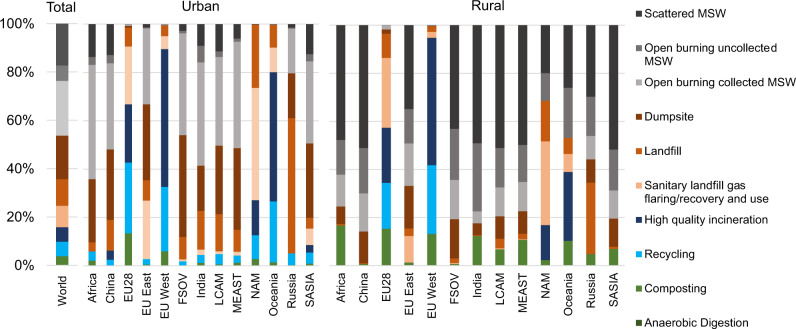
- The paper estimates that about 16% of global MSW generated was openly burned in 2010 and 2015 (380 Tg/yr and 394 Tg/yr, respectively), and that open-burning air pollutants can be virtually eliminated by 2050 in MFR scenarios; SSP1_MFR reaches eradication of littering and open burning in 2035.
## Methods
- Global scenario analysis using the Shared Socioeconomic Pathways (SSP1–SSP5) plus an IEA WEO 2018-based Eclipse_V6b scenario; for each pathway, the authors compare a baseline CLE case with an MFR case that implements circular MSW management globally.
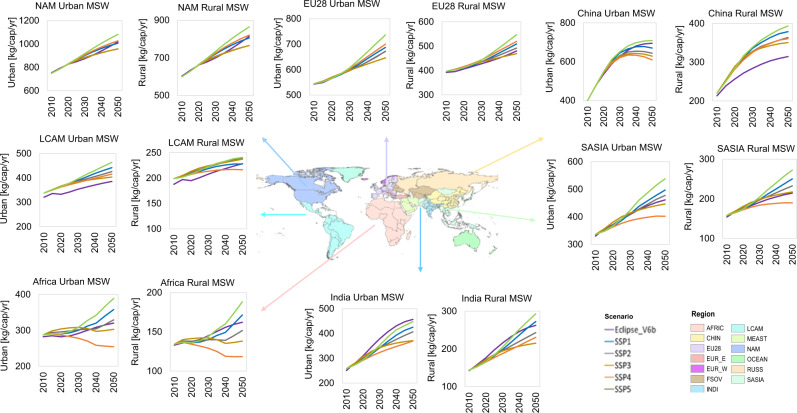
- MSW generation, composition, collection, and management are modeled for urban and rural areas using GDP per capita-driven elasticities, regional income-group assumptions, country-specific activity data, and the IIASA-GAINS model framework.
- Emissions of CH4, CO2, particulate matter, and air pollutants are estimated from waste-management technologies and open-burning assumptions, with atmospheric PM2.5 impacts derived using GAINS transfer coefficients.
## Limitations
- The paper states that quantitative uncertainty estimation is difficult because many inputs vary: activity data, emission factors, and management-type assumptions; it also notes uncertainties from inconsistent MSW definitions and incomplete data, especially in developing countries.
- It does not account for MSW trade or MSW generated from tourism, so unmanaged MSW and related emissions may be under- or overestimated in some countries.
- The authors state that emission savings from energy recovery are not considered at this stage because consistent estimation would require scenario- and region-specific fuel mixes and emission factors.
Model-written summary. Check it against the paper before relying on it.
Integrity signals
Registry
Cites
Statistics
Figures
Verification
Claims the paper makes
8 Valid · 3 Not valid · 34 Not checked · 96 Own results and interpretations
The cited sources support only part of this claim — read each source’s verdict below.
In the paper
“Work focused on GHG and air pollution suggest that landfills contribute about 15% to global anthropogenic CH4 emissions30”
§ Potential for future reductions of global GHG and air pollutants from circular waste management systems > Introduction The quantities of municipal solid waste (MSW) generated globally each year has grown over the last decades, due to population and economic growth, and the consequent changes in production and consumption patterns1,2. Estimates suggest that the world population generated 1.9 Gt/yr of MSW in 2015 and is expected to generate about 3.5 Gt/yr of MSW in 20503. High-income countries (World Bank income classification) generate more waste per capita per year than low-income countries: they are responsible for 34% of the amount of MSW generated each year, even though they account for just 16% of the global population4. The absence of suitable treatment facilities to cope with the large quantities of MSW will result in various environmental and health impacts5. High-income countries can deploy policies and instruments to cope with the rising MSW flows and hence they can potentially have cleaner and better-organized waste management systems. Examples include the EU Waste Framework Directive 2008/98/EC6 and the amendment EU Directive 2018/8517, the EU Landfill Directive 1999/31/EC8 and the amendment EU Directive 2018/8509, the EU Directive on packaging and packaging waste 94/62/EC10 and the amendment EU Directive 2018/85211, the 3 R’s strategy in Japan12 and the Resource Conservation and Recovery Act 197613 in the United States. However, measures focusing solely on increasing re-use and recycling have a marginal impact on reducing waste generation14. Although some countries e.g., Japan and Netherlands, have managed to reduce MSW generation, most of them are still not successful in reducing the per capita amounts of MSW generated each year15. By contrast, low-income countries often lack suitable management systems, resulting from the shortage of funds, poor planning, poor implementation of law, and lack of technology and expertise4,16,17. In addition, the outsourcing of resource-intensive production and waste exports from high-income to low-income countries exacerbates the environmental problems resulting from inadequate waste management systems18. Often, open burning, littering and poorly managed landfills are the main ways of waste disposal in low-income countries4. Open waste burning results in the release of toxic pollutants and greenhouse gases (GHGs)19–21. Litter harms wildlife and ecosystems, especially marine life. Global marine litter is currently recognized as one of the biggest sources of ocean’s pollution22,23. Decomposition of organic matter in landfills can result in the release of methane (CH4)24, a GHG that is 28 times more potent per kg emitted than carbon dioxide (CO2) in a 100 year timeframe25. In addition to the negative impacts on the environment and climate, these unsustainable practices have well-documented adverse effects on human health26–28. Recently, research on waste concentrates on the assessment of the linkages between waste and resource use, climate change, air, and water pollution. Previous work determined that only around 13% of the global MSW generated is recycled and 5.5% composted4. Furthermore, it is estimated that the relative contribution of energy from waste and wastewater to the global primary energy could increase from 2% to 9% by 2040 and deliver 64 EJ of energy per year (1 EJ = 1018 Joules) at the end of this period upon implementation of circular management systems29. Work focused on GHG and air pollution suggest that landfills contribute about 15% to global anthropogenic CH4 emissions30 and show that open burning of MSW is an important contributor to particulate matter and air pollutant emissions20,31,32, specifically, it contributes 11% to total global particulate matter <2.5 µm (PM2.5) emissions and 6–7% to total global black carbon (BC) emissions31,32. BC from open burning of waste amounts to 2–10% of global CO2eq emissions33.
What the sources say
- Partly supportedcites [30] Höglund-Isaksson L Gómez-Sanabria A Klimont Z Rafaj P Schöpp W Technical potentials and costs for reducing global anthropogenic methane emissions in the 2050 timeframe–results from the GAINS model Environ. Res. Commun. 2020 2 025004 10.1088/2515-7620/ab7457 sourceExperimental — accuracy not yet measured
The emissions table reproduced in section 4 lists municipal solid waste at 31.9 Tg CH₄ in 2015 and 60.4 Tg CH₄ in the 2050 baseline. This supports identifying solid waste as a methane source, but the table does not identify landfill emissions separately or state that landfills account for about 15% of global anthropogenic methane emissions. (LLM, conf=0.82)
hedgedstates an association- Asserted: passes — The authors put it forward as true.
- Checkable: passes — It can be checked against evidence.
- Load-bearing: unclear — It is unclear whether the paper’s conclusions depend on it.
- Based: passes — The paper gives a reason why it holds.
- Partly supported
The cited sources support only part of this claim — read each source’s verdict below.
In the paper
“We estimate that MSW handling accounts for 8% (30 Tg/yr) of the global CH4 anthropogenic emissions estimated at 344 Tg/yr in 201530.”
§ Potential for future reductions of global GHG and air pollutants from circular waste management systems > Results > Anthropogenic emissions to air
What the sources say
- Partly supportedcites [30] Höglund-Isaksson L Gómez-Sanabria A Klimont Z Rafaj P Schöpp W Technical potentials and costs for reducing global anthropogenic methane emissions in the 2050 timeframe–results from the GAINS model Environ. Res. Commun. 2020 2 025004 10.1088/2515-7620/ab7457 sourceExperimental — accuracy not yet measured
Table 2 (in the indexed Conclusions section; page unavailable) gives 31.9 Tg CH₄ for municipal solid waste in 2015, broadly consistent with the cited 30 Tg/yr. The retrieved passages do not substantiate the claimed global total of 344 Tg/yr or the 8% share; 31.9 divided by 344 is about 9.3%. (LLM, conf=0.83)
hedged- Asserted: passes — The authors put it forward as true.
- Checkable: passes — It can be checked against evidence.
- Load-bearing: passes — The paper’s conclusions depend on it.
- Based: passes — The paper gives a reason why it holds.
- Partly supported
The cited sources support only part of this claim — read each source’s verdict below.
In the paper
“However, comparing CH4 emissions from MSW in the Eclipse_V5a32 to this study, we can see that the estimate in the latter is 6% higher.”
§ Potential for future reductions of global GHG and air pollutants from circular waste management systems > Results > Anthropogenic emissions to air
What the sources say
- Partly supportedcites [32] Klimont Z Global anthropogenic emissions of particulate matter including black carbon Atmos. Chem. Phys. 2017 17 8681 8723 10.5194/acp-17-8681-2017 sourceExperimental — accuracy not yet measured
The Method section identifies ECLIPSE as a GAINS dataset and says GAINS calculates methane emissions; Section 3.8 discusses municipal solid waste in GAINS. Our copy does not give an ECLIPSE V5a methane-emissions estimate for MSW, so it cannot substantiate the stated 6% comparison. (LLM, conf=0.78)
plain- Asserted: passes — The authors put it forward as true.
- Checkable: passes — It can be checked against evidence.
- Load-bearing: unclear — It is unclear whether the paper’s conclusions depend on it.
- Based: passes — The paper gives a reason why it holds.
- Partly supported
Every source the paper cites for this claim was checked and supports it.
In the paper
“and 57% higher than the estimate of ref. 32”
§ Potential for future reductions of global GHG and air pollutants from circular waste management systems > Results > Anthropogenic emissions to air
What the sources say
- Supportedcites [32] Klimont Z Global anthropogenic emissions of particulate matter including black carbon Atmos. Chem. Phys. 2017 17 8681 8723 10.5194/acp-17-8681-2017 source
Section 3.8 (Waste; page unavailable) estimates that 115–160 Tg of global municipal solid waste was openly burned during 1990–2010, providing the reference estimate cited. The 57% difference is the citing authors’ comparison with their own estimate, not a figure attributed to this source. (LLM, conf=0.87)
plain- Asserted: passes — The authors put it forward as true.
- Checkable: passes — It can be checked against evidence.
- Load-bearing: unclear — It is unclear whether the paper’s conclusions depend on it.
- Based: passes — The paper gives a reason why it holds.
- Supported
Every source the paper cites for this claim was checked and supports it.
In the paper
“In contrast, our results for particulate matter are 60% higher than those from ref. 32.”
§ Potential for future reductions of global GHG and air pollutants from circular waste management systems > Results > Anthropogenic emissions to air
What the sources say
- Supportedcites [32] Klimont Z Global anthropogenic emissions of particulate matter including black carbon Atmos. Chem. Phys. 2017 17 8681 8723 10.5194/acp-17-8681-2017 source
The Results and discussion section reports particulate-matter emission estimates, including global PM₁₀ and PM₂.₅ totals for 2010. The cited paper therefore provides the estimates used as the comparison point; the statement that the citing authors’ results are 60% higher is their own comparison, not a finding attributed to this source. (LLM, conf=0.84)
plain- Asserted: passes — The authors put it forward as true.
- Checkable: passes — It can be checked against evidence.
- Load-bearing: unclear — It is unclear whether the paper’s conclusions depend on it.
- Based: passes — The paper gives a reason why it holds.
- Supported
78 more claims · 1 with their cited sources checked
Create a free account to see all 141 claims and to verify the 18 references still open.
- It may state two separate claims as one. 35
- Probably not a substantial claim. 25
- The quote only partly states this claim. 3
Claims other papers make about this one
Each is checked against this paper’s own text: does it say what the citing paper says it does?
In the citing paper
“Effective waste recycling and disposal help mitigate negative environmental externalities such as waste-carbon emissions and pollutant reduction 1 .”
From Characterizing the polycentricity in waste governance: a comparative study on Shanghai, Tokyo, and Hong Kong (2024) · cites this paper as [1]
Citations
Cites
Plastic waste inputs from land into the ocean
Jambeck, J. R., Geyer, R., Wilcox, C., Siegler, T. R., Perryman, M., Andrady, A., Narayan, R., & Law, K. L. (2015) · Science · doi:10.1126/science.1260352 · Cited by 13,163
Riahi, K., van Vuuren, D. P., Kriegler, E., Edmonds, J., O’Neill, B. C., Fujimori, S., Bauer, N., Calvin, K., Dellink, R., Fricko, O., et al. (2017) · Global Environmental Change · doi:10.1016/j.gloenvcha.2016.05.009 · Cited by 6,607
Self-citationWhat a Waste 2.0: A Global Snapshot of Solid Waste Management to 2050
Kaza, S., Yao, L. C., Bhada-Tata, P., Van Woerden, F., & Levine, D. (2018) · doi:10.1596/978-1-4648-1329-0 · Cited by 6,126 · cited 1×
“(4) Implementation of the current legislation for waste management adopted before 2018.”
BackgroundEnvironmental science and pollution research: International A New Journal — A New Concept
Hutzinger, O. (1993) · Umweltwissenschaften und Schadstoff-Forschung · doi:10.1007/bf02981237 · Cited by 4,492
What a Waste : A Global Review of Solid Waste Management
Hoornweg, D., & Bhada-Tata, P. (2012) · doi:10.1596/17388 · Cited by 3,129
International Energy Agency (2018) · World energy outlook · doi:10.1787/weo-2018-en · Cited by 2,841
A technology‐based global inventory of black and organic carbon emissions from combustion
Bond, T. C., Streets, D. G., Yarber, K. F., Nelson, S. M., Woo, J., & Klimont, Z. (2004) · Journal of Geophysical Research: Atmospheres · doi:10.1029/2003jd003697 · Cited by 2,393
Self-citationHoesly, R. M., Smith, S. J., Feng, L., Klimont, Z., Janssens-Maenhout, G., Pitkanen, T., Seibert, J. J., Vu, L., Andres, R. J., Bolt, R. M., et al. (2018) · Geoscientific Model Development · doi:10.5194/gmd-11-369-2018 · Cited by 2,203
Self-citationEmission factors for open and domestic biomass burning for use in atmospheric models
Akagi, S. K., Yokelson, R. J., Wiedinmyer, C., Alvarado, M. J., Reid, J. S., Karl, T., Crounse, J. D., & Wennberg, P. O. (2011) · Atmospheric Chemistry and Physics · doi:10.5194/acp-11-4039-2011 · Cited by 2,047
Resources, Conservation and Recycling
Nithikul, J., Paramasivam, K., & Visvanathan, C. (2011) · Cited by 1,711
Research works printed but not linked: 1
- EEA. Managing municipal solid waste. A review of achievements in 32 European countries. (2013).
Cited by
Items 101–200 of 305
Schmidt, S., & Laner, D. (2025) · Waste Management · doi:10.1016/j.wasman.2025.02.048 · Cited by 13
Sustainable utilization of aging-deteriorated microplastics as triboelectric nanogenerator
Cho, S., Cha, K., Kim, B., Lee, J., Park, K., Chung, S., Song, M., Heo, D., Son, J.-H., Choi, M., et al. (2023) · Chemical Engineering Journal · doi:10.1016/j.cej.2023.144283 · Cited by 14
Hao, X., Dong, L., Liu, G., & Zhang, X. (2023) · Resources, Conservation and Recycling · doi:10.1016/j.resconrec.2023.106879 · Cited by 12
Yang, G., Liu, M., Gao, Y., Han, S., Meng, F., Ju, T., & Jiang, J. (2024) · Environmental Science and Pollution Research · doi:10.1007/s11356-024-33042-1 · Cited by 15
Amoh, P. O., Elkady, M. F., Nasr, M., & Shokry, H. (2024) · Recycling · doi:10.3390/recycling9030038 · Cited by 11
Balaban, D., Lubura, J., Bera, O. J., & Kojić, P. S. (2024) · Environmental Progress & Sustainable Energy · doi:10.1002/ep.14472 · Cited by 11
“9,13 Variety of solutions have been developed to monitor and reduce waste-based emissions 14 including recycling and waste-to-energy conversion (WtE), where the other is focused on implementation of different technologies (incineration, pyrolysis, gasification, digestion, and so on 15,16 ),…”
Lerpiniere, D. J., Wilson, D. C., & Velis, C. A. (2024) · Resources Conservation and Recycling · doi:10.1016/j.resconrec.2024.107918 · Cited by 24
Liu, Y., Li, R., Cai, W., & Liu, Q. (2024) · Environmental Research · doi:10.1016/j.envres.2024.120497 · Cited by 11
Chen, W., Ohnishi, S., Maki, S., Kawai, K., Sun, L., Dong, H., Dong, L., Dou, Y., Qian, T., Hijioka, Y., et al. (2025) · Journal of Cleaner Production · doi:10.1016/j.jclepro.2025.144802 · Cited by 12
Hossain, M. K., Das, R. C., Hossain, M. I., Rahman, M. A., Paramasivam, P., Chakma, R., Amami, M., Mahmoud, M. H. H., Bousbih, R., Haldhar, R., et al. (2025) · Global Challenges · doi:10.1002/gch2.202500119 · Cited by 18
Hu, S., Chen, W., & Liu, Y. (2025) · Sustainable Cities and Society · doi:10.1016/j.scs.2025.106575 · Cited by 15
Kassem, N., Pecchi, M., Maag, A. R., Baratieri, M., Tester, J. W., & Goldfarb, J. L. (2022) · ACS Sustainable Chemistry & Engineering · doi:10.1021/acssuschemeng.2c04188 · Cited by 10
Reducing Pb and Cl Mobility in Waste-to-Energy Fly Ashes via Chlorellestadite Formation
Kumar, V., Baral, A., Roesler, J. R., & Garg, N. (2024) · ACS ES&T Engineering · doi:10.1021/acsestengg.3c00597 · Cited by 11
Advances in plastic waste valorization: Economic and green perspectives
Valasara, V., Yun, S., Joo, J. C., Lee, U., Park, B. J., & Won, W. (2026) · Renewable and Sustainable Energy Reviews · doi:10.1016/j.rser.2026.117031 · Cited by 15
Brezoiu, A.-M., Deaconu, M., Mitran, R., Stanciuc, A., Matei, C., & Berger, D. (2023) · Molecules · doi:10.3390/molecules28155795 · Cited by 9
Unleashing virtuous cycles of sustainable development goals and well‐being
Nobre, F. S. (2024) · Business and Society Review · doi:10.1111/basr.12339 · Cited by 12
Tian, H., Tang, J., & Wang, T. (2024) · Sustainability · doi:10.3390/su16177670 · Cited by 10
Baral, A., Kumar, V., Roesler, J. R., & Garg, N. (2024) · Chemical Engineering Journal · doi:10.1016/j.cej.2024.156038 · Cited by 10
van Caspel, W. E., Klimont, Z., Heyes, C., & Fagerli, H. (2024) · Atmospheric chemistry and physics · doi:10.5194/acp-24-11545-2024 · Cited by 16
“The MFR mitigation scenario assumes the full implementation of the proven technical mitigation potential as included in the GAINS model for precursor emissions (Amann et al., 2020, 2013; Rafaj et al., 2018) and CH 4 (Gomez Sanabria et al., 2022).”
MethodSelf-citationChen, Y., Yang, L., Ren, Y., Yan, P., & Lu, H. (2024) · Sustainable Cities and Society · doi:10.1016/j.scs.2024.106056 · Cited by 10
Rethinking waste and resource management for underserved communities
Whiteman, A. D., Hennessy, N., & Wilson, D. C. (2025) · Oxford Development Studies · doi:10.1080/13600818.2025.2473957 · Cited by 15
Huang, T., Li, Y., Li, J., Sung, J. J. �., & Yim, S. H. L. (2025) · GeoHealth · doi:10.1029/2024gh001290 · Cited by 12
“Mitigation of air pollution and climate change should be implemented simultaneously to achieve co‐benefits (Gómez‐Sanabria et al., 2022).”
Artificial intelligence in sustainable organic waste treatment: a review
Sugumaran, D., Dananjaya, U. M., Kodippili, S. P., Alwis, M. M. D., Attigala, D. L., Ranasinghe, N. N., Manatunga, D. C., Dassanayake, R. S., Zhou, Y., & Liu, Y. (2025) · Waste Disposal & Sustainable Energy · doi:10.1007/s42768-025-00246-1 · Cited by 20
Chen, F., Gu, X., Yu, H., Zhang, X., & Wang, Y. (2023) · Environmental Science and Pollution Research · doi:10.1007/s11356-023-26658-2 · Cited by 9
“2022) and has generated widespread concern in the international community (Chen 2017; Bolzan et al. 2022; Gómez-Sanabria et al. 2022).”
BackgroundAlawa, B., & Chakma, S. (2023) · Environmental Science and Pollution Research · doi:10.1007/s11356-023-26576-3 · Cited by 10
“As per the findings, the open burning of plastic and polymeric materials produces a huge amount of CO and CO2, which is carcinogenic to humans and imbalance the ecosystems (Estrellan and Iino 2010; Sharma et al. 2019; Gómez-Sanabria et al. 2022).”
BackgroundMeasuring Zero-Waste City Performance of a Coal Resource-Based Area in China with MCDM Approach
Zhao, W., Dandan, Y., & Duan, Y. (2022) · Mathematical Problems in Engineering · doi:10.1155/2022/8479760 · Cited by 19
Kim, J. Y., Lee, T., Cha, H., Song, H., & Kwon, E. E. (2025) · Journal of Environmental Management · doi:10.1016/j.jenvman.2025.125484 · Cited by 8
Vinti, G., Batinić, B., Bauza, V., Clasen, T., Tudor, T. L., Zurbrügg, C., & Vaccari, M. (2024) · International Journal of Environmental Research · doi:10.1007/s41742-024-00643-0 · Cited by 9
“Furthermore, SWM influences greenhouse gas (GHG) emissions globally; for example, open waste burning produces GHGs, and the decomposition of organic matter in landfills and dumpsites releases methane (Gómez-Sanabria et al. 2022; Trapani et al. 2018).”
BackgroundThe use of plastic as a household fuel among the urban poor in the Global South
Bharadwaj, B., Gates, T. D., Borthakur, M., Rose, S., Oranu, C. O., Allison, A. L., Bohlmann, J., Dhungana, P. K., Glenn, D. E., Jeuland, M., et al. (2025) · Nature Cities · doi:10.1038/s44284-025-00201-5 · Cited by 8
“…plastic-waste management in the Global South are scarce, but evidence in the literature suggests that more than 60% of solid waste in African cities is either burned or scattered 30 , with projections of ‘out of use’ and mismanaged plastics alone in Africa exceeding 10 million tonnes by 2025 (ref.”
Thermo–chemical coupled activation of multisource solid waste for silicon fertilizer preparation
Zhou, H., Jia, J., Ma, D., et al. (2025) · Journal of Environmental Management · doi:10.1016/j.jenvman.2025.127385 · Cited by 8
Xia, H., Tang, J., Wang, T., et al. (2023) · Chinese Control and Decision Conference (CCDC) · doi:10.1109/ccdc58219.2023.10327044 · Cited by 8
“The municipal solid waste incineration (MSWI) process is a typical complex process industry [1,2], which can realize the transformation from waste-to-energy (WTE) via fermentation, combustion, heat exchange, and purification [3].”
BackgroundPrioritizing countries for implementing waste recycling under socioeconomic supports
Dong, X., Song, J., & Duan, H. (2022) · Journal of Environmental Management · doi:10.1016/j.jenvman.2022.116158 · Cited by 8
Atkinson, W., Eastham, S. D., Chen, Y.-H. H., Morris, J., Paltsev, S., Schlosser, C. A., & Selin, N. E. (2022) · Geoscientific model development · doi:10.5194/gmd-15-7767-2022 · Cited by 8
Hao, X., Dong, L., Qian, X., Benjamin, S., Wang, H., Chen, P., Wang, X., Ma, W., Li, J., Tong, X., et al. (2024) · npj Urban Sustainability · doi:10.1038/s42949-024-00179-4 · Cited by 8
“Thewastegovernancemodesimplementedunderthethreepolycentric structures have led to improvements in ecological bene fi ts. Effective waste recycling and disposal help mitigate negative environmental externalities such as waste-carbon emissions and pollutant reduction 1 .”
Zhou, J., Li, D., Duan, X., Zhang, X., Chen, C., & Chen, Y. (2025) · Water Research · doi:10.1016/j.watres.2025.123201 · Cited by 7
Zhang, J., Zhang, Y., Qin, Q., Borrion, A. L., & Li, G. (2025) · Journal of Environmental Management · doi:10.1016/j.jenvman.2025.125436 · Cited by 8
Zhang, B., Liu, Z., Lu, Y., Xu, C., Li, H., & Wang, Z. (2025) · Waste Management · doi:10.1016/j.wasman.2025.115185 · Cited by 8
Castellani, P., Ferronato, N., Barbieri, J., & Torretta, V. (2024) · Environmental Development · doi:10.1016/j.envdev.2024.101008 · Cited by 9
Greenhouse gas mitigation potential via a large-scale compulsory circular waste management system
Li, R. (2024) · Journal of Environmental Management · doi:10.1016/j.jenvman.2024.122425 · Cited by 6
Küfeoğlu, S. (2024) · Sustainable development goals series · doi:10.1007/978-3-031-70322-5_11 · Cited by 8
Xu, C., Gao, Y., & Lv, M. (2025) · Chinese Journal of Population Resources and Environment · doi:10.1016/j.cjpre.2025.05.002 · Cited by 13
Gao, R., Pan, Z., Huan-chun, L., Bi, P., Huang, Z., Zhang, F., Liu, X., Jing, Y., Men, J., Huang, N., et al. (2025) · Ecological Engineering · doi:10.1016/j.ecoleng.2025.107773 · Cited by 6
Regenerating end-of-life membranes for enhanced sustainability and unexpected performance
Tian, C., Chen, J., Qiu, Z., et al. (2026) · Nature Communications · doi:10.1038/s41467-026-70415-1 · Cited by 6
Endogeneity and other problems in curvilinear income-waste response function estimations
Schneider, N. (2023) · Stochastic Environmental Research and Risk Assessment · doi:10.1007/s00477-023-02598-8 · Cited by 6
We need a global agreement to safeguard human health from plastic pollution
Bowyer, C. J., & Fletcher, S. (2025) · BMJ · doi:10.1136/bmj.q2890 · Cited by 8
Li, Q., & Chu, Z. (2025) · Resources Conservation and Recycling · doi:10.1016/j.resconrec.2025.108149 · Cited by 6
Hata, S., Nansai, K., & Nakajima, K. (2023) · Environmental Science & Technology · doi:10.1021/acs.est.3c00859 · Cited by 7
China’s Urban Waste Resource Management Systems: A Case of the Yangtze River Basin
Wang, X., Tang, Y. J., & Li, J. (2024) · Journal of Urban Technology · doi:10.1080/10630732.2024.2316628 · Cited by 5
“They have emphasized the importance of collaborative governance, policy coordination, and capacity building to ensure e ff ective waste management (Istrate et al., 2020; Ha fi d et al., 2022; Gómez-Sanabria et al., 2022).”
BackgroundLiao, N., Lü, F., Li, X., Zhang, H., & He, P. (2025) · Journal of Cleaner Production · doi:10.1016/j.jclepro.2025.144747 · Cited by 7
Robinson, D. T., Le, T. T., Ngo, H. T. T., Hoang, T. T., Zurbrügg, C., & Nguyen, T. H. T. (2025) · Marine Pollution Bulletin · doi:10.1016/j.marpolbul.2025.118058 · Cited by 9
Health benefits of decarbonization and clean air policies in Beijing and China
Kiesewetter, G., Zhang, S., & Liu, J. (2024) · Environmental Research Letters · doi:10.1088/1748-9326/ad8c65 · Cited by 5
“Other non-energy sectors (like waste and wastewater) are based on GAINS internal projections (Gomez Sanabria et al 2021).”
Self-citationBaltrušaitis, J., Bakshi, B. R., Chojnacka, K., Chuck, C. J., Coppens, M., Edge, J. S., Harper, G. D. J., Hsiao, B. S., Li, H., Wright, M. M., et al. (2024) · Sustainability Science and Technology · doi:10.1088/2977-3504/ad555a · Cited by 13
Enriching IAM scenarios for effective pLCA integration: A clinker case study
Maes, B., Craeye, B., Buyle, M., et al. (2024) · Journal of Cleaner Production · doi:10.1016/j.jclepro.2024.143316 · Cited by 5
Coupling an integrated assessment model with an input–output database
Dai, N., Liu, Q., Li, M., Malik, A., & Lenzen, M. (2024) · Economic Systems Research · doi:10.1080/09535314.2024.2387023 · Cited by 7
“However, there is some work undertaken using Shared Socioeconomic Pathways to assess the potential of circular waste management systems (Gómez-Sanabria et al., 2022).”
Zhou, X.-Y., Hu, Z., Zhou, J.-L., Cai, Q., Wu, Y., Zhao, L., & Lü, Q. (2022) · Journal of Analytical and Applied Pyrolysis · doi:10.1016/j.jaap.2022.105750 · Cited by 5
Assessing the eco-efficiency of inter-municipal waste management services in France
Ndimblane, A., Ayouba, K., & Aznar, O. (2025) · Journal of Environmental Management · doi:10.1016/j.jenvman.2025.126941 · Cited by 4
Resin composites filled with solid waste under the background of carbon neutrality
Dong, X., Zhang, N., Cai, Q., Zhang, Y., Wang, Y., & Zhang, Y. (2025) · Renewable and Sustainable Energy Reviews · doi:10.1016/j.rser.2025.116251 · Cited by 9
Song, P., Gao, Z., Duan, Z., Song, J., Duan, H., Chen, S., He, B., & Gao, M. C. (2025) · Environmental Impact Assessment Review · doi:10.1016/j.eiar.2025.108223 · Cited by 4
Chowdhury, P. P., Khan, M. M. A., Sayem, A., Asif, M. A. R., & Roy, A. (2025) · Cleaner Logistics and Supply Chain · doi:10.1016/j.clscn.2025.100286 · Cited by 8
Anton, B., Haines, A., Green, R., Meinsma, N., Reynolds, T., & Whitmee, S. (2025) · npj Urban Sustainability · doi:10.1038/s42949-025-00311-y · Cited by 6
“Actions in the wastesectorshowedfewreportedhealthco-bene fi tsdespitetheopportunity for sustainable waste management interventions to result in substantial health bene fi ts through reduced air pollution 20,21 .”
Zhang, L., & Li, H. (2026) · Environmental Science & Technology · doi:10.1021/acs.est.5c18261 · Cited by 6
Zhang, L., Yang, J., Liu, J., Zhou, Q., Wang, X. G., Zhang, H., Ren, Y., Bai, Z., & Ma, L. (2026) · Nature Food · doi:10.1038/s43016-026-01361-w · Cited by 4
Vartiainen, T., K鋜ri, T., Afonso, P., & Happonen, A. (2025) · Intelligent and sustainable manufacturing · doi:10.70322/ism.2025.10015 · Cited by 8
Chekole, D. T., Tadesse, K., Aragaw, T. T., Vinti, G., Trapani, D. D., & Viviani, G. (2025) · Environmental Monitoring and Assessment · doi:10.1007/s10661-025-14490-9 · Cited by 5
“Open dumping sites represent the oldest and, in many developing countries, still the most widely used method of municipal solid waste (MSW) disposal (Gómez-Sanabria et al., 2022), including Bahir Dar city, Ethiopia, located within the Blue Nile River Basin.”
Владиславович, М. Д., Mikheev, P. Y., & Maslikov, V. (2024) · International Journal of Hydrogen Energy · doi:10.1016/j.ijhydene.2024.07.430 · Cited by 8
Synergizing awareness and policy: A system dynamics approach to reducing illegal waste dumping
Du, L., Chang, R., Yuan, H., Zuo, J., & Zillante, G. (2025) · Environmental Development · doi:10.1016/j.envdev.2025.101296 · Cited by 4
Zhang, M., Zhou, M., Ling, H., et al. (2025) · Environmental Impact Assessment Review · doi:10.1016/j.eiar.2025.107829 · Cited by 3
Socio-environmental Impacts of Sustainable Waste Management
Singh, A., Joshi, R., Patel, A., Maurya, S., & Shehu, S. A. (2025) · Advances in Science, Technology & Innovation/Advances in science, technology & innovation · doi:10.1007/978-3-031-85685-3_18 · Cited by 3
Feng, R., Fan, K.-W., & Qi, Z. (2025) · Atmosphere · doi:10.3390/atmos16111245 · Cited by 4
“Largely attributed to pyrogenic and biogenic sources [54], anthropogenic CH 4 emissions can be divided into three categories: agriculture [55,56], energy utilization [56,57], and waste management [58–60].”
Engineering solutions for reducing open dumping and illegal waste disposal in Ghana
Hamid, I. K.-N., Dapaah, E. K., & Hamid, H. H. (2025) · Waste Management Bulletin · doi:10.1016/j.wmb.2025.100265 · Cited by 5
Schipfer, F., Harasek, M., Tiwari, S. K., Kraxner, F., Schmidt, J., Wehrle, S., KOLUR, N. A., Thrän, D., Aliabadi, D. E., & Breunig, H. M. (2025) · Energy Research & Social Science · doi:10.1016/j.erss.2025.104505 · Cited by 10
Global production potential and environmental benefits of alternative proteins from biowaste
Bai, X., Gong, Y., Wei, W., Wang, W., Zhuang, M., & Yang, Y. (2026) · Resources Conservation and Recycling · doi:10.1016/j.resconrec.2026.108818 · Cited by 4
Environmental impact of open burning of polyester and cotton textile waste: a comparative analysis
Bayramova, J., Pires, S. T., Holden, P. A., Sagues, W. J., Venditti, R. A., & Daystar, J. (2026) · Environmental Science and Pollution Research · doi:10.1007/s11356-026-37563-9 · Cited by 6
“Gómez-Sanabria et al. (2022) noted that this default may be inadequate in some regions, with lower fractions observed in low-income rural settings dominated by organic waste, and higher fractions where uncollected waste is more frequently burned.”
Wu, X., Wang, M., Zhang, X., Zhou, Z., Wang, Y., Li, J., Du, G., Chen, J., & Liu, X. (2026) · Journal of Agricultural and Food Chemistry · doi:10.1021/acs.jafc.5c17203 · Cited by 4
Bangura, A. M., & Kanty, P. F. (2024) · Journal of Geoscience and Environment Protection · doi:10.4236/gep.2024.128012 · Cited by 5
Yang, W., Tang, J., Tian, H., & Wang, T. (2025) · Sustainability · doi:10.3390/su17073048 · Cited by 3
Claiming-based allocation for waste-to-energy in district heating
Næss, J. S., Mattson, K. R., Brattebø, H., & Hertwich, E. G. (2025) · The International Journal of Life Cycle Assessment · doi:10.1007/s11367-025-02494-z · Cited by 5
Yang, Z., Yin, K., Ye, R., Zhang, C., Wang, Y., Zhang, H., & Fei, X. (2025) · Journal of Environmental Management · doi:10.1016/j.jenvman.2025.127244 · Cited by 4
Modelling PM2.5 reduction scenarios for future cardiopulmonary disease reduction
Weber, E., Daioglou, V., Vreedenburgh, L., Doelman, J., Downward, G. S., de Pinho, M. G. M., & van Vuuren, D. P. (2025) · Nature Sustainability · doi:10.1038/s41893-025-01676-9 · Cited by 5
“1 are from the maps package found in ggplot2, which is derived from public domain data 49,50 .”
Vinti, G., Tudor, T. L., & Vaccari, M. (2023) · IWA Publishing eBooks · doi:10.2166/9781789063318_0001 · Cited by 3
Breukelman, H., Krikke, H., & Löhr, A. J. (2024) · Systems · doi:10.3390/systems12040129 · Cited by 3
Integrated municipal solid waste management for energy recovery and pollution prevention
Prasad, M. N. V. (2024) · Elsevier eBooks · doi:10.1016/b978-0-443-22069-2.00018-8 · Cited by 5
Modeling Solid Waste Minimization Performance at Source in Dar es Salaam City, Tanzania
Mapunda, A. S., Kimwaga, R. J., & Kassuwi, S. A. A. (2024) · Journal of Geoscience and Environment Protection · doi:10.4236/gep.2024.129002 · Cited by 5
Outdoor air pollution due to transportation, landfill, and incinerator
Astuti, R. D. P., & Rauf, A. U. (2024) · Elsevier eBooks · doi:10.1016/b978-0-443-16088-2.00006-5 · Cited by 5
Truncation in the scaling of urban pollution control
Chen, C., Zhang, X., & Webster, C. J. (2025) · npj Urban Sustainability · doi:10.1038/s42949-025-00197-w · Cited by 4
“A city ’ s accumulated infrastructural capability for pollution abatement, meaning the technological and operational capacities dedicated to mitigating environmental externalities, also matters when determining city size-performance relationships 26 .”
Dioxin Emission Detection Based on Dynamic Pruning Online Ensemble Binary Tree Algorithm
Xu, C., Tang, J., Xia, H., Yu, W., & Qiao, J. (2025) · IEEE Transactions on Automation Science and Engineering · doi:10.1109/tase.2025.3563856 · Cited by 2
“Currently, MSW incineration (MSWI) technology is widely adopted globally due to its advantages of waste reduction, harmlessness, and low pollution [5] and it has become a pivotal component of contemporary urban pollution prevention and control strategies [6].”
Liu, J., Ye, G., Wang, Z., Li, C. Z., & Zuo, J. (2025) · Waste Management & Research The Journal for a Sustainable Circular Economy · doi:10.1177/0734242x251369619 · Cited by 3
“The improvement of recycling technology in social benefits can not only reduce the recycling cost and promote economic development but also reduce GHG emissions and improve environmental benefits (Gómez-Sanabria et al., 2022; Wang et al.,2025).”
Managing solid waste to co-control carbon and nitrogen leakage in China
Xu, X., Zhan, J., Chen, T., Zhang, X., Zou, Y., & Gu, B. (2025) · Resources Conservation and Recycling · doi:10.1016/j.resconrec.2025.108603 · Cited by 3
Tang, J., Yang, X., Wang, W., et al. (2025) · Sustainability · doi:10.3390/su17198872 · Cited by 2
Maletz, R., Schmidt, N., & Dornack, C. (2025) · Journal of Cleaner Production · doi:10.1016/j.jclepro.2025.146821 · Cited by 3
Vinti, G., Bauza, V., Clasen, T. F., Trapani, D. D., & Viviani, G. (2025) · Environmental Monitoring and Assessment · doi:10.1007/s10661-025-14842-5 · Cited by 2
“At the same time, waste burning in dumpsites is a strong contributor of GHG emissions (Gómez-Sanabria et al., 2022).”
Waste is Not a Waste: The Material and Temporal Value of Waste in the Anthropogenic Era
Kachef, R. L., & Kwan, G. C. (2026) · Journal of Sustainability · doi:10.55845/jos-2026-2132 · Cited by 2
“The transport, processing, and burning of waste create high volumes of toxic air pollutants (Gómez-Sanabria et al. , 2022) .”
Unlocking value from residual municipal waste: A primary data analysis of recovery rates and costs
Eid, M., Albizzati, P. F., Dolci, G., Rigamonti, L., Tonini, D., & Grosso, M. (2026) · Waste Management · doi:10.1016/j.wasman.2026.115472 · Cited by 2
Hydroxybenzoic Acid Production Using Metabolically Engineered Corynebacterium glutamicum
Doke, M., Kishida, M., Hirata, Y., et al. (2023) · Synthetic biology and engineering · doi:10.35534/sbe.2023.10010 · Cited by 2
“This trend reflects mounting concerns regarding global warming and the limited availability of fossil fuels [4,5].”
Anthropogenic Emissions Inventories of Air Pollutants
Granier, C., Liousse, C., McDonald, B., & Middleton, P. B. (2023) · Springer eBooks · doi:10.1007/978-981-15-2760-9_5 · Cited by 8
Zhang, R. C., Tang, J., & Xia, H. (2023) · IEEE Symposium Series on Computational Intelligence (SSCI) · doi:10.1109/ssci52147.2023.10371908 · Cited by 2
“Thus, many cities have appeared "the garbage siege" phenomenon, and the treatment of MSW is imminent [2].”
BackgroundRelease potential, neglected leakage and reduction countermeasures of COD and Ammonia in MSWLs
Yang, H., Huang, Q., Xu, Y., Xiang, R., & Liu, Y. (2024) · The Science of The Total Environment · doi:10.1016/j.scitotenv.2024.171894 · Cited by 2
Development of Measures to Reduce Air Pollutants As Much As Possible
Ruziyev, S., Hamraqulova, H., Rustamova, R. A., & Tolibova, D. M. (2024) · Sustainable Civil Building Management and Engineering Journal · doi:10.47134/scbmej.v1i2.2400 · Cited by 3
Bukhari, M. U., Riaz, K., Khan, A., Maqbool, K. Q., Wang, B., & Bermak, A. (2024) · IEEE Conference on Technologies for Sustainability · doi:10.1109/sustech60925.2024.10553544 · Cited by 3
Municipal solid waste biorefinery
Dahunsi, O. S. (2024) · Elsevier eBooks · doi:10.1016/b978-0-443-24129-1.00012-0 · Cited by 3
Metadata
- Authors
- Gómez-Sanabria, A., Kiesewetter, G., Klimont, Z., Schoepp, W., & Haberl, H.
- Affiliations
- International Institute for Applied Systems Analysis (AT)
- BOKU University (AT)
- Corresponding author
- Gómez-Sanabria, Adriana
- Venue
- Nature Communications
- Published
- 2022-01-10
- Volume
- 13
- Issue
- 1
- Pages
- 106-106
- ISSN
- 2041-1723 (ISSN-L)
- PMC
- PMC8748894
- OpenAlex
- W4206697818
- Semantic Scholar
- 4449fe41fcc2759ebeab024f7ab133b249429624
- Cited by
- 306
- References
- 47
- Citations by year
- 2026: 51 · 2025: 85 · 2024: 85 · 2023: 58 · 2022: 27
- FWCI
- 35.75
- Type
- journal article
- Language
- en
- Open access
- gold
- doi.org
- Licence
- cc-by
- creativecommons.org/licenses/by/4.0 (tdm)
- creativecommons.org/licenses/by/4.0 (vor)
- Locations
- Nature Communications (publishedVersion, cc-by)
- Research Square (acceptedVersion, cc-by)
- PubMed Central (publishedVersion, cc-by)
- PubMed (publishedVersion)
- IIASA PURE (International Institute of Applied Systems Analysis) (acceptedVersion)
- RePEc: Research Papers in Economics (submittedVersion)
- DOAJ (DOAJ: Directory of Open Access Journals) (submittedVersion, cc-by-sa)
- Social Science Open Access Repository (GESIS – Leibniz Institute for the Social Sciences) (submittedVersion, cc-by)
- Funders
- European Commission
- Topics
- Physical Sciences › Environmental Science › Waste Management and Disposal › Municipal Solid Waste Management
- Social Sciences › Economics, Econometrics and Finance › Economics and Econometrics › Climate Change Policy and Economics
- Health Sciences › Medicine › Public Health, Environmental and Occupational Health › Healthcare and Environmental Waste Management
- Keywords
- circular economy, municipal solid waste, waste management, greenhouse gas emissions, air pollutants, methane, open burning, Shared Socioeconomic Pathways, climate change mitigation scenarios, co-benefits
About these checks
Registry, retraction, Cites and statistics results are computed, not judged, with one exception: a printed reference that no index lists is read once by a model before it counts as a citation error. Claims are extracted by a model and kept only when their quote appears verbatim in the text; each cited source is then checked, with a model’s help, for whether it says what the claim relies on. Those verdicts can be wrong — read the claim’s quote and the cited source before relying on one.
The claim verdicts this report counts are experimental: their accuracy is not yet measured.
A language model drew the claims from the paper on 2026-10-10, under version 3 of the claim definition (model deepseek-v4.1-flash, prompt extract-v3).
A second model labelled each claim on 2026-10-10 (model jev-1.13-20260917, definition revision gold-guideline-v0.2).
Cited sources are checked with a language model’s help (gpt-6-sol).
Statistics and arithmetic are recomputed, not judged.
Confidence bands are shown only for fields calibrated on our annotated test set. None is calibrated yet, so no band is shown.
What counts as a claim ›How we measure confidence ›How we check this ›
Are you an author, or do you see a problem with this page? Request a review
Data sources
Bibliographic data: Semantic Scholar, OpenAlex, Crossref.
Contains information from the Semantic Scholar Academic Graph Datasets, made available under the ODC Attribution License (ODC-BY 1.0).
Semantic Scholar’s data is described in: Kinney, R., et al. (2023). The Semantic Scholar Open Data Platform. arXiv:2301.10140.
