

Potential for future reductions of global GHG and air pollutants from circular waste management systems
Open accessPublished version of a preprint
The DOI matches its Crossref record; 58 of the 58 references it cites were found in a registry or an index; 8 of the 52 sources its claims cite were checked for support.
Abstract
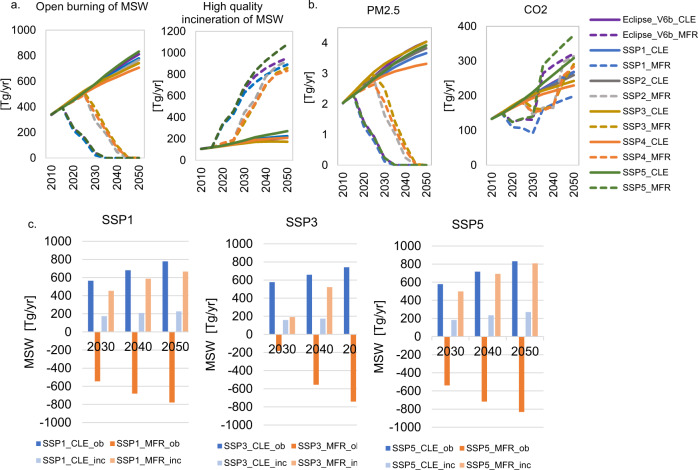
The rapidly rising generation of municipal solid waste jeopardizes the environment and contributes to climate heating. Based on the Shared Socioeconomic Pathways, we here develop a global systematic approach for evaluating the potentials to reduce emissions of greenhouse gases and air pollutants from the implementation of circular municipal waste management systems. We contrast two sets of global scenarios until 2050, namely baseline and mitigation scenarios, and show that mitigation strategies in the sustainability-oriented scenario yields earlier, and major, co-benefits compared to scenarios in which inequalities are reduced but that are focused solely on technical solutions. The sustainability-oriented scenario leaves 386 Tg CO 2eq /yr of GHG (CH 4 and CO 2 ) to be released while air pollutants from open burning can be eliminated, indicating that this source of ambient air pollution can be entirely eradicated before 2050.
Overview
CoChat Summary
## TL;DR
This paper models global municipal solid waste (MSW) generation and related greenhouse gas and air pollutant emissions under six socioeconomic pathways and two waste-management futures: current legislation (CLE) and maximum technically feasible reduction (MFR). It finds that a sustainability-oriented pathway with circular MSW systems can eliminate open-burning air pollutants before 2050 and leave 386 Tg CO2eq/yr of GHGs in 2050.
## Key findings
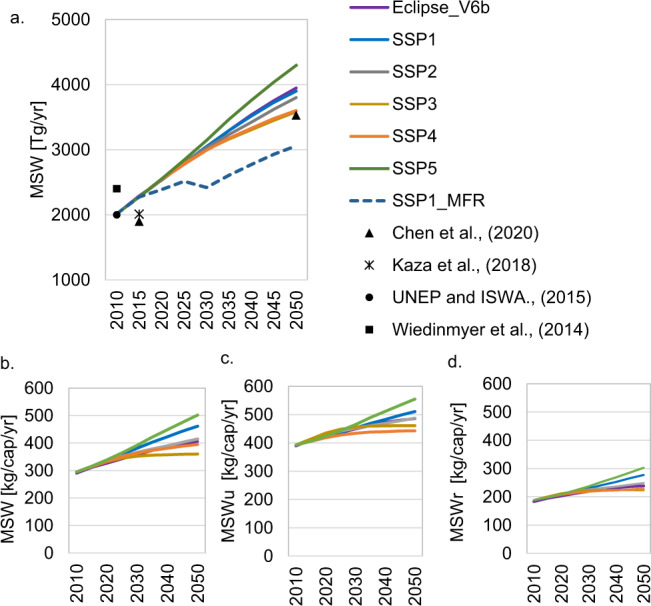
- Global MSW generation is projected to rise from 2,289 Tg/yr in 2015 to 4,296 Tg/yr in 2050 in SSP5; SSP1 is 10% lower than SSP5, and an added food/plastic waste reduction case (SSP1_MFR) lowers 2050 MSW generation by a further 20% compared with SSP5.
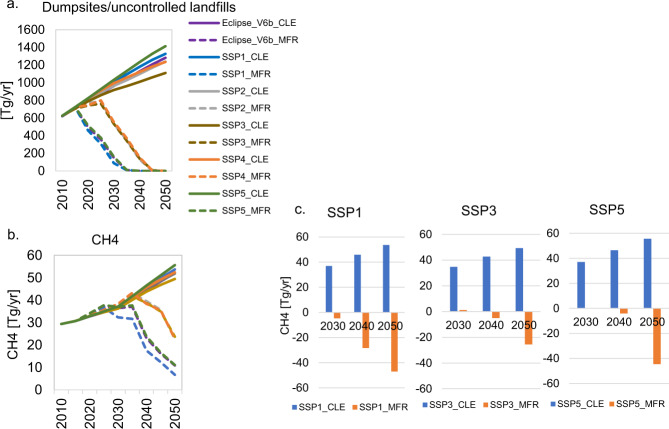
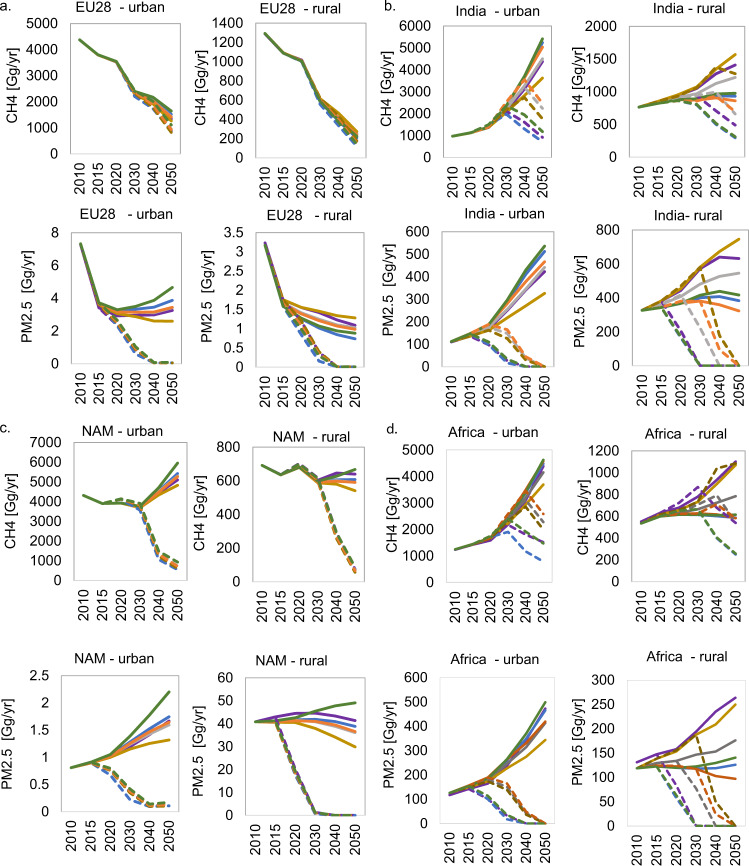
- The study estimates that MSW handling accounted for 8% (30 Tg/yr) of global anthropogenic CH4 emissions in 2015, and if current management persists, CH4 emissions from MSW will rise by 71% to 49–55 Tg CH4 by 2050.
- Under SSP1_MFR, CH4 emissions are projected to fall by 88% versus the baseline, leaving 187 Tg CO2eq/yr of CH4 in 2050; total GHGs (CH4 + CO2) in SSP1_MFR are 386 Tg CO2eq/yr in 2050.
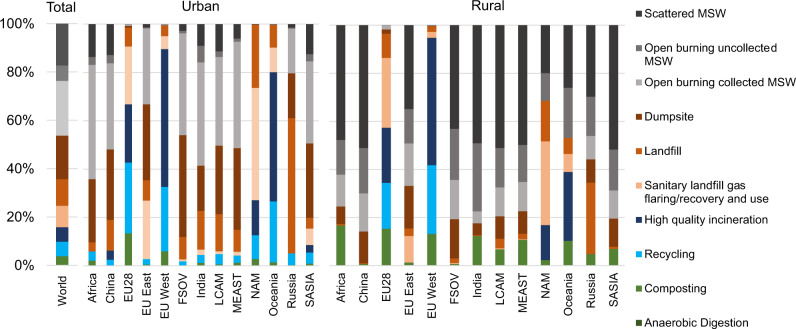
- The paper estimates that about 16% of global MSW generated was openly burned in 2010 and 2015 (380 Tg/yr and 394 Tg/yr, respectively), and that open-burning air pollutants can be virtually eliminated by 2050 in MFR scenarios; SSP1_MFR reaches eradication of littering and open burning in 2035.
## Methods
- Global scenario analysis using the Shared Socioeconomic Pathways (SSP1–SSP5) plus an IEA WEO 2018-based Eclipse_V6b scenario; for each pathway, the authors compare a baseline CLE case with an MFR case that implements circular MSW management globally.
- MSW generation, composition, collection, and management are modeled for urban and rural areas using GDP per capita-driven elasticities, regional income-group assumptions, country-specific activity data, and the IIASA-GAINS model framework.
- Emissions of CH4, CO2, particulate matter, and air pollutants are estimated from waste-management technologies and open-burning assumptions, with atmospheric PM2.5 impacts derived using GAINS transfer coefficients.
## Limitations
- The paper states that quantitative uncertainty estimation is difficult because many inputs vary: activity data, emission factors, and management-type assumptions; it also notes uncertainties from inconsistent MSW definitions and incomplete data, especially in developing countries.
- It does not account for MSW trade or MSW generated from tourism, so unmanaged MSW and related emissions may be under- or overestimated in some countries.
- The authors state that emission savings from energy recovery are not considered at this stage because consistent estimation would require scenario- and region-specific fuel mixes and emission factors.
Model-written summary. Check it against the paper before relying on it.
Integrity signals
Registry
Cites
Statistics
Figures
Verification
Claims the paper makes
8 Valid · 3 Not valid · 34 Not checked · 96 Own results and interpretations
The cited sources support only part of this claim — read each source’s verdict below.
In the paper
“Work focused on GHG and air pollution suggest that landfills contribute about 15% to global anthropogenic CH4 emissions30”
§ Potential for future reductions of global GHG and air pollutants from circular waste management systems > Introduction The quantities of municipal solid waste (MSW) generated globally each year has grown over the last decades, due to population and economic growth, and the consequent changes in production and consumption patterns1,2. Estimates suggest that the world population generated 1.9 Gt/yr of MSW in 2015 and is expected to generate about 3.5 Gt/yr of MSW in 20503. High-income countries (World Bank income classification) generate more waste per capita per year than low-income countries: they are responsible for 34% of the amount of MSW generated each year, even though they account for just 16% of the global population4. The absence of suitable treatment facilities to cope with the large quantities of MSW will result in various environmental and health impacts5. High-income countries can deploy policies and instruments to cope with the rising MSW flows and hence they can potentially have cleaner and better-organized waste management systems. Examples include the EU Waste Framework Directive 2008/98/EC6 and the amendment EU Directive 2018/8517, the EU Landfill Directive 1999/31/EC8 and the amendment EU Directive 2018/8509, the EU Directive on packaging and packaging waste 94/62/EC10 and the amendment EU Directive 2018/85211, the 3 R’s strategy in Japan12 and the Resource Conservation and Recovery Act 197613 in the United States. However, measures focusing solely on increasing re-use and recycling have a marginal impact on reducing waste generation14. Although some countries e.g., Japan and Netherlands, have managed to reduce MSW generation, most of them are still not successful in reducing the per capita amounts of MSW generated each year15. By contrast, low-income countries often lack suitable management systems, resulting from the shortage of funds, poor planning, poor implementation of law, and lack of technology and expertise4,16,17. In addition, the outsourcing of resource-intensive production and waste exports from high-income to low-income countries exacerbates the environmental problems resulting from inadequate waste management systems18. Often, open burning, littering and poorly managed landfills are the main ways of waste disposal in low-income countries4. Open waste burning results in the release of toxic pollutants and greenhouse gases (GHGs)19–21. Litter harms wildlife and ecosystems, especially marine life. Global marine litter is currently recognized as one of the biggest sources of ocean’s pollution22,23. Decomposition of organic matter in landfills can result in the release of methane (CH4)24, a GHG that is 28 times more potent per kg emitted than carbon dioxide (CO2) in a 100 year timeframe25. In addition to the negative impacts on the environment and climate, these unsustainable practices have well-documented adverse effects on human health26–28. Recently, research on waste concentrates on the assessment of the linkages between waste and resource use, climate change, air, and water pollution. Previous work determined that only around 13% of the global MSW generated is recycled and 5.5% composted4. Furthermore, it is estimated that the relative contribution of energy from waste and wastewater to the global primary energy could increase from 2% to 9% by 2040 and deliver 64 EJ of energy per year (1 EJ = 1018 Joules) at the end of this period upon implementation of circular management systems29. Work focused on GHG and air pollution suggest that landfills contribute about 15% to global anthropogenic CH4 emissions30 and show that open burning of MSW is an important contributor to particulate matter and air pollutant emissions20,31,32, specifically, it contributes 11% to total global particulate matter <2.5 µm (PM2.5) emissions and 6–7% to total global black carbon (BC) emissions31,32. BC from open burning of waste amounts to 2–10% of global CO2eq emissions33.
What the sources say
- Partly supportedcites [30] Höglund-Isaksson L Gómez-Sanabria A Klimont Z Rafaj P Schöpp W Technical potentials and costs for reducing global anthropogenic methane emissions in the 2050 timeframe–results from the GAINS model Environ. Res. Commun. 2020 2 025004 10.1088/2515-7620/ab7457 sourceExperimental — accuracy not yet measured
The emissions table reproduced in section 4 lists municipal solid waste at 31.9 Tg CH₄ in 2015 and 60.4 Tg CH₄ in the 2050 baseline. This supports identifying solid waste as a methane source, but the table does not identify landfill emissions separately or state that landfills account for about 15% of global anthropogenic methane emissions. (LLM, conf=0.82)
hedgedstates an association- Asserted: passes — The authors put it forward as true.
- Checkable: passes — It can be checked against evidence.
- Load-bearing: unclear — It is unclear whether the paper’s conclusions depend on it.
- Based: passes — The paper gives a reason why it holds.
- Partly supported
The cited sources support only part of this claim — read each source’s verdict below.
In the paper
“We estimate that MSW handling accounts for 8% (30 Tg/yr) of the global CH4 anthropogenic emissions estimated at 344 Tg/yr in 201530.”
§ Potential for future reductions of global GHG and air pollutants from circular waste management systems > Results > Anthropogenic emissions to air
What the sources say
- Partly supportedcites [30] Höglund-Isaksson L Gómez-Sanabria A Klimont Z Rafaj P Schöpp W Technical potentials and costs for reducing global anthropogenic methane emissions in the 2050 timeframe–results from the GAINS model Environ. Res. Commun. 2020 2 025004 10.1088/2515-7620/ab7457 sourceExperimental — accuracy not yet measured
Table 2 (in the indexed Conclusions section; page unavailable) gives 31.9 Tg CH₄ for municipal solid waste in 2015, broadly consistent with the cited 30 Tg/yr. The retrieved passages do not substantiate the claimed global total of 344 Tg/yr or the 8% share; 31.9 divided by 344 is about 9.3%. (LLM, conf=0.83)
hedged- Asserted: passes — The authors put it forward as true.
- Checkable: passes — It can be checked against evidence.
- Load-bearing: passes — The paper’s conclusions depend on it.
- Based: passes — The paper gives a reason why it holds.
- Partly supported
The cited sources support only part of this claim — read each source’s verdict below.
In the paper
“However, comparing CH4 emissions from MSW in the Eclipse_V5a32 to this study, we can see that the estimate in the latter is 6% higher.”
§ Potential for future reductions of global GHG and air pollutants from circular waste management systems > Results > Anthropogenic emissions to air
What the sources say
- Partly supportedcites [32] Klimont Z Global anthropogenic emissions of particulate matter including black carbon Atmos. Chem. Phys. 2017 17 8681 8723 10.5194/acp-17-8681-2017 sourceExperimental — accuracy not yet measured
The Method section identifies ECLIPSE as a GAINS dataset and says GAINS calculates methane emissions; Section 3.8 discusses municipal solid waste in GAINS. Our copy does not give an ECLIPSE V5a methane-emissions estimate for MSW, so it cannot substantiate the stated 6% comparison. (LLM, conf=0.78)
plain- Asserted: passes — The authors put it forward as true.
- Checkable: passes — It can be checked against evidence.
- Load-bearing: unclear — It is unclear whether the paper’s conclusions depend on it.
- Based: passes — The paper gives a reason why it holds.
- Partly supported
Every source the paper cites for this claim was checked and supports it.
In the paper
“and 57% higher than the estimate of ref. 32”
§ Potential for future reductions of global GHG and air pollutants from circular waste management systems > Results > Anthropogenic emissions to air
What the sources say
- Supportedcites [32] Klimont Z Global anthropogenic emissions of particulate matter including black carbon Atmos. Chem. Phys. 2017 17 8681 8723 10.5194/acp-17-8681-2017 source
Section 3.8 (Waste; page unavailable) estimates that 115–160 Tg of global municipal solid waste was openly burned during 1990–2010, providing the reference estimate cited. The 57% difference is the citing authors’ comparison with their own estimate, not a figure attributed to this source. (LLM, conf=0.87)
plain- Asserted: passes — The authors put it forward as true.
- Checkable: passes — It can be checked against evidence.
- Load-bearing: unclear — It is unclear whether the paper’s conclusions depend on it.
- Based: passes — The paper gives a reason why it holds.
- Supported
Every source the paper cites for this claim was checked and supports it.
In the paper
“In contrast, our results for particulate matter are 60% higher than those from ref. 32.”
§ Potential for future reductions of global GHG and air pollutants from circular waste management systems > Results > Anthropogenic emissions to air
What the sources say
- Supportedcites [32] Klimont Z Global anthropogenic emissions of particulate matter including black carbon Atmos. Chem. Phys. 2017 17 8681 8723 10.5194/acp-17-8681-2017 source
The Results and discussion section reports particulate-matter emission estimates, including global PM₁₀ and PM₂.₅ totals for 2010. The cited paper therefore provides the estimates used as the comparison point; the statement that the citing authors’ results are 60% higher is their own comparison, not a finding attributed to this source. (LLM, conf=0.84)
plain- Asserted: passes — The authors put it forward as true.
- Checkable: passes — It can be checked against evidence.
- Load-bearing: unclear — It is unclear whether the paper’s conclusions depend on it.
- Based: passes — The paper gives a reason why it holds.
- Supported
78 more claims · 1 with their cited sources checked
Create a free account to see all 141 claims and to verify the 18 references still open.
- It may state two separate claims as one. 35
- Probably not a substantial claim. 25
- The quote only partly states this claim. 3
Claims other papers make about this one
Each is checked against this paper’s own text: does it say what the citing paper says it does?
In the citing paper
“Effective waste recycling and disposal help mitigate negative environmental externalities such as waste-carbon emissions and pollutant reduction 1 .”
From Characterizing the polycentricity in waste governance: a comparative study on Shanghai, Tokyo, and Hong Kong (2024) · cites this paper as [1]
Citations
Cites
Plastic waste inputs from land into the ocean
Jambeck, J. R., Geyer, R., Wilcox, C., Siegler, T. R., Perryman, M., Andrady, A., Narayan, R., & Law, K. L. (2015) · Science · doi:10.1126/science.1260352 · Cited by 13,163
Riahi, K., van Vuuren, D. P., Kriegler, E., Edmonds, J., O’Neill, B. C., Fujimori, S., Bauer, N., Calvin, K., Dellink, R., Fricko, O., et al. (2017) · Global Environmental Change · doi:10.1016/j.gloenvcha.2016.05.009 · Cited by 6,607
Self-citationWhat a Waste 2.0: A Global Snapshot of Solid Waste Management to 2050
Kaza, S., Yao, L. C., Bhada-Tata, P., Van Woerden, F., & Levine, D. (2018) · doi:10.1596/978-1-4648-1329-0 · Cited by 6,126 · cited 1×
“(4) Implementation of the current legislation for waste management adopted before 2018.”
BackgroundEnvironmental science and pollution research: International A New Journal — A New Concept
Hutzinger, O. (1993) · Umweltwissenschaften und Schadstoff-Forschung · doi:10.1007/bf02981237 · Cited by 4,492
What a Waste : A Global Review of Solid Waste Management
Hoornweg, D., & Bhada-Tata, P. (2012) · doi:10.1596/17388 · Cited by 3,129
International Energy Agency (2018) · World energy outlook · doi:10.1787/weo-2018-en · Cited by 2,841
A technology‐based global inventory of black and organic carbon emissions from combustion
Bond, T. C., Streets, D. G., Yarber, K. F., Nelson, S. M., Woo, J., & Klimont, Z. (2004) · Journal of Geophysical Research: Atmospheres · doi:10.1029/2003jd003697 · Cited by 2,393
Self-citationHoesly, R. M., Smith, S. J., Feng, L., Klimont, Z., Janssens-Maenhout, G., Pitkanen, T., Seibert, J. J., Vu, L., Andres, R. J., Bolt, R. M., et al. (2018) · Geoscientific Model Development · doi:10.5194/gmd-11-369-2018 · Cited by 2,203
Self-citationEmission factors for open and domestic biomass burning for use in atmospheric models
Akagi, S. K., Yokelson, R. J., Wiedinmyer, C., Alvarado, M. J., Reid, J. S., Karl, T., Crounse, J. D., & Wennberg, P. O. (2011) · Atmospheric Chemistry and Physics · doi:10.5194/acp-11-4039-2011 · Cited by 2,047
Resources, Conservation and Recycling
Nithikul, J., Paramasivam, K., & Visvanathan, C. (2011) · Cited by 1,711
Research works printed but not linked: 1
- EEA. Managing municipal solid waste. A review of achievements in 32 European countries. (2013).
Cited by
Items 201–300 of 305
Peng, Z., Li, Z., Huang, X., Yu, X., Leung, M. K. H., Wang, Z., & Yang, Z. (2024) · EcoMat · doi:10.1002/eom2.12497 · Cited by 4
The future of cement: Technological innovation in representative concentration pathways
Maes, B., Audenaert, A., Craeye, B., & Buyle, M. (2025) · Journal of Industrial Ecology · doi:10.1111/jiec.70007 · Cited by 3
Public participation of illegal dumping management: mining of web based data
Du, L., Zuo, J., & Han, J. (2025) · Journal of Environmental Management · doi:10.1016/j.jenvman.2025.125986 · Cited by 2
Wu, P., Liou, J., & Huang, T. (2022) · International Journal of Environmental Research and Public Health · doi:10.3390/ijerph192215385 · Cited by 2
Zhou, X.-Y., Zhou, J.-L., Guo, R., Wu, Y., Zhang, B., Zhao, L. H., & Lü, Q. (2023) · Applied Surface Science · doi:10.1016/j.apsusc.2023.158169 · Cited by 2
Mutual disposal of municipal solid waste and flue gas on isolated islands
Chen, X., Yu, Y., Wang, Y., et al. (2023) · Applied Energy · doi:10.1016/j.apenergy.2023.122057 · Cited by 2
Ren, X. (2023) · International Conference on Integrated Intelligence and Communication Systems (ICIICS) · doi:10.1109/iciics59993.2023.10421477 · Cited by 2
“By comparatively analyzing two global scenarios to 2050, the baseline and the mitigation scenarios, a sustainable development-oriented mitigation strategy produces earlier and greater benefits than a scenario focusing on technological solutions [10].”
BackgroundLerpiniere, D. J., Wilson, D. C., & Velis, C. A. (2024) · Research Square · doi:10.21203/rs.3.rs-4248450/v1 · Cited by 2
Kamugisha, P. P. (2025) · Environmental Quality Management · doi:10.1002/tqem.70026 · Cited by 2
Ogunnaike, D., Srikrishnan, V., & Goldfarb, J. L. (2025) · ACS Sustainable Chemistry & Engineering · doi:10.1021/acssuschemeng.5c03969 · Cited by 3
LSTM Neural Network-Based on Model Predictive Control for Furnace Temperature in MSWI Process
Tian, H., Tang, J., & Yu, W. (2025) · Chinese Control and Decision Conference (CCDC) · doi:10.1109/ccdc65474.2025.11090927 · Cited by 2
A composite constitutive model for municipal solid waste considering multiple influencing factors
Chen, D., Chen, Y.-G., Sun, Z. L., et al. (2025) · Computers and Geotechnics · doi:10.1016/j.compgeo.2025.107615 · Cited by 1
Wu, Y., Wang, W., Tang, J., et al. (2025) · Sustainability · doi:10.3390/su172310577 · Cited by 1
Luutu, H., Rose, M. T., McIntosh, S. R., ZWIETEN, L. V., & Rose, T. J. (2026) · Sustainability · doi:10.3390/su18041794 · Cited by 2
Li, H. C., Lu, X., Liu, F., Li, Z., Liu, X., Lu, B., Ma, S., Gu, B., Zhou, C., & Wang, Z. (2026) · The Innovation · doi:10.1016/j.xinn.2026.101315 · Cited by 2
“12,42,43 By 2021, China’s harmless treatment rate for MSW had reached 99.9%, with incineration, landfilling, and bioconversion accounting for 72.5%, 21.1%, and 6.5%, respectively.”
InfluentialSatheesh, S., Pradhan, V., Shukla, K., & Patil, Y. (2026) · Discover Sustainability · doi:10.1007/s43621-026-02756-2 · Cited by 1
Mondragón-Zarza, E., Berriel, M. D. C. H., Cuellar-Robles, F., Domínguez, E. R. R., Turpin-Marion, S. J., & Flores‐Alamo, N. (2026) · Environments · doi:10.3390/environments13050247 · Cited by 1
Municipal solid waste generation in Norway: A panel analysis investigating the waste Kuznets curve
Mattson, K. R., Sborz, J., Henning, E., & Ottelin, J. (2026) · Ecological Economics · doi:10.1016/j.ecolecon.2026.109101 · Cited by 1
Liu, F., Zhang, N., Xu, G., et al. (2026) · Journal of Cleaner Production · doi:10.1016/j.jclepro.2026.148764 · Cited by 1
Dioxin emission reduction optimization based on an improved particle swarm optimization algorithm
Wang, T., Tang, J., & Aljerf, L. (2026) · Applied Soft Computing · doi:10.1016/j.asoc.2026.115860 · Cited by 7
Li, Y., & Wang, F. (2023) · Economic Research-Ekonomska Istraživanja · doi:10.1080/1331677x.2023.2190798 · Cited by 2
Anthropogenic Emissions Inventories of Air Pollutants
Granier, C., Liousse, C., McDonald, B., & Middleton, P. B. (2023) · Springer eBooks · doi:10.1007/978-981-15-2527-8_5-1 · Cited by 1
Municipal solid waste management using electric vehicle by variable neighbourhood search algorithm
Zamanian, A., Khodaei, Z., & Ziarati, K. (2024) · International Journal of Systems Science Operations & Logistics · doi:10.1080/23302674.2024.2393859 · Cited by 3
Maria, F. D., Sisani, F., Cesari, D., & Bontempi, E. (2024) · Environmental Science and Pollution Research · doi:10.1007/s11356-024-34989-x · Cited by 1
Successful Local Experiences in Waste Management of Rural Destinations in India
Basak, A., Pathania, R., & Banerjee, S. (2024) · Advances in hospitality, tourism and the services industry (AHTSI) book series · doi:10.4018/979-8-3693-9621-6.ch006 · Cited by 1
Przydatek, G. (2022) · Open Access Journal of Waste Management & Xenobiotics · doi:10.23880/oajwx-16000180 · Cited by 1
Replacement of biochar from waste for cement: mechanisms and eco-benefitsPreprint
Wang, Z., Chen, M., Fang, H., Peng, J., Huang, Q., Li, P., He, X., Yan, T., Zhang, C., Patil, A. J., et al. (2022) · Research Square · doi:10.21203/rs.3.rs-1693640/v1 · Cited by 1
Zhang, L., & Li, H. (2025) · SSRN Electronic Journal · doi:10.2139/ssrn.5379558 · Cited by 1
Harpet, C., & Gautier, M. (2026) · Springer eBooks · doi:10.1007/978-3-031-51703-7_66-1 · Cited by 1
Atkinson, W., Eastham, S. D., Chen, Y.-H. H., et al. (2022) · Geoscientific model development · doi:10.5194/gmd-2022-103-rc1
APPLICATION OF ARTIFICIAL NEURAL NETWORK FOR SOLID WASTE PROJECTION AND ENERGY CONTENT EVALUATION
Hoy, Z. X., Woon, K. S., & Chin, W.-S. (2022) · doi:10.17501/26510251.2022.3102
Author response to referee comments - acp-2021-1059
Smith, S. J. (2022) · Atmospheric chemistry and physics · doi:10.5194/acp-2021-1059-ac1
Asim, M., Kumar, R., Kanwal, A., Shahzad, A., Ahmad, A., & Farooq, M. U. (2023) · Energy Reports · doi:10.1016/j.egyr.2022.12.074 · Cited by 2
Analysis of the double-side power supply for electronic-ion technology devices with pulse voltage
Muzafarov, S. M., Balitsky, V., Togaev, B. K., et al. (2023) · IOP Conference Series Earth and Environmental Science · doi:10.1088/1755-1315/1142/1/012012
“Production waste was thrown into the air in the expectation that all of them would eventually be neutralized and recycled by nature itself [1].”
BackgroundChen, W., Ohnishi, S., Maki, S., et al. (2023) · SSRN Electronic Journal · doi:10.2139/ssrn.4626950
Andevari, M. H., Karrabi, M., & Shahnavaz, B. (2023) · SSRN Electronic Journal · doi:10.2139/ssrn.4638797
Evaluation of Domestic Solid Waste Management in Cai Rang District, Can Tho City, Vietnam
Dan, T. H., Liem, L. T. T., Lua, N. T. B., & Mi, L. T. D. (2023) · Indonesian Journal of Environmental Management and Sustainability · doi:10.26554/ijems.2023.7.4.128-136 · Cited by 2
Elshaboury, N., Al-Sakkaf, A., Alfalah, G., et al. (2024) · Lecture notes in civil engineering · doi:10.1007/978-3-031-35471-7_12
Brocza, F. M., Rafaj, P., Sander, R., et al. (2024) · doi:10.5194/egusphere-2024-41-rc1
Brocza, F. M., Rafaj, P., Sander, R., et al. (2024) · doi:10.5194/egusphere-2024-41-rc2
Li, R. (2024) · SSRN Electronic Journal · doi:10.2139/ssrn.4781973
Brocza, F. M. (2024) · doi:10.5194/egusphere-2024-41-ac1
Water Body Utilization Pattern Influences Greenhouse Gas Emissions in Jiashan County, ChinaPreprint
Li, N., Wu, J., Li, J., Xiong, J., Yuan, H., Jiao, S., Shao, X., Zhang, Y., Zhang, L., & Wu, M. (2024) · SSRN Electronic Journal · doi:10.2139/ssrn.4790096
Yao, P., Huang, G., Zhang, S., Shan, F., Ding, H., Wang, D., Song, L., Tai, J., Zhao, J., & Qian, G. (2024) · ACS Sustainable Resource Management · doi:10.1021/acssusresmgt.4c00125
Tian, H., Tang, J., Xia, H., et al. (2024) · Chinese Control and Decision Conference (CCDC) · doi:10.1109/ccdc62350.2024.10587781
Sun, X., Behr, S. M., & Küçük, M. (2024) · SSRN Electronic Journal · doi:10.2139/ssrn.4907471
Role of IoT Smart Waste Management in Achieving Sustainable Development Goals
Dzulkefly, N. H., Suhaimi, N. A., Razani, N. N. H. N. A., et al. (2024) · Studies in systems, decision and control · doi:10.1007/978-3-031-65203-5_8
Teixeira, A. R., Kenney, D. H., Charlebois, A., et al. (2024) · Research Square · doi:10.21203/rs.3.rs-4797633/v1
Zhang, R. C., Tang, J., Wang, T., et al. (2024) · International Conference on Industrial Artificial Intelligence (IAI) · doi:10.1109/iai63275.2024.10730619
“This rapid growth in MSW production has exacerbated environmental risks, often described as "garbage encircling cities" [3 ], significantly hindering sustainable and healthy development [4-5].”
BackgroundWang, Z., Tang, J., Xia, H., Zhang, R. C., & Wang, T. (2024) · International Conference on Industrial Artificial Intelligence (IAI) · doi:10.1109/iai63275.2024.10730314 · Cited by 1
“Currently, the annual growth rate of MSW ranges from 8% to 10% [2].”
BackgroundUsing Gas Molecules to Assemble Value‐Added Materials through Dynamic Gas‐Bridged Bond
Liang, X., Wang, Y., Wang, Y., et al. (2025) · Macromolecular Rapid Communications · doi:10.1002/marc.202500053
Goren, A. Y., Kalincı, Y., & Dinçer, İ. (2025) · Elsevier eBooks · doi:10.1016/b978-0-44-313219-3.00018-6
Zhang, Y., & Yan, Q. (2025) · Green Chemistry · doi:10.1039/d4gc05893c
First testing of horse-drawn roller-cutter for green-manure crops management in Croatia
Gantner, R., Schmit, P., Steiner, Z., Zimmer, D., Banaj, A., DelVechio, I., & Gantner, V. (2023) · AgroReS · doi:10.7251/zars2301054g
Ulfah, M., Santoso, L. P., & Nurwahyunani, A. (2025) · Jurnal Ilmu Lingkungan · doi:10.14710/jil.23.2.435-442
Zhang, R. C., Tang, J., & Wang, T. (2025) · Sustainability · doi:10.3390/su17135672 · Cited by 1
Intelligent control of sludge and municipal solid waste incineration using artificial neural network
Hu, Y., Zhang, H., Niu, Y., et al. (2025) · Energy Sources Part A Recovery Utilization and Environmental Effects · doi:10.1080/15567036.2025.2526671
Garau, C., Annunziata, A., & Scorza, F. (2025) · Lecture notes in computer science · doi:10.1007/978-3-031-97654-4_2
Process Data Correlation Analysis for Semi-Supervised Modeling of Dioxin Emissions in MSWI Processes
Cui, W., Tang, J., & Wang, T. (2025) · Chinese Control and Decision Conference (CCDC) · doi:10.1109/ccdc65474.2025.11090440
Wu, Y., Chang, R., Du, L., Song, J., Zhang, W. E., wang, T., & Zuo, J. (2025) · SSRN Electronic Journal · doi:10.2139/ssrn.5388100
Andevari, M. H., Karrabi, M., Shahnavaz, B., et al. (2025) · SSRN Electronic Journal · doi:10.2139/ssrn.5385854
Economopoulos, A. (2025) · SSRN Electronic Journal · doi:10.2139/ssrn.5394988
Wang, B., Tang, J., Wang, W., et al. (2025) · Applied Sciences · doi:10.3390/app151910329
Liu, H., Duan, H., Zhang, N., Mao, R., Miller, T. R., Xu, M., Yang, J., & Ma, Y. (2025) · Atmospheric chemistry and physics · doi:10.5194/acp-25-11469-2025
“As investigated, regions generating the highest amounts of waste quantities may have the lowest collection rates and the poorest management systems, and unsuitable management, such as dumpsite disposal or burning without air pollution controls, may exist (Gómez-Sanabria et al., 2022).”
Air Pollution Control Strategies for Sustainable Landfill Management
Farid, M. A. A., Norrrahim, M. N. F., Lease, J., & Andou, Y. (2025) · Springer eBooks · doi:10.1007/978-3-032-01951-6_9
Martín-Hernández, E., Chen, K., Santoro, D., & Omelon, S. J. (2026) · RSC Sustainability · doi:10.1039/d5su00688k · Cited by 1
Rodrigues, P. F., & da Costa, R. F. (2025) · Elsevier eBooks · doi:10.1016/b978-0-443-40407-8.00003-5 · Cited by 2
Tang, J., Wang, T., Tian, H., Yu, W., & Qiao, J. (2025) · Elsevier eBooks · doi:10.1016/b978-0-443-26779-6.00009-7
IoT and PLC Enabled Smart Waste Segregation and Sustainable Energy Generation Management System
Kumar, C., Thennarasi, I., Kanchana, K., Jothi, P., Manju, K., & Vishalini, M. (2025) · International Conference on Intelligent Cyber Physical Systems and Internet of Things (ICoICI) · doi:10.1109/icoici65217.2025.11252995 · Cited by 1
“Together, these studies [6 – 15] present an integrated strategy for waste management based on circular economy concepts, renewable energy technologies, digital technologies, and strategies tailored to regional contexts for encouraging global environmental sustainability and resource efficiency.”
Wang, Y., Hang, X., Shao, C., Zhang, Z., Guo, S., Li, R., & Shen, Q. (2025) · Plants · doi:10.3390/plants14233660 · Cited by 2
Li, Q., & Zhang, P. (2025) · Sustainability · doi:10.3390/su172411191
Kenney, D. H., Charlebois, A., Wang, S., Rahbar, N., Timko, M. T., & Teixeira, A. R. (2025) · RSC Sustainability · doi:10.1039/d5su00765h
Li, N., Gao, J., Jiang, P., Ye, X., Shao, X., & Wu, M. (2026) · Inland Waters · doi:10.1080/20442041.2025.2606353
Suryawan, I. W. K., Suhardono, S., Phan, T. T. T., Lee, C., Rahman, A., & Ulhasanah, N. (2026) · Local Development & Society · doi:10.1080/26883597.2025.2599904 · Cited by 3
Zhang, Z., Pang, Y., Shi, X., Shi, J., Zhang, H., & Cheng, J. (2026) · Atmosphere · doi:10.3390/atmos17020204
Mikalauskienė, A., Štreimikienė, D., & Mikalauskas, I. (2026) · Springer climate · doi:10.1007/978-3-032-16218-2_3
Zongrun, S., & Zhiyuan, M. (2026) · Biomass and Bioenergy · doi:10.1016/j.biombioe.2026.109111
Solid Waste Management in a Context of Sustainability in the Sahuangal Community, Ecuador
Coello-Choez, B., Bravo-Montero, L., & Herrera-Franco, G. (2026) · Sustainability · doi:10.3390/su18062811
Jibrin, A. M., Aldrees, A., Dan’azumi, S., & Abba, S. I. (2026) · Water Air & Soil Pollution · doi:10.1007/s11270-026-09399-z
Sustainable Pathways: A Lifecycle Assessment of Municipal Solid Waste Management in Lalitpur, Nepal
Gautam, R., Chen, L., Abbasi, M. W., Pant, S., Talpur, M. Y., Dong, R., & Guo, J. (2026) · Springer proceedings in earth and environmental sciences · doi:10.1007/978-3-032-09299-1_46
Yadav, V., Shinde, A. M., Yadav, B. R., Pandey, D. S., Maji, K. J., Manu, M. K., Singh, V., & Arora, M. (2026) · Journal of Industrial Ecology · doi:10.1007/s44498-026-00067-3 · Cited by 3
“Recent scholarship has identified substantial co-benefits from transforming MSW systems, suggesting that this sector warrants more focused attention in emerging economies (Gomez-Sanabria et al., 2022; Kang et al., 2022; Zhang et al., 2022).”
Qualitative analysis and modeling of temperature states in municipal solid waste incineration
Cui, C., Tang, J., & Qiao, J. (2026) · Measurement · doi:10.1016/j.measurement.2026.121652
City-Level Nexus of Embodied Waste Carbon in China
Fang, W., Wang, X., Ye, L., et al. (2026) · Environmental Science & Technology · doi:10.1021/acs.est.6c03175
Cui, C., Yao, J., & Xia, H. (2026) · IEEE Transactions on Industrial Informatics · doi:10.1109/tii.2026.3687100
“M UNICIPAL solid waste incineration (MSWI) is an effective treatment method that achieves waste reduction, reuse, and innocuity [1], [2].”
Global warming potential assessment of municipal solid waste management in Greater Lisbon
Costa, E. I., Oshita, K., & Takaoka, M. (2026) · Waste Management · doi:10.1016/j.wasman.2026.115609 · Cited by 3
Zou, Q., Li, S., Ding, Y., et al. (2026) · Journal of Cleaner Production · doi:10.1016/j.jclepro.2026.148617
Meng, X., Yue, S., Liu, X., et al. (2026) · IEEE Transactions on Industrial Informatics · doi:10.1109/tii.2026.3694959
“T HE municipal solid waste (MSW) generation has increased significantly in recent years, driven by rapid urbanization and economic growths [1].”
Ling-zhi, P., & Cai, J. (2026) · Sustainable Production and Consumption · doi:10.1016/j.spc.2026.06.007 · Cited by 1
Chen, D., & Chen, Y. (2026) · Mechanisms and machine science · doi:10.1007/978-3-032-11169-2_27
Şehir Merkezindeki Hava Kirliliği Faktörlerinin AHP Yöntemiyle Değerlendirilmesi: Karabük İli Örneği
Onaran, S., Uslu, Y. D., & Aygün, S. (2026) · Doğal Afetler ve Çevre Dergisi · doi:10.21324/dacd.1831376
Katona, A. I., Szigetvari, Z., Hegedűs, C., Kosztyán, Z. T., Kurdi, R., & Sebestyén, V. (2026) · Cleaner Logistics and Supply Chain · doi:10.1016/j.clscn.2026.100354 · Cited by 1
Xu, Y., Tan, W., Hao, X., Wang, H., Zhang, X., & Dong, L. (2026) · Computers & Industrial Engineering · doi:10.1016/j.cie.2026.112266
Organic waste management reveals methane reduction opportunities in Uganda
Gómez-Sanabria, A., Okello, G., Nyamurungi, K. N., kiconco, E., Kiguli, D., Onyai, F., Dell’Orto, A., & Trois, C. (2026) · Communications Sustainability · doi:10.1038/s44458-026-00127-6
“…itsmanagementare crucialforbuildingmoreclimate-resilient,adaptativeandequitablesocieties 9 ,especiallyintheGlobalSouthin which current and projected increasing quantities of waste generation worsens the already critical situation of waste management systems and associated impacts 3,10 – 12 .”
InfluentialSelf-citationQuantifying the carbon budget cost of overlooked landfill methane in sub-Saharan AfricaPreprint
Longfor, N. R., Istrate, I.-R., Joseph Jr., A., et al. (2026) · Research Square · doi:10.21203/rs.3.rs-10766372/v1
Multidimensional Inequality of CO2 and Air Pollutant Footprints in China under Dual-Carbon Policy
Li, R., Yu, L., Zhu, X., et al. (2026) · Environmental Science & Technology · doi:10.1021/acs.est.6c04314
Pata, S. K., Pata, U. K., & Naimoğlu, M. (2026) · International Journal of Sustainable Development & World Ecology · doi:10.1080/13504509.2026.2732017 · Cited by 1
Levi, A. (2026) · Frontiers in Environmental Science · doi:10.3389/fenvs.2026.1946800
Goal Oriented Decision Making for Municipal Solid Waste: A Case Study Using the SWEET
Rana, S., Shoaib, M., & Kumar, A. (2026) · Lecture notes in civil engineering · doi:10.1007/978-981-92-4436-2_34
Tan, W., Zhang, X., Wang, C., Jiang, H., Zheng, Y., Wang, Y., Xiong, Z., Zhang, J., & Zhao, Y. (2026) · Chinese Journal of Chemical Engineering · doi:10.1016/j.cjche.2026.08.029
Liang, J. L., Ren, W., & Wang, X. (2026) · Journal of Environmental Economics and Management · doi:10.1016/j.jeem.2026.103429
Metadata
- Authors
- Gómez-Sanabria, A., Kiesewetter, G., Klimont, Z., Schoepp, W., & Haberl, H.
- Affiliations
- International Institute for Applied Systems Analysis (AT)
- BOKU University (AT)
- Corresponding author
- Gómez-Sanabria, Adriana
- Venue
- Nature Communications
- Published
- 2022-01-10
- Volume
- 13
- Issue
- 1
- Pages
- 106-106
- ISSN
- 2041-1723 (ISSN-L)
- PMC
- PMC8748894
- OpenAlex
- W4206697818
- Semantic Scholar
- 4449fe41fcc2759ebeab024f7ab133b249429624
- Cited by
- 306
- References
- 47
- Citations by year
- 2026: 51 · 2025: 85 · 2024: 85 · 2023: 58 · 2022: 27
- FWCI
- 35.75
- Type
- journal article
- Language
- en
- Open access
- gold
- doi.org
- Licence
- cc-by
- creativecommons.org/licenses/by/4.0 (tdm)
- creativecommons.org/licenses/by/4.0 (vor)
- Locations
- Nature Communications (publishedVersion, cc-by)
- Research Square (acceptedVersion, cc-by)
- PubMed Central (publishedVersion, cc-by)
- PubMed (publishedVersion)
- IIASA PURE (International Institute of Applied Systems Analysis) (acceptedVersion)
- RePEc: Research Papers in Economics (submittedVersion)
- DOAJ (DOAJ: Directory of Open Access Journals) (submittedVersion, cc-by-sa)
- Social Science Open Access Repository (GESIS – Leibniz Institute for the Social Sciences) (submittedVersion, cc-by)
- Funders
- European Commission
- Topics
- Physical Sciences › Environmental Science › Waste Management and Disposal › Municipal Solid Waste Management
- Social Sciences › Economics, Econometrics and Finance › Economics and Econometrics › Climate Change Policy and Economics
- Health Sciences › Medicine › Public Health, Environmental and Occupational Health › Healthcare and Environmental Waste Management
- Keywords
- circular economy, municipal solid waste, waste management, greenhouse gas emissions, air pollutants, methane, open burning, Shared Socioeconomic Pathways, climate change mitigation scenarios, co-benefits
About these checks
Registry, retraction, Cites and statistics results are computed, not judged, with one exception: a printed reference that no index lists is read once by a model before it counts as a citation error. Claims are extracted by a model and kept only when their quote appears verbatim in the text; each cited source is then checked, with a model’s help, for whether it says what the claim relies on. Those verdicts can be wrong — read the claim’s quote and the cited source before relying on one.
The claim verdicts this report counts are experimental: their accuracy is not yet measured.
A language model drew the claims from the paper on 2026-10-10, under version 3 of the claim definition (model deepseek-v4.1-flash, prompt extract-v3).
A second model labelled each claim on 2026-10-10 (model jev-1.13-20260917, definition revision gold-guideline-v0.2).
Cited sources are checked with a language model’s help (gpt-6-sol).
Statistics and arithmetic are recomputed, not judged.
Confidence bands are shown only for fields calibrated on our annotated test set. None is calibrated yet, so no band is shown.
What counts as a claim ›How we measure confidence ›How we check this ›
Are you an author, or do you see a problem with this page? Request a review
Data sources
Bibliographic data: Semantic Scholar, OpenAlex, Crossref.
Contains information from the Semantic Scholar Academic Graph Datasets, made available under the ODC Attribution License (ODC-BY 1.0).
Semantic Scholar’s data is described in: Kinney, R., et al. (2023). The Semantic Scholar Open Data Platform. arXiv:2301.10140.
