

A programmable qudit-based quantum processor
Open accessThe DOI matches its Crossref record; 79 of the 79 references it cites were found in a registry or an index.
Abstract
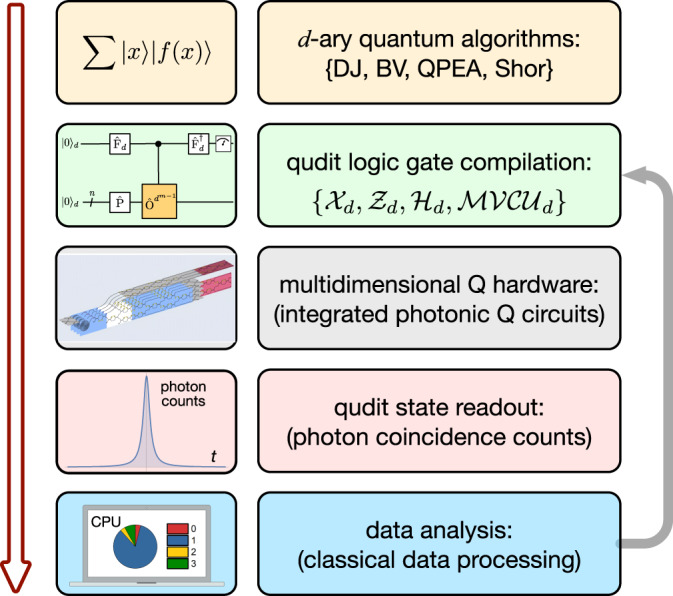
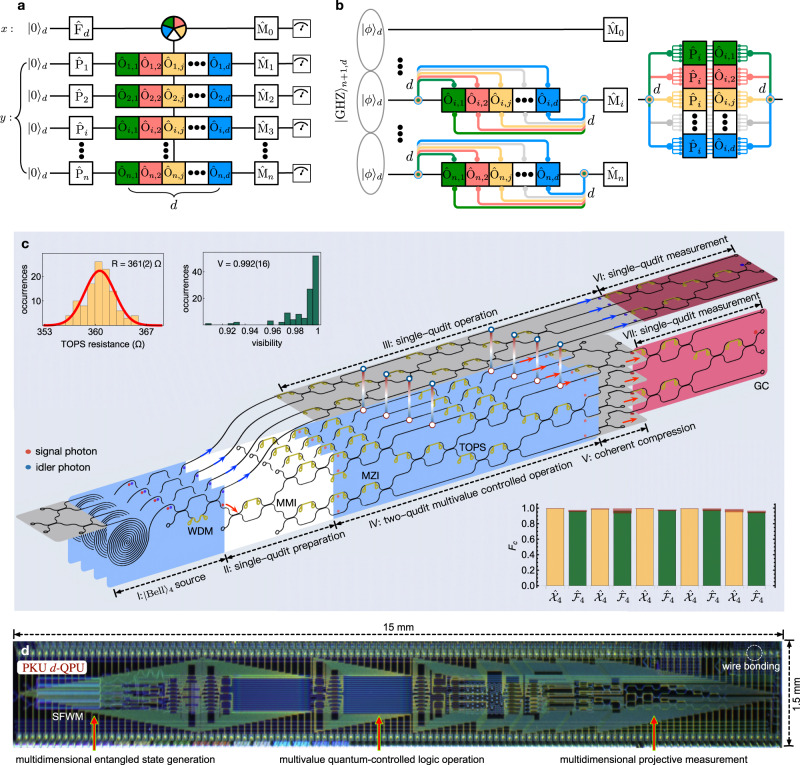
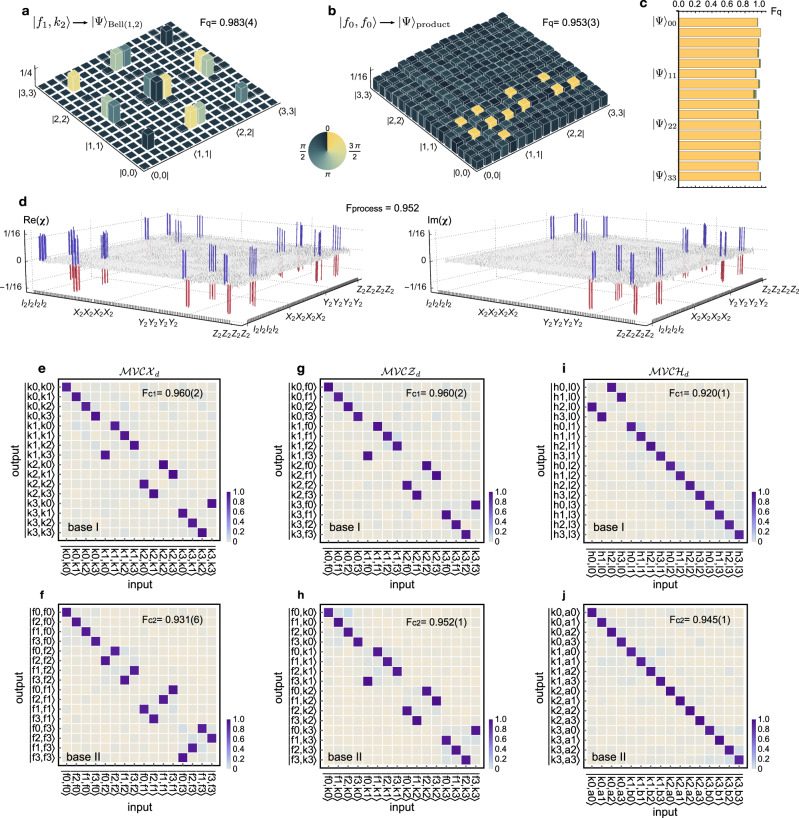
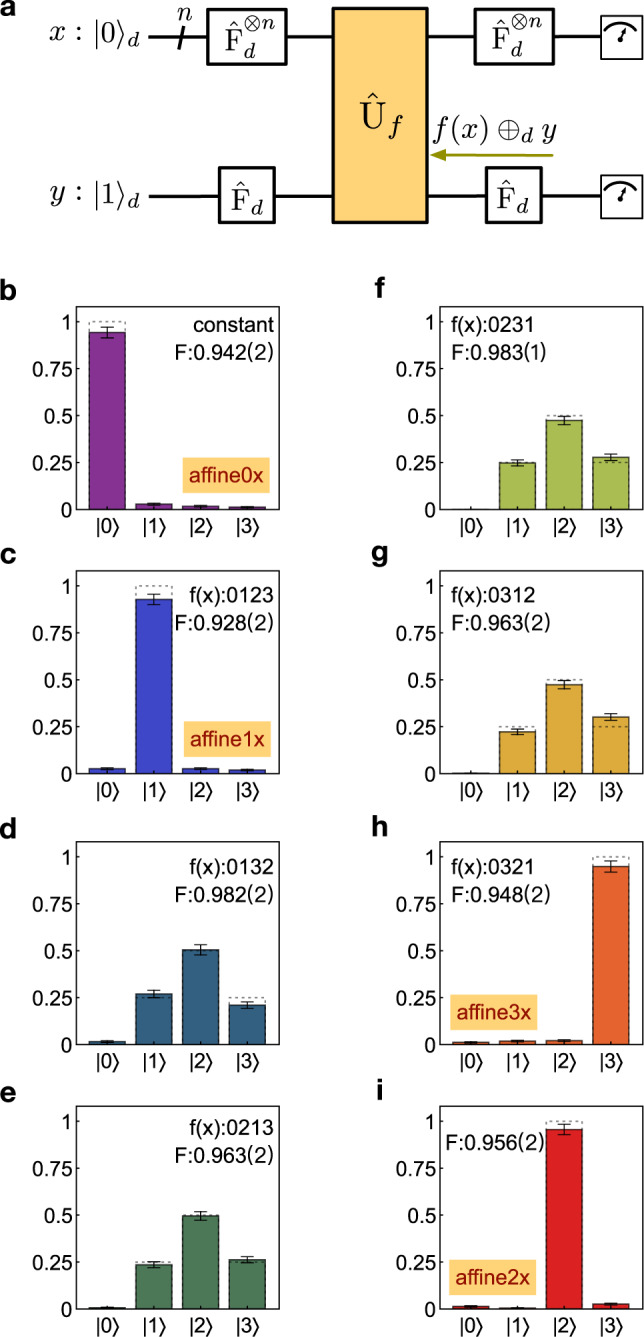
Controlling and programming quantum devices to process quantum information by the unit of quantum dit, i.e., qudit, provides the possibilities for noise-resilient quantum communications, delicate quantum molecular simulations, and efficient quantum computations, showing great potential to enhance the capabilities of qubit-based quantum technologies. Here, we report a programmable qudit-based quantum processor in silicon-photonic integrated circuits and demonstrate its enhancement of quantum computational parallelism. The processor monolithically integrates all the key functionalities and capabilities of initialisation, manipulation, and measurement of the two quantum quart (ququart) states and multi-value quantum-controlled logic gates with high-level fidelities. By reprogramming the configuration of the processor, we implemented the most basic quantum Fourier transform algorithms, all in quaternary, to benchmark the enhancement of quantum parallelism using qudits, which include generalised Deutsch-Jozsa and Bernstein-Vazirani algorithms, quaternary phase estimation and fast factorization algorithms. The monolithic integration and high programmability have allowed the implementations of more than one million high-fidelity preparations, operations and projections of qudit states in the processor. Our work shows an integrated photonic quantum technology for qudit-based quantum computing with enhanced capacity, accuracy, and efficiency, which could lead to the acceleration of building a large-scale quantum computer.
Overview
The claims and statistics of this paper haven’t been checked yet.
Free: it reads the open-access text and checks the first 5 claims that cite a source we can check. Create a free account to check every claim.
Integrity signals
Registry
Cites
Statistics
Figures
Verification
Claims the paper makes
The claims and statistics of this paper haven’t been checked yet.
Free: it reads the open-access text and checks the first 5 claims that cite a source we can check. Create a free account to check every claim.
Self-check
Percentages, sums and reported differences re-computed from the paper’s own numbers.
The self-check needs the paper’s full text.
Citations
Cites
Quantum supremacy using a programmable superconducting processor
Arute, F., Arya, K., Babbush, R., Bacon, D., Bardin, J. C., Barends, R., Biswas, R., Boixo, S., Brandao, F. G. S. L., Buell, D. A., et al. (2019) · Nature · doi:10.1038/s41586-019-1666-5 · Cited by 7,720 · cited 1×
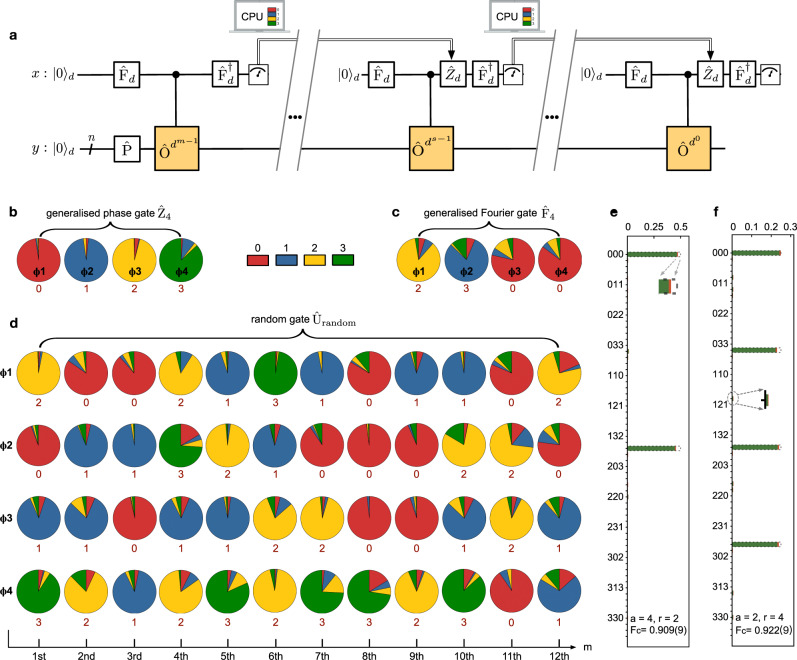
“The order-finding algorithm together with classical processing using the continued fraction algorithm returns the factor of gcd(ar/2 ± 1,N) = (3, 5).”
MethodRapid solution of problems by quantum computation
Deutsch, D., & Jozsa, R. (1992) · Proceedings of the Royal Society of London. Series A: Mathematical and Physical Sciences · doi:10.1098/rspa.1992.0167 · Cited by 2,700
Satellite-to-ground quantum key distribution
Liao, S.-K., Cai, W.-Q., Liu, W.-Y., Zhang, L., Li, Y., Ren, J.-G., Yin, J., Shen, Q., Cao, Y., Li, Z.-P., et al. (2017) · Nature · doi:10.1038/nature23655 · Cited by 1,821 · cited 1×
“The order-finding algorithm together with classical processing using the continued fraction algorithm returns the factor of gcd(ar/2 ± 1,N) = (3, 5).”
MethodSelf-citationIntegrated photonic quantum technologies
Wang, J., Sciarrino, F., Laing, A., & Thompson, M. G. (2020) · Nature Photonics · doi:10.1038/s41566-019-0532-1 · Cited by 1,576 · cited 1×
“We designed the integrated quantum photonic circuit and use 248nm deep ultraviolet lithography to fabricate the silicon-based quantum photonic chip shown in Fig 1A on 220nm silicon-on-insulator (SOI) [3].”
MethodSelf-citationSignificant-Loophole-Free Test of Bell’s Theorem with Entangled Photons
Giustina, M., Versteegh, M. A. M., Wengerowsky, S., Handsteiner, J., Hochrainer, A., Phelan, K., Steinlechner, F., Kofler, J., Larsson, J.-Å., Abellán, C., et al. (2015) · Physical Review Letters · doi:10.1103/physrevlett.115.250401 · Cited by 1,529
Bernstein, E., & Vazirani, U. (1997) · SIAM Journal on Computing · doi:10.1137/s0097539796300921 · Cited by 1,503
Simulated Quantum Computation of Molecular Energies
Aspuru-Guzik, A., Dutoi, A. D., Love, P. J., & Head-Gordon, M. (2005) · Science · doi:10.1126/science.1113479 · Cited by 1,418
Strong Loophole-Free Test of Local Realism
Shalm, L. K., Meyer-Scott, E., Christensen, B. G., Bierhorst, P., Wayne, M. A., Stevens, M. J., Gerrits, T., Glancy, S., Hamel, D. R., Allman, M. S., et al. (2015) · Physical Review Letters · doi:10.1103/physrevlett.115.250402 · Cited by 1,402 · cited 1×
“967(2) was measured to quantify its success probability.”
BackgroundSecurity of Quantum Key Distribution Usingd-Level Systems
Cerf, N. J., Bourennane, M., Karlsson, A., & Gisin, N. (2002) · Physical Review Letters · doi:10.1103/physrevlett.88.127902 · Cited by 1,354 · cited 1×
“922(9) were obtained in comparison with theoretical distributions, showing successful estimations of the order of r= 2 (Fig.”
BackgroundOptimal design for universal multiport interferometers
Clements, W. R., Humphreys, P. C., Metcalf, B. J., Kolthammer, W. S., & Walsmley, I. A. (2016) · Optica · doi:10.1364/optica.3.001460 · Cited by 1,216 · cited 1×
“Together with the combination of on-chip integrated Mach-Zehnder interferometers (MZI) [4], we achieved high-dimensional quantum state generations, unitary operations, coherent state compression, and projection measurements.”
Method
Research works printed but not linked: 1
- Shor, P. W. Algorithms for quantum computation: Discrete logarithms and factoring. Proc. 35nd Annual Symposium on Foundations of Computer Science, IEEE Computer Society Press (1994).
Cited by
Items 201–273 of 273
Transpiling Quantum Assembly Language Circuits to a Qudit Form
Drozhzhin, D. A., Nikolaeva, A. S., Kiktenko, E. O., & Fedorov, A. K. (2024) · Entropy · doi:10.3390/e26121129 · Cited by 7
Implementation of double Feynman gate in high dimensional quantum systems
Zhu, Y., Shang, J., Fan, Y.-N., Kou, Y., Qu, X., Yan, X.-A., Zhang, Y., & Wang, F. (2025) · Scientific Reports · doi:10.1038/s41598-025-97002-6 · Cited by 3
Synthesis of single-qutrit circuits from Clifford + R gates
Gustafson, E., Lamm, H., Liu, D., Murairi, E. M., & Zhu, S. (2025) · Physical Review A · doi:10.1103/98q1-3yv8 · Cited by 7
“While most devices are qubit-based, many have access to higher levels and thus could be run as qudit-based platforms including: trapped ions [1–3], transmons [4– 12], Rydberg arrays [13, 14], photonic circuits [15], cold atoms [16, 17], and superconducting radio frequency (SRF) cavities [18].”
A Prototype For Quantum Database in Hybrid QuantumPreprint
chakraborty, S. (2022) · doi:10.36227/techrxiv.20237202.v4 · Cited by 1
A Prototype For Quantum Database In Hybrid Quantum: A Complete EcosystemPreprint
chakraborty, S. (2022) · Research Square · doi:10.21203/rs.3.rs-2156463/v2 · Cited by 4
Barren Plateaus Induced by the Dimension of QuditsPreprint
Friedrich, L., Farias, T. D. S., & Maziero, J. (2024) · SSRN Electronic Journal · doi:10.2139/ssrn.4834601 · Cited by 1
Extra levels give extra functionality
Zhang, J. (2022) · Nature Physics · doi:10.1038/s41567-022-01865-9
Belinsky, A. V., & Singh, R. (2022) · Bulletin of the Russian Academy of Sciences Physics · doi:10.3103/s1062873822110053
A Prototype For Quantum Database in Hybrid QuantumPreprint
chakraborty, S. (2022) · doi:10.36227/techrxiv.20237202.v6
A Prototype For Quantum Database In Hybrid Quantum: A Complete EcosystemPreprint
chakraborty, S. (2022) · Research Square · doi:10.21203/rs.3.rs-2156463/v3
Maximally Entangled Two-Qutrit Quantum Information States and De Gua’s Theorem for Tetrahedron
Пашаев, О. К. О. (2023) · Springer proceedings in mathematics & statistics · doi:10.1007/978-3-031-21700-5_10 · Cited by 1
Atomically Thick Barium Borate for Entangled Multiphoton Generators and Ultraviolet Laser Sources
Yang, G.-Y., & Wu, K. (2023) · ACS Applied Optical Materials · doi:10.1021/acsaom.3c00029
Mode-dispersion phase matching single photon source based on thin-film lithium niobate
Yu, G.-F., Li, Z., Xiao, T.-Q., Feng, T., & Zhou, X. (2023) · Acta Physica Sinica · doi:10.7498/aps.72.20230743
Self-citationGenerating hypergraph states on a silicon-photonic chip
Huang, J., Li, X., Chen, X., Gong, Q., & Wang, J. (2023) · Conference on Lasers and Electro-Optics · doi:10.1364/cleo_fs.2023.fm2l.5
“In this work, we report experimental generation, manipulation and verification of arbitrary four-qubit hypergraph states on a programmable silicon-photonic quantum chip [7].”
MethodSelf-citationProcessing in the Quantum World
Ferry, D. K. (2024) · Synthesis lectures on engineering, science, and technology · doi:10.1007/978-3-031-62925-9_2
Ultra-compact, Tunable Photon Pair Source for Pulsed Temporal-mode Encoding
Ye, L., Ma, H., Wang, Y., & Yang, J. (2024) · doi:10.1364/cleo_at.2024.jw2a.146
Demonstration of Quantum Generative Adversarial Network with a Silicon Photonic Chip
Ma, H., Ye, L., Ruan, F., Li, M., Zhao, Z., Wang, Y., & Yang, J. (2024) · Conference on Lasers and Electro-Optics · doi:10.1364/cleo_at.2024.jth2a.73 · Cited by 1
Towards Fault-tolerant Design of Quaternary Quantum Arithmetic
Zhu, Y., Yang, R., Gu, Y., Gu, F., Kong, L., & Li, H. (2024) · IEEE International Test Conference in Asia (ITC-Asia) · doi:10.1109/itc-asia62534.2024.10661353 · Cited by 1
“Recently, many advanced quantum computing platforms have been developed based on photonics, trapped ion, solid-state, and superconducting techniques [5].”
BackgroundProgrammable Photonics Using Dynamically Modulated Coupled Resonances
Piao, X. (2024) · Conference on Lasers and Electro-Optics Pacific Rim (CLEO-PR) · doi:10.1109/cleo-pr60912.2024.10676823
Freezing phenomenon in high-dimensional quantum correlation dynamics
Fu, Y., Liu, W., Wang, Y., Duan, C., Zhang, B., Wang, Y., & Rong, X. (2024) · Physical Review Applied · doi:10.1103/physrevapplied.22.054067
A Brief Analysis of Prospects for Photonic Integrated Circuits in Next-Generation Space Applications
Yang, S., Zhang, L., Zhu, M. F., Zhang, D., & Zhang, S. (2024) · Lecture notes in electrical engineering · doi:10.1007/978-981-97-7774-7_18
Scalable high-dimensional multipartite entanglement with trapped ions
Upadhyay, H. V., Tripathy, S., Tan, T. R., Suri, B., & Shankar, A. (2025) · Quantum Science and Technology · doi:10.1088/2058-9565/adac06 · Cited by 2
“Such a high-dimensional multipartite entangled state can find potential applications in, e.g., quantum sensing [3, 4], qudit-based quantum computing [5], studies of violations of local realism [6–8], and quantum communication [9– 13].”
BackgroundQudit encoding in Rydberg-blockaded arrays of atoms
Robert, A., & Bienaimé, T. (2026) · Physical Review A · doi:10.1103/dv2h-ryps · Cited by 2
“Recently controlling qudit states and realizing quantum logic gates have been realized on a variety of experimental platforms including in photonics [2, 3], trapped ions [4, 5], molecular spins [6], superconducting devices [7], semiconductor platforms [8] and cold atoms [9] or molecules [10].”
Qutrit Control for Bucket Brigade RAM Using Transmon Systems
Spyridopoulos, L., Ntalaperas, D., & Konofaos, N. (2025) · Applied Sciences · doi:10.3390/app15073950 · Cited by 1
Qudit-native measurement protocol for dynamical correlations using Hadamard tests
Popov, P. P., Geier, K. T., Kasper, V., Lewenstein, M., & Hauke, P. (2025) · Physical Review A · doi:10.1103/physreva.111.042604
Wigner function for N-ququarts systems
Guevara, J. J. J. D., Sainz, I., & Klimov, A. B. (2025) · Journal of Physics A Mathematical and Theoretical · doi:10.1088/1751-8121/adcbf6
Machine Learning-Assisted Power Modeling and Simulation of Quantum Cloud Data Centers
Safari, A., & Rahimi, A. (2025) · IEEE Conference on Prognostics and Health Management · doi:10.1109/icphm65385.2025.11062033
Quantum computational resources for lattice QCD in the strong-coupling limit
Fromm, M., Katschke, L., Philipsen, O., & Unger, W. (2025) · EPJ Quantum Technology · doi:10.1140/epjqt/s40507-025-00395-6 · Cited by 2
“…at the field of quantum processing with qudits, a more realistic picture has to be drawn: The first demonstrations of qudit quantum processors [14, 49] with d 8 were quickly followed by applications to quantum simulations of LGT [15, 34] where the local dof could be completely encoded by the…”
Composite-dimensional topological codes with boundaries and defects
Mousa, M., Jamadagni, A., & Dumitrescu, E. (2026) · Physical Review A · doi:10.1103/qr5v-1rg6
Entanglement Swapping for Partially Entangled Qudits and the Role of Quantum Complementarity
Starke, D. S., Basso, M. L. W., Céleri, L. C., & Maziero, J. (2025) · Advanced Quantum Technologies · doi:10.1002/qute.202500674 · Cited by 1
“Several physical implementations now support qudits, including trapped ions [67, 68], photonic systems [69, 70], and Rydberg atoms [66, 71–73], which naturally provide access to high-dimensional Hilbert spaces.”
Efficient Implementation of a Single-Qutrit Gate Set via Coherent Control
Yu, X., Deng, X. H., Zheng, W., Xin, W., Zhang, T., Che, H., Zhou, K., Zhou, H., Ge, Y., Zhang, Z., et al. (2026) · Physical Review Letters · doi:10.1103/vwzp-szjp · Cited by 5
Self-citationQuantum fidelity estimation in the resource theory of nonstabilizerness
Liu, Z., Wang, K., & Wang, X. (2025) · Physical Review A · doi:10.1103/l8tq-hhxk
QUARTET : Quantum Utilization and Adaptation via Resource-Tuned Execution Techniques
Choudhury, N., Bhave, A., & Basu, K. (2025) · IEEE International Conference on Quantum Computing and Engineering (QCE) · doi:10.1109/qce65121.2025.00082 · Cited by 1
“Each subcircuit is executed independently on a quantum device, and classical post-processing is used to reconstruct the overall result [24].”
Almost Optimal Synthesis of Reversible Function in Qudit Model
Xu, B., Nie, J., & Sun, X. (2025) · IEEE Transactions on Information Theory · doi:10.1109/tit.2025.3640111
“Pioneer implementations of qudit systems [13], [14], [15] and progress of error mitigation [16], [17] demonstrate promising possibilities for practical use in the future.”
Enconding qubits in valleytronic states in chiral lattices
Yuan, J., Deng, J., & Wang, D. (2025) · AVS Quantum Science · doi:10.1116/5.0304854
Scalable Optical Unitary Converting Circuit and Its Applications
Tanemura, T., Tanomura, R., Rui, T. A. N. G., & NAKANO, Y. (2023) · The Review of Laser Engineering · doi:10.2184/lsj.51.10_619
Scalable unitary computing using time‐parallelized photonic lattices
Park, H., Chae, B., Jang, H., Yu, S., & Piao, X. (2025) · Nanophotonics · doi:10.1515/nanoph-2025-0498 · Cited by 1
“Implementing high-dimensional and universal unitary operations using light signals [13], [14], [23]–[28] has become an urgent issue in achieving photonic deep learning acceleration [29], [30] and quantum gate operations [7], [31], [32].”
Sahu, S. K., & Mazumdar, K. (2026) · Studies in big data · doi:10.1007/978-3-032-00586-1_1
Photonic QPU With Coherent States for Reversible Quantum Logic
Aguiar, A. F., Gomes, O. C. V., & Silva, J. B. R. (2026) · Annalen der Physik · doi:10.1002/andp.202500635
“Various approaches have been explored in the literature, each with its own advantages and drawbacks [ 7–11 ].”
Resource-efficient teleportation of high-dimensional quantum coherence via initial phase engineering
Huang, L., Liao, C.-H., Li, Y., & Xiao, X. M. (2026) · Physical Review A · doi:10.1103/91z1-ykmj
Self-citationSilicon bidirectional-pumping-assisted multiplexing single-photon sources with high count rates
Hou, B., Ma, H., Zhao, Z., Liang, Q., Ruan, F., Huang, Q., Chen, D., Zhang, B., Dai, T., Wang, Y., et al. (2026) · Optics Letters · doi:10.1364/ol.586532 · Cited by 3
Self-citationFast arbitrary qutrit gates for NV centers in the low-field regime
López-García, A., Morillas-Rozas, M., Mayorgas, A., & Cerrillo, J. (2026) · EPJ Quantum Technology · doi:10.1140/epjqt/s40507-026-00554-3 · Cited by 2
“Examples of hardware for qudit quantum computation are superconducting systems [32, 33] including transmons [34, 35], a single photon [36, 37], the silicon-photonic quantum chip [38], trapped-ions [39–45], and molecular magnets [46, 47].”
Hybrid analog-digital simulation of the Abelian Higgs model with transmon qutrits
Asaduzzaman, M., Parker, R. W., Goss, N., Mohamed, A. I., Neiderbach, M., Ozzello, Z., Naik, R., Kemper, A. F., Siddiqi, I., Meurice, Y., et al. (2026) · Physical Review A · doi:10.1103/r632-zl7s · Cited by 3
Infinite-scale decoherence of GGHZ-states: an algebraic approach
Souissi, A., & Andolsi, A. (2026) · Quantum Information Processing · doi:10.1007/s11128-026-05131-2 · Cited by 1
“Recent advances have demonstrated their feasibility in real devices such as programmable qudit processors [34, 35].”
Automated design of photonic quantum circuits
Yao, Y. (2023) · theses.fr (ABES) · doi:10.70675/137f6c70zbc72z4cbdzb338z6722012d84e0
Silicon Photonics for On-Chip Quantum Communications
Medina-Quiroz, D. E. (2024) · theses.fr (ABES) · doi:10.70675/53bd5f5ez7562z4a72z86aaz5be09592d925 · Cited by 1
Creating a two-qudit maximally entangled quantum link through bulk
Agarwal, K. D., Haldar, S. K., & SenDe, A. (2026) · Physical Review A · doi:10.1103/1cgl-m12y · Cited by 2
“The advantage of this dynamical approach is that the unitary gates on the qudits have already been experimentally realized [46, 51, 54, 64–67], thus eliminating the need for the temperature control required in the static scenario, provided that decoherence effects remain minimal.”
Study of Free‐Space Optical Quantum Network: Review and Prospectives
Liu, H., Xie, Z., & Zhu, S. Z. S. (2026) · Advanced Science · doi:10.1002/advs.202521923
“In the long term, quantum chips for other quantum information tasks such as quantum computing [ 153 ], quantum teleportation [ 154 ] might also be used in a free-space quantum network, for application in distributed quantum computing, quantum sensing, etc [ 155 ].”
Zhu, X., & Xu, L. (2026) · Advanced Quantum Technologies · doi:10.1002/qute.202500975
Experimental qudit-assisted quantum operations by dimension expansion and partial measurement
Chi, Y., Pan, C., Lu, X. P., Zhu, Y., & Wang, F. (2026) · APL Photonics · doi:10.1063/5.0309870 · Cited by 1
Self-citationZhou, Y., Wu, Y., Li, X.-R., Yang, Y., & Shi, W. (2026) · Advanced Quantum Technologies · doi:10.1002/qute.70306
“The practical generation of 𝑑 -level quantum states has seen substantial progress across various experimental frameworks [ 39–41 ].”
Self-citationAsymmetric photon bunching recurring interferences and distributions via quantum frequency combs
Chang, K.-C., Cheng, X., Chen, Y., & Wong, C. W. (2026) · New Journal of Physics · doi:10.1088/1367-2630/ae6f45
Experimental cross-dimensional programmable quantum gate teleportation
Chi, Y., Ding, H., Cheng, Y., Wang, G., Zheng, P., Wang, F., Pan, C., & Shao, C. (2026) · Optica Quantum · doi:10.1364/opticaq.591961
Self-citationEfficient circuit compression by multiqudit entangling gates in linear optical quantum computation
Tehri, A., & Singh, J. (2026) · Physical Review A · doi:10.1103/cx92-c6cm
CTLIM: A 1.92 Mb/mm 2 4T1C eDRAM Macro for Area-Efficient Cryogenic Ternary Logic-in-Memory
Ning, B., Zhou, Y., Wang, J., Li, Y., Lan, L., Kou, X., Shu, Y., & Ha, Y. (2026) · IEEE Journal of Solid-State Circuits · doi:10.1109/jssc.2026.3701950
“Second, existing ternary write–read schemes rely heavily on complex peripheral circuits to achieve true ternary write and read operations, yet still lack robust sensing schemes capable of reliably discriminating ternary data [17].”
Self-citationHigh-dimensional entanglement purification with Hermitian generalized-XOR gate of hybrid system
Zi-hao, W., QI, J., Guo, Z.-Y., Yang, Z., Yuan, R., & Ren, B. (2026) · Optics & Laser Technology · doi:10.1016/j.optlastec.2026.115744
Congestion-free routing on quantum chips
Kumar, M., Tahir, Y., Daiya, V., Mattaparthi, S., & Shaurya, A. (2026) · Physical Review A · doi:10.1103/v3gd-1xhv
“Experimental works have demonstrated control over 3–7 energy levels, making them suitable candidates for implementing the routing subspace H R [9, 10].”
Heralded high-dimensional module-based quantum computation
Zhang, X., Liu, W., & Wei, H. (2026) · Optics Express · doi:10.1364/oe.606666
“…computing, including photons (using d optical modes in path, frequency, orbital angular momentum (OAM), and time-bin degrees of freedom (DOFs)) [31, 32], ion traps [33], continuous spin systems [34], diamond nitrogen-vacancy centers [35], nuclear magnetic resonances [36], molecular magnets…”
Qudit gate decomposition for lattice gauge theories on superconducting radio-frequency cavities
Anonymous, Lamm, H., & Maestri, A. (2026) · Physical Review A · doi:10.1103/bd87-g26f · Cited by 23
Transversal AND in Quantum Codes
Li, C., & Yeh, L. (2026) · Lecture notes in computer science · doi:10.1007/978-3-032-30839-9_1 · Cited by 2
“…on systems such as nuclear magnetic resonance [25], nuclear spins [31], cold atoms [1], Rydberg atoms [78], linear optics [41,53], integrated photonics [17], trapped ion [40,65], and superconducting [15,33], with a recent demonstration of GKP qutrit error correction beyond break-even [9].”
Hybrid SiN-Liquid Crystal Platform for Scalable Quantum Optical Circuits
Ahn, C., Hwang, Y., Lee, S., Lee, J., Ko, H., Moon, S., Jung, H., Yu, H., Kim, S., & Kwon, H. (2026) · doi:10.1364/cleo_si.2026.sth3a.7
Simulation of vibrational dynamics using qubits and qudits
Anonymous, & Yamanouchi, K. (2026) · Physical Review A · doi:10.1103/q69k-y623 · Cited by 1
“Qudit-based quantum computers having up to around ten qudits have been realized with superconducting circuits [23–28], trapped ions [29–39], photonic circuits [40–42], donor atoms [43], neutral atoms [44–46], and vacancy centers [47, 48].”
Qudit W and Greenberger–Horne–Zeilinger states on a two-photon chip
Chi, Y., Ding, H., Wang, F., Pan, C., & Shao, C. (2026) · Light Science & Applications · doi:10.1038/s41377-026-02285-7
Self-citationQuantum-optical reset with classical memory
Anonymous, Sotnikov, O. M., Iakovlev, I. A., Biriukov, Y., Fedorov, A. K., Straupe, S. S., Dyakonov, I. V., & Mazurenko, V. V. (2026) · Physical Review A · doi:10.1103/7gf7-66d4 · Cited by 1
“It is natural to expect a higher complexity of monitoring conditional states in the case of multi-level (qudits) quantum systems [20, 21].”
Multivalued quantum encoding protocol based on the N − V center in diamond
Anonymous, Liu, Y., Fu, Y., 吴, M. 明. W., Mei, Y., Wang, Y., Gao, Z., & Zhang, B. (2026) · Physical Review Applied · doi:10.1103/r6jz-nmqm
Wenzhuo, L., Lu, Q., Yingying, Z., Zhou, Y., Lu, L., Zeyun, S., Zhu, Z., Wuming, L., & Xingdong, Z. (2026) · Acta Physica Sinica · doi:10.7498/aps.76.20260973
Scaling strategies for photonic neural networks
Zhang, H., Ma, Y., Wang, Z., Cheng, X., Laing, A., & Liu, A. Q. (2026) · Nature Reviews Physics · doi:10.1038/s42254-026-00984-z · Cited by 1
“A qudit exists in a coherent superposition of multiple orthogonal basis states 176–178 , allowing quantum evolution and interference in a high-dimensional state space 179 .”
Direct quantum process characterization via erasure-based closed timelike curves
Anonymous, Yang, G., Zhou, W., Guo, D., Li, X., Zhang, J.-N., Cui, Y., Gong, Y.-X., & Zhu, S.-N. (2026) · Physical Review Research · doi:10.1103/bskn-3gy3
Detecting multilevel entanglement from light-based entanglement witnesses
Rosário, P., & Bachelard, R. (2026) · Physical Review A · doi:10.1103/m4bn-6d48
Quantum error correction and fault tolerance: A comprehensive tutorial
Spencer, D. J., Jain, S. P., Tanggara, A., Sun, Z., Haug, T., Khu, D., & Bharti, K. (2026) · arXiv
Metadata
- Authors
- Chi, Y., Huang, J., Zhang, Z., Mao, J., Zhou, Z., Chen, X., Zhai, C., Bao, J., Dai, T., Yuan, H., Zhang, M., Dai, D., Tang, B., Yang, Y., Li, Z., Ding, Y., Oxenløwe, L. K., Thompson, M. G., O’Brien, J. L., Li, Y., Gong, Q., & Wang, J.
- Affiliations
- Peking University (CN)
- State Key Laboratory of Modern Optical Instruments (CN)
- Chinese Academy of Sciences (CN)
- Technical University of Denmark (DK)
- University of Bristol (GB)
- The University of Western Australia (AU)
- Shanxi University (CN)
- Corresponding author
- Wang, Jianwei
- ORCID
- Venue
- Nature Communications
- Published
- 2022-03-04
- Volume
- 13
- Issue
- 1
- Pages
- 1166-1166
- ISSN
- 2041-1723 (ISSN-L)
- PMC
- PMC8897515
- OpenAlex
- W4214944326
- Semantic Scholar
- a4390a7f1c46ff8a7fdae863295d0b610023d977
- Cited by
- 273
- References
- 78
- Citations by year
- 2026: 44 · 2025: 73 · 2024: 72 · 2023: 61 · 2022: 23
- FWCI
- 18.77
- Type
- journal article
- Language
- en
- Open access
- gold
- doi.org
- Licence
- cc-by
- creativecommons.org/licenses/by/4.0 (tdm)
- creativecommons.org/licenses/by/4.0 (vor)
- Locations
- Nature Communications (publishedVersion, cc-by)
- PubMed Central (publishedVersion, cc-by)
- PubMed (publishedVersion)
- UWA Profiles and Research Repository (UWA) (submittedVersion, cc-by)
- UWA Profiles and Research Repository (University of Western Australia) (submittedVersion)
- RePEc: Research Papers in Economics (submittedVersion)
- DOAJ (DOAJ: Directory of Open Access Journals) (submittedVersion, cc-by-sa)
- Technical University of Denmark, DTU Orbit (Technical University of Denmark, DTU) (submittedVersion, other-oa)
- Technical University of Denmark, DTU Orbit (Technical University of Denmark, DTU) (submittedVersion)
- Greater South Information System
- Funders
- Villum Fonden (00013367, 00025371)
- National Natural Science Foundation of China (61975001, 61675007, 61775003, 61590933, 61904196, 2018B030329001)
- Topics
- Physical Sciences › Computer Science › Artificial Intelligence › Quantum Computing Algorithms and Architecture
- Physical Sciences › Physics and Astronomy › Atomic and Molecular Physics, and Optics › Quantum Information and Cryptography
- Physical Sciences › Engineering › Electrical and Electronic Engineering › Photonic and Optical Devices
- Keywords
- qudits, silicon photonics, photonic integrated circuits, programmable quantum processors, quantum parallelism, quantum Fourier transform, Deutsch-Jozsa algorithm, Bernstein-Vazirani algorithm, phase estimation, quantum state preparation and measurement, monolithic integration
About these checks
Registry, retraction, Cites and statistics results are computed, not judged, with one exception: a printed reference that no index lists is read once by a model before it counts as a citation error. Claims are extracted by a model and kept only when their quote appears verbatim in the text; each cited source is then checked, with a model’s help, for whether it says what the claim relies on. Those verdicts can be wrong — read the claim’s quote and the cited source before relying on one.
Statistics and arithmetic are recomputed, not judged.
Confidence bands are shown only for fields calibrated on our annotated test set. None is calibrated yet, so no band is shown.
What counts as a claim ›How we measure confidence ›How we check this ›
Are you an author, or do you see a problem with this page? Request a review
Data sources
Bibliographic data: Semantic Scholar, OpenAlex, Crossref.
Contains information from the Semantic Scholar Academic Graph Datasets, made available under the ODC Attribution License (ODC-BY 1.0).
Semantic Scholar’s data is described in: Kinney, R., et al. (2023). The Semantic Scholar Open Data Platform. arXiv:2301.10140.
