

The DOI matches its Crossref record; 66 of the 66 references it cites were found in a registry or an index.
Normalizing and denoising protein expression data from droplet-based single cell profiling
Open accessPublished version of a preprint
Abstract
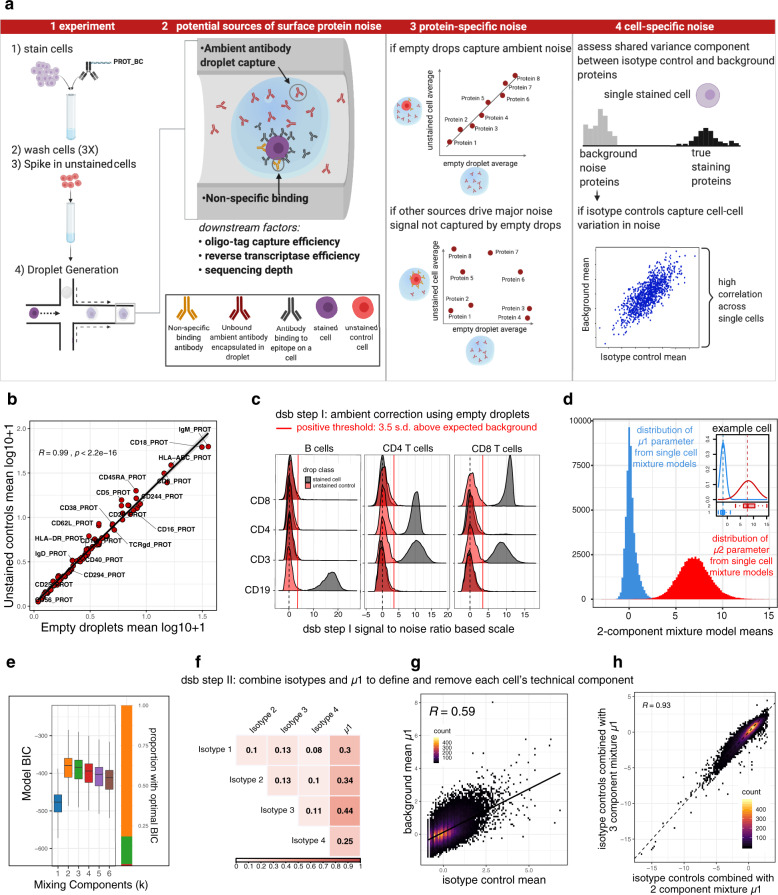
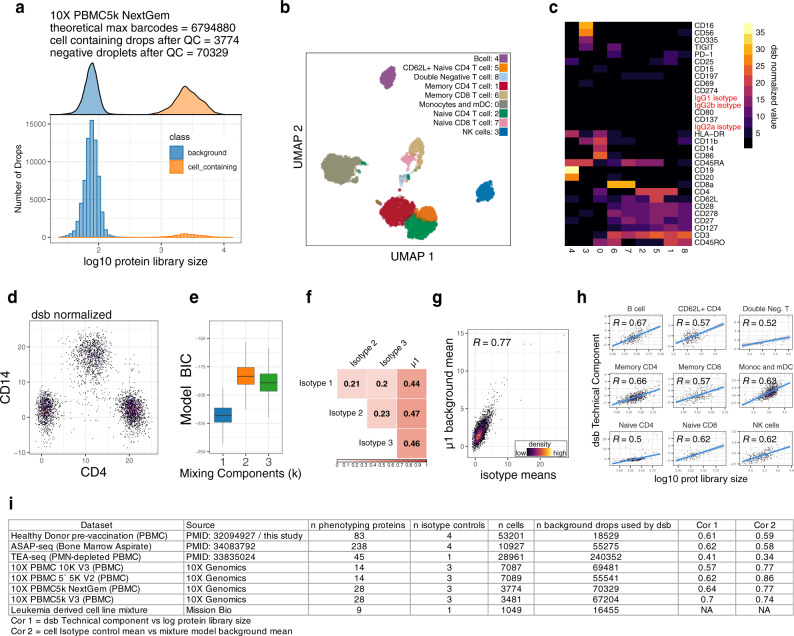
Multimodal single-cell profiling methods that measure protein expression with oligo-conjugated antibodies hold promise for comprehensive dissection of cellular heterogeneity, yet the resulting protein counts have substantial technical noise that can mask biological variations. Here we integrate experiments and computational analyses to reveal two major noise sources and develop a method called "dsb" (denoised and scaled by background) to normalize and denoise droplet-based protein expression data. We discover that protein-specific noise originates from unbound antibodies encapsulated during droplet generation; this noise can thus be accurately estimated and corrected by utilizing protein levels in empty droplets. We also find that isotype control antibodies and the background protein population average in each cell exhibit significant correlations across single cells, we thus use their shared variance to correct for cell-to-cell technical noise in each cell. We validate these findings by analyzing the performance of dsb in eight independent datasets spanning multiple technologies, including CITE-seq, ASAP-seq, and TEA-seq. Compared to existing normalization methods, our approach improves downstream analyses by better unmasking biologically meaningful cell populations. Our method is available as an open-source R package that interfaces easily with existing single cell software platforms such as Seurat, Bioconductor, and Scanpy and can be accessed at "dsb [ https://cran.r-project.org/package=dsb ]".
Overview
The claims and statistics of this paper haven’t been checked yet.
Run the check — free, no account needed. It reads the open-access text and checks the sources it cites.
Integrity signals
Registry
Cites
Statistics
Figures
Verification
Claims the paper makes
The claims and statistics of this paper haven’t been checked yet.
Run the check — free, no account needed. It reads the open-access text and checks the sources it cites.
Claims other papers make about this one
Each is checked against this paper’s own text: does it say what the citing paper says it does?
In the citing paper
“DSB uses background droplets that represent protein background noise to correct values in cells while removing cell-to-cell variation by combining isotype control levels with the specific background level of the respective cell.”
From Best practices for single-cell analysis across modalities (2023) · cites this paper as [161]
Self-check
Percentages, sums and reported differences re-computed from the paper’s own numbers.
The self-check needs the paper’s full text.
Citations
Cites
limma powers differential expression analyses for RNA-sequencing and microarray studies
Ritchie, M. E., Phipson, B., Wu, D., Hu, Y., Law, C. W., Shi, W., & Smyth, G. K. (2015) · Nucleic Acids Research · doi:10.1093/nar/gkv007 · Cited by 40,458
Integrated analysis of multimodal single-cell data
Hao, Y., Hao, S., Andersen-Nissen, E., Mauck, W. M., Zheng, S., Butler, A., Lee, M. J., Wilk, A. J., Darby, C., Zagar, M., et al. (2020) · doi:10.1101/2020.10.12.335331 · Cited by 15,508
Comprehensive Integration of Single-Cell Data
Stuart, T., Butler, A., Hoffman, P., Hafemeister, C., Papalexi, E., Mauck, W. M., Hao, Y., Stoeckius, M., Smibert, P., & Satija, R. (2019) · Cell · doi:10.1016/j.cell.2019.05.031 · Cited by 15,453
Integrating single-cell transcriptomic data across different conditions, technologies, and species
Butler, A., Hoffman, P., Smibert, P., Papalexi, E., & Satija, R. (2018) · Nature Biotechnology · doi:10.1038/nbt.4096 · Cited by 13,174
UMAP: Uniform Manifold Approximation and Projection
McInnes, L., Healy, J., Saul, N., & Großberger, L. (2018) · Journal of Open Source Software · doi:10.21105/joss.00861 · Cited by 9,826
Near-optimal probabilistic RNA-seq quantification
Bray, N. L., Pimentel, H., Melsted, P., & Pachter, L. (2016) · Nature Biotechnology · doi:10.1038/nbt.3519 · Cited by 9,723
SCANPY: large-scale single-cell gene expression data analysis
Wolf, F. A., Angerer, P., & Theis, F. J. (2018) · Genome Biology · doi:10.1186/s13059-017-1382-0 · Cited by 8,881
Santos, A. G., da Rocha, G. O., & de Andrade, J. B. (2019) · Scientific Reports · doi:10.1038/s41598-018-37186-2 · Cited by 8,495
Wood, S. N. (2010) · Journal of the Royal Statistical Society Series B (Statistical Methodology) · doi:10.1111/j.1467-9868.2010.00749.x · Cited by 7,538
Estimating the Number of Clusters in a Data Set Via the Gap Statistic
Tibshirani, R., Walther, G., & Hastie, T. (2001) · Journal of the Royal Statistical Society Series B: Statistical Methodology · doi:10.1111/1467-9868.00293 · Cited by 6,205
Research works printed but not linked: 1
- Swanson, E. et al. Integrated single cell analysis of chromatin accessibility and cell surface markers. eLife. 10, e63632 (2021). · DOI · Paper page
Cited by
Sorted by citations
Best practices for single-cell analysis across modalities
Heumos, L., Schaar, A. C., Lance, C., Litinetskaya, A., Drost, F., Zappia, L., Lücken, M. D., Strobl, D. C., Henao, J., Curion, F., et al. (2023) · Nature Reviews Genetics · doi:10.1038/s41576-023-00586-w · Cited by 1,051
“Alternative methods for all modality combinations are Stabmap 253 , which traverses the shortest path along the mosaic topology by projecting all cells onto reference coordinates, and Multigrate 254 , which leverages transfer learning to impute missing modalities.”
BackgroundMethodMimitou, E. P., Lareau, C. A., Chen, K. Y., Zorzetto-Fernandes, A. L., Hao, Y., Takeshima, Y., Luo, W., Huang, T.-S., Yeung, B. Z., Papalexi, E., et al. (2021) · Nature Biotechnology · doi:10.1038/s41587-021-00927-2 · Cited by 529
Magen, A., Hamon, P., Fiaschi, N., Soong, B. Y., Park, M. D., Mattiuz, R., Humblin, E., Troncoso, L., D’souza, D., Dawson, T., et al. (2023) · Nature Medicine · doi:10.1038/s41591-023-02345-0 · Cited by 429
Single-cell proteomics enabled by next-generation sequencing or mass spectrometry
Bennett, H. M., Stephenson, W., Rose, C. M., & Darmanis, S. (2023) · Nature Methods · doi:10.1038/s41592-023-01791-5 · Cited by 351
A blood atlas of COVID-19 defines hallmarks of disease severity and specificity
Ahern, D. J., Ai, Z., Ainsworth, M., Allan, C., Allcock, A., Angus, B., Ansari, M. A., Arancibia-Cárcamo, C. V., Aschenbrenner, D., Attar, M., et al. (2022) · Cell · doi:10.1016/j.cell.2022.01.012 · Cited by 328
Metadata
- Authors
- Mulè, M. P., Martins, A. J., & Tsang, J. S.
- Affiliations
- National Institutes of Health (US)
- Corresponding author
- Tsang, John S.
- Venue
- Nature Communications
- Published
- 2022-04-19
- Volume
- 13
- Issue
- 1
- Pages
- 2099-2099
- ISSN
- 2041-1723 (ISSN-L)
- PMC
- PMC9018908
- OpenAlex
- W4225731526
- Cited by
- 197
- References
- 65
- Citations by year
- 2026: 39 · 2025: 43 · 2024: 41 · 2023: 36 · 2022: 27
- FWCI
- 12.65
- Type
- journal article
- Language
- en
- Open access
- gold
- doi.org
- Locations
- Nature Communications (publishedVersion, cc-by)
- bioRxiv (Cold Spring Harbor Laboratory) (acceptedVersion, public-domain)
- PubMed Central (publishedVersion, cc-by)
- PubMed (publishedVersion)
- RePEc: Research Papers in Economics (submittedVersion)
- DOAJ (DOAJ: Directory of Open Access Journals) (submittedVersion, cc-by-sa)
- Apollo (University of Cambridge) (submittedVersion, cc-by)
- Apollo
- Apollo (cc-by)
- Funders
- Johns Hopkins University
- National Institutes of Health
- National Institute of Allergy and Infectious Diseases (ZIAAI001152)
- Topics
- Life Sciences › Biochemistry, Genetics and Molecular Biology › Molecular Biology › Single-cell and spatial transcriptomics
- Life Sciences › Biochemistry, Genetics and Molecular Biology › Molecular Biology › Gene expression and cancer classification
- Physical Sciences › Chemical Engineering › Fluid Flow and Transfer Processes › Innovative Microfluidic and Catalytic Techniques Innovation
- Keywords
- data denoising, CITE-seq, cellular heterogeneity
- MeSH terms
- Software, Gene Expression Profiling, Single-Cell Analysis
About these checks
Registry, retraction, Cites and statistics results are computed, not judged, with one exception: a printed reference that no index lists is read once by a model before it counts as a citation error. Claims are extracted by a model and kept only when their quote appears verbatim in the text; each cited source is then checked, with a model’s help, for whether it says what the claim relies on. Those verdicts can be wrong — read the claim’s quote and the cited source before relying on one.
Statistics and arithmetic are recomputed, not judged.
Confidence bands are shown only for fields calibrated on our annotated test set. None is calibrated yet, so no band is shown.
What counts as a claim ›How we measure confidence ›How we check this ›
Are you an author, or do you see a problem with this page? Request a review
