

The DOI matches its Crossref record; 69 of the 70 references it cites were found in a registry or an index, and 1 are not checked yet.
Cas9-induced large deletions and small indels are controlled in a convergent fashion
Open accessPublished version of a preprint
Abstract
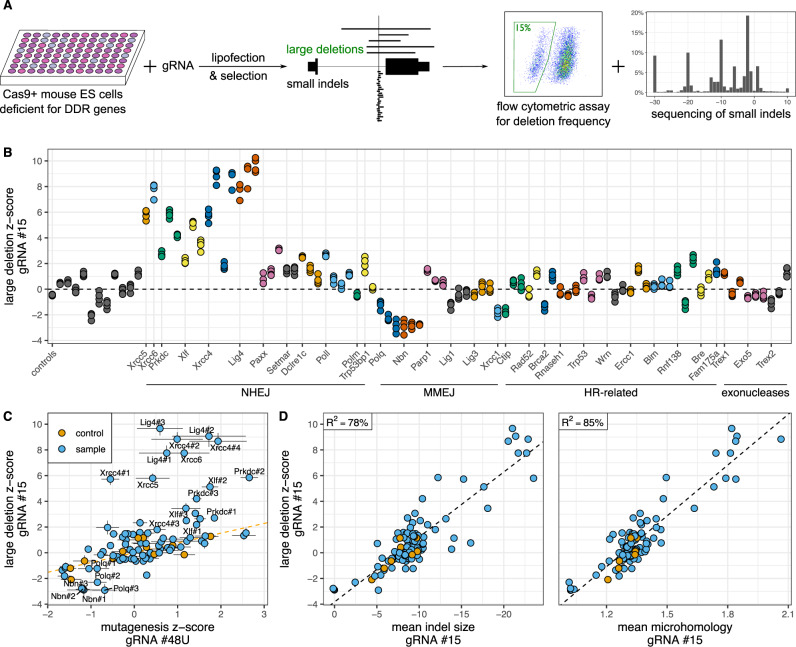
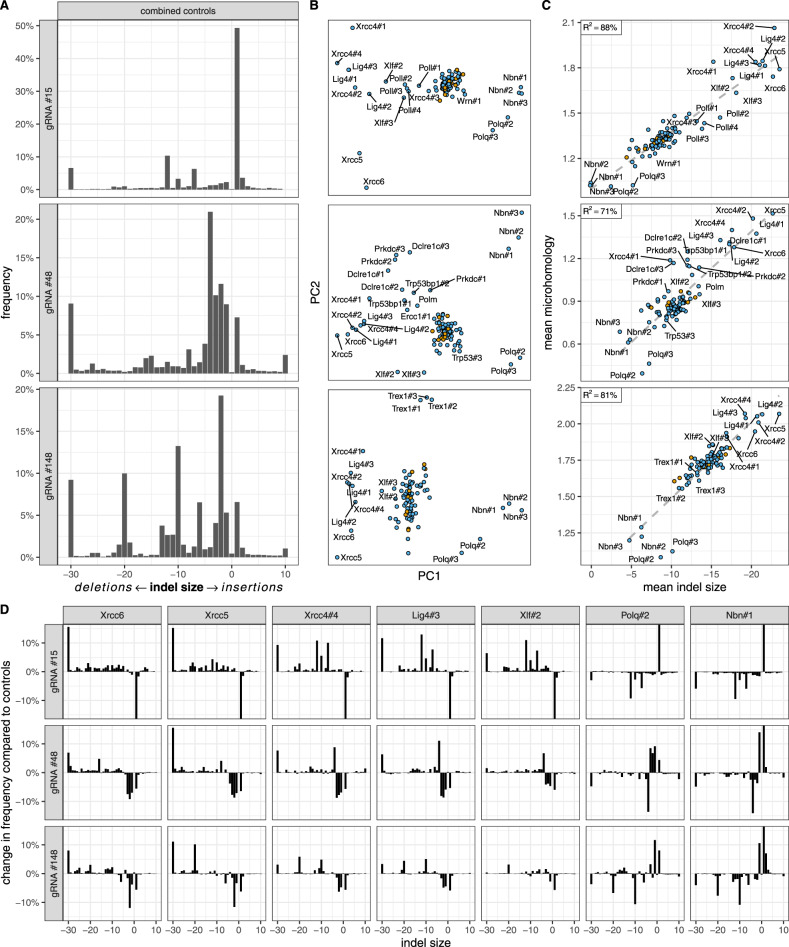
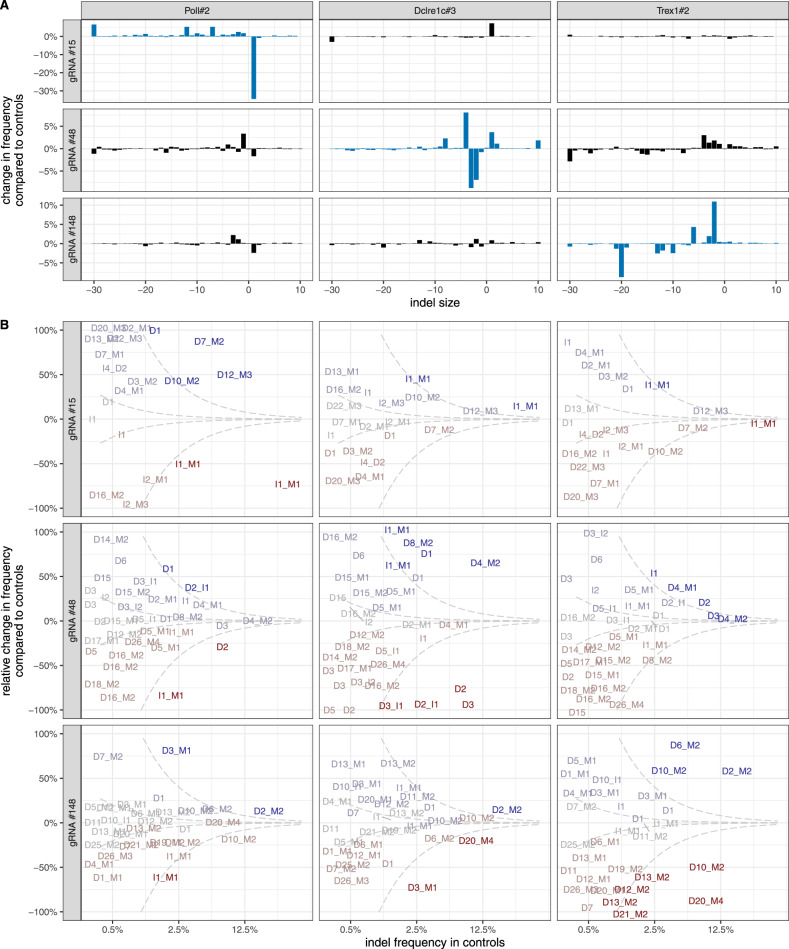
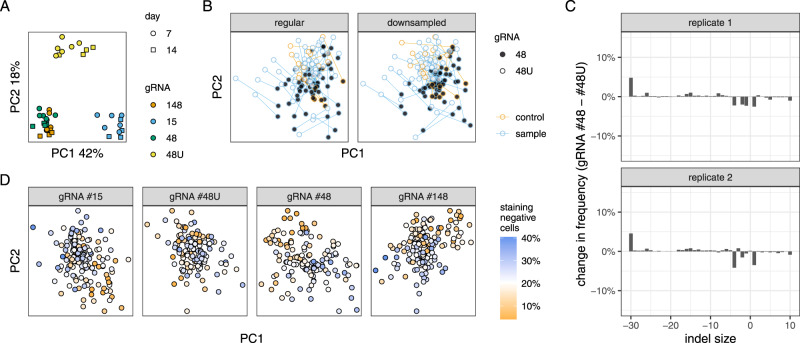
Repair of Cas9-induced double-stranded breaks results primarily in formation of small insertions and deletions (indels), but can also cause potentially harmful large deletions. While mechanisms leading to the creation of small indels are relatively well understood, very little is known about the origins of large deletions. Using a library of clonal NGS-validated mouse embryonic stem cells deficient for 32 DNA repair genes, we have shown that large deletion frequency increases in cells impaired for non-homologous end joining and decreases in cells deficient for the central resection gene Nbn and the microhomology-mediated end joining gene Polq . Across deficient clones, increase in large deletion frequency was closely correlated with the increase in the extent of microhomology and the size of small indels, implying a continuity of repair processes across different genomic scales. Furthermore, by targeting diverse genomic sites, we identified examples of repair processes that were highly locus-specific, discovering a role for exonuclease Trex1. Finally, we present evidence that indel sizes increase with the overall efficiency of Cas9 mutagenesis. These findings may have impact on both basic research and clinical use of CRISPR-Cas9, in particular in conjunction with repair pathway modulation.
Overview
The claims and statistics of this paper haven’t been checked yet.
Run the check — free, no account needed. It reads the open-access text and checks the sources it cites.
Integrity signals
Registry
Cites
Statistics
Figures
Verification
Claims the paper makes
The claims and statistics of this paper haven’t been checked yet.
Run the check — free, no account needed. It reads the open-access text and checks the sources it cites.
Claims other papers make about this one
Each is checked against this paper’s own text: does it say what the citing paper says it does?
The source backs part of the claim, not all of it — or backs it for a different population, condition or comparison.
In the citing paper
“Cell types with deficiencies in DNA damage repair genes are also less suited for Cas9 knockouts due to their increased risk for genomic instability, which is exacerbated by DSB induction.8”
From Adenine base editor for knockout of proteins: A practical guide from design to analysis with updated MultiEditRbatch (2026) · cites this paper as [8]
Experimental — accuracy not yet measured
Self-check
Percentages, sums and reported differences re-computed from the paper’s own numbers.
The self-check needs the paper’s full text.
Citations
Cites
STAR: ultrafast universal RNA-seq aligner
Dobin, A., Davis, C. A., Schlesinger, F., Drenkow, J., Zaleski, C., Jha, S., Batut, P., Chaisson, M., & Gingeras, T. R. (2013) · Bioinformatics · doi:10.1093/bioinformatics/bts635 · Cited by 51,709
Wickham, H., Averick, M., Bryan, J., Chang, W., McGowan, L., François, R., Grolemund, G., Hayes, A., Henry, L., Hester, J., et al. (2019) · Journal of Open Source Software · doi:10.21105/joss.01686 · Cited by 22,138
A Programmable Dual-RNA–Guided DNA Endonuclease in Adaptive Bacterial Immunity
Jinek, M., Chylinski, K., Fonfara, I., Hauer, M., Doudna, J. A., & Charpentier, E. (2012) · Science · doi:10.1126/science.1225829 · Cited by 17,116
In situ click chemistry generation of cyclooxygenase-2 inhibitors
Bhardwaj, A., Kaur, J., Wuest, M., & Wuest, F. (2017) · Nature Communications · doi:10.1038/s41467-016-0009-6 · Cited by 7,448
Programmable editing of a target base in genomic DNA without double-stranded DNA cleavage
Komor, A. C., Kim, Y. B., Packer, M. S., Zuris, J. A., & Liu, D. R. (2016) · Nature · doi:10.1038/nature17946 · Cited by 5,437
Search-and-replace genome editing without double-strand breaks or donor DNA
Anzalone, A. V., Randolph, P. B., Davis, J. R., Sousa, A. A., Koblan, L. W., Levy, J. M., Chen, P. J., Wilson, C., Newby, G. A., Raguram, A., et al. (2019) · Nature · doi:10.1038/s41586-019-1711-4 · Cited by 4,767
DNA targeting specificity of RNA-guided Cas9 nucleases
Hsu, P. D., Scott, D. A., Weinstein, J. A., Ran, F. A., Konermann, S., Agarwala, V., Li, Y., Fine, E. J., Wu, X., Shalem, O., et al. (2013) · Nature Biotechnology · doi:10.1038/nbt.2647 · Cited by 4,741
Kosicki, M., Tomberg, K., & Bradley, A. (2018) · Nature Biotechnology · doi:10.1038/nbt.4192 · Cited by 1,883
Self-citationDNA interrogation by the CRISPR RNA-guided endonuclease Cas9
Sternberg, S. H., Redding, S., Jinek, M., Greene, E. C., & Doudna, J. A. (2014) · Nature · doi:10.1038/nature13011 · Cited by 1,822
Non-homologous DNA end joining and alternative pathways to double-strand break repair
Chang, H. H. Y., Pannunzio, N. R., Adachi, N., & Lieber, M. R. (2017) · Nature Reviews Molecular Cell Biology · doi:10.1038/nrm.2017.48 · Cited by 1,757
Cited by
Sorted by citations
Items 101–117 of 117
Tang, Q., Song, X.-H., Guo, A.-N., Chen, Y., & Shao, J.-W. (2026) · Biochemical and Biophysical Research Communications · doi:10.1016/j.bbrc.2026.153719
CRISPR-Cas9-based strategies for enhanced targeted integration
Lacombe, L. (2024) · theses.fr (ABES) · doi:10.70675/9c9d279dz512az4b72z8322zea205cef9b67
Reprogramming endogenous NK circuits by highly efficient nonviral genome editing
Huang, R., Phung, S. K., Sumstad, D., Weis, A., Kile, Q. M., Bendzick, L. E., Khaw, M. J., Vue, Y. Y., McKenna, D. H., Kennedy, P. R., et al. (2026) · The Journal of Experimental Medicine · doi:10.1084/jem.20260192
CRISPR/Cas9 system-mediated p21 knockout impairs the MITF signaling pathway
Kim, G. H., & Kim, M.-M. (2026) · Journal of Biotechnology · doi:10.1016/j.jbiotec.2026.05.014
Graham, J. P., Arteaga, A., Moghaddam, A. S., Spiller, K. L., Laverty, D. J., & Gonzalez‐Fernandez, T. (2026) · bioRxiv (Cold Spring Harbor Laboratory) · doi:10.64898/2026.05.29.728905 · Cited by 1
McGill, L. P., Banas, K. H., Tiesi, G., & Kmiec, E. B. (2026) · Biomolecules · doi:10.3390/biom16060828
Eom, K.-H., Yum, S., Gim, G., Son, W. J., Kim, Y.-C., Choi, J. H., Kwon, D.-H., & Jang, G. (2026) · BMC Biotechnology · doi:10.1186/s12896-026-01180-8
Liu, P., Shou, J., & Wu, Q. (2026) · bioRxiv (Cold Spring Harbor Laboratory) · doi:10.64898/2026.06.09.731072
Effah, S. N., Barrera, S. C., Ortiz, N. U., Dampier, W., Nonnemacher, M. R., & Wigdahl, B. L. (2026) · International Journal of Molecular Sciences · doi:10.3390/ijms27135905
Foessl, I., Guo, Y., Mies, R., Kassem, M. S., van Leeuwen, J. P. T. M., van der Eerden, B. C. J., Obermayer-Pietsch, B. M., & van de Peppel, J. (2026) · JBMR Plus · doi:10.1093/jbmrpl/ziag117
Zheng, W., Yu, L., Wu, C., Cao, S., Zhao, M., Wang, G., So, K. H., Song, J., Chen, C., Ho, J. W. K., et al. (2026) · Genome biology · doi:10.1186/s13059-026-04211-x
Ling, L., Cao, M.-X., Farhab, M., Kyaw, P. O., Zhao, S.-Q., Zhao, Y., Chen, F.-L., Sohail, T., Ahmad, E., Cao, S.-X., et al. (2026) · Functional & Integrative Genomics · doi:10.1007/s10142-026-02002-y
Wahab, A. F. F. A., Mokhtar, M. A. A., Vetaryan, S., & Lee, Y. P. (2026) · Journal of Fungi · doi:10.3390/jof12080594
Li, H., Zhang, X., Wang, X., Zhang, R., Liu, L., Sun, L., Yao, Z., & Zhu, H. (2026) · International Journal of Molecular Sciences · doi:10.3390/ijms27167318
Analysis of Sp Cas9 on- and off-target effects in high efficiency multiplex editing in ArabidopsisPreprint
Stuttmann, J., Keilwagen, J., Ortet, P., Lim, F. S., Schmutzer, T., Llauro, C., Mbodj, A., Mirouze, M., Hartung, F., & Wilhelm, R. (2026) · bioRxiv (Cold Spring Harbor Laboratory) · doi:10.64898/2026.09.28.754964
Abbas, B., Abbas, A., Khan, I., & Nazeer, S. (2026) · Clinical Immunology · doi:10.1016/j.clim.2026.110782
Intellectual Property, New Genomic Technologies and Plant Innovation: Clearing Innovation Pathways
Valtere, L., Sherkow, J. S., & Minssen, T. (2026) · GRURRR. Gewerblicher Rechtsschutz und Urheberrecht, Rechtsprechungs-Report/GRUR-DVD/GRUR-CD/IIC/Gewerblicher Rechtsschutz und Urheberrecht/Gewerblicher Rechtsschutz und Urheberrecht. Internationaler Teil · doi:10.1007/s40319-026-01779-6
Metadata
- Authors
- Kosicki, M., Allen, F., Steward, F., Tomberg, K., Pan, Y., & Bradley, A.
- Affiliations
- Lawrence Berkeley National Laboratory (US)
- Wellcome Sanger Institute (GB)
- University of Cambridge (GB)
- Corresponding author
- Bradley, Allan
- Venue
- Nature Communications
- Published
- 2022-06-14
- Volume
- 13
- Issue
- 1
- Pages
- 3422-3422
- ISSN
- 2041-1723 (ISSN-L)
- PMC
- PMC9197861
- OpenAlex
- W4282823317
- Cited by
- 115
- References
- 69
- Citations by year
- 2026: 27 · 2025: 28 · 2024: 26 · 2023: 26 · 2022: 4
- FWCI
- 7.02
- Type
- journal article
- Language
- en
- Open access
- gold
- doi.org
- Locations
- Nature Communications (publishedVersion, cc-by)
- bioRxiv (Cold Spring Harbor Laboratory) (acceptedVersion, cc-by-nc)
- PubMed Central (publishedVersion, cc-by)
- PubMed (publishedVersion)
- eScholarship (California Digital Library) (submittedVersion, cc-by)
- OSTI OAI (U.S. Department of Energy Office of Scientific and Technical Information) (submittedVersion)
- DOAJ (DOAJ: Directory of Open Access Journals) (submittedVersion)
- Apollo (University of Cambridge) (submittedVersion, cc-by)
- Apollo
- Apollo (cc-by)
- Funders
- Wellcome Trust (098051)
- Topics
- Life Sciences › Biochemistry, Genetics and Molecular Biology › Molecular Biology › CRISPR and Genetic Engineering
- Life Sciences › Biochemistry, Genetics and Molecular Biology › Molecular Biology › DNA Repair Mechanisms
- Life Sciences › Biochemistry, Genetics and Molecular Biology › Molecular Biology › RNA regulation and disease
- Keywords
- large deletions, small insertions and deletions, CRISPR/Cas9 mutagenesis, non-homologous end joining, niobium nitride, DNA polymerase theta, microhomology-mediated end joining, mouse embryonic stem cells
- MeSH terms
- Animals, DNA Repair, Mice, DNA Breaks, Double-Stranded, INDEL Mutation, DNA End-Joining Repair, CRISPR-Cas Systems
About these checks
Registry, retraction, Cites and statistics results are computed, not judged, with one exception: a printed reference that no index lists is read once by a model before it counts as a citation error. Claims are extracted by a model and kept only when their quote appears verbatim in the text; each cited source is then checked, with a model’s help, for whether it says what the claim relies on. Those verdicts can be wrong — read the claim’s quote and the cited source before relying on one.
Statistics and arithmetic are recomputed, not judged.
Confidence bands are shown only for fields calibrated on our annotated test set. None is calibrated yet, so no band is shown.
What counts as a claim ›How we measure confidence ›How we check this ›
Are you an author, or do you see a problem with this page? Request a review
