

Land use change and carbon emissions of a transformation to timber cities
Open accessThe DOI matches its Crossref record; 73 of the 76 references it cites were found in a registry or an index, and 3 are not checked yet.
Abstract
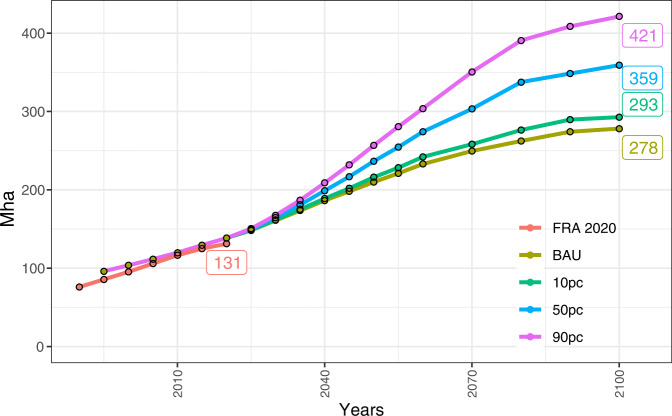
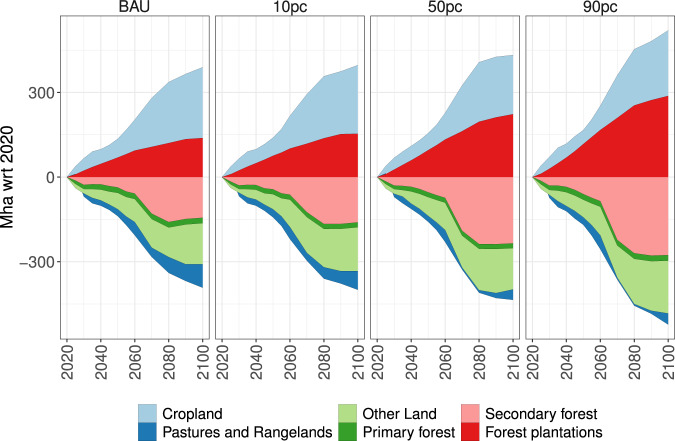
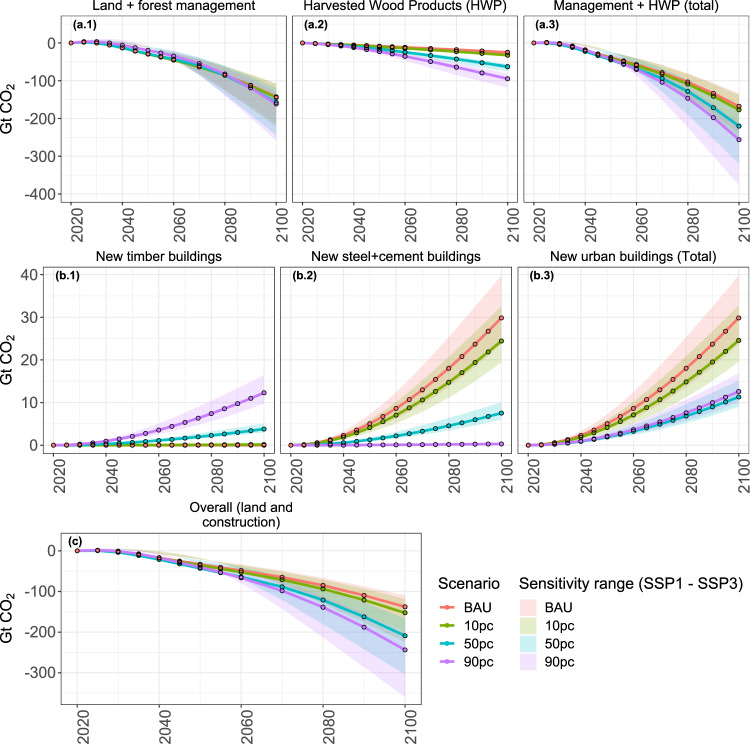
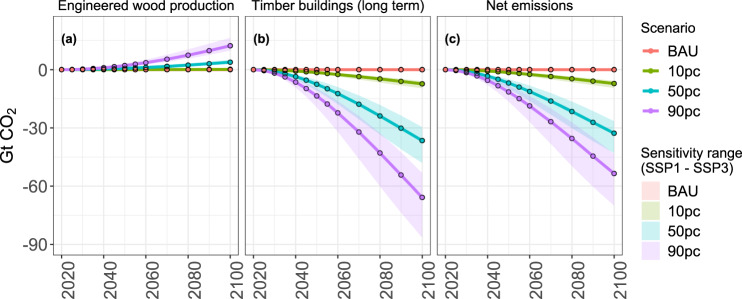
Using engineered wood for construction has been discussed for climate change mitigation. It remains unclear where and in which way the additional demand for wooden construction material shall be fulfilled. Here we assess the global and regional impacts of increased demand for engineered wood on land use and associated CO 2 emissions until 2100 using an open-source land system model. We show that if 90% of the new urban population would be housed in newly built urban mid-rise buildings with wooden constructions, 106 Gt of additional CO 2 could be saved by 2100. Forest plantations would need to expand by up to 149 Mha by 2100 and harvests from unprotected natural forests would increase. Our results indicate that expansion of timber plantations for wooden buildings is possible without major repercussions on agricultural production. Strong governance and careful planning are required to ensure a sustainable transition to timber cities even if frontier forests and biodiversity hotspots are protected.
Overview
The claims and statistics of this paper haven’t been checked yet.
Free: it reads the open-access text and checks the first 5 claims that cite a source we can check. Create a free account to check every claim.
Integrity signals
Registry
Cites
Statistics
Figures
Verification
Claims the paper makes
The claims and statistics of this paper haven’t been checked yet.
Free: it reads the open-access text and checks the first 5 claims that cite a source we can check. Create a free account to check every claim.
Claims other papers make about this one
Each is checked against this paper’s own text: does it say what the citing paper says it does?
The cited source says what the claim attributes to it.
In the citing paper
“Global analyses of mass timber products show the GHG mitigation potential of wood use in buildings (16) and their impacts on land use change (41), but high-resolution, spatially explicit understandings of various combinations of wood use and forest plantation management have not been fully explored.”
From Climate-smart forestry through innovative wood products and commercial afforestation and reforestation on marginal land (2023) · cites this paper as [41]
Self-check
Percentages, sums and reported differences re-computed from the paper’s own numbers.
The self-check needs the paper’s full text.
Citations
Cites
Ultrastructural Characterization of the Lower Motor System in a Mouse Model of Krabbe Disease
Cappello, V., Marchetti, L., Parlanti, P., Landi, S., Tonazzini, I., Cecchini, M., Piazza, V., & Gemmi, M. (2016) · Scientific Reports · doi:10.1038/s41598-016-0001-8 · Cited by 13,097
U1 snRNP regulates cancer cell migration and invasion in vitro
Oh, J.-M., Venters, C. C., Di, C., Pinto, A. M., Wan, L., Younis, I., Cai, Z., Arai, C., So, B. R., Duan, J., et al. (2020) · Nature Communications · doi:10.1038/s41467-019-13993-7 · Cited by 7,157
Riahi, K., van Vuuren, D. P., Kriegler, E., Edmonds, J., O’Neill, B. C., Fujimori, S., Bauer, N., Calvin, K., Dellink, R., Fricko, O., et al. (2017) · Global Environmental Change · doi:10.1016/j.gloenvcha.2016.05.009 · Cited by 6,607
Self-citationYang (2021) · doi:10.1038/s41598-020-79139-8 · Cited by 5,035
Griscom, B. W., Adams, J., Ellis, P. W., Houghton, R. A., Lomax, G., Miteva, D. A., Schlesinger, W. H., Shoch, D., Siikamäki, J. V., Smith, P., et al. (2017) · Proceedings of the National Academy of Sciences · doi:10.1073/pnas.1710465114 · Cited by 3,481
Forest disturbances under climate change
Seidl, R., Thom, D., Kautz, M., Martin-Benito, D., Peltoniemi, M., Vacchiano, G., Wild, J., Ascoli, D., Petr, M., Honkaniemi, J., et al. (2017) · Nature Climate Change · doi:10.1038/nclimate3303 · Cited by 2,878
Self-citationGreening of the Earth and its drivers
Zhu, Z., Piao, S., Myneni, R. B., Huang, M., Zeng, Z., Canadell, J. G., Ciais, P., Sitch, S., Friedlingstein, P., Arneth, A., et al. (2016) · Nature Climate Change · doi:10.1038/nclimate3004 · Cited by 2,779
Classifying drivers of global forest loss
Curtis, P. G., Slay, C. M., Harris, N. L., Tyukavina, A., & Hansen, M. C. (2018) · Science · doi:10.1126/science.aau3445 · Cited by 2,340
Dynamics of global forest area: Results from the FAO Global Forest Resources Assessment 2015
Keenan, R. J., Reams, G. A., Achard, F., de Freitas, J. V., Grainger, A., & Lindquist, E. (2015) · Forest Ecology and Management · doi:10.1016/j.foreco.2015.06.014 · Cited by 1,656
The dominant role of semi-arid ecosystems in the trend and variability of the land CO 2 sink
Ahlström, A., Raupach, M. R., Schurgers, G., Smith, B., Arneth, A., Jung, M., Reichstein, M., Canadell, J. G., Friedlingstein, P., Jain, A. K., et al. (2015) · Science · doi:10.1126/science.aaa1668 · Cited by 1,471
Research works printed but not linked: 5
- Carle J Holmgren P Wood from planted forests Forest Products J. 2008 58 6
- Adhikari S Quesada H Bond B Hammett T Potential of hardwood lumber in cross laminated timber in North America: a CLT manufacturer’s perspective Mass Timber Construction J. 2020 3 1 9
- Glavinić IU Boko I Torić N Vranković JL Application of hardwood for glued laminated timber in Europe J. Croation Assoc. Civil Eng. 2020 72 607 616
- IPCC. Climate change 2021: The physical science basis. in Intergovernmental Panel on Climate Change (IPCC) (Cambridge University Press, 2007).
- Organschi, A., Ruff, A., Oliver, C. D., Carbone, C. & Herrmann, E. Timber city: Growing an urban carbon sink with glue, screws, and cellulose fiber. in World Conference on Timber Engineering (WCTE) 2016, 5612–5621 (WCTE, 2016).
Cited by
Items 101–200 of 279
Brożek, J., Kożuch, A. M., Wieruszewski, M., Jaszczak, R., & Adamowicz, K. (2024) · Sustainability · doi:10.3390/su16208799 · Cited by 14
Xu, H., Tao, X., Lü, Y., Wang, Y., Li, H., & Ye, Z. (2025) · Scientific Reports · doi:10.1038/s41598-025-86769-3 · Cited by 10
A global policy framework for the circular use of forest biomass as building materials
Araújo, V. A. D., Pramreiter, M., & Christoforo, A. L. (2025) · Nature Reviews Materials · doi:10.1038/s41578-025-00780-8 · Cited by 10
Holtström, J., Kenlind, S. S., & Nord, T. (2024) · Construction Management and Economics · doi:10.1080/01446193.2024.2312158 · Cited by 17
“There is a growing trend in urbanization, which means an increased density of cities and pressure on society to allow for further development of buildings and other infrastructure (Mishra et al .”
BackgroundClimate effects of post-use wood materials from the building sector in a system perspective
Truong, N. L. (2023) · Waste Management · doi:10.1016/j.wasman.2023.09.011 · Cited by 11
Hansen, R. N., Hoxha, E., Birgisdóttir, H., & Pittau, F. (2024) · Resources Conservation and Recycling · doi:10.1016/j.resconrec.2024.107926 · Cited by 11
Yamashita, N., Fishman, T., Kayo, C., & Tanikawa, H. (2024) · Sustainable Production and Consumption · doi:10.1016/j.spc.2024.11.003 · Cited by 13
Greener homes: Factors underpinning Europeans' intention to live in multi-storey wooden buildings
Kim, D.-H., Franzini, F., Thorsen, B. J., Berghäll, S., & Aguilar, F. X. (2023) · Sustainable Production and Consumption · doi:10.1016/j.spc.2023.05.030 · Cited by 15
Magerl, A., Gingrich, S., Matej, S., Cunfer, G., Forrest, M., Lauk, C., Schlaffer, S., Weidinger, F., Yuskiw, C., & Erb, K. (2023) · Global Biogeochemical Cycles · doi:10.1029/2023gb007813 · Cited by 10
Zhang, K., Wang, Y., Mamtimin, A., Liu, Y., Zhang, L., Gao, J., Aihaiti, A., Wen, C., Song, M., Yang, F., et al. (2024) · Land · doi:10.3390/land13050608 · Cited by 9
Forests: A passive CO2 sink or an active CO2 pump?
Köhl, M., & Martes, L. (2023) · Forest Policy and Economics · doi:10.1016/j.forpol.2023.103040 · Cited by 12
Spatial Interaction and Driving Factors between Urban Land Expansion and Population Change in China
Meng, H., Liu, Q., Yang, J., Li, J., Chuai, X., & Huang, X. (2024) · Land · doi:10.3390/land13081295 · Cited by 8
Ljunggren, F., Fredriksson, M., Johansson, N., & Kalagasidis, A. S. (2025) · Wood Material Science and Engineering · doi:10.1080/17480272.2025.2507145 · Cited by 18
“2020, Mishra et al .”
Yang, L., Zhang, H., Liao, X., Wang, H., Bian, Y., Liu, G., & Luo, W. (2023) · International Journal of Environmental Research and Public Health · doi:10.3390/ijerph20032659 · Cited by 8
Ashton, M. S., Martin, M. P., & Vincent, J. R. (2024) · Frontiers in Forests and Global Change · doi:10.3389/ffgc.2024.1372409 · Cited by 10
Modelling the impact sound reduction of floating floors applied on cross-laminated timber floors
Caniato, M., Bettarello, F., Granzotto, N., Marzi, A., & Gasparella, A. (2024) · Journal of Building Engineering · doi:10.1016/j.jobe.2024.109679 · Cited by 8
Sun, X., Duan, H., Song, J., Zheng, H., Yang, W., & Mi, Z. (2024) · Energy · doi:10.1016/j.energy.2024.133063 · Cited by 8
Using Timber in Mid-Rise and Tall Buildings to Construct Our Cities: A Science Mapping Study
Wenzel, A., Guindos, P., & Carpio, M. (2025) · Sustainability · doi:10.3390/su17051928 · Cited by 8
Vertical Extensions: Stakeholder Perspectives on Development Decisions and Construction Strategies
Julistiono, E. K., Oldfield, P., & Cardellicchio, L. (2023) · Journal of Architectural Engineering · doi:10.1061/jaeied.aeeng-1474 · Cited by 11
Svatoš-Ražnjević, H., Krtschil, A., Orozco, L., Neubauer, G., Knippers, J., & Menges, A. (2023) · World Conference on Timber Engineering (WCTE) · doi:10.52202/069179-0508 · Cited by 7
Du, P., Ni, Y., & Chen, H. (2023) · Environmental Science and Pollution Research · doi:10.1007/s11356-023-25994-7 · Cited by 7
Zhao, Q., Xie, B., & Han, M. (2023) · Land · doi:10.3390/land12101927 · Cited by 7
Design considerations for eco-friendly palm-strand reinforced concrete for low-cost housing
Momoh, E. O., Osofero, A. I., & Menshykov, O. V. (2024) · Case Studies in Construction Materials · doi:10.1016/j.cscm.2024.e02929 · Cited by 8
Co-Design Methods for Non-Standard Multi-Storey Timber Buildings
Orozco, L., Krtschil, A., Wagner, H. J., Bechert, S., Amtsberg, F., Knippers, J., & Menges, A. (2023) · Sustainability · doi:10.3390/su152316178 · Cited by 7
“Although the calculations are uncertain [8,9], there are more trees now than ever [10] and the data support the idea that increased wood consumption would not detrimentally affect global forests [11,12], growth stocks [13], or agricultural production [14].”
BackgroundAdvancing timber construction: historical growth, research frontiers, and time series forecasting
Huang, H., Su, S., & Li, L. (2024) · Journal of Asian Architecture and Building Engineering · doi:10.1080/13467581.2024.2373829 · Cited by 13
“The positive outlook for WMCs and timber cities has been emphasized in contemporary discourse, whose depictions demonstrate a palpable sense that we are standing on the precipice of a paradigm shift toward timber construction (Mishra et al. 2022).”
InfluentialPerformance of axial flow hydrokinetic turbines: A comprehensive review
Prasad, N., Singhal, M. K., & Kumar, A. (2025) · Ocean Engineering · doi:10.1016/j.oceaneng.2025.121715 · Cited by 6
Svatoš-Ražnjević, H., Boeva, Y., Kropp, C., & Menges, A. (2025) · Building Research & Information · doi:10.1080/09613218.2025.2482970 · Cited by 7
“One answer to these issues, discussed in scientific literature and policy proposals (Churkina et al., 2020; Mishra et al., 2022), is increasing the use of renewable materials such as timber in multi-storey construction.”
Bradford, K., Gentry, R., Ben-Alon, L., & Kurtis, K. E. (2025) · Construction and Building Materials · doi:10.1016/j.conbuildmat.2025.143150 · Cited by 8
Li, W., Wang, K., Liu, H., Zhang, Y., & Zhu, X. (2024) · Land · doi:10.3390/land13070917 · Cited by 6
Auburtin, P. N., Saadé-Sbeih, M., Manthey, M., Louërat, M., Martin, J.-L., & Baverel, O. (2024) · Journal of Building Engineering · doi:10.1016/j.jobe.2024.110879 · Cited by 11
Guan, Q., Meng, T., Guan, C., Chen, J., Li, H., & Zhou, X. (2024) · Land · doi:10.3390/land13111861 · Cited by 6
Wang, M., Yue, C., He, J., Zhang, P., Xu, M., Li, Y., Wang, J., Wang, L., & Xu, C. (2024) · Global and Planetary Change · doi:10.1016/j.gloplacha.2024.104626 · Cited by 9
Kim, E. S., Hyun, J. H., Kim, N. Y., Heo, S., Kim, D. S., & Lee, D. (2025) · Journal of Environmental Management · doi:10.1016/j.jenvman.2025.125648 · Cited by 6
Mast, H. S. (2022) · GAIA - Ecological Perspectives for Science and Society · doi:10.14512/gaia.31.3.5 · Cited by 6
Carbon stocks of particle board and fiberboard in Japan
Kayo, C., Sanjo, K., Sato, I., Liu, M., Prasetyadi, G. V., & Hirahara, S. (2023) · Scientific Reports · doi:10.1038/s41598-023-37132-x · Cited by 8
Yang, X., Jiang, P., Guo, J., Ni, K., Ma, Q., Ma, L., Shi, Y., Ruan, J., & Luo, G. (2025) · Agriculture Ecosystems & Environment · doi:10.1016/j.agee.2025.110095 · Cited by 5
Low-carbon concrete has the potential to meet global urban housing needs by 2050
Hafez, H., Marsh, A., Flegar, M., Peng, L., & Scrivener, K. L. (2026) · Communications Sustainability · doi:10.1038/s44458-025-00027-1 · Cited by 7
“Building-level fi ndings have led to recommendations to rapidly expand the use of bio-based construction as a climate mitigation solution in the coming years 10,11 .”
Carbon dioxide neutrality of sustainably managed forests of Austria
Jandl, R., Hager, H., Kraxner, F., Ledermann, T., & Weiss, P. (2024) · Ecological Engineering · doi:10.1016/j.ecoleng.2024.107417 · Cited by 6
Mazzoni, F., Binz, C., & Losacker, S. (2025) · Geoforum · doi:10.1016/j.geoforum.2025.104378 · Cited by 7
Zhao, C., Shen, Y., Su, N., Yan, Y., Feng, S., Xiang, W., Liu, Y., & Zhao, T. (2023) · IEEE Journal of Selected Topics in Applied Earth Observations and Remote Sensing · doi:10.1109/jstars.2023.3338977 · Cited by 5
“L AND resources constitute the fundamental material basis for the survival and development of human societies [1], [2], [3].”
BackgroundJakob, M., Janesch, J., Müller, U., & Gindl‐Altmutter, W. (2024) · ACS Sustainable Chemistry & Engineering · doi:10.1021/acssuschemeng.4c07642 · Cited by 5
Land-use change, no-net-loss policies, and effects on carbon dioxide removals
Wear, D. N., & Wibbenmeyer, M. J. (2024) · Carbon Balance and Management · doi:10.1186/s13021-024-00287-9 · Cited by 5
Sanjo, K., Kayo, C., & Tonosaki, M. (2025) · Journal of Building Engineering · doi:10.1016/j.jobe.2025.112916 · Cited by 9
Zhang, C., Yao, X., Wang, G., Jin, H., Sha, T., Chu, X., Zhang, J., & Cao, J. (2022) · Sustainability · doi:10.3390/su142416489 · Cited by 5
Singkronart, K., Gaduan, A. N., Shamsuddin, S., Ward, K., & Lee, K. (2023) · Green Chemistry · doi:10.1039/d3gc02198j · Cited by 5
Assessing conditions to scale up private investment in forest restoration
Vincent, J. R., Aga, Y., Boscolo, M., Chang, K., Cheng, Z., Dilger, J., Machado, D. G., Herrera, D., Kaczan, D. J., McMahon, A., et al. (2025) · Journal of Forest Business Research · doi:10.62320/jfbr.v4i1.64 · Cited by 8
“Governments can also promote use of wood as a low-carbon construction material by revising building regulations (Binkley et al. 2020, Mishra et al. 2022, Wellspring Development Capital Limited 2024) and as a reduced-carbon commercial energy source by removing obstacles to substituting woody biomass…”
Gong, S., Hu, X., Yu, R., Li, J., Zhang, J., Li, T., Hong, W., & Nie, J. (2025) · Structures · doi:10.1016/j.istruc.2025.110477 · Cited by 6
Reciprocal frame design for large-scale timber construction
Xu, P., Zhao, P., Xia, B., Zhao, Z., Liu, N., Zhang, S., & Du, J. (2025) · Nature Communications · doi:10.1038/s41467-025-66491-4 · Cited by 4
Li, H., Bai, Y., Liu, Y., Huang, Y., Duan, X., Gao, Y., Wang, P., Liu, R., Du, G., & Yang, L. (2026) · ACS Sustainable Chemistry & Engineering · doi:10.1021/acssuschemeng.5c13487 · Cited by 4
Osuolale, M. D., & Felkner, J. (2026) · Journal of Engineering Design and Technology · doi:10.1108/jedt-01-2026-0018 · Cited by 10
Amiri, A., & Junnila, S. (2025) · Environmental Research Infrastructure and Sustainability · doi:10.1088/2634-4505/addc16 · Cited by 7
“Similarly, Mishra et al [66] projected that rising global demand for wood could have significant land use impacts by 2100.”
Land use and housing policy implications on building whole life carbon
Talvitie, I., Amiri, A., Junnila, S., & Vimpari, J. (2025) · Environmental Research Letters · doi:10.1088/1748-9326/ade60a · Cited by 11
Kayo, C., Oka, H., Komata, H., & Goh, C. S. (2025) · Biomass and Bioenergy · doi:10.1016/j.biombioe.2025.108156 · Cited by 4
Experimentally validated bending capacity models for strip-reinforced timber beams
Cao, A. S., Steiger, R., & Frangi, A. (2025) · Wood Material Science and Engineering · doi:10.1080/17480272.2025.2509076 · Cited by 5
“The increased use of timber in the global construction sector may greatly aid in reducing greenhouse gas emissions (Chur-kina et al. 2020, Mishra et al. 2022).”
Between a log and a hard place: European forests under competing demands
Laimer, T., Gregor, K., Grote, R., Jung, C., Schindler, D., & Arneth, A. (2026) · European Journal of Forest Research · doi:10.1007/s10342-026-01899-1 · Cited by 7
“The corresponding harvest requirements of around 0.5 GtC yr −1 from global forests could however require a drastic increase of current plantation forest area, threatening unprotected forests and other natural ecosystems (Churkina et al. 2020; Mishra et al. 2022 ).”
InfluentialWesterholm, N., & Franssila, J. (2023) · World Conference on Timber Engineering (WCTE) · doi:10.52202/069179-0150 · Cited by 4
Kaufmann, L., Wiedenhofer, D., Cao, Z., Theurl, M. C., Lauk, C., Baumgart, A., Gingrich, S., & Haberl, H. (2024) · Environmental Research Letters · doi:10.1088/1748-9326/ad236b · Cited by 7
“Scenarios for increasing wood in construction in the next decades estimate NAS in buildings to range from 10 to 680 TgC yr − 1 in 2020–2050 [9], and from 32 to 243 TgC yr − 1 in 2020–2100 [8] depending on the scenario assumptions.”
BackgroundBauhaus Earth: Sustainable Use of Wood in the Construction Sector
Schellnhuber, H. J. (2024) · Springer eBooks · doi:10.1007/978-3-031-58144-1_8 · Cited by 7
Self-citationLand-Based Carbon Effects and Human Well-Being Nexus
Wang, K., He, K., Wang, X., Xie, L., Dong, X., Lei, F., Gong, C., & Liu, M. (2024) · Land · doi:10.3390/land13091419 · Cited by 4
Biomass Production and Nutritional Sustainability in Different Species of African Mahogany
Gomes, G. S. L., Caldeira, M. V. W., Gomes, R., Duarte, V. B. R., Momolli, D. R., Faria, J. C. T., Godinho, T. D. O., Trazzi, P. A., Sobrinho, L. S., Neto, S. N. D. O., et al. (2024) · Forests · doi:10.3390/f15111951 · Cited by 5
Spatiotemporal evaluation of embodied carbon in urban residential development
Talvitie, I., Amiri, A., & Junnila, S. (2024) · Buildings and Cities · doi:10.5334/bc.471 · Cited by 6
Structural performance of boards through nanoparticle reinforcement: An advance review
Mirindi, D., Hunter, J. G., Mirindi, F., Sinkhonde, D., & Yazdandoust, F. (2024) · Nanotechnology Reviews · doi:10.1515/ntrev-2024-0119 · Cited by 6
Jakob, M., Hochwallner, C., Halbauer, P., Al-musawi, H., van Herwijnen, H. W. G., Gindl‐Altmutter, W., & Müller, U. (2025) · Carbohydrate Polymer Technologies and Applications · doi:10.1016/j.carpta.2025.100744 · Cited by 4
Zhao, R., Liu, Y., & Gundale, M. J. (2023) · GCB Bioenergy · doi:10.1111/gcbb.13087 · Cited by 5
“, food and fiber), especially in plantations (Coban et al., 2022; Mishra et al., 2022; Newbold et al., 2015).”
BackgroundHe, J., Liu, X., Wang, X., Li, X., Yu, L., & Niu, B. (2024) · Land · doi:10.3390/land13101717 · Cited by 4
Logging emissions from a Forest Stewardship Council certified forest in Guyana
Roopsind, A., Rodney, K., Lagoudou, L., & Putz, F. E. (2024) · Carbon Management · doi:10.1080/17583004.2024.2378740 · Cited by 5
“Additionally, these resource-intensive non-wood building materials do not provide CO 2 removals, as the regrowth of forests from where the wood is sourced does, further contributing needed climate mitigation [15,16].”
Hou, J., Liu, J., Wu, X., Luo, S., Li, X., Li, Z., Wu, Y., & Qing, Y. (2025) · Advanced Functional Materials · doi:10.1002/adfm.202504292 · Cited by 7
Piayda, C., Hafner, A., & Rüter, S. (2025) · Sustainability · doi:10.3390/su17198593 · Cited by 2
Priore, Y. D., Delmenico, S., Rinquet, L., Habert, G., & Jusselme, T. (2026) · Journal of Cleaner Production · doi:10.1016/j.jclepro.2026.147558 · Cited by 6
Nasiri, B., & Hughes, M. (2026) · Resources Conservation and Recycling · doi:10.1016/j.resconrec.2026.108804 · Cited by 5
Estrada, R. D., Kannenberg, F., Chen, T.-Y., Guo, Y., Knippers, J., & Menges, A. (2026) · Scientific Reports · doi:10.1038/s41598-026-40584-6 · Cited by 3
“Studies indicate that if 90% of new urban housing were to be built with timber by 2100, global forest plantation areas would need to expand by 200% compared to current levels 9 .”
Mapping wood flows to final product and energy uses in 2021 in the European Union
Orfanidou, T., Martinez, G. E., Järvikylä, J., Verkerk, P. J., & Cardellini, G. (2026) · Resources Conservation & Recycling Advances · doi:10.1016/j.rcradv.2026.200331 · Cited by 7
Zanon-Zotin, M., Fortes, P., Corbier, D., Deetman, S., Edelenbosch, O. Y., van Engelenburg, M., Hauenstein, C., Hertwich, E. G., Jiang, M., von Köckritz, L., et al. (2026) · Resources Conservation and Recycling · doi:10.1016/j.resconrec.2026.109053 · Cited by 3
Drivers and challenges for wood-based construction in urban areas
Iliescu, O., Amiri, A., & Junnila, S. (2025) · Environmental Research Communications · doi:10.1088/2515-7620/adaf0f · Cited by 6
López, N., Berwart, S., & Guindos, P. (2025) · European Journal of Wood and Wood Products · doi:10.1007/s00107-025-02201-7 · Cited by 3
“Nowadays, given the current context of urban population concentration (Mishra et al. 2022), there is an increasing interest in using timber for medium and tall buildings.”
Gingrich, S., Matej, S., Erb, K.-H., Haberl, H., Noë, J. L., Kaufmann, L., Magerl, A., Schaffartzik, A., Wiedenhofer, D., & Pauliuk, S. (2025) · iScience · doi:10.1016/j.isci.2025.113472 · Cited by 8
“Scenario results for Floorspace +_ timber ∼ fit well with results by Johnston and Radeloff 20 for 2020–2050, but lie above values reported by Mishra et al. 21 for final consumption of wood products in the same period.”
Lifespan of wooden houses and analysis of their environmental and social indicators
Budajová, J., Vilčeková, S., Burdová, E. K., Harčárová, K., & Mésároš, P. (2023) · Pollack Periodica · doi:10.1556/606.2023.00801 · Cited by 3
Quantification of urban mitigation potentials - coping with data heterogeneity
Reitemeyer, F., Fritz, D., Jacobi, N., Díaz-Bone, L., Viteri, C. M., & Kropp, J. P. (2023) · Heliyon · doi:10.1016/j.heliyon.2023.e16733 · Cited by 3
“The pure use of wood as a substitute material could lead to land use and target conflicts, which is why the additional use of alternative sustainable materials is necessary [62].”
BackgroundPathakoti, M., Rajan, K. S., Kanchana, A. L., Santhoshi, T., Mahalakshmi, D. V., Sujatha, P., Taori, A. K., Bothale, R. V., Chauhan, P., Shaik, I., et al. (2024) · The Science of The Total Environment · doi:10.1016/j.scitotenv.2024.171226 · Cited by 3
Casanova, E., Graciano, C., Iturra, H., Benedetti, F., & Crocetti, R. (2024) · Wood Material Science and Engineering · doi:10.1080/17480272.2024.2401050 · Cited by 3
“2021, Mishra et al .”
Wood-based textiles & modern wood buildings
Orfanidou, T., Hassegawa, M., Leskinen, P., Sixta, H., Oinas, P., & Cardellini, G. (2023) · doi:10.36333/k2a06 · Cited by 4
Carbon implications of wood harvesting and forest management
Sohngen, B., Baker, J. S., Favero, A., & Daigneault, A. (2025) · Nature · doi:10.1038/s41586-025-09380-6 · Cited by 3
“…approach for calculating emissions from burning oil, driving cars and other human actions, and is the same forestry-accounting approach used in land-use change models 2,3 long relied on by the Intergovernmental Panel on Climate Change 4,5 , the Global Carbon Project 6 and many other papers 7,8 .”
Yan, H., Gao, J., Li, S., Bai, J., Liu, Z., & Mai, C. (2025) · Frontiers in Environmental Science · doi:10.3389/fenvs.2025.1545626 · Cited by 2
Bashir, M. A., Vasa, L., Li, Q., Mentel, U., & Shahzadi, I. (2025) · Land Degradation and Development · doi:10.1002/ldr.5661 · Cited by 2
Taylor, C., Allwood, J. M., Watari, T., & Hawkins, W. (2025) · Architecture Structures and Construction · doi:10.1007/s44150-025-00171-1 · Cited by 2
Jiang, C. B., Zhou, A., Falzon, B. G., & Tao, Z. (2025) · Engineering Structures · doi:10.1016/j.engstruct.2025.121714 · Cited by 2
Towards sustainable and high-performance engineered wood products for the construction sector
Christoforo, A. L., & Araújo, V. A. D. (2025) · Nature Reviews Materials · doi:10.1038/s41578-025-00865-4 · Cited by 2
Engineered Wood Products (EWP)—Resource Efficiency and Environmental Performance
Pramreiter, M., Konnerth, J., & Mayencourt, P. (2025) · Springer series in materials science · doi:10.1007/978-3-031-97818-0_21 · Cited by 2
Ye, F., Wei, H., Wang, J., Xiao, Y., Quaranta, G., Gardoni, P., & Demartino, C. (2026) · Journal of Building Engineering · doi:10.1016/j.jobe.2026.115721 · Cited by 4
Palumbo, M., Alva, A., Palacio, A. M. L., Lagouin, M., Haurie, L., Avellaneda, A., Alam, B., Laborel-Préneron, A., & Magniont, C. (2026) · Construction and Building Materials · doi:10.1016/j.conbuildmat.2026.146806 · Cited by 3
Gubana, A., & Mazelli, A. (2023) · World Conference on Timber Engineering (WCTE) · doi:10.52202/069179-0325 · Cited by 2
Yang, Q., Liu, G., Gonella, F., Wang, Q., Chen, S., & Yang, Z. (2024) · Fundamental Research · doi:10.1016/j.fmre.2024.02.017 · Cited by 4
Mishra, A., Humpenöder, F., Reyer, C., Beier, F., Lotze‐Campen, H., & Popp, A. (2024) · Environmental Research Letters · doi:10.1088/1748-9326/ad42b4 · Cited by 3
“Age-class distribution in natural forests is based on the global forest age dataset [47] and age-class distribution in forest plantations is based on forest resources assessment (FRA) data on plantation forests in MAgPIE [22].”
BackgroundSelf-citationLi, J., Han, J., Zhang, Y., Liu, S., Ye, H., & Zhang, Z. (2024) · International Journal of Digital Earth · doi:10.1080/17538947.2024.2436494 · Cited by 2
“…understanding and effective management of the dynamic balance between land use carbon emissions (LUCE) and ecological environment quality (EEQ) are crucial for achieving the United Nations Sustainable Development Goals (SDGs) (Hasanah and Wu 2024; Mishra et al. 2022; Nathaniel and Adeleye 2021).”
Rethinking resources: Structural floor trusses from underutilised English timber
Marino, S. D., Mills, H. F., Shah, D. U., Koronaki, A., & Ramage, M. H. (2025) · Journal of Building Engineering · doi:10.1016/j.jobe.2025.112533 · Cited by 2
Economics of carbon sequestration in forestry
Sohngen, B. (2024) · Elsevier eBooks · doi:10.1016/b978-0-323-91013-2.00062-9 · Cited by 3
Szemelvények a BGE kutatásaiból
Szegedi, K. (2022) · doi:10.29180/978-615-6342-49-2 · Cited by 1
Janiec, M. M., & Lisiecka, E. (2024) · Civil And Environmental Engineering Reports · doi:10.59440/ceer/192984 · Cited by 1
Bioeconomic Construction: Technical, Economic, and Cultural Challenges
Grossarth, J. (2025) · Springer eBooks · doi:10.1007/978-3-031-84014-2_2 · Cited by 1
A-T-G Louvers: a novel geometry and material driven spatial syntax for flexible structures
Tabari, M. H. S., Khojastehmehr, F., & Filz, G. H. (2025) · Architecture Structures and Construction · doi:10.1007/s44150-025-00150-6 · Cited by 1
Metadata
- Authors
- Mishra, A., Humpenöder, F., Churkina, G., Reyer, C. P. O., Beier, F., Bodirsky, B. L., Schellnhuber, H. J., Lotze-Campen, H., & Popp, A.
- Affiliations
- Leibniz Association (DE)
- World Vegetable Center (TW)
- Corresponding author
- Mishra, Abhijeet
- ORCID
- Venue
- Nature Communications
- Published
- 2022-08-30
- Volume
- 13
- Issue
- 1
- Pages
- 4889-4889
- ISSN
- 2041-1723 (ISSN-L)
- PMC
- PMC9427734
- OpenAlex
- W4293582167
- Semantic Scholar
- 76da8359d8293b2ef64623b1e674a01fcfe1228d
- Cited by
- 279
- References
- 71
- Citations by year
- 2026: 47 · 2025: 84 · 2024: 86 · 2023: 54 · 2022: 8
- FWCI
- 23.11
- Type
- journal article
- Language
- en
- Open access
- gold
- doi.org
- Licence
- cc-by
- creativecommons.org/licenses/by/4.0 (tdm)
- creativecommons.org/licenses/by/4.0 (vor)
- Locations
- Nature Communications (publishedVersion, cc-by)
- PubMed Central (publishedVersion, cc-by)
- PubMed (publishedVersion)
- RePEc: Research Papers in Economics (submittedVersion)
- DOAJ (DOAJ: Directory of Open Access Journals) (submittedVersion, cc-by-sa)
- edoc Publication server (Humboldt University of Berlin) (submittedVersion, cc-by)
- Publication Database PIK (Potsdam Institute for Climate Impact Research (PIK)) (submittedVersion, cc-by)
- edoc Publication server (Humboldt University of Berlin) (cc-by)
- Funders
- Bundesministerium für Bildung und Forschung (01LA1809A)
- Leibniz-Gemeinschaft (SAW-2016-PIK-1)
- EC | Horizon 2020 Framework Programme (821124, 821471, 821010, 776479)
- Deutsche Bundesstiftung Umwelt
- Topics
- Life Sciences › Agricultural and Biological Sciences › Forestry › Forest Management and Policy
- Physical Sciences › Environmental Science › Global and Planetary Change › Land Use and Ecosystem Services
- Physical Sciences › Environmental Science › Environmental Engineering › Environmental Impact and Sustainability
- Keywords
- engineered wood products, land use change, CO2 emissions, forest plantations, urban housing, mid-rise buildings, climate change mitigation, agricultural production, biodiversity hotspots
- MeSH terms
- Carbon, Carbon Dioxide, Cities, Conservation of Natural Resources, Forests
About these checks
Registry, retraction, Cites and statistics results are computed, not judged, with one exception: a printed reference that no index lists is read once by a model before it counts as a citation error. Claims are extracted by a model and kept only when their quote appears verbatim in the text; each cited source is then checked, with a model’s help, for whether it says what the claim relies on. Those verdicts can be wrong — read the claim’s quote and the cited source before relying on one.
Statistics and arithmetic are recomputed, not judged.
Confidence bands are shown only for fields calibrated on our annotated test set. None is calibrated yet, so no band is shown.
What counts as a claim ›How we measure confidence ›How we check this ›
Are you an author, or do you see a problem with this page? Request a review
Data sources
Bibliographic data: Semantic Scholar, OpenAlex, Crossref.
Contains information from the Semantic Scholar Academic Graph Datasets, made available under the ODC Attribution License (ODC-BY 1.0).
Semantic Scholar’s data is described in: Kinney, R., et al. (2023). The Semantic Scholar Open Data Platform. arXiv:2301.10140.
