

Land use change and carbon emissions of a transformation to timber cities
Open accessThe DOI matches its Crossref record; 73 of the 76 references it cites were found in a registry or an index, and 3 are not checked yet.
Abstract
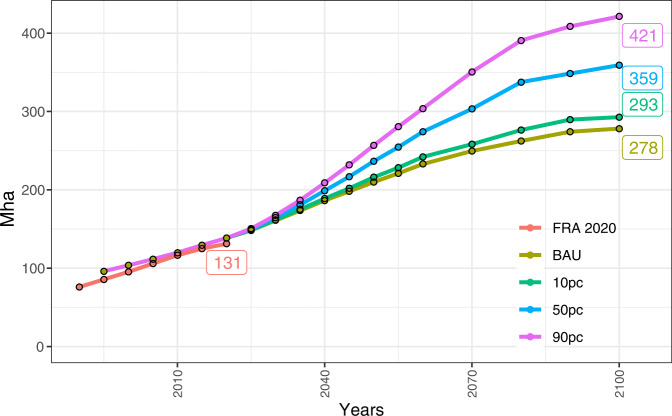
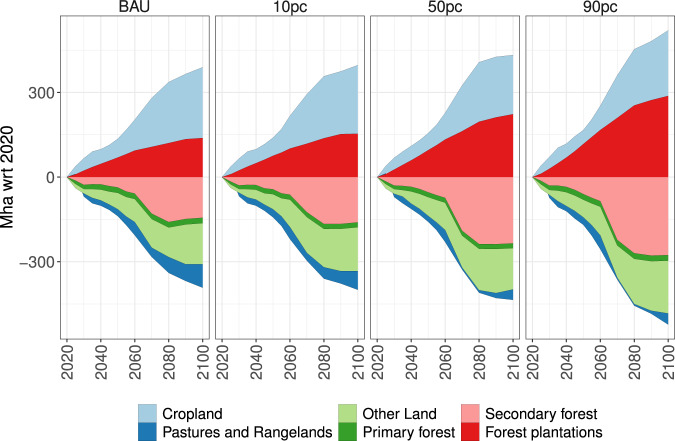
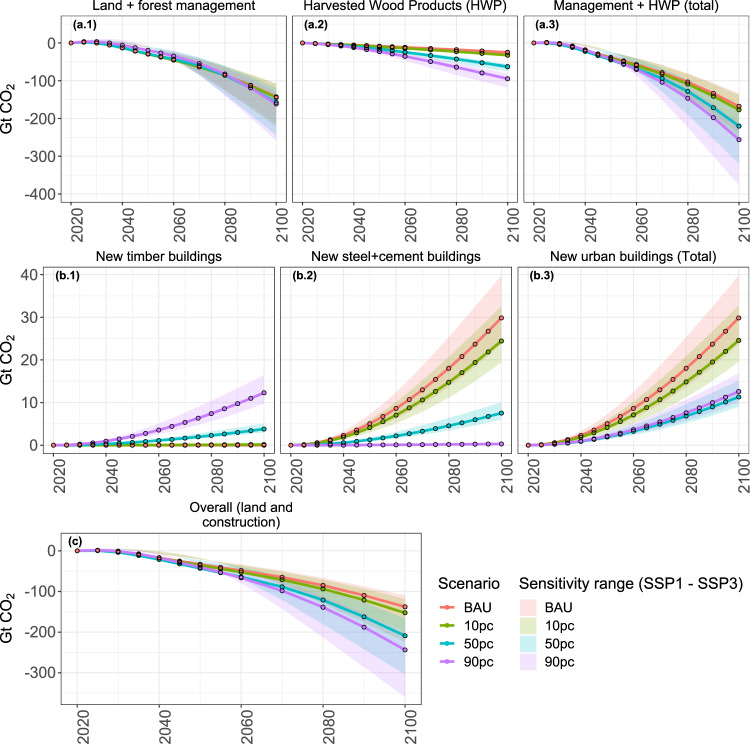
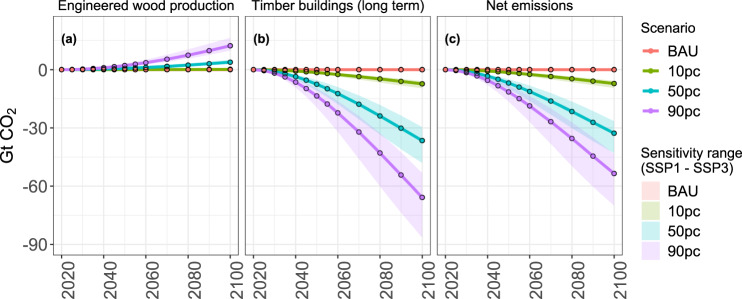
Using engineered wood for construction has been discussed for climate change mitigation. It remains unclear where and in which way the additional demand for wooden construction material shall be fulfilled. Here we assess the global and regional impacts of increased demand for engineered wood on land use and associated CO 2 emissions until 2100 using an open-source land system model. We show that if 90% of the new urban population would be housed in newly built urban mid-rise buildings with wooden constructions, 106 Gt of additional CO 2 could be saved by 2100. Forest plantations would need to expand by up to 149 Mha by 2100 and harvests from unprotected natural forests would increase. Our results indicate that expansion of timber plantations for wooden buildings is possible without major repercussions on agricultural production. Strong governance and careful planning are required to ensure a sustainable transition to timber cities even if frontier forests and biodiversity hotspots are protected.
Overview
The claims and statistics of this paper haven’t been checked yet.
Free: it reads the open-access text and checks the first 5 claims that cite a source we can check. Create a free account to check every claim.
Integrity signals
Registry
Cites
Statistics
Figures
Verification
Claims the paper makes
The claims and statistics of this paper haven’t been checked yet.
Free: it reads the open-access text and checks the first 5 claims that cite a source we can check. Create a free account to check every claim.
Claims other papers make about this one
Each is checked against this paper’s own text: does it say what the citing paper says it does?
The cited source says what the claim attributes to it.
In the citing paper
“Global analyses of mass timber products show the GHG mitigation potential of wood use in buildings (16) and their impacts on land use change (41), but high-resolution, spatially explicit understandings of various combinations of wood use and forest plantation management have not been fully explored.”
From Climate-smart forestry through innovative wood products and commercial afforestation and reforestation on marginal land (2023) · cites this paper as [41]
Self-check
Percentages, sums and reported differences re-computed from the paper’s own numbers.
The self-check needs the paper’s full text.
Citations
Cites
Ultrastructural Characterization of the Lower Motor System in a Mouse Model of Krabbe Disease
Cappello, V., Marchetti, L., Parlanti, P., Landi, S., Tonazzini, I., Cecchini, M., Piazza, V., & Gemmi, M. (2016) · Scientific Reports · doi:10.1038/s41598-016-0001-8 · Cited by 13,097
U1 snRNP regulates cancer cell migration and invasion in vitro
Oh, J.-M., Venters, C. C., Di, C., Pinto, A. M., Wan, L., Younis, I., Cai, Z., Arai, C., So, B. R., Duan, J., et al. (2020) · Nature Communications · doi:10.1038/s41467-019-13993-7 · Cited by 7,157
Riahi, K., van Vuuren, D. P., Kriegler, E., Edmonds, J., O’Neill, B. C., Fujimori, S., Bauer, N., Calvin, K., Dellink, R., Fricko, O., et al. (2017) · Global Environmental Change · doi:10.1016/j.gloenvcha.2016.05.009 · Cited by 6,607
Self-citationYang (2021) · doi:10.1038/s41598-020-79139-8 · Cited by 5,035
Griscom, B. W., Adams, J., Ellis, P. W., Houghton, R. A., Lomax, G., Miteva, D. A., Schlesinger, W. H., Shoch, D., Siikamäki, J. V., Smith, P., et al. (2017) · Proceedings of the National Academy of Sciences · doi:10.1073/pnas.1710465114 · Cited by 3,481
Forest disturbances under climate change
Seidl, R., Thom, D., Kautz, M., Martin-Benito, D., Peltoniemi, M., Vacchiano, G., Wild, J., Ascoli, D., Petr, M., Honkaniemi, J., et al. (2017) · Nature Climate Change · doi:10.1038/nclimate3303 · Cited by 2,878
Self-citationGreening of the Earth and its drivers
Zhu, Z., Piao, S., Myneni, R. B., Huang, M., Zeng, Z., Canadell, J. G., Ciais, P., Sitch, S., Friedlingstein, P., Arneth, A., et al. (2016) · Nature Climate Change · doi:10.1038/nclimate3004 · Cited by 2,779
Classifying drivers of global forest loss
Curtis, P. G., Slay, C. M., Harris, N. L., Tyukavina, A., & Hansen, M. C. (2018) · Science · doi:10.1126/science.aau3445 · Cited by 2,340
Dynamics of global forest area: Results from the FAO Global Forest Resources Assessment 2015
Keenan, R. J., Reams, G. A., Achard, F., de Freitas, J. V., Grainger, A., & Lindquist, E. (2015) · Forest Ecology and Management · doi:10.1016/j.foreco.2015.06.014 · Cited by 1,656
The dominant role of semi-arid ecosystems in the trend and variability of the land CO 2 sink
Ahlström, A., Raupach, M. R., Schurgers, G., Smith, B., Arneth, A., Jung, M., Reichstein, M., Canadell, J. G., Friedlingstein, P., Jain, A. K., et al. (2015) · Science · doi:10.1126/science.aaa1668 · Cited by 1,471
Research works printed but not linked: 5
- Carle J Holmgren P Wood from planted forests Forest Products J. 2008 58 6
- Adhikari S Quesada H Bond B Hammett T Potential of hardwood lumber in cross laminated timber in North America: a CLT manufacturer’s perspective Mass Timber Construction J. 2020 3 1 9
- Glavinić IU Boko I Torić N Vranković JL Application of hardwood for glued laminated timber in Europe J. Croation Assoc. Civil Eng. 2020 72 607 616
- IPCC. Climate change 2021: The physical science basis. in Intergovernmental Panel on Climate Change (IPCC) (Cambridge University Press, 2007).
- Organschi, A., Ruff, A., Oliver, C. D., Carbone, C. & Herrmann, E. Timber city: Growing an urban carbon sink with glue, screws, and cellulose fiber. in World Conference on Timber Engineering (WCTE) 2016, 5612–5621 (WCTE, 2016).
Cited by
Items 201–279 of 279
Ipsen, K. L., Pizzol, M., Birkved, M., & Amor, B. (2025) · The International Journal of Life Cycle Assessment · doi:10.1007/s11367-025-02448-5 · Cited by 1
“…wood and other biobased materials, where several studies assess multiple impact categories (Lukić et al. 2020; Kayo et al. 2019; Hansen et al. 2024; Mishra et al. 2022; Andersen et al. 2024; Mouton et al. 2023) or a single impact category that is not GHG emissions but, for example, land use…”
Carbon reduction strategies with steel-CLT hybrid structures
Laboy, M. M., Eckelman, M. J., Hajjar, J. F., & Webster, M. D. (2025) · CRC Press eBooks · doi:10.1201/9781003658641-70 · Cited by 1
Wolf, I., Kratzer, J., & Reimer, C. (2025) · Buildings · doi:10.3390/buildings15193566 · Cited by 3
“The cement sector and steel production alone contributed about 10% of global greenhouse gas emissions in 2020, a figure likely to grow with continued population increases and rising construction demands [4].”
Harvested wood products' full lifecycle assessment for sustainable construction: A Systemised review
Eisimsidele, J. I., O’Donoghue, C., & McGetrick, P. J. (2025) · Cleaner Waste Systems · doi:10.1016/j.clwas.2025.100430 · Cited by 2
Urban Agglomerations Promote the Coordinated Development of Urbanization and Intensive Land Use
Zhang, M., Li, X., & Lu, Z. (2025) · Land · doi:10.3390/land14112231 · Cited by 1
Urban Sustainability Studies as an Integrated Academic Field: A Systematic Review
Nakajima, H., & Asatani, K. (2025) · Sustainability · doi:10.3390/su18010201 · Cited by 3
Decarbonization through wood-based building material substitution in mountain territories
Sebastian, B., Morresi, D., Berretti, R., Garbarino, M., Motta, R., & Vacchiano, G. (2025) · Trees Forests and People · doi:10.1016/j.tfp.2025.101140 · Cited by 1
Zhang, Y., Cao, S., Sun, T., Chang, J., Ding, S., Wu, K., Zhao, Q., & Zhao, Q. (2026) · Journal of Building Engineering · doi:10.1016/j.jobe.2026.115242 · Cited by 4
Wood extraction and utilisation in Norway 2012–2022: a national material and carbon flow analysis
Modaresi, R., & Landaas, M. O. (2026) · Wood Material Science and Engineering · doi:10.1080/17480272.2026.2639739 · Cited by 1
“Studies have shown that the transformation to timber cities in the future is possible with strong governance and is environmentally beneficial globally (Churkina et al. 2020, Mishra et al. 2022).”
Suzuki, A., Kanematsu, Y., Heiho, A., Fushimi, M., Kita, S., Nakamura, K., & Kikuchi, Y. (2026) · Resources Conservation and Recycling · doi:10.1016/j.resconrec.2026.108922 · Cited by 1
Shear behavior and parametric analysis of steel-to-timber connections using coach screws
Zhang, C., Yang, H., Chen, W., Wu, Z., Tao, H., Wen, B., & Shi, B. (2026) · Construction and Building Materials · doi:10.1016/j.conbuildmat.2026.146292 · Cited by 1
Can we make it? Prospective life cycle assessment of building structures
Auburtin, P. N., Saadé-Sbeih, M., Manthey, M., Louërat, M., Martin, J.-L., & Baverel, O. (2026) · Structures · doi:10.1016/j.istruc.2026.112434 · Cited by 1
Roy, J., Dutta, S., Sarkar, S., Gorain, S., & Banerjee, K. (2026) · Discover Soil. · doi:10.1007/s44378-026-00289-8 · Cited by 1
“[28, 83].”
Palumbo, M., Alva, A., Haurie, L., Avellaneda, A., & Palacio, A. M. L. (2026) · Journal of Building Engineering · doi:10.1016/j.jobe.2026.117062 · Cited by 2
Épületek ökológiai lábnyoma: fából vagy betonból építsünk?
Szigeti, C., Szennay, Á., & Major, Z. (2022) · doi:10.29180/978-615-6342-49-2_25 · Cited by 2
Legitimation der kreislaufeffektiven Holzbauweise – Nachweis der Klimaschutzwirkung
Graf, J., Hao, B., Birk, S., Poteschkin, V., Shi, W., Klopfer, R., Jagsch, C., & Ciesla, E. (2024) · Bautechnik · doi:10.1002/bate.202300087 · Cited by 1
Logging disrupts the ecology of molecules in headwater streams
Freeman, E. C., Emilson, E. J. S., Webster, K. L., Dittmar, T., & Tanentzap, A. J. (2025) · Proceedings of the National Academy of Sciences · doi:10.1073/pnas.2409104122 · Cited by 4
“Long - lasting wood products and subsequent forest regrowth generated from logging are increasingly used as natural climate solutions to sequester atmospheric carbon ( 1 , 2 ).”
Planetary impact shifts from fossil fuels to material extractionPreprint
Creutzig, F., Azevedo, I., Berrill, P., Edelenbosch, O. Y., Fishman, T., Haberl, H., Hertwich, E. G., Krey, V., Lima, A. T., Makov, T., et al. (2024) · Authorea · doi:10.22541/au.171901018.84864468/v1 · Cited by 5
Wiedenhofer, D., Wieland, H., Leipold, S., Aoki‐Suzuki, C., Edelenbosch, O. Y., Zanon-Zotin, M., Kaufmann, L., Fortes, P., Haas, W., & Streeck, J. (2025) · SSRN Electronic Journal · doi:10.2139/ssrn.5034599 · Cited by 1
TIMBER VAULTS FOR ULTRA-LOW-CARBON BUILDING STRUCTURES
Hossell, S., Hawkins, W., Darby, A. P., Ibell, T. J., & Lines, N. (2023) · World Conference on Timber Engineering (WCTE) · doi:10.52202/069179-0452 · Cited by 1
Mazelli, A., Bedon, C., & Morassi, A. (2023) · Vibroengineering PROCEDIA · doi:10.21595/vp.2023.23429
Pathakoti, M., Rajan, K. S., Asuri, K. L., Santoshi, T., Mahalakshmi, D. V., Sujatha, P., Taori, A. K., Bothale, R. V., Chauhan, P., Shaik, I., et al. (2023) · SSRN Electronic Journal · doi:10.2139/ssrn.4608122
Zhao, R., Page‐Dumroese, D. S., Liu, Y., Wang, K., & Dumroese, R. K. (2023) · GCB Bioenergy · doi:10.1111/gcbb.13110 · Cited by 1
“…as well as frequent harvesting operations (Labelle et al., 2022), especially in plantations, can deplete soil C, cause nutrient imbalances, and exacerbate drought conditions that result in a subsequent decrease in ecosystem functions (Coban et al., 2022; Mishra et al., 2022; Newbold et al., 2015).”
BackgroundVerma, A., Lanssens, B., Tölle, M. H., Jacquemin, I., Chaudhari, T., Hambuckers, A., & François, L. (2023) · SSRN Electronic Journal · doi:10.2139/ssrn.4674758
YOSHIDA, H., TSUTSUI, T., Nishiura, O., Fujimori, S., & Oshiro, K. (2023) · Japanese Journal of JSCE · doi:10.2208/jscejj.23-27030
Der ressourcenschonende Bau als technische, ökonomische und kulturelle Herausforderung
Grossarth, J. (2024) · Springer eBooks · doi:10.1007/978-3-658-40198-6_2
Estimativa do módulo de elasticidade transversal (G) da madeira: um estudo bibliográfico
Aguiar, F. D. S., Branco, L. A. M. N., Chahud, E., Christoforo, A. L., & Lahr, F. A. R. (2024) · Caderno Pedagógico · doi:10.54033/cadpedv21n3-040
Experimental Studies of Lawn-Induced Cooling Performance and Irrigation InfluencePreprint
Huang, B., & He, B. (2024) · SSRN Electronic Journal · doi:10.2139/ssrn.4757228
Examination of upstream supply chain and logistics issues in the US logging industry
Dogru, A. K., Elmadağ, A. B., Gong, K., Travers, J. M., & Meng, C. (2024) · Transportation Journal · doi:10.1002/tjo3.12009
Kapitel 5. Mitigation des Klimawandels
Kraxner, F., Zollitsch, W. J., Kottusch, C., Bruckman, V. J., Glatzel, S., Hood-Nowotny, R. C., Jandl, R., Lindenthal, T., Schmid, C., Theurl, M. C., et al. (2024) · Springer eBooks · doi:10.1007/978-3-662-67864-0_7 · Cited by 3
Kim, E. S., Lee, D., Hyun, J. H., Kim, N. Y., Heo, S. J., & Kim, D. S. (2024) · SSRN Electronic Journal · doi:10.2139/ssrn.4846586
And the stars look down: science beyond the finite
Leksa, V. (2024) · EMBO Reports · doi:10.1038/s44319-024-00202-w
“For example, they insist on less logging and more planting; they propose to cultivate forests and use wood, which has a lighter environmental footprint, as a building material (Mishra et al, 2022).”
Wen, W., Wang, H., Feng, T., & Luo, X. (2024) · SSRN Electronic Journal · doi:10.2139/ssrn.4904268
Wen, W., Wang, H., Feng, T., & Luo, X. (2024) · SSRN Electronic Journal · doi:10.2139/ssrn.4907224
Deng, Z., Zhang, Y., Supriyadi, A., Wang, L., & Zhang, F. (2024) · Forests · doi:10.3390/f15091534
Brahma, S., de moortel, E. V., Wurm, J., & Allacker, K. (2024) · IOP Conference Series Earth and Environmental Science · doi:10.1088/1755-1315/1402/1/012050
“Research on biomaterials shows that they are the key to reducing embodied GHG emissions as they absorb carbon from the atmosphere and store it in the building structure [6].”
Wood Waste Generation and the Circularity Potential of Finnish Houses Built Before 2021Preprint
Nasiri, B., & Hughes, M. (2025) · SSRN Electronic Journal · doi:10.2139/ssrn.5279787
Bohn, F. J., Arnold, U., Bucak, Ö., Frank, E., Schrafstetter, L., & Kuse, K. (2025) · Environmental Research Letters · doi:10.1088/1748-9326/addfed · Cited by 2
“In addition to lower embodied emissions, wood has the added benefit of acting as a long-term carbon store [23, 24].”
Guanxi and innovation in China: insights from the (bio-based) construction sector
Losacker, S., Becker, T., & Shang, Y. (2025) · Innovation and Development · doi:10.1080/2157930x.2025.2518825 · Cited by 2
“Technological advancements and innovations in bio-based building materials, in particular, are expected to drive the sector’s sustainability transition (Churkina et al. 2020; Mishra et al. 2022; United Nations Environment Programme 2022).”
Magerl, A., Erb, K., Lauk, C., Roux, N., & Gingrich, S. (2025) · Ecological Economics · doi:10.1016/j.ecolecon.2025.108746
Potential for biogenic carbon storage towards a net-zero built environment in Switzerland
Priore, Y. D., Schulthess, L., Delmenico, S., Rinquet, L., Habert, G., & Jusselme, T. (2025) · Sustainable Production and Consumption · doi:10.1016/j.spc.2025.08.019
Amorim, J. C., de Sousa, J. M. R., Prataviera, F., da Silva, P. H. M., Rodrigues, S. A., Holsbeeck, S. V., Guerra, S. P. S., Lee, D. J., & Eufrade-Junior, H. D. J. (2025) · New Forests · doi:10.1007/s11056-025-10129-2 · Cited by 1
“These strategies include the valorization of engineered wood products in urban buildings to replace steel and concrete (Mishra et al. 2022), the retention of carbon in harvested wood products or their use for bioenergy to replace fossil fuels (Gustavsson et al. 2017), and their diversification into…”
Ökobilanzierung als Bewertungsinstrument im Holzbau: Normative Grundlagen und Forschungsperspektiven
Hafner, A., Rüter, S., Hani, C., & Ebert, S. (2025) · Bautechnik · doi:10.1002/bate.70027
Carbon Module: An add-on package for TiMBAPreprint
Honkomp, T. (2025) · SSRN Electronic Journal · doi:10.2139/ssrn.5637361
Mazelli, A., Bedon, C., & Morassi, A. (2025) · Bulletin of Earthquake Engineering · doi:10.1007/s10518-025-02308-5
“After, “housing a growing population in homes made out of wood instead of conventional steel and concrete could avoid more than 100 billion tons of emissions of CO 2 until 2100” (Mishra et al. 2022).”
Reframing construction labor for sustainable urban land transformation
Liu, L., Tai, H.-W., Chen, T.-C., & Cheng, K.-T. (2025) · Environment Development and Sustainability · doi:10.1007/s10668-025-07095-2
Puls, S. J., Cook, R. L., Baker, J. S., Rakestraw, J. L., & Trlica, A. (2024) · Figshare · doi:10.6084/m9.figshare.25264382
Closed-loop processing of in-situ modified wood: Biopolymer-structure-property relationships
Farid, T., Abbass, K., Trusov, L. A., Gorshunov, B. P., Gorbachev, E. A., Hussain, S., Ashiq, M. N., Li, Y., Asghar, M. I., Li, S., et al. (2025) · Carbohydrate Polymers · doi:10.1016/j.carbpol.2025.124613
Long-term changes in the lifespan of buildings at the national level: A case study in Japan
Kayo, C., Sanjo, K., Tanikawa, H., Komata, H., Maekawa, Y., & Tonosaki, M. (2026) · Energy and Buildings · doi:10.1016/j.enbuild.2026.117220 · Cited by 2
Carbon module: An open-source python package for global forest carbon accounting
Honkomp, T. (2026) · SoftwareX · doi:10.1016/j.softx.2026.102588
Amin, A., Hossain, M. A., Habib, M. A., Sujon, A. S., Nasim, M., & Rahman, M. A. (2026) · Industrial Crops and Products · doi:10.1016/j.indcrop.2026.123099
Navigating trade-offs across ownership and ecological priorities in forest conservation planning
Castelli, F., Hanson, J. O., Sabatini, F. M., Law, E. A., Dutta, T., & Lindner, M. (2026) · Journal of Environmental Management · doi:10.1016/j.jenvman.2026.129517
Kitazawa, M., ICHIKAWA, S., Aoki, D., & Senzaki, M. (2026) · bioRxiv (Cold Spring Harbor Laboratory) · doi:10.64898/2026.04.16.718952
“The other promising pathway is to restore and improve already modified forests (Lindenmayer et al. 2012), as the area of plantation forest is rapidly increasing (Curtis et al. 2018; Mishra et al. 2022).”
Li, Z., & Tan, J. (2026) · Carbon Balance and Management · doi:10.1186/s13021-026-00445-1
Hassaan, M. A., Barakat, K. M., & Nemr, A. E. (2026) · Springer eBooks · doi:10.1007/978-981-95-6071-4_10
Wood anatomy-guided machine learning linking macromechanics in plantation-grown Chinese fir
Liu, S., Zhan, W., Chang, Z., Lu, Y., Guo, J., Jiao, L., He, T., Ma, L., Jiang, X., & Yin, Y. (2026) · Holzforschung · doi:10.1515/hf-2025-0143
Yayla, A., Danneaux, A., Schurer, E., Gao, M., Demirci, C., Rose, C. M., van Ewijk, S., & Myers, R. J. (2026) · Environmental Science & Technology · doi:10.1021/acs.est.5c12250 · Cited by 1
Linking economic value, trade dynamics and forest loss in global primary wood production
Yao, Y., Zhang, X., Zhang, Y., Long, Y., Polasky, S., Han, B., Xiao, Y., Lu, F., Gong, C., & Ouyang, Z. (2026) · Resources Conservation and Recycling · doi:10.1016/j.resconrec.2026.109037 · Cited by 1
Lausselet, C., Hingorani, R., & Moschetti, R. (2026) · Journal of Industrial Ecology · doi:10.1007/s44498-026-00122-z
“…as cementitious materials (Pamenter & Myers, 2021), steel (Garvey et al., 2022; Morfeldt et al., 2015), aluminium (Pedneault et al., 2021), timber (Mishra et al., 2022), and glass (Schmitz et al., 2011), whereas comparatively little attention has been given to lightweight materials, such as…”
Quantitative social life cycle assessment of plastic, bioplastic, and paper packaging systems
Si, C., Fan, Y. V., Krajnc, D., Čuček, L., Sun, X., Kravanja, Z., & Varbanov, P. S. (2026) · Journal of Cleaner Production · doi:10.1016/j.jclepro.2026.148939
Mastrucci, A., Maierhofer, D., Zhong, X., Alaux, N., Creutzig, F., Maczek, F., Quade, M., Röck, M., Sheng, D., Gidden, M., et al. (2026) · Environmental Research Letters · doi:10.1088/1748-9326/ae9f73
“While previous research has primarily focused on carbon storage in wood (Mishra et al 2022, Gingrich et al 2025), we expand the scope by including biochar-based concrete, an alternative, yet highly debated, structural material.”
InfluentialHossell, S., Darby, A. P., & Hawkins, W. (2026) · Structures · doi:10.1016/j.istruc.2026.112639
Advances in understanding the size effect of structural timber: The role of defect-induced fracture
Yi, D., Li, Z., Li, M., He, M., Yan, L., Wang, Y., & Chen, Y. (2026) · Engineering Fracture Mechanics · doi:10.1016/j.engfracmech.2026.112477
Circularity Engineering: A Scientific White Paper
Geist, H., Ambacher, O., Brundiers, K., Cojocaru‐Mirédin, O., Eberl, C., Gumbsch, P., Hansen, E. G., Neuhaus, H., Quay, R., Ramey, A., et al. (2026) · Circular Economy · doi:10.55845/joce-2026-42386
“For example, using timber for long-term applications like buildings shows potential for creating significant carbon sinks (Churkina et al., 2020), but only if strong governance and careful planning prevent degenerative trade-offs (Mishra et al., 2022).”
Li, X., Xie, W., Weng, M., Lin, C., & Jim, C. Y. (2026) · Results in Engineering · doi:10.1016/j.rineng.2026.112297
Vandamme, E., Santana-Sosa, A., Staehr, E. R., Passarelli, R. N., & Rinke, M. (2026) · Buildings · doi:10.3390/buildings16153096
Amaringo-Cordova, L. P., Ucañay-Ayllón, T. M., Rodríguez-Sotelo, J. A., Pashanasi, H. F., Mori-Montero, C., Ruiz-Torres, O. A., Guerra‐Arévalo, W. F., Árevalo, H. G., Aldava-Pardave, U., Bernaola-Paucar, R. M., et al. (2026) · Forests · doi:10.3390/f17080915
Hayajneh, S. M., & Naser, J. (2026) · Fire · doi:10.3390/fire9090368
Mangliár, L., & Hudert, M. (2026) · Frontiers in Built Environment · doi:10.3389/fbuil.2026.1819177
Chen, T.-Y., Guo, Y., LINDSTAM, O., Chef, Q., & Knippers, J. (2026) · Results in Engineering · doi:10.1016/j.rineng.2026.113229
The (Ever) emerging wooden multistory construction? Tracing niche development in Finland
Koskivaara, A. (2026) · Journal of Cleaner Production · doi:10.1016/j.jclepro.2026.149658
Twenty core challenges to global wood security in the Anthropocene
Bousfield, C. G., Meeks, D., Cerullo, G. R., Betts, M. G., Miao, X., Adams, M. A., Pérez, G., Saiya, H. G., Bryant, R. G., Weiss, J., et al. (2026) · Trends Open · doi:10.1016/j.treopn.2026.08.021
The overshoot integral can inform climate science and policy beyond 1.5 °C of warming
Dyke, J. G., Abrams, J. F., & Schellnhuber, J. (2026) · Environmental Research Letters · doi:10.1088/1748-9326/aeb55a
Chen, B., Gheyle, T., Josipovic, I., Boone, M., Paepegem, W. V., Acker, J. V., & den Bulcke, J. V. (2026) · Construction and Building Materials · doi:10.1016/j.conbuildmat.2026.148521
Towards Circular Timber Construction: Benchmarking Material Use in Nordic Timber Buildings
Amiri, A., Schäfer, S., & Junnila, S. (2026) · Buildings · doi:10.3390/buildings16214293
Zeng, Q., & Tang, J. (2026) · Sustainability · doi:10.3390/su182110905
Yang, F., Zhao, J., Luo, Z., Gu, X., & Wang, S. (2026) · Environment Development and Sustainability · doi:10.1007/s10668-026-08239-8
Metadata
- Authors
- Mishra, A., Humpenöder, F., Churkina, G., Reyer, C. P. O., Beier, F., Bodirsky, B. L., Schellnhuber, H. J., Lotze-Campen, H., & Popp, A.
- Affiliations
- Leibniz Association (DE)
- World Vegetable Center (TW)
- Corresponding author
- Mishra, Abhijeet
- ORCID
- Venue
- Nature Communications
- Published
- 2022-08-30
- Volume
- 13
- Issue
- 1
- Pages
- 4889-4889
- ISSN
- 2041-1723 (ISSN-L)
- PMC
- PMC9427734
- OpenAlex
- W4293582167
- Semantic Scholar
- 76da8359d8293b2ef64623b1e674a01fcfe1228d
- Cited by
- 279
- References
- 71
- Citations by year
- 2026: 47 · 2025: 84 · 2024: 86 · 2023: 54 · 2022: 8
- FWCI
- 23.11
- Type
- journal article
- Language
- en
- Open access
- gold
- doi.org
- Licence
- cc-by
- creativecommons.org/licenses/by/4.0 (tdm)
- creativecommons.org/licenses/by/4.0 (vor)
- Locations
- Nature Communications (publishedVersion, cc-by)
- PubMed Central (publishedVersion, cc-by)
- PubMed (publishedVersion)
- RePEc: Research Papers in Economics (submittedVersion)
- DOAJ (DOAJ: Directory of Open Access Journals) (submittedVersion, cc-by-sa)
- edoc Publication server (Humboldt University of Berlin) (submittedVersion, cc-by)
- Publication Database PIK (Potsdam Institute for Climate Impact Research (PIK)) (submittedVersion, cc-by)
- edoc Publication server (Humboldt University of Berlin) (cc-by)
- Funders
- Bundesministerium für Bildung und Forschung (01LA1809A)
- Leibniz-Gemeinschaft (SAW-2016-PIK-1)
- EC | Horizon 2020 Framework Programme (821124, 821471, 821010, 776479)
- Deutsche Bundesstiftung Umwelt
- Topics
- Life Sciences › Agricultural and Biological Sciences › Forestry › Forest Management and Policy
- Physical Sciences › Environmental Science › Global and Planetary Change › Land Use and Ecosystem Services
- Physical Sciences › Environmental Science › Environmental Engineering › Environmental Impact and Sustainability
- Keywords
- engineered wood products, land use change, CO2 emissions, forest plantations, urban housing, mid-rise buildings, climate change mitigation, agricultural production, biodiversity hotspots
- MeSH terms
- Carbon, Carbon Dioxide, Cities, Conservation of Natural Resources, Forests
About these checks
Registry, retraction, Cites and statistics results are computed, not judged, with one exception: a printed reference that no index lists is read once by a model before it counts as a citation error. Claims are extracted by a model and kept only when their quote appears verbatim in the text; each cited source is then checked, with a model’s help, for whether it says what the claim relies on. Those verdicts can be wrong — read the claim’s quote and the cited source before relying on one.
Statistics and arithmetic are recomputed, not judged.
Confidence bands are shown only for fields calibrated on our annotated test set. None is calibrated yet, so no band is shown.
What counts as a claim ›How we measure confidence ›How we check this ›
Are you an author, or do you see a problem with this page? Request a review
Data sources
Bibliographic data: Semantic Scholar, OpenAlex, Crossref.
Contains information from the Semantic Scholar Academic Graph Datasets, made available under the ODC Attribution License (ODC-BY 1.0).
Semantic Scholar’s data is described in: Kinney, R., et al. (2023). The Semantic Scholar Open Data Platform. arXiv:2301.10140.
