

Land use change and carbon emissions of a transformation to timber cities
Open accessThe DOI matches its Crossref record; 73 of the 76 references it cites were found in a registry or an index, and 3 are not checked yet.
Abstract
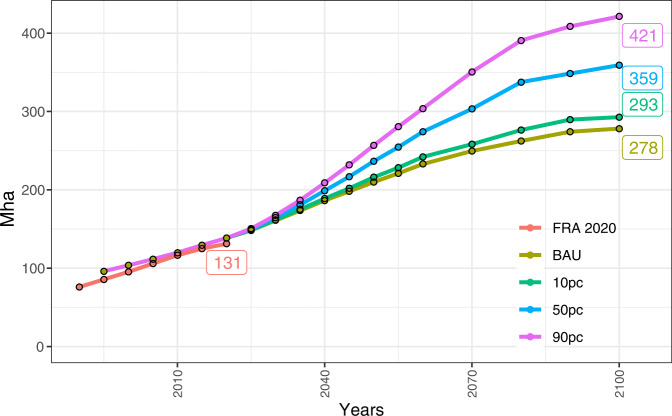
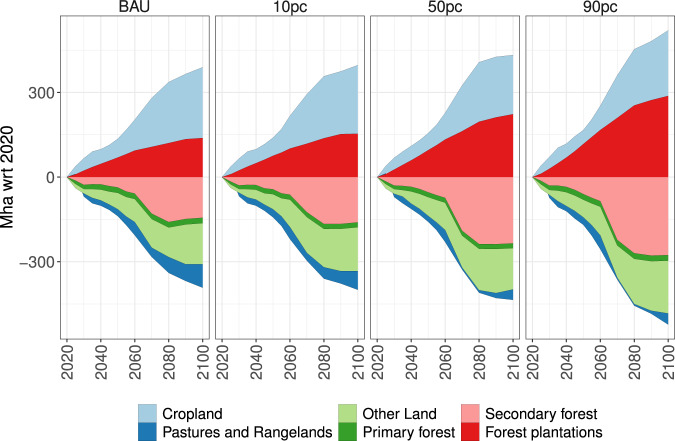
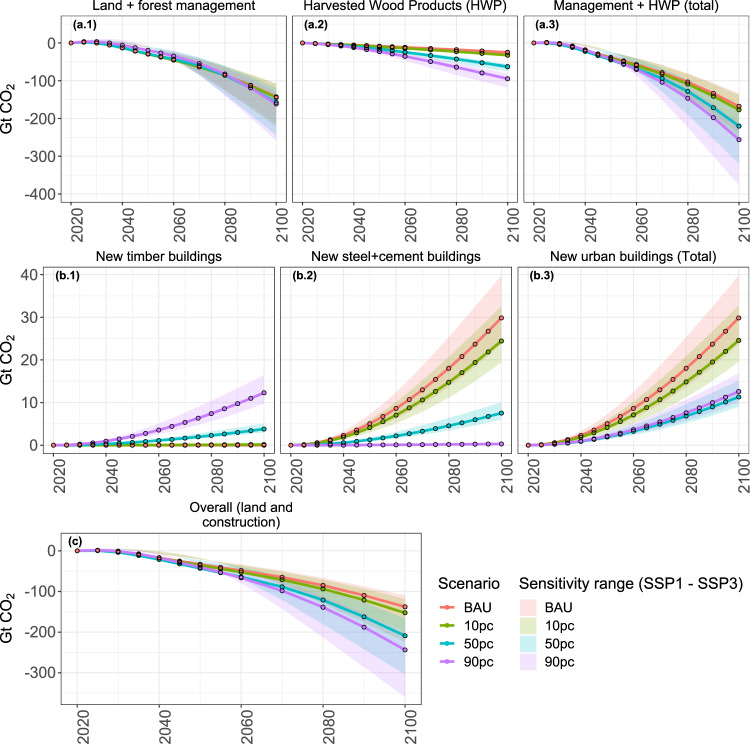
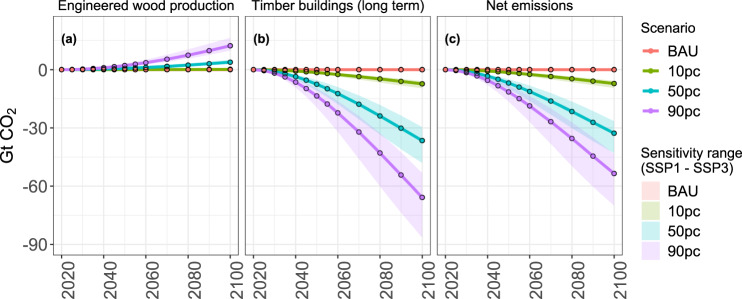
Using engineered wood for construction has been discussed for climate change mitigation. It remains unclear where and in which way the additional demand for wooden construction material shall be fulfilled. Here we assess the global and regional impacts of increased demand for engineered wood on land use and associated CO 2 emissions until 2100 using an open-source land system model. We show that if 90% of the new urban population would be housed in newly built urban mid-rise buildings with wooden constructions, 106 Gt of additional CO 2 could be saved by 2100. Forest plantations would need to expand by up to 149 Mha by 2100 and harvests from unprotected natural forests would increase. Our results indicate that expansion of timber plantations for wooden buildings is possible without major repercussions on agricultural production. Strong governance and careful planning are required to ensure a sustainable transition to timber cities even if frontier forests and biodiversity hotspots are protected.
Overview
The claims and statistics of this paper haven’t been checked yet.
Free: it reads the open-access text and checks the first 5 claims that cite a source we can check. Create a free account to check every claim.
Integrity signals
Registry
Cites
Statistics
Figures
Verification
Claims the paper makes
The claims and statistics of this paper haven’t been checked yet.
Free: it reads the open-access text and checks the first 5 claims that cite a source we can check. Create a free account to check every claim.
Claims other papers make about this one
Each is checked against this paper’s own text: does it say what the citing paper says it does?
The cited source says what the claim attributes to it.
In the citing paper
“Global analyses of mass timber products show the GHG mitigation potential of wood use in buildings (16) and their impacts on land use change (41), but high-resolution, spatially explicit understandings of various combinations of wood use and forest plantation management have not been fully explored.”
From Climate-smart forestry through innovative wood products and commercial afforestation and reforestation on marginal land (2023) · cites this paper as [41]
Self-check
Percentages, sums and reported differences re-computed from the paper’s own numbers.
The self-check needs the paper’s full text.
Citations
Cites
Ultrastructural Characterization of the Lower Motor System in a Mouse Model of Krabbe Disease
Cappello, V., Marchetti, L., Parlanti, P., Landi, S., Tonazzini, I., Cecchini, M., Piazza, V., & Gemmi, M. (2016) · Scientific Reports · doi:10.1038/s41598-016-0001-8 · Cited by 13,097
U1 snRNP regulates cancer cell migration and invasion in vitro
Oh, J.-M., Venters, C. C., Di, C., Pinto, A. M., Wan, L., Younis, I., Cai, Z., Arai, C., So, B. R., Duan, J., et al. (2020) · Nature Communications · doi:10.1038/s41467-019-13993-7 · Cited by 7,157
Riahi, K., van Vuuren, D. P., Kriegler, E., Edmonds, J., O’Neill, B. C., Fujimori, S., Bauer, N., Calvin, K., Dellink, R., Fricko, O., et al. (2017) · Global Environmental Change · doi:10.1016/j.gloenvcha.2016.05.009 · Cited by 6,607
Self-citationYang (2021) · doi:10.1038/s41598-020-79139-8 · Cited by 5,035
Griscom, B. W., Adams, J., Ellis, P. W., Houghton, R. A., Lomax, G., Miteva, D. A., Schlesinger, W. H., Shoch, D., Siikamäki, J. V., Smith, P., et al. (2017) · Proceedings of the National Academy of Sciences · doi:10.1073/pnas.1710465114 · Cited by 3,481
Forest disturbances under climate change
Seidl, R., Thom, D., Kautz, M., Martin-Benito, D., Peltoniemi, M., Vacchiano, G., Wild, J., Ascoli, D., Petr, M., Honkaniemi, J., et al. (2017) · Nature Climate Change · doi:10.1038/nclimate3303 · Cited by 2,878
Self-citationGreening of the Earth and its drivers
Zhu, Z., Piao, S., Myneni, R. B., Huang, M., Zeng, Z., Canadell, J. G., Ciais, P., Sitch, S., Friedlingstein, P., Arneth, A., et al. (2016) · Nature Climate Change · doi:10.1038/nclimate3004 · Cited by 2,779
Classifying drivers of global forest loss
Curtis, P. G., Slay, C. M., Harris, N. L., Tyukavina, A., & Hansen, M. C. (2018) · Science · doi:10.1126/science.aau3445 · Cited by 2,340
Dynamics of global forest area: Results from the FAO Global Forest Resources Assessment 2015
Keenan, R. J., Reams, G. A., Achard, F., de Freitas, J. V., Grainger, A., & Lindquist, E. (2015) · Forest Ecology and Management · doi:10.1016/j.foreco.2015.06.014 · Cited by 1,656
The dominant role of semi-arid ecosystems in the trend and variability of the land CO 2 sink
Ahlström, A., Raupach, M. R., Schurgers, G., Smith, B., Arneth, A., Jung, M., Reichstein, M., Canadell, J. G., Friedlingstein, P., Jain, A. K., et al. (2015) · Science · doi:10.1126/science.aaa1668 · Cited by 1,471
Biophysical and economic limits to negative CO2 emissions
Smith, P., Davis, S. J., Creutzig, F., Fuss, S., Minx, J., Gabrielle, B., Kato, E., Jackson, R. B., Cowie, A., Kriegler, E., et al. (2016) · Nature Climate Change · doi:10.1038/nclimate2870 · Cited by 1,440
The wood from the trees: The use of timber in construction
Ramage, M. H., Burridge, H., Busse-Wicher, M., Fereday, G., Reynolds, T., Shah, D. U., Wu, G., Yu, L., Fleming, P., Densley-Tingley, D., et al. (2017) · Renewable and Sustainable Energy Reviews · doi:10.1016/j.rser.2016.09.107 · Cited by 1,402
Modelling the role of agriculture for the 20th century global terrestrial carbon balance
BONDEAU, A., SMITH, P. C., ZAEHLE, S., SCHAPHOFF, S., LUCHT, W., CRAMER, W., GERTEN, D., LOTZE‐CAMPEN, H., MÜLLER, C., REICHSTEIN, M., et al. (2007) · Global Change Biology · doi:10.1111/j.1365-2486.2006.01305.x · Cited by 1,296
Self-citationLand-use futures in the shared socio-economic pathways
Popp, A., Calvin, K., Fujimori, S., Havlik, P., Humpenöder, F., Stehfest, E., Bodirsky, B. L., Dietrich, J. P., Doelmann, J. C., Gusti, M., et al. (2017) · Global Environmental Change · doi:10.1016/j.gloenvcha.2016.10.002 · Cited by 1,070
Self-citationBuildings as a global carbon sink
Churkina, G., Organschi, A., Reyer, C. P. O., Ruff, A., Vinke, K., Liu, Z., Reck, B. K., Graedel, T. E., & Schellnhuber, H. J. (2020) · Nature Sustainability · doi:10.1038/s41893-019-0462-4 · Cited by 1,045
Self-citationEnergy, land-use and greenhouse gas emissions trajectories under a green growth paradigm
van Vuuren, D. P., Stehfest, E., Gernaat, D. E. H. J., Doelman, J. C., van den Berg, M., Harmsen, M., de Boer, H. S., Bouwman, L. F., Daioglou, V., Edelenbosch, O. Y., et al. (2017) · Global Environmental Change · doi:10.1016/j.gloenvcha.2016.05.008 · Cited by 908
Local cooling and warming effects of forests based on satellite observations
Li, Y., Zhao, M., Motesharrei, S., Mu, Q., Kalnay, E., & Li, S. (2015) · Nature Communications · doi:10.1038/ncomms7603 · Cited by 733
Hyvönen, R., Ågren, G. I., Linder, S., Persson, T., Cotrufo, M. F., Ekblad, A., Freeman, M., Grelle, A., Janssens, I. A., Jarvis, P. G., et al. (2007) · New Phytologist · doi:10.1111/j.1469-8137.2007.01967.x · Cited by 688
Contribution of the land sector to a 1.5 °C world
Roe, S., Streck, C., Obersteiner, M., Frank, S., Griscom, B., Drouet, L., Fricko, O., Gusti, M., Harris, N., Hasegawa, T., et al. (2019) · Nature Climate Change · doi:10.1038/s41558-019-0591-9 · Cited by 619
Self-citationSSP3: AIM implementation of Shared Socioeconomic Pathways
Fujimori, S., Hasegawa, T., Masui, T., Takahashi, K., Herran, D. S., Dai, H., Hijioka, Y., & Kainuma, M. (2017) · Global Environmental Change · doi:10.1016/j.gloenvcha.2016.06.009 · Cited by 611
A sustainable development pathway for climate action within the UN 2030 Agenda
Soergel, B., Kriegler, E., Weindl, I., Rauner, S., Dirnaichner, A., Ruhe, C., Hofmann, M., Bauer, N., Bertram, C., Bodirsky, B. L., et al. (2021) · Nature Climate Change · doi:10.1038/s41558-021-01098-3 · Cited by 544
Self-citationCarbon Emissions of Infrastructure Development
Müller, D. B., Liu, G., Løvik, A. N., Modaresi, R., Pauliuk, S., Steinhoff, F. S., & Brattebø, H. (2013) · Environmental Science & Technology · doi:10.1021/es402618m · Cited by 445
Land‐based measures to mitigate climate change: Potential and feasibility by country
Roe, S., Streck, C., Beach, R., Busch, J., Chapman, M., Daioglou, V., Deppermann, A., Doelman, J., Emmet‐Booth, J., Engelmann, J., et al. (2021) · Global Change Biology · doi:10.1111/gcb.15873 · Cited by 408
Self-citationBiodiversity at risk under future cropland expansion and intensification
Kehoe, L., Romero-Muñoz, A., Polaina, E., Estes, L., Kreft, H., & Kuemmerle, T. (2017) · Nature Ecology & Evolution · doi:10.1038/s41559-017-0234-3 · Cited by 395
Impact of Forest Management on Species Richness: Global Meta-Analysis and Economic Trade-Offs
Chaudhary, A., Burivalova, Z., Koh, L. P., & Hellweg, S. (2016) · Scientific Reports · doi:10.1038/srep23954 · Cited by 391
Afforestation for climate change mitigation: Potentials, risks and trade‐offs
Doelman, J. C., Stehfest, E., van Vuuren, D. P., Tabeau, A., Hof, A. F., Braakhekke, M. C., Gernaat, D. E. H. J., van den Berg, M., van Zeist, W., Daioglou, V., et al. (2020) · Global Change Biology · doi:10.1111/gcb.14887 · Cited by 382
Increased carbon footprint of materials production driven by rise in investments
(2021) · doi:10.1038/s41561-021-00690-8 · Cited by 355
Global Forest Resources Assessment 2015: What, why and how?
MacDicken, K. G. (2015) · Forest Ecology and Management · doi:10.1016/j.foreco.2015.02.006 · Cited by 345
Thresholds of Logging Intensity to Maintain Tropical Forest Biodiversity
Burivalova, Z., Şekercioğlu, Ç. H., & Koh, L. P. (2014) · Current Biology · doi:10.1016/j.cub.2014.06.065 · Cited by 325
Lotze‐Campen, H., Müller, C., Bondeau, A., Rost, S., Popp, A., & Lucht, W. (2008) · Agricultural Economics · doi:10.1111/j.1574-0862.2008.00336.x · Cited by 325
Self-citationThe sponge effect and carbon emission mitigation potentials of the global cement cycle
Cao, Z., Myers, R. J., Lupton, R. C., Duan, H., Sacchi, R., Zhou, N., Reed Miller, T., Cullen, J. M., Ge, Q., & Liu, G. (2020) · Nature Communications · doi:10.1038/s41467-020-17583-w · Cited by 301
Carbon, Fossil Fuel, and Biodiversity Mitigation With Wood and Forests
Oliver, C. D., Nassar, N. T., Lippke, B. R., & McCarter, J. B. (2014) · Journal of Sustainable Forestry · doi:10.1080/10549811.2013.839386 · Cited by 234
Global mitigation potential of carbon stored in harvested wood products
Johnston, C. M. T., & Radeloff, V. C. (2019) · Proceedings of the National Academy of Sciences · doi:10.1073/pnas.1904231116 · Cited by 214
Impacts of Chilean forest subsidies on forest cover, carbon and biodiversity
Heilmayr, R., Echeverría, C., & Lambin, E. F. (2020) · Nature Sustainability · doi:10.1038/s41893-020-0547-0 · Cited by 213
Potential Roles of Swedish Forestry in the Context of Climate Change Mitigation
Lundmark, T., Bergh, J., Hofer, P., Lundström, A., Nordin, A., Poudel, B., Sathre, R., Taverna, R., & Werner, F. (2014) · Forests · doi:10.3390/f5040557 · Cited by 202
The impact of high-end climate change on agricultural welfare
Stevanović, M., Popp, A., Lotze-Campen, H., Dietrich, J. P., Müller, C., Bonsch, M., Schmitz, C., Bodirsky, B. L., Humpenöder, F., & Weindl, I. (2016) · Science Advances · doi:10.1126/sciadv.1501452 · Cited by 202
Self-citationQuantifying the biophysical climate change mitigation potential of Canada's forest sector
Smyth, C. E., Stinson, G., Neilson, E., Lemprière, T. C., Hafer, M., Rampley, G. J., & Kurz, W. A. (2014) · Biogeosciences · doi:10.5194/bg-11-3515-2014 · Cited by 194
Trading more food: Implications for land use, greenhouse gas emissions, and the food system
Schmitz, C., Biewald, A., Lotze-Campen, H., Popp, A., Dietrich, J. P., Bodirsky, B., Krause, M., & Weindl, I. (2012) · Global Environmental Change · doi:10.1016/j.gloenvcha.2011.09.013 · Cited by 192
Self-citationInvestigating afforestation and bioenergy CCS as climate change mitigation strategies
Humpenöder, F., Popp, A., Dietrich, J. P., Klein, D., Lotze-Campen, H., Bonsch, M., Bodirsky, B. L., Weindl, I., Stevanovic, M., & Müller, C. (2014) · Environmental Research Letters · doi:10.1088/1748-9326/9/6/064029 · Cited by 191
Self-citationDisturbance suppresses the aboveground carbon sink in North American boreal forests
Wang, J. A., Baccini, A., Farina, M. K., Randerson, J. T., & Friedl, M. A. (2021) · Nature Climate Change · doi:10.1038/s41558-021-01027-4 · Cited by 178
Pei, S., van de Lindt, J. W., Barbosa, A. R., Berman, J. W., McDonnell, E., Daniel Dolan, J., Blomgren, H.-E., Zimmerman, R. B., Huang, D., & Wichman, S. (2019) · Journal of Structural Engineering · doi:10.1061/(asce)st.1943-541x.0002382 · Cited by 161
MAgPIE 4 – a modular open-source framework for modeling global land systems
Dietrich, J. P., Bodirsky, B. L., Humpenöder, F., Weindl, I., Stevanović, M., Karstens, K., Kreidenweis, U., Wang, X., Mishra, A., Klein, D., et al. (2019) · Geoscientific Model Development · doi:10.5194/gmd-12-1299-2019 · Cited by 159
Self-citationMeasuring agricultural land-use intensity – A global analysis using a model-assisted approach
Dietrich, J. P., Schmitz, C., Müller, C., Fader, M., Lotze‐Campen, H., & Popp, A. (2012) · Ecological Modelling · doi:10.1016/j.ecolmodel.2012.03.002 · Cited by 152
Self-citationBuildings as a Global Carbon Sink? A Reality Check on Feasibility Limits
Pomponi, F., Hart, J., Arehart, J. H., & D’Amico, B. (2020) · One Earth · doi:10.1016/j.oneear.2020.07.018 · Cited by 150
Mass timber – the emergence of a modern construction material
Harte, A. M. (2017) · Journal of Structural Integrity and Maintenance · doi:10.1080/24705314.2017.1354156 · Cited by 140
Cities as carbon sinks—classification of wooden buildings
Amiri, A., Ottelin, J., Sorvari, J., & Junnila, S. (2020) · Environmental Research Letters · doi:10.1088/1748-9326/aba134 · Cited by 135
Hof, C., Voskamp, A., Biber, M. F., Böhning-Gaese, K., Engelhardt, E. K., Niamir, A., Willis, S. G., & Hickler, T. (2018) · Proceedings of the National Academy of Sciences · doi:10.1073/pnas.1807745115 · Cited by 131
Do timber plantations contribute to forest conservation?
Pirard, R., Dal Secco, L., & Warman, R. (2016) · Environmental Science & Policy · doi:10.1016/j.envsci.2015.12.010 · Cited by 123
Embodied carbon of concrete in buildings, Part 1: analysis of published EPD
Anderson, J., & Moncaster, A. (2020) · Buildings and Cities · doi:10.5334/bc.59 · Cited by 123
Impacts of tropical selective logging on carbon storage and tree species richness: A meta-analysis
Martin, P. A., Newton, A. C., Pfeifer, M., Khoo, M., & Bullock, J. M. (2015) · Forest Ecology and Management · doi:10.1016/j.foreco.2015.07.010 · Cited by 115
Carbon dioxide fluxes from contrasting ecosystems in the Sudanian Savanna in West Africa
Quansah, E., Mauder, M. R., Balogun, A. A., Amekudzi, L. K., Hingerl, L., Bliefernicht, J., & Kunstmann, H. G. (2015) · Carbon Balance and Management · doi:10.1186/s13021-014-0011-4 · Cited by 105
Moncaster, A. M., Pomponi, F., Symons, K. E., & Guthrie, P. M. (2018) · Energy and Buildings · doi:10.1016/j.enbuild.2018.05.039 · Cited by 96
Global climate change impacts on forests and markets
Tian, X., Sohngen, B., Kim, J. B., Ohrel, S. B., & Cole, J. (2016) · Environmental Research Letters · doi:10.1088/1748-9326/11/3/035011 · Cited by 95
Eriksson, L. O., Gustavsson, L., Hänninen, R. H., Kallio, M., Lyhykäinen, H. T., Pingoud, K., Pohjola, J., Sathre, R., Solberg, B., Svanæs, J., et al. (2011) · European Journal of Forest Research · doi:10.1007/s10342-010-0463-3 · Cited by 92
Feasibility Study of Mass-Timber Cores for the UBC Tall Wood Building
Connolly, T., Loss, C., Iqbal, A., & Tannert, T. (2018) · Buildings · doi:10.3390/buildings8080098 · Cited by 88
Climate mitigation by energy and material substitution of wood products has an expiry date
Brunet-Navarro, P., Jochheim, H., Cardellini, G., Richter, K., & Muys, B. (2021) · Journal of Cleaner Production · doi:10.1016/j.jclepro.2021.127026 · Cited by 84
Stoy, P. C., Ahmed, S., Jarchow, M., Rashford, B., Swanson, D., Albeke, S., Bromley, G., Brookshire, E. N. J., Dixon, M. D., Haggerty, J., et al. (2018) · BioScience · doi:10.1093/biosci/bix145 · Cited by 81
Graham, V., Geldmann, J., Adams, V. M., Negret, P. J., Sinovas, P., & Chang, H. (2021) · Scientific Reports · doi:10.1038/s41598-021-03188-w · Cited by 78
Greenhouse Gas Dynamics of an Increased Use of Wood in Buildings in Switzerland
Werner, F., Taverna, R., Hofer, P., & Richter, K. (2006) · Climatic Change · doi:10.1007/s10584-006-0427-2 · Cited by 62
Dietrich, J. P., Popp, A., & Lotze-Campen, H. (2013) · Ecological Modelling · doi:10.1016/j.ecolmodel.2013.05.009 · Cited by 50
Self-citationWang, X., Dietrich, J. P., Lotze‐Campen, H., Biewald, A., Stevanović, M., Bodirsky, B. L., Brümmer, B., & Popp, A. (2020) · Technological Forecasting and Social Change · doi:10.1016/j.techfore.2020.120208 · Cited by 49
Self-citationThe global forest age dataset and its uncertainties (GFADv1.1)
Poulter, B., Aragão, L. E. O. C., Andela, N., Bellassen, V., Ciais, P., Kato, T., Lin, X., Nachin, B., Luyssaert, S., Pederson, N., et al. (2019) · Figshare · doi:10.1594/pangaea.897392 · Cited by 48
Modeling forest plantations for carbon uptake with the LPJmL dynamic global vegetation model
Braakhekke, M. C., Doelman, J. C., Baas, P., Müller, C., Schaphoff, S., Stehfest, E., & van Vuuren, D. P. (2019) · Earth System Dynamics · doi:10.5194/esd-10-617-2019 · Cited by 48
Taking account of governance: Implications for land-use dynamics, food prices, and trade patterns
Wang, X., Biewald, A., Dietrich, J. P., Schmitz, C., Lotze‐Campen, H., Humpenöder, F., Bodirsky, B. L., & Popp, A. (2015) · Ecological Economics · doi:10.1016/j.ecolecon.2015.11.018 · Cited by 43
Self-citationA Framework for Assessing the Environmental Benefits of Mass Timber Construction
Crawford, R. H., & Cadorel, X. (2017) · Procedia Engineering · doi:10.1016/j.proeng.2017.08.015 · Cited by 41
Estimating global land system impacts of timber plantations using MAgPIE 4.3.5
Mishra, A., Humpenöder, F., Dietrich, J. P., Bodirsky, B. L., Sohngen, B., Reyer, C., Lotze‐Campen, H., & Popp, A. (2021) · Geoscientific model development · doi:10.5194/gmd-14-6467-2021 · Cited by 26
Self-citationSimulating growth-based harvest adaptive to future climate change
Yousefpour, R., Nabel, J. E. M. S., & Pongratz, J. (2019) · Biogeosciences · doi:10.5194/bg-16-241-2019 · Cited by 17
Recent Developments in US Hardwood Lumber Markets and Linkages to Housing Construction
Buehlmann, U., Bumgardner, M. S., & Alderman, D. R. (2017) · Current Forestry Reports · doi:10.1007/s40725-017-0059-y · Cited by 16
LUH2: Harmonization of global land-use scenarios for the period 850-2100
HURTT, G. C., Chini, L. P., Sahajpal, R., Frolking, S., Bodirsky, B. L., Calvin, K., Doelman, J., Fisk, J., Fujimori, S., Goldewijk, K. K., et al. (2016) · AGU Fall Meeting Abstracts · Cited by 5
Self-citationInnovative Approaches to Increase Service Life of Poplar Lightweight Hardwood Construction Products
Acker, J., Jiang, X., & Bulcke, J. (2020) · XV International Conference on Durability of Building Materials and Components. eBook of Proceedings · doi:10.23967/dbmc.2020.086 · Cited by 5
Estimating global land system impacts of timber plantations using MAgPIE 4.3.2Preprint
Mishra, A., Humpenöder, F., Dietrich, J. P., Bodirsky, B. L., Sohngen, B., Reyer, C., Lotze‐Campen, H., & Popp, A. (2021) · doi:10.5194/gmd-2021-76 · Cited by 3
Self-citationData repository - Land use change and carbon emissions of a transformation to timber cities
Mishra, A., Humpenöder, F., Churkina, G., et al. (2022) · Zenodo (CERN European Organization for Nuclear Research) · doi:10.5281/zenodo.6551229 · Cited by 1
Self-citationMAgPIE model - Land use change and carbon emissions of a transformation to timber cities
Mishra, A., & Humpenöder, F. (2022) · Zenodo (CERN European Organization for Nuclear Research) · doi:10.5281/zenodo.6643301 · Cited by 1
Self-citationMAgPIE model - Land use change and carbon emissions of a transformation to timber cities
Mishra, A., & Humpenöder, F. (2022) · Publication Database PIK (Potsdam Institute for Climate Impact Research (PIK)) · doi:10.5281/zenodo.6551236 · Cited by 1
Self-citationData repository - Land use change and carbon emissions of a transformation to timber cities
Mishra, A., Humpenöder, F., Churkina, G., Reyer, C., Beier, F., Bodirsky, B. L., Schellnhuber, H. J., Lotze‐Campen, H., & Popp, A. (2022) · Publication Database PIK (Potsdam Institute for Climate Impact Research (PIK)) · doi:10.5281/zenodo.6549361 · Cited by 1
Self-citationMAgPIE - An Open Source land-use modeling framework
Dietrich, J. P., Bodirsky, B. L., Weindl, I., Humpenöder, F., Stevanović, M., Kreidenweis, U., Wang, X., Karstens, K., Mishra, A., Beier, F., et al. (2021) · Zenodo (CERN European Organization for Nuclear Research) · doi:10.5281/zenodo.6653241 · Cited by 1
Self-citation
Research works printed but not linked: 5
- Carle J Holmgren P Wood from planted forests Forest Products J. 2008 58 6
- Adhikari S Quesada H Bond B Hammett T Potential of hardwood lumber in cross laminated timber in North America: a CLT manufacturer’s perspective Mass Timber Construction J. 2020 3 1 9
- Glavinić IU Boko I Torić N Vranković JL Application of hardwood for glued laminated timber in Europe J. Croation Assoc. Civil Eng. 2020 72 607 616
- IPCC. Climate change 2021: The physical science basis. in Intergovernmental Panel on Climate Change (IPCC) (Cambridge University Press, 2007).
- Organschi, A., Ruff, A., Oliver, C. D., Carbone, C. & Herrmann, E. Timber city: Growing an urban carbon sink with glue, screws, and cellulose fiber. in World Conference on Timber Engineering (WCTE) 2016, 5612–5621 (WCTE, 2016).
Cited by
Thermochemical conversion of biomass: Potential future prospects
Wang, Y., & Wu, J. J. (2023) · Renewable and Sustainable Energy Reviews · doi:10.1016/j.rser.2023.113754 · Cited by 259
“To achieve carbon benefit, the carbon generated by displacing fossil fuels must overtake the carbon sequestration forgone directly and indirectly by land-use change [17,18].”
Building materials could store more than 16 billion tonnes of CO 2 annually
Van Roijen, E., Miller, S. A., & Davis, S. J. (2025) · Science · doi:10.1126/science.adq8594 · Cited by 112
Demand-side strategies key for mitigating material impacts of energy transitions
Creutzig, F., Simões, S. G., Leipold, S., Berrill, P., Azevedo, I., Edelenbosch, O. Y., Fishman, T., Haberl, H., Hertwich, E. G., Krey, V., et al. (2024) · Nature Climate Change · doi:10.1038/s41558-024-02016-z · Cited by 135
“However, large-scale use of bio-based materials in construction raises important trade-offs with other ecosystem services; it would also imply the expansion of forestry to nearly 150 Mha by 2100 41 .”
Limited quantity and quality of steel supply in a zero-emission future
Watari, T., Hata, S., Nakajima, K., & Nansai, K. (2023) · Nature Sustainability · doi:10.1038/s41893-022-01025-0 · Cited by 100
County-level land use carbon emissions in China: Spatiotemporal patterns and impact factors
Liu, C., Hu, S., Wu, S. Q., Song, J., & Li, H. (2024) · Sustainable Cities and Society · doi:10.1016/j.scs.2024.105304 · Cited by 108
Metadata
- Authors
- Mishra, A., Humpenöder, F., Churkina, G., Reyer, C. P. O., Beier, F., Bodirsky, B. L., Schellnhuber, H. J., Lotze-Campen, H., & Popp, A.
- Affiliations
- Leibniz Association (DE)
- World Vegetable Center (TW)
- Corresponding author
- Mishra, Abhijeet
- ORCID
- Venue
- Nature Communications
- Published
- 2022-08-30
- Volume
- 13
- Issue
- 1
- Pages
- 4889-4889
- ISSN
- 2041-1723 (ISSN-L)
- PMC
- PMC9427734
- OpenAlex
- W4293582167
- Cited by
- 279
- References
- 71
- Citations by year
- 2026: 47 · 2025: 84 · 2024: 86 · 2023: 54 · 2022: 8
- FWCI
- 23.11
- Type
- journal article
- Language
- en
- Open access
- gold
- doi.org
- Licence
- cc-by
- creativecommons.org/licenses/by/4.0 (tdm)
- creativecommons.org/licenses/by/4.0 (vor)
- Locations
- Nature Communications (publishedVersion, cc-by)
- PubMed Central (publishedVersion, cc-by)
- PubMed (publishedVersion)
- RePEc: Research Papers in Economics (submittedVersion)
- DOAJ (DOAJ: Directory of Open Access Journals) (submittedVersion, cc-by-sa)
- edoc Publication server (Humboldt University of Berlin) (submittedVersion, cc-by)
- Publication Database PIK (Potsdam Institute for Climate Impact Research (PIK)) (submittedVersion, cc-by)
- edoc Publication server (Humboldt University of Berlin) (cc-by)
- Funders
- Bundesministerium für Bildung und Forschung (01LA1809A)
- Leibniz-Gemeinschaft (SAW-2016-PIK-1)
- EC | Horizon 2020 Framework Programme (821124, 821471, 821010, 776479)
- Deutsche Bundesstiftung Umwelt
- Topics
- Life Sciences › Agricultural and Biological Sciences › Forestry › Forest Management and Policy
- Physical Sciences › Environmental Science › Global and Planetary Change › Land Use and Ecosystem Services
- Physical Sciences › Environmental Science › Environmental Engineering › Environmental Impact and Sustainability
- Keywords
- engineered wood products, land use change, CO2 emissions, forest plantations, urban housing, mid-rise buildings, climate change mitigation, agricultural production, biodiversity hotspots
- MeSH terms
- Carbon, Carbon Dioxide, Cities, Conservation of Natural Resources, Forests
About these checks
Registry, retraction, Cites and statistics results are computed, not judged, with one exception: a printed reference that no index lists is read once by a model before it counts as a citation error. Claims are extracted by a model and kept only when their quote appears verbatim in the text; each cited source is then checked, with a model’s help, for whether it says what the claim relies on. Those verdicts can be wrong — read the claim’s quote and the cited source before relying on one.
Statistics and arithmetic are recomputed, not judged.
Confidence bands are shown only for fields calibrated on our annotated test set. None is calibrated yet, so no band is shown.
What counts as a claim ›How we measure confidence ›How we check this ›
Are you an author, or do you see a problem with this page? Request a review
Data sources
Bibliographic data: Semantic Scholar, OpenAlex, Crossref.
Contains information from the Semantic Scholar Academic Graph Datasets, made available under the ODC Attribution License (ODC-BY 1.0).
Semantic Scholar’s data is described in: Kinney, R., et al. (2023). The Semantic Scholar Open Data Platform. arXiv:2301.10140.
