

Organization of the gravity-sensing system in zebrafish
Open accessPublished version of a preprint
The DOI matches its Crossref record; 112 of the 112 references it cites were found in a registry or an index.
Abstract
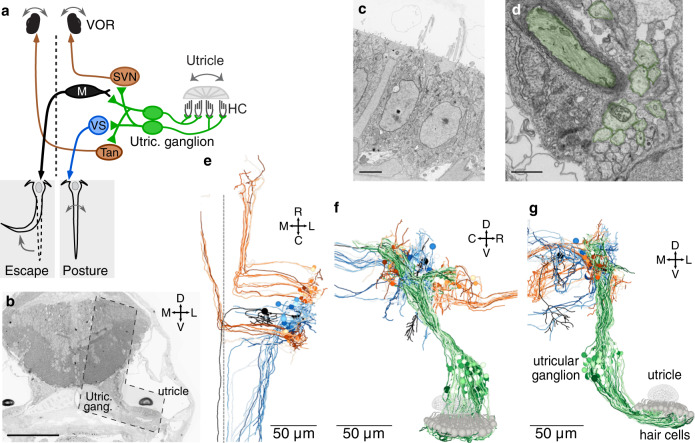
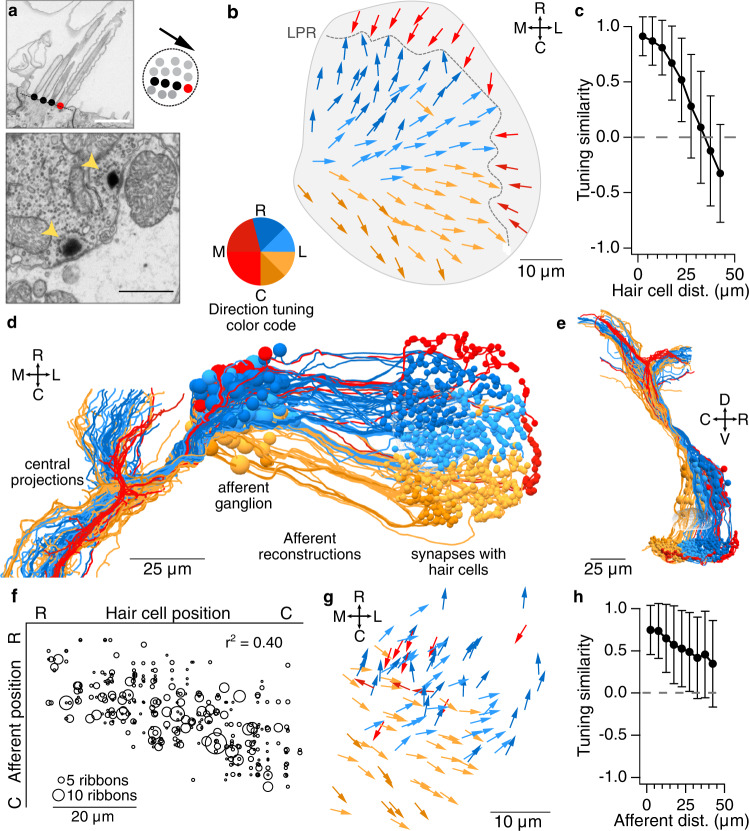
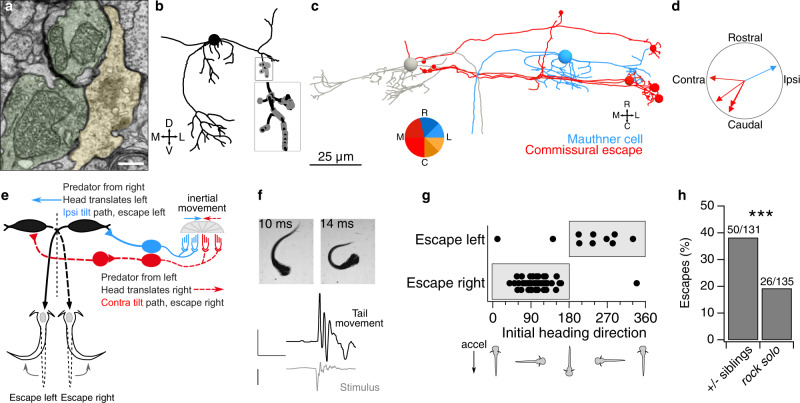
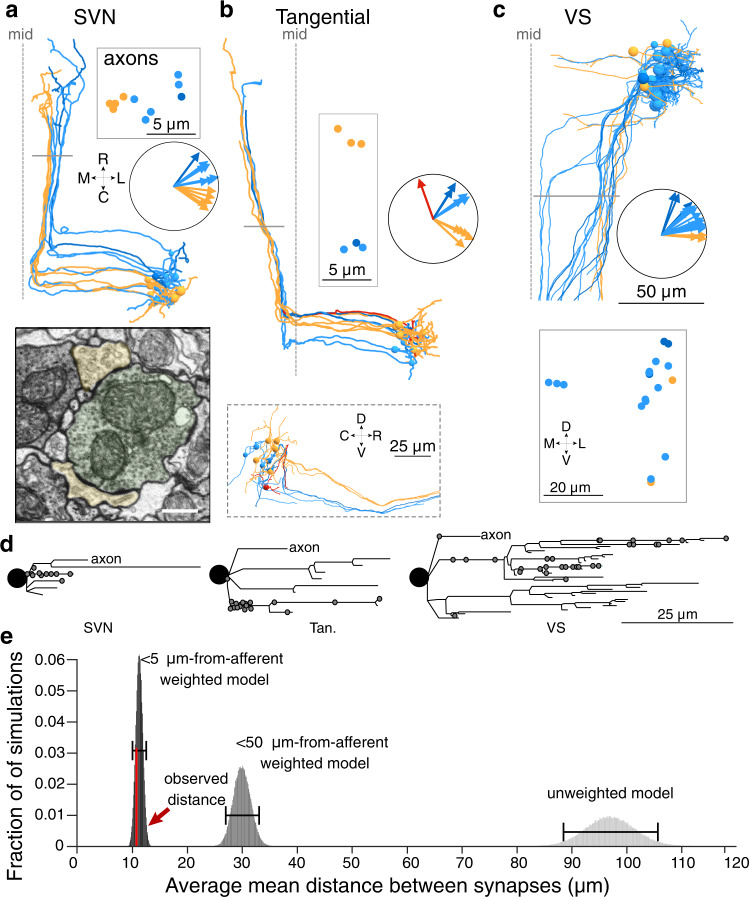
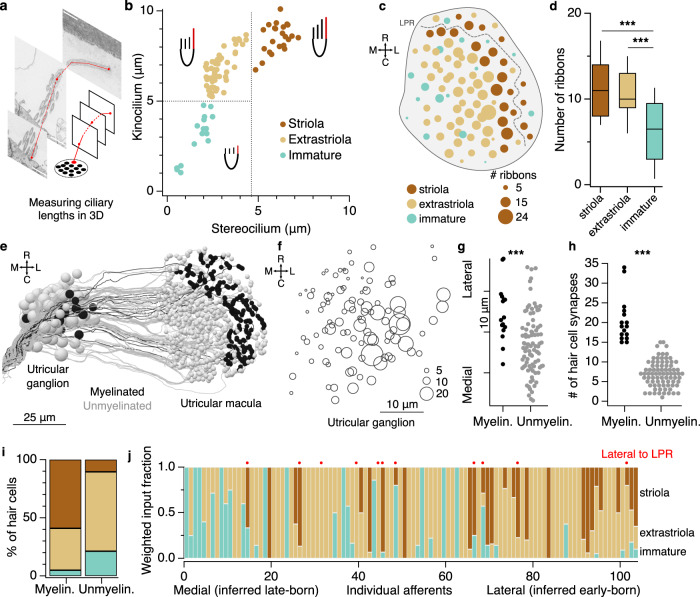
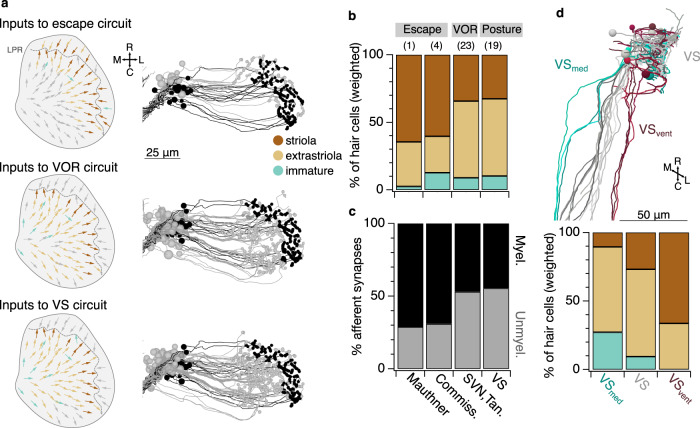
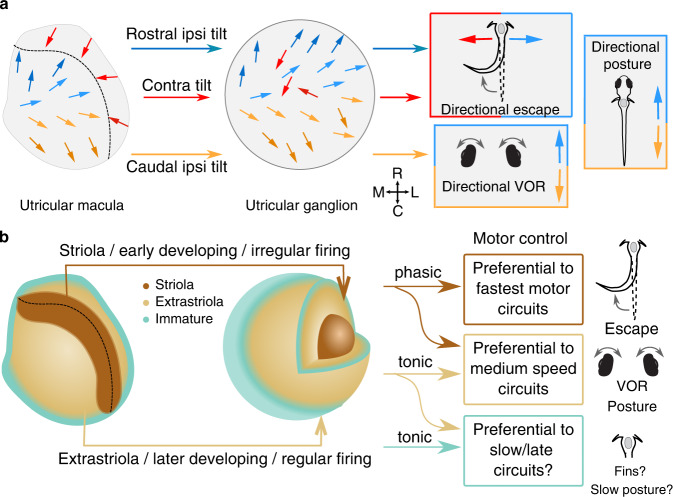
Motor circuits develop in sequence from those governing fast movements to those governing slow. Here we examine whether upstream sensory circuits are organized by similar principles. Using serial-section electron microscopy in larval zebrafish, we generated a complete map of the gravity-sensing (utricular) system spanning from the inner ear to the brainstem. We find that both sensory tuning and developmental sequence are organizing principles of vestibular topography. Patterned rostrocaudal innervation from hair cells to afferents creates an anatomically inferred directional tuning map in the utricular ganglion, forming segregated pathways for rostral and caudal tilt. Furthermore, the mediolateral axis of the ganglion is linked to both developmental sequence and neuronal temporal dynamics. Early-born pathways carrying phasic information preferentially excite fast escape circuits, whereas later-born pathways carrying tonic signals excite slower postural and oculomotor circuits. These results demonstrate that vestibular circuits are organized by tuning direction and dynamics, aligning them with downstream motor circuits and behaviors.
Overview
The claims and statistics of this paper haven’t been checked yet.
Free: it reads the open-access text and checks the first 5 claims that cite a source we can check. Create a free account to check every claim.
Integrity signals
Registry
Cites
Statistics
Figures
Verification
Claims the paper makes
The claims and statistics of this paper haven’t been checked yet.
Free: it reads the open-access text and checks the first 5 claims that cite a source we can check. Create a free account to check every claim.
Self-check
Percentages, sums and reported differences re-computed from the paper’s own numbers.
The self-check needs the paper’s full text.
Citations
Cites
Fiji: an open-source platform for biological-image analysis
Schindelin, J., Arganda-Carreras, I., Frise, E., Kaynig, V., Longair, M., Pietzsch, T., Preibisch, S., Rueden, C., Saalfeld, S., Schmid, B., et al. (2012) · Nature Methods · doi:10.1038/nmeth.2019 · Cited by 66,890 · cited 1×
“The resulting images were aligned onto the original 56.4×56.4× 60 nm 3 per voxel dataset using af fi ne and elastic transformations in FIJI ’ s TrakEM2 plugin 102,103 , with custom support from UniDesign Solutions.”
MethodInfluentialNeuronal activity promotes oligodendrogenesis and adaptive myelination in the mammalian brain
Gibson, E. M., Purger, D., Mount, C. W., Goldstein, A. K., Lin, G. L., Wood, L. S., Inema, I., Miller, S. E., Bieri, G., Zuchero, J. B., et al. (2014) · Science · doi:10.1126/science.1252304 · Cited by 1,472
TrakEM2 Software for Neural Circuit Reconstruction
Cardona, A., Saalfeld, S., Schindelin, J., Arganda-Carreras, I., Preibisch, S., Longair, M., Tomancak, P., Hartenstein, V., & Douglas, R. J. (2012) · PLoS ONE · doi:10.1371/journal.pone.0038011 · Cited by 1,013
Fernandez, C., & Goldberg, J. M. (1976) · Journal of Neurophysiology · doi:10.1152/jn.1976.39.5.970 · Cited by 764 · cited 2×
“Despite a rich literature of physiological responses in utri-cular afferents recorded in their axonal processes 19 – 21 , the bone surrounding this ganglion in adult animals has historically prevented somatic recordings, rendering its sensory topography unknown.”
BackgroundTime course of the development of motor behaviors in the zebrafish embryo
Saint-Amant, L., & Drapeau, P. (1998) · Journal of Neurobiology · doi:10.1002/(sici)1097-4695(199812)37:4<622::aid-neu10>3.0.co;2-s · Cited by 621
Fernandez, C., & Goldberg, J. M. (1976) · Journal of Neurophysiology · doi:10.1152/jn.1976.39.5.996 · Cited by 604 · cited 1×
“Striolar hair cells typically drive phasic, adapting, irregular-fi ring afferents with high-pass sensitivity, whereas extrastriolar hair cells drive tonic or tonic-phasic regular-fi ring affer-ents that are less dependent on stimulus frequency 8,19,43,45 – 47 .”
BackgroundSensorimotor Gating in Larval Zebrafish
Burgess, H. A., & Granato, M. (2007) · The Journal of Neuroscience · doi:10.1523/jneurosci.0615-07.2007 · Cited by 518
Afferent diversity and the organization of central vestibular pathways
Goldberg, J. M. (2000) · Experimental Brain Research · doi:10.1007/s002210050033 · Cited by 422
A topographic map of recruitment in spinal cord
McLean, D. L., Fan, J., Higashijima, S.-I., Hale, M. E., & Fetcho, J. R. (2007) · Nature · doi:10.1038/nature05588 · Cited by 384 · cited 6×
“2d and Supplementary Movie 3).”
BackgroundInfluentialCATMAID: collaborative annotation toolkit for massive amounts of image data
Saalfeld, S., Cardona, A., Hartenstein, V., & Tomančák, P. (2009) · Bioinformatics · doi:10.1093/bioinformatics/btp266 · Cited by 384 · cited 1×
“The entire image volume was hosted in a CATMAID instance 104,105 .”
Method
Cited by
Shi, T., Beaulieu, M. O., Saunders, L. M., Fabian, P., Trapnell, C., Segil, N., Crump, J. G., & Raible, D. W. (2023) · eLife · doi:10.7554/elife.82978 · Cited by 173
Automated synapse-level reconstruction of neural circuits in the larval zebrafish brain
Svara, F., Förster, D., Kubo, F., Januszewski, M., dal Maschio, M., Schubert, P. J., Kornfeld, J., Wanner, A. A., Laurell, E., Denk, W., et al. (2022) · Nature Methods · doi:10.1038/s41592-022-01621-0 · Cited by 124
Mechanotransduction in mammalian sensory hair cells
Caprara, G. A., & Peng, A. W. (2022) · Molecular and Cellular Neuroscience · doi:10.1016/j.mcn.2022.103706 · Cited by 78
“A general organizing principle of the vestibular epithelia like the tonotopy observed in the cochlea is lacking, but recent work suggests that tuning for fast and slow responses and developmental sequence may be an organizing principle of the larval zebrafish utricle (Liu et al., 2021).”
BackgroundSpinal Interneurons: Diversity and Connectivity in Motor Control
Sengupta, M., & Bagnall, M. W. (2023) · Annual Review of Neuroscience · doi:10.1146/annurev-neuro-083122-025325 · Cited by 67
Self-citationDeterminants of motor neuron functional subtypes important for locomotor speed
D’Elia, K. P., Hameedy, H., Goldblatt, D., Frazel, P. W., Kriese, M., Zhu, Y., Hamling, K. R., Kawakami, K., Liddelow, S. A., Schoppik, D., et al. (2023) · Cell Reports · doi:10.1016/j.celrep.2023.113049 · Cited by 45
Predicting modular functions and neural coding of behavior from a synaptic wiring diagram
Vishwanathan, A., Sood, A., Wu, J., Ramirez, A. D., Yang, R., Kemnitz, N., Ih, D., Turner, N., Lee, K., Tartavull, I., et al. (2024) · Nature Neuroscience · doi:10.1038/s41593-024-01784-3 · Cited by 36
“Recent connectomic efforts have enabled the generation of wiring diagrams in the fly and in vertebrate circuits like the retina 1,2 , utricular system 3,4 , olfactory bulb 5 , visual thalamus 6 , visual cortex 7,8 and somatosensory cortex 9 .”
Tanimoto, M., Watakabe, I., & Higashijima, S. (2022) · Nature Communications · doi:10.1038/s41467-022-35190-9 · Cited by 32
“2f, response vector orientation was consistent with the morphological hair-bundle polarity 23,27,28 .”
InfluentialVestibular physiology and function in zebrafish
Baeza‐Loya, S., & Raible, D. W. (2023) · Frontiers in Cell and Developmental Biology · doi:10.3389/fcell.2023.1172933 · Cited by 28
“Brainstem neurons that project across the midline (referred to as commissural-projecting neurons, or CPNs) to make contact on the contralateral MC receive input from lateral striola of the utricle, such that each target has opposite tuning (Jia and Bagnall, 2022; Liu et al., 2022) (Figure 2A).”
BackgroundInfluentialNeuronal birthdate reveals topography in a vestibular brainstem circuit for gaze stabilization
Goldblatt, D., Huang, S., Greaney, M. R., Hamling, K. R., Voleti, V., Campos, C. P., Patel, K., Li, W., Hillman, E. M. C., Bagnall, M. W., et al. (2023) · Current Biology · doi:10.1016/j.cub.2023.02.048 · Cited by 29
“Using an existing set of serial electron micrographs, 55 we traced afferents from 5 dpf anterior (n = 6 afferents) and posterior (n = 5 afferents) semicircular canal cristae across two synaptic connections: to the statoacoustic ganglion and then to projection neurons in the tangential vestibular…”
InfluentialSelf-citationVenuto, A., Thibodeau-Beganny, S., Trapani, J. G., & Erickson, T. (2023) · Journal of Experimental Biology · doi:10.1242/jeb.245635 · Cited by 17
The Nature and Origin of Synaptic Inputs to Vestibulospinal Neurons in the Larval Zebrafish
Hamling, K. R., Harmon, K., & Schoppik, D. (2023) · eNeuro · doi:10.1523/eneuro.0090-23.2023 · Cited by 16
Beaulieu, M. O., Thomas, E. D., & Raible, D. W. (2024) · Development · doi:10.1242/dev.202944 · Cited by 14
Evolutionarily conserved brainstem architecture enables gravity-guided vertical navigation
Zhu, Y., Gelnaw, H., Auer, F., Hamling, K. R., Ehrlich, D., & Schoppik, D. (2024) · PLoS Biology · doi:10.1371/journal.pbio.3002902 · Cited by 13
Localization of Piezo 1 and Piezo 2 in Lateral Line System and Inner Ear of Zebrafish (Danio rerio)
Aragona, M., Mhalhel, K., Pansera, L., Montalbano, G., Guerrera, M. C., Levanti, M. B., Laurà, R., Abbate, F., Vega, J. A., & Germanà, A. (2024) · International Journal of Molecular Sciences · doi:10.3390/ijms25179204 · Cited by 12
“Moreover, spatial heterogeneity in the zebrafish maculae has also been previously noted [20,24,28].”
BackgroundThe Vestibulospinal Nucleus Is a Locus of Balance Development
Hamling, K. R., Harmon, K., Kimura, Y., Higashijima, S., & Schoppik, D. (2024) · Journal of Neuroscience · doi:10.1523/jneurosci.2315-23.2024 · Cited by 13
Motor neurons are dispensable for the assembly of a sensorimotor circuit for gaze stabilizationPreprint
Goldblatt, D., Rosti, B., Hamling, K. R., Leary, P., Panchal, H., Li, M., Gelnaw, H., Huang, S., Quainoo, C., & Schoppik, D. (2024) · eLife · doi:10.7554/elife.96893 · Cited by 13
“…innervate specific motor neurons that selectively control either eyes-down or eyes-up muscles ( Straka et al., 2001 ; Diaz et al., 2003 ; Glover, 2003 ; Bianco et al., 2012 ; Schoppik et al., 2017 ; Bagnall and Schoppik, 2018 ; Diaz and Puelles, 2019 ; Liu et al., 2022 ; Goldblatt et al., 2023 ).”
InfluentialMildren, R. L., Gómez, L. J., & Cullen, K. E. (2025) · Current Biology · doi:10.1016/j.cub.2024.11.063 · Cited by 11
Sun, P., Smith, E. T., & Nicolson, T. A. (2023) · Journal of Neuroscience · doi:10.1523/jneurosci.1298-23.2023 · Cited by 11
Smith, E. T., Sun, P., Yu, K. S., Raible, D. W., & Nicolson, T. A. (2023) · Frontiers in Molecular Neuroscience · doi:10.3389/fnmol.2023.1274822 · Cited by 10
Monosynaptic targets of utricular afferents in the larval zebrafish
Jia, Y., & Bagnall, M. W. (2022) · Frontiers in Neurology · doi:10.3389/fneur.2022.937054 · Cited by 9
Self-citationDefects in Exosome Biogenesis Are Associated with Sensorimotor Defects in Zebrafish vps4a Mutants
Shipman, A., Gao, Y., Liu, D., Sun, S., Zang, J., Sun, P., Syed, Z., Bhagavathi, A., Smith, E. T., Erickson, T., et al. (2024) · Journal of Neuroscience · doi:10.1523/jneurosci.0680-24.2024 · Cited by 8
Larval zebrafish maintain elevation with multisensory control of posture and locomotion
Davis, S. N., Zhu, Y., & Schoppik, D. (2025) · Journal of Experimental Biology · doi:10.1242/jeb.250087 · Cited by 7
Organization of vestibular circuits for postural control in zebrafish
Liu, Z., & Bagnall, M. W. (2023) · Current Opinion in Neurobiology · doi:10.1016/j.conb.2023.102776 · Cited by 7
Self-citationMigault, G., Beiza-Canelo, N., Chatterjee, S., Debrégeas, G., & Bormuth, V. (2026) · Communications Biology · doi:10.1038/s42003-026-10141-y · Cited by 7
“Thisdirectionallybiasedresponsealignswithanatomicalstudies demonstratingthattheseneuronspredominantlyreceiveinputfromhair cellsinthemacula,tunedtorostral-lateralotolithdisplacements 25 .”
Epigenetic and physiological alterations in zebrafish subjected to hypergravity
Salazar, M., Joly, S., Anglada-Escudé, G., & Ribas, L. (2024) · PLoS ONE · doi:10.1371/journal.pone.0300310 · Cited by 6
“A complete map of the grav-ity-sensing system straddling from the inner ear to the brainstem was described [75].”
BackgroundDevelopment of the semicircular canals and otolithic organs of the vertebrate inner ear
Whitfield, T. T. (2025) · Current topics in developmental biology/Current Topics in Developmental Biology · doi:10.1016/bs.ctdb.2025.04.001 · Cited by 6
Auer, F., & Schoppik, D. (2022) · Frontiers in Neuroscience · doi:10.3389/fnins.2022.904765 · Cited by 6
Instrumented swim test for quantifying motor impairment in rodents
Hughes, N., Roberts, D., Tarchini, B., & Cullen, K. E. (2024) · Scientific Reports · doi:10.1038/s41598-024-80344-y · Cited by 5
“In zebrafish, for instance, the utricle is thought to be the primary vestibular organ 51,52,53 and proper vestibular function has been shown to be essential for the development of normal swimming behavior 54,53,55,56,57,58,59 .”
Huang, S., Gershowitz, E., Greaney, M. R., Davis, S. N., Schoppik, D., & Goldblatt, D. (2026) · Development · doi:10.1242/dev.204616 · Cited by 6
“…images of the tangential nucleus, including analyses of tangential nucleus neurons that received synaptic input from utricular-innervated ganglion neurons, was based on previously-published analyses, available in the supplementary material (supplementary data 1 and 2) in Liu et al. (2022).”
InfluentialMotor neurons are dispensable for the assembly of a sensorimotor circuit for gaze stabilizationPreprint
Goldblatt, D., Rosti, B., Hamling, K. R., Leary, P., Panchal, H., Li, M., Gelnaw, H., Huang, S., Quainoo, C., & Schoppik, D. (2024) · eLife · doi:10.7554/elife.96893.1 · Cited by 4
Multisensory navigational strategies of hatchling fish for dispersal
Lin, A., Álvarez-Salvado, E., Milicic, N., Pujara, N., & Ehrlich, D. (2023) · Current Biology · doi:10.1016/j.cub.2023.09.070 · Cited by 3
Shi, W., Wu, K. L., Yang, M., Botelho, F. P. D. N., Chua, O. W. H., Hu, H., Ng, K., Tsz-fung, U. L., Tam, K.-W., Ma, C., et al. (2025) · iScience · doi:10.1016/j.isci.2025.112566 · Cited by 2
“16 This implied existence of distinct signal processing circuits within the VN. Evidence suggests that such differences in the processing of sensory inputs arise not only from differing intrinsic properties of neuronal subtypes, 17 but also from differences in inhibitory inputs.”
Activity and retinoic acid drive hair cell spatial patterning in the zebrafish utricle
Baeza‐Loya, S., Bùi, J. T., & Raible, D. W. (2026) · Development · doi:10.1242/dev.205363 · Cited by 2
“By contrast, Liu et al. (2022) described striolar hair cells as more mature than extrastriolar cells based on morphological features (long kinocilium, many synaptic ribbons, innervation by myelinated afferents).”
Hypergravity induces changes in physiology, gene expression and epigenetics in zebrafish
Salazar-Moscoso, M., Joly, S., Anglada-Escudé, G., & Ribas, L. (2022) · Symposium on Space Educational Activities (SSEA) · doi:10.5821/conference-9788419184405.044 · Cited by 2
Motor neurons are dispensable for the assembly of a sensorimotor circuit for gaze stabilization
Goldblatt, D., Rosti, B., Hamling, K. R., Leary, P., Panchal, H., Li, M., Gelnaw, H., Huang, S., Quainoo, C., & Schoppik, D. (2024) · eLife · doi:10.7554/elife.96893.3 · Cited by 2
Highlights from the 31st Annual Meeting of the Society for the Neural Control of Movement
Cregg, J. M., Mirdamadi, J. L., Fortunato, C., Okorokova, E. V., Kuper, C., Nayeem, R., Byun, A. J. S., Avraham, C., Buonocore, A., Winner, T. S., et al. (2022) · Journal of Neurophysiology · doi:10.1152/jn.00500.2022 · Cited by 2
Lim, K. H., Kim, H. K., Park, S., Han, E., Song, I., Yoon, H. S., Kim, J., Lee, Y., Jang, Y. H., Rah, Y. C., et al. (2024) · Journal of the Association for Research in Otolaryngology · doi:10.1007/s10162-024-00936-3 · Cited by 1
Liu, J., Kraja, A., Davis, S. N., Gelnaw, H., Mahmood, N., Schoppik, D., & Zhu, Y. (2026) · Proceedings of the Royal Society B Biological Sciences · doi:10.1098/rspb.2026.1651 · Cited by 1
Motor neurons are dispensable for the assembly of a sensorimotor circuit for gaze stabilizationPreprint
Goldblatt, D., Rosti, B., Hamling, K. R., Leary, P., Panchal, H., Li, M., Gelnaw, H., Huang, S., Quainoo, C., & Schoppik, D. (2024) · eLife · doi:10.7554/elife.96893.2 · Cited by 1
Dehem, S., Hugues, A., Folmer, O., Dai, S., Piscicelli, C., Lhommée, E., & Pérennou, D. A. (2025) · Research Square · doi:10.21203/rs.3.rs-7472074/v1 · Cited by 1
Gershowitz, E., Hamling, K. R., Rosti, B., Gelnaw, H., Xiang, G., Quainoo, C., Goldblatt, D., Leary, P., & Schoppik, D. (2026) · bioRxiv (Cold Spring Harbor Laboratory) · doi:10.64898/2026.04.07.717009 · Cited by 1
Shariati, M. R., Alavi-Yeganeh, M. S., Ghanbarifardi, M., Saç, G., Özuluğ, M., & ÇİÇEK, E. (2025) · TURKISH JOURNAL OF ZOOLOGY · doi:10.55730/1300-0179.3220
“They are essential for hearing, gravity detection, balance, and motion detection (Ramos de Miguel et al., 2020; Boyle, 2021; Liu et al., 2022; Sand et al., 2023).”
Oligodendrocytes support functional development of subcortical premotor neurons and navigationPreprint
Auer, F., Zhang, Y., & Schoppik, D. (2025) · bioRxiv (Cold Spring Harbor Laboratory) · doi:10.1101/2025.11.01.686017
Head stabilization behavior and underlying circuit mechanisms in larval zebrafish
Sugioka, T., Thiele, T. R., Baier, H., Tanimoto, M., & Higashijima, S. (2026) · Communications Biology · doi:10.1038/s42003-026-09990-4
Mildren, R. L., Gómez, L. J., & Cullen, K. E. (2026) · Current Biology · doi:10.1016/j.cub.2026.03.047
Behavioural strategies & neuronal circuits for postural control
Chatterjee, S. (2024) · theses.fr (ABES) · doi:10.70675/63db00baz61a2z4062z8394z41396f87c704
Gershowitz, E., Hamling, K. R., Rosti, B., Gelnaw, H., Xiang, G., Quainoo, C., Goldblatt, D., Leary, P., & Schoppik, D. (2026) · eLife · doi:10.7554/elife.111633
Gershowitz, E., Hamling, K. R., Rosti, B., Gelnaw, H., Xiang, G., Quainoo, C., Goldblatt, D., Leary, P., & Schoppik, D. (2026) · eLife · doi:10.7554/elife.111633.1
Morphological and functional diversity of spatially resolved vestibular ganglion neuron cell types
Liu, R., Liu, J., Chen, Z., Li, J., Liu, Z., & Sun, S. (2026) · Proceedings of the National Academy of Sciences · doi:10.1073/pnas.2530677123
Self-citationAimon, S., Naumann, H., & Bahl, A. (2026) · bioRxiv (Cold Spring Harbor Laboratory) · doi:10.64898/2026.09.30.752102
Gao, Y., Shipman, A., Sun, P., Zhang, N., Smith, E. T., Pacentine, I. V., Nechiporuk, A. V., & Nicolson, T. A. (2026) · Science Advances · doi:10.1126/sciadv.aeg8139
Zhu, Y., Gelnaw, H., Auer, F., Hamling, K. R., Ehrlich, D. E., & Schoppik, D. (2024) · doi:10.1371/journal.pbio.3002902.r001
Metadata
- Authors
- Liu, Z., Hildebrand, D. G. C., Morgan, J. L., Jia, Y., Slimmon, N., & Bagnall, M. W.
- Affiliations
- Washington University in St. Louis (US)
- Rockefeller University (US)
- Corresponding author
- Bagnall, Martha W.
- Venue
- Nature Communications
- Published
- 2022-08-27
- Volume
- 13
- Issue
- 1
- Pages
- 5060-5060
- ISSN
- 2041-1723 (ISSN-L)
- PMC
- PMC9420129
- OpenAlex
- W4293354730
- Semantic Scholar
- cd2ebe3c9198df0627cc1645e6df4c160f18167a
- Cited by
- 51
- References
- 109
- Citations by year
- 2026: 10 · 2025: 7 · 2024: 15 · 2023: 12 · 2022: 7
- FWCI
- 3.60
- Type
- journal article
- Language
- en
- Open access
- gold
- doi.org
- Licence
- cc-by
- creativecommons.org/licenses/by/4.0 (tdm)
- creativecommons.org/licenses/by/4.0 (vor)
- Locations
- Nature Communications (publishedVersion, cc-by)
- bioRxiv (Cold Spring Harbor Laboratory) (acceptedVersion, cc-by-nc-nd)
- PubMed Central (publishedVersion, cc-by)
- PubMed (publishedVersion)
- Digital Commons@Becker (Washington University School of Medicine) (submittedVersion, cc-by)
- RePEc: Research Papers in Economics (submittedVersion)
- DOAJ (DOAJ: Directory of Open Access Journals) (submittedVersion, cc-by-sa)
- Funders
- Leon Levy Foundation
- Brain and Behavior Research Foundation
- U.S. Department of Health & Human Services | NIH | Office of Extramural Research, National Institutes of Health (EY030623, EY029313, R01 DC016413)
- Research to Prevent Blindness
- McKnight Endowment Fund for Neuroscience
- Alfred P. Sloan Foundation
- Topics
- Life Sciences › Neuroscience › Neurology › Vestibular and auditory disorders
- Life Sciences › Neuroscience › Sensory Systems › Hearing, Cochlea, Tinnitus, Genetics
- Social Sciences › Psychology › Experimental and Cognitive Psychology › Multisensory perception and integration
- Keywords
- gravity sensing, utricle, hair cells, afferent innervation, directional tuning, developmental sequence, brainstem, zebrafish
- MeSH terms
- Animals, Eye Movements, Larva, Vestibule, Labyrinth, Zebrafish, Gravity Sensing
About these checks
Registry, retraction, Cites and statistics results are computed, not judged, with one exception: a printed reference that no index lists is read once by a model before it counts as a citation error. Claims are extracted by a model and kept only when their quote appears verbatim in the text; each cited source is then checked, with a model’s help, for whether it says what the claim relies on. Those verdicts can be wrong — read the claim’s quote and the cited source before relying on one.
Statistics and arithmetic are recomputed, not judged.
Confidence bands are shown only for fields calibrated on our annotated test set. None is calibrated yet, so no band is shown.
What counts as a claim ›How we measure confidence ›How we check this ›
Are you an author, or do you see a problem with this page? Request a review
Data sources
Bibliographic data: Semantic Scholar, OpenAlex, Crossref.
Contains information from the Semantic Scholar Academic Graph Datasets, made available under the ODC Attribution License (ODC-BY 1.0).
Semantic Scholar’s data is described in: Kinney, R., et al. (2023). The Semantic Scholar Open Data Platform. arXiv:2301.10140.
