

Organization of the gravity-sensing system in zebrafish
Open accessPublished version of a preprint
The DOI matches its Crossref record; 112 of the 112 references it cites were found in a registry or an index.
Abstract
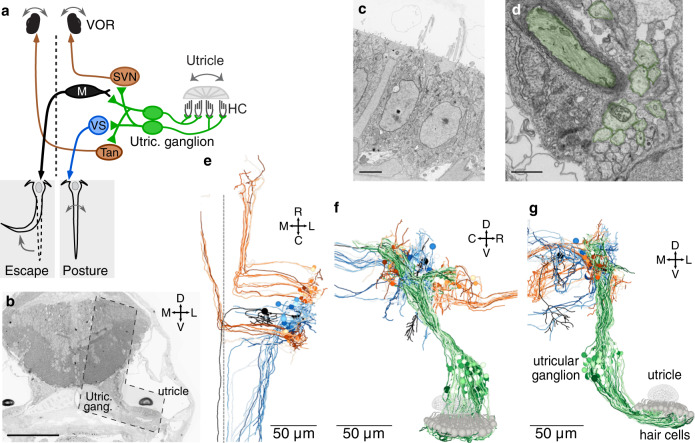
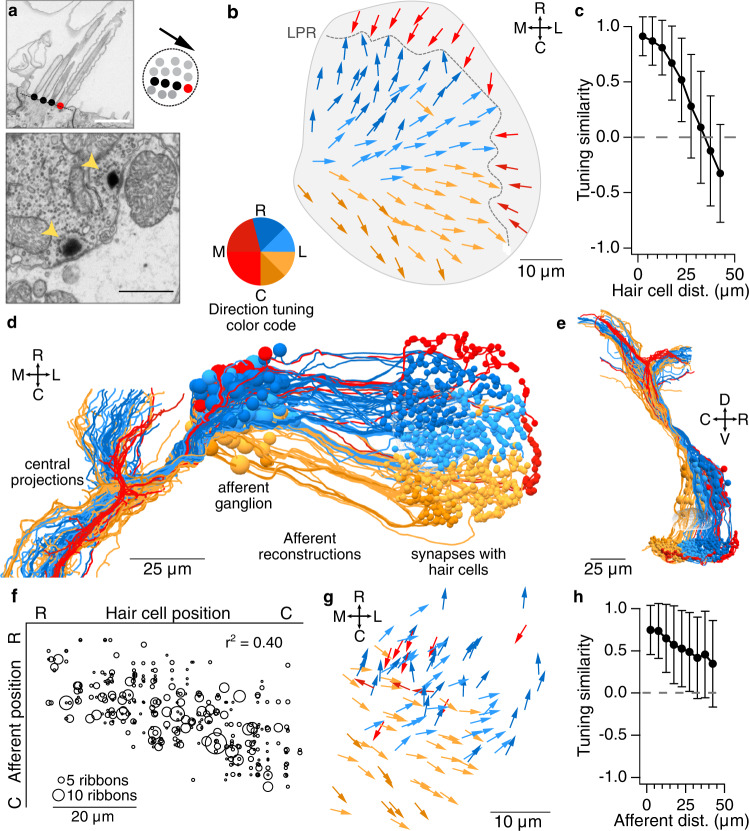
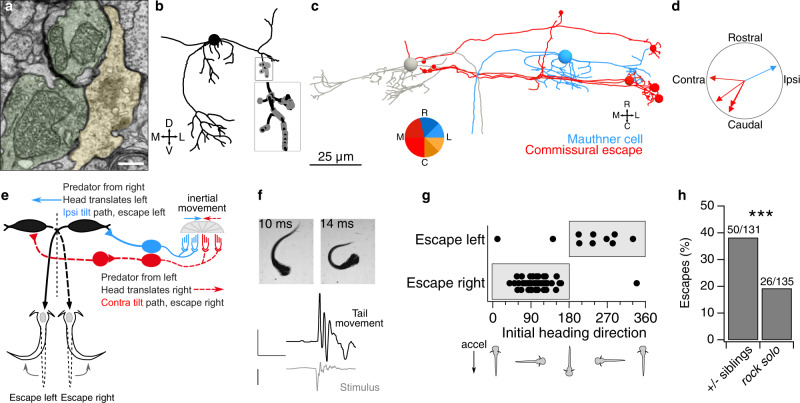
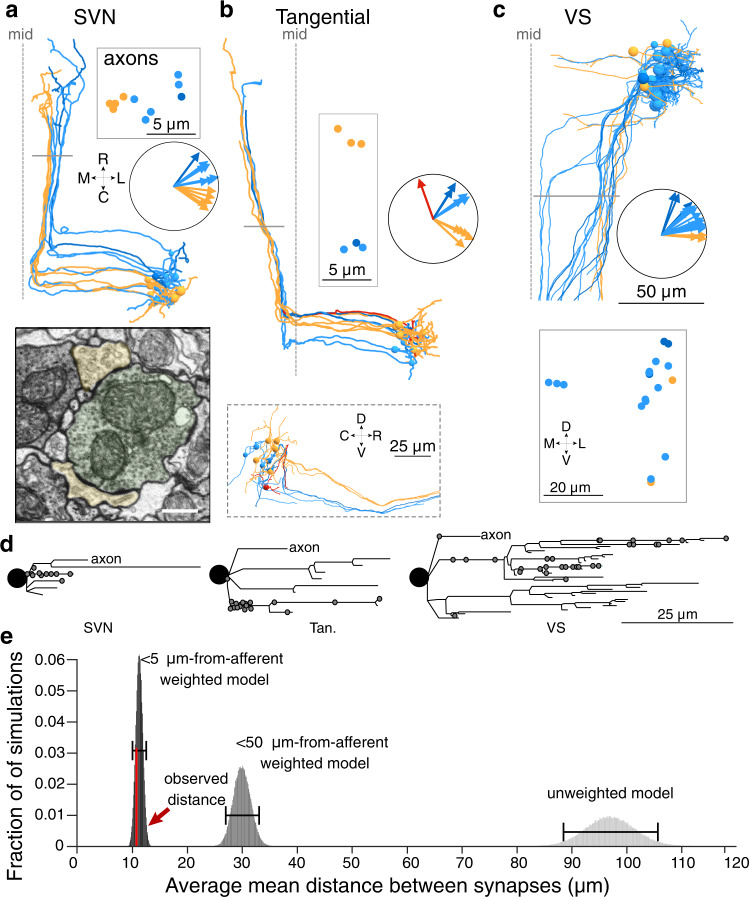
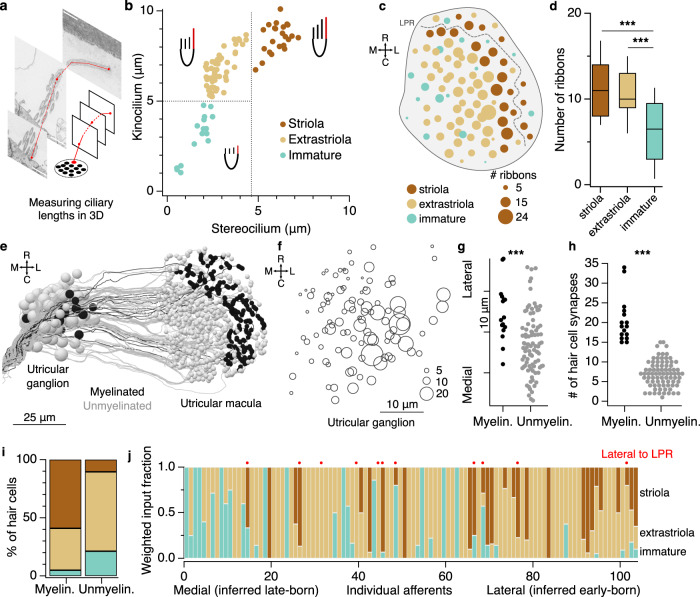
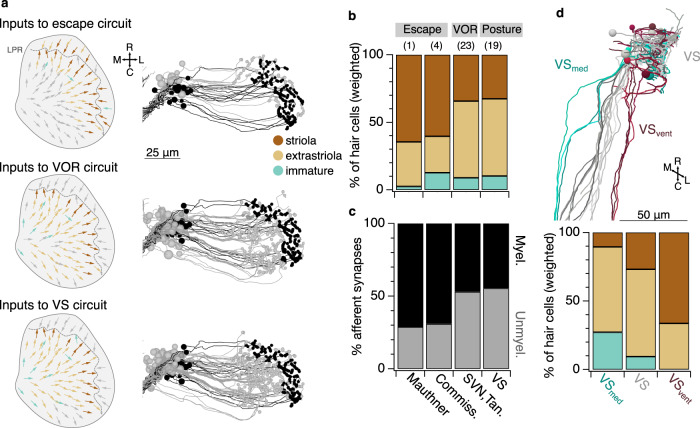
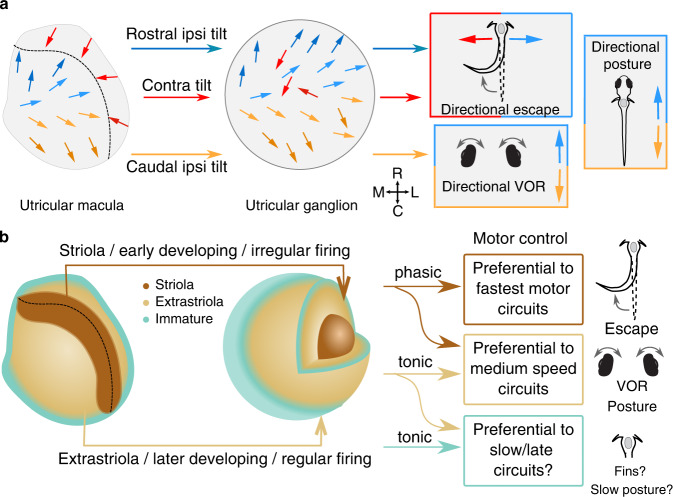
Motor circuits develop in sequence from those governing fast movements to those governing slow. Here we examine whether upstream sensory circuits are organized by similar principles. Using serial-section electron microscopy in larval zebrafish, we generated a complete map of the gravity-sensing (utricular) system spanning from the inner ear to the brainstem. We find that both sensory tuning and developmental sequence are organizing principles of vestibular topography. Patterned rostrocaudal innervation from hair cells to afferents creates an anatomically inferred directional tuning map in the utricular ganglion, forming segregated pathways for rostral and caudal tilt. Furthermore, the mediolateral axis of the ganglion is linked to both developmental sequence and neuronal temporal dynamics. Early-born pathways carrying phasic information preferentially excite fast escape circuits, whereas later-born pathways carrying tonic signals excite slower postural and oculomotor circuits. These results demonstrate that vestibular circuits are organized by tuning direction and dynamics, aligning them with downstream motor circuits and behaviors.
Overview
The claims and statistics of this paper haven’t been checked yet.
Free: it reads the open-access text and checks the first 5 claims that cite a source we can check. Create a free account to check every claim.
Integrity signals
Registry
Cites
Statistics
Figures
Verification
Claims the paper makes
The claims and statistics of this paper haven’t been checked yet.
Free: it reads the open-access text and checks the first 5 claims that cite a source we can check. Create a free account to check every claim.
Self-check
Percentages, sums and reported differences re-computed from the paper’s own numbers.
The self-check needs the paper’s full text.
Citations
Cites
Fiji: an open-source platform for biological-image analysis
Schindelin, J., Arganda-Carreras, I., Frise, E., Kaynig, V., Longair, M., Pietzsch, T., Preibisch, S., Rueden, C., Saalfeld, S., Schmid, B., et al. (2012) · Nature Methods · doi:10.1038/nmeth.2019 · Cited by 66,890 · cited 1×
“The resulting images were aligned onto the original 56.4×56.4× 60 nm 3 per voxel dataset using af fi ne and elastic transformations in FIJI ’ s TrakEM2 plugin 102,103 , with custom support from UniDesign Solutions.”
MethodInfluentialNeuronal activity promotes oligodendrogenesis and adaptive myelination in the mammalian brain
Gibson, E. M., Purger, D., Mount, C. W., Goldstein, A. K., Lin, G. L., Wood, L. S., Inema, I., Miller, S. E., Bieri, G., Zuchero, J. B., et al. (2014) · Science · doi:10.1126/science.1252304 · Cited by 1,472
TrakEM2 Software for Neural Circuit Reconstruction
Cardona, A., Saalfeld, S., Schindelin, J., Arganda-Carreras, I., Preibisch, S., Longair, M., Tomancak, P., Hartenstein, V., & Douglas, R. J. (2012) · PLoS ONE · doi:10.1371/journal.pone.0038011 · Cited by 1,013
Fernandez, C., & Goldberg, J. M. (1976) · Journal of Neurophysiology · doi:10.1152/jn.1976.39.5.970 · Cited by 764 · cited 2×
“Despite a rich literature of physiological responses in utri-cular afferents recorded in their axonal processes 19 – 21 , the bone surrounding this ganglion in adult animals has historically prevented somatic recordings, rendering its sensory topography unknown.”
BackgroundTime course of the development of motor behaviors in the zebrafish embryo
Saint-Amant, L., & Drapeau, P. (1998) · Journal of Neurobiology · doi:10.1002/(sici)1097-4695(199812)37:4<622::aid-neu10>3.0.co;2-s · Cited by 621
Fernandez, C., & Goldberg, J. M. (1976) · Journal of Neurophysiology · doi:10.1152/jn.1976.39.5.996 · Cited by 604 · cited 1×
“Striolar hair cells typically drive phasic, adapting, irregular-fi ring afferents with high-pass sensitivity, whereas extrastriolar hair cells drive tonic or tonic-phasic regular-fi ring affer-ents that are less dependent on stimulus frequency 8,19,43,45 – 47 .”
BackgroundSensorimotor Gating in Larval Zebrafish
Burgess, H. A., & Granato, M. (2007) · The Journal of Neuroscience · doi:10.1523/jneurosci.0615-07.2007 · Cited by 518
Afferent diversity and the organization of central vestibular pathways
Goldberg, J. M. (2000) · Experimental Brain Research · doi:10.1007/s002210050033 · Cited by 422
A topographic map of recruitment in spinal cord
McLean, D. L., Fan, J., Higashijima, S.-I., Hale, M. E., & Fetcho, J. R. (2007) · Nature · doi:10.1038/nature05588 · Cited by 384 · cited 6×
“2d and Supplementary Movie 3).”
BackgroundInfluentialCATMAID: collaborative annotation toolkit for massive amounts of image data
Saalfeld, S., Cardona, A., Hartenstein, V., & Tomančák, P. (2009) · Bioinformatics · doi:10.1093/bioinformatics/btp266 · Cited by 384 · cited 1×
“The entire image volume was hosted in a CATMAID instance 104,105 .”
MethodDevelopment of the locomotor network in zebrafish
Drapeau, P., Saint-Amant, L., Buss, R. R., Chong, M., McDearmid, J. R., & Brustein, E. (2002) · Progress in Neurobiology · doi:10.1016/s0301-0082(02)00075-8 · Cited by 376
Whole-brain serial-section electron microscopy in larval zebrafish
Hildebrand, D. G. C., Cicconet, M., Torres, R. M., Choi, W., Quan, T. M., Moon, J., Wetzel, A. W., Scott Champion, A., Graham, B. J., Randlett, O., et al. (2017) · Nature · doi:10.1038/nature22356 · Cited by 375
Self-citationQuantitative neuroanatomy for connectomics in Drosophila
Schneider-Mizell, C. M., Gerhard, S., Longair, M., Kazimiers, T., Li, F., Zwart, M. F., Champion, A., Midgley, F. M., Fetter, R. D., Saalfeld, S., et al. (2016) · eLife · doi:10.7554/elife.12059 · Cited by 332 · cited 1×
“The entire image volume was hosted in a CATMAID instance 104,105 .”
MethodEarly ear development in the embryo of the Zebrafish,Danio rerio
Haddon, C., & Lewis, J. (1996) · The Journal of Comparative Neurology · doi:10.1002/(sici)1096-9861(19960129)365:1<113::aid-cne9>3.0.co;2-6 · Cited by 329
Mutations affecting development of the zebrafish inner ear and lateral line
Whitfield, T. T., Granato, M., Eeden, F. J. M. V., Schach, U., Brand, M., Furutani-Seiki, M., Haffter, P., Hammerschmidt, M., Heisenberg, C.-P., Jiang, Y.-J., et al. (1996) · Development · doi:10.1242/dev.123.1.241 · Cited by 302
Vestibular Hair Cells and Afferents: Two Channels for Head Motion Signals
Eatock, R. A., & Songer, J. E. (2011) · Annual Review of Neuroscience · doi:10.1146/annurev-neuro-061010-113710 · Cited by 297 · cited 2×
“Hair cells are maximally depolarized by head tilts in the direction of their kinocilium relative to the cluster of stereocilia 8 .”
BackgroundHayworth, K. J., Morgan, J. L., Schalek, R., Berger, D. R., Hildebrand, D. G. C., & Lichtman, J. W. (2014) · Frontiers in Neural Circuits · doi:10.3389/fncir.2014.00068 · Cited by 282 · cited 1×
“WaferMapper software 100 was used to control an ATLAS scan engine for automated focus and acquisition 101 .”
MethodSelf-citationThe Fuzzy Logic of Network Connectivity in Mouse Visual Thalamus
Morgan, J. L., Berger, D. R., Wetzel, A. W., & Lichtman, J. W. (2016) · Cell · doi:10.1016/j.cell.2016.02.033 · Cited by 268 · cited 1×
“WaferMapper software 100 was used to control an ATLAS scan engine for automated focus and acquisition 101 .”
MethodSelf-citationHighstein, S. M., Goldberg, J. M., Moschovakis, A. K., & Fernandez, C. (1987) · Journal of Neurophysiology · doi:10.1152/jn.1987.58.4.719 · Cited by 266 · cited 1×
“Our observation that VOR and VS neurons receive similar mixtures of striolar and extrastriolar input are consistent with physiological analyses suggesting that both populations receive similar amounts of synaptic input from irregular and regular fi ring vestibular afferents 84,91,92 .”
ResultIntrinsic membrane properties of vertebrate vestibular neurons: Function, development and plasticity
Straka, H., Vibert, N., Vidal, P. P., Moore, L. E., & Dutia, M. B. (2005) · Progress in Neurobiology · doi:10.1016/j.pneurobio.2005.10.002 · Cited by 232 · cited 1×
“There are also likely to be signi fi cant variations across vertebrates in the balance between phasic and tonic vestibular signals, based on characteristics of movement 96 .”
BackgroundLee, G., Foss, M., Goodwin, S. F., Carlo, T., Taylor, B. J., & Hall, J. C. (2000) · Journal of Neurobiology · doi:10.1002/1097-4695(20000615)43:4<404::aid-neu8>3.0.co;2-d · Cited by 232
On Myelinated Axon Plasticity and Neuronal Circuit Formation and Function
Almeida, R. G., & Lyons, D. A. (2017) · The Journal of Neuroscience · doi:10.1523/jneurosci.3185-16.2017 · Cited by 221 · cited 1×
“Myeli-nation is responsive to neuronal activity 56,57 , and evidence suggests that it initiates fi rst in early-born neurons 58,59 .”
BackgroundIndividual axons regulate the myelinating potential of single oligodendrocytes in vivo
Almeida, R. G., Czopka, T., ffrench-Constant, C., & Lyons, D. A. (2011) · Development · doi:10.1242/dev.071001 · Cited by 214 · cited 1×
“Myeli-nation is responsive to neuronal activity 56,57 , and evidence suggests that it initiates fi rst in early-born neurons 58,59 .”
BackgroundHair cell distribution and orientation in goldfish otolith organs
Platt, C. (1977) · Journal of Comparative Neurology · doi:10.1002/cne.901720207 · Cited by 178
Koudelka, S., Voas, M. G., Almeida, R. G., Baraban, M., Soetaert, J., Meyer, M. P., Talbot, W. S., & Lyons, D. A. (2016) · Current Biology · doi:10.1016/j.cub.2016.03.070 · Cited by 171 · cited 1×
“Myeli-nation is responsive to neuronal activity 56,57 , and evidence suggests that it initiates fi rst in early-born neurons 58,59 .”
BackgroundAngelaki, D. E., & Dickman, J. D. (2000) · Journal of Neurophysiology · doi:10.1152/jn.2000.84.4.2113 · Cited by 168 · cited 1×
“Some VS neurons are contacted by divergently tuned afferents in the rostrocaudal axis and are predicted to have correspondingly more complex tuning responses, as seen in mammals 88,89 .”
BackgroundDenman-Johnson, K., & Forge, A. (1999) · Journal of Neurocytology · doi:10.1023/a:1007061819934 · Cited by 166
Uemura, O., Okada, Y., Ando, H., Guedj, M., Higashijima, S., Shimazaki, T., Chino, N., Okano, H., & Okamoto, H. (2004) · Developmental Biology · doi:10.1016/j.ydbio.2004.11.031 · Cited by 166
The development of eye movements in the zebrafish (Danio rerio)
Easter, S. S., & Nicola, G. N. (1997) · Developmental Psychobiology · doi:10.1002/(sici)1098-2302(199712)31:4<267::aid-dev4>3.0.co;2-p · Cited by 166
McLean, D. L., & Fetcho, J. R. (2009) · The Journal of Neuroscience · doi:10.1523/jneurosci.3277-09.2009 · Cited by 156
Riley, B. B., & Moorman, S. J. (2000) · Journal of Neurobiology · doi:10.1002/1097-4695(20000615)43:4<329::aid-neu2>3.0.co;2-h · Cited by 156
ZebraZoom: an automated program for high-throughput behavioral analysis and categorization
Mirat, O., Sternberg, J. R., Severi, K. E., & Wyart, C. (2013) · Frontiers in Neural Circuits · doi:10.3389/fncir.2013.00107 · Cited by 149
Spinal Network of the Mauthner Cell (Part 1 of 2)
Fetcho, J. R. (1991) · Brain, Behavior and Evolution · doi:10.1159/000114367 · Cited by 149
Tuning and Timing in Mammalian Type I Hair Cells and Calyceal Synapses
Songer, J. E., & Eatock, R. A. (2013) · Journal of Neuroscience · doi:10.1523/jneurosci.4067-12.2013 · Cited by 148
Hair cell types and distributions in the otolithic and auditory organs of the bullfrog
Lewis, E., & Li, C. W. (1975) · Brain Research · doi:10.1016/0006-8993(75)90856-2 · Cited by 140 · cited 3×
“We marked the position of each cell by its kinocilium and found that striolar hair cells straddled the LPR while extrastriolar hair cells populated the rest of the macula, as expected 44,49 (Fig.”
BackgroundLiu, D. W., & Westerfield, M. (1988) · The Journal of Physiology · doi:10.1113/jphysiol.1988.sp017239 · Cited by 137
Fetcho, J. R., & McLean, D. L. (2010) · Annals of the New York Academy of Sciences · doi:10.1111/j.1749-6632.2010.05539.x · Cited by 135
The tangential nucleus controls a gravito-inertial vestibulo-ocular reflex
Bianco, I. H., Ma, L.-H., Schoppik, D., Robson, D. N., Orger, M. B., Beck, J. C., Li, J. M., Schier, A. F., Engert, F., & Baker, R. (2012) · Current Biology · doi:10.1016/j.cub.2012.05.026 · Cited by 134
Development of tonotopy in the auditory periphery
Mann, Z. F., & Kelley, M. W. (2011) · Hearing Research · doi:10.1016/j.heares.2011.01.011 · Cited by 133 · cited 1×
“The mechanisms shaping topographic patterning in these two sensory systems may have been templates for tonotopic organization in the auditory cochlear afferents that evolved later 69 .”
BackgroundSomatotopy of the lateral line projection in larval zebrafish
Alexandre, D., & Ghysen, A. (1999) · Proceedings of the National Academy of Sciences · doi:10.1073/pnas.96.13.7558 · Cited by 126
Principles governing recruitment of motoneurons during swimming in zebrafish
Gabriel, J. P., Ausborn, J., Ampatzis, K., Mahmood, R. Z., Ljunggren, E. E., & Manira, A. E. (2010) · Nature Neuroscience · doi:10.1038/nn.2704 · Cited by 124
Architecture of the Mouse Utricle: Macular Organization and Hair Bundle Heights
Li, A., Xue, J., & Peterson, E. H. (2008) · Journal of Neurophysiology · doi:10.1152/jn.00831.2007 · Cited by 123
Boyle, R., Goldberg, J. M., & Highstein, S. M. (1992) · Journal of Neurophysiology · doi:10.1152/jn.1992.68.2.471 · Cited by 122 · cited 1×
“Our observation that VOR and VS neurons receive similar mixtures of striolar and extrastriolar input are consistent with physiological analyses suggesting that both populations receive similar amounts of synaptic input from irregular and regular fi ring vestibular afferents 84,91,92 .”
ResultLong-term potentiation of inhibitory circuits and synapses in the central nervous system.
Korn, H., Oda, Y., & Faber, D. S. (1992) · Proceedings of the National Academy of Sciences · doi:10.1073/pnas.89.1.440 · Cited by 122
Transcription factor Emx2 controls stereociliary bundle orientation of sensory hair cells
Jiang, T., Kindt, K. S., & Wu, D. K. (2017) · eLife · doi:10.7554/elife.23661 · Cited by 121 · cited 1×
“Utricular hair cells differentiate in a temporal sequence, with roughly radial development from the center or striola to the periphery 50 – 54 .”
BackgroundModular Organization of Axial Microcircuits in Zebrafish
Bagnall, M. W., & McLean, D. L. (2014) · Science · doi:10.1126/science.1245629 · Cited by 120
Self-citationMenelaou, E., & McLean, D. L. (2012) · The Journal of Neuroscience · doi:10.1523/jneurosci.1809-12.2012 · Cited by 116
Osseward, P. J., Amin, N. D., Moore, J. D., Temple, B. A., Barriga, B. K., Bachmann, L. C., Beltran, F., Gullo, M., Clark, R. C., Driscoll, S. P., et al. (2021) · Science · doi:10.1126/science.abe0690 · Cited by 115
Neural Representation of Orientation Relative to Gravity in the Macaque Cerebellum
Laurens, J., Meng, H., & Angelaki, D. E. (2013) · Neuron · doi:10.1016/j.neuron.2013.09.029 · Cited by 115 · cited 1×
“The translational stimulus was delivered with an air-fl oated sled (Aerotech ABL 1500WB) and designed for large amplitude acceleration and jerk, to maximize responses of irregular otolith afferents 106 .”
MethodTrafficking of molecules and metabolic signals in the retina
Tsacopoulos, M., Poitry‐Yamate, C. L., MacLeish, P. R., & Poitry, S. (1998) · Progress in Retinal and Eye Research · doi:10.1016/s1350-9462(98)00010-x · Cited by 114
Burns, J. C., On, D. M., Baker, W., Collado, M. S., & Corwin, J. T. (2012) · Journal of the Association for Research in Otolaryngology · doi:10.1007/s10162-012-0337-0 · Cited by 113
A Convergent and Essential Interneuron Pathway for Mauthner-Cell-Mediated Escapes
Lacoste, A. M. B., Schoppik, D., Robson, D. N., Haesemeyer, M., Portugues, R., Li, J., Randlett, O., Wee, C. L., Engert, F., & Schier, A. F. (2015) · Current Biology · doi:10.1016/j.cub.2015.04.025 · Cited by 106 · cited 1×
“Basedontheiranatomy,theyarenotsimilartoexcitatory spiral fi ber neurons, whose axons target the Mauthner axon cap 80 , nor to inhibitory commissural neurons underlying left-right choice in the auditorysystem,whoseaxonstarget the Mauthnercellbody 81 .”
BackgroundPrey fish escape by sensing the bow wave of a predator
Stewart, W. J., Nair, A., Jiang, H., & McHenry, M. J. (2014) · Journal of Experimental Biology · doi:10.1242/jeb.111773 · Cited by 105
Development of reticulospinal neurons of the zebrafish. I. Time of origin
Mendelson, B. (1986) · Journal of Comparative Neurology · doi:10.1002/cne.902510203 · Cited by 104
Vestibular blueprint in early vertebrates
Straka, H., & Baker, R. (2013) · Frontiers in Neural Circuits · doi:10.3389/fncir.2013.00182 · Cited by 103 · cited 3×
“This inferred tuning also aligns with the angles of theanterior and posteriorsemicircularcanals, which contribute to rotational VOR behaviors later in development 9 .”
BackgroundMethodPattern of innervation and recruitment of different classes of motoneurons in adult zebrafish
Ampatzis, K., Song, J., Ausborn, J., & El Manira, A. (2013) · Journal of Neuroscience · doi:10.1523/jneurosci.0896-13.2013 · Cited by 102
Optical trapping of otoliths drives vestibular behaviours in larval zebrafish
Favre‐Bulle, I. A., Stilgoe, A. B., Rubinsztein-Dunlop, H. H., & Scott, E. K. (2017) · Nature Communications · doi:10.1038/s41467-017-00713-2 · Cited by 100
Whole-Brain Calcium Imaging during Physiological Vestibular Stimulation in Larval Zebrafish
Migault, G., van der Plas, T. L., Trentesaux, H., Panier, T., Candelier, R., Proville, R., Englitz, B., Debrégeas, G., & Bormuth, V. (2018) · Current Biology · doi:10.1016/j.cub.2018.10.017 · Cited by 97
Cellular-Resolution Imaging of Vestibular Processing across the Larval Zebrafish Brain
Favre‐Bulle, I. A., Vanwalleghem, G. C., Taylor, M. A., Rubinsztein-Dunlop, H. H., & Scott, E. K. (2018) · Current Biology · doi:10.1016/j.cub.2018.09.060 · Cited by 97
Ono, K., Keller, J., López, O., González-Garrido, A., Zobeiri, O. A., Chang, H. H. V., Vijayakumar, S., Ayiotis, A. I., Duester, G., Santina, C. C. D., et al. (2020) · Nature Communications · doi:10.1038/s41467-019-13710-4 · Cited by 96
Quantification of vestibular-induced eye movements in zebrafish larvae
Mo, W., Chen, F., Nechiporuk, A., & Nicolson, T. (2010) · BMC Neuroscience · doi:10.1186/1471-2202-11-110 · Cited by 94
Murray, A., Croce, K. R., Belton, T., Akay, T., & Jessell, T. M. (2018) · Cell Reports · doi:10.1016/j.celrep.2018.01.009 · Cited by 93 · cited 1×
“In mammals, the slower-onset portion of postural re fl exes is mediated in part by a subset of lateral vestibular nucleus neurons (LVN C ) which collateralize to contact pontine reticulospinal neurons 79 .”
BackgroundSans, A., & Chat, M. (1982) · The Journal of Comparative Neurology · doi:10.1002/cne.902060102 · Cited by 90
Carriot, J., Jamali, M., Chacron, M. J., & Cullen, K. E. (2017) · The Journal of Physiology · doi:10.1113/jp273734 · Cited by 85
Multisensory Signaling Shapes Vestibulo-Motor Circuit Specificity
Basaldella, E., Takeoka, A., Sigrist, M., & Arber, S. (2015) · Cell · doi:10.1016/j.cell.2015.09.023 · Cited by 83
Control of Movement Initiation Underlies the Development of Balance
Ehrlich, D. E., & Schoppik, D. (2017) · Current Biology · doi:10.1016/j.cub.2016.12.003 · Cited by 83 · cited 2×
“Over the following days and weeks, vestibular behaviors improve and re fi ne 13,14 .”
BackgroundConnecting Ears to Eye Muscles: Evolution of a ‘Simple' Reflex Arc
Straka, H., Fritzsch, B., & Glover, J. C. (2014) · Brain Behavior and Evolution · doi:10.1159/000357833 · Cited by 81
Baird, R. A., & Lewis, E. (1986) · Brain Research · doi:10.1016/0006-8993(86)90512-3 · Cited by 81
Pujala, A., & Koyama, M. (2019) · eLife · doi:10.7554/elife.42135 · Cited by 80 · cited 1×
“The link between developmental sequence and motor control has been shown most robustly in zebra fi sh 3 – 5, 70 and Our work demonstrates that developmental sequence also links sensory inputs to motor outputs.”
BackgroundHair cells without supporting cells: further studies in the ear of the zebrafish mind bomb mutant
Haddon, C., Mowbray, C., Whitfield, T. T., Jones, D., Gschmeissner, S., & Lewis, J. H. (1999) · Journal of Neurocytology · doi:10.1023/a:1007013904913 · Cited by 78
Zebrafish inner ear sensory surfaces are similar to those in goldfish
Platt, C. (1993) · Hearing Research · doi:10.1016/0378-5955(93)90208-i · Cited by 78
Hair Bundle Heights in the Utricle: Differences Between Macular Locations and Hair Cell Types
Xue, J., & PETERSON, E. H. (2005) · Journal of Neurophysiology · doi:10.1152/jn.00800.2005 · Cited by 78 · cited 1×
“In addition to their directional tuning, hair cells are characterized as striolar or extrastriolar, based on morphological differences in soma shape and ciliary lengths 41 – 44 .”
BackgroundMultiple Types of Cerebellar Target Neurons and Their Circuitry in the Vestibulo-ocular Reflex
Shin, M., Moghadam, S. H., Sekirnjak, C., Bagnall, M. W., Kolkman, K. E., Jacobs, R., Faulstich, M., & du Lac, S. (2011) · Journal of Neuroscience · doi:10.1523/jneurosci.0768-11.2011 · Cited by 77
Self-citationKoyama, M., Minale, F., Shum, J., Nishimura, N., Schaffer, C. B., & Fetcho, J. R. (2016) · eLife · doi:10.7554/elife.16808 · Cited by 74
Development of vestibular behaviors in zebrafish
Bagnall, M. W., & Schoppik, D. (2018) · Current Opinion in Neurobiology · doi:10.1016/j.conb.2018.06.004 · Cited by 74
Self-citationSato, F., & Sasaki, H. (1993) · The Journal of Comparative Neurology · doi:10.1002/cne.903330408 · Cited by 71 · cited 1×
“We suggest that synaptic contacts onto VOR and VS neurons from irregular afferents are stronger in amplitude than those from regular-fi ring afferents, consistent with their morphologically larger synaptic contacts 93 .”
ResultA primal role for the vestibular sense in the development of coordinated locomotion
Ehrlich, D. E., & Schoppik, D. (2019) · eLife · doi:10.7554/elife.45839 · Cited by 70 · cited 4×
“Both oculomotor and postural behaviors appear around 3 – 4 dpf in zebra fi sh 12,15,73 – 75 , with continued maturation at later stages 14 .”
BackgroundInfluentialA developmental framework linking neurogenesis and circuit formation in the Drosophila CNS
Mark, B., Lai, S.-L., Zarin, A. A., Manning, L., Pollington, H. Q., Litwin-Kumar, A., Cardona, A., Truman, J. W., & Doe, C. Q. (2021) · eLife · doi:10.7554/elife.67510 · Cited by 70
Canfield, J. G., & Rose, G. J. (1996) · Brain, Behavior and Evolution · doi:10.1159/000113193 · Cited by 68
The structural maturation of the stato‐acoustic nerve in the cat
Romand, R., Sans, A., Romand, M. ‐., & Marty, R. (1976) · The Journal of Comparative Neurology · doi:10.1002/cne.901700102 · Cited by 68 · cited 1×
“1d), similar to early developmental stages in other animals 60 – 62 .”
BackgroundVemaraju, S., Kantarci, H., Padanad, M. S., & Riley, B. B. (2012) · PLoS Genetics · doi:10.1371/journal.pgen.1003068 · Cited by 67
Brunelli, S. A., Vinocur, D. D., Soo-Hoo, D., & Hofer, M. A. (1997) · Developmental Psychobiology · doi:10.1002/(sici)1098-2302(199712)31:4<255::aid-dev3>3.0.co;2-q · Cited by 67
Response properties of pigeon otolith afferents to linear acceleration
Si, X., Angelaki, D. E., & Dickman, J. D. (1997) · Experimental Brain Research · doi:10.1007/s002210050219 · Cited by 64
Jamali, M., Carriot, J., Chacron, M. J., & Cullen, K. E. (2019) · eLife · doi:10.7554/elife.45573 · Cited by 64
Detection Thresholds of Macaque Otolith Afferents
Yu, X.-J., Dickman, J. D., & Angelaki, D. E. (2012) · Journal of Neuroscience · doi:10.1523/jneurosci.1067-12.2012 · Cited by 62 · cited 1×
“Despite a rich literature of physiological responses in utri-cular afferents recorded in their axonal processes 19 – 21 , the bone surrounding this ganglion in adult animals has historically prevented somatic recordings, rendering its sensory topography unknown.”
BackgroundSelf-motion evokes precise spike timing in the primate vestibular system
Jamali, M., Chacron, M. J., & Cullen, K. E. (2016) · Nature Communications · doi:10.1038/ncomms13229 · Cited by 62 · cited 2×
“Our observation that VOR and VS neurons receive similar mixtures of striolar and extrastriolar input are consistent with physiological analyses suggesting that both populations receive similar amounts of synaptic input from irregular and regular fi ring vestibular afferents 84,91,92 .”
BackgroundResultThe Algebra of Neural Response Vectors
Schor, R. H., & Angelaki, D. E. (1992) · Annals of the New York Academy of Sciences · doi:10.1111/j.1749-6632.1992.tb25209.x · Cited by 56 · cited 1×
“Some VS neurons are contacted by divergently tuned afferents in the rostrocaudal axis and are predicted to have correspondingly more complex tuning responses, as seen in mammals 88,89 .”
BackgroundDeller, T., Frotscher, M., & Nitsch, R. (1996) · The Journal of Comparative Neurology · doi:10.1002/(sici)1096-9861(19960129)365:1<42::aid-cne4>3.0.co;2-j · Cited by 56
Gaze-Stabilizing Central Vestibular Neurons Project Asymmetrically to Extraocular Motoneuron Pools
Schoppik, D., Bianco, I. H., Prober, D. A., Douglass, A. D., Robson, D. N., Li, J. M. B., Greenwood, J. S. F., Soucy, E., Engert, F., & Schier, A. F. (2017) · The Journal of Neuroscience · doi:10.1523/jneurosci.1711-17.2017 · Cited by 55 · cited 2×
“…the eyes-up pathway through motor neurons that control the superior rectus and inferior oblique, whereas those with inferred caudal tilt encoding traveled dorsally where they likely activate the eyes-down pathway through motor neurons of the inferior rectus and superior oblique 35 – 37 (Fig.”
BackgroundCross‐Striolar and Commissural Inhibition in the Otolith System
Uchino, Y., Sato, H., Kushiro, K., Zakir, M., Imagawa, M., Ogawa, Y., Katsuta, M., & Isu, N. (1999) · Annals of the New York Academy of Sciences · doi:10.1111/j.1749-6632.1999.tb09182.x · Cited by 53 · cited 1×
“The contralateral tilt-sensitive pathway is also thought to drive local feedforward inhibition to amplify target tuning by a push-pull mechanism 90 .”
BackgroundLiao, J. C., & Haehnel, M. (2012) · Journal of Neurophysiology · doi:10.1152/jn.01108.2011 · Cited by 52
Central Vestibular Tuning Arises from Patterned Convergence of Otolith Afferents
Liu, Z., Kimura, Y., Higashijima, S.-I., Hildebrand, D. G. C., Morgan, J. L., & Bagnall, M. W. (2020) · Neuron · doi:10.1016/j.neuron.2020.08.019 · Cited by 50
Self-citationOrderly compartmental mapping of premotor inhibition in the developing zebrafish spinal cord
Kishore, S., Cadoff, E. B., Agha, M. A., & McLean, D. L. (2020) · Science · doi:10.1126/science.abb4608 · Cited by 48
Triller, A., & Korn, H. (1981) · The Journal of Comparative Neurology · doi:10.1002/cne.902030111 · Cited by 48
Peripheral innervation patterns of vestibular nerve afferents in the bullfrog utriculus
Baird, R. A., & Schuff, N. R. (1994) · The Journal of Comparative Neurology · doi:10.1002/cne.903420210 · Cited by 45 · cited 3×
“Consistent with previous reports 22 , each afferent received input from hair cells exclusively on one side or the other of the LPR.”
BackgroundResultExtraocular motoneuron pools develop along a dorsoventral axis in zebrafish, Danio rerio
Greaney, M. R., Privorotskiy, A., D’Elia, K. P., & Schoppik, D. (2016) · The Journal of Comparative Neurology · doi:10.1002/cne.24042 · Cited by 45
Zecca, A., Dyballa, S., Voltes, A., Bradley, R. S., & Pujades, C. (2015) · Journal of Neuroscience · doi:10.1523/jneurosci.3743-14.2015 · Cited by 41
Kimmel, C. B., Schabtach, E., & Kimmel, R. J. (1977) · Developmental Biology · doi:10.1016/0012-1606(77)90170-1 · Cited by 40 · cited 1×
“3b), as reported 27 .”
Delayed Otolith Development Does Not Impair Vestibular Circuit Formation in Zebrafish
Roberts, R., Elsner, J. A., & Bagnall, M. W. (2017) · Journal of the Association for Research in Otolaryngology · doi:10.1007/s10162-017-0617-9 · Cited by 40
Self-citationDeska‐Gauthier, D., Borowska-Fielding, J., Jones, C. T., & Zhang, Y. (2019) · Journal of Neuroscience · doi:10.1523/jneurosci.1518-19.2019 · Cited by 38
Principles of Linear and Angular Vestibuloocular Reflex Organization in the Frog
Rohregger, M., & Dieringer, N. (2002) · Journal of Neurophysiology · doi:10.1152/jn.00404.2001 · Cited by 38
Wreden, C. C., Meng, J. L., Feng, W., Chi, W., Marshall, Z. D., & Heckscher, E. S. (2017) · Current Biology · doi:10.1016/j.cub.2017.04.024 · Cited by 37
Development of hair cell phenotype and calyx nerve terminals in the neonatal mouse utricle
Warchol, M. E., Massoodnia, R., Pujol, R., Cox, B. C., & Stone, J. S. (2019) · The Journal of Comparative Neurology · doi:10.1002/cne.24658 · Cited by 33
Dyballa, S., Savy, T., Germann, P., Mikula, K., Remešíková, M., Špir, R., Zecca, A., Peyriéras, N., & Pujades, C. (2017) · eLife · doi:10.7554/elife.22268 · Cited by 27 · cited 2×
“5f) occupy the most lateral edge of the nascent ganglion, the site of the earliest-born vestibular afferents 63 – 65 .”
BackgroundDevelopment of Synaptic Innervation in the Rodent Utricle
Lysakowski, A. (1999) · Annals of the New York Academy of Sciences · doi:10.1111/j.1749-6632.1999.tb09209.x · Cited by 20 · cited 1×
“We wondered whether hair cell ribbon counts, which generally increase during development 55 , could establish additional signatures of this ongoing sequence of differentiation.”
BackgroundDevelopment of Second‐Order Vestibular Projections in the Chicken Embryoa
Glover, J. C. (1996) · Annals of the New York Academy of Sciences · doi:10.1111/j.1749-6632.1996.tb15689.x · Cited by 20 · cited 1×
“Correspondingly, the VS and VOR neurons develop after the Mauthner cell in zebra fi sh 38 (Goldblatt et al., 17th International Zebra fi sh Conference abstract, 2022), and these populations appeartodevelopatroughlythesametimeinamniotes 76 .”
BackgroundMyelination of the Mouse Vestibular Ganglion
Dechesne, C. J., Desmadryl, G., & Demêmes, D. (1987) · Acta Oto-Laryngologica · doi:10.3109/00016488709134693 · Cited by 19 · cited 2×
“1d), similar to early developmental stages in other animals 60 – 62 .”
BackgroundSynaptic Encoding of Vestibular Sensation Regulates Movement Timing and CoordinationPreprint
Hamling, K. R., Harmon, K., Greaney, M. R., Dobler, Z., Kimura, Y., Higashijima, S., & Schoppik, D. (2021) · bioRxiv (Cold Spring Harbor Laboratory) · doi:10.1101/2021.07.05.451142 · Cited by 15 · cited 5×
“Nonetheless, the 19 VS neurons identi fi ed here is a large proportion of the 27 identi fi ed by retrograde labeling 38 .”
BackgroundInfluentialMonosynaptic targets of utricular afferents in the larval zebrafish
Jia, Y., & Bagnall, M. W. (2022) · Frontiers in Neurology · doi:10.3389/fneur.2022.937054 · Cited by 9
Self-citationTemporal Vestibular Deficits in synaptojanin 1 (synj1) Mutants
Gao, Y., & Nicolson, T. A. (2021) · Frontiers in Molecular Neuroscience · doi:10.3389/fnmol.2020.604189 · Cited by 8
Whole-brain calcium imaging during physiological vestibular stimulation in larval zebrafishPreprint
Migault, G., Panier, T., Candelier, R., Debrégeas, G., & Bormuth, V. (2018) · bioRxiv (Cold Spring Harbor Laboratory) · doi:10.1101/300350 · Cited by 6
Regional differences in myelination of chick vestibulocochlear ganglion cells
Sun, Y., Kobayashi, H., Yoshida, S., Shirasawa, N., & Naito, A. (2013) · International Journal of Developmental Neuroscience · doi:10.1016/j.ijdevneu.2013.07.001 · Cited by 3
Cited by
Shi, T., Beaulieu, M. O., Saunders, L. M., Fabian, P., Trapnell, C., Segil, N., Crump, J. G., & Raible, D. W. (2023) · eLife · doi:10.7554/elife.82978 · Cited by 173
Automated synapse-level reconstruction of neural circuits in the larval zebrafish brain
Svara, F., Förster, D., Kubo, F., Januszewski, M., dal Maschio, M., Schubert, P. J., Kornfeld, J., Wanner, A. A., Laurell, E., Denk, W., et al. (2022) · Nature Methods · doi:10.1038/s41592-022-01621-0 · Cited by 124
Mechanotransduction in mammalian sensory hair cells
Caprara, G. A., & Peng, A. W. (2022) · Molecular and Cellular Neuroscience · doi:10.1016/j.mcn.2022.103706 · Cited by 78
“A general organizing principle of the vestibular epithelia like the tonotopy observed in the cochlea is lacking, but recent work suggests that tuning for fast and slow responses and developmental sequence may be an organizing principle of the larval zebrafish utricle (Liu et al., 2021).”
BackgroundSpinal Interneurons: Diversity and Connectivity in Motor Control
Sengupta, M., & Bagnall, M. W. (2023) · Annual Review of Neuroscience · doi:10.1146/annurev-neuro-083122-025325 · Cited by 67
Self-citationDeterminants of motor neuron functional subtypes important for locomotor speed
D’Elia, K. P., Hameedy, H., Goldblatt, D., Frazel, P. W., Kriese, M., Zhu, Y., Hamling, K. R., Kawakami, K., Liddelow, S. A., Schoppik, D., et al. (2023) · Cell Reports · doi:10.1016/j.celrep.2023.113049 · Cited by 45
Metadata
- Authors
- Liu, Z., Hildebrand, D. G. C., Morgan, J. L., Jia, Y., Slimmon, N., & Bagnall, M. W.
- Affiliations
- Washington University in St. Louis (US)
- Rockefeller University (US)
- Corresponding author
- Bagnall, Martha W.
- Venue
- Nature Communications
- Published
- 2022-08-27
- Volume
- 13
- Issue
- 1
- Pages
- 5060-5060
- ISSN
- 2041-1723 (ISSN-L)
- PMC
- PMC9420129
- OpenAlex
- W4293354730
- Semantic Scholar
- cd2ebe3c9198df0627cc1645e6df4c160f18167a
- Cited by
- 51
- References
- 109
- Citations by year
- 2026: 10 · 2025: 7 · 2024: 15 · 2023: 12 · 2022: 7
- FWCI
- 3.60
- Type
- journal article
- Language
- en
- Open access
- gold
- doi.org
- Licence
- cc-by
- creativecommons.org/licenses/by/4.0 (tdm)
- creativecommons.org/licenses/by/4.0 (vor)
- Locations
- Nature Communications (publishedVersion, cc-by)
- bioRxiv (Cold Spring Harbor Laboratory) (acceptedVersion, cc-by-nc-nd)
- PubMed Central (publishedVersion, cc-by)
- PubMed (publishedVersion)
- Digital Commons@Becker (Washington University School of Medicine) (submittedVersion, cc-by)
- RePEc: Research Papers in Economics (submittedVersion)
- DOAJ (DOAJ: Directory of Open Access Journals) (submittedVersion, cc-by-sa)
- Funders
- Leon Levy Foundation
- Brain and Behavior Research Foundation
- U.S. Department of Health & Human Services | NIH | Office of Extramural Research, National Institutes of Health (EY030623, EY029313, R01 DC016413)
- Research to Prevent Blindness
- McKnight Endowment Fund for Neuroscience
- Alfred P. Sloan Foundation
- Topics
- Life Sciences › Neuroscience › Neurology › Vestibular and auditory disorders
- Life Sciences › Neuroscience › Sensory Systems › Hearing, Cochlea, Tinnitus, Genetics
- Social Sciences › Psychology › Experimental and Cognitive Psychology › Multisensory perception and integration
- Keywords
- gravity sensing, utricle, hair cells, afferent innervation, directional tuning, developmental sequence, brainstem, zebrafish
- MeSH terms
- Animals, Eye Movements, Larva, Vestibule, Labyrinth, Zebrafish, Gravity Sensing
About these checks
Registry, retraction, Cites and statistics results are computed, not judged, with one exception: a printed reference that no index lists is read once by a model before it counts as a citation error. Claims are extracted by a model and kept only when their quote appears verbatim in the text; each cited source is then checked, with a model’s help, for whether it says what the claim relies on. Those verdicts can be wrong — read the claim’s quote and the cited source before relying on one.
Statistics and arithmetic are recomputed, not judged.
Confidence bands are shown only for fields calibrated on our annotated test set. None is calibrated yet, so no band is shown.
What counts as a claim ›How we measure confidence ›How we check this ›
Are you an author, or do you see a problem with this page? Request a review
Data sources
Bibliographic data: Semantic Scholar, OpenAlex, Crossref.
Contains information from the Semantic Scholar Academic Graph Datasets, made available under the ODC Attribution License (ODC-BY 1.0).
Semantic Scholar’s data is described in: Kinney, R., et al. (2023). The Semantic Scholar Open Data Platform. arXiv:2301.10140.
