

Demonstrating multi-round subsystem quantum error correction using matching and maximum likelihood decoders
Open accessThe DOI matches its Crossref record; 50 of the 51 references it cites were found in a registry or an index.
Abstract
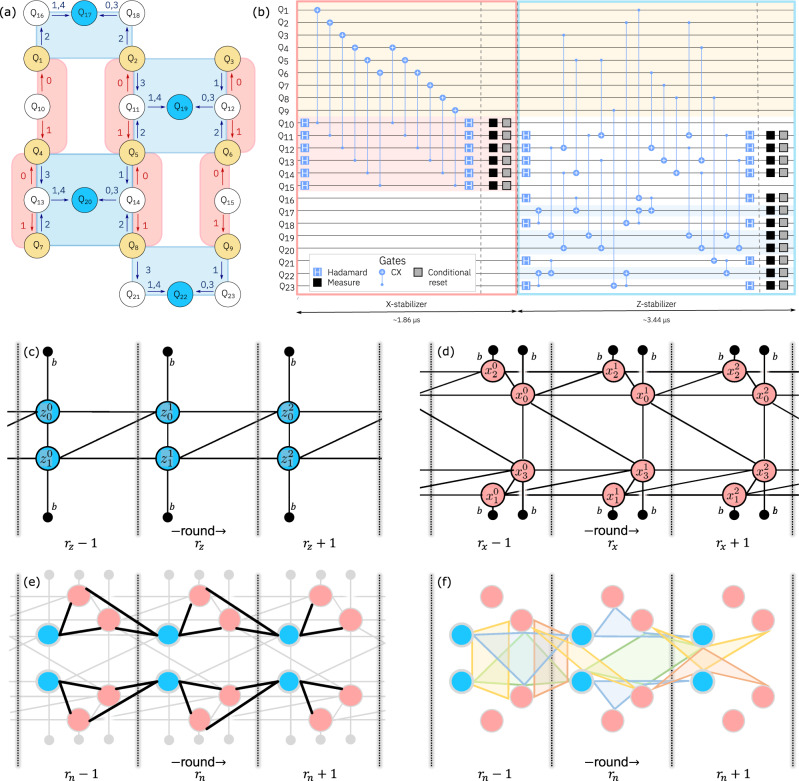
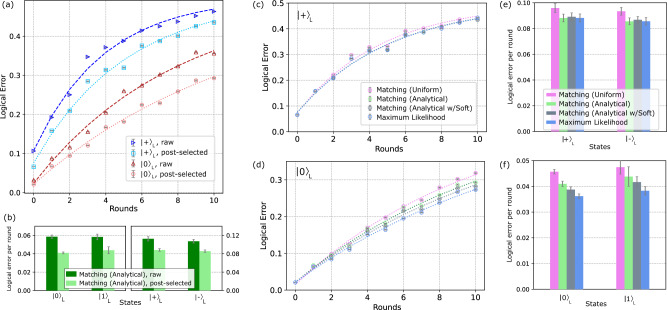
Quantum error correction offers a promising path for performing high fidelity quantum computations. Although fully fault-tolerant executions of algorithms remain unrealized, recent improvements in control electronics and quantum hardware enable increasingly advanced demonstrations of the necessary operations for error correction. Here, we perform quantum error correction on superconducting qubits connected in a heavy-hexagon lattice. We encode a logical qubit with distance three and perform several rounds of fault-tolerant syndrome measurements that allow for the correction of any single fault in the circuitry. Using real-time feedback, we reset syndrome and flag qubits conditionally after each syndrome extraction cycle. We report decoder dependent logical error, with average logical error per syndrome measurement in Z(X)-basis of ~0.040 (~0.088) and ~0.037 (~0.087) for matching and maximum likelihood decoders, respectively, on leakage post-selected data.
Overview
The claims and statistics of this paper haven’t been checked yet.
Free: it reads the open-access text and checks the first 5 claims that cite a source we can check. Create a free account to check every claim.
Integrity signals
Registry
Cites
Statistics
Figures
Verification
Claims the paper makes
The claims and statistics of this paper haven’t been checked yet.
Free: it reads the open-access text and checks the first 5 claims that cite a source we can check. Create a free account to check every claim.
Claims other papers make about this one
Each is checked against this paper’s own text: does it say what the citing paper says it does?
The source backs part of the claim, not all of it — or backs it for a different population, condition or comparison.
In the citing paper
“Over the past several years, there has been vast progress made in both theory, with the introduction of novel code constructions, improvements in code parameters, and decoding algorithms, and experiment, with advancements in the quality of qubits, coherence times, and gate fidelities, and even some early demonstrations of logical error suppression below threshold and small fault-tolerant primitiv”
From Quantum error correction and fault tolerance: A comprehensive tutorial (2026) · cites this paper as [29]
Experimental — accuracy not yet measuredThe cited source says what the claim attributes to it.
In the citing paper
“Recently, QEC experiments have been performed in various hardware platforms, including superconducting quantum circuits25–28, trapped ions29 and neutral atoms30.”
From Hardware-efficient quantum error correction via concatenated bosonic qubits (2025) · cites this paper as [27]
The cited source says what the claim attributes to it.
In the citing paper
“Correcting for both types of error requires QEC codes such as the surface code25–27, which have a relatively high overhead penalty1.”
From Hardware-efficient quantum error correction via concatenated bosonic qubits (2025) · cites this paper as [27]
Self-check
Percentages, sums and reported differences re-computed from the paper’s own numbers.
The self-check needs the paper’s full text.
Citations
Cites
A Limited Memory Algorithm for Bound Constrained Optimization
Byrd, R. H., Lu, P., Nocedal, J., & Zhu, C. (1995) · SIAM Journal on Scientific Computing · doi:10.1137/0916069 · Cited by 6,221 · cited 1×
“Here we chose to use the L-BFGS-B algorithm 38 due to ef fi ciency of optimization and ability to work with simple linear constraints.”
MethodDennis, E., Kitaev, A., Landahl, A., & Preskill, J. (2002) · Journal of Mathematical Physics · doi:10.1063/1.1499754 · Cited by 1,768 · cited 1×
“We further exploit recently described decoding strategies 15 and extend the decoding ideas to include maximum likelihood concepts 4,23,24 .”
MethodUniversal quantum computation with ideal Clifford gates and noisy ancillas
Bravyi, S., & Kitaev, A. (2005) · Physical Review A · doi:10.1103/physreva.71.022316 · Cited by 1,525 · cited 1×
“Also,someprotocols,likeusingamagicstateforalogical T -gate 9 , require the application of real-time feed-forward.”
BackgroundDennis, E., Kitaev, A., Landahl, A., & Preskill, J. (2001) · CERN Document Server (European Organization for Nuclear Research) · Cited by 1,485
Topological Quantum Distillation
Bombin, H., & Martin-Delgado, M. A. (2006) · Physical Review Letters · doi:10.1103/physrevlett.97.180501 · Cited by 700
Realizing repeated quantum error correction in a distance-three surface code
Krinner, S., Lacroix, N., Remm, A., Di Paolo, A., Genois, E., Leroux, C., Hellings, C., Lazar, S., Swiadek, F., Herrmann, J., et al. (2022) · Nature · doi:10.1038/s41586-022-04566-8 · Cited by 686 · cited 1×
“Inthe realmof error correction, there have been recent realizations of the distance-3 surface code on superconducting qubits with decoding 18 and post-selection 19 , as well as a FT implementation of a dynamically protected quantum memory using the color code 20 and the FT state preparation,…”
MethodThe Heisenberg Representation of Quantum Computers
Gottesman, D. (1998) · arXiv · doi:10.48550/arxiv.quant-ph/9807006 · Cited by 489 · cited 2×
“Constructing a decoding hypergraph for stabilizer circuits with Pauli noise can be done using standard Gottesman-Knill simulations 25 or similar Pauli tracing techniques 26 .”
MethodOperator quantum error-correcting subsystems for self-correcting quantum memories
Bacon, D. (2006) · Physical Review A · doi:10.1103/physreva.73.012340 · Cited by 486 · cited 1×
“We demonstrate these tools as part of the FT operation of a subsystem code [21], the heavy-hexagon code [1], on a superconducting quantum processor.”
MethodStim: a fast stabilizer circuit simulator
Gidney, C. (2021) · Quantum · doi:10.22331/q-2021-07-06-497 · Cited by 415 · cited 1×
“Constructing a decoding hypergraph for stabilizer circuits with Pauli noise can be done using standard Gottesman-Knill simulations 25 or similar Pauli tracing techniques 26 .”
MethodExponential suppression of bit or phase errors with cyclic error correction
Google Quantum, A. I., Chen, Z., Satzinger, K. J., Atalaya, J., Korotkov, A. N., Dunsworth, A., Sank, D., Quintana, C., McEwen, M., Barends, R., et al. (2021) · Nature · doi:10.1038/s41586-021-03588-y · Cited by 393 · cited 1×
“Repeated cycles of syndrome extraction have been shown in superconducting qubits in small error detecting codes 13,14 , including partial error correction 15 as well as a universal (albeit not FT) set of single-qubit gates 16 .”
Background
Cited by
Items 101–112 of 112
Soft information decoding with superconducting qubits
Hanisch, M. D., Hetényi, B., & Wootton, J. R. (2026) · APS Open Science · doi:10.1103/y9fh-4x6n · Cited by 4
“…soft decoding has been implemented in different settings: for improving the readout fidelity on a Si/SiGe two-qubit system [11], and for superconducting qubits using both a distance-three ( d = 3) heavy-hexagon code [12] and, recently, a distance-three ( d = 3) two-dimensional repetition code [13].”
InfluentialDimensionality reduction for closed-loop quantum gate calibration
Berger, E., Maurya, V., McIntyre, Z. M., Wei, K. X., Haas, H., & Puzzuoli, D. (2026) · Physical Review Applied · doi:10.1103/w2v4-7pvc · Cited by 5
Shinde, U. U., & Bandaru, R. (2025) · Scientific Reports · doi:10.1038/s41598-025-87782-2 · Cited by 1
QuantumACES.jl: design noise characterisation experiments for quantum computers
Hockings, E. T. (2025) · The Journal of Open Source Software · doi:10.21105/joss.07707 · Cited by 5
“The noise estimates produced by QuantumACES can inform decoders of the likelihood of physical error configurations in a quantum device (Chen et al., 2022; Higgott et al., 2023; Sundaresan et al., 2023; Tiurev et al., 2023; Tuckett et al., 2020), enabling noise-aware decoding.”
Pulsed HEMT LNA Operation for Qubit Readout
Zeng, Y., Stenarson, J., Sobis, P. J., & Grahn, J. V. (2025) · IEEE Transactions on Microwave Theory and Techniques · doi:10.1109/tmtt.2025.3556982 · Cited by 2
“The qubit readout pulse duration, which must be significantly shorter than the qubit’s deco-herence time to ensure high-fidelity measurements, typically ranging from tens of nanoseconds to several microseconds depending on the design of the readout circuits [22], [23], [24], [25], [26], [27].”
Community Detection via Quantum Random Walks with Subgraph Sampling
Gu, Q., Wen, Z., & Liu, J. (2026) · Communications in computer and information science · doi:10.1007/978-981-95-4791-3_8
Trotter-based quantum algorithm for solving transport equations with exponentially fewer time-steps
Zylberman, J., Fredon, T., Loureiro, N., & Debbasch, F. (2026) · Quantum Science and Technology · doi:10.1088/2058-9565/ae488e · Cited by 8
Hypergraph-based approximate maximum likelihood decoding for quantum codes under circuit-level noise
Chen, K., Zhu, M., Song, H. Y., Xie, W., & Li, X. (2026) · Physical Review Research · doi:10.1103/ydb8-vd3x · Cited by 1
Robust Error Detection and Correction for Low-Power, High-Speed Digital Data Communication
Rameshkumar, J., Veeramani, R., Karuppanasamy, K., Girija, S., Gouseeharan, S., & Dharanish, J. (2026) · International Conference on Computing Theory and Wireless Communications (ICCTWC) · doi:10.1109/icctwc68241.2026.11583490
“The rate of power consumption is 15% as it has less computational complexity [17] The proposed method has Cyclic Redundancy Check and Bose Chaudhuri Hocquenghem based encoding, detection and correction has CRC based error handling techniques enabling reliable data recovery.”
Anonymous, van der Meer, S. L. M., Serra-Peralta, M., Vroomans, T. H. F., Finkel, M. I., Veen, H. M., Beekman, M., & DiCarlo, L. (2026) · PRX Quantum · doi:10.1103/y66v-988s · Cited by 11
“We perform two experiments that benchmark the basic tasks in fault-tolerant quantum computation: the memory experiment [4–6, 32– 34”
Error Detection and Correction in Quantum Memory System Using Neuro-Quantum Net Enabled Intelligent
Devi, S. R., Baskaran, S., Rajendran, E., Rathika, N., Devi, G. S., & Sathiya, S. (2026) · International Conference on Data Science for Cyber-Physical Systems Resilience using Advanced Applications (ICDCA) · doi:10.1109/icdca69396.2026.11620018
“Traditional error correction methods are solely concerned with fixing only hardware issues, whereas AI-based methods focus only on the integrity of the data and the model is performing [7-9].”
Noise-Symmetry Optimization of Quantum Error-Corrected Metrology
Anonymous, & Pang, S. (2026) · Physical Review Letters · doi:10.1103/9xmv-s7wp
Metadata
- Authors
- Sundaresan, N., Yoder, T. J., Kim, Y., Li, M., Chen, E. H., Harper, G., Thorbeck, T., Cross, A. W., Córcoles, A. D., & Takita, M.
- Affiliations
- IBM (United States) (US)
- IBM Research - Thomas J. Watson Research Center (US)
- IBM Research - Almaden (US)
- Corresponding author
- Sundaresan, Neereja
- Yoder, Theodore J.
- ORCID
- Venue
- Nature Communications
- Published
- 2023-05-18
- Volume
- 14
- Issue
- 1
- Pages
- 2852-2852
- ISSN
- 2041-1723 (ISSN-L)
- PMC
- PMC10195837
- OpenAlex
- W4377047148
- Semantic Scholar
- 449a780217b93457d617e6ecdf3ca3b7c785f98f
- Cited by
- 108
- References
- 41
- Citations by year
- 2026: 13 · 2025: 41 · 2024: 34 · 2023: 16
- FWCI
- 9.80
- Type
- journal article
- Language
- en
- Open access
- gold
- doi.org
- Licence
- cc-by
- creativecommons.org/licenses/by/4.0 (tdm)
- creativecommons.org/licenses/by/4.0 (vor)
- Locations
- Nature Communications (publishedVersion, cc-by)
- PubMed Central (publishedVersion, cc-by)
- PubMed (publishedVersion)
- arXiv (Cornell University) (submittedVersion)
- RePEc: Research Papers in Economics (submittedVersion)
- DOAJ (DOAJ: Directory of Open Access Journals) (submittedVersion, cc-by-sa)
- arXiv (Cornell University) (cc-by)
- Funders
- ODNI | Intelligence Advanced Research Projects Activity (W911NF-16-1-0114, youngseok.kim1@ibm.com)
- Topics
- Physical Sciences › Computer Science › Artificial Intelligence › Quantum Computing Algorithms and Architecture
- Physical Sciences › Physics and Astronomy › Atomic and Molecular Physics, and Optics › Quantum Information and Cryptography
- Physical Sciences › Physics and Astronomy › Atomic and Molecular Physics, and Optics › Quantum many-body systems
- Keywords
- quantum error correction, subsystem codes, superconducting qubits, logical qubits, syndrome measurement, real-time feedback, logical error rate, post-selection, fault-tolerant quantum computing
About these checks
Registry, retraction, Cites and statistics results are computed, not judged, with one exception: a printed reference that no index lists is read once by a model before it counts as a citation error. Claims are extracted by a model and kept only when their quote appears verbatim in the text; each cited source is then checked, with a model’s help, for whether it says what the claim relies on. Those verdicts can be wrong — read the claim’s quote and the cited source before relying on one.
Statistics and arithmetic are recomputed, not judged.
Confidence bands are shown only for fields calibrated on our annotated test set. None is calibrated yet, so no band is shown.
What counts as a claim ›How we measure confidence ›How we check this ›
Are you an author, or do you see a problem with this page? Request a review
Data sources
Bibliographic data: Semantic Scholar, OpenAlex, Crossref.
Contains information from the Semantic Scholar Academic Graph Datasets, made available under the ODC Attribution License (ODC-BY 1.0).
Semantic Scholar’s data is described in: Kinney, R., et al. (2023). The Semantic Scholar Open Data Platform. arXiv:2301.10140.
