

Demonstrating multi-round subsystem quantum error correction using matching and maximum likelihood decoders
Open accessThe DOI matches its Crossref record; 50 of the 51 references it cites were found in a registry or an index.
Abstract
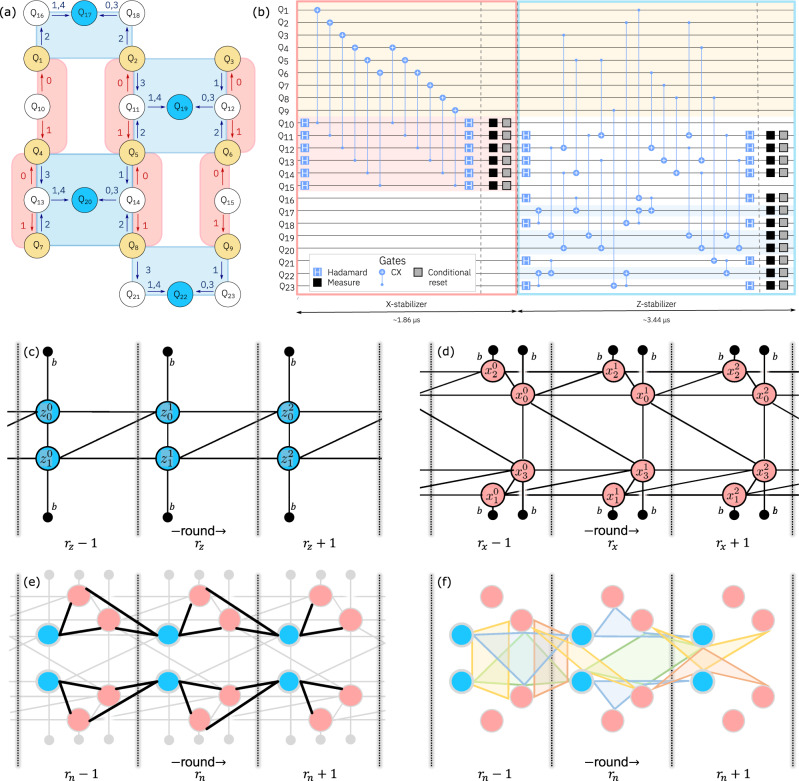
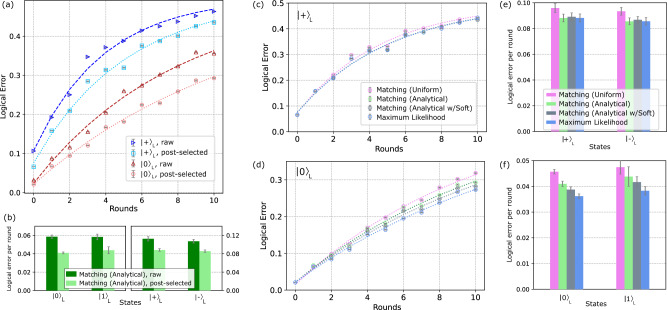
Quantum error correction offers a promising path for performing high fidelity quantum computations. Although fully fault-tolerant executions of algorithms remain unrealized, recent improvements in control electronics and quantum hardware enable increasingly advanced demonstrations of the necessary operations for error correction. Here, we perform quantum error correction on superconducting qubits connected in a heavy-hexagon lattice. We encode a logical qubit with distance three and perform several rounds of fault-tolerant syndrome measurements that allow for the correction of any single fault in the circuitry. Using real-time feedback, we reset syndrome and flag qubits conditionally after each syndrome extraction cycle. We report decoder dependent logical error, with average logical error per syndrome measurement in Z(X)-basis of ~0.040 (~0.088) and ~0.037 (~0.087) for matching and maximum likelihood decoders, respectively, on leakage post-selected data.
Overview
The claims and statistics of this paper haven’t been checked yet.
Free: it reads the open-access text and checks the first 5 claims that cite a source we can check. Create a free account to check every claim.
Integrity signals
Registry
Cites
Statistics
Figures
Verification
Claims the paper makes
The claims and statistics of this paper haven’t been checked yet.
Free: it reads the open-access text and checks the first 5 claims that cite a source we can check. Create a free account to check every claim.
Claims other papers make about this one
Each is checked against this paper’s own text: does it say what the citing paper says it does?
The source backs part of the claim, not all of it — or backs it for a different population, condition or comparison.
In the citing paper
“Over the past several years, there has been vast progress made in both theory, with the introduction of novel code constructions, improvements in code parameters, and decoding algorithms, and experiment, with advancements in the quality of qubits, coherence times, and gate fidelities, and even some early demonstrations of logical error suppression below threshold and small fault-tolerant primitiv”
From Quantum error correction and fault tolerance: A comprehensive tutorial (2026) · cites this paper as [29]
Experimental — accuracy not yet measuredThe cited source says what the claim attributes to it.
In the citing paper
“Recently, QEC experiments have been performed in various hardware platforms, including superconducting quantum circuits25–28, trapped ions29 and neutral atoms30.”
From Hardware-efficient quantum error correction via concatenated bosonic qubits (2025) · cites this paper as [27]
The cited source says what the claim attributes to it.
In the citing paper
“Correcting for both types of error requires QEC codes such as the surface code25–27, which have a relatively high overhead penalty1.”
From Hardware-efficient quantum error correction via concatenated bosonic qubits (2025) · cites this paper as [27]
Self-check
Percentages, sums and reported differences re-computed from the paper’s own numbers.
The self-check needs the paper’s full text.
Citations
Cites
A Limited Memory Algorithm for Bound Constrained Optimization
Byrd, R. H., Lu, P., Nocedal, J., & Zhu, C. (1995) · SIAM Journal on Scientific Computing · doi:10.1137/0916069 · Cited by 6,221 · cited 1×
“Here we chose to use the L-BFGS-B algorithm 38 due to ef fi ciency of optimization and ability to work with simple linear constraints.”
MethodDennis, E., Kitaev, A., Landahl, A., & Preskill, J. (2002) · Journal of Mathematical Physics · doi:10.1063/1.1499754 · Cited by 1,768 · cited 1×
“We further exploit recently described decoding strategies 15 and extend the decoding ideas to include maximum likelihood concepts 4,23,24 .”
MethodUniversal quantum computation with ideal Clifford gates and noisy ancillas
Bravyi, S., & Kitaev, A. (2005) · Physical Review A · doi:10.1103/physreva.71.022316 · Cited by 1,525 · cited 1×
“Also,someprotocols,likeusingamagicstateforalogical T -gate 9 , require the application of real-time feed-forward.”
BackgroundDennis, E., Kitaev, A., Landahl, A., & Preskill, J. (2001) · CERN Document Server (European Organization for Nuclear Research) · Cited by 1,485
Topological Quantum Distillation
Bombin, H., & Martin-Delgado, M. A. (2006) · Physical Review Letters · doi:10.1103/physrevlett.97.180501 · Cited by 700
Realizing repeated quantum error correction in a distance-three surface code
Krinner, S., Lacroix, N., Remm, A., Di Paolo, A., Genois, E., Leroux, C., Hellings, C., Lazar, S., Swiadek, F., Herrmann, J., et al. (2022) · Nature · doi:10.1038/s41586-022-04566-8 · Cited by 686 · cited 1×
“Inthe realmof error correction, there have been recent realizations of the distance-3 surface code on superconducting qubits with decoding 18 and post-selection 19 , as well as a FT implementation of a dynamically protected quantum memory using the color code 20 and the FT state preparation,…”
MethodThe Heisenberg Representation of Quantum Computers
Gottesman, D. (1998) · arXiv · doi:10.48550/arxiv.quant-ph/9807006 · Cited by 489 · cited 2×
“Constructing a decoding hypergraph for stabilizer circuits with Pauli noise can be done using standard Gottesman-Knill simulations 25 or similar Pauli tracing techniques 26 .”
MethodOperator quantum error-correcting subsystems for self-correcting quantum memories
Bacon, D. (2006) · Physical Review A · doi:10.1103/physreva.73.012340 · Cited by 486 · cited 1×
“We demonstrate these tools as part of the FT operation of a subsystem code [21], the heavy-hexagon code [1], on a superconducting quantum processor.”
MethodStim: a fast stabilizer circuit simulator
Gidney, C. (2021) · Quantum · doi:10.22331/q-2021-07-06-497 · Cited by 415 · cited 1×
“Constructing a decoding hypergraph for stabilizer circuits with Pauli noise can be done using standard Gottesman-Knill simulations 25 or similar Pauli tracing techniques 26 .”
MethodExponential suppression of bit or phase errors with cyclic error correction
Google Quantum, A. I., Chen, Z., Satzinger, K. J., Atalaya, J., Korotkov, A. N., Dunsworth, A., Sank, D., Quintana, C., McEwen, M., Barends, R., et al. (2021) · Nature · doi:10.1038/s41586-021-03588-y · Cited by 393 · cited 1×
“Repeated cycles of syndrome extraction have been shown in superconducting qubits in small error detecting codes 13,14 , including partial error correction 15 as well as a universal (albeit not FT) set of single-qubit gates 16 .”
BackgroundQiskit/qiskit-metapackage: Qiskit 0.43.0
Gambetta, J., Treinish, M., Kassebaum, P., Rodríguez, D. M., De La Puente González, S., Hu, S., Javadi-Abhari, A., Azaustre, C., Pistoia, M., Scholten, T. L., et al. (2019) · Zenodo (CERN European Organization for Nuclear Research) · doi:10.5281/zenodo.2573505 · Cited by 386
Fault-tolerant control of an error-corrected qubit
Egan, L., Debroy, D. M., Noel, C., Risinger, A., Zhu, D., Biswas, D., Newman, M., Li, M., Brown, K. R., Cetina, M., et al. (2021) · Nature · doi:10.1038/s41586-021-03928-y · Cited by 348 · cited 1×
“…qubits with decoding 18 and post-selection 19 , as well as a FT implementation of a dynamically protected quantum memory using the color code 20 and the FT state preparation, operation, and measurement, including its stabilizers,of a logical state in the Bacon-Shor code in ions 20,21 .”
MethodSelf-citationMitigating measurement errors in multiqubit experiments
Bravyi, S., Sheldon, S., Kandala, A., Mckay, D. C., & Gambetta, J. M. (2021) · Physical Review A · doi:10.1103/physreva.103.042605 · Cited by 343 · cited 1×
“S2a are classified according to calibration data obtained by preparing the |0〉, |1〉, and |2〉 states, using the closest distribution mean for each outcome, and then applying readout error mitigation by constraining the formalism described in [39] for multi-qubit readout to our single-qubit three-state subspace.”
MethodStabilizer Formalism for Operator Quantum Error Correction
Poulin, D. (2005) · Physical Review Letters · doi:10.1103/physrevlett.95.230504 · Cited by 342 · cited 1×
“Specifically for a heavy-hexagon lattice [1, 2] of qubits, subsystem QEC codes [3] are attractive because they are wellsuited for qubits with reduced connectivities.”
BackgroundRepeated quantum error detection in a surface code
Andersen, C. K., Remm, A., Lazar, S., Krinner, S., Lacroix, N., Norris, G. J., Gabureac, M., Eichler, C., & Wallraff, A. (2020) · Nature Physics · doi:10.1038/s41567-020-0920-y · Cited by 337 · cited 1×
“Repeated cycles of syndrome extraction have been shown in superconducting qubits in small error detecting codes [12, 13], including partial error correction [14] as well as a universal (albeit not FT) set of single-qubit gates [15].”
BackgroundRealization of an Error-Correcting Surface Code with Superconducting Qubits
Zhao, Y., Ye, Y., Huang, H.-L., Zhang, Y., Wu, D., Guan, H., Zhu, Q., Wei, Z., He, T., Cao, S., et al. (2022) · Physical Review Letters · doi:10.1103/physrevlett.129.030501 · Cited by 321 · cited 1×
“…error correction, there have been recent realizations of the distance-3 surface code on superconducting qubits with decoding 18 and post-selection 19 , as well as a FT implementation of a dynamically protected quantum memory using the color code 20 and the FT state preparation, operation, and…”
MethodRealization of Real-Time Fault-Tolerant Quantum Error Correction
Ryan-Anderson, C., Bohnet, J. G., Lee, K., Gresh, D., Hankin, A., Gaebler, J. P., Francois, D., Chernoguzov, A., Lucchetti, D., Brown, N. C., et al. (2021) · Physical Review X · doi:10.1103/physrevx.11.041058 · Cited by 306 · cited 1×
“…qubits with decoding 18 and post-selection 19 , as well as a FT implementation of a dynamically protected quantum memory using the color code 20 and the FT state preparation, operation, and measurement, including its stabilizers,of a logical state in the Bacon-Shor code in ions 20,21 .”
MethodDemonstration of fault-tolerant universal quantum gate operations
Postler, L., Heuβen, S., Pogorelov, I., Rispler, M., Feldker, T., Meth, M., Marciniak, C. D., Stricker, R., Ringbauer, M., Blatt, R., et al. (2022) · Nature · doi:10.1038/s41586-022-04721-1 · Cited by 287 · cited 1×
“A FT demonstration of a universal gate set on two logical qubits hasrecentlybeen reported inions 17 .”
BackgroundFault-tolerant operation of a logical qubit in a diamond quantum processor
Abobeih, M. H., Wang, Y., Randall, J., Loenen, S. J. H., Bradley, C. E., Markham, M., Twitchen, D. J., Terhal, B. M., & Taminiau, T. H. (2022) · Nature · doi:10.1038/s41586-022-04819-6 · Cited by 230 · cited 1×
“In particular, FT logical state preparation has been demonstrated on ions 10 , nuclear spins in diamond 11 and superconducting qubits 12 .”
Experimental Demonstration of Fault-Tolerant State Preparation with Superconducting Qubits
Takita, M., Cross, A. W., Córcoles, A. D., Chow, J. M., & Gambetta, J. M. (2017) · Physical Review Letters · doi:10.1103/physrevlett.119.180501 · Cited by 228 · cited 1×
“In particular, FT logical state preparation has been demonstrated on ions [9], nuclear spins in diamond [10] and superconducting qubits [11].”
BackgroundSelf-citationTopological and Subsystem Codes on Low-Degree Graphs with Flag Qubits
Chamberland, C., Zhu, G., Yoder, T. J., Hertzberg, J. B., & Cross, A. W. (2020) · Physical Review X · doi:10.1103/physrevx.10.011022 · Cited by 223
Self-citationEfficient algorithms for maximum likelihood decoding in the surface code
Bravyi, S., Suchara, M., & Vargo, A. (2014) · Physical Review A · doi:10.1103/physreva.90.032326 · Cited by 214
Towards Practical Classical Processing for the Surface Code
Fowler, A. G., Whiteside, A. C., & Hollenberg, L. C. L. (2012) · Physical Review Letters · doi:10.1103/physrevlett.108.180501 · Cited by 204
Sank, D., Chen, Z., Khezri, M., Kelly, J., Barends, R., Campbell, B., Chen, Y., Chiaro, B., Dunsworth, A., Fowler, A., et al. (2016) · Physical Review Letters · doi:10.1103/physrevlett.117.190503 · Cited by 203
Laser-annealing Josephson junctions for yielding scaled-up superconducting quantum processors
Hertzberg, J. B., Zhang, E. J., Rosenblatt, S., Magesan, E., Smolin, J. A., Yau, J.-B., Adiga, V. P., Sandberg, M., Brink, M., Chow, J. M., et al. (2021) · npj Quantum Information · doi:10.1038/s41534-021-00464-5 · Cited by 198 · cited 1×
“For fi xed-frequency superconducting qubits, a certain set of qubit frequency assignments may lead to frequency collisions during the cross-resonant gate operation 2 .”
BackgroundPyMatching: A Python Package for Decoding Quantum Codes with Minimum-Weight Perfect Matching
Higgott, O. (2022) · ACM Transactions on Quantum Computing · doi:10.1145/3505637 · Cited by 181 · cited 2×
“Matching decoders continue to be studied because of their practicality 27 and broad applicability 28,29 .”
BackgroundMethodQuantification and characterization of leakage errors
Wood, C. J., & Gambetta, J. M. (2018) · Physical Review A · doi:10.1103/physreva.97.032306 · Cited by 177
Fault-tolerant quantum error detection
Linke, N. M., Gutierrez, M., Landsman, K. A., Figgatt, C., Debnath, S., Brown, K. R., & Monroe, C. (2017) · Science Advances · doi:10.1126/sciadv.1701074 · Cited by 172 · cited 1×
“In particular, FT logical state preparation has been demonstrated on ions 10 , nuclear spins in diamond 11 and superconducting qubits 12 .”
Three-Qubit Randomized Benchmarking
McKay, D. C., Sheldon, S., Smolin, J. A., Chow, J. M., & Gambetta, J. M. (2019) · Physical Review Letters · doi:10.1103/physrevlett.122.200502 · Cited by 156 · cited 1×
“Furthermore, by introducing mixed dimensionality simultaneous RB [34], we can”
MethodReducing Unitary and Spectator Errors in Cross Resonance with Optimized Rotary Echoes
Sundaresan, N., Lauer, I., Pritchett, E., Magesan, E., Jurcevic, P., & Gambetta, J. M. (2020) · PRX Quantum · doi:10.1103/prxquantum.1.020318 · Cited by 142 · cited 1×
“The CX gates are constructed from the echoed cross-resonance gate [35], with lengths and gate directions optimized for overall device performance.”
MethodSelf-citationLogical-qubit operations in an error-detecting surface code
(2021) · doi:10.1038/s41567-021-01423-9 · Cited by 141 · cited 1×
“Repeated cycles of syndrome extraction have been shown in superconducting qubits in small error detecting codes 13,14 , including partial error correction 15 as well as a universal (albeit not FT) set of single-qubit gates 16 .”
BackgroundEffective Fault-Tolerant Quantum Computation with Slow Measurements
DiVincenzo, D. P., & Aliferis, P. (2007) · Physical Review Letters · doi:10.1103/physrevlett.98.020501 · Cited by 135 · cited 1×
“At the decoding level, whereas some protocols exist to perform quantum error correction asynchronously within a FT formalism [7, 8], the rate at which the error syndromes are received should be commensurate with their classical processing time to avoid an increasing backlog of syndrome data.”
MethodRemoving leakage-induced correlated errors in superconducting quantum error correction
McEwen, M., Kafri, D., Chen, Z., Atalaya, J., Satzinger, K. J., Quintana, C., Klimov, P. V., Sank, D., Gidney, C., Fowler, A. G., et al. (2021) · Nature Communications · doi:10.1038/s41467-021-21982-y · Cited by 129 · cited 1×
“…with leakage in superconducting qubit systems by moving all the qubit excitations to the readout resonator, from which they decay to the environment 43 , or by designing readout resonator leakage reduction units (LRU) 44 which exploit particular transition levels of the qubit-resonator system and…”
BackgroundRemoving leakage-induced correlated errors in superconducting quantum error correction
McEwen, M., Kafri, D., Chen, Z., Atalaya, J., Satzinger, K. J., Quintana, C., Klimov, P. V., Sank, D., Gidney, C., Fowler, A. G., et al. (2021) · RePEc: Research Papers in Economics · Cited by 82
Escape of a Driven Quantum Josephson Circuit into Unconfined States
Lescanne, R., Verney, L., Ficheux, Q., Devoret, M. H., Huard, B., Mirrahimi, M., & Leghtas, Z. (2019) · Physical Review Applied · doi:10.1103/physrevapplied.11.014030 · Cited by 81
Error Mitigation for Universal Gates on Encoded Qubits
Piveteau, C., Sutter, D., Bravyi, S., Gambetta, J. M., & Temme, K. (2021) · Physical Review Letters · doi:10.1103/physrevlett.127.200505 · Cited by 81 · cited 2×
“(6) for all hyperedges that contain bit j and have not already been included.”
BackgroundCalibrated Decoders for Experimental Quantum Error Correction
Chen, E. H., Yoder, T. J., Kim, Y., Sundaresan, N., Srinivasan, S., Li, M., Córcoles, A. D., Cross, A. W., & Takita, M. (2022) · Physical Review Letters · doi:10.1103/physrevlett.128.110504 · Cited by 71 · cited 6×
“[25] In the distance 2 case of [14], the hyperedges that did not have a unique logical label were called ambiguous, and were the motivation for a partial post-selection scheme.”
BackgroundMethodInfluentialSelf-citationImproved quantum error correction using soft informationPreprint
Pattison, C. A., Beverland, M. E., Silva, M. P. D., & Delfosse, N. (2021) · arXiv (Cornell University) · doi:10.48550/arxiv.2107.13589 · Cited by 69 · cited 1×
“We also include a version of the analytical decoder that exploits soft-information 33 , which is described in Meth-ods “ Soft-information decoding ” .”
MethodFault-Tolerant Operation of a Quantum Error-Correction Code
Egan, L., Debroy, D. M., Noel, C., Risinger, A., Zhu, D., Biswas, D., Newman, M., Li, M., Brown, K. R., Cetina, M., et al. (2020) · arXiv · doi:10.48550/arxiv.2009.11482 · Cited by 65
Self-citationFault-tolerant quantum computing in the Pauli or Clifford frame with slow error diagnostics
Chamberland, C., Iyer, P., & Poulin, D. (2018) · Quantum · doi:10.22331/q-2018-01-04-43 · Cited by 53 · cited 1×
“At the decoding level, whereas some protocols exist to perform quantum error correction asynchronously within a FT formalism [7, 8], the rate at which the error syndromes are received should be commensurate with their classical processing time to avoid an increasing backlog of syndrome data.”
MethodA Scalable Decoder Micro-architecture for Fault-Tolerant Quantum ComputingPreprint
Das, P., Pattison, C. A., Manne, S., Carmean, D. M., Svore, K. M., Qureshi, M. K., & Delfosse, N. (2020) · arXiv (Cornell University) · doi:10.48550/arxiv.2001.06598 · Cited by 53 · cited 1×
“Better noise modeling and the techniques of pre-decoding errors 34,35 might improve the performance and run-time of these decoders.”
MethodLocal Predecoder to Reduce the Bandwidth and Latency of Quantum Error Correction
Smith, S. C., Brown, B. J., & Bartlett, S. D. (2023) · Physical Review Applied · doi:10.1103/physrevapplied.19.034050 · Cited by 52
Battistel, F., Varbanov, B. M., & Terhal, B. M. (2021) · PRX Quantum · doi:10.1103/prxquantum.2.030314 · Cited by 44
Marques, J. F., Ali, H., Varbanov, B. M., Finkel, M., Veen, H. M., van der Meer, S. L. M., Valles-Sanclemente, S., Muthusubramanian, N., Beekman, M., Haider, N., et al. (2023) · Physical Review Letters · doi:10.1103/physrevlett.130.250602 · Cited by 42
Leakage suppression in the toric code
Suchara, M., Cross, A. W., & Gambetta, J. M. (2015) · 2015 IEEE International Symposium on Information Theory (ISIT) · doi:10.1109/isit.2015.7282629 · Cited by 38
Self-citationOptimal Circuit-Level Decoding for Surface CodesPreprint
Heim, B., Svore, K. M., & Hastings, M. B. (2016) · arXiv (Cornell University) · doi:10.48550/arxiv.1609.06373 · Cited by 30
Bravyi, S., & Cross, A. (2015) · arXiv · doi:10.48550/arxiv.1509.03239 · Cited by 27 · cited 1×
“In its original conception, MLD was applied to phenomenological noise models where errors occur only just before syndromes are measured [23, 30].”
MethodSelf-citationOn maximum-likelihood decoding with circuit-level errors
Pryadko, L. P. (2020) · Quantum · doi:10.22331/q-2020-08-06-304 · Cited by 20 · cited 2×
“More recently, MLD has been extended to include circuit noise 23,31 .”
BackgroundMethodQuantum error correction with fractal topological codes
Dua, A., Jochym-O’Connor, T., & Zhu, G. (2023) · Quantum · doi:10.22331/q-2023-09-26-1122 · Cited by 18 · cited 1×
“Matching decoders continue to be studied because of their practicality 27 and broad applicability 28,29 .”
BackgroundPyMatching: A Python package for decoding quantum codes with minimum-weight perfect matching
Higgott, O. (2021) · arXiv (Cornell University) · doi:10.48550/arxiv.2105.13082 · Cited by 10 · cited 2×
“Matching decoders continue to be studied because of their practicality 27 and broad applicability 28,29 .”
BackgroundMethodСучасний підхід до проблеми виникнення університету як соціокультурного феномену
Aslan (2018) · Electronic Volyn National University Institutional Repository · doi:10.5281/zenodo
Cited by
Suppressing quantum errors by scaling a surface code logical qubit
Google Quantum, A. I., Acharya, R., Aleiner, I., Allen, R., Andersen, T. I., Ansmann, M., Arute, F., Arya, K., Asfaw, A., Atalaya, J., et al. (2023) · Nature · doi:10.1038/s41586-022-05434-1 · Cited by 1,103
Real-time quantum error correction beyond break-even
Sivak, V. V., Eickbusch, A., Royer, B., Singh, S., Tsioutsios, I., Ganjam, S., Miano, A., Brock, B. L., Ding, A. Z., Frunzio, L., et al. (2023) · Nature · doi:10.1038/s41586-023-05782-6 · Cited by 407
Sparse blossom: correcting a million errors per core second with minimum-weight matching
Higgott, O., & Gidney, C. (2025) · Quantum · doi:10.22331/q-2025-01-20-1600 · Cited by 180
Sparse Blossom: correcting a million errors per core second with minimum-weight matching
Higgott, O., & Gidney, C. (2023) · arXiv · doi:10.48550/arxiv.2303.15933 · Cited by 148
Encoding a magic state with beyond break-even fidelity
Gupta, R. S., Sundaresan, N., Alexander, T., Wood, C. J., Merkel, S. T., Healy, M. B., Hillenbrand, M., Jochym-O’Connor, T., Wootton, J. R., Yoder, T. J., et al. (2024) · Nature · doi:10.1038/s41586-023-06846-3 · Cited by 115
“Here we propose and implement an error-suppressed encoding circuit to prepare a state that is input to magic-state distillation using a heavy-hexagonal lattice of superconducting qubits 4,5,27 .”
Self-citation
Metadata
- Authors
- Sundaresan, N., Yoder, T. J., Kim, Y., Li, M., Chen, E. H., Harper, G., Thorbeck, T., Cross, A. W., Córcoles, A. D., & Takita, M.
- Affiliations
- IBM (United States) (US)
- IBM Research - Thomas J. Watson Research Center (US)
- IBM Research - Almaden (US)
- Corresponding author
- Sundaresan, Neereja
- Yoder, Theodore J.
- ORCID
- Venue
- Nature Communications
- Published
- 2023-05-18
- Volume
- 14
- Issue
- 1
- Pages
- 2852-2852
- ISSN
- 2041-1723 (ISSN-L)
- PMC
- PMC10195837
- OpenAlex
- W4377047148
- Semantic Scholar
- 449a780217b93457d617e6ecdf3ca3b7c785f98f
- Cited by
- 108
- References
- 41
- Citations by year
- 2026: 13 · 2025: 41 · 2024: 34 · 2023: 16
- FWCI
- 9.80
- Type
- journal article
- Language
- en
- Open access
- gold
- doi.org
- Licence
- cc-by
- creativecommons.org/licenses/by/4.0 (tdm)
- creativecommons.org/licenses/by/4.0 (vor)
- Locations
- Nature Communications (publishedVersion, cc-by)
- PubMed Central (publishedVersion, cc-by)
- PubMed (publishedVersion)
- arXiv (Cornell University) (submittedVersion)
- RePEc: Research Papers in Economics (submittedVersion)
- DOAJ (DOAJ: Directory of Open Access Journals) (submittedVersion, cc-by-sa)
- arXiv (Cornell University) (cc-by)
- Funders
- ODNI | Intelligence Advanced Research Projects Activity (W911NF-16-1-0114, youngseok.kim1@ibm.com)
- Topics
- Physical Sciences › Computer Science › Artificial Intelligence › Quantum Computing Algorithms and Architecture
- Physical Sciences › Physics and Astronomy › Atomic and Molecular Physics, and Optics › Quantum Information and Cryptography
- Physical Sciences › Physics and Astronomy › Atomic and Molecular Physics, and Optics › Quantum many-body systems
- Keywords
- quantum error correction, subsystem codes, superconducting qubits, logical qubits, syndrome measurement, real-time feedback, logical error rate, post-selection, fault-tolerant quantum computing
About these checks
Registry, retraction, Cites and statistics results are computed, not judged, with one exception: a printed reference that no index lists is read once by a model before it counts as a citation error. Claims are extracted by a model and kept only when their quote appears verbatim in the text; each cited source is then checked, with a model’s help, for whether it says what the claim relies on. Those verdicts can be wrong — read the claim’s quote and the cited source before relying on one.
Statistics and arithmetic are recomputed, not judged.
Confidence bands are shown only for fields calibrated on our annotated test set. None is calibrated yet, so no band is shown.
What counts as a claim ›How we measure confidence ›How we check this ›
Are you an author, or do you see a problem with this page? Request a review
Data sources
Bibliographic data: Semantic Scholar, OpenAlex, Crossref.
Contains information from the Semantic Scholar Academic Graph Datasets, made available under the ODC Attribution License (ODC-BY 1.0).
Semantic Scholar’s data is described in: Kinney, R., et al. (2023). The Semantic Scholar Open Data Platform. arXiv:2301.10140.
