

Demonstrating multi-round subsystem quantum error correction using matching and maximum likelihood decoders
Open accessThe DOI matches its Crossref record; 50 of the 51 references it cites were found in a registry or an index.
Abstract
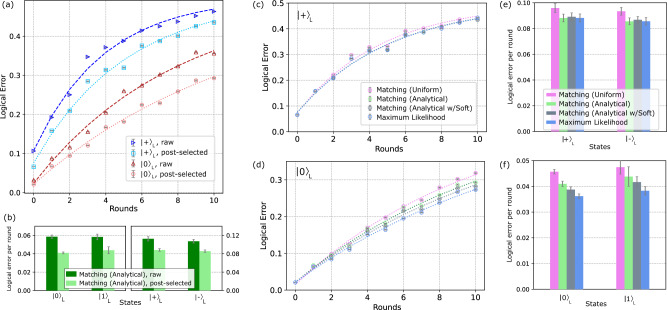
Quantum error correction offers a promising path for performing high fidelity quantum computations. Although fully fault-tolerant executions of algorithms remain unrealized, recent improvements in control electronics and quantum hardware enable increasingly advanced demonstrations of the necessary operations for error correction. Here, we perform quantum error correction on superconducting qubits connected in a heavy-hexagon lattice. We encode a logical qubit with distance three and perform several rounds of fault-tolerant syndrome measurements that allow for the correction of any single fault in the circuitry. Using real-time feedback, we reset syndrome and flag qubits conditionally after each syndrome extraction cycle. We report decoder dependent logical error, with average logical error per syndrome measurement in Z(X)-basis of ~0.040 (~0.088) and ~0.037 (~0.087) for matching and maximum likelihood decoders, respectively, on leakage post-selected data.
Overview
The claims and statistics of this paper haven’t been checked yet.
Free: it reads the open-access text and checks the first 5 claims that cite a source we can check. Create a free account to check every claim.
Integrity signals
Registry
Cites
Statistics
Figures
Verification
Claims the paper makes
The claims and statistics of this paper haven’t been checked yet.
Free: it reads the open-access text and checks the first 5 claims that cite a source we can check. Create a free account to check every claim.
Claims other papers make about this one
Each is checked against this paper’s own text: does it say what the citing paper says it does?
The source backs part of the claim, not all of it — or backs it for a different population, condition or comparison.
In the citing paper
“Over the past several years, there has been vast progress made in both theory, with the introduction of novel code constructions, improvements in code parameters, and decoding algorithms, and experiment, with advancements in the quality of qubits, coherence times, and gate fidelities, and even some early demonstrations of logical error suppression below threshold and small fault-tolerant primitiv”
From Quantum error correction and fault tolerance: A comprehensive tutorial (2026) · cites this paper as [29]
Experimental — accuracy not yet measuredThe cited source says what the claim attributes to it.
In the citing paper
“Recently, QEC experiments have been performed in various hardware platforms, including superconducting quantum circuits25–28, trapped ions29 and neutral atoms30.”
From Hardware-efficient quantum error correction via concatenated bosonic qubits (2025) · cites this paper as [27]
The cited source says what the claim attributes to it.
In the citing paper
“Correcting for both types of error requires QEC codes such as the surface code25–27, which have a relatively high overhead penalty1.”
From Hardware-efficient quantum error correction via concatenated bosonic qubits (2025) · cites this paper as [27]
Self-check
Percentages, sums and reported differences re-computed from the paper’s own numbers.
The self-check needs the paper’s full text.
Citations
Cites
A Limited Memory Algorithm for Bound Constrained Optimization
Byrd, R. H., Lu, P., Nocedal, J., & Zhu, C. (1995) · SIAM Journal on Scientific Computing · doi:10.1137/0916069 · Cited by 6,221 · cited 1×
“Here we chose to use the L-BFGS-B algorithm 38 due to ef fi ciency of optimization and ability to work with simple linear constraints.”
MethodDennis, E., Kitaev, A., Landahl, A., & Preskill, J. (2002) · Journal of Mathematical Physics · doi:10.1063/1.1499754 · Cited by 1,768 · cited 1×
“We further exploit recently described decoding strategies 15 and extend the decoding ideas to include maximum likelihood concepts 4,23,24 .”
MethodUniversal quantum computation with ideal Clifford gates and noisy ancillas
Bravyi, S., & Kitaev, A. (2005) · Physical Review A · doi:10.1103/physreva.71.022316 · Cited by 1,525 · cited 1×
“Also,someprotocols,likeusingamagicstateforalogical T -gate 9 , require the application of real-time feed-forward.”
BackgroundDennis, E., Kitaev, A., Landahl, A., & Preskill, J. (2001) · CERN Document Server (European Organization for Nuclear Research) · Cited by 1,485
Topological Quantum Distillation
Bombin, H., & Martin-Delgado, M. A. (2006) · Physical Review Letters · doi:10.1103/physrevlett.97.180501 · Cited by 700
Realizing repeated quantum error correction in a distance-three surface code
Krinner, S., Lacroix, N., Remm, A., Di Paolo, A., Genois, E., Leroux, C., Hellings, C., Lazar, S., Swiadek, F., Herrmann, J., et al. (2022) · Nature · doi:10.1038/s41586-022-04566-8 · Cited by 686 · cited 1×
“Inthe realmof error correction, there have been recent realizations of the distance-3 surface code on superconducting qubits with decoding 18 and post-selection 19 , as well as a FT implementation of a dynamically protected quantum memory using the color code 20 and the FT state preparation,…”
MethodThe Heisenberg Representation of Quantum Computers
Gottesman, D. (1998) · arXiv · doi:10.48550/arxiv.quant-ph/9807006 · Cited by 489 · cited 2×
“Constructing a decoding hypergraph for stabilizer circuits with Pauli noise can be done using standard Gottesman-Knill simulations 25 or similar Pauli tracing techniques 26 .”
MethodOperator quantum error-correcting subsystems for self-correcting quantum memories
Bacon, D. (2006) · Physical Review A · doi:10.1103/physreva.73.012340 · Cited by 486 · cited 1×
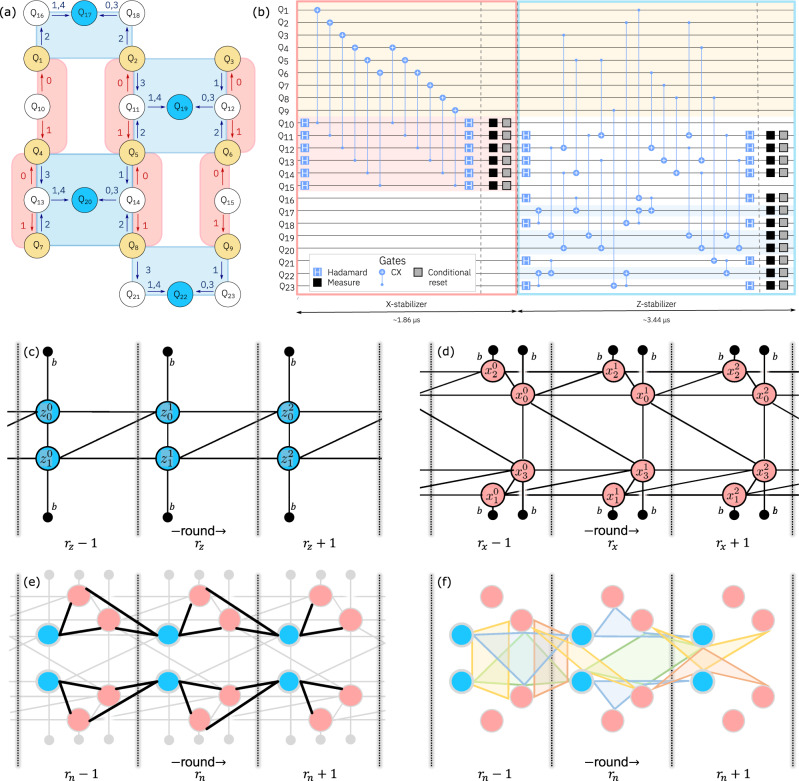
“We demonstrate these tools as part of the FT operation of a subsystem code [21], the heavy-hexagon code [1], on a superconducting quantum processor.”
MethodStim: a fast stabilizer circuit simulator
Gidney, C. (2021) · Quantum · doi:10.22331/q-2021-07-06-497 · Cited by 415 · cited 1×
“Constructing a decoding hypergraph for stabilizer circuits with Pauli noise can be done using standard Gottesman-Knill simulations 25 or similar Pauli tracing techniques 26 .”
MethodExponential suppression of bit or phase errors with cyclic error correction
Google Quantum, A. I., Chen, Z., Satzinger, K. J., Atalaya, J., Korotkov, A. N., Dunsworth, A., Sank, D., Quintana, C., McEwen, M., Barends, R., et al. (2021) · Nature · doi:10.1038/s41586-021-03588-y · Cited by 393 · cited 1×
“Repeated cycles of syndrome extraction have been shown in superconducting qubits in small error detecting codes 13,14 , including partial error correction 15 as well as a universal (albeit not FT) set of single-qubit gates 16 .”
Background
Cited by
Suppressing quantum errors by scaling a surface code logical qubit
Google Quantum, A. I., Acharya, R., Aleiner, I., Allen, R., Andersen, T. I., Ansmann, M., Arute, F., Arya, K., Asfaw, A., Atalaya, J., et al. (2023) · Nature · doi:10.1038/s41586-022-05434-1 · Cited by 1,103
Real-time quantum error correction beyond break-even
Sivak, V. V., Eickbusch, A., Royer, B., Singh, S., Tsioutsios, I., Ganjam, S., Miano, A., Brock, B. L., Ding, A. Z., Frunzio, L., et al. (2023) · Nature · doi:10.1038/s41586-023-05782-6 · Cited by 407
Sparse blossom: correcting a million errors per core second with minimum-weight matching
Higgott, O., & Gidney, C. (2025) · Quantum · doi:10.22331/q-2025-01-20-1600 · Cited by 180
Sparse Blossom: correcting a million errors per core second with minimum-weight matching
Higgott, O., & Gidney, C. (2023) · arXiv · doi:10.48550/arxiv.2303.15933 · Cited by 148
Encoding a magic state with beyond break-even fidelity
Gupta, R. S., Sundaresan, N., Alexander, T., Wood, C. J., Merkel, S. T., Healy, M. B., Hillenbrand, M., Jochym-O’Connor, T., Wootton, J. R., Yoder, T. J., et al. (2024) · Nature · doi:10.1038/s41586-023-06846-3 · Cited by 115
“Here we propose and implement an error-suppressed encoding circuit to prepare a state that is input to magic-state distillation using a heavy-hexagonal lattice of superconducting qubits 4,5,27 .”
Self-citationLearning high-accuracy error decoding for quantum processors
Bausch, J., Senior, A. W., Heras, F. J. H., Edlich, T., Davies, A., Newman, M., Jones, C., Satzinger, K., Niu, M. Y., Blackwell, S., et al. (2024) · Nature · doi:10.1038/s41586-024-08148-8 · Cited by 106
Hardware-efficient quantum error correction via concatenated bosonic qubits
Putterman, H., Noh, K., Hann, C. T., MacCabe, G. S., Aghaeimeibodi, S., Patel, R. N., Lee, M., Jones, W. M., Moradinejad, H., Rodriguez, R., et al. (2025) · Nature · doi:10.1038/s41586-025-08642-7 · Cited by 108
“Capitalizing on this noise bias, the authors can afford to correct only one type of error, therefore requiring only a one-dimensional repetition code, rather than a two-dimensional quantum error correction (QEC) code, therefore justifying the "hardware-efficient" qualifier.”
Overcoming leakage in quantum error correction
Miao, K. C., McEwen, M., Atalaya, J., Kafri, D., Pryadko, L. P., Bengtsson, A., Opremcak, A., Satzinger, K. J., Chen, Z., Klimov, P. V., et al. (2023) · Nature Physics · doi:10.1038/s41567-023-02226-w · Cited by 99
Relaxing Hardware Requirements for Surface Code Circuits using Time-dynamics
McEwen, M., Bacon, D., & Gidney, C. (2023) · Quantum · doi:10.22331/q-2023-11-07-1172 · Cited by 78
Real-time decoding for fault-tolerant quantum computing: progress, challenges and outlook
Battistel, F., Chamberland, C., Johar, K., Overwater, R. W. J., Sebastiano, F., Skorić, L., Ueno, Y., & Usman, M. (2023) · Nano Futures · doi:10.1088/2399-1984/aceba6 · Cited by 168
Scaling and logic in the colour code on a superconducting quantum processor
Lacroix, N., Bourassa, A., Heras, F. J. H., Zhang, L. M., Bausch, J., Senior, A. W., Edlich, T., Shutty, N., Sivak, V., Bengtsson, A., et al. (2025) · Nature · doi:10.1038/s41586-025-09061-4 · Cited by 51
“QEC implementations with superconducting qubits [7–9, 11, 34–36] have predominantly focused on the surface code [14] or variants thereof [37, 38], although alternative approaches such as bosonic encodings are also being explored [39, 40].”
Astrea: Accurate Quantum Error-Decoding via Practical Minimum-Weight Perfect-Matching
Vittal, S., Das, P., & Qureshi, M. K. (2023) · Proceedings - International Symposium on Computer Architecture/Proceedings · doi:10.1145/3579371.3589037 · Cited by 79
“Quantum error correction is reaching a regime where there are demonstrations of small QEC codes on both trapped-ions and superconducting based systems [1, 11, 39, 50, 56].”
BackgroundMethodSingle-shot quantum error correction with the three-dimensional subsystem toric code
Kubica, A., & Vasmer, M. (2022) · Nature Communications · doi:10.1038/s41467-022-33923-4 · Cited by 94
Autonomous Quantum Error Correction of Gottesman-Kitaev-Preskill States
Lachance-Quirion, D., Lemonde, M.-A., Simoneau, J. O., St-Jean, L., Lemieux, P., Turcotte, S., Wright, W., Lacroix, A., Fréchette-Viens, J., Shillito, R., et al. (2024) · Physical Review Letters · doi:10.1103/physrevlett.132.150607 · Cited by 92
ARQUIN: Architectures for Multinode Superconducting Quantum Computers
Ang, J., Carini, G. A., Chen, Y., Chuang, I. L., Demarco, M., Economou, S. E., Eickbusch, A., Faraon, A., Fu, K. C., Girvin, S. M., et al. (2024) · ACM Transactions on Quantum Computing · doi:10.1145/3674151 · Cited by 124
Demonstration of logical qubits and repeated error correction with better-than-physical error rates
Paetznick, A., da Silva, M. P., Ryan-Anderson, C., Bello-Rivas, J. M., Campora, J. P., Chernoguzov, A., Dreiling, J. M., Foltz, C., Frachon, F., Gaebler, J. P., et al. (2024) · arXiv · doi:10.48550/arxiv.2404.02280 · Cited by 42
Quantum computing for chemistry and physics applications from a Monte Carlo perspective
Mazzola, G. (2024) · The Journal of Chemical Physics · doi:10.1063/5.0173591 · Cited by 64
“For instance, direct matrix exponentiation e iHt for a typical many-body quantum Hamiltonian, H , and 50 spin-1/2 particles would require an array made of 10 15 entries undergoing a matrix-vector multiplication of size 2 50 × 2 50 = 10 30 .”
BackgroundIntroduction to quantum error correction and fault tolerance
Girvin, S. M. (2023) · SciPost Physics Lecture Notes · doi:10.21468/scipostphyslectnotes.70 · Cited by 70
Hyyppä, E., Kundu, S., Chan, C. F., Gunyhó, A., Hotari, J., Janzso, D., Júlíusson, K., Kiuru, O., Kotilahti, J., Landra, A., et al. (2022) · Nature Communications · doi:10.1038/s41467-022-34614-w · Cited by 60
Model-Based Optimization of Superconducting Qubit Readout
Bengtsson, A., Opremcak, A., Khezri, M., Sank, D., Bourassa, A., Satzinger, K. J., Hong, S., Erickson, C., Lester, B., Miao, K. C., et al. (2024) · Physical Review Letters · doi:10.1103/physrevlett.132.100603 · Cited by 69
Constructions and Performance of Hyperbolic and Semi-Hyperbolic Floquet Codes
Higgott, O., & Breuckmann, N. P. (2024) · PRX Quantum · doi:10.1103/prxquantum.5.040327 · Cited by 85
Creating Entangled Logical Qubits in the Heavy-Hex Lattice with Topological Codes
Hetényi, B., & Wootton, J. R. (2024) · PRX Quantum · doi:10.1103/prxquantum.5.040334 · Cited by 71
“Our results also allow the 3CX code to be compared to the heavy-hex code [12], which has also been implemented on IBM Quantum hardware [28, 29].”
Fast Flux-Activated Leakage Reduction for Superconducting Quantum Circuits
Lacroix, N., Hofele, L., Remm, A., Benhayoune-Khadraoui, O., McDonald, A., Shillito, R., Lazar, S., Hellings, C., Swiadek, F., Zanuz, D. C., et al. (2025) · Physical Review Letters · doi:10.1103/physrevlett.134.120601 · Cited by 65
“4(e)] that discards experimental runs in which a leakage event on the auxiliary qubit is detected using three-level readout [49, 50].”
Fast Flux-Activated Leakage Reduction for Superconducting Quantum Circuits
Lacroix, N., Hofele, L., Remm, A., Benhayoune-Khadraoui, O., McDonald, A., Shillito, R., Lazar, S., Hellings, C., Swiadek, F., Colao-Zanuz, D., et al. (2023) · arXiv · doi:10.48550/arxiv.2309.07060 · Cited by 29
“4(e)] that discards experimental runs in which a leakage event on the auxiliary qubit is detected using three-level readout [49, 50].”
Superconducting quantum computers: who is leading the future?
AbuGhanem, M. (2025) · EPJ Quantum Technology · doi:10.1140/epjqt/s40507-025-00405-7 · Cited by 61
Advancements in superconducting quantum computing
Jiang, Y.-Y., Deng, C., Fan, H., Li, B.-Y., Sun, L., Tan, X., Wang, W., Xue, G., Yan, F., Yu, H., et al. (2025) · National Science Review · doi:10.1093/nsr/nwaf246 · Cited by 85
Advancements in Quantum Computing—Viewpoint: Building Adoption and Competency in Industry
Pfaendler, S. M.-L., Konson, K., & Greinert, F. (2024) · Datenbank-Spektrum · doi:10.1007/s13222-024-00467-4 · Cited by 43
Data-driven decoding of quantum error correcting codes using graph neural networks
Lange, M., Havström, P., Srivastava, B., Bengtsson, I., Bergentall, V., Hammar, K., Heuts, O., van Nieuwenburg, E., & Granath, M. (2025) · Physical Review Research · doi:10.1103/physrevresearch.7.023181 · Cited by 76
“Efforts are under way to realize stabilizer codes experimentally using various qubit architectures [14–30].”
Demonstration of dynamic surface codes
Eickbusch, A., McEwen, M., Sivak, V., Bourassa, A., Atalaya, J., Claes, J., Kafri, D., Gidney, C., Warren, C. W., Gross, J., et al. (2025) · Nature Physics · doi:10.1038/s41567-025-03070-w · Cited by 34
A randomized benchmarking suite for mid-circuit measurements
Govia, L. C. G., Jurcevic, P., Wood, C. J., Kanazawa, N., Merkel, S., & McKay, D. C. (2023) · New Journal of Physics · doi:10.1088/1367-2630/ad0e19 · Cited by 52
Comparing Shor and Steane error correction using the Bacon-Shor code
Huang, S., Brown, K. R., & Cetina, M. (2024) · Science Advances · doi:10.1126/sciadv.adp2008 · Cited by 37
Group-theoretic error mitigation enabled by classical shadows and symmetries
Zhao, A., & Miyake, A. (2024) · npj Quantum Information · doi:10.1038/s41534-024-00854-5 · Cited by 50
Dissipative Dynamics of Graph-State Stabilizers with Superconducting Qubits
Shirizly, L., Misguich, G., & Landa, H. (2024) · Physical Review Letters · doi:10.1103/physrevlett.132.010601 · Cited by 31
Reducing the error rate of a superconducting logical qubit using analog readout information
Ali, H. A., Marques, J., Crawford, O., Majaniemi, J., Serra-Peralta, M., Byfield, D., Varbanov, B., Terhal, B. M., DiCarlo, L., & Campbell, E. T. (2024) · Physical Review Applied · doi:10.1103/physrevapplied.22.044031 · Cited by 37
“The process of converting a continuous measurement signal to binary outcomes inevitably leads to a loss of information that reduces decoder performance.”
Neural network decoder for near-term surface-code experiments
Varbanov, B. M., Serra-Peralta, M., Byfield, D., & Terhal, B. M. (2025) · Physical Review Research · doi:10.1103/physrevresearch.7.013029 · Cited by 20
Low-loss superconducting resonators fabricated from tantalum films grown at room temperature
Marcaud, G., Perello, D., Chen, C., Umbarkar, E. A., Weiland, C. R., Gao, J., Díez, S., Ly, V., Mahuli, N., D’Souza, N., et al. (2025) · Communications Materials · doi:10.1038/s43246-025-00897-x · Cited by 33
Codesign of quantum error-correcting codes and modular chiplets in the presence of defects
Lin, S. F., Viszlai, J., Smith, K. N., Ravi, G. S., Yuan, C., Chong, F. T., & Brown, B. J. (2024) · International Conference on Architectural Support for Programming Languages and Operating Systems (ASPLOS) · doi:10.1145/3620665.3640362 · Cited by 44
Effective qubit dephasing induced by spectator-qubit relaxation
Jurcevic, P., & Govia, L. C. G. (2022) · Quantum Science and Technology · doi:10.1088/2058-9565/ac8cad · Cited by 24
Characterizing non-Markovian off-resonant errors in quantum gates
Wei, K. X., Pritchett, E., Zajac, D. M., McKay, D. C., & Merkel, S. (2024) · Physical Review Applied · doi:10.1103/physrevapplied.21.024018 · Cited by 35
Three-qubit parity gate via simultaneous cross-resonance drives
Itoko, T., Malekakhlagh, M., Kanazawa, N., & Takita, M. (2024) · Physical Review Applied · doi:10.1103/physrevapplied.21.034018 · Cited by 23
“In particular, the SCRP implementation can reduce the average syndrome error probability of X -parity measurement for the heavy-hexagon code [51–53] by up to 28 percents comparing with a naive implementation with CNOT gates on the device (Sec.”
MethodSelf-citationLow-overhead quantum computing with the color code
Thomsen, F., Kesselring, M. S., Bartlett, S. D., & Brown, B. J. (2024) · Physical Review Research · doi:10.1103/physrevresearch.6.043125 · Cited by 15
Promatch: Extending the Reach of Real-Time Quantum Error Correction with Adaptive Predecoding
Alavisamani, N., Vittal, S., Ayanzadeh, R., Das, P., & Qureshi, M. K. (2024) · International Conference on Architectural Support for Programming Languages and Operating Systems (ASPLOS) · doi:10.1145/3620666.3651339 · Cited by 43
Artificial neural network syndrome decoding on IBM quantum processors
Hall, B., Gicev, S., & Usman, M. (2024) · Physical Review Research · doi:10.1103/physrevresearch.6.l032004 · Cited by 21
Non-Markovian Feedback for Optimized Quantum Error Correction
Puviani, M. B., Borah, S., Zen, R. A. M., Ollé, J., & Marquardt, F. (2025) · Physical Review Letters · doi:10.1103/physrevlett.134.020601 · Cited by 30
ERASER: Towards Adaptive Leakage Suppression for Fault-Tolerant Quantum Computing
Vittal, S., Das, P., & Qureshi, M. K. (2023) · IEEE/ACM International Symposium on Microarchitecture (MICRO) · doi:10.1145/3613424.3614251 · Cited by 17
“Recent studies from IBM and Google show that leakage errors degrade QEC performance on real hardware [1, 41, 64].”
BackgroundMethodInfluentialMitigation of quantum crosstalk in cross-resonance-based qubit architectures
Zhao, P. (2023) · Physical Review Applied · doi:10.1103/physrevapplied.20.054033 · Cited by 21
“For instance, the past decade has witnessed tremendous progress toward improving both the system size and gate performance for the CR-based transmon architecture, which has led to the demonstrations of small-scale error correction codes [10, 11] and the exploration of quantum advantage before fault tolerance [12].”
BackgroundMitigating errors in logical qubits
Smith, S. C., Brown, B. J., & Bartlett, S. D. (2024) · Communications Physics · doi:10.1038/s42005-024-01883-4 · Cited by 47
Hockings, E. T., Doherty, A. C., & Harper, R. (2025) · PRX Quantum · doi:10.1103/prxquantum.6.010334 · Cited by 37
“Scalable noise characterisation methods can improve the performance of error correction by identifying which physical configurations of errors are more and less likely [17].”
Hellings, C., Lacroix, N., Remm, A., Boell, R., Herrmann, J., Lazar, S., Krinner, S., Swiadek, F., Andersen, C. K., Eichler, C., et al. (2025) · Physical Review Research · doi:10.1103/1qhb-r4fb · Cited by 32
Improving Threshold for Fault-Tolerant Color-Code Quantum Computing by Flagged Weight Optimization
Takada, Y., & Fujii, K. (2024) · PRX Quantum · doi:10.1103/prxquantum.5.030352 · Cited by 10
“[38, 39], i.e., immediately apply Pauli operators corresponding to the errors that are implied by the flag values to the data qubits.”
BackgroundMethodLewalle, P., Zhang, Y., & Whaley, K. B. (2024) · PRX Quantum · doi:10.1103/prxquantum.5.020366 · Cited by 27
Enhanced qubit readout via reinforcement learning
Chatterjee, A., Schwinger, J., & Gao, Y. Y. (2025) · Physical Review Applied · doi:10.1103/physrevapplied.23.054057 · Cited by 22
“As we strive toward practical quantum computation, rapid and effective readout is essential for many critical tasks, such as adaptive quantum error correction protocols [2, 3] or dynamic quantum circuits that demand many mid-circuit measurements [4].”
Convolutional-Neural-Network-Based Hexagonal Quantum Error Correction Decoder
Li, A.-Q., Li, F., Qi-Di, G. A. N., & Ma, H. (2023) · Applied Sciences · doi:10.3390/app13179689 · Cited by 15
“[20].”
Weight-Reduced Stabilizer Codes with Lower Overhead
Sabo, E., Gunderman, L. G., Ide, B., Vasmer, M., & Dauphinais, G. (2024) · PRX Quantum · doi:10.1103/prxquantum.5.040302 · Cited by 32
“…an input hypergraph product code with parameters [[45 , 9 , 3]] , weight seven checks, and qubit degree four, our method gives a [[65 , 9 , 4]] code with weight six checks and qubit degree three, whereas Hastings’s method gives a [[2892 , 9 , 5]] code with weight six checks and qubit degree six.”
MethodQuantum error correction under numerically exact open-quantum-system dynamics
Babu, A. P., Orell, T., Vadimov, V., Teixeira, W. S., Möttönen, M., & Silveri, M. (2023) · Physical Review Research · doi:10.1103/physrevresearch.5.043161 · Cited by 14
Quantum computer error structure probed by quantum error correction syndrome measurements
Gicev, S., Hollenberg, L. C. L., & Usman, M. (2024) · Physical Review Research · doi:10.1103/physrevresearch.6.043249 · Cited by 20
“These investigations, based on data after the decoding process, revealed instances of leakage, cross-talk and unwanted interactions which can be present in real QEC operation, highlighting the inadequacy of the uniform depolarizing noise model at the foundation of the field.”
Modeling error correction with Lindblad dynamics and approximate channels
Schwartzman-Nowik, Z., Shirizly, L., & Landa, H. (2025) · Physical Review A · doi:10.1103/physreva.111.022613 · Cited by 17
Burgelman, M., Wonglakhon, N., Bernal-García, D. N., Paz-Silva, G. A., & Viola, L. (2025) · PRX Quantum · doi:10.1103/prxquantum.6.010323 · Cited by 10
“…proved instrumental in enabling recent landmark achievements, ranging from the demonstration of a provable algorithmic quantum speedup [35] to initial realizations of multi-round quantum error correction (QEC) in repetition [36], color [37], surface codes [36, 38], and surface code hybrids [39].”
Universal quantum control with dynamical correction
Jin, Z.-Y., & Jing, J. (2025) · Physical Review A · doi:10.1103/vfrs-fyzw · Cited by 6
“Inspired by Shor’s code, many QEC coding schemes [12–21] have been proposed, including the Bacon-Shor [12], color [13], five-qubit [14], heavy-hexagon [15], surface [16, 17], and continuous-variable [18–21] codes.”
Universal Adapters between Quantum Low-Density Parity Check Codes
Swaroop, E., Jochym-O'Connor, T., & Yoder, T. J. (2026) · PRX Quantum · doi:10.1103/1g44-jp62 · Cited by 103
Self-citationZhang, Z., Gokhale, P., & Larson, J. M. (2025) · Physical Review A · doi:10.1103/physreva.111.012619 · Cited by 13
“Superconducting (SC) quantum processors have led to significant progress in numerous domains, including demonstrations of quantum advantage [1, 2], quantum error correction [3, 4], variational methods [5–8], and analog simulations [9, 10].”
Probing Quantum Telecloning on Superconducting Quantum Processors
Pelofske, E., Bärtschi, A., Eidenbenz, S., Garcia, B., & Kiefer, B. (2024) · IEEE Transactions on Quantum Engineering · doi:10.1109/tqe.2024.3391654 · Cited by 9
“This is a very important feature to be evaluated, since it is a critical ingredient in quantum error correction [67], [110], [111], [112], [113].”
BackgroundTransmon-qubit readout using an in situ bifurcation amplification in the mesoscopic regime
Dassonneville, R., Ramos, T., Milchakov, V., Mori, C., Planat, L., Foroughi, F., Naud, C., Guichard, W., García‐Ripoll, J. J., Roch, N., et al. (2023) · Physical Review Applied · doi:10.1103/physrevapplied.20.044050 · Cited by 6
Error crafting in mixed quantum gate synthesis
Yoshioka, N., Akibue, S., Morisaki, H., Tsubouchi, K., & Suzuki, Y. (2025) · npj Quantum Information · doi:10.1038/s41534-025-01032-x · Cited by 10
“With the tremendous advancements in quantum technology, the earliest experimental demonstrations of quantum error correction were realized with various codes 7 – 15 .”
Single-shot error correction on toric codes with high-weight stabilizers
Lin, Y., Huang, S., & Brown, K. R. (2024) · Physical Review A · doi:10.1103/physreva.109.052438 · Cited by 8
Advances in quantum error correction based on superconducting quantum systems
Chen, Z.-J., Pan, X., Hua, Z., Wang, W., Ma, Y., Li, M., Zou, X., Sun, L., & Zou, C. (2022) · Acta Physica Sinica · doi:10.7498/aps.71.20221824 · Cited by 5
Self-citationEnhanced repetition codes for the cross-platform comparison of progress towards fault-tolerance
Liepelt, M., Peduzzi, T., & Wootton, J. R. (2024) · Journal of Physics A Mathematical and Theoretical · doi:10.1088/1751-8121/ad5085 · Cited by 8
Thresholds for Postselected Quantum Error Correction from Statistical Mechanics
English, L., Williamson, D. J., & Bartlett, S. D. (2025) · Physical Review Letters · doi:10.1103/nh49-52y2 · Cited by 25
Decoding across Transversal Clifford Gates in the Surface Code
Serra-Peralta, M., Shaw, M. H., & Terhal, B. M. (2026) · PRX Quantum · doi:10.1103/sk5y-25b1 · Cited by 52
“As a consequence, single measurement errors can flip more than two detectors, corresponding to so-called hyper-edges in a decoding hypergraph [16].”
Neural Decoders for Universal Quantum Algorithms
Ataides, J. P. B., Gu, A., Yelin, S. F., & Lukin, M. D. (2026) · PRX Intelligence · doi:10.1103/vjn1-mbxl · Cited by 28
Li, A.-Q., 田, C.-W. 策. T., Xu, X., Ma, H., & Liang, J. (2025) · Chinese Physics B · doi:10.1088/1674-1056/adab63 · Cited by 8
Chang, H.-C., Hsu, H.-C., & Lin, Y. (2025) · Physical Review Research · doi:10.1103/physrevresearch.7.013043 · Cited by 8
“To obtain the best possible re-sults from today’s noisy intermediate-scale quantum (NISQ) devices, numerous techniques for error correction [8, 9], error mitigation [10] and optimization strategies [11] have been developed in the past few years.”
BackgroundSynchronization for Fault-Tolerant Quantum Computers
Maurya, S., & Tannu, S. (2025) · Proceedings - International Symposium on Computer Architecture/Proceedings · doi:10.1145/3695053.3730991 · Cited by 20
Effectiveness of the syndrome extraction circuit with flag qubits on IBM quantum hardware
Kim, Y., Kim, H., Kang, J., Choi, W., & Kwon, Y. (2025) · Quantum · doi:10.22331/q-2025-10-23-1893 · Cited by 8
“Quantum error correction on current IBM machines has been explored to demonstrate logical encodings [1, 29, 30, 31, 32] and to observe error suppression by scaling the distance of a logical qubit [1, 2].”
Self-citationReadout Error Mitigation for Mid-Circuit Measurements and Feedforward
Koh, J. M., Koh, D. E., & Thompson, J. (2026) · PRX Quantum · doi:10.1103/cj89-4h5t · Cited by 29
“It also underpins quantum error correction [4–7], which functions by way of repeated syndrome measurements and conditioned recovery operations.”
Exact results on finite size corrections for surface codes tailored to biased noise
Xiao, Y., Srivastava, B., & Granath, M. (2024) · Quantum · doi:10.22331/q-2024-09-11-1468 · Cited by 11
“With the recent advances in hardware implementations of quantum error correcting codes [ 1– 21], important In parallel with experimental developments, new error correcting codes that cater to hardware specificities such as low qubit connectivity [31–34], or biased single-qubit noise profiles…”
BackgroundUsing detector likelihood for benchmarking quantum error correction
Hesner, I., Hetényi, B., & Wootton, J. R. (2025) · Physical Review A · doi:10.1103/physreva.111.052452 · Cited by 3
More buck-per-shot: Why learning trumps mitigation in noisy quantum sensing
Ijaz, A., Alderete, C. H., Sauvage, F., Cincio, Ł., Cerezo, M., & Goh, M. L. (2025) · Materials Today Quantum · doi:10.1016/j.mtquan.2025.100042 · Cited by 12
Experimentally informed decoding of stabilizer codes based on syndrome correlations
Remm, A., Lacroix, N., Bödeker, L., Genois, É., Hellings, C., Swiadek, F., Norris, G. J., Eichler, C., Blais, A., Müller, M., et al. (2026) · Physical Review Research · doi:10.1103/z1ng-wg3k · Cited by 15
Randomized benchmarking protocol for dynamic circuits
Shirizly, L., Govia, L. C. G., & McKay, D. C. (2025) · Physical Review A · doi:10.1103/physreva.111.012611 · Cited by 14
“Firstly, there is a different assignment error whether the measured qubit is in | 0 ⟩ or | 1 ⟩ , partly due to T 1 decay during the measurement [47] impacting the assigned bit value, but also be due to other issues such as leakage [1, 43].”
Simultaneous transient dispersive readout of multiple spin qubits
Ginzel, F., & Burkard, G. (2023) · Physical review. B./Physical review. B · doi:10.1103/physrevb.108.125437 · Cited by 3
On the Efficacy of Surface Codes in Compensating for Radiation Events in Superconducting Devices
Vallero, M., Casagranda, G., Vella, F., & Rech, P. (2024) · International Conference for High Performance Computing, Networking, Storage and Analysis (SC) · doi:10.1109/sc41406.2024.00075 · Cited by 12
Magic Mirror on the Wall, How to Benchmark Quantum Error Correction Codes, Overall?
Chatterjee, A., & Ghosh, S. (2024) · IEEE International Conference on Quantum Computing and Engineering (QCE) · doi:10.1109/qce60285.2024.00050 · Cited by 8
“5 shows the two different layouts of a surface code: unrotated and rotated.”
Zhao, Y., & Liu, D. E. (2025) · PNAS Nexus · doi:10.1093/pnasnexus/pgaf063 · Cited by 5
“Such a procedure is also adopted by experiments (23).”
Characterising the failure mechanisms of error-corrected quantum logic gates
Harper, R., Lainé, C., Hockings, E. T., McLauchlan, C., Nixon, G. M., Brown, B. J., & Bartlett, S. D. (2026) · Nature Communications · doi:10.1038/s41467-026-71773-6 · Cited by 25
“We also vary these parameters individually to examine the effect of each noise parameter on stability and memory performance and present these results in Fig.”
Generalizing the matching decoder for the Chamon code
Schwartzman-Nowik, Z., & Brown, B. J. (2025) · Quantum · doi:10.22331/q-2025-06-18-1775 · Cited by 4
Magic state injection on IBM quantum processors above the distillation threshold
Kim, Y., Sevior, M. E., & Usman, M. (2026) · Scientific Reports · doi:10.1038/s41598-026-40381-1 · Cited by 21
“Second, we classically controlled the X gates based on the measurement results of the qubits to reset the physical qubits [42].”
Self-citationMinimising surface-code failures using a color-code decoder
Benhemou, A., Sahay, K., Lao, L., & Brown, B. J. (2025) · Quantum · doi:10.22331/q-2025-02-17-1632 · Cited by 10
“Topological codes, such as the surface code [15, 16, 7, 17] and color code [18, 19, 20, 21], are among the most promising quantum error-correcting codes to be realised with quantum technology that is now under development [22, 23, 24, 25, 26, 27].”
Transversal cnot gate with multicycle error correction
Kim, Y., Sevior, M. E., & Usman, M. (2025) · Physical Review Applied · doi:10.1103/physrevapplied.23.024074 · Cited by 7
“The post-selection method has been used as a key technique in recent experimental demonstrations of quantum error correction in the NISQ era [15, 35–40, 49, 50].”
Self-citationComputational Renaissance and Quantum Horizons: New Directions for Cybersecurity
Bedi, P., Das, S., Goyal, S. B., Rajawat, A. S., & Kumar, V. G. (2025) · Springer eBooks · doi:10.1007/978-981-96-4948-8_5 · Cited by 1
Karmakar, T., Lewalle, P., Zhang, Y., & Whaley, K. B. (2026) · Physical Review A · doi:10.1103/cnxj-m1wn · Cited by 8
Feedforward suppression of readout-induced faults in quantum error correction
Shirizly, L., Meirom, D., Carroll, M. S., & Landa, H. (2025) · Physical Review A · doi:10.1103/ght4-yqmb · Cited by 7
“Leakage rates on the order of 10 − 3 have been reported with transmon qubits [3] and we vary the leakage rate in this regime.”
Robust hybrid qubit plane architecture for enhancing lattice-surgery-based surface codes
Heng, S., Heng, S., Kim, D., & Han, Y. (2024) · Physical Review A · doi:10.1103/physreva.109.022440 · Cited by 1
RESCUED: Robust Quantum Error Correction with Surface Code in Noisy Channels Using Ensemble Decoder
Barua, S., Shubha, S. E. U., Rahman, M., Uchash, A. J., & Mahdy, M. R. C. (2023) · IEEE International Conference on Telecommunications and Photonics (ICTP) · doi:10.1109/ictp60248.2023.10490966 · Cited by 3
Reducing the Error Rate of a Superconducting Logical Qubit using Analog Readout Information
Ali, H. A., Marques, J., Crawford, O., Majaniemi, J., Serra-Peraltal, M., Byfield, D., Varbanov, B., Terhal, B. M., DiCarlo, L., & Campbell, E. T. (2024) · IEEE International Conference on Quantum Computing and Engineering (QCE) · doi:10.1109/qce60285.2024.10316 · Cited by 3
Logical Noise Bias in Magic State Injection
Fazio, N., Harper, R., & Bartlett, S. D. (2025) · Quantum · doi:10.22331/q-2025-06-24-1779 · Cited by 8
Q-Pandora Unboxed: Characterizing Noise Resilience of Quantum Error Correction CodesPreprint
Chatterjee, A., Das, S. K., & Ghosh, S. (2023) · Research Square · doi:10.21203/rs.3.rs-3663236/v1 · Cited by 3
Quantum error correction and fault tolerance: A comprehensive tutorial
Spencer, D. J., Jain, S. P., Tanggara, A., Sun, Z., Haug, T., Khu, D., & Bharti, K. (2026) · arXiv
RETRACTED: Tripartite W-States and LOCC Marvel: Quantum Communication's Dynamic DuoPreprint
Aman, M. N., Khan, M. A., Ullah, N., & Sikdar, B. (2024) · Research Square · doi:10.21203/rs.3.rs-4724445/v1
RetractedFreezing phenomenon in high-dimensional quantum correlation dynamics
Fu, Y., Liu, W., Wang, Y., Duan, C., Zhang, B., Wang, Y., & Rong, X. (2024) · Physical Review Applied · doi:10.1103/physrevapplied.22.054067
Metadata
- Authors
- Sundaresan, N., Yoder, T. J., Kim, Y., Li, M., Chen, E. H., Harper, G., Thorbeck, T., Cross, A. W., Córcoles, A. D., & Takita, M.
- Affiliations
- IBM (United States) (US)
- IBM Research - Thomas J. Watson Research Center (US)
- IBM Research - Almaden (US)
- Corresponding author
- Sundaresan, Neereja
- Yoder, Theodore J.
- ORCID
- Venue
- Nature Communications
- Published
- 2023-05-18
- Volume
- 14
- Issue
- 1
- Pages
- 2852-2852
- ISSN
- 2041-1723 (ISSN-L)
- PMC
- PMC10195837
- OpenAlex
- W4377047148
- Cited by
- 108
- References
- 41
- Citations by year
- 2026: 13 · 2025: 41 · 2024: 34 · 2023: 16
- FWCI
- 9.80
- Type
- journal article
- Language
- en
- Open access
- gold
- doi.org
- Licence
- cc-by
- creativecommons.org/licenses/by/4.0 (tdm)
- creativecommons.org/licenses/by/4.0 (vor)
- Locations
- Nature Communications (publishedVersion, cc-by)
- PubMed Central (publishedVersion, cc-by)
- PubMed (publishedVersion)
- arXiv (Cornell University) (submittedVersion)
- RePEc: Research Papers in Economics (submittedVersion)
- DOAJ (DOAJ: Directory of Open Access Journals) (submittedVersion, cc-by-sa)
- arXiv (Cornell University) (cc-by)
- Funders
- ODNI | Intelligence Advanced Research Projects Activity (W911NF-16-1-0114, youngseok.kim1@ibm.com)
- Topics
- Physical Sciences › Computer Science › Artificial Intelligence › Quantum Computing Algorithms and Architecture
- Physical Sciences › Physics and Astronomy › Atomic and Molecular Physics, and Optics › Quantum Information and Cryptography
- Physical Sciences › Physics and Astronomy › Atomic and Molecular Physics, and Optics › Quantum many-body systems
- Keywords
- quantum error correction, subsystem codes, superconducting qubits, logical qubits, syndrome measurement, real-time feedback, logical error rate, post-selection, fault-tolerant quantum computing
About these checks
Registry, retraction, Cites and statistics results are computed, not judged, with one exception: a printed reference that no index lists is read once by a model before it counts as a citation error. Claims are extracted by a model and kept only when their quote appears verbatim in the text; each cited source is then checked, with a model’s help, for whether it says what the claim relies on. Those verdicts can be wrong — read the claim’s quote and the cited source before relying on one.
Statistics and arithmetic are recomputed, not judged.
Confidence bands are shown only for fields calibrated on our annotated test set. None is calibrated yet, so no band is shown.
What counts as a claim ›How we measure confidence ›How we check this ›
Are you an author, or do you see a problem with this page? Request a review
Data sources
Bibliographic data: Semantic Scholar, OpenAlex, Crossref.
Contains information from the Semantic Scholar Academic Graph Datasets, made available under the ODC Attribution License (ODC-BY 1.0).
Semantic Scholar’s data is described in: Kinney, R., et al. (2023). The Semantic Scholar Open Data Platform. arXiv:2301.10140.
