

The NuRD complex cooperates with SALL4 to orchestrate reprogramming
Open accessThe DOI matches its Crossref record; 79 of the 79 references it cites were found in a registry or an index; 22 of the 40 sources its claims cite were checked for support.
Abstract
Cell fate decision involves rewiring of the genome, but remains poorly understood at the chromatin level. Here, we report that chromatin remodeling complex NuRD participates in closing open chromatin in the early phase of somatic reprogramming. Sall4, Jdp2, Glis1 and Esrrb can reprogram MEFs to iPSCs efficiently, but only Sall4 is indispensable capable of recruiting endogenous components of NuRD. Yet knocking down NuRD components only reduces reprogramming modestly, in contrast to disrupting the known Sall4-NuRD interaction by mutating or deleting the NuRD interacting motif at its N-terminus that renders Sall4 inept to reprogram. Remarkably, these defects can be partially rescured by grafting NuRD interacting motif onto Jdp2. Further analysis of chromatin accessibility dynamics demonstrates that the Sall4-NuRD axis plays a critical role in closing the open chromatin in the early phase of reprogramming. Among the chromatin loci closed by Sall4-NuRD encode genes resistant to reprogramming. These results identify a previously unrecognized role of NuRD in reprogramming, and may further illuminate chromatin closing as a critical step in cell fate control.
Overview
CoChat Summary
## TL;DR
The paper shows that during JGES reprogramming of mouse embryonic fibroblasts (MEFs) to iPSCs, SALL4 recruits the NuRD complex to close somatic chromatin in the early phase of reprogramming. Disrupting the SALL4–NuRD interaction, especially by mutating the N-terminal N12 motif in SALL4, largely abolishes reprogramming, while grafting this motif onto JDP2 can partially rescue the defect.
## Key findings
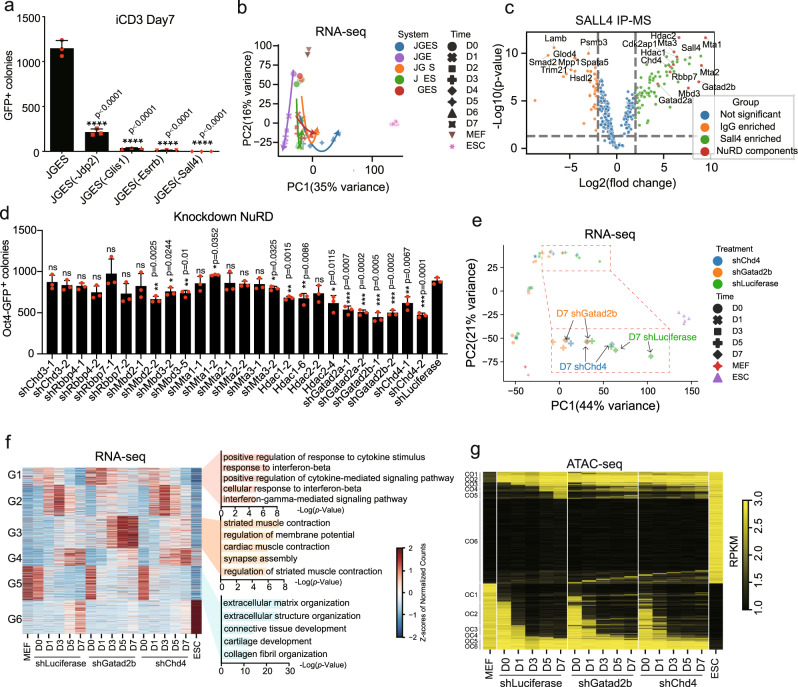
- JGES (Jdp2, Glis1, Esrrb, Sall4) reprograms MEFs to iPSCs at an efficiency comparable to 7F under iCD1, generating 12–13 colonies per 150 MEF cells (~8%) in 7 days under iCD3.
- In drop-out experiments, removing Sall4 nearly eliminated reprogramming (“close to 0”), while removing J, G, or E reduced reprogramming but less drastically.
- Knocking down NuRD subunits Gatad2b/2a and Chd4 significantly reduced Oct4-GFP+ colonies and delayed the transition from somatic to pluripotent state; ATAC-seq showed more open-to-close and close-to-open abnormalities, with 45.45% and 24.96% overlap for CO2 loci in shGatad2b and shChd4 vs control.
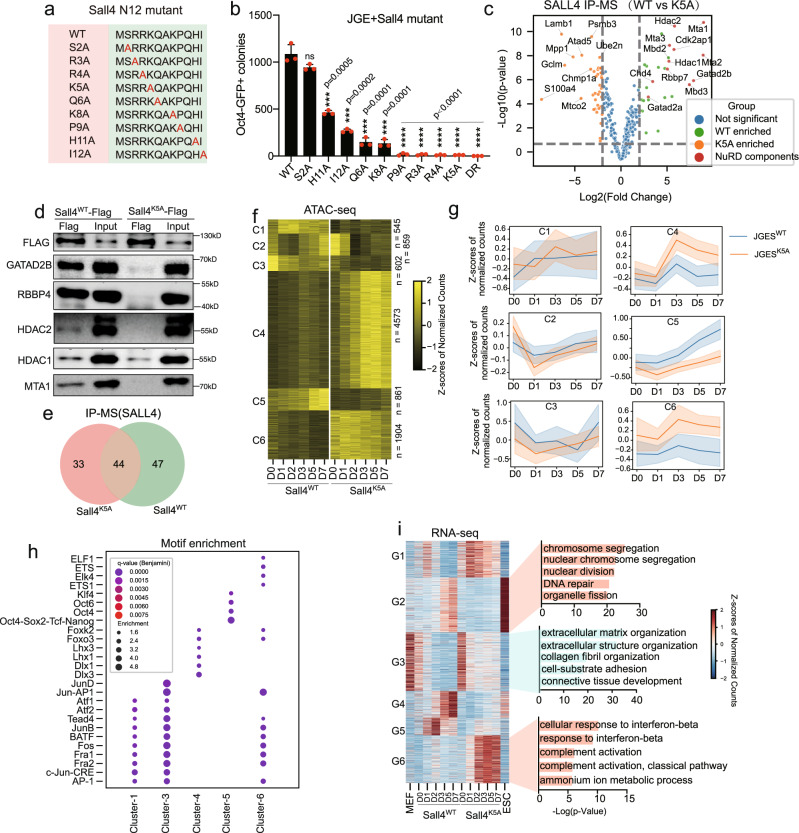
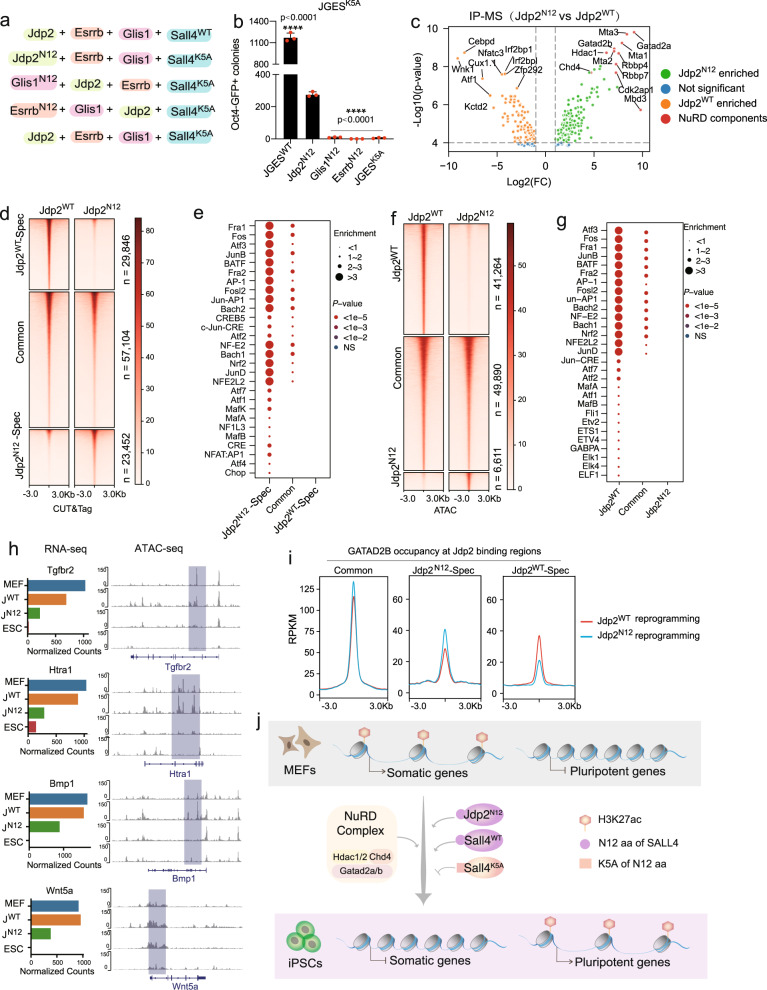
- The Sall4 K5A mutant failed to interact with NuRD and showed a near-complete loss of reprogramming, whereas grafting the N12 NuRD-interaction motif onto JDP2 partially rescued the defect.
## Methods
- The study used mouse embryonic fibroblasts (MEFs) as the starting somatic cells and compared reprogramming under JGES conditions, with knockout/knockdown or mutant versions of Sall4 and NuRD components.
- Main assays included drop-out reprogramming experiments, IP-mass spectrometry, co-immunoprecipitation/western blot, RNA-seq, ATAC-seq, CUT&Tag, and motif/GO enrichment analyses to track transcriptional and chromatin changes.
- For reprogramming efficiency and rescue tests, the authors counted Oct4-GFP+ colonies and analyzed chromatin accessibility dynamics across time during reprogramming.
## Limitations
- The paper explicitly notes that knocking down NuRD components only reduced reprogramming modestly compared with the near-complete loss caused by disrupting SALL4–NuRD interaction; this is presented as a limitation of component knockdown for capturing the axis’s full functional importance.
- The authors state that their findings differ from earlier NuRD studies because of different reprogramming cocktails and conditions, implying the role of NuRD may be context-dependent; this is an interpretation made evident by the text.
- No statistical method was used to predetermine sample size, and no specific randomization or blinding protocols were used.
Model-written summary. Check it against the paper before relying on it.
Integrity signals
Registry
Cites
Statistics
Figures
Verification
Claims the paper makes
10 Valid · 3 Not valid · 9 Not checked · 127 Own results and interpretations
The cited sources support only part of this claim — read each source’s verdict below.
In the paper
“These results are entirely consistent with our earlier findings that somatic gene loci enriched with somatic state specific TFs from AP-1 and ETS family members are barriers for reprogramming10,53,54.”
§ The NuRD complex cooperates with SALL4 to orchestrate reprogramming > Results > NuRD mediates chromatin closing of somatic loci Given the mixed roles of NuRD reported earlier in reprogramming studies, we wish to resolve its role in JGES reprogramming by ATAC-seq to analyze the chromatin accessibility dynamics (CAD). Consistent with the reduction of reprogramming efficiency, we observed that shGatad2b and shChd4 impact CAD quite dramatically, altering CO (close to open) and OC (open to close) peaks (Fig.1g). For example, the number of CO1, CO2, and CO3 peaks are much higher in shGatad2b and shChd4 than in shLuciferase, suggesting that many loci are opened improperly in shGatad2b and shChd4 at reprogramming day0, day1 and day3. The number of OC4 and OC5 peaks is much higher in shGatad2b and shChd4 than in shLuciferase, indicating that more loci fail to be closed in shGatad2b and shChd4 at reprogramming day3 and day5 than in shLuciferase (Supplementary Fig. 2c). Specifically, only 45.45% and 24.96% loci in CO2 of shGatad2b and shChd4 overlap with those of shLuciferase, 59.06% and 68.12% loci in OC1 change as expected, respectively (Supplementary Fig. 2d, e). We calculated the number of genes that gene body or promoter was located in the ATAC-seq peaks region (Supplementary Fig. 2f, g). Consistent with chromatin accessibility results, hundreds of additional genes were enriched by Gatad2b or Chd4 knockdown when compared to the control. Interestingly, when compared to the common and shLuciferase parts, fewer genes were enriched from OC1 and OC2 but more genes were found in OC3-OC6 by Gatad2b knockdown. Similar results could be found from the Chd4 knockdown reprogramming (Supplementary Fig. 2f, g). These results indicated that there is a delay of lots of gene regions becoming inaccessible during reprogramming by Gatad2b/Chd4 knockdown. Besides, when analyzing the Sall4, Gatad2b occupancy and H3K27ac modification at OC regions, Sall4 and Gatad2b displayed a higher binding density at shLuciferase than shGatad2b and shChd4 specific regions. However, an increased H3K27ac signal was found by Gatad2b or Chd4 knockdown (Supplementary Fig. 2h, i). These data support that the NuRD complex is involved in the inactivation of the somatic program early in JGES reprogramming. To further analyze the dynamics of progressively closing of chromatin loci, we defined gradually closed regions (GCRs) by subtracting ATAC-seq signals between adjacent stages below a threshold which was set at 0.05 multiplied by the range of the normalized ATAC-seq signal. Knocking-down either Chd4 or Gatad2b appears to slow down closing of somatic loci (Supplementary Fig. 2j), as measured by the normalized signal intensity of the gradually close region (GCR). The GCRs are dominated by transcription factor motifs for AP-1, ETS, and TEAD family genes such as JUNB, ETV1, and TEAD1 (Supplementary Fig. 2k). We then approached the Sall4-NuRD axis through their known interactions through the N-terminal 12 residues50 by mutating individual residues (Fig. 2a) and show that Sall4P9A, Sall4R3A, Sall4R4A, and Sall4K5A render it no longer able to reprogram (Fig. 2b). We then focused on Sall4K5A and show that this mutant fails to interact with NuRD through IP-Mass or CO-IP (Fig. 2c, d, processed data provided in Supplementary data 1). Consistently, this mutant also fails to mediate the requisite transcriptomic and chromatin reprogramming as measured by RNA- and ATAC-seq, respectively (Supplementary Fig. 3a, b).
What the sources say
- Partly supportedcites [10] Chronis C Cooperative binding of transcription factors orchestrates reprogramming Cell 2017 168 442 459 e420 10.1016/j.cell.2016.12.016 28111071 PMC5302508 sourceExperimental — accuracy not yet measured
In Results, “Loss of somatic TFs from OSK-bound and unbound MEs at 48h” identifies the AP-1-family factor Fra1 at somatic enhancers. Results, “Fra1 repression is critical for somatic program silencing and reprogramming” reports that maintaining Fra1 expression sharply reduced reprogramming efficiency, supporting its role as a barrier. The cited paper does not establish the corresponding claim for ETS-family factors (searched: ETS and ETS-family barriers). Page numbers are unavailable in our copy. (LLM, conf=0.88)
- Not checked — no full text of the sourcecites [53] Li D Chromatin accessibility dynamics during iPSC reprogramming Cell Stem Cell 2017 21 819 833.e816 10.1016/j.stem.2017.10.012 29220666 source
- Not checked — no full text of the sourcecites [54] Liu Y AP-1 activity is a major barrier of human somatic cell reprogramming Cell Mol. Life Sci. 2021 78 5847 5863 10.1007/s00018-021-03883-x 34181046 PMC11072308 source
boostedstates a cause- Asserted: passes — The authors put it forward as true.
- Checkable: passes — It can be checked against evidence.
- Load-bearing: passes — The paper’s conclusions depend on it.
- Based: passes — The paper gives a reason why it holds.
- Partly supported
A result the paper reports from its own data — it cites no other source for it, so there is none to check. The quote shows it is in the paper.
In the paper
“Sall4, Jdp2, Glis1 and Esrrb can reprogram MEFs to iPSCs efficiently, but only Sall4 is indispensable capable of recruiting endogenous components of NuRD.”
§ The NuRD complex cooperates with SALL4 to orchestrate reprogramming > Abstract
plainstates a cause- Asserted: passes — The authors put it forward as true.
- Checkable: passes — It can be checked against evidence.
- Load-bearing: passes — The paper’s conclusions depend on it.
- Based: passes — The paper gives a reason why it holds.
A result the paper reports from its own data — it cites no other source for it, so there is none to check. The quote shows it is in the paper.
In the paper
“Consistently, this mutant also fails to mediate the requisite transcriptomic and chromatin reprogramming as measured by RNA- and ATAC-seq, respectively (Supplementary Fig. 3a, b).”
§ The NuRD complex cooperates with SALL4 to orchestrate reprogramming > Results > NuRD mediates chromatin closing of somatic loci Given the mixed roles of NuRD reported earlier in reprogramming studies, we wish to resolve its role in JGES reprogramming by ATAC-seq to analyze the chromatin accessibility dynamics (CAD). Consistent with the reduction of reprogramming efficiency, we observed that shGatad2b and shChd4 impact CAD quite dramatically, altering CO (close to open) and OC (open to close) peaks (Fig.1g). For example, the number of CO1, CO2, and CO3 peaks are much higher in shGatad2b and shChd4 than in shLuciferase, suggesting that many loci are opened improperly in shGatad2b and shChd4 at reprogramming day0, day1 and day3. The number of OC4 and OC5 peaks is much higher in shGatad2b and shChd4 than in shLuciferase, indicating that more loci fail to be closed in shGatad2b and shChd4 at reprogramming day3 and day5 than in shLuciferase (Supplementary Fig. 2c). Specifically, only 45.45% and 24.96% loci in CO2 of shGatad2b and shChd4 overlap with those of shLuciferase, 59.06% and 68.12% loci in OC1 change as expected, respectively (Supplementary Fig. 2d, e). We calculated the number of genes that gene body or promoter was located in the ATAC-seq peaks region (Supplementary Fig. 2f, g). Consistent with chromatin accessibility results, hundreds of additional genes were enriched by Gatad2b or Chd4 knockdown when compared to the control. Interestingly, when compared to the common and shLuciferase parts, fewer genes were enriched from OC1 and OC2 but more genes were found in OC3-OC6 by Gatad2b knockdown. Similar results could be found from the Chd4 knockdown reprogramming (Supplementary Fig. 2f, g). These results indicated that there is a delay of lots of gene regions becoming inaccessible during reprogramming by Gatad2b/Chd4 knockdown. Besides, when analyzing the Sall4, Gatad2b occupancy and H3K27ac modification at OC regions, Sall4 and Gatad2b displayed a higher binding density at shLuciferase than shGatad2b and shChd4 specific regions. However, an increased H3K27ac signal was found by Gatad2b or Chd4 knockdown (Supplementary Fig. 2h, i). These data support that the NuRD complex is involved in the inactivation of the somatic program early in JGES reprogramming. To further analyze the dynamics of progressively closing of chromatin loci, we defined gradually closed regions (GCRs) by subtracting ATAC-seq signals between adjacent stages below a threshold which was set at 0.05 multiplied by the range of the normalized ATAC-seq signal. Knocking-down either Chd4 or Gatad2b appears to slow down closing of somatic loci (Supplementary Fig. 2j), as measured by the normalized signal intensity of the gradually close region (GCR). The GCRs are dominated by transcription factor motifs for AP-1, ETS, and TEAD family genes such as JUNB, ETV1, and TEAD1 (Supplementary Fig. 2k). We then approached the Sall4-NuRD axis through their known interactions through the N-terminal 12 residues50 by mutating individual residues (Fig. 2a) and show that Sall4P9A, Sall4R3A, Sall4R4A, and Sall4K5A render it no longer able to reprogram (Fig. 2b). We then focused on Sall4K5A and show that this mutant fails to interact with NuRD through IP-Mass or CO-IP (Fig. 2c, d, processed data provided in Supplementary data 1). Consistently, this mutant also fails to mediate the requisite transcriptomic and chromatin reprogramming as measured by RNA- and ATAC-seq, respectively (Supplementary Fig. 3a, b).
plain- Asserted: passes — The authors put it forward as true.
- Checkable: passes — It can be checked against evidence.
- Load-bearing: passes — The paper’s conclusions depend on it.
- Based: passes — The paper gives a reason why it holds.
A result the paper reports from its own data — it cites no other source for it, so there is none to check. The quote shows it is in the paper.
In the paper
“Gene ontology analysis show that the common proteins are associated with DNA repair (Supplementary Fig. 3c).”
§ The NuRD complex cooperates with SALL4 to orchestrate reprogramming > Results > NuRD mediates chromatin closing of somatic loci Given the mixed roles of NuRD reported earlier in reprogramming studies, we wish to resolve its role in JGES reprogramming by ATAC-seq to analyze the chromatin accessibility dynamics (CAD). Consistent with the reduction of reprogramming efficiency, we observed that shGatad2b and shChd4 impact CAD quite dramatically, altering CO (close to open) and OC (open to close) peaks (Fig.1g). For example, the number of CO1, CO2, and CO3 peaks are much higher in shGatad2b and shChd4 than in shLuciferase, suggesting that many loci are opened improperly in shGatad2b and shChd4 at reprogramming day0, day1 and day3. The number of OC4 and OC5 peaks is much higher in shGatad2b and shChd4 than in shLuciferase, indicating that more loci fail to be closed in shGatad2b and shChd4 at reprogramming day3 and day5 than in shLuciferase (Supplementary Fig. 2c). Specifically, only 45.45% and 24.96% loci in CO2 of shGatad2b and shChd4 overlap with those of shLuciferase, 59.06% and 68.12% loci in OC1 change as expected, respectively (Supplementary Fig. 2d, e). We calculated the number of genes that gene body or promoter was located in the ATAC-seq peaks region (Supplementary Fig. 2f, g). Consistent with chromatin accessibility results, hundreds of additional genes were enriched by Gatad2b or Chd4 knockdown when compared to the control. Interestingly, when compared to the common and shLuciferase parts, fewer genes were enriched from OC1 and OC2 but more genes were found in OC3-OC6 by Gatad2b knockdown. Similar results could be found from the Chd4 knockdown reprogramming (Supplementary Fig. 2f, g). These results indicated that there is a delay of lots of gene regions becoming inaccessible during reprogramming by Gatad2b/Chd4 knockdown. Besides, when analyzing the Sall4, Gatad2b occupancy and H3K27ac modification at OC regions, Sall4 and Gatad2b displayed a higher binding density at shLuciferase than shGatad2b and shChd4 specific regions. However, an increased H3K27ac signal was found by Gatad2b or Chd4 knockdown (Supplementary Fig. 2h, i). These data support that the NuRD complex is involved in the inactivation of the somatic program early in JGES reprogramming. To further analyze the dynamics of progressively closing of chromatin loci, we defined gradually closed regions (GCRs) by subtracting ATAC-seq signals between adjacent stages below a threshold which was set at 0.05 multiplied by the range of the normalized ATAC-seq signal. Knocking-down either Chd4 or Gatad2b appears to slow down closing of somatic loci (Supplementary Fig. 2j), as measured by the normalized signal intensity of the gradually close region (GCR). The GCRs are dominated by transcription factor motifs for AP-1, ETS, and TEAD family genes such as JUNB, ETV1, and TEAD1 (Supplementary Fig. 2k). We then approached the Sall4-NuRD axis through their known interactions through the N-terminal 12 residues50 by mutating individual residues (Fig. 2a) and show that Sall4P9A, Sall4R3A, Sall4R4A, and Sall4K5A render it no longer able to reprogram (Fig. 2b). We then focused on Sall4K5A and show that this mutant fails to interact with NuRD through IP-Mass or CO-IP (Fig. 2c, d, processed data provided in Supplementary data 1). Consistently, this mutant also fails to mediate the requisite transcriptomic and chromatin reprogramming as measured by RNA- and ATAC-seq, respectively (Supplementary Fig. 3a, b).
plainstates an association- Asserted: passes — The authors put it forward as true.
- Checkable: passes — It can be checked against evidence.
- Load-bearing: unclear — It is unclear whether the paper’s conclusions depend on it.
- Based: passes — The paper gives a reason why it holds.
A result the paper reports from its own data — it cites no other source for it, so there is none to check. The quote shows it is in the paper.
In the paper
“Yet knocking down NuRD components only reduces reprogramming modestly, in contrast to disrupting the known Sall4-NuRD interaction by mutating or deleting the NuRD interacting motif at its N-terminus that renders Sall4 inept to reprogram.”
§ The NuRD complex cooperates with SALL4 to orchestrate reprogramming > Abstract
plainstates a cause- Asserted: passes — The authors put it forward as true.
- Checkable: passes — It can be checked against evidence.
- Load-bearing: passes — The paper’s conclusions depend on it.
- Based: passes — The paper gives a reason why it holds.
89 more claims
Create a free account to see all 149 claims and to verify the 3 references still open.
- It may state two separate claims as one. 36
- Probably not a substantial claim. 25
- The quote only partly states this claim. 2
Citations
Cites
Moderated estimation of fold change and dispersion for RNA-seq data with DESeq2
Love, M. I., Huber, W., & Anders, S. (2014) · Genome Biology · doi:10.1186/s13059-014-0550-8 · Cited by 95,106
Fast gapped-read alignment with Bowtie 2
Langmead, B., & Salzberg, S. L. (2012) · Nature Methods · doi:10.1038/nmeth.1923 · Cited by 56,400
Takahashi, K., & Yamanaka, S. (2006) · Cell · doi:10.1016/j.cell.2006.07.024 · Cited by 26,673
RSEM: accurate transcript quantification from RNA-Seq data with or without a reference genome
Li, B., & Dewey, C. N. (2011) · BMC Bioinformatics · doi:10.1186/1471-2105-12-323 · Cited by 22,179
Model-based Analysis of ChIP-Seq (MACS)
Zhang, Y., Liu, T., Meyer, C. A., Eeckhoute, J., Johnson, D. S., Bernstein, B. E., Nusbaum, C., Myers, R. M., Brown, M., Li, W., et al. (2008) · Genome Biology · doi:10.1186/gb-2008-9-9-r137 · Cited by 18,386
Heinz, S., Benner, C., Spann, N., Bertolino, E., Lin, Y. C., Laslo, P., Cheng, J. X., Murre, C., Singh, H., & Glass, C. K. (2010) · Molecular Cell · doi:10.1016/j.molcel.2010.05.004 · Cited by 13,382
Induced Pluripotent Stem Cell Lines Derived from Human Somatic Cells
Yu, J., Vodyanik, M. A., Smuga-Otto, K., Antosiewicz-Bourget, J., Frane, J. L., Tian, S., Nie, J., Jonsdottir, G. A., Ruotti, V., Stewart, R., et al. (2007) · Science · doi:10.1126/science.1151526 · Cited by 10,310
Establishment in culture of pluripotential cells from mouse embryos
Evans, M. J., & Kaufman, M. H. (1981) · Nature · doi:10.1038/292154a0 · Cited by 8,607
deepTools2: a next generation web server for deep-sequencing data analysis
Ramírez, F., Ryan, D. P., Grüning, B., Bhardwaj, V., Kilpert, F., Richter, A. S., Heyne, S., Dündar, F., & Manke, T. (2016) · Nucleic Acids Research · doi:10.1093/nar/gkw257 · Cited by 8,096
ChIPseeker: an R/Bioconductor package for ChIP peak annotation, comparison and visualization
Yu, G., Wang, L.-G., & He, Q.-Y. (2015) · Bioinformatics · doi:10.1093/bioinformatics/btv145 · Cited by 4,362
Cited by
Chromatin accessibility: biological functions, molecular mechanisms and therapeutic application
Chen, Y., Liang, R., Li, Y., Jiang, L., Ma, D., Luo, Q., & Song, G. (2024) · Signal Transduction and Targeted Therapy · doi:10.1038/s41392-024-02030-9 · Cited by 223
“55 The core ATPase-containing subunits of NuRD complexes include CHD3, CHD4, and CHD5.”
Chen, S., Yan, K., Li, X., & Liu, B. (2025) · IEEE Transactions on Neural Networks and Learning Systems · doi:10.1109/tnnls.2025.3540291 · Cited by 31
“Restrictions apply. of Wang et al. [87].”
Manipulating cell fate through reprogramming: approaches and applications
Yagi, M., Horng, J. E., & Hochedlinger, K. (2024) · Development · doi:10.1242/dev.203090 · Cited by 17
Cell reprogramming: methods, mechanisms and applications
Zhu, F., & Nie, G. (2025) · Cell Regeneration · doi:10.1186/s13619-025-00229-x · Cited by 28
“In a proof-of-principle study led by Jaenisch, the authors generated high-quality iPSCs with a completely different set of transcription factors: Sall4, Nanog, Esrrb and Lin28 (Buganim et al. 2014).”
InfluentialAge reprogramming: Innovations and ethical considerations for prolonged longevity (Review)
Saliev, T., & Singh, P. (2025) · Biomedical Reports · doi:10.3892/br.2025.1974 · Cited by 14
“The study by Wang et al (26) on the nucleosome remodeling deacetylase (NuRD) complex and spalt like transcription factor 4 (Sall4) further enriches our understanding of chromatin remod‑ eling during early reprogramming (26).”
SALL4 is a CRL3REN/KCTD11 substrate that drives Sonic Hedgehog-dependent medulloblastoma
Lospinoso Severini, L., Loricchio, E., Navacci, S., Basili, I., Alfonsi, R., Bernardi, F., Moretti, M., Conenna, M., Cucinotta, A., Coni, S., et al. (2024) · Cell Death & Differentiation · doi:10.1038/s41418-023-01246-6 · Cited by 13
“…presents a conserved motif of 12 amino acids at the N-terminal that interacts with the nucleosome remodeling and histone deacetylase (NuRD) complex [15, 16], and seven zinc fi nger (ZF) motifs organized in three clusters (ZFC1, ZFC2, ZFC4) with an additional single ZF near the N-terminal [17].”
Exclusion of HDAC1/2 complexes by oncogenic nuclear condensates
Kuang, J., Li, P., Zhai, Z., Fan, Y., Xu, H., Zhao, C., Li, W., Li, X., Liang, Z., Huang, T., et al. (2024) · Molecular Cancer · doi:10.1186/s12943-024-02002-1 · Cited by 12
“SS, SS18-SSX1 part of NuRD complex [22, 23].”
BackgroundSelf-citationGeneration and characterization of giant panda induced pluripotent stem cells
Liu, Y., Zhang, S., Zou, G., An, J., Li, Y., Lin, D., Wang, D., Li, Y., Chen, J.-S., Feng, T., et al. (2024) · Science Advances · doi:10.1126/sciadv.adn7724 · Cited by 16
“They have also developed efficient reprogramming culture media, such as iCD1 (iPS chemically defined medium1) and iCD3 (iPS chemically defined medium 3) ( 34 – 37 ).”
BackgroundSelf-citationReconstitution of pluripotency from mouse fibroblast through Sall4 overexpression
Xiao, L., Huang, Z., Wu, Z., Yang, Y., Zhang, Z., Kumar, M., Wu, H., Mao, H., Lin, L., Lin, R., et al. (2024) · Nature Communications · doi:10.1038/s41467-024-54924-5 · Cited by 11
“In addition, earlier studies have indicated that SALL4 recruits a transcriptional repressor, the NuRD complex, to facilitate JGES ( Jdp2, Glis1, Esrrb , and Sall4 )-mediated reprogramming by targeting speci fi c somatic loci 28 .”
Self-citationThalidomide-induced limb malformations: an update and reevaluation
Collins, M. D., & Scott, W. J. (2025) · Archives of Toxicology · doi:10.1007/s00204-024-03930-z · Cited by 10
GATAD2B O-GlcNAcylation Regulates Breast Cancer Stem-like Potential and Drug Resistance
Minh, G. L., Merzy, J., Esquea, E. M., Ahmed, N. N., Young, R. G., Sharp, R. J., Dhameliya, T. T., Agana, B. A., Lee, M., Bethard, J. R., et al. (2025) · Cells · doi:10.3390/cells14060398 · Cited by 9
“Although GATAD2B has an analog, GATAD2A in the NuRD complex, recent evidence suggests that NuRD complexes containing GATAD2B as opposed to GATAD2A may possess distinct functions [20,50,52].”
Li, Y.-Y., & Tay, F. R. (2026) · Ageing Research Reviews · doi:10.1016/j.arr.2026.103009 · Cited by 11
Cpt1a Drives primed-to-naïve pluripotency transition through lipid remodeling
Ma, Z., Huang, X., Kuang, J., Wang, Q., Qin, Y., Huang, T., Liang, Z., Li, W., Fu, Y., Li, P., et al. (2024) · Communications Biology · doi:10.1038/s42003-024-06874-3 · Cited by 8
“H3K27ac is commonly used to assess chromatin accessibility and transcriptional activity 8,57,58 .”
BackgroundSelf-citationZhou, J., Zhu, D., Wang, Y., Wang, Z., Zhang, N., Huang, X., Zhang, Y., Wang, Y., Wu, X., & Tian, Y. (2025) · Science China Life Sciences · doi:10.1007/s11427-025-2954-3 · Cited by 9
“…include sequence-specific transcription factors, such as ZFP296, IKAROS, Thpok, Sall4 (Bottardi et al., 2014; Gao et al., 2022; Kloet et al., 2018; Wang et al., 2023), methyl-CpG-binding domain proteins MBD ( C . elegans lacks canonical DNA methylation), and non-coding RNAs (Yu et al., 2024; Zhao…”
Self-citationInterplay between pioneer transcription factors and epigenetic modifiers in cell reprogramming
Mirizio, G. G., Sampson, S., & Iwafuchi, M. (2024) · Regenerative Therapy · doi:10.1016/j.reth.2024.12.014 · Cited by 6
“In a non-Yamanaka iPSC reprogramming method using Sall4, Jdp2, Glis1, and Esrrb TFs, NuRD is essential for ef fi cient iPSC generation from mouse fi broblasts by closing chromatin at somatic genes during the early stages of reprogramming [56].”
Engineering mouse cell fate controller by rational design
Huang, T., Liu, D., Wang, X., Kuang, J., Wu, M., Wang, B., Liang, Z., Fan, Y., Chen, B., Ma, Z., et al. (2024) · Nature Communications · doi:10.1038/s41467-024-50551-2 · Cited by 4
“For example, the 12 residue NuRD interacting motif from Sall4 can be engineered to transcription activators to function as transcription repressors 20 .”
BackgroundSelf-citationADT increases prostate cancer cell invasion via altering AR/SALL4/SOX2-OCT4 stem cell signaling
Guo, C., Kadier, A., Zhang, Z., Huang, C., Mao, S., Yang, B., Zheng, J., & Yao, X. (2025) · Cell Biology and Toxicology · doi:10.1007/s10565-025-10046-2 · Cited by 5
“The regulatory function of SALL4 may be closely related to its modification of chromatin state (Wang et al. 2023).”
New progress in roles of TGF-β signaling crosstalks in cellular functions, immunity and diseases
Gu, S., Derynck, R., Chen, Y., & Feng, X. (2024) · Cell Regeneration · doi:10.1186/s13619-024-00194-x · Cited by 6
“The increased secretion of interleukins, particularly IL-1 and IL-17α, by stromal cells intensifies mucin production by goblet cells through NF-κB signaling, leading to structural changes, epithelial barrier disruption, and the progression of polyps (Wang et al. 2023b).”
BackgroundGenerating high-quality porcine iPSCs with the new medium cocktail LACID
Shi, B., Li, J., Wang, X., Liu, D., Xiang, J., Wang, H., Xu, C., Zou, X., Wang, Z., Huang, T., et al. (2026) · Stem Cell Reports · doi:10.1016/j.stemcr.2026.102790 · Cited by 2
Self-citationTranscription regulation of cell fate plasticity — from embryonic development to tissue regeneration
Zhao, W., Huang, X., & Xu, C. (2026) · Current Opinion in Genetics & Development · doi:10.1016/j.gde.2026.102507 · Cited by 2
Self-citationNeural crest induction requires SALL4-mediated BAF recruitment to lineage specific enhancers
Demurtas, M., Barnada, S. M., van Domselaar, E., Mitchell, Z. H., Deelen, L., & Trizzino, M. (2025) · Development · doi:10.1242/dev.205248 · Cited by 2
“However, its involvement in this developmental process has not yet been investigated.”
Promises of reprogramming-induced rejuvenation
Simpson, D. J., Arif, N., Suwanlikit, Y., Kirschner, K., & Chandra, T. (2026) · Current Opinion in Genetics & Development · doi:10.1016/j.gde.2026.102484 · Cited by 2
Neural crest induction requires SALL4-mediated BAF recruitment to lineage specific enhancers
Demurtas, M., Barnada, S. M., van Domselaar, E., Mitchell, Z. H., Deelen, L., & Trizzino, M. (2025) · doi:10.1101/2025.06.10.658805 · Cited by 2
Cell fate decision by a morphogen-transcription factor-chromatin modifier axis
Jin, M., Lin, L., Li, J., Wu, L., Fang, S., Huang, T., Fu, Y., Liu, D., Zhang, W., Li, C., et al. (2024) · Nature Communications · doi:10.1038/s41467-024-50144-z · Cited by 2
“5 inner cell massor ICM) ina NuRD-dependent manner 20 .”
BackgroundSelf-citationc-JUN: a chromatin repressor that limits mesoderm differentiation in human pluripotent stem cells
Zhang, R., Li, G., Zhang, Q., Wang, Z., Xiang, D., Zhang, X., Chen, J., Hutchins, A. P., Qin, D., Su, H., et al. (2025) · Nucleic Acids Research · doi:10.1093/nar/gkaf001 · Cited by 3
Self-citationHyperactivation of mTORC1 blocks stem cell fate transitions through TFE3-NuRD association
Li, P., Xu, S., Wu, X., Gao, Y., Ahmed, T., Huang, Y., Qin, D., Qin, B., Wang, L., & Xu, X. (2026) · EMBO Reports · doi:10.1038/s44319-025-00544-z · Cited by 1
“Given the context-dependent roles of the NuRD complex in reprogramming (Mor et al, 2018; dos Santos et al, 2014; Wang et al, 2023) and the well-established reprogramming-enhancing effects of HDAC inhibition (Huangfu et al, 2008; Karantzali et al, 2008; Zhang et al, 2014), we conducted additional…”
Self-citationRole of frustrations in cell reprogramming
Yao, Y., Zhu, J., Li, W., & Pei, D. (2025) · PNAS Nexus · doi:10.1093/pnasnexus/pgaf303 · Cited by 3
Self-citationRole of genetic frustrations in cell reprogrammingPreprint
Yao, Y., Zhu, J., Li, W., & Pei, D. (2025) · bioRxiv (Cold Spring Harbor Laboratory) · doi:10.1101/2025.01.31.635856 · Cited by 1
Self-citationTetramerisation governs SALL transcription factor function in development and disease
Giuliani, S., Chhatbar, K., Wear, M., Guy, J., Mathieson, T., Burdett, H., George, L., Alston, G., Spanos, C., McHugh, T., et al. (2025) · bioRxiv · doi:10.1101/2025.10.27.684836
Emerging Insights into Sall4’s Role in Cardiac Regenerative Medicine
Yang, J. (2025) · Cells · doi:10.3390/cells14030154
Ostalé, C. M., Azpiazu, N., Peropadre, A., Martín, M., Ruiz-Losada, M., López‐Varea, A., Viales, R. R., Girardot, C., Furlong, E. E. M., & de Celis, J. F. (2025) · Development · doi:10.1242/dev.204258
Pervasive binding of the stem cell transcription factor SALL4 shapes the chromatin landscapePreprint
Chhatbar, K., Giuliani, S., Quante, T., Alexander-Howden, B., Selfridge, J., Guy, J., Auchynnikava, T., Spanos, C., Mathieson, T., Sanguinetti, G., et al. (2025) · bioRxiv (Cold Spring Harbor Laboratory) · doi:10.1101/2025.11.14.688441
Chen, S., Yan, K., Shao, J., Zeng, X., & Liu, B. (2026) · bioRxiv (Cold Spring Harbor Laboratory) · doi:10.64898/2026.02.12.705667
A Phospho-Switch for Cell Fate ControlPreprint
ming, J., liu, X., Jia, Z., Shi, W., Li, J., Wang, S., chen, Y., Lin, S., liang, Y., guo, P., et al. (2026) · bioRxiv (Cold Spring Harbor Laboratory) · doi:10.64898/2026.02.21.707151
Self-citationDose-resolved control of somatic reprogramming by Rora
Wang, H., Li, Y., Yin, C., Zhang, Z., Wang, Y., Li, Y., Li, C., Lin, R., Zhang, X., Guo, J., et al. (2026) · Stem Cell Reports · doi:10.1016/j.stemcr.2026.102870 · Cited by 1
“Chromatin remodeling is essential for cell-fate conversion (Chen et al., 2024; Wang et al., 2023).”
Self-citationLiu, X., Tuergong, A., Wang, M., Shi, W., Tian, X., Ting, X., Cui, L., & Si, W. (2026) · Journal of Translational Medicine · doi:10.1186/s12967-026-08424-3
“This complex can assume multiple mutually exclusive conformations and is involved in various cellular functions, such as somatic reprogramming [28], cell lineage differentiation [29], DNA damage response [30], aging [31] and carcinogenesis [32].”
Subcellularly Resolved 3D Translatome in Mouse Oocytes and Early EmbryosPreprint
Ren, J., Furniss, S. T. E., Zhou, C., Zhou, H., Hagihara, Y., Wang, X., & Zhang, Y. (2026) · bioRxiv (Cold Spring Harbor Laboratory) · doi:10.64898/2026.07.31.742119
“Jdp2 is a transcription factor with established roles in cell differentiation, stress response, and proliferation ( 47 , 48 ), and has previously been shown to partially substitute for Oct4 in iPSC reprogramming ( 49 ).”
DNA methylation in cell state establishment and stability
Khatib, A., Sabag, O., Buganim, Y., & Cedar, H. (2026) · Trends Open · doi:10.1016/j.treopn.2026.08.013
Metadata
- Authors
- Wang, B., Li, C., Ming, J., Wu, L., Fang, S., Huang, Y., Lin, L., Liu, H., Kuang, J., Zhao, C., Huang, X., Feng, H., Guo, J., Yang, X., Guo, L., Zhang, X., Chen, J., Liu, J., Zhu, P., & Pei, D.
- Affiliations
- Chinese Academy of Sciences (CN)
- Westlake University (CN)
- Guangzhou Regenerative Medicine and Health Guangdong Laboratory (CN)
- Guangdong Academy of Medical Sciences (CN)
- Corresponding author
- Zhu, Ping
- Pei, Duanqing
- ORCID
- Venue
- Nature Communications
- Published
- 2023-05-18
- Volume
- 14
- Issue
- 1
- Pages
- 2846-2846
- ISSN
- 2041-1723 (ISSN-L)
- PMC
- PMC10199099
- OpenAlex
- W4377137492
- Semantic Scholar
- fa0493e6f1e18afca274acd794b01787903c970f
- Cited by
- 39
- References
- 79
- Citations by year
- 2026: 11 · 2025: 15 · 2024: 12 · 2023: 1
- FWCI
- 3.46
- Type
- journal article
- Language
- en
- Open access
- gold
- doi.org
- Licence
- cc-by
- creativecommons.org/licenses/by/4.0 (tdm)
- creativecommons.org/licenses/by/4.0 (vor)
- Locations
- Nature Communications (publishedVersion, cc-by)
- PubMed Central (publishedVersion, cc-by)
- PubMed (publishedVersion)
- RePEc: Research Papers in Economics (submittedVersion)
- DOAJ (DOAJ: Directory of Open Access Journals) (submittedVersion, cc-by-sa)
- Funders
- National Natural Science Foundation of China (31830060,92068201,3200050044,81974019)
- Guangdong Science and Technology Department (2020B1212060052)
- Topics
- Life Sciences › Biochemistry, Genetics and Molecular Biology › Molecular Biology › Pluripotent Stem Cells Research
- Life Sciences › Biochemistry, Genetics and Molecular Biology › Molecular Biology › Genomics and Chromatin Dynamics
- Life Sciences › Biochemistry, Genetics and Molecular Biology › Molecular Biology › Epigenetics and DNA Methylation
- Keywords
- NuRD complex, SALL4, somatic cell reprogramming, induced pluripotent stem cells, chromatin remodeling, chromatin accessibility, JDP2, GLIS1, ESRRB, cell fate determination, protein-protein interaction motifs
- MeSH terms
- Cell Differentiation, Chromatin, Histone Deacetylases, Transcription Factors, Mi-2 Nucleosome Remodeling and Deacetylase Complex, Cellular Reprogramming
About these checks
Registry, retraction, Cites and statistics results are computed, not judged, with one exception: a printed reference that no index lists is read once by a model before it counts as a citation error. Claims are extracted by a model and kept only when their quote appears verbatim in the text; each cited source is then checked, with a model’s help, for whether it says what the claim relies on. Those verdicts can be wrong — read the claim’s quote and the cited source before relying on one.
The claim verdicts this report counts are experimental: their accuracy is not yet measured.
A language model drew the claims from the paper on 2026-10-10, under version 3 of the claim definition (model deepseek-v4.1-flash, prompt extract-v3).
A second model labelled each claim on 2026-10-10 (model jev-1.13-20260917, definition revision gold-guideline-v0.2).
Cited sources are checked with a language model’s help (gpt-6-sol).
Statistics and arithmetic are recomputed, not judged.
Confidence bands are shown only for fields calibrated on our annotated test set. None is calibrated yet, so no band is shown.
What counts as a claim ›How we measure confidence ›How we check this ›
Are you an author, or do you see a problem with this page? Request a review
Data sources
Bibliographic data: Semantic Scholar, OpenAlex, Crossref.
Contains information from the Semantic Scholar Academic Graph Datasets, made available under the ODC Attribution License (ODC-BY 1.0).
Semantic Scholar’s data is described in: Kinney, R., et al. (2023). The Semantic Scholar Open Data Platform. arXiv:2301.10140.
