

The NuRD complex cooperates with SALL4 to orchestrate reprogramming
Open accessThe DOI matches its Crossref record; 79 of the 79 references it cites were found in a registry or an index; 22 of the 40 sources its claims cite were checked for support.
Abstract
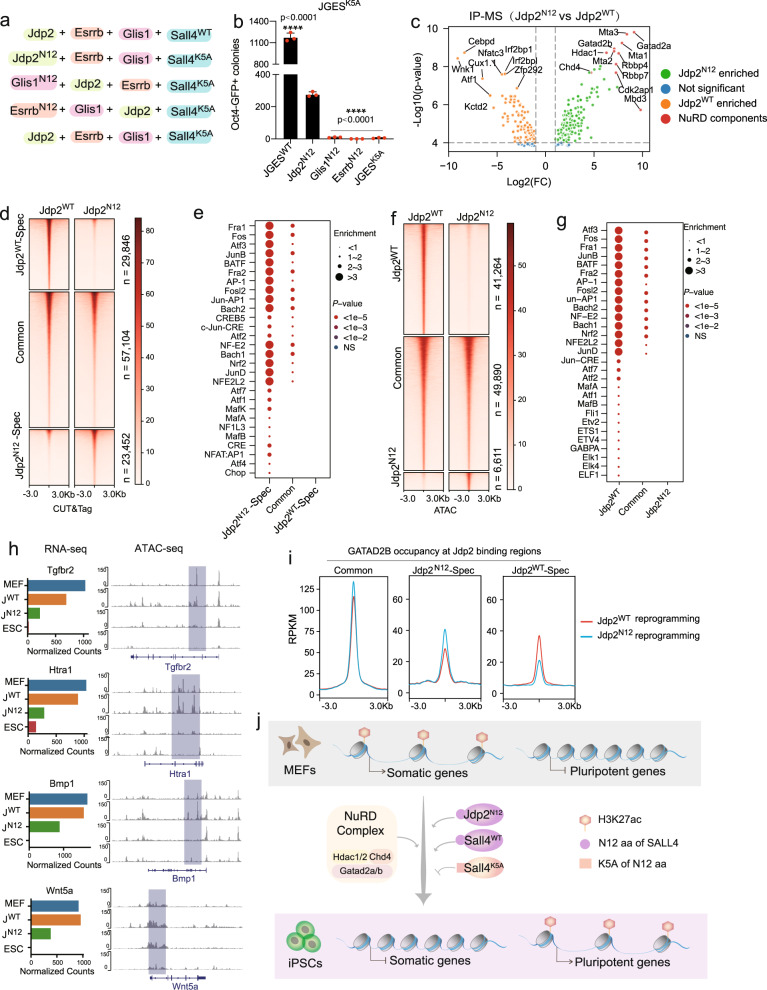
Cell fate decision involves rewiring of the genome, but remains poorly understood at the chromatin level. Here, we report that chromatin remodeling complex NuRD participates in closing open chromatin in the early phase of somatic reprogramming. Sall4, Jdp2, Glis1 and Esrrb can reprogram MEFs to iPSCs efficiently, but only Sall4 is indispensable capable of recruiting endogenous components of NuRD. Yet knocking down NuRD components only reduces reprogramming modestly, in contrast to disrupting the known Sall4-NuRD interaction by mutating or deleting the NuRD interacting motif at its N-terminus that renders Sall4 inept to reprogram. Remarkably, these defects can be partially rescured by grafting NuRD interacting motif onto Jdp2. Further analysis of chromatin accessibility dynamics demonstrates that the Sall4-NuRD axis plays a critical role in closing the open chromatin in the early phase of reprogramming. Among the chromatin loci closed by Sall4-NuRD encode genes resistant to reprogramming. These results identify a previously unrecognized role of NuRD in reprogramming, and may further illuminate chromatin closing as a critical step in cell fate control.
Overview
CoChat Summary
## TL;DR
The paper shows that during JGES reprogramming of mouse embryonic fibroblasts (MEFs) to iPSCs, SALL4 recruits the NuRD complex to close somatic chromatin in the early phase of reprogramming. Disrupting the SALL4–NuRD interaction, especially by mutating the N-terminal N12 motif in SALL4, largely abolishes reprogramming, while grafting this motif onto JDP2 can partially rescue the defect.
## Key findings
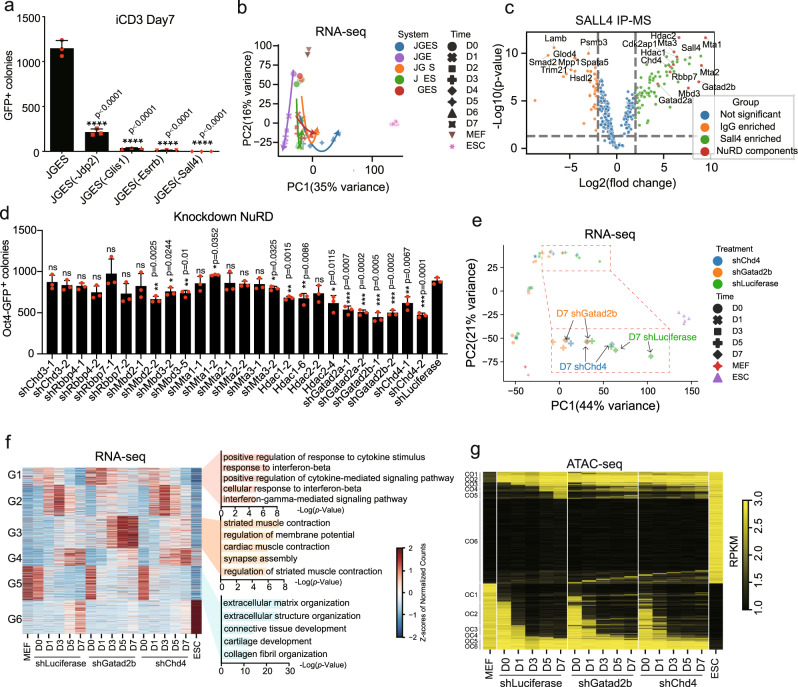
- JGES (Jdp2, Glis1, Esrrb, Sall4) reprograms MEFs to iPSCs at an efficiency comparable to 7F under iCD1, generating 12–13 colonies per 150 MEF cells (~8%) in 7 days under iCD3.
- In drop-out experiments, removing Sall4 nearly eliminated reprogramming (“close to 0”), while removing J, G, or E reduced reprogramming but less drastically.
- Knocking down NuRD subunits Gatad2b/2a and Chd4 significantly reduced Oct4-GFP+ colonies and delayed the transition from somatic to pluripotent state; ATAC-seq showed more open-to-close and close-to-open abnormalities, with 45.45% and 24.96% overlap for CO2 loci in shGatad2b and shChd4 vs control.
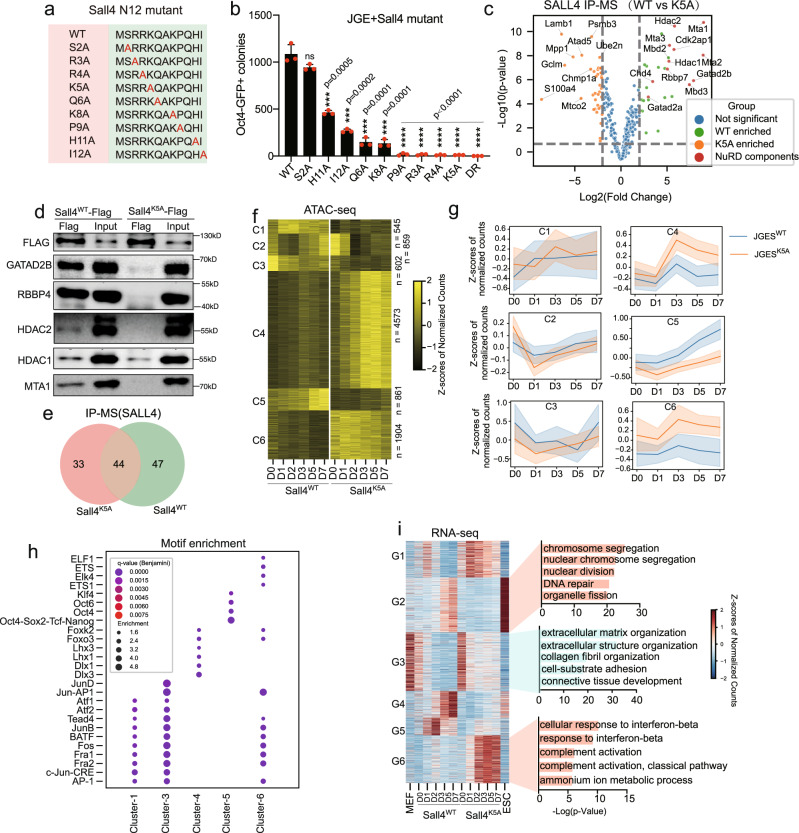
- The Sall4 K5A mutant failed to interact with NuRD and showed a near-complete loss of reprogramming, whereas grafting the N12 NuRD-interaction motif onto JDP2 partially rescued the defect.
## Methods
- The study used mouse embryonic fibroblasts (MEFs) as the starting somatic cells and compared reprogramming under JGES conditions, with knockout/knockdown or mutant versions of Sall4 and NuRD components.
- Main assays included drop-out reprogramming experiments, IP-mass spectrometry, co-immunoprecipitation/western blot, RNA-seq, ATAC-seq, CUT&Tag, and motif/GO enrichment analyses to track transcriptional and chromatin changes.
- For reprogramming efficiency and rescue tests, the authors counted Oct4-GFP+ colonies and analyzed chromatin accessibility dynamics across time during reprogramming.
## Limitations
- The paper explicitly notes that knocking down NuRD components only reduced reprogramming modestly compared with the near-complete loss caused by disrupting SALL4–NuRD interaction; this is presented as a limitation of component knockdown for capturing the axis’s full functional importance.
- The authors state that their findings differ from earlier NuRD studies because of different reprogramming cocktails and conditions, implying the role of NuRD may be context-dependent; this is an interpretation made evident by the text.
- No statistical method was used to predetermine sample size, and no specific randomization or blinding protocols were used.
Model-written summary. Check it against the paper before relying on it.
Integrity signals
Registry
Cites
Statistics
Figures
Verification
Claims the paper makes
10 Valid · 3 Not valid · 9 Not checked · 127 Own results and interpretations
The cited sources support only part of this claim — read each source’s verdict below.
In the paper
“These results are entirely consistent with our earlier findings that somatic gene loci enriched with somatic state specific TFs from AP-1 and ETS family members are barriers for reprogramming10,53,54.”
§ The NuRD complex cooperates with SALL4 to orchestrate reprogramming > Results > NuRD mediates chromatin closing of somatic loci Given the mixed roles of NuRD reported earlier in reprogramming studies, we wish to resolve its role in JGES reprogramming by ATAC-seq to analyze the chromatin accessibility dynamics (CAD). Consistent with the reduction of reprogramming efficiency, we observed that shGatad2b and shChd4 impact CAD quite dramatically, altering CO (close to open) and OC (open to close) peaks (Fig.1g). For example, the number of CO1, CO2, and CO3 peaks are much higher in shGatad2b and shChd4 than in shLuciferase, suggesting that many loci are opened improperly in shGatad2b and shChd4 at reprogramming day0, day1 and day3. The number of OC4 and OC5 peaks is much higher in shGatad2b and shChd4 than in shLuciferase, indicating that more loci fail to be closed in shGatad2b and shChd4 at reprogramming day3 and day5 than in shLuciferase (Supplementary Fig. 2c). Specifically, only 45.45% and 24.96% loci in CO2 of shGatad2b and shChd4 overlap with those of shLuciferase, 59.06% and 68.12% loci in OC1 change as expected, respectively (Supplementary Fig. 2d, e). We calculated the number of genes that gene body or promoter was located in the ATAC-seq peaks region (Supplementary Fig. 2f, g). Consistent with chromatin accessibility results, hundreds of additional genes were enriched by Gatad2b or Chd4 knockdown when compared to the control. Interestingly, when compared to the common and shLuciferase parts, fewer genes were enriched from OC1 and OC2 but more genes were found in OC3-OC6 by Gatad2b knockdown. Similar results could be found from the Chd4 knockdown reprogramming (Supplementary Fig. 2f, g). These results indicated that there is a delay of lots of gene regions becoming inaccessible during reprogramming by Gatad2b/Chd4 knockdown. Besides, when analyzing the Sall4, Gatad2b occupancy and H3K27ac modification at OC regions, Sall4 and Gatad2b displayed a higher binding density at shLuciferase than shGatad2b and shChd4 specific regions. However, an increased H3K27ac signal was found by Gatad2b or Chd4 knockdown (Supplementary Fig. 2h, i). These data support that the NuRD complex is involved in the inactivation of the somatic program early in JGES reprogramming. To further analyze the dynamics of progressively closing of chromatin loci, we defined gradually closed regions (GCRs) by subtracting ATAC-seq signals between adjacent stages below a threshold which was set at 0.05 multiplied by the range of the normalized ATAC-seq signal. Knocking-down either Chd4 or Gatad2b appears to slow down closing of somatic loci (Supplementary Fig. 2j), as measured by the normalized signal intensity of the gradually close region (GCR). The GCRs are dominated by transcription factor motifs for AP-1, ETS, and TEAD family genes such as JUNB, ETV1, and TEAD1 (Supplementary Fig. 2k). We then approached the Sall4-NuRD axis through their known interactions through the N-terminal 12 residues50 by mutating individual residues (Fig. 2a) and show that Sall4P9A, Sall4R3A, Sall4R4A, and Sall4K5A render it no longer able to reprogram (Fig. 2b). We then focused on Sall4K5A and show that this mutant fails to interact with NuRD through IP-Mass or CO-IP (Fig. 2c, d, processed data provided in Supplementary data 1). Consistently, this mutant also fails to mediate the requisite transcriptomic and chromatin reprogramming as measured by RNA- and ATAC-seq, respectively (Supplementary Fig. 3a, b).
What the sources say
- Partly supportedcites [10] Chronis C Cooperative binding of transcription factors orchestrates reprogramming Cell 2017 168 442 459 e420 10.1016/j.cell.2016.12.016 28111071 PMC5302508 sourceExperimental — accuracy not yet measured
In Results, “Loss of somatic TFs from OSK-bound and unbound MEs at 48h” identifies the AP-1-family factor Fra1 at somatic enhancers. Results, “Fra1 repression is critical for somatic program silencing and reprogramming” reports that maintaining Fra1 expression sharply reduced reprogramming efficiency, supporting its role as a barrier. The cited paper does not establish the corresponding claim for ETS-family factors (searched: ETS and ETS-family barriers). Page numbers are unavailable in our copy. (LLM, conf=0.88)
- Not checked — no full text of the sourcecites [53] Li D Chromatin accessibility dynamics during iPSC reprogramming Cell Stem Cell 2017 21 819 833.e816 10.1016/j.stem.2017.10.012 29220666 source
- Not checked — no full text of the sourcecites [54] Liu Y AP-1 activity is a major barrier of human somatic cell reprogramming Cell Mol. Life Sci. 2021 78 5847 5863 10.1007/s00018-021-03883-x 34181046 PMC11072308 source
boostedstates a cause- Asserted: passes — The authors put it forward as true.
- Checkable: passes — It can be checked against evidence.
- Load-bearing: passes — The paper’s conclusions depend on it.
- Based: passes — The paper gives a reason why it holds.
- Partly supported
A result the paper reports from its own data — it cites no other source for it, so there is none to check. The quote shows it is in the paper.
In the paper
“Sall4, Jdp2, Glis1 and Esrrb can reprogram MEFs to iPSCs efficiently, but only Sall4 is indispensable capable of recruiting endogenous components of NuRD.”
§ The NuRD complex cooperates with SALL4 to orchestrate reprogramming > Abstract
plainstates a cause- Asserted: passes — The authors put it forward as true.
- Checkable: passes — It can be checked against evidence.
- Load-bearing: passes — The paper’s conclusions depend on it.
- Based: passes — The paper gives a reason why it holds.
A result the paper reports from its own data — it cites no other source for it, so there is none to check. The quote shows it is in the paper.
In the paper
“Consistently, this mutant also fails to mediate the requisite transcriptomic and chromatin reprogramming as measured by RNA- and ATAC-seq, respectively (Supplementary Fig. 3a, b).”
§ The NuRD complex cooperates with SALL4 to orchestrate reprogramming > Results > NuRD mediates chromatin closing of somatic loci Given the mixed roles of NuRD reported earlier in reprogramming studies, we wish to resolve its role in JGES reprogramming by ATAC-seq to analyze the chromatin accessibility dynamics (CAD). Consistent with the reduction of reprogramming efficiency, we observed that shGatad2b and shChd4 impact CAD quite dramatically, altering CO (close to open) and OC (open to close) peaks (Fig.1g). For example, the number of CO1, CO2, and CO3 peaks are much higher in shGatad2b and shChd4 than in shLuciferase, suggesting that many loci are opened improperly in shGatad2b and shChd4 at reprogramming day0, day1 and day3. The number of OC4 and OC5 peaks is much higher in shGatad2b and shChd4 than in shLuciferase, indicating that more loci fail to be closed in shGatad2b and shChd4 at reprogramming day3 and day5 than in shLuciferase (Supplementary Fig. 2c). Specifically, only 45.45% and 24.96% loci in CO2 of shGatad2b and shChd4 overlap with those of shLuciferase, 59.06% and 68.12% loci in OC1 change as expected, respectively (Supplementary Fig. 2d, e). We calculated the number of genes that gene body or promoter was located in the ATAC-seq peaks region (Supplementary Fig. 2f, g). Consistent with chromatin accessibility results, hundreds of additional genes were enriched by Gatad2b or Chd4 knockdown when compared to the control. Interestingly, when compared to the common and shLuciferase parts, fewer genes were enriched from OC1 and OC2 but more genes were found in OC3-OC6 by Gatad2b knockdown. Similar results could be found from the Chd4 knockdown reprogramming (Supplementary Fig. 2f, g). These results indicated that there is a delay of lots of gene regions becoming inaccessible during reprogramming by Gatad2b/Chd4 knockdown. Besides, when analyzing the Sall4, Gatad2b occupancy and H3K27ac modification at OC regions, Sall4 and Gatad2b displayed a higher binding density at shLuciferase than shGatad2b and shChd4 specific regions. However, an increased H3K27ac signal was found by Gatad2b or Chd4 knockdown (Supplementary Fig. 2h, i). These data support that the NuRD complex is involved in the inactivation of the somatic program early in JGES reprogramming. To further analyze the dynamics of progressively closing of chromatin loci, we defined gradually closed regions (GCRs) by subtracting ATAC-seq signals between adjacent stages below a threshold which was set at 0.05 multiplied by the range of the normalized ATAC-seq signal. Knocking-down either Chd4 or Gatad2b appears to slow down closing of somatic loci (Supplementary Fig. 2j), as measured by the normalized signal intensity of the gradually close region (GCR). The GCRs are dominated by transcription factor motifs for AP-1, ETS, and TEAD family genes such as JUNB, ETV1, and TEAD1 (Supplementary Fig. 2k). We then approached the Sall4-NuRD axis through their known interactions through the N-terminal 12 residues50 by mutating individual residues (Fig. 2a) and show that Sall4P9A, Sall4R3A, Sall4R4A, and Sall4K5A render it no longer able to reprogram (Fig. 2b). We then focused on Sall4K5A and show that this mutant fails to interact with NuRD through IP-Mass or CO-IP (Fig. 2c, d, processed data provided in Supplementary data 1). Consistently, this mutant also fails to mediate the requisite transcriptomic and chromatin reprogramming as measured by RNA- and ATAC-seq, respectively (Supplementary Fig. 3a, b).
plain- Asserted: passes — The authors put it forward as true.
- Checkable: passes — It can be checked against evidence.
- Load-bearing: passes — The paper’s conclusions depend on it.
- Based: passes — The paper gives a reason why it holds.
A result the paper reports from its own data — it cites no other source for it, so there is none to check. The quote shows it is in the paper.
In the paper
“Gene ontology analysis show that the common proteins are associated with DNA repair (Supplementary Fig. 3c).”
§ The NuRD complex cooperates with SALL4 to orchestrate reprogramming > Results > NuRD mediates chromatin closing of somatic loci Given the mixed roles of NuRD reported earlier in reprogramming studies, we wish to resolve its role in JGES reprogramming by ATAC-seq to analyze the chromatin accessibility dynamics (CAD). Consistent with the reduction of reprogramming efficiency, we observed that shGatad2b and shChd4 impact CAD quite dramatically, altering CO (close to open) and OC (open to close) peaks (Fig.1g). For example, the number of CO1, CO2, and CO3 peaks are much higher in shGatad2b and shChd4 than in shLuciferase, suggesting that many loci are opened improperly in shGatad2b and shChd4 at reprogramming day0, day1 and day3. The number of OC4 and OC5 peaks is much higher in shGatad2b and shChd4 than in shLuciferase, indicating that more loci fail to be closed in shGatad2b and shChd4 at reprogramming day3 and day5 than in shLuciferase (Supplementary Fig. 2c). Specifically, only 45.45% and 24.96% loci in CO2 of shGatad2b and shChd4 overlap with those of shLuciferase, 59.06% and 68.12% loci in OC1 change as expected, respectively (Supplementary Fig. 2d, e). We calculated the number of genes that gene body or promoter was located in the ATAC-seq peaks region (Supplementary Fig. 2f, g). Consistent with chromatin accessibility results, hundreds of additional genes were enriched by Gatad2b or Chd4 knockdown when compared to the control. Interestingly, when compared to the common and shLuciferase parts, fewer genes were enriched from OC1 and OC2 but more genes were found in OC3-OC6 by Gatad2b knockdown. Similar results could be found from the Chd4 knockdown reprogramming (Supplementary Fig. 2f, g). These results indicated that there is a delay of lots of gene regions becoming inaccessible during reprogramming by Gatad2b/Chd4 knockdown. Besides, when analyzing the Sall4, Gatad2b occupancy and H3K27ac modification at OC regions, Sall4 and Gatad2b displayed a higher binding density at shLuciferase than shGatad2b and shChd4 specific regions. However, an increased H3K27ac signal was found by Gatad2b or Chd4 knockdown (Supplementary Fig. 2h, i). These data support that the NuRD complex is involved in the inactivation of the somatic program early in JGES reprogramming. To further analyze the dynamics of progressively closing of chromatin loci, we defined gradually closed regions (GCRs) by subtracting ATAC-seq signals between adjacent stages below a threshold which was set at 0.05 multiplied by the range of the normalized ATAC-seq signal. Knocking-down either Chd4 or Gatad2b appears to slow down closing of somatic loci (Supplementary Fig. 2j), as measured by the normalized signal intensity of the gradually close region (GCR). The GCRs are dominated by transcription factor motifs for AP-1, ETS, and TEAD family genes such as JUNB, ETV1, and TEAD1 (Supplementary Fig. 2k). We then approached the Sall4-NuRD axis through their known interactions through the N-terminal 12 residues50 by mutating individual residues (Fig. 2a) and show that Sall4P9A, Sall4R3A, Sall4R4A, and Sall4K5A render it no longer able to reprogram (Fig. 2b). We then focused on Sall4K5A and show that this mutant fails to interact with NuRD through IP-Mass or CO-IP (Fig. 2c, d, processed data provided in Supplementary data 1). Consistently, this mutant also fails to mediate the requisite transcriptomic and chromatin reprogramming as measured by RNA- and ATAC-seq, respectively (Supplementary Fig. 3a, b).
plainstates an association- Asserted: passes — The authors put it forward as true.
- Checkable: passes — It can be checked against evidence.
- Load-bearing: unclear — It is unclear whether the paper’s conclusions depend on it.
- Based: passes — The paper gives a reason why it holds.
A result the paper reports from its own data — it cites no other source for it, so there is none to check. The quote shows it is in the paper.
In the paper
“Yet knocking down NuRD components only reduces reprogramming modestly, in contrast to disrupting the known Sall4-NuRD interaction by mutating or deleting the NuRD interacting motif at its N-terminus that renders Sall4 inept to reprogram.”
§ The NuRD complex cooperates with SALL4 to orchestrate reprogramming > Abstract
plainstates a cause- Asserted: passes — The authors put it forward as true.
- Checkable: passes — It can be checked against evidence.
- Load-bearing: passes — The paper’s conclusions depend on it.
- Based: passes — The paper gives a reason why it holds.
89 more claims
Create a free account to see all 149 claims and to verify the 3 references still open.
- It may state two separate claims as one. 36
- Probably not a substantial claim. 25
- The quote only partly states this claim. 2
Citations
Cites
Moderated estimation of fold change and dispersion for RNA-seq data with DESeq2
Love, M. I., Huber, W., & Anders, S. (2014) · Genome Biology · doi:10.1186/s13059-014-0550-8 · Cited by 95,106
Fast gapped-read alignment with Bowtie 2
Langmead, B., & Salzberg, S. L. (2012) · Nature Methods · doi:10.1038/nmeth.1923 · Cited by 56,400
Takahashi, K., & Yamanaka, S. (2006) · Cell · doi:10.1016/j.cell.2006.07.024 · Cited by 26,673
RSEM: accurate transcript quantification from RNA-Seq data with or without a reference genome
Li, B., & Dewey, C. N. (2011) · BMC Bioinformatics · doi:10.1186/1471-2105-12-323 · Cited by 22,179
Model-based Analysis of ChIP-Seq (MACS)
Zhang, Y., Liu, T., Meyer, C. A., Eeckhoute, J., Johnson, D. S., Bernstein, B. E., Nusbaum, C., Myers, R. M., Brown, M., Li, W., et al. (2008) · Genome Biology · doi:10.1186/gb-2008-9-9-r137 · Cited by 18,386
Heinz, S., Benner, C., Spann, N., Bertolino, E., Lin, Y. C., Laslo, P., Cheng, J. X., Murre, C., Singh, H., & Glass, C. K. (2010) · Molecular Cell · doi:10.1016/j.molcel.2010.05.004 · Cited by 13,382
Induced Pluripotent Stem Cell Lines Derived from Human Somatic Cells
Yu, J., Vodyanik, M. A., Smuga-Otto, K., Antosiewicz-Bourget, J., Frane, J. L., Tian, S., Nie, J., Jonsdottir, G. A., Ruotti, V., Stewart, R., et al. (2007) · Science · doi:10.1126/science.1151526 · Cited by 10,310
Establishment in culture of pluripotential cells from mouse embryos
Evans, M. J., & Kaufman, M. H. (1981) · Nature · doi:10.1038/292154a0 · Cited by 8,607
deepTools2: a next generation web server for deep-sequencing data analysis
Ramírez, F., Ryan, D. P., Grüning, B., Bhardwaj, V., Kilpert, F., Richter, A. S., Heyne, S., Dündar, F., & Manke, T. (2016) · Nucleic Acids Research · doi:10.1093/nar/gkw257 · Cited by 8,096
ChIPseeker: an R/Bioconductor package for ChIP peak annotation, comparison and visualization
Yu, G., Wang, L.-G., & He, Q.-Y. (2015) · Bioinformatics · doi:10.1093/bioinformatics/btv145 · Cited by 4,362
Sambamba: fast processing of NGS alignment formats
Tarasov, A., Vilella, A. J., Cuppen, E., Nijman, I. J., & Prins, P. (2015) · Bioinformatics · doi:10.1093/bioinformatics/btv098 · Cited by 2,413
Huangfu, D., Maehr, R., Guo, W., Eijkelenboom, A., Snitow, M., Chen, A. E., & Melton, D. A. (2008) · Nature Biotechnology · doi:10.1038/nbt1418 · Cited by 1,606
Dissecting direct reprogramming through integrative genomic analysis
Mikkelsen, T. S., Hanna, J., Zhang, X., Ku, M., Wernig, M., Schorderet, P., Bernstein, B. E., Jaenisch, R., Lander, E. S., & Meissner, A. (2008) · Nature · doi:10.1038/nature07056 · Cited by 1,480 · cited 3×
“Genetic screening identi fi ed numerous barriers with repressive functions that act on pluripotent-associated genes, including DNA Methyltransferases (DNMT) 27 , Nucleosome Remodeling and histone Deacetylation (NuRD) 28 , histone deacetylases (HDACs) 29 , H3K9 methylation 30 , and chromatin assembly factor 1 (CAF1) 31 .”
InfluentialSelf-citationPluripotent stem cells induced from mouse somatic cells by small-molecule compounds.
Hou, P., Li, Y., Zhang, X., Liu, C., Guan, J., Li, H., Zhao, T., Ye, J., Yang, W., Liu, K., et al. (2013) · Science · doi:10.1126/science.1239278 · Cited by 1,402 · cited 1×
“…achieved through non-Yamanaka methods such as combinations of factors or chemicals suggests that reprogramming can start at divergent points or pathways 11 – 16 , but eventually converge to a common path towards pluripotency, thus, unifying the classic Yamanaka system with all these alternatives.”
Self-citationIn vivo reprogramming of murine cardiac fibroblasts into induced cardiomyocytes
Qian, L., Huang, Y., Spencer, C. I., Foley, A., Vedantham, V., Liu, L., Conway, S. J., Fu, J.-D., & Srivastava, D. (2012) · Nature · doi:10.1038/nature11044 · Cited by 1,360
Self-citationUnderstanding the language of Lys36 methylation at histone H3
Wagner, E. J., & Carpenter, P. B. (2012) · Nature Reviews Molecular Cell Biology · doi:10.1038/nrm3274 · Cited by 936 · cited 1×
“Repressive factors are associated with actively transcribed loci in somatic cells, such as H3K4/36/79 methylation 21 – 23 , SUMOylation 24 , Facilitates Chromatin Transcription (FACT) 25 , and Poly (ADP-Ribose) Polymerase 1 (PARP1) 26 .”
A decade of transcription factor-mediated reprogramming to pluripotency
Takahashi, K., & Yamanaka, S. (2016) · Nature Reviews Molecular Cell Biology · doi:10.1038/nrm.2016.8 · Cited by 878
Pioneer Transcription Factors Target Partial DNA Motifs on Nucleosomes to Initiate Reprogramming
Soufi, A., Garcia, M. F., Jaroszewicz, A., Osman, N., Pellegrini, M., & Zaret, K. S. (2015) · Cell · doi:10.1016/j.cell.2015.03.017 · Cited by 780
Chromatin-modifying enzymes as modulators of reprogramming
Onder, T. T., Kara, N., Cherry, A., Sinha, A. U., Zhu, N., Bernt, K. M., Cahan, P., Mancarci, B. O., Unternaehrer, J., Gupta, P. B., et al. (2012) · Nature · doi:10.1038/nature10953 · Cited by 634
Cooperative Binding of Transcription Factors Orchestrates Reprogramming
Chronis, C., Fiziev, P., Papp, B., Butz, S., Bonora, G., Sabri, S., Ernst, J., & Plath, K. (2017) · Cell · doi:10.1016/j.cell.2016.12.016 · Cited by 555 · cited 3×
“These results are entirely consistent with our earlier fi ndings that somatic gene loci enriched with somatic state speci fi c TFs from AP-1 and ETS family members are barriersforreprogramming 10,53,54 .”
Deterministic direct reprogramming of somatic cells to pluripotency
Rais, Y., Zviran, A., Geula, S., Gafni, O., Chomsky, E., Viukov, S., Mansour, A. A., Caspi, I., Krupalnik, V., Zerbib, M., et al. (2013) · Nature · doi:10.1038/nature12587 · Cited by 522
H3K9 methylation is a barrier during somatic cell reprogramming into iPSCs
Chen, J., Liu, H., Liu, J., Qi, J., Wei, B., Yang, J., Liang, H., Chen, Y., Chen, J., Wu, Y., et al. (2013) · Nature Genetics · doi:10.1038/ng.2491 · Cited by 462 · cited 1×
“…fi ed numerous barriers with repressive functions that act on pluripotent-associated genes, including DNA Methyltransferases (DNMT) 27 , Nucleosome Remodeling and histone Deacetylation (NuRD) 28 , histone deacetylases (HDACs) 29 , H3K9 methylation 30 , and chromatin assembly factor 1 (CAF1) 31 .”
Self-citationMAnorm: a robust model for quantitative comparison of ChIP-Seq data sets
Shao, Z., Zhang, Y., Yuan, G.-C., Orkin, S. H., & Waxman, D. J. (2012) · Genome Biology · doi:10.1186/gb-2012-13-3-r16 · Cited by 414
Chemical reprogramming of human somatic cells to pluripotent stem cells.
Guan, J., Wang, G., Wang, J., Zhang, Z., Fu, Y., Cheng, L., Meng, G., Lyu, Y., Zhu, J., Li, Y., et al. (2022) · Nature · doi:10.1038/s41586-022-04593-5 · Cited by 388
Self-citationChromatin-Remodeling Components of the BAF Complex Facilitate Reprogramming
Singhal, N., Graumann, J., Wu, G., Araúzo-Bravo, M. J., Han, D. W., Greber, B., Gentile, L., Mann, M., & Schöler, H. R. (2010) · Cell · doi:10.1016/j.cell.2010.04.037 · Cited by 378 · cited 1×
“According to recent research, Oct4 has the ability to interact with SWI/SNF complex compounds, which enhances reprogramming by facilitating OCT4 binding to target promoters 38 .”
Reprogramming Factor Expression Initiates Widespread Targeted Chromatin Remodeling
Koche, R. P., Smith, Z. D., Adli, M., Gu, H., Ku, M., Gnirke, A., Bernstein, B. E., & Meissner, A. (2011) · Cell Stem Cell · doi:10.1016/j.stem.2010.12.001 · Cited by 355 · cited 1×
“Repressive factors are associated with actively transcribed loci in somatic cells, such as H3K4/36/79 methylation 21 – 23 , SUMOylation 24 , Facilitates Chromatin Transcription (FACT) 25 , and Poly (ADP-Ribose) Polymerase 1 (PARP1) 26 .”
Ferguson-Smith, M. A., & Trifonov, V. (2007) · Nature Reviews Genetics · doi:10.1038/nrg2199 · Cited by 351
Epigenetics of Reprogramming to Induced Pluripotency
Papp, B., & Plath, K. (2013) · Cell · doi:10.1016/j.cell.2013.02.043 · Cited by 307
Induction of Pluripotency in Mouse Somatic Cells with Lineage Specifiers
Shu, J., Wu, C., Wu, Y., Li, Z., Shao, S., Zhao, W., Tang, X., Yang, H., Shen, L., Zuo, X., et al. (2013) · Cell · doi:10.1016/j.cell.2013.05.001 · Cited by 305
Mesenchymal–epithelial transition in development and reprogramming
Pei, D., Shu, X., Gassama-Diagne, A., & Thiery, J. P. (2019) · Nature Cell Biology · doi:10.1038/s41556-018-0195-z · Cited by 304
Self-citationGeneration of Human Striatal Neurons by MicroRNA-Dependent Direct Conversion of Fibroblasts
Victor, M. B., Richner, M., Hermanstyne, T. O., Ransdell, J. L., Sobieski, C., Deng, P.-Y., Klyachko, V. A., Nerbonne, J. M., & Yoo, A. S. (2014) · Neuron · doi:10.1016/j.neuron.2014.10.016 · Cited by 295
The histone chaperone CAF-1 safeguards somatic cell identity
Cheloufi, S., Elling, U., Hopfgartner, B., Jung, Y. L., Murn, J., Ninova, M., Hubmann, M., Badeaux, A. I., Euong Ang, C., Tenen, D., et al. (2015) · Nature · doi:10.1038/nature15749 · Cited by 272
Sakaki-Yumoto, M., Kobayashi, C., Sato, A., Fujimura, S., Matsumoto, Y., Takasato, M., Kodama, T., Aburatani, H., Asashima, M., Yoshida, N., et al. (2006) · Development · doi:10.1242/dev.02457 · Cited by 264
Chromatin Accessibility Dynamics during iPSC Reprogramming
Li, D., Liu, J., Yang, X., Zhou, C., Guo, J., Wu, C., Qin, Y., Guo, L., He, J., Yu, S., et al. (2017) · Cell Stem Cell · doi:10.1016/j.stem.2017.10.012 · Cited by 251 · cited 3×
“These results are entirely consistent with our earlier fi ndings that somatic gene loci enriched with somatic state speci fi c TFs from AP-1 and ETS family members are barriersforreprogramming 10,53,54 .”
Self-citationPioneer factors as master regulators of the epigenome and cell fate
Balsalobre, A., & Drouin, J. (2022) · Nature Reviews Molecular Cell Biology · doi:10.1038/s41580-022-00464-z · Cited by 251 · cited 1×
“The pioneering model of reprogramming has been proposed for OSKM based on their ability to bindtochromatinnotnormallyaccessiblebytranscriptionfactors 60 – 62 .”
Wang, S., Xia, P., Ye, B., Huang, G., Liu, J., & Fan, Z. (2013) · Cell Stem Cell · doi:10.1016/j.stem.2013.10.005 · Cited by 209 · cited 1×
“This claim was disputed by others showing that the role of NuRD is context dependent, e.g., being a positive regulator in one reprogramming system while negative in others 32,36,37 .”
Self-citationMurine inner cell mass-derived lineages depend on Sall4 function
Elling, U., Klasen, C., Eisenberger, T., Anlag, K., & Treier, M. (2006) · Proceedings of the National Academy of Sciences · doi:10.1073/pnas.0607884103 · Cited by 186
Reprogramming Fibroblasts into Bipotential Hepatic Stem Cells by Defined Factors
Yu, B., He, Z.-Y., You, P., Han, Q.-W., Xiang, D., Chen, F., Wang, M.-J., Liu, C.-C., Lin, X.-W., Borjigin, U., et al. (2013) · Cell Stem Cell · doi:10.1016/j.stem.2013.06.017 · Cited by 176
MBD3/NuRD Facilitates Induction of Pluripotency in a Context-Dependent Manner
dos Santos, R. L., Tosti, L., Radzisheuskaya, A., Caballero, I. M., Kaji, K., Hendrich, B., & Silva, J. C. R. (2014) · Cell Stem Cell · doi:10.1016/j.stem.2014.04.019 · Cited by 172
The oncogene c-Jun impedes somatic cell reprogramming
Liu, J., Han, Q., Peng, T., Peng, M., Wei, B., Li, D., Wang, X., Yu, S., Yang, J., Cao, S., et al. (2015) · Nature Cell Biology · doi:10.1038/ncb3193 · Cited by 167
Self-citationThe Developmental Potential of iPSCs Is Greatly Influenced by Reprogramming Factor Selection
Buganim, Y., Markoulaki, S., van Wietmarschen, N., Hoke, H., Wu, T., Ganz, K., Akhtar-Zaidi, B., He, Y., Abraham, B. J., Porubsky, D., et al. (2014) · Cell Stem Cell · doi:10.1016/j.stem.2014.07.003 · Cited by 163
Molecular features of cellular reprogramming and development
Smith, Z. D., Sindhu, C., & Meissner, A. (2016) · Nature Reviews Molecular Cell Biology · doi:10.1038/nrm.2016.6 · Cited by 155
Roles of Sall4 in the generation of pluripotent stem cells from blastocysts and fibroblasts
Tsubooka, N., Ichisaka, T., Okita, K., Takahashi, K., Nakagawa, M., & Yamanaka, S. (2009) · Genes to Cells · doi:10.1111/j.1365-2443.2009.01301.x · Cited by 154
Abernathy, D. G., Kim, W. K., McCoy, M. J., Lake, A. M., Ouwenga, R., Lee, S. W., Xing, X., Li, D., Lee, H. J., Heuckeroth, R. O., et al. (2017) · Cell Stem Cell · doi:10.1016/j.stem.2017.08.002 · Cited by 145
Cooperative Action between SALL4A and TET Proteins in Stepwise Oxidation of 5-Methylcytosine
Xiong, J., Zhang, Z., Chen, J., Huang, H., Xu, Y., Ding, X., Zheng, Y., Nishinakamura, R., Xu, G.-L., Wang, H., et al. (2016) · Molecular Cell · doi:10.1016/j.molcel.2016.10.013 · Cited by 143 · cited 8×
“3f. Consistent with point mutation data described above, deleting N12 abolishes Sall4-dependent reprogramming, while other mutations have either no effect (ZF1) or limited impacts (C420A, ZFC2-4) (Supplementary Fig.”
InfluentialSelf-citationSUMO Safeguards Somatic and Pluripotent Cell Identities by Enforcing Distinct Chromatin States
Cossec, J.-C., Theurillat, I., Chica, C., Búa Aguín, S., Gaume, X., Andrieux, A., Iturbide, A., Jouvion, G., Li, H., Bossis, G., et al. (2018) · Cell Stem Cell · doi:10.1016/j.stem.2018.10.001 · Cited by 142 · cited 1×
“Repressive factors are associated with actively transcribed loci in somatic cells, such as H3K4/36/79 methylation 21 – 23 , SUMOylation 24 , Facilitates Chromatin Transcription (FACT) 25 , and Poly (ADP-Ribose) Polymerase 1 (PARP1) 26 .”
Lauberth, S. M., & Rauchman, M. (2006) · Journal of Biological Chemistry · doi:10.1074/jbc.m513461200 · Cited by 140
The transcription factor SALL4 regulates stemness of EpCAM-positive hepatocellular carcinoma
Zeng, S. S., Yamashita, T., Kondo, M., Nio, K., Hayashi, T., Hara, Y., Nomura, Y., Yoshida, M., Hayashi, T., Oishi, N., et al. (2014) · Journal of Hepatology · doi:10.1016/j.jhep.2013.08.024 · Cited by 140 · cited 1×
“Sall4-NuRD interaction has been reported in cancer and in development processes such as hematopoiesis and neurogenesis 63 – 66 .”
Li, Q., Hutchins, A. P., Chen, Y., Li, S., Shan, Y., Liao, B., Zheng, D., Shi, X., Li, Y., Chan, W., et al. (2017) · Nature Communications · doi:10.1038/ncomms15166 · Cited by 136
Self-citationSALL4, the missing link between stem cells, development and cancer
Tatetsu, H., Kong, N. R., Chong, G., Amabile, G., Tenen, D. G., & Chai, L. (2016) · Gene · doi:10.1016/j.gene.2016.02.019 · Cited by 130 · cited 1×
“5 40 – 42 .”
Lentini, C., d’Orange, M., Marichal, N., Trottmann, M.-M., Vignoles, R., Foucault, L., Verrier, C., Massera, C., Raineteau, O., Conzelmann, K.-K., et al. (2021) · Cell Stem Cell · doi:10.1016/j.stem.2021.09.002 · Cited by 114 · cited 1×
“Lhx3 and Dlx1/2 selectively drive fi broblast to distinct subtypes of neurons 6,56 – 58 .”
NuRD and Pluripotency: A Complex Balancing Act
Hu, G., & Wade, P. A. (2012) · Cell Stem Cell · doi:10.1016/j.stem.2012.04.011 · Cited by 111 · cited 2×
“The NuRD complex consists of seven core components, each with multiple paralogues, including HDAC1/2, CHD3/4, RbAp46/48, MBD2/3, GATAD2a/b, and MTA1/2/3.”
Velasco, S., Ibrahim, M. M., Kakumanu, A., Garipler, G., Aydin, B., Al-Sayegh, M. A., Hirsekorn, A., Abdul-Rahman, F., Satija, R., Ohler, U., et al. (2017) · Cell Stem Cell · doi:10.1016/j.stem.2016.11.006 · Cited by 111
Chromatin Accessibility Dynamics during Chemical Induction of Pluripotency
Cao, S., Yu, S., Li, D., Ye, J., Yang, X., Li, C., Wang, X., Mai, Y., Qin, Y., Wu, J., et al. (2018) · Cell Stem Cell · doi:10.1016/j.stem.2018.03.005 · Cited by 110 · cited 1×
“JGES may convert MEFs to iPSCs by closing somatic chromatin and opening pluripotent ones, similar to OSKM and chemical reprogramming 53,59 .”
Self-citationNuRD Blocks Reprogramming of Mouse Somatic Cells into Pluripotent Stem Cells
Luo, M., Ling, T., Xie, W., Sun, H., Zhou, Y., Zhu, Q., Shen, M., Zong, L., Lyu, G., Zhao, Y., et al. (2013) · Stem Cells · doi:10.1002/stem.1374 · Cited by 104
The SIN3A/HDAC Corepressor Complex Functionally Cooperates with NANOG to Promote Pluripotency
Saunders, A., Huang, X., Fidalgo, M., Reimer, M. H., Faiola, F., Ding, J., Sánchez-Priego, C., Guallar, D., Sáenz, C., Li, D., et al. (2017) · Cell Reports · doi:10.1016/j.celrep.2017.01.055 · Cited by 92
Self-citationFACT Sets a Barrier for Cell Fate Reprogramming in Caenorhabditis elegans and Human Cells
Kolundzic, E., Ofenbauer, A., Bulut, S. I., Uyar, B., Baytek, G., Sommermeier, A., Seelk, S., He, M., Hirsekorn, A., Vucicevic, D., et al. (2018) · Developmental Cell · doi:10.1016/j.devcel.2018.07.006 · Cited by 87 · cited 1×
“Repressive factors are associated with actively transcribed loci in somatic cells, such as H3K4/36/79 methylation 21 – 23 , SUMOylation 24 , Facilitates Chromatin Transcription (FACT) 25 , and Poly (ADP-Ribose) Polymerase 1 (PARP1) 26 .”
Mor, N., Rais, Y., Sheban, D., Peles, S., Aguilera-Castrejon, A., Zviran, A., Elinger, D., Viukov, S., Geula, S., Krupalnik, V., et al. (2018) · Cell Stem Cell · doi:10.1016/j.stem.2018.07.004 · Cited by 79 · cited 3×
“Mor and colleagues used knockdown experiments by siRNA or knockout to inhibit Gatad2 or Chd4 during reprogramming, in contrast to our retrovirus delivery 34 .”
Targeting cancer addiction for SALL4 by shifting its transcriptome with a pharmacologic peptide
Liu, B. H., Jobichen, C., Chia, C. S. B., Chan, T. H. M., Tang, J. P., Chung, T. X. Y., Li, J., Poulsen, A., Hung, A. W., Koh-Stenta, X., et al. (2018) · Proceedings of the National Academy of Sciences · doi:10.1073/pnas.1801253115 · Cited by 67 · cited 1×
“Sall4-NuRD interaction has been reported in cancer and in development processes such as hematopoiesis and neurogenesis 63 – 66 .”
An Improved Technique for Chromosomal Analysis of Human ES and iPS Cells
Moralli, D., Yusuf, M., Mandegar, M. A., Khoja, S., Monaco, Z. L., & Volpi, E. V. (2010) · Stem Cell Reviews and Reports · doi:10.1007/s12015-010-9224-4 · Cited by 65
Wang, B., Wu, L., Li, D., Liu, Y., Guo, J., Li, C., Yao, Y., Wang, Y., Zhao, G., Wang, X., et al. (2019) · Cell Reports · doi:10.1016/j.celrep.2019.05.068 · Cited by 64
Self-citationLi, S., Zheng, E. B., Zhao, L., & Liu, S. (2019) · Cell Reports · doi:10.1016/j.celrep.2019.07.103 · Cited by 61
Transcriptional Control of Somatic Cell Reprogramming
Xu, Y., Zhang, M., Li, W., Zhu, X., Bao, X., Qin, B., Hutchins, A. P., & Esteban, M. A. (2016) · Trends in Cell Biology · doi:10.1016/j.tcb.2015.12.003 · Cited by 60
Zinc finger protein SALL4 functions through an AT-rich motif to regulate gene expression
Kong, N. R., Bassal, M. A., Tan, H. K., Kurland, J. V., Yong, K. J., Young, J. J., Yang, Y., Li, F., Lee, J. D., Liu, Y., et al. (2021) · Cell Reports · doi:10.1016/j.celrep.2020.108574 · Cited by 56
Yamashita, K., Sato, A., Asashima, M., Wang, P., & Nishinakamura, R. (2007) · Genes to Cells · doi:10.1111/j.1365-2443.2007.01042.x · Cited by 52
The topology of chromatin-binding domains in the NuRD deacetylase complex
Millard, C. J., Fairall, L., Ragan, T. J., Savva, C. G., & Schwabe, J. W. R. (2020) · Nucleic Acids Research · doi:10.1093/nar/gkaa1121 · Cited by 47 · cited 1×
“These components perform various functions such as histone deacetylation, ATP-dependent chromatin remodeling, histone chaperoning, CpG-binding, DNA-binding, and transcriptional regulation 35 .”
SALL4 controls cell fate in response to DNA base composition
Pantier, R., Chhatbar, K., Quante, T., Skourti-Stathaki, K., Cholewa-Waclaw, J., Alston, G., Alexander-Howden, B., Lee, H. Y., Cook, A. G., Spruijt, C. G., et al. (2021) · Molecular Cell · doi:10.1016/j.molcel.2020.11.046 · Cited by 45
The RNA Polymerase II Factor RPAP1 Is Critical for Mediator-Driven Transcription and Cell Identity
Lynch, C. J., Bernad, R., Calvo, I., Pereira, S. N., Ruiz, S., Ibarz, N., Martínez‐Val, A., Graña‐Castro, O., Goméz-López, G., Andrés‐León, E., et al. (2018) · Cell Reports · doi:10.1016/j.celrep.2017.12.062 · Cited by 36 · cited 1×
“Repressive factors are associated with actively transcribed loci in somatic cells, such as H3K4/36/79 methylation 21 – 23 , SUMOylation 24 , Facilitates Chromatin Transcription (FACT) 25 , and Poly (ADP-Ribose) Polymerase 1 (PARP1) 26 .”
Tahara, N., Kawakami, H., Chen, K. Q., Anderson, A., Yamashita Peterson, M., Gong, W., Shah, P., Hayashi, S., Nishinakamura, R., Nakagawa, Y., et al. (2019) · Development · doi:10.1242/dev.177659 · Cited by 35
Going up the hill: chromatin‐based barriers to epigenetic reprogramming
Arabacı, D. H., Terzioğlu, G., Bayırbaşı, B., & Önder, T. T. (2020) · FEBS Journal · doi:10.1111/febs.15628 · Cited by 22
MBD3/NuRD Facilitates Induction of Pluripotency in a Context-Dependent Manner
dos Santos, R. L., Tosti, L., Radzisheuskaya, A., Caballero, I. M., Kaji, K., Hendrich, B., & Silva, J. C. R. (2014) · Cell Stem Cell · doi:10.1016/j.stem.2014.08.005 · Cited by 21
Fu, M., Chen, H., Cai, Z., Yang, Y., Feng, Z., Zeng, M., Chen, L., Qin, Y., Cai, B., Zhu, P., et al. (2021) · Cell Regeneration · doi:10.1186/s13619-021-00078-4 · Cited by 20 · cited 2×
“Motifs for ETS and FOX family (FoxK2, FoxO3) members are both found in C6 and C4.”
Self-citationRole of SALL4 in hematopoiesis
Yang, J., Liao, W., & Ma, Y. (2012) · Current Opinion in Hematology · doi:10.1097/moh.0b013e328353c684 · Cited by 17
Xiao, X., Li, N., Zhang, D., Yang, B. K., Guo, H., & Li, Y. (2016) · Cellular Reprogramming · doi:10.1089/cell.2016.0020 · Cited by 17
Xing, G., Liu, Z., Huang, L., Zhao, D., Wang, T., Yuan, H., Wu, Y., Li, L., Long, Q., Zhou, Y., et al. (2021) · Cell Death and Differentiation · doi:10.1038/s41418-021-00902-z · Cited by 17 · cited 1×
“NuRD has been implicated in reprogramming in previous studies 32 – 34, 48, 49 , but with mixed results”
Self-citationKaryotype analysis in meiosis: Giemsa banding in the genus Secale L.
Kranz, A. R. (1976) · Theoretical and Applied Genetics · doi:10.1007/bf00274937 · Cited by 12
AP-1 activity is a major barrier of human somatic cell reprogramming
Liu, Y., He, J., Chen, R., Liu, H., Chen, J., Liu, Y., Wang, B., Guo, L., Pei, D., Wang, J., et al. (2021) · Cellular and Molecular Life Sciences · doi:10.1007/s00018-021-03883-x · Cited by 10 · cited 1×
“These results are entirely consistent with our earlier fi ndings that somatic gene loci enriched with somatic state speci fi c TFs from AP-1 and ETS family members are barriersforreprogramming 10,53,54 .”
Self-citationMbd3 Promotes Reprogramming of Primary Human Fibroblasts
Jaffer, S., Goh, P., Abbasian, M., & Nathwani, A. C. (2018) · International Journal of Stem Cells · doi:10.15283/ijsc18036 · Cited by 9
Establishment of a CRISPR/Cas9-mediated GATAD2B homozygous knockout human embryonic stem cell line
Wang, B., Zhu, S., Deng, Y., Sai, X., Chen, Z., Liu, J., Li, G., Liu, N., Chen, J., Yu, C., et al. (2021) · Stem Cell Research · doi:10.1016/j.scr.2021.102590 · Cited by 4
Self-citation
Cited by
Chromatin accessibility: biological functions, molecular mechanisms and therapeutic application
Chen, Y., Liang, R., Li, Y., Jiang, L., Ma, D., Luo, Q., & Song, G. (2024) · Signal Transduction and Targeted Therapy · doi:10.1038/s41392-024-02030-9 · Cited by 223
“55 The core ATPase-containing subunits of NuRD complexes include CHD3, CHD4, and CHD5.”
Chen, S., Yan, K., Li, X., & Liu, B. (2025) · IEEE Transactions on Neural Networks and Learning Systems · doi:10.1109/tnnls.2025.3540291 · Cited by 31
“Restrictions apply. of Wang et al. [87].”
Manipulating cell fate through reprogramming: approaches and applications
Yagi, M., Horng, J. E., & Hochedlinger, K. (2024) · Development · doi:10.1242/dev.203090 · Cited by 17
Cell reprogramming: methods, mechanisms and applications
Zhu, F., & Nie, G. (2025) · Cell Regeneration · doi:10.1186/s13619-025-00229-x · Cited by 28
“In a proof-of-principle study led by Jaenisch, the authors generated high-quality iPSCs with a completely different set of transcription factors: Sall4, Nanog, Esrrb and Lin28 (Buganim et al. 2014).”
InfluentialAge reprogramming: Innovations and ethical considerations for prolonged longevity (Review)
Saliev, T., & Singh, P. (2025) · Biomedical Reports · doi:10.3892/br.2025.1974 · Cited by 14
“The study by Wang et al (26) on the nucleosome remodeling deacetylase (NuRD) complex and spalt like transcription factor 4 (Sall4) further enriches our understanding of chromatin remod‑ eling during early reprogramming (26).”
Metadata
- Authors
- Wang, B., Li, C., Ming, J., Wu, L., Fang, S., Huang, Y., Lin, L., Liu, H., Kuang, J., Zhao, C., Huang, X., Feng, H., Guo, J., Yang, X., Guo, L., Zhang, X., Chen, J., Liu, J., Zhu, P., & Pei, D.
- Affiliations
- Chinese Academy of Sciences (CN)
- Westlake University (CN)
- Guangzhou Regenerative Medicine and Health Guangdong Laboratory (CN)
- Guangdong Academy of Medical Sciences (CN)
- Corresponding author
- Zhu, Ping
- Pei, Duanqing
- ORCID
- Venue
- Nature Communications
- Published
- 2023-05-18
- Volume
- 14
- Issue
- 1
- Pages
- 2846-2846
- ISSN
- 2041-1723 (ISSN-L)
- PMC
- PMC10199099
- OpenAlex
- W4377137492
- Semantic Scholar
- fa0493e6f1e18afca274acd794b01787903c970f
- Cited by
- 39
- References
- 79
- Citations by year
- 2026: 11 · 2025: 15 · 2024: 12 · 2023: 1
- FWCI
- 3.46
- Type
- journal article
- Language
- en
- Open access
- gold
- doi.org
- Licence
- cc-by
- creativecommons.org/licenses/by/4.0 (tdm)
- creativecommons.org/licenses/by/4.0 (vor)
- Locations
- Nature Communications (publishedVersion, cc-by)
- PubMed Central (publishedVersion, cc-by)
- PubMed (publishedVersion)
- RePEc: Research Papers in Economics (submittedVersion)
- DOAJ (DOAJ: Directory of Open Access Journals) (submittedVersion, cc-by-sa)
- Funders
- National Natural Science Foundation of China (31830060,92068201,3200050044,81974019)
- Guangdong Science and Technology Department (2020B1212060052)
- Topics
- Life Sciences › Biochemistry, Genetics and Molecular Biology › Molecular Biology › Pluripotent Stem Cells Research
- Life Sciences › Biochemistry, Genetics and Molecular Biology › Molecular Biology › Genomics and Chromatin Dynamics
- Life Sciences › Biochemistry, Genetics and Molecular Biology › Molecular Biology › Epigenetics and DNA Methylation
- Keywords
- NuRD complex, SALL4, somatic cell reprogramming, induced pluripotent stem cells, chromatin remodeling, chromatin accessibility, JDP2, GLIS1, ESRRB, cell fate determination, protein-protein interaction motifs
- MeSH terms
- Cell Differentiation, Chromatin, Histone Deacetylases, Transcription Factors, Mi-2 Nucleosome Remodeling and Deacetylase Complex, Cellular Reprogramming
About these checks
Registry, retraction, Cites and statistics results are computed, not judged, with one exception: a printed reference that no index lists is read once by a model before it counts as a citation error. Claims are extracted by a model and kept only when their quote appears verbatim in the text; each cited source is then checked, with a model’s help, for whether it says what the claim relies on. Those verdicts can be wrong — read the claim’s quote and the cited source before relying on one.
The claim verdicts this report counts are experimental: their accuracy is not yet measured.
A language model drew the claims from the paper on 2026-10-10, under version 3 of the claim definition (model deepseek-v4.1-flash, prompt extract-v3).
A second model labelled each claim on 2026-10-10 (model jev-1.13-20260917, definition revision gold-guideline-v0.2).
Cited sources are checked with a language model’s help (gpt-6-sol).
Statistics and arithmetic are recomputed, not judged.
Confidence bands are shown only for fields calibrated on our annotated test set. None is calibrated yet, so no band is shown.
What counts as a claim ›How we measure confidence ›How we check this ›
Are you an author, or do you see a problem with this page? Request a review
Data sources
Bibliographic data: Semantic Scholar, OpenAlex, Crossref.
Contains information from the Semantic Scholar Academic Graph Datasets, made available under the ODC Attribution License (ODC-BY 1.0).
Semantic Scholar’s data is described in: Kinney, R., et al. (2023). The Semantic Scholar Open Data Platform. arXiv:2301.10140.
