

Epidemiological drivers of transmissibility and severity of SARS-CoV-2 in England
Open accessPublished version of a preprint
The DOI matches its Crossref record; 38 of the 40 references it cites were found in a registry or an index.
Abstract
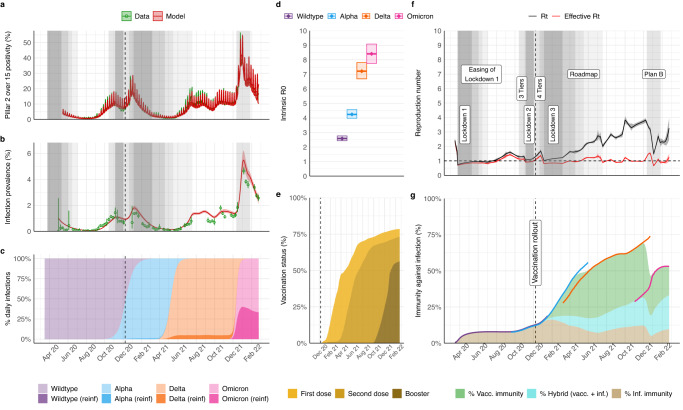
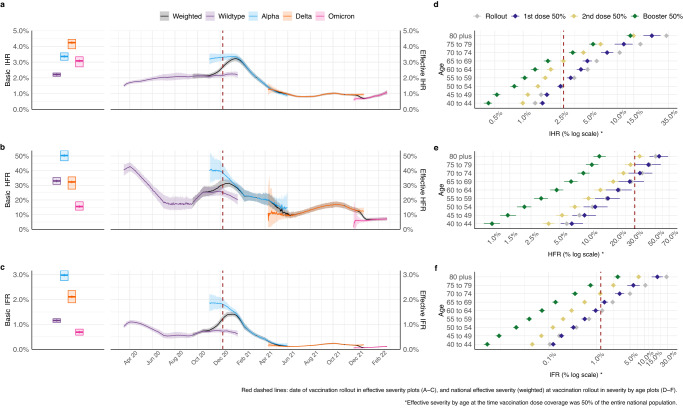
As the SARS-CoV-2 pandemic progressed, distinct variants emerged and dominated in England. These variants, Wildtype, Alpha, Delta, and Omicron were characterized by variations in transmissibility and severity. We used a robust mathematical model and Bayesian inference framework to analyse epidemiological surveillance data from England. We quantified the impact of non-pharmaceutical interventions (NPIs), therapeutics, and vaccination on virus transmission and severity. Each successive variant had a higher intrinsic transmissibility. Omicron (BA.1) had the highest basic reproduction number at 8.4 (95% credible interval (CrI) 7.8-9.1). Varying levels of NPIs were crucial in controlling virus transmission until population immunity accumulated. Immune escape properties of Omicron decreased effective levels of immunity in the population by a third. Furthermore, in contrast to previous studies, we found Alpha had the highest basic infection fatality ratio (3.0%, 95% CrI 2.8-3.2), followed by Delta (2.1%, 95% CrI 1.9–2.4), Wildtype (1.2%, 95% CrI 1.1–1.2), and Omicron (0.7%, 95% CrI 0.6-0.8). Our findings highlight the importance of continued surveillance. Long-term strategies for monitoring and maintaining effective immunity against SARS-CoV-2 are critical to inform the role of NPIs to effectively manage future variants with potentially higher intrinsic transmissibility and severe outcomes.
Overview
The claims and statistics of this paper haven’t been checked yet.
Free: it reads the open-access text and checks the first 5 claims that cite a source we can check. Create a free account to check every claim.
Integrity signals
Registry
Cites
Statistics
Figures
Verification
Claims the paper makes
The claims and statistics of this paper haven’t been checked yet.
Free: it reads the open-access text and checks the first 5 claims that cite a source we can check. Create a free account to check every claim.
Claims other papers make about this one
Each is checked against this paper’s own text: does it say what the citing paper says it does?
The source backs part of the claim, not all of it — or backs it for a different population, condition or comparison.
In the citing paper
“Published estimates of CFR suggest high severity, with more than 10% of cases being fatal, which is one order of magnitude higher than that estimated for SARS-CoV-2 (CFR up to approximately 2% for the most severe variants 112,119 ) or pandemic influenza virus (CFR up to approximately 1-3% for the 1918 influenza pandemic 120 ).”
From Severe acute respiratory syndrome (SARS) mathematical models and disease parameters: a systematic review (2025) · cites this paper as [112]
Experimental — accuracy not yet measured
Self-check
Percentages, sums and reported differences re-computed from the paper’s own numbers.
The self-check needs the paper’s full text.
Citations
Cites
Dexamethasone in Hospitalized Patients with Covid-19
The RECOVERY Collaborative Group (2021) · New England Journal of Medicine · doi:10.1056/nejmoa2021436 · Cited by 11,477
Remdesivir for the Treatment of Covid-19 — Final Report
Beigel, J. H., Tomashek, K. M., Dodd, L. E., Mehta, A. K., Zingman, B. S., Kalil, A. C., Hohmann, E., Chu, H. Y., Luetkemeyer, A., Kline, S., et al. (2020) · New England Journal of Medicine · doi:10.1056/nejmoa2007764 · Cited by 7,267
Estimating the effects of non-pharmaceutical interventions on COVID-19 in Europe
Flaxman, S., Mishra, S., Gandy, A., Unwin, H. J. T., Mellan, T. A., Coupland, H., Whittaker, C., Zhu, H., Berah, T., Eaton, J. W., et al. (2020) · Nature · doi:10.1038/s41586-020-2405-7 · Cited by 3,350
Self-citationSocial Contacts and Mixing Patterns Relevant to the Spread of Infectious Diseases
Mossong, J., Hens, N., Jit, M., Beutels, P., Auranen, K., Mikolajczyk, R., Massari, M., Salmaso, S., Tomba, G. S., Wallinga, J., et al. (2008) · PLoS Medicine · doi:10.1371/journal.pmed.0050074 · Cited by 2,900 · cited 1×
“To model heterogenous contact rates among age groups, we use the POLYMOD contact matrix for England 48 .”
Assessing transmissibility of SARS-CoV-2 lineage B.1.1.7 in England
The COVID-19 Genomics UK (COG-UK) consortium, Volz, E., Mishra, S., Chand, M., Barrett, J. C., Johnson, R., Geidelberg, L., Hinsley, W. R., Laydon, D. J., Dabrera, G., et al. (2021) · Nature · doi:10.1038/s41586-021-03470-x · Cited by 1,611 · cited 1×
“Epidemiological studies have assessed changes in the transmissibility and severity of SARS-Received CoV-2 and the overall effectiveness of interventions over these sequential waves of infections 8 – 13 .”
BackgroundSelf-citationA New Framework and Software to Estimate Time-Varying Reproduction Numbers During Epidemics
Cori, A., Ferguson, N. M., Fraser, C., & Cauchemez, S. (2013) · American Journal of Epidemiology · doi:10.1093/aje/kwt133 · Cited by 1,530 · cited 2×
“Rt eff is determined by the inherent transmission potential of a variant and by 68 contact patterns and immunity levels in the host population.(14) We estimated both Rt eff and the time-varying reproduction 69”
BackgroundSelf-citationNyberg, T., Ferguson, N. M., Nash, S. G., Webster, H. H., Flaxman, S., Andrews, N., Hinsley, W., Bernal, J. L., Kall, M., Bhatt, S., et al. (2022) · The Lancet · doi:10.1016/s0140-6736(22)00462-7 · Cited by 1,221 · cited 1×
“Waning vaccine-and infection-induced immunity against Omicron subvariants is well established 4,12,41 , and recent studies suggest that hybrid immunity (from prior infection and vaccination) may be more effective than repeated boosting through vaccination 42 .”
BackgroundSelf-citationNyberg, T., Ferguson, N. M., Nash, S., Webster, H. H., Flaxman, S. R., Andrews, N. J., Hinsley, W. R., Bernal, J. L., Kall, M. M., Bhatt, S., et al. (2022) · Northumbria Research Link (Northumbria University) · doi:10.17863/cam.81883 · Cited by 1,129
Self-citationThe Lancet Commission on lessons for the future from the COVID-19 pandemic
Sachs, J. D., Karim, S. S. A., Aknin, L., Allen, J., Brosbøl, K., Colombo, F., Barron, G. C., Espinosa, M. F., Gaspar, V., Gaviria, A., et al. (2022) · The Lancet · doi:10.1016/s0140-6736(22)01585-9 · Cited by 842 · cited 2×
“Main 40 The COVID-19 pandemic has driven unprecedented surges in excess mortality,(1) and caused severe disruptions to 41 healthcare systems and economies globally.(2,3) The Omicron sub-variants are more transmissible and thus more difficult 42 to control than ancestral lineages;(4,5) and their severity levels, althou…”
Twohig, K. A., Nyberg, T., Zaidi, A., Thelwall, S., Sinnathamby, M. A., Aliabadi, S., Seaman, S. R., Harris, R. J., Hope, R., Lopez-Bernal, J., et al. (2022) · The Lancet Infectious Diseases · doi:10.1016/s1473-3099(21)00475-8 · Cited by 803
Self-citationBobrovitz, N., Ware, H., Ma, X., Li, Z., Hosseini, R., Cao, C., Selemon, A., Whelan, M., Premji, Z., Issa, H., et al. (2023) · The Lancet Infectious Diseases · doi:10.1016/s1473-3099(22)00801-5 · Cited by 614
SARS-CoV-2 Omicron variant: recent progress and future perspectives
Fan, Y., Li, X., Zhang, L., Wan, S., Zhang, L., & Zhou, F. (2022) · Signal Transduction and Targeted Therapy · doi:10.1038/s41392-022-00997-x · Cited by 589 · cited 2×
“Waning vaccine-and infection-induced immunity against Omicron subvariants is well established 4,12,41 , and recent studies suggest that hybrid immunity (from prior infection and vaccination) may be more effective than repeated boosting through vaccination 42 .”
Twohig, K. A., Nyberg, T., Zaidi, A., Thelwall, S., Sinnathamby, M., Aliabadi, S., Seaman, S. R., Harris, R., Hope, R., Bernal, J. L., et al. (2021) · Northumbria Research Link (Northumbria University) · doi:10.17863/cam.76294 · Cited by 514
The population genetics and evolutionary epidemiology of RNA viruses
Moya, A., Holmes, E. C., & González-Candelas, F. (2004) · Nature Reviews Microbiology · doi:10.1038/nrmicro863 · Cited by 395 · cited 2×
“Viral evolution tends to select for more transmissible lineages 15 .”
Infection and Vaccine-Induced Neutralizing-Antibody Responses to the SARS-CoV-2 B.1.617 Variants
Edara, V.-V., Pinsky, B. A., Suthar, M. S., Lai, L., Davis-Gardner, M. E., Floyd, K., Flowers, M. W., Wrammert, J., Hussaini, L., Ciric, C. R., et al. (2021) · New England Journal of Medicine · doi:10.1056/nejmc2107799 · Cited by 328
The Disease Severity and Clinical Outcomes of the SARS-CoV-2 Variants of Concern
Lin, L., Liu, Y., Tang, X., & He, D. (2021) · Frontiers in Public Health · doi:10.3389/fpubh.2021.775224 · Cited by 231 · cited 3×
“However, observational studies such as these 31 – 33 were restricted to short E ff e c t i v e H F R 0.0% E ff e c t i v e I F R time periods when both variants co-circulated and, as a result, are unable to capture variant-driven severity characteristics over the entire period of variant…”
InfluentialInfectiousness of SARS-CoV-2 breakthrough infections and reinfections during the Omicron wave
Tan, S. T., Kwan, A. T., Rodríguez-Barraquer, I., Singer, B. J., Park, H. J., Lewnard, J. A., Sears, D., & Lo, N. C. (2023) · Nature Medicine · doi:10.1038/s41591-022-02138-x · Cited by 231 · cited 3×
“We ran sensitivity analyses for parameters affecting the transmissibility of all the variants and, for the case of Omicron only, the cross-protection conferred from a prior infection by any variant and the vaccine effectiveness of booster doses (see Supplement section 5).”
COVID-19 will continue but the end of the pandemic is near
Murray, C. J. L. (2022) · The Lancet · doi:10.1016/s0140-6736(22)00100-3 · Cited by 216 · cited 1×
“Despite recent optimism that COVID-19 is becoming endemic 43 , the riskof new SARS-CoV-2 variants emerging remains 2 .”
BackgroundVaccination against pandemic influenza A/H1N1v in England: A real-time economic evaluation
Baguelin, M., Hoek, A. J. V., Jit, M., Flasche, S., White, P. J., & Edmunds, W. J. (2010) · Vaccine · doi:10.1016/j.vaccine.2010.01.002 · Cited by 182 · cited 1×
“Models can be used to systematically explore uncertainties around the target population and vaccination programmes for pandemic and seasonal respiratory pathogens 38 – 40 .”
MethodSelf-citationSonabend, R., Whittles, L. K., Imai, N., Perez-Guzman, P. N., Knock, E. S., Rawson, T., Gaythorpe, K. A. M., Djaafara, B. A., Hinsley, W., FitzJohn, R. G., et al. (2021) · The Lancet · doi:10.1016/s0140-6736(21)02276-5 · Cited by 161
Self-citationChallenges in Inferring Intrinsic Severity of the SARS-CoV-2 Omicron Variant
Bhattacharyya, R. P., & Hanage, W. P. (2022) · New England Journal of Medicine · doi:10.1056/nejmp2119682 · Cited by 157 · cited 3×
“Discussion 211 Many factors influence pathogen transmission and severity, including pathogen evolution,(15) intervention-based or self212 adopted changes in behaviours,(26) and changing infection- and/or vaccine-induced protection.(19) Estimating the relative 213 role of these factors in shaping an epidemic is difficu…”
BackgroundInfluentialKey epidemiological drivers and impact of interventions in the 2020 SARS-CoV-2 epidemic in England
Knock, E., Whittles, L. K., Lees, J. A., Perez‐Guzman, P. N., Verity, R., FitzJohn, R. G., Gaythorpe, K. A. M., Imai, N., Hinsley, W. R., Okell, L., et al. (2021) · Science Translational Medicine · doi:10.1126/scitranslmed.abg4262 · Cited by 148
Self-citationStructural and antigenic variations in the spike protein of emerging SARS-CoV-2 variants
Mittal, A., Khattri, A., & Verma, V. (2022) · PLoS Pathogens · doi:10.1371/journal.ppat.1010260 · Cited by 134 · cited 2×
“1) variant had further mutations allowing substantial immune escape.(16) The R0 of SARS-CoV-2 75”
BackgroundLin, D.-Y., Gu, Y., Xu, Y., Wheeler, B., Young, H., Sunny, S. K., Moore, Z., & Zeng, D. (2022) · JAMA · doi:10.1001/jama.2022.17876 · Cited by 129 · cited 1×
“We were unable to account for biological nuan-ces underpinning cross-protection, such as the individual-level production of neutralising antibodies 28 , or a different rate of infection-induced immunity waning against infection vs against hospitalisation or death 29 .”
Docherty, A. B., Mulholland, R. H., Lone, N., Cheyne, C. P., Angelis, D. D., Diaz‐Ordaz, K., Donegan, C., Drake, T. M., Dunning, J. W., Funk, S., et al. (2021) · The Lancet Respiratory Medicine · doi:10.1016/s2213-2600(21)00175-2 · Cited by 125
Infection and vaccine-induced neutralizing antibody responses to the SARS-CoV-2 B.1.617.1 variant
Edara, V.-V., Lai, L., Sahoo, M. K., Floyd, K., Sibai, M., Solis, D., Flowers, M. W., Hussaini, L., Ciric, C. R., Bechnack, S., et al. (2021) · bioRxiv (Cold Spring Harbor Laboratory) · doi:10.1101/2021.05.09.443299 · Cited by 101 · cited 1×
“We were unable to account for biological nuan-ces underpinning cross-protection, such as the individual-level production of neutralising antibodies 28 , or a different rate of infection-induced immunity waning against infection vs against hospitalisation or death 29 .”
BackgroundPerez‐Guzman, P. N., Daunt, A., Mukherjee, S. K., Crook, P., Forlano, R., Kont, M. D., Løchen, A., Vollmer, M., Middleton, P. K., Judge, R., et al. (2020) · Clinical Infectious Diseases · doi:10.1093/cid/ciaa1091 · Cited by 84
Self-citationSpatial and temporal fluctuations in COVID-19 fatality rates in Brazilian hospitals
Brizzi, A., Whittaker, C., Servo, L. M. S., Hawryluk, I., Junior, C. A. P., de Souza, W. M., Aguiar, R. S., de Araújo, L. J. T., Bastos, L. S., Blenkinsop, A., et al. (2022) · Nature Medicine · doi:10.1038/s41591-022-01807-1 · Cited by 84 · cited 1×
“However, we and other authors 36,37 also fi nd strong evidence that improvements in clinical care can be nulli fi ed unless paired with effective and timely interventions to control infec-tionratesinthepopulation.”
ResultSelf-citationIncreased risk of hospitalisation and death with the delta variant in the USA
Bast, E. S., Tang, F., Dahn, J. R., & Palacio, A. (2021) · The Lancet Infectious Diseases · doi:10.1016/s1473-3099(21)00685-x · Cited by 80
Health and economic impact of the seasonal influenza vaccination programme in England
Baguelin, M., Jit, M., Miller, E., & Edmunds, W. J. (2012) · Vaccine · doi:10.1016/j.vaccine.2012.03.019 · Cited by 79
Self-citationIntroduction to particle Markov-chain Monte Carlo for disease dynamics modellers
Endo, A., van Leeuwen, E., & Baguelin, M. (2019) · Epidemics · doi:10.1016/j.epidem.2019.100363 · Cited by 77 · cited 2×
“We expanded a previously described 8 – 10 stochastic compartmental SARS-CoV-2 mathematical model and Bayesian evidence synthesis framework, fi tting to a range of epidemiological surveillance data streams using particle Markov Chain Monte Carlo 44 , Data range between March 16, 2020 and February 24, 2022 and are aggreg…”
Self-citationBaguelin, M., Camacho, A., Flasche, S., & Edmunds, W. J. (2015) · BMC Medicine · doi:10.1186/s12916-015-0452-y · Cited by 73
Self-citationTracking COVID-19 infections: time for change
Dean, N. E. (2022) · Nature · doi:10.1038/d41586-022-00336-8 · Cited by 39
Severity of COVID-19 cases in the months of predominance of the Alpha and Delta variants
Florensa, D., Mateo, J., Spaimoc, R., Miret, C., Godoy, S., Solsona, F., & Godoy, P. (2022) · Scientific Reports · doi:10.1038/s41598-022-19125-4 · Cited by 39 · cited 1×
“A higher HFR of Alpha compared to Delta has indeed been previously suggested by an observational study 30 .”
Modelling the adjustment of COVID-19 response and exit from dynamic zero-COVID in ChinaPreprint
Leung, K. S. M., Leung, G. M., & Wu, J. T. K. (2022) · medRxiv · doi:10.1101/2022.12.14.22283460 · Cited by 37 · cited 3×
“The Omicron sub-variants are more transmissible and thus more difficult 42 to control than ancestral lineages;(4,5) and their severity levels, although lower, remain a threat to populations and health 43 systems.(6) 44 45 The global public health response to the virus has included varying degrees of non-pharmaceutical…”
BackgroundInfluentialImai, N., Rawson, T., Knock, E., Sonabend, R., Elmaci, Y., Perez‐Guzman, P. N., Whittles, L. K., Kanapram, D. T., Gaythorpe, K. A. M., Hinsley, W. R., et al. (2023) · The Lancet Public Health · doi:10.1016/s2468-2667(22)00337-1 · Cited by 33
Self-citationNyberg, T., Harman, K., Zaidi, A., Seaman, S. R., Andrews, N. J., Nash, S., Charlett, A., Bernal, J. L., Myers, R. E., Groves, N., et al. (2022) · The Journal of Infectious Diseases · doi:10.1093/infdis/jiac063 · Cited by 11
Kirwan, P., Elgohari, S., Jackson, C. H., Tom, B. D. M., Mandal, S., Angelis, D. D., & Presanis, A. M. (2021) · arXiv (Cornell University) · doi:10.48550/arxiv.2103.04867 · Cited by 9
Cited by
SARS-CoV-2: The Interplay Between Evolution and Host Immunity
Case, J. B., Jain, S., Suthar, M. S., & Diamond, M. (2024) · Annual Review of Immunology · doi:10.1146/annurev-immunol-083122-043054 · Cited by 29
“Between 2020 and 2022, at least six distinct SARS-CoV-2 variants emerged with successively higher R 0 values (D614G, Alpha, Beta, Gamma, Delta, and Omicron) (143–145).”
Pisanic, N., Antar, A. A. R., Hetrich, M. K., Demko, Z. O., Zhang, X., Spicer, K., Kruczynski, K. L., Detrick, B., Clarke, W. A., Knoll, M. D., et al. (2024) · The Journal of Infectious Diseases · doi:10.1093/infdis/jiae447 · Cited by 25
Inference of epidemic dynamics in the COVID-19 era and beyond
Cori, A., & Kucharski, A. J. (2024) · Epidemics · doi:10.1016/j.epidem.2024.100784 · Cited by 20
Self-citationAssessing the role of children in the COVID-19 pandemic in Belgium using perturbation analysis
Angeli, L., Caetano, C., Franco, N., Coletti, P., Faes, C., Molenberghs, G., Beutels, P., Abrams, S., Willem, L., & Hens, N. (2025) · Nature Communications · doi:10.1038/s41467-025-57087-z · Cited by 23
“The spread of more transmissible variants, such as Alpha 33 – 38 , Delta 39 – 43 , and Omicron 33,44,45 further increased the prevalence and transmission risk within the paediatric population globally 32,46 .”
Nunes, M. C., Thommes, E. W., Fröhlich, H., Flahault, A., Arino, J., Baguelin, M., Biggerstaff, M., Bizel-Bizellot, G., Borchering, R. K., Cacciapaglia, G., et al. (2024) · Infectious Disease Modelling · doi:10.1016/j.idm.2024.02.008 · Cited by 25
Self-citation
Metadata
- Authors
- Perez-Guzman, P. N., Knock, E., Imai, N., Rawson, T., Santoni, C. N., Alcada, J., Whittles, L. K., Thekke Kanapram, D., Sonabend, R., Gaythorpe, K. A. M., Hinsley, W., FitzJohn, R. G., Volz, E., Verity, R., Ferguson, N. M., Cori, A., & Baguelin, M.
- Affiliations
- Imperial College London (GB)
- National Institute for Health and Care Research (GB)
- Corresponding author
- Baguelin, Marc
- ORCID
- Venue
- Nature Communications
- Published
- 2023-07-17
- Volume
- 14
- Issue
- 1
- Pages
- 4279-4279
- ISSN
- 2041-1723 (ISSN-L)
- PMC
- PMC10352350
- OpenAlex
- W4384499096
- Cited by
- 42
- References
- 40
- Citations by year
- 2026: 6 · 2025: 12 · 2024: 21 · 2023: 3
- FWCI
- 8.84
- Type
- journal article
- Language
- en
- Update notices
- correction (2023-12-07)
- Open access
- gold
- doi.org
- Licence
- cc-by
- creativecommons.org/licenses/by/4.0 (tdm)
- creativecommons.org/licenses/by/4.0 (vor)
- Locations
- Nature Communications (publishedVersion, cc-by)
- medRxiv (acceptedVersion, cc-by)
- PubMed Central (publishedVersion, cc-by)
- PubMed (publishedVersion)
- LSHTM Research Online (London School of Hygiene and Tropical Medicine) (acceptedVersion)
- Apollo (University of Cambridge) (submittedVersion, cc-by)
- RePEc: Research Papers in Economics (submittedVersion)
- DOAJ (DOAJ: Directory of Open Access Journals) (submittedVersion, cc-by-sa)
- Spiral (Imperial College London) (submittedVersion, cc-by)
- CINECA IRIS Institutial Research Information System (University of Genoa) (submittedVersion, other-oa)
- Funders
- DH | National Institute for Health Research (NIHR200908)
- Wellcome Trust (218669/Z/19/Z)
- Department for International Development (DFID; 221350)
- Topics
- Physical Sciences › Mathematics › Modeling and Simulation › COVID-19 epidemiological studies
- Health Sciences › Medicine › Infectious Diseases › SARS-CoV-2 and COVID-19 Research
- Physical Sciences › Mathematics › Applied Mathematics › Mathematical and Theoretical Epidemiology and Ecology Models
- Keywords
- SARS-CoV-2, SARS-CoV-2 variants, Omicron variant, Alpha variant, Delta variant, basic reproduction number, infection fatality rate, non-pharmaceutical interventions, vaccination, therapeutics, immune evasion, herd immunity, transmission dynamics, England
- MeSH terms
- COVID-19, SARS-CoV-2, Bayes Theorem, England, Humans
About these checks
Registry, retraction, Cites and statistics results are computed, not judged, with one exception: a printed reference that no index lists is read once by a model before it counts as a citation error. Claims are extracted by a model and kept only when their quote appears verbatim in the text; each cited source is then checked, with a model’s help, for whether it says what the claim relies on. Those verdicts can be wrong — read the claim’s quote and the cited source before relying on one.
Statistics and arithmetic are recomputed, not judged.
Confidence bands are shown only for fields calibrated on our annotated test set. None is calibrated yet, so no band is shown.
What counts as a claim ›How we measure confidence ›How we check this ›
Are you an author, or do you see a problem with this page? Request a review
Data sources
Bibliographic data: Semantic Scholar, OpenAlex, Crossref.
Contains information from the Semantic Scholar Academic Graph Datasets, made available under the ODC Attribution License (ODC-BY 1.0).
Semantic Scholar’s data is described in: Kinney, R., et al. (2023). The Semantic Scholar Open Data Platform. arXiv:2301.10140.
