

The DOI matches its Crossref record; 70 of the 70 references it cites were found in a registry or an index.
Cell-free biosynthesis combined with deep learning accelerates de novo-development of antimicrobial peptides
Open accessPublished version of a preprint
Abstract
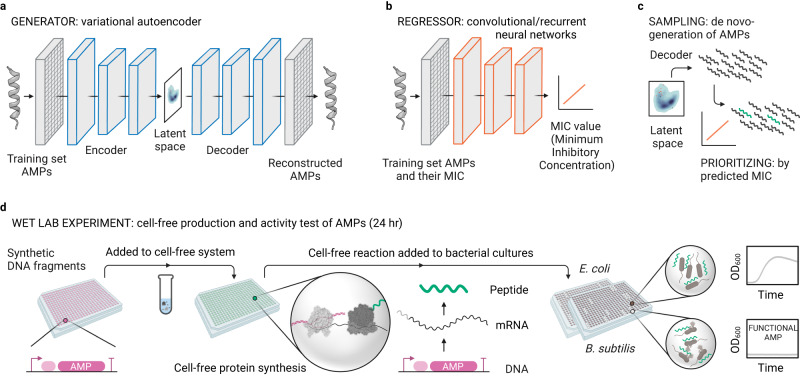
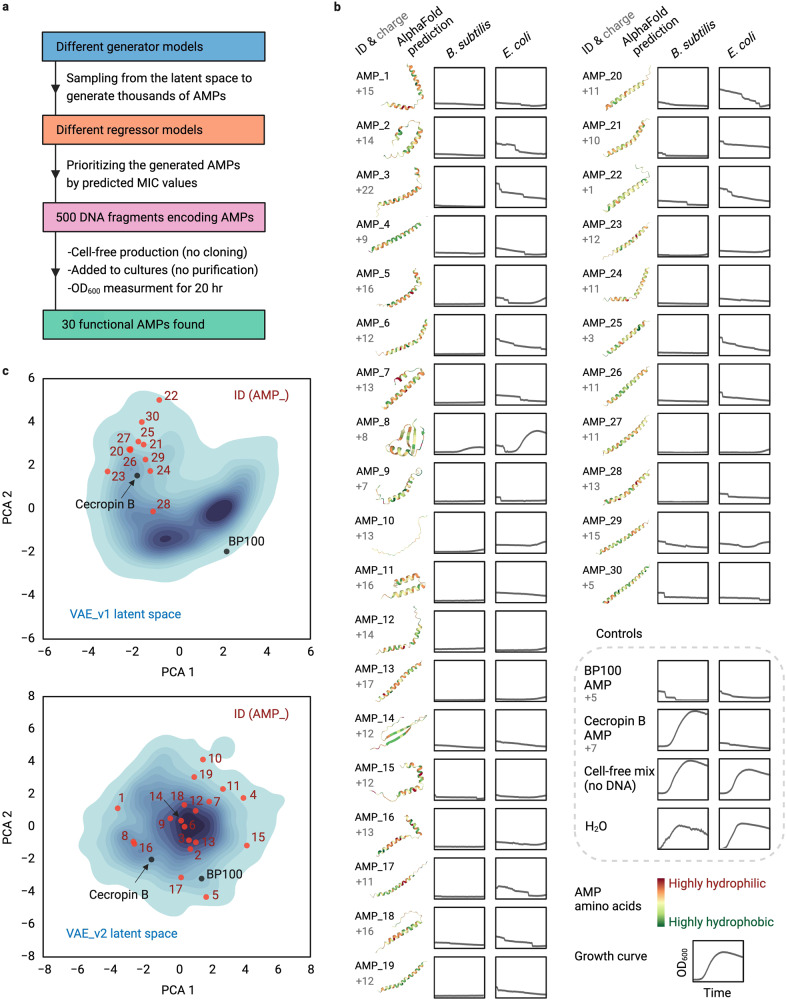
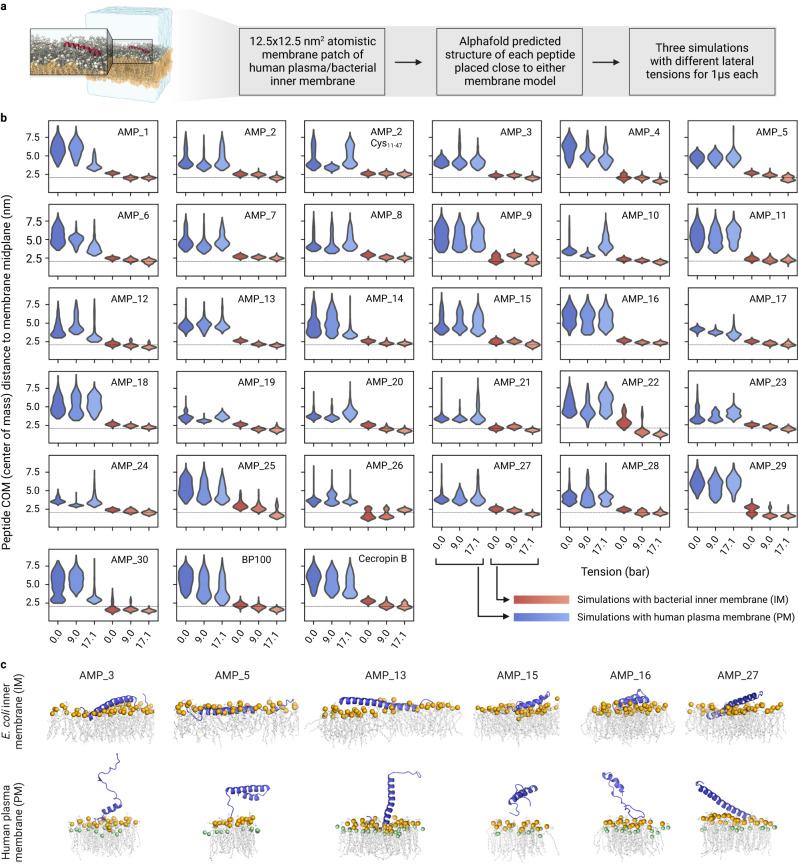
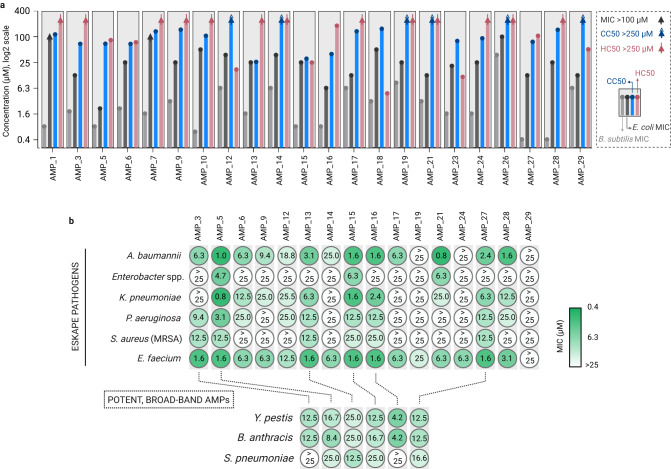
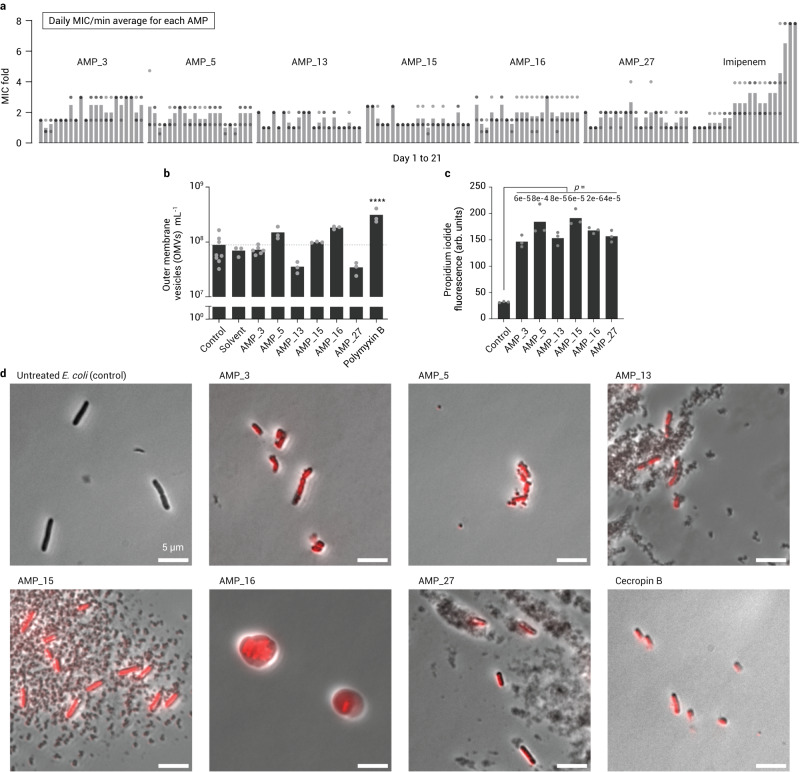
Bioactive peptides are key molecules in health and medicine. Deep learning holds a big promise for the discovery and design of bioactive peptides. Yet, suitable experimental approaches are required to validate candidates in high throughput and at low cost. Here, we established a cell-free protein synthesis (CFPS) pipeline for the rapid and inexpensive production of antimicrobial peptides (AMPs) directly from DNA templates. To validate our platform, we used deep learning to design thousands of AMPs de novo. Using computational methods, we prioritized 500 candidates that we produced and screened with our CFPS pipeline. We identified 30 functional AMPs, which we characterized further through molecular dynamics simulations, antimicrobial activity and toxicity. Notably, six de novo-AMPs feature broad-spectrum activity against multidrug-resistant pathogens and do not develop bacterial resistance. Our work demonstrates the potential of CFPS for high throughput and low-cost production and testing of bioactive peptides within less than 24 h.
Overview
The claims and statistics of this paper haven’t been checked yet.
Run the check — free, no account needed. It reads the open-access text and checks the sources it cites.
Integrity signals
Registry
Cites
Statistics
Figures
Verification
Claims the paper makes
The claims and statistics of this paper haven’t been checked yet.
Run the check — free, no account needed. It reads the open-access text and checks the sources it cites.
Self-check
Percentages, sums and reported differences re-computed from the paper’s own numbers.
The self-check needs the paper’s full text.
Citations
Cites
VMD: visual molecular dynamics
Humphrey, W., Dalke, A., & Schulten, K. (1996) · Journal of Molecular Graphics · doi:10.1016/0263-7855(96)00018-5 · Cited by 66,952
Highly accurate protein structure prediction with AlphaFold
Jumper, J., Evans, R., Pritzel, A., Green, T., Figurnov, M., Ronneberger, O., Tunyasuvunakool, K., Bates, R., Žídek, A., Potapenko, A., et al. (2021) · Nature · doi:10.1038/s41586-021-03819-2 · Cited by 43,764
Comparison of simple potential functions for simulating liquid water
Jorgensen, W. L., Chandrasekhar, J., Madura, J., Impey, R., & Klein, M. (1983) · The Journal of Chemical Physics · doi:10.1063/1.445869 · Cited by 38,397
Molecular dynamics with coupling to an external bath
Berendsen, H. J. C., Postma, J. P. M., van Gunsteren, W. F., DiNola, A., & Haak, J. R. (1984) · The Journal of Chemical Physics · doi:10.1063/1.448118 · Cited by 31,057
Abraham, M. J., Murtola, T., Schulz, R., Páll, S., Smith, J. C., Hess, B., & Lindahl, E. (2015) · SoftwareX · doi:10.1016/j.softx.2015.06.001 · Cited by 27,190
A smooth particle mesh Ewald method
Essmann, U., Perera, L., Berkowitz, M., Darden, T., Lee, H.-C., & Pedersen, L. (1995) · The Journal of Chemical Physics · doi:10.1063/1.470117 · Cited by 21,378
Polymorphic transitions in single crystals: A new molecular dynamics method
Parrinello, M., & Rahman, A. (1981) · Journal of Applied Physics · doi:10.1063/1.328693 · Cited by 20,009
LINCS: A linear constraint solver for molecular simulations
Hess, B., Bekker, H., Berendsen, H. J. C., & Fraaije, J. G. E. M. (1997) · Journal of Computational Chemistry · doi:10.1002/(sici)1096-987x(199709)18:12 · Cited by 18,479
Canonical sampling through velocity rescaling
Bussi, G., Donadio, D., & Parrinello, M. (2007) · The Journal of Chemical Physics · doi:10.1063/1.2408420 · Cited by 18,327
Global burden of bacterial antimicrobial resistance in 2019: a systematic analysis
Murray, C. J. L., Ikuta, K. S., Sharara, F., Swetschinski, L., Robles Aguilar, G., Gray, A., Han, C., Bisignano, C., Rao, P., Wool, E., et al. (2022) · The Lancet · doi:10.1016/s0140-6736(21)02724-0 · Cited by 16,316
Ultrastructural Characterization of the Lower Motor System in a Mouse Model of Krabbe Disease
Cappello, V., Marchetti, L., Parlanti, P., Landi, S., Tonazzini, I., Cecchini, M., Piazza, V., & Gemmi, M. (2016) · Scientific Reports · doi:10.1038/s41598-016-0001-8 · Cited by 13,097
UCSF ChimeraX : Structure visualization for researchers, educators, and developers
Pettersen, E. F., Goddard, T. D., Huang, C. C., Meng, E. C., Couch, G. S., Croll, T. I., Morris, J. H., & Ferrin, T. E. (2020) · Protein Science · doi:10.1002/pro.3943 · Cited by 9,521
CHARMM‐GUI: A web‐based graphical user interface for CHARMM
Jo, S., Kim, T., Iyer, V. G., & Im, W. (2008) · Journal of Computational Chemistry · doi:10.1002/jcc.20945 · Cited by 9,284
CHARMM36m: an improved force field for folded and intrinsically disordered proteins
Huang, J., Rauscher, S., Nawrocki, G., Ran, T., Feig, M., de Groot, B. L., Grubmüller, H., & MacKerell, A. D. (2016) · Nature Methods · doi:10.1038/nmeth.4067 · Cited by 7,334
UniProt: the universal protein knowledgebase in 2021
The UniProt Consortium, Bateman, A., Martin, M.-J., Orchard, S., Magrane, M., Agivetova, R., Ahmad, S., Alpi, E., Bowler-Barnett, E. H., Britto, R., et al. (2021) · Nucleic Acids Research · doi:10.1093/nar/gkaa1100 · Cited by 6,372
APD3: the antimicrobial peptide database as a tool for research and education
Wang, G., Li, X., & Wang, Z. (2015) · Nucleic Acids Research · doi:10.1093/nar/gkv1278 · Cited by 2,402
Robust deep learning–based protein sequence design using ProteinMPNN
Dauparas, J., Anishchenko, I., Bennett, N., Bai, H., Ragotte, R. J., Milles, L. F., Wicky, B. I. M., Courbet, A., de Haas, R. J., Bethel, N., et al. (2022) · Science · doi:10.1126/science.add2187 · Cited by 2,210
Robust deep learning based protein sequence design using ProteinMPNN
Dauparas, J., Anishchenko, I., Bennett, N., Bai, H., Ragotte, R. J., Milles, L. F., Wicky, B. I. M., Courbet, A., de Haas, R. J., Bethel, N., et al. (2022) · doi:10.1101/2022.06.03.494563 · Cited by 2,107
Generating Sentences from a Continuous Space
Bowman, S. R., Vilnis, L., Vinyals, O., Dai, A., Jozefowicz, R., & Bengio, S. (2016) · Proceedings of The 20th SIGNLL Conference on Computational Natural Language Learning · doi:10.18653/v1/k16-1002 · Cited by 2,061
Designing antimicrobial peptides: form follows function
Fjell, C. D., Hiss, J. A., Hancock, R. E. W., & Schneider, G. (2011) · Nature Reviews Drug Discovery · doi:10.1038/nrd3591 · Cited by 2,041
Automated design of synthetic ribosome binding sites to control protein expression
Salis, H. M., Mirsky, E. A., & Voigt, C. A. (2009) · Nature Biotechnology · doi:10.1038/nbt.1568 · Cited by 1,844
Biological Functions and Biogenesis of Secreted Bacterial Outer Membrane Vesicles
Kulp, A., & Kuehn, M. J. (2010) · Annual Review of Microbiology · doi:10.1146/annurev.micro.091208.073413 · Cited by 1,540
The coming of age of de novo protein design
Huang, P.-S., Boyken, S. E., & Baker, D. (2016) · Nature · doi:10.1038/nature19946 · Cited by 1,478
Towards the sustainable discovery and development of new antibiotics
Miethke, M., Pieroni, M., Weber, T., Brönstrup, M., Hammann, P., Halby, L., Arimondo, P. B., Glaser, P., Aigle, B., Bode, H. B., et al. (2021) · Nature Reviews Chemistry · doi:10.1038/s41570-021-00313-1 · Cited by 1,228
Self-citationAutomated Builder and Database of Protein/Membrane Complexes for Molecular Dynamics Simulations
Jo, S., Kim, T., & Im, W. (2007) · PLoS ONE · doi:10.1371/journal.pone.0000880 · Cited by 1,190
Antimicrobial peptides: Application informed by evolution
Lazzaro, B. P., ZASLOFF, M. A., & Rolff, J. (2020) · Science · doi:10.1126/science.aau5480 · Cited by 1,091
ProtGPT2 is a deep unsupervised language model for protein design
Ferruz, N., Schmidt, S., & Höcker, B. (2022) · Nature Communications · doi:10.1038/s41467-022-32007-7 · Cited by 795
Plasma membranes are asymmetric in lipid unsaturation, packing and protein shape
Lorent, J. H., Levental, K. R., Ganesan, L., Rivera-Longsworth, G., Sezgin, E., Doktorova, M., Lyman, E. R., & Levental, I. (2020) · Nature Chemical Biology · doi:10.1038/s41589-020-0529-6 · Cited by 780
A cleavage method which minimizes side reactions following Fmoc solid phase peptide synthesis
King, D., Fields, C. G., & Fields, G. (1990) · International journal of peptide & protein research · doi:10.1111/j.1399-3011.1990.tb00976.x · Cited by 718
Contribution of bacterial outer membrane vesicles to innate bacterial defense
Manning, A. J., & Kuehn, M. J. (2011) · BMC Microbiology · doi:10.1186/1471-2180-11-258 · Cited by 623
Cell-free gene expression: an expanded repertoire of applications
Silverman, A. D., Karim, A. S., & Jewett, M. C. (2019) · Nature Reviews Genetics · doi:10.1038/s41576-019-0186-3 · Cited by 602
Identification of antimicrobial peptides from the human gut microbiome using deep learning
Ma, Y., Guo, Z., Xia, B., Zhang, Y., Liu, X., Yu, Y., Tang, N., Tong, X., Wang, M., Ye, X., et al. (2022) · Nature Biotechnology · doi:10.1038/s41587-022-01226-0 · Cited by 512
Accelerated antimicrobial discovery via deep generative models and molecular dynamics simulations
Das, P., Sercu, T., Wadhawan, K., Padhi, I., Gehrmann, S., Cipcigan, F. S., Chenthamarakshan, V., Strobelt, H., dos Santos, C., Chen, P.-Y., et al. (2021) · Nature Biomedical Engineering · doi:10.1038/s41551-021-00689-x · Cited by 506
ProGen2: Exploring the boundaries of protein language models
Nijkamp, E., Ruffolo, J. A., Weinstein, E. N., Naik, N., & Madani, A. (2023) · Cell Systems · doi:10.1016/j.cels.2023.10.002 · Cited by 480
Deep learning-based kcat prediction enables improved enzyme-constrained model reconstruction
Li, F., Yuan, L., Lu, H., Li, G., Chen, Y., Engqvist, M. K. M., Kerkhoven, E. J., & Nielsen, J. (2022) · Nature Catalysis · doi:10.1038/s41929-022-00798-z · Cited by 466 · cited 2×
“– Puri fi cation: The peptides were puri fi ed by reverse-phase (RP)- HPLC using a preparative Agilent 1260 In fi nity II Series HPLC-system (Agilent Technologies) with column 1 (Supplementary Table 16).”
MethodReview: Lessons Learned From Clinical Trials Using Antimicrobial Peptides (AMPs)
Dijksteel, G. S., Ulrich, M. M. W., Middelkoop, E., & Boekema, B. K. H. L. (2021) · Frontiers in Microbiology · doi:10.3389/fmicb.2021.616979 · Cited by 445
Structural Basis for the Transition from Initiation to Elongation Transcription in T7 RNA Polymerase
Yin, Y. W., & Steitz, T. A. (2002) · Science · doi:10.1126/science.1077464 · Cited by 352
Portable, On-Demand Biomolecular Manufacturing
Pardee, K., Slomovic, S., Nguyen, P. Q., Lee, J. W., Donghia, N. M., Burrill, D. R., Ferrante, T., McSorley, F. R., Furuta, Y., Vernet, A., et al. (2016) · Cell · doi:10.1016/j.cell.2016.09.013 · Cited by 339
YADAMP: yet another database of antimicrobial peptides
Piotto, S., Sessa, L., Concilio, S., & Iannelli, P. (2012) · International Journal of Antimicrobial Agents · doi:10.1016/j.ijantimicag.2011.12.003 · Cited by 256
High-resolution structure of the Escherichia coli ribosome
Noeske, J., Wasserman, M. R., Terry, D. S., Altman, R. B., Blanchard, S. C., & Cate, J. H. D. (2015) · Nature Structural & Molecular Biology · doi:10.1038/nsmb.2994 · Cited by 256
Pearson, D. A., Blanchette, M. A., Baker, M. L., & Guindon, C. A. (1989) · Tetrahedron Letters · doi:10.1016/s0040-4039(00)99113-5 · Cited by 248
Pirtskhalava, M., Gabrielian, A. E., Cruz, P., Griggs, H. L., Squires, R. B., Hurt, D. E., Grigolava, M., Chubinidze, M., Gogoladze, G., Vishnepolsky, B., et al. (2015) · Nucleic Acids Research · doi:10.1093/nar/gkv1174 · Cited by 246
DRAMP: a comprehensive data repository of antimicrobial peptides
Fan, L., Sun, J., Zhou, M., Zhou, J., Lao, X., Zheng, H., & Xu, H. (2016) · Scientific Reports · doi:10.1038/srep24482 · Cited by 238
Discovering highly potent antimicrobial peptides with deep generative model HydrAMP
Szymczak, P., Możejko, M., Grzegorzek, T., Jurczak, R., Bauer, M., Neubauer, D., Sikora, K., Michalski, M., Sroka, J., Setny, P., et al. (2023) · Nature Communications · doi:10.1038/s41467-023-36994-z · Cited by 231
Recent advances in de novo protein design: Principles, methods, and applications
Pan, X., & Kortemme, T. (2021) · Journal of Biological Chemistry · doi:10.1016/j.jbc.2021.100558 · Cited by 228
DADP: the database of anuran defense peptides
Novković, M., Simunić, J., Bojović, V., Tossi, A., & Juretić, D. (2012) · Bioinformatics · doi:10.1093/bioinformatics/bts141 · Cited by 219
Generating functional protein variants with variational autoencoders
Hawkins‐Hooker, A., Depardieu, F., Baur, S., Couairon, G., Chen, A., & Bikard, D. (2021) · PLoS Computational Biology · doi:10.1371/journal.pcbi.1008736 · Cited by 217
Garenne, D., Haines, M., Romantseva, E. F., Freemont, P. S., Strychalski, E. A., & Noireaux, V. (2021) · Nature Reviews Methods Primers · doi:10.1038/s43586-021-00046-x · Cited by 215
Berglund, N. A., Piggot, T. J., Jefferies, D. F., Sessions, R. B., Bond, P. J., & Khalid, S. (2015) · PLoS Computational Biology · doi:10.1371/journal.pcbi.1004180 · Cited by 196
A library of linear undecapeptides with bactericidal activity against phytopathogenic bacteria
Badosa, E., Ferré, R., Planas, M., Feliu, L., Besalú, E., Cabrefiga, J., Bardajı́, E., & Montesinos, E. (2007) · Peptides · doi:10.1016/j.peptides.2007.09.010 · Cited by 173
Two decades of imipenem therapy
Rodloff, A. C., Goldstein, E. J. C., & Torres, A. (2006) · Journal of Antimicrobial Chemotherapy · doi:10.1093/jac/dkl354 · Cited by 171
A Simple, Robust, and Low-Cost Method To Produce the PURE Cell-Free System
Lavickova, B., & Maerkl, S. J. (2019) · ACS Synthetic Biology · doi:10.1021/acssynbio.8b00427 · Cited by 159
Translation Initiation is Controlled by RNA Folding Kinetics via a Ribosome Drafting Mechanism
Borujeni, A. E., & Salis, H. M. (2016) · Journal of the American Chemical Society · doi:10.1021/jacs.6b01453 · Cited by 143
Protein-inspired antibiotics active against vancomycin- and daptomycin-resistant bacteria
Blaskovich, M. A. T., Hansford, K. A., Gong, Y., Butler, M. S., Muldoon, C. A., Huang, J. X., Ramu, S., Silva, A. B., Cheng, M., Kavanagh, A. M., et al. (2017) · Nature Communications · doi:10.1038/s41467-017-02123-w · Cited by 141
Dean, S. N., Alvarez, J. A. E., Zabetakis, D., Walper, S. A., & Malanoski, A. P. (2021) · Frontiers in Microbiology · doi:10.3389/fmicb.2021.725727 · Cited by 132
Deep generative modeling for protein design
Strokach, A. V., & Kim, P. M. (2021) · Current Opinion in Structural Biology · doi:10.1016/j.sbi.2021.11.008 · Cited by 122
Variational Autoencoder for Generation of Antimicrobial Peptides
Dean, S. N., & Walper, S. A. (2020) · ACS Omega · doi:10.1021/acsomega.0c00442 · Cited by 119
Deep Learning for Novel Antimicrobial Peptide Design
Wang, C. E., Garlick, S., & Zloh, M. (2021) · Biomolecules · doi:10.3390/biom11030471 · Cited by 117
Deep learning regression model for antimicrobial peptide designPreprint
Witten, J. J., & Witten, Z. (2019) · bioRxiv (Cold Spring Harbor Laboratory) · doi:10.1101/692681 · Cited by 101
Fujii, N., Otaka, A., SUGIYAMA, N., Hatano, M., & Yajima, H. (1987) · Chemical and Pharmaceutical Bulletin · doi:10.1248/cpb.35.3880 · Cited by 99
Bauwens, A., Kunsmann, L., Karch, H., Mellmann, A., & Bielaszewska, M. (2017) · Antimicrobial Agents and Chemotherapy · doi:10.1128/aac.00937-17 · Cited by 91
Jarvis, D. L., Summers, M. D., García, A., & Bohlmeyer, D. A. (1993) · Journal of Biological Chemistry · doi:10.1016/s0021-9258(19)85481-9 · Cited by 85
Pirtskhalava, M., Gabrielian, A. E., Cruz, P., Griggs, H. L., Squires, R. B., Hurt, D. E., Grigolava, M., Chubinidze, M., Gogoladze, G., Vishnepolsky, B., et al. (2016) · Nucleic Acids Research · doi:10.1093/nar/gkw243 · Cited by 63
Binding of SARS-CoV-2 Fusion Peptide to Host Endosome and Plasma Membrane
Schaefer, S. L., Jung, H., & Hummer, G. (2021) · The Journal of Physical Chemistry B · doi:10.1021/acs.jpcb.1c04176 · Cited by 54
Self-citationPonath, V., Hoffmann, N., Bergmann, L., Maeder, C., Alhamwe, B. A., Preußer, C., & von Strandmann, E. P. (2021) · International Journal of Molecular Sciences · doi:10.3390/ijms22042189 · Cited by 32
Self-citationIn the Age of Synthetic Biology, Will Antimicrobial Peptides be the Next Generation of Antibiotics?
Jaumaux, F., de Cadiñanos, L. P. G., & Gabant, P. (2020) · Antibiotics · doi:10.3390/antibiotics9080484 · Cited by 25
Grasemann, L., Lavickova, B., Elizondo-Cantú, M. C., & Maerkl, S. J. (2021) · Journal of Visualized Experiments · doi:10.3791/62625 · Cited by 19
Deep attention based variational autoencoder for antimicrobial peptide discoveryPreprint
Ghorbani, M., Prasad, S., Brooks, B. R., & Klauda, J. B. (2022) · bioRxiv (Cold Spring Harbor Laboratory) · doi:10.1101/2022.07.08.499340 · Cited by 15
Structural basis for the transition from initiation to elongation transcription in T7 RNA polymerase
Yin, Y. W., & Steitz, T. A. (2002) · Worldwide Protein Data Bank · doi:10.2210/pdb1msw/pdb · Cited by 2
High-resolution structure of the Escherichia coli ribosome
Cocozaki, A., & Ferguson, A. D. (2016) · Worldwide Protein Data Bank · doi:10.2210/pdb5it8/pdb · Cited by 1
Research works printed but not linked: 1
- Konur, O. Handbook of Algal Science, Technology and Medicine (Academic Press, 2020).
Cited by
Sorted by citations
Artificial intelligence in drug development
Zhang, K., Yang, X., Wang, Y., Yu, Y., Huang, N., Li, G. L., Li, X., Wu, J. C., & Yang, S. (2025) · Nature Medicine · doi:10.1038/s41591-024-03434-4 · Cited by 585
Advances in antimicrobial peptides: From mechanistic insights to chemical modifications
Yang, R., Ma, X., Peng, F., Wen, J., Allahou, L. W., Williams, G. R., Knowles, J. C., & Poma, A. (2025) · Biotechnology Advances · doi:10.1016/j.biotechadv.2025.108570 · Cited by 131
Antimicrobial resistance crisis: could artificial intelligence be the solution?
Liu, G., Yu, D., Fan, M.-M., Zhang, X., Jin, Z., Tang, C. M., & Liu, X. (2024) · Military Medical Research · doi:10.1186/s40779-024-00510-1 · Cited by 138
Wang, J., Feng, J., Kang, Y., Pan, P., Ge, J., Wang, Y., Wang, M., Wu, Z., Zhang, X., Yu, J., et al. (2025) · Science Advances · doi:10.1126/sciadv.ads8932 · Cited by 125
A review on the screening methods for the discovery of natural antimicrobial peptides
Yang, B., Yang, H., Liang, J., Chen, J., Wang, C., Wang, Y., Wang, J., Luo, W., Deng, T., & Guo, J. (2024) · Journal of Pharmaceutical Analysis · doi:10.1016/j.jpha.2024.101046 · Cited by 110
Metadata
- Authors
- Pandi, A., Adam, D., Zare, A., Trinh, V. T., Schaefer, S. L., Burt, M., Klabunde, B., Bobkova, E., Kushwaha, M., Foroughijabbari, Y., Braun, P., Spahn, C., Preußer, C., Pogge von Strandmann, E., Bode, H. B., von Buttlar, H., Bertrams, W., Jung, A. L., Abendroth, F., Schmeck, B., Hummer, G., Vázquez, O., & Erb, T. J.
- Affiliations
- Max Planck Institute for Terrestrial Microbiology (DE)
- Philipps University of Marburg (DE)
- Max Planck Institute of Biophysics (DE)
- AgroParisTech (FR)
- Fraunhofer Institute for Translational Medicine and Pharmacology (DE)
- Goethe University Frankfurt (DE)
- German Center for Infection Research (DE)
- Corresponding author
- Pandi, Amir
- Erb, Tobias J.
- ORCID
- Pandi, Amir
- Zare, Amir
- Trinh, Van Tuan
- Schaefer, Stefan L.
- Klabunde, Björn
- Bobkova, Elizaveta
- Kushwaha, Manish
- Foroughijabbari, Yeganeh
- Braun, Peter
- Spahn, Christoph
- Preußer, Christian
- Bode, Helge B.
- von Buttlar, Heiner
- Bertrams, Wilhelm
- Jung, Anna Lena
- Abendroth, Frank
- Schmeck, Bernd
- Hummer, Gerhard
- Vázquez, Olalla
- Erb, Tobias J.
- Venue
- Nature Communications
- Published
- 2023-11-08
- Volume
- 14
- Issue
- 1
- Pages
- 7197-7197
- ISSN
- 2041-1723 (ISSN-L)
- PMC
- PMC10632401
- OpenAlex
- W4388492286
- Cited by
- 173
- References
- 69
- Citations by year
- 2026: 54 · 2025: 67 · 2024: 50 · 2023: 2
- FWCI
- 31.50
- Type
- journal article
- Language
- en
- Open access
- gold
- doi.org
- Locations
- Nature Communications (publishedVersion, cc-by)
- bioRxiv (Cold Spring Harbor Laboratory) (acceptedVersion, cc-by)
- PubMed Central (publishedVersion, cc-by)
- PubMed (publishedVersion)
- HAL (submittedVersion, other-oa)
- RePEc: Research Papers in Economics (submittedVersion)
- DOAJ (DOAJ: Directory of Open Access Journals) (submittedVersion, cc-by-sa)
- Fraunhofer-Publica (Fraunhofer-Gesellschaft) (submittedVersion)
- Funders
- Max-Planck-Gesellschaft
- European Molecular Biology Organization (ALTG 165-2020)
- Topics
- Life Sciences › Immunology and Microbiology › Microbiology › Antimicrobial Peptides and Activities
- Physical Sciences › Chemistry › Organic Chemistry › Chemical Synthesis and Analysis
- Life Sciences › Immunology and Microbiology › Applied Microbiology and Biotechnology › Microbial Natural Products and Biosynthesis
- Keywords
- antimicrobial peptides, cell-free protein synthesis, de novo peptide design, deep learning, bioactive peptides, multidrug-resistant pathogens, broad-spectrum antimicrobial activity, peptide toxicity, molecular dynamics simulation
- MeSH terms
- Deep Learning, Antimicrobial Peptides, DNA Replication, Protein Biosynthesis, Molecular Dynamics Simulation
About these checks
Registry, retraction, Cites and statistics results are computed, not judged, with one exception: a printed reference that no index lists is read once by a model before it counts as a citation error. Claims are extracted by a model and kept only when their quote appears verbatim in the text; each cited source is then checked, with a model’s help, for whether it says what the claim relies on. Those verdicts can be wrong — read the claim’s quote and the cited source before relying on one.
Statistics and arithmetic are recomputed, not judged.
Confidence bands are shown only for fields calibrated on our annotated test set. None is calibrated yet, so no band is shown.
What counts as a claim ›How we measure confidence ›How we check this ›
Are you an author, or do you see a problem with this page? Request a review
