

Holographic codes from hyperinvariant tensor networks
Open accessThe DOI matches its Crossref record; 48 of the 48 references it cites were found in a registry or an index.
Abstract
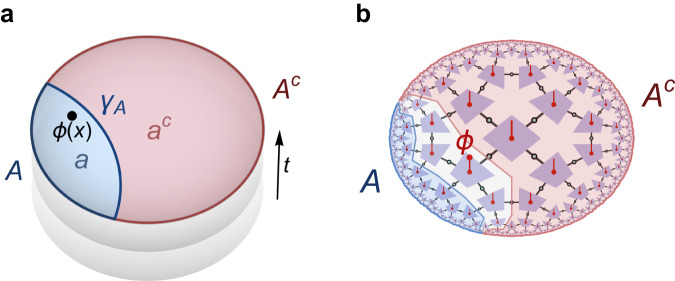
Holographic quantum-error correcting codes are models of bulk/boundary dualities such as the anti-de Sitter/conformal field theory (AdS/CFT) correspondence, where a higher-dimensional bulk geometry is associated with the code’s logical degrees of freedom. Previous discrete holographic codes based on tensor networks have reproduced the general code properties expected from continuum AdS/CFT, such as complementary recovery. However, the boundary states of such tensor networks typically do not exhibit the expected correlation functions of CFT boundary states. In this work, we show that a new class of exact holographic codes, extending the previously proposed hyperinvariant tensor networks into quantum codes, produce the correct boundary correlation functions. This approach yields a dictionary between logical states in the bulk and the critical renormalization group flow of boundary states. Furthermore, these codes exhibit a state-dependent breakdown of complementary recovery as expected from AdS/CFT under small quantum gravity corrections.
Overview
The claims and statistics of this paper haven’t been checked yet.
Free: it reads the open-access text and checks the first 5 claims that cite a source we can check. Create a free account to check every claim.
Integrity signals
Registry
Cites
Statistics
Figures
Verification
Claims the paper makes
The claims and statistics of this paper haven’t been checked yet.
Free: it reads the open-access text and checks the first 5 claims that cite a source we can check. Create a free account to check every claim.
Claims other papers make about this one
Each is checked against this paper’s own text: does it say what the citing paper says it does?
The source backs part of the claim, not all of it — or backs it for a different population, condition or comparison.
In the citing paper
“For higher valence q, more indices are pointing inward, and therefore additional isometries including three or more contractions of A might be necessary to relate entanglement properties of the boundary state to geometric properties of the bulk that has been found in [18].”
From Hyperinvariant spin network states — an AdS/CFT model from first principles (2026) · cites this paper as [18]
Experimental — accuracy not yet measuredThe cited source says what the claim attributes to it.
In the citing paper
“It has been shown in Refs.[17,18] that hyperinvariant tensor networks do not always fulfil the RT formula (for instance in a (5,4) tiling).”
From Hyperinvariant spin network states — an AdS/CFT model from first principles (2026) · cites this paper as [18]
The check wasn’t confident either way, so it gives no verdict — never disputed.
In the citing paper
“There are cases where the causal wedge is slightly larger than the entanglement wedge and thus the tensors separated by the geodesic do not trace to identity.”
From Hyperinvariant spin network states — an AdS/CFT model from first principles (2026) · cites this paper as [18]
Experimental — accuracy not yet measured
Self-check
Percentages, sums and reported differences re-computed from the paper’s own numbers.
The self-check needs the paper’s full text.
Citations
Cites
The large $N$ limit of superconformal field theories and supergravity
Maldacena, J. (1998) · Advances in Theoretical and Mathematical Physics · doi:10.4310/atmp.1998.v2.n2.a1 · Cited by 14,524
Anti de Sitter space and holography
Witten, E. (1998) · Advances in Theoretical and Mathematical Physics · doi:10.4310/atmp.1998.v2.n2.a2 · Cited by 13,070
Ryu, S., & Takayanagi, T. (2006) · Physical Review Letters · doi:10.1103/physrevlett.96.181602 · Cited by 4,302
Generalized gravitational entropy
Lewkowycz, A., & Maldacena, J. (2013) · Journal of High Energy Physics · doi:10.1007/jhep08(2013)090 · Cited by 1,183
Holographic quantum error-correcting codes: toy models for the bulk/boundary correspondence
Pastawski, F., Yoshida, B., Harlow, D., & Preskill, J. (2015) · Journal of High Energy Physics · doi:10.1007/jhep06(2015)149 · Cited by 958
Quantum corrections to holographic entanglement entropy
Faulkner, T., Lewkowycz, A., & Maldacena, J. (2013) · Journal of High Energy Physics · doi:10.1007/jhep11(2013)074 · Cited by 945 · cited 1×
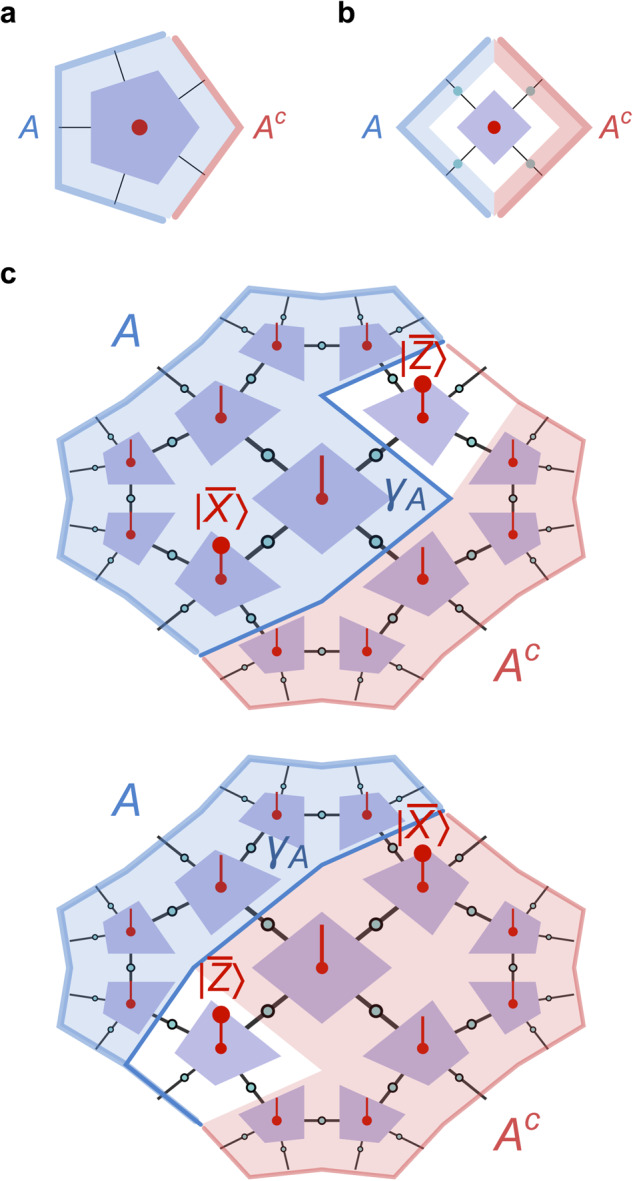
“As this termscaleswiththelengthoftheminimalsurface γ A andisboundedby j γ A j log χ , we identify it as the state-dependent area term in AdS/CFT under quantum corrections 7,10 , with an example of such state dependence given below.”
Class of Quantum Many-Body States That Can Be Efficiently Simulated
Vidal, G. (2008) · Physical Review Letters · doi:10.1103/physrevlett.101.110501 · Cited by 847 · cited 2×
“A related problem arises when considering HaPPY codes from an RG perspective: In a tensor network representation of critical systems 30,31 , the lattice version of a primary operator is an eigen-operator of the scaling superoperator , a map constructed from a single radial layer of tensor networks…”
Quantum extremal surfaces: holographic entanglement entropy beyond the classical regime
Engelhardt, N., & Wall, A. C. (2015) · Journal of High Energy Physics · doi:10.1007/jhep01(2015)073 · Cited by 836 · cited 2×
“It has been conjectured that (1) becomes exactinallordersof G ifonereplaces γ A bya quantumextremalsurface , extremizing the entire (quantum) entropy rather than the classical area 10 .”
Bulk Locality and Quantum Error Correction in AdS/CFT
Almheiri, A., Dong, X., & Harlow, D. (2014) · arXiv · doi:10.48550/arxiv.1411.7041 · Cited by 803
Bulk locality and quantum error correction in AdS/CFT
Almheiri, A., Dong, X., & Harlow, D. (2015) · Journal of High Energy Physics · doi:10.1007/jhep04(2015)163 · Cited by 802 · cited 2×
“This duality implies a dictionary between operators and fi elds between these two theories, and the details of this dictionary exhibit the de fi ning features of a quantum error-correcting code 3 .”
Cited by
Tensor networks for quantum computing
Berezutskii, A. V., Liu, M., Acharya, A., Ellerbrock, R., Gray, J., Haghshenas, R., He, Z., Khan, A., Kuzmin, V., Lyakh, D. I., et al. (2025) · Nature Reviews Physics · doi:10.1038/s42254-025-00853-1 · Cited by 124
“3a.”
Self-citationGravitational Backreaction is Magical
Cao, C., Cheng, G., Hamma, A., Leone, L., Munizzi, W., & Oliviero, S. F. E. (2025) · PRX Quantum · doi:10.1103/z3vr-w5c5 · Cited by 111
“…CFTs, but also for more general quantum many-body systems like tensor network toy models, which have been enormously successful in reproducing an analogous Ryu-Takayanagi formula [22], the emergent bulk geometry, and subregion operator reconstruction through quantum error correction [23–28].”
Quantum Lego Expansion Pack: Enumerators from Tensor Networks
Cao, C., Gullans, M. J., Lackey, B., & Wang, Z. (2024) · PRX Quantum · doi:10.1103/prxquantum.5.030313 · Cited by 38
“For tensor networks of holographic codes [29, 30, 31, 32], the network is taken from a tessellation of the hyperbolic disk.”
MethodFar from Perfect: Quantum Error Correction with (Hyperinvariant) Evenbly Codes
Steinberg, M., Fan, J., Harris, R. J., Elkouss, D., Feld, S., & Jahn, A. (2025) · Quantum · doi:10.22331/q-2025-08-08-1826 · Cited by 26
“Figure 2”
InfluentialSelf-citationApproximate Quantum Error Correcting Codes from Conformal Field Theory
Sang, S., Hsieh, T. H., & Zou, Y. (2024) · Physical Review Letters · doi:10.1103/physrevlett.133.210601 · Cited by 21
Absolutely maximally entangled pure states of multipartite quantum systems
Rajchel-Mieldzioć, G., Bistroń, R., Rico, A., Lakshminarayan, A., & Życzkowski, K. (2026) · Reports on Progress in Physics · doi:10.1088/1361-6633/ae672a · Cited by 22
“Furthermore, another extension of HTN incorporating bulk degrees of freedom [165] led to a new family of powerful error correcting codes: Evenbly codes [166].”
A correspondence between quantum error correcting codes and quantum reference framesPreprint
Carrozza, S., Chatwin-Davies, A., Höhn, P. A., & Mele, F. M. (2024) · arXiv (Cornell University) · doi:10.48550/arxiv.2412.15317 · Cited by 22
Non-trivial area operators require non-local magic
Cao, C. (2024) · Journal of High Energy Physics · doi:10.1007/jhep11(2024)105 · Cited by 17
“Many popular bottom-up constructions of holographic codes[13–16] have concentrated on the stabilizer formalism.”
BackgroundDual-Isometric Projected Entangled Pair States
Yu, X.-H., Cirac, J. I., Kos, P., & Styliaris, G. (2024) · Physical Review Letters · doi:10.1103/physrevlett.133.190401 · Cited by 15
State-dependent geometries from magic-enriched quantum codes
Cao, C., Cheng, G., Karthikeyan, K., Li, Y., & Preskill, J. (2026) · Journal of High Energy Physics · doi:10.48550/arxiv.2603.13475 · Cited by 13
Universal fault-tolerant logic with heterogeneous holographic codesPreprint
Steinberg, M., Fan, J., Eisert, J., Feld, S., Jahn, A., & Cao, C. (2025) · arXiv (Cornell University) · doi:10.48550/arxiv.2504.10386 · Cited by 12
Self-citationNon-isometry, state dependence and holography
Antonini, S., Balasubramanian, V., Bao, N., Cao, C., & Chemissany, W. (2025) · Journal of High Energy Physics · doi:10.1007/jhep02(2025)150 · Cited by 11
Ramadas, N., & Lakshminarayan, A. (2025) · Journal of Physics A Mathematical and Theoretical · doi:10.1088/1751-8121/adbf75 · Cited by 11
Near-Term Spin-Qubit Architecture Design via Multipartite Maximally Entangled States
Paraskevopoulos, N., Steinberg, M., Undseth, B., Sarkar, A., Vandersypen, L. M. K., Xue, X., & Feld, S. (2025) · PRX Quantum · doi:10.1103/prxquantum.6.020307 · Cited by 11
Self-citationBulk-boundary correspondence from hyperinvariant tensor networks
Bistroń, R., Hontarenko, M., & Życzkowski, K. (2025) · Physical review. D/Physical review. D. · doi:10.1103/physrevd.111.026006 · Cited by 9
“The proposed model connects them with nodes of hyper-invariant tenor networks [16], constructed from dual unitary matrices [17–19].”
LEGO_HQEC: Automating the Analysis, Construction, and Decoding of Holographic Quantum CodesPreprint
Fan, J., Steinberg, M., Jahn, A., Cao, C., Sarkar, A., & Feld, S. (2024) · arXiv (Cornell University) · doi:10.48550/arxiv.2410.22861 · Cited by 9
“LEGO_HQEC has already featured in several holographic code studies, including those exploring the novel Evenbly codes [53], [62], analyses of asymptotically zero-rate holographic codes as compared to the hashing bound [51], [64], as well as for constructions of heterogeneous holographic codes [61],…”
Self-citationBiased-noise thresholds of zero-rate holographic codes with tensor-network decoding
Fan, J., Steinberg, M., Jahn, A., Cao, C., & Feld, S. (2026) · Physical Review A · doi:10.1103/rcxg-x3hy · Cited by 8
“It would be interesting to see if a tensor-network decoder would allow for a more complete biased-noise threshold exploration of Evenbly codes and their many derivatives [38, 82, 83].”
InfluentialSelf-citationQuantum circuits for high-dimensional absolutely maximally entangled states
Casas, B., Rajchel-Mieldzioć, G., Rather, S. A., Płodzień, M., Bruzda, W., Cervera-Lierta, A., & Życzkowski, K. (2026) · Quantum Science and Technology · doi:10.1088/2058-9565/ae46d6 · Cited by 7
“Moreover, this advancement also brings the prospect of experimentally studying non-stabilizer holographic codes closer to reality [54, 55] While AME states can be mathematically constructed and studied so far, there is no known physical process generating such states, or a known Hamiltonian whose…”
Scalable and fault-tolerant preparation of encoded k -uniform states
Majidy, S., Hangleiter, D., & Gullans, M. J. (2025) · Physical Review A · doi:10.1103/cl23-c3jg · Cited by 7
Holographic coarse-grained states and the necessity of perfect entanglement
Lin, Y.-Y., & Zhang, J. (2024) · Physical review. D/Physical review. D. · doi:10.1103/physrevd.109.126012 · Cited by 6
Vertex representation of hyperbolic tensor networks
Moško, M., Polackova, M., Krčmár, R., & Gendiar, A. (2025) · Physical review. E · doi:10.1103/physreve.111.024105 · Cited by 3
Bit by Bit: Gravity Through the Lens of Quantum InformationPreprint
Munizzi, W. (2024) · arXiv (Cornell University) · doi:10.48550/arxiv.2406.01695 · Cited by 3
Minimal decomposition entropy and optimal representations of absolutely maximally entangled states
Ramadas, N. (2026) · Physical Review A · doi:10.1103/cvdl-1jw6 · Cited by 2
Holographic codes seen through ZX-calculusPreprint
Wan, K. H., Price, H. C. W., Yao, Q., Zhong, Z., & Zapirain, A. (2026) · arXiv (Cornell University) · doi:10.48550/arxiv.2601.04467 · Cited by 2
“In contrast to [32, 34], where a [[4 , 1 , 2]] encoding tensor is placed at each vertex, we replace every tensor by the following ZX-diagram: The central uncontracted leg in equation 36 represents a bulk qubit, while the four corner legs are to be contracted with neighbouring tensors.”
Hyperinvariant spin network states — an AdS/CFT model from first principles
Otto, F., Mansuroglu, R., Schuch, N., Gühne, O., & Sahlmann, H. (2026) · Journal of High Energy Physics · doi:10.1007/jhep06(2026)145 · Cited by 1
On infinite tensor networks, complementary recovery and type II factors
Chemissany, W., Gesteau, E., Jahn, A., Murphy, D., & Shaposhnik, L. (2025) · Journal of Physics A: Mathematical and Theoretical · doi:10.1088/1751-8121/ae0edd · Cited by 1
“An explicit example of such a situation is given in [39] where the entanglement wedges of boundary regions do not have a simple geometric picture.”
Self-citationUniqueness of complementary recovery in holographic error-correcting codes
Jones, J., & Pollack, J. (2026) · Journal of High Energy Physics · doi:10.1007/jhep08(2026)096 · Cited by 1
“However, since holographic codes with Clifford encoding circuits have trivial area operators [21, 22], the geometric information in stabilizer tensor networks must come entirely from other operators in the center of the code subalgebra.”
Building holographic code from the boundaryPreprint
Wang, W. (2024) · arXiv (Cornell University) · doi:10.48550/arxiv.2407.10271 · Cited by 1
Synthesis and Optimization of Encoding Circuits for Fault-Tolerant Quantum ComputationPreprint
Peham, T., Steinberg, M., Wille, R., & Heußen, S. (2026) · arXiv (Cornell University) · doi:10.48550/arxiv.2605.15266 · Cited by 1
Self-citationEmergent de Sitter Space and Non-Unitary Tensor Networks from Non-Hermitian Quantum CriticalityPreprint
Chou, K.-H., & Chang, P.-Y. (2026) · arXiv (Cornell University) · doi:10.48550/arxiv.2606.17983 · Cited by 1
Angular $k$-uniformity and the Hyperinvariance of Holographic CodesPreprint
Cheng, W. (2025) · arXiv (Cornell University) · doi:10.48550/arxiv.2506.06577
“One approach that integrates both strategies is the hyperinvari-ant tensor network [4–7], which generalizes the HaPPY construction to broader classes of isometries, and richer entanglement structures.”
InfluentialNoisy Holographic Quantum Error Correcting Codes
He, Z. (2024) · eScholarship (California Digital Library)
Vaid, D. (2026) · arXiv (Cornell University) · doi:10.48550/arxiv.2605.16316
Yoon, H.-E. (2026) · SSRN Electronic Journal · doi:10.2139/ssrn.7250701
A sharp bound on spacetime distance from quantum entanglementPreprint
Wang, Z.-W., Shabir, A., Faizal, M., & Braunstein, S. L. (2026) · arXiv (Cornell University) · doi:10.48550/arxiv.2608.12245
Metadata
- Authors
- Steinberg, M., Feld, S., & Jahn, A.
- Affiliations
- QuTech (NL)
- California Institute of Technology (US)
- Corresponding author
- Jahn, Alexander
- Venue
- Nature Communications
- Published
- 2023-11-11
- Volume
- 14
- Issue
- 1
- Pages
- 7314-7314
- ISSN
- 2041-1723 (ISSN-L)
- PMC
- PMC10640591
- OpenAlex
- W4388593305
- Cited by
- 20
- References
- 43
- Citations by year
- 2026: 5 · 2025: 10 · 2024: 5
- FWCI
- 1.46
- Type
- journal article
- Language
- en
- Open access
- gold
- doi.org
- Licence
- cc-by
- creativecommons.org/licenses/by/4.0 (tdm)
- creativecommons.org/licenses/by/4.0 (vor)
- Locations
- Nature Communications (publishedVersion, cc-by)
- PubMed Central (publishedVersion, cc-by)
- PubMed (publishedVersion)
- OSTI OAI (U.S. Department of Energy Office of Scientific and Technical Information) (submittedVersion, other-oa)
- DOAJ (DOAJ: Directory of Open Access Journals) (submittedVersion, cc-by-sa)
- Research Repository (Delft University of Technology) (submittedVersion, cc-by)
- Funders
- Einstein Stiftung Berlin (ERUQD)
- Topics
- Physical Sciences › Physics and Astronomy › Nuclear and High Energy Physics › Black Holes and Theoretical Physics
- Physical Sciences › Physics and Astronomy › Atomic and Molecular Physics, and Optics › Quantum many-body systems
- Physical Sciences › Computer Science › Artificial Intelligence › Quantum Computing Algorithms and Architecture
- Keywords
- AdS/CFT correspondence, boundary correlation functions, quantum gravity corrections, tensor networks
About these checks
Registry, retraction, Cites and statistics results are computed, not judged, with one exception: a printed reference that no index lists is read once by a model before it counts as a citation error. Claims are extracted by a model and kept only when their quote appears verbatim in the text; each cited source is then checked, with a model’s help, for whether it says what the claim relies on. Those verdicts can be wrong — read the claim’s quote and the cited source before relying on one.
Statistics and arithmetic are recomputed, not judged.
Confidence bands are shown only for fields calibrated on our annotated test set. None is calibrated yet, so no band is shown.
What counts as a claim ›How we measure confidence ›How we check this ›
Are you an author, or do you see a problem with this page? Request a review
Data sources
Bibliographic data: Semantic Scholar, OpenAlex, Crossref.
Contains information from the Semantic Scholar Academic Graph Datasets, made available under the ODC Attribution License (ODC-BY 1.0).
Semantic Scholar’s data is described in: Kinney, R., et al. (2023). The Semantic Scholar Open Data Platform. arXiv:2301.10140.
