

Holographic codes from hyperinvariant tensor networks
Open accessThe DOI matches its Crossref record; 48 of the 48 references it cites were found in a registry or an index.
Abstract
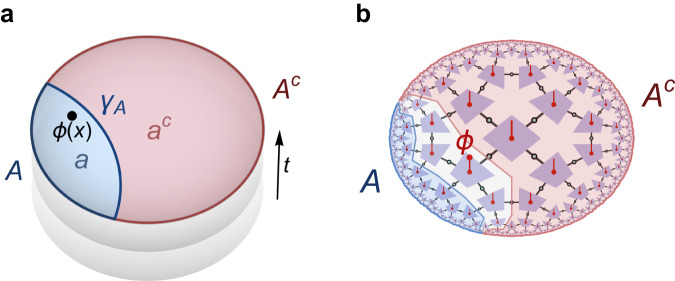
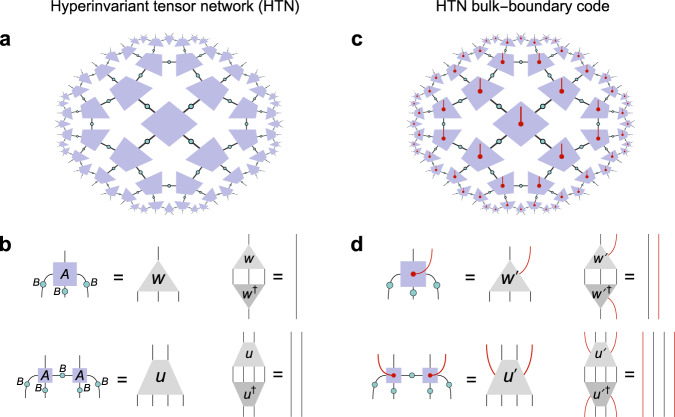
Holographic quantum-error correcting codes are models of bulk/boundary dualities such as the anti-de Sitter/conformal field theory (AdS/CFT) correspondence, where a higher-dimensional bulk geometry is associated with the code’s logical degrees of freedom. Previous discrete holographic codes based on tensor networks have reproduced the general code properties expected from continuum AdS/CFT, such as complementary recovery. However, the boundary states of such tensor networks typically do not exhibit the expected correlation functions of CFT boundary states. In this work, we show that a new class of exact holographic codes, extending the previously proposed hyperinvariant tensor networks into quantum codes, produce the correct boundary correlation functions. This approach yields a dictionary between logical states in the bulk and the critical renormalization group flow of boundary states. Furthermore, these codes exhibit a state-dependent breakdown of complementary recovery as expected from AdS/CFT under small quantum gravity corrections.
Overview
The claims and statistics of this paper haven’t been checked yet.
Free: it reads the open-access text and checks the first 5 claims that cite a source we can check. Create a free account to check every claim.
Integrity signals
Registry
Cites
Statistics
Figures
Verification
Claims the paper makes
The claims and statistics of this paper haven’t been checked yet.
Free: it reads the open-access text and checks the first 5 claims that cite a source we can check. Create a free account to check every claim.
Claims other papers make about this one
Each is checked against this paper’s own text: does it say what the citing paper says it does?
The source backs part of the claim, not all of it — or backs it for a different population, condition or comparison.
In the citing paper
“For higher valence q, more indices are pointing inward, and therefore additional isometries including three or more contractions of A might be necessary to relate entanglement properties of the boundary state to geometric properties of the bulk that has been found in [18].”
From Hyperinvariant spin network states — an AdS/CFT model from first principles (2026) · cites this paper as [18]
Experimental — accuracy not yet measuredThe cited source says what the claim attributes to it.
In the citing paper
“It has been shown in Refs.[17,18] that hyperinvariant tensor networks do not always fulfil the RT formula (for instance in a (5,4) tiling).”
From Hyperinvariant spin network states — an AdS/CFT model from first principles (2026) · cites this paper as [18]
The check wasn’t confident either way, so it gives no verdict — never disputed.
In the citing paper
“There are cases where the causal wedge is slightly larger than the entanglement wedge and thus the tensors separated by the geodesic do not trace to identity.”
From Hyperinvariant spin network states — an AdS/CFT model from first principles (2026) · cites this paper as [18]
Experimental — accuracy not yet measured
Self-check
Percentages, sums and reported differences re-computed from the paper’s own numbers.
The self-check needs the paper’s full text.
Citations
Cites
The large $N$ limit of superconformal field theories and supergravity
Maldacena, J. (1998) · Advances in Theoretical and Mathematical Physics · doi:10.4310/atmp.1998.v2.n2.a1 · Cited by 14,524
Anti de Sitter space and holography
Witten, E. (1998) · Advances in Theoretical and Mathematical Physics · doi:10.4310/atmp.1998.v2.n2.a2 · Cited by 13,070
Ryu, S., & Takayanagi, T. (2006) · Physical Review Letters · doi:10.1103/physrevlett.96.181602 · Cited by 4,302
Generalized gravitational entropy
Lewkowycz, A., & Maldacena, J. (2013) · Journal of High Energy Physics · doi:10.1007/jhep08(2013)090 · Cited by 1,183
Holographic quantum error-correcting codes: toy models for the bulk/boundary correspondence
Pastawski, F., Yoshida, B., Harlow, D., & Preskill, J. (2015) · Journal of High Energy Physics · doi:10.1007/jhep06(2015)149 · Cited by 958
Quantum corrections to holographic entanglement entropy
Faulkner, T., Lewkowycz, A., & Maldacena, J. (2013) · Journal of High Energy Physics · doi:10.1007/jhep11(2013)074 · Cited by 945 · cited 1×
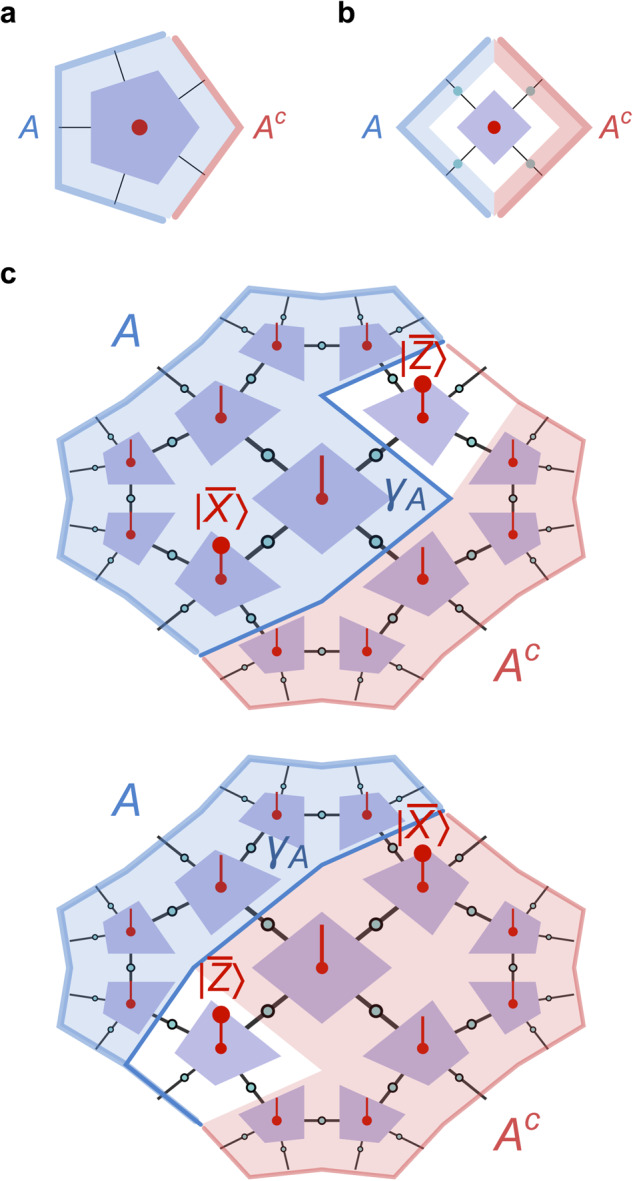
“As this termscaleswiththelengthoftheminimalsurface γ A andisboundedby j γ A j log χ , we identify it as the state-dependent area term in AdS/CFT under quantum corrections 7,10 , with an example of such state dependence given below.”
Class of Quantum Many-Body States That Can Be Efficiently Simulated
Vidal, G. (2008) · Physical Review Letters · doi:10.1103/physrevlett.101.110501 · Cited by 847 · cited 2×
“A related problem arises when considering HaPPY codes from an RG perspective: In a tensor network representation of critical systems 30,31 , the lattice version of a primary operator is an eigen-operator of the scaling superoperator , a map constructed from a single radial layer of tensor networks…”
Quantum extremal surfaces: holographic entanglement entropy beyond the classical regime
Engelhardt, N., & Wall, A. C. (2015) · Journal of High Energy Physics · doi:10.1007/jhep01(2015)073 · Cited by 836 · cited 2×
“It has been conjectured that (1) becomes exactinallordersof G ifonereplaces γ A bya quantumextremalsurface , extremizing the entire (quantum) entropy rather than the classical area 10 .”
Bulk Locality and Quantum Error Correction in AdS/CFT
Almheiri, A., Dong, X., & Harlow, D. (2014) · arXiv · doi:10.48550/arxiv.1411.7041 · Cited by 803
Bulk locality and quantum error correction in AdS/CFT
Almheiri, A., Dong, X., & Harlow, D. (2015) · Journal of High Energy Physics · doi:10.1007/jhep04(2015)163 · Cited by 802 · cited 2×
“This duality implies a dictionary between operators and fi elds between these two theories, and the details of this dictionary exhibit the de fi ning features of a quantum error-correcting code 3 .”
Holographic duality from random tensor networks
Hayden, P., Nezami, S., Qi, X.-L., Thomas, N., Walter, M., & Yang, Z. (2016) · Journal of High Energy Physics · doi:10.1007/jhep11(2016)009 · Cited by 599 · cited 2×
“A number of previous models have been proposed as approximate holographic codes in the past, the earliest being random tensor networks at fi nite bond dimension 19,40 .”
Reconstruction of Bulk Operators within the Entanglement Wedge in Gauge-Gravity Duality
Dong, X., Harlow, D., & Wall, A. C. (2016) · Physical Review Letters · doi:10.1103/physrevlett.117.021601 · Cited by 541 · cited 1×
“Conversely, any local bulk information around a point x can be represented on any boundary region whose entanglement wedge contains it 4,5 .”
Reconstruction of Bulk Operators within the Entanglement Wedge in Gauge-Gravity Duality
Dong, X., Harlow, D., & Wall, A. C. (2016) · arXiv · doi:10.48550/arxiv.1601.05416 · Cited by 541 · cited 1×
“Conversely, any local bulk information around a point x can be represented on any boundary region whose entanglement wedge contains it 4,5 .”
The Ryu–Takayanagi Formula from Quantum Error Correction
Harlow, D. (2017) · Communications in Mathematical Physics · doi:10.1007/s00220-017-2904-z · Cited by 384 · cited 1×
“The general form of (1) is a direct consequence of the holographic code properties 11 .”
Holographic entanglement beyond classical gravity
Barrella, T., Dong, X., Hartnoll, S. A., & Martin, V. L. (2013) · Journal of High Energy Physics · doi:10.1007/jhep09(2013)109 · Cited by 168
Absolutely maximally entangled states, combinatorial designs, and multiunitary matrices
Goyeneche, D., Alsina, D., Latorre, J. I., Riera, A., & Życzkowski, K. (2015) · Physical Review A · doi:10.1103/physreva.92.032316 · Cited by 164
Entanglement renormalization, scale invariance, and quantum criticality
Pfeifer, R. N. C., Evenbly, G., & Vidal, G. (2009) · Physical Review A · doi:10.1103/physreva.79.040301 · Cited by 160 · cited 1×
“A related problem arises when considering HaPPY codes from an RG perspective: In a tensor network representation of critical systems 30,31 , the lattice version of a primary operator is an eigen-operator of the scaling superoperator , a map constructed from a single radial layer of tensor networks…”
Flat entanglement spectra in fixed-area states of quantum gravity
Dong, X., Harlow, D., & Marolf, D. (2019) · Journal of High Energy Physics · doi:10.1007/jhep10(2019)240 · Cited by 146
Holographic Renyi entropy from quantum error correction
Akers, C., & Rath, P. (2019) · Journal of High Energy Physics · doi:10.1007/jhep05(2019)052 · Cited by 132 · cited 2×
“Thus even small boundary operations can have an effect on information deep in the bulk for part of the codespace. each corresponding to a different Ryu – Takayanagi surface γ A separating the entanglement wedges a and a c , representing different bulk geometries in superposition 14,15 .”
Learning the Alpha-bits of black holes
Hayden, P., & Penington, G. (2019) · Journal of High Energy Physics · doi:10.1007/jhep12(2019)007 · Cited by 125 · cited 2×
“It has been argued that such state-dependent, approximate recovery is an essential featureof continuum AdS/ CFT 32 .”
Optimal quantum error correcting codes from absolutely maximally entangled states
Raissi, Z., Gogolin, C., Riera, A., & Acín, A. (2018) · Journal of Physics A Mathematical and Theoretical · doi:10.1088/1751-8121/aaa151 · Cited by 74
Calderbank-Shor-Steane holographic quantum error-correcting codes
Harris, R. J., McMahon, N. A., Brennen, G. K., & Stace, T. M. (2018) · Physical Review A · doi:10.1103/physreva.98.052301 · Cited by 71 · cited 1×
“This property is similar to that of block-perfect tensors (which represent planar maximally-entangled (PME) states 34 ) that have been previously considered in the context of holography 35 .”
Holography and criticality in matchgate tensor networks
Jahn, A., Gluza, M., Pastawski, F., & Eisert, J. (2019) · Science Advances · doi:10.1126/sciadv.aaw0092 · Cited by 65 · cited 1×
“While the entanglement entropy scaling agrees with results for critical states 12,13 , the expected smooth polynomial decay of n -point correlation functions with distance is precluded by the code properties of the model; for example, simple spin-spin correlation functions such as h X j X k i of…”
Self-citationHyperinvariant Tensor Networks and Holography
Evenbly, G. (2017) · Physical Review Letters · doi:10.1103/physrevlett.119.141602 · Cited by 57 · cited 4×
“22 with the introduction of hyperinvariant tensor networks (HTN).”
InfluentialLarge breakdowns of entanglement wedge reconstruction
Akers, C., Levine, A., & Leichenauer, S. (2019) · Physical Review D · doi:10.1103/physrevd.100.126006 · Cited by 56 · cited 2×
“As we further fi nd that the size of the reconstruct-able region is generally dependent on the bulk state, we will refer to it as the reconstruction wedge in analogy to work on state-dependent bulk reconstruction in continuum AdS/CFT 32,33 .”
Maximally Entangled Multipartite States: A Brief Survey
Enríquez, M., Wintrowicz, I., & Życzkowski, K. (2016) · Journal of Physics: Conference Series · doi:10.1088/1742-6596/698/1/012003 · Cited by 54 · cited 2×
“For perfect tensors, these states are given by absolutely maximally entangled (AME) states 24 – 29 .”
Code Properties from Holographic Geometries
Pastawski, F., & Preskill, J. (2017) · Physical Review X · doi:10.1103/physrevx.7.021022 · Cited by 52 · cited 1×
“This drastically changes the code properties of HTN codes when compared to HaPPY codes: In HaPPY codes, bulk qudits remain resilient even against high-weight boundary errors as long as those are suf fi ciently sparse, a property know as uberholography 37 .”
Complexity and entanglement in non-local computation and holography
May, A. (2022) · Quantum · doi:10.22331/q-2022-11-28-864 · Cited by 49 · cited 1×
“A holographic code relating local boundary to local bulk time evolution, potentially realizable by an HTN code, would also have a number of useful features regarding non-local quantum computation 42,43 .”
Space-time random tensor networks and holographic dualityPreprint
Qi, X.-L., & Yang, Z. (2018) · arXiv (Cornell University) · doi:10.48550/arxiv.1801.05289 · Cited by 49 · cited 1×
“A number of previous models have been proposed as approximate holographic codes in the past, the earliest being random tensor networks at fi nite bond dimension 19,40 .”
The holographic map as a conditional expectationPreprint
Faulkner, T. (2020) · arXiv (Cornell University) · doi:10.48550/arxiv.2008.04810 · Cited by 48 · cited 1×
“Indeed, this has been argued to hold for codes describing continuum AdS/CFT as a consequence of the Reeh – Schlieder theorem for boundary quantum fi elds 17,18 .”
Approximate Bacon-Shor code and holography
Cao, C., & Lackey, B. (2021) · Journal of High Energy Physics · doi:10.1007/jhep05(2021)127 · Cited by 44 · cited 4×
“20 for small operators acting on one of the perfect tensors.”
InfluentialConstructions of k -uniform and absolutely maximally entangled states beyond maximum distance codes
Raissi, Z., Teixidó-Bonfill, A., Gogolin, C., & Acín, A. (2020) · Physical Review Research · doi:10.1103/physrevresearch.2.033411 · Cited by 43
Large N von Neumann Algebras and the Renormalization of Newton’s Constant
Gesteau, E. (2025) · Communications in Mathematical Physics · doi:10.1007/s00220-024-05192-3 · Cited by 39 · cited 1×
“However, due the discretization of the bulk space, such entanglement is not resolved on sizes below the curvature radius (the size of a single tile), while in continuum AdS/CFT this sub-cutoff entanglement would become part of the area term 16 .”
Quantum error-correction codes and absolutely maximally entangled states
Mazurek, P., Farkas, M., Grudka, A., Horodecki, M., & Studziński, M. (2020) · Physical Review A · doi:10.1103/physreva.101.042305 · Cited by 33
Tensor network models of AdS/qCFT
Jahn, A., Zimborás, Z., & Eisert, J. (2022) · Quantum · doi:10.22331/q-2022-02-03-643 · Cited by 28 · cited 3×
“Within the wedge a bounded by A ∪ γ A , logical operators can be isometrically mapped to A . complementary recovery is expected from AdS/CFT at N → ∞ , but createsproblemsfordiscreteholographiccodeswhere codestatesare supposed to be related to CFTs and hence exhibit smoothly decaying correlation functions.”
Self-citationCao, C., Pollack, J., & Wang, Y. (2022) · Physical review. D/Physical review. D. · doi:10.1103/physrevd.105.026018 · Cited by 26 · cited 2×
“21 it was argued that any holographic code with local bulk reconstruction (i.e., tensor-by-tensor from boundary to bulk) can only achieve this by breaking the tiling symmetries and placing different tensors on different sites of the tiling.”
Approximate Bacon-Shor code and holography
Cao, C. (2023) · OSTI OAI (U.S. Department of Energy Office of Scientific and Technical Information) · doi:10.1007/jhep05%282021%29127 · Cited by 21
Conformal properties of hyperinvariant tensor networks
Steinberg, M., & Prior, J. (2022) · Scientific Reports · doi:10.1038/s41598-021-04375-5 · Cited by 21 · cited 2×
“22,23 and is related to that of Ref.”
Self-citationPlanar maximally entangled states
Doroudiani, M., & Karimipour, V. (2020) · Physical Review A · doi:10.1103/physreva.102.012427 · Cited by 18 · cited 1×
“This property is similar to that of block-perfect tensors (which represent planar maximally-entangled (PME) states 34 ) that have been previously considered in the context of holography 35 .”
Fault-Tolerant Logical Gates in Holographic Stabilizer Codes Are Severely Restricted
Cree, S., Dolev, K., Calvera, V., & Williamson, D. J. (2021) · PRX Quantum · doi:10.1103/prxquantum.2.030337 · Cited by 17
Non-trivial area operators require non-local magic
Cao, C. (2024) · Journal of High Energy Physics · doi:10.1007/jhep11(2024)105 · Cited by 17
Modifying Method of Constructing Quantum Codes From Highly Entangled States
Raissi, Z. (2020) · IEEE Access · doi:10.1109/access.2020.3043401 · Cited by 16
Bulk locality and entanglement swapping in AdS/CFT
Kelly, W. R. (2017) · Journal of High Energy Physics · doi:10.1007/jhep03(2017)153 · Cited by 15 · cited 1×
“Indeed, this has been argued to hold for codes describing continuum AdS/CFT as a consequence of the Reeh – Schlieder theorem for boundary quantum fi elds 17,18 .”
Holography as a resource for non-local quantum computationPreprint
Dolev, K., & Cree, S. (2022) · arXiv (Cornell University) · doi:10.48550/arxiv.2210.13500 · Cited by 15
Quantum error correction and entanglement spectrum in tensor networks
Ling, Y., Liu, Y., Xian, Z.-Y., & Xiao, Y. (2019) · Physical review. D/Physical review. D. · doi:10.1103/physrevd.99.026008 · Cited by 11 · cited 1×
“This behavior was previously observed in the original HTN model without bulk legs 36 .”
Precursor problem and holographic mutual informationPreprint
Bao, N., & Kim, I. H. (2016) · CaltechAUTHORS (California Institute of Technology) · doi:10.48550/arxiv.1601.07616 · Cited by 8 · cited 1×
“Conversely, any local bulk information around a point x can be represented on any boundary region whose entanglement wedge contains it 4,5 .”
Large $N$ von Neumann algebras and the renormalization of Newton's constantPreprint
Gesteau, E. (2023) · arXiv (Cornell University) · doi:10.48550/arxiv.2302.01938 · Cited by 3 · cited 1×
“However, due the discretization of the bulk space, such entanglement is not resolved on sizes below the curvature radius (the size of a single tile), while in continuum AdS/CFT this sub-cutoff entanglement would become part of the area term 16 .”
Non-trivial Area Operators Require Non-local MagicPreprint
Cao, C. (2023) · arXiv (Cornell University) · doi:10.48550/arxiv.2306.14996 · Cited by 1
Cited by
Tensor networks for quantum computing
Berezutskii, A. V., Liu, M., Acharya, A., Ellerbrock, R., Gray, J., Haghshenas, R., He, Z., Khan, A., Kuzmin, V., Lyakh, D. I., et al. (2025) · Nature Reviews Physics · doi:10.1038/s42254-025-00853-1 · Cited by 124
“3a.”
Self-citationGravitational Backreaction is Magical
Cao, C., Cheng, G., Hamma, A., Leone, L., Munizzi, W., & Oliviero, S. F. E. (2025) · PRX Quantum · doi:10.1103/z3vr-w5c5 · Cited by 111
“…CFTs, but also for more general quantum many-body systems like tensor network toy models, which have been enormously successful in reproducing an analogous Ryu-Takayanagi formula [22], the emergent bulk geometry, and subregion operator reconstruction through quantum error correction [23–28].”
Quantum Lego Expansion Pack: Enumerators from Tensor Networks
Cao, C., Gullans, M. J., Lackey, B., & Wang, Z. (2024) · PRX Quantum · doi:10.1103/prxquantum.5.030313 · Cited by 38
“For tensor networks of holographic codes [29, 30, 31, 32], the network is taken from a tessellation of the hyperbolic disk.”
MethodFar from Perfect: Quantum Error Correction with (Hyperinvariant) Evenbly Codes
Steinberg, M., Fan, J., Harris, R. J., Elkouss, D., Feld, S., & Jahn, A. (2025) · Quantum · doi:10.22331/q-2025-08-08-1826 · Cited by 26
“Figure 2”
InfluentialSelf-citationApproximate Quantum Error Correcting Codes from Conformal Field Theory
Sang, S., Hsieh, T. H., & Zou, Y. (2024) · Physical Review Letters · doi:10.1103/physrevlett.133.210601 · Cited by 21
Metadata
- Authors
- Steinberg, M., Feld, S., & Jahn, A.
- Affiliations
- QuTech (NL)
- California Institute of Technology (US)
- Corresponding author
- Jahn, Alexander
- Venue
- Nature Communications
- Published
- 2023-11-11
- Volume
- 14
- Issue
- 1
- Pages
- 7314-7314
- ISSN
- 2041-1723 (ISSN-L)
- PMC
- PMC10640591
- OpenAlex
- W4388593305
- Cited by
- 20
- References
- 43
- Citations by year
- 2026: 5 · 2025: 10 · 2024: 5
- FWCI
- 1.46
- Type
- journal article
- Language
- en
- Open access
- gold
- doi.org
- Licence
- cc-by
- creativecommons.org/licenses/by/4.0 (tdm)
- creativecommons.org/licenses/by/4.0 (vor)
- Locations
- Nature Communications (publishedVersion, cc-by)
- PubMed Central (publishedVersion, cc-by)
- PubMed (publishedVersion)
- OSTI OAI (U.S. Department of Energy Office of Scientific and Technical Information) (submittedVersion, other-oa)
- DOAJ (DOAJ: Directory of Open Access Journals) (submittedVersion, cc-by-sa)
- Research Repository (Delft University of Technology) (submittedVersion, cc-by)
- Funders
- Einstein Stiftung Berlin (ERUQD)
- Topics
- Physical Sciences › Physics and Astronomy › Nuclear and High Energy Physics › Black Holes and Theoretical Physics
- Physical Sciences › Physics and Astronomy › Atomic and Molecular Physics, and Optics › Quantum many-body systems
- Physical Sciences › Computer Science › Artificial Intelligence › Quantum Computing Algorithms and Architecture
- Keywords
- AdS/CFT correspondence, boundary correlation functions, quantum gravity corrections, tensor networks
About these checks
Registry, retraction, Cites and statistics results are computed, not judged, with one exception: a printed reference that no index lists is read once by a model before it counts as a citation error. Claims are extracted by a model and kept only when their quote appears verbatim in the text; each cited source is then checked, with a model’s help, for whether it says what the claim relies on. Those verdicts can be wrong — read the claim’s quote and the cited source before relying on one.
Statistics and arithmetic are recomputed, not judged.
Confidence bands are shown only for fields calibrated on our annotated test set. None is calibrated yet, so no band is shown.
What counts as a claim ›How we measure confidence ›How we check this ›
Are you an author, or do you see a problem with this page? Request a review
Data sources
Bibliographic data: Semantic Scholar, OpenAlex, Crossref.
Contains information from the Semantic Scholar Academic Graph Datasets, made available under the ODC Attribution License (ODC-BY 1.0).
Semantic Scholar’s data is described in: Kinney, R., et al. (2023). The Semantic Scholar Open Data Platform. arXiv:2301.10140.
