

Isochronic development of cortical synapses in primates and mice
Open accessThe DOI matches its Crossref record; 105 of the 105 references it cites were found in a registry or an index.
Abstract
The neotenous, or delayed, development of primate neurons, particularly human ones, is thought to underlie primate-specific abilities like cognition. We tested whether synaptic development follows suit—would synapses, in absolute time, develop slower in longer-lived, highly cognitive species like non-human primates than in shorter-lived species with less human-like cognitive abilities, e.g., the mouse? Instead, we find that excitatory and inhibitory synapses in the male Mus musculus (mouse) and Rhesus macaque (primate) cortex form at similar rates, at similar times after birth. Primate excitatory and inhibitory synapses and mouse excitatory synapses also prune in such an isochronic fashion. Mouse inhibitory synapses are the lone exception, which are not pruned and instead continuously added throughout life. The monotony of synaptic development clocks across species with disparate lifespans, experiences, and cognitive abilities argues that such programs are likely orchestrated by genetic events rather than experience.
Overview
The claims and statistics of this paper haven’t been checked yet.
Free: it reads the open-access text and checks the first 5 claims that cite a source we can check. Create a free account to check every claim.
Integrity signals
Registry
Cites
Statistics
Figures
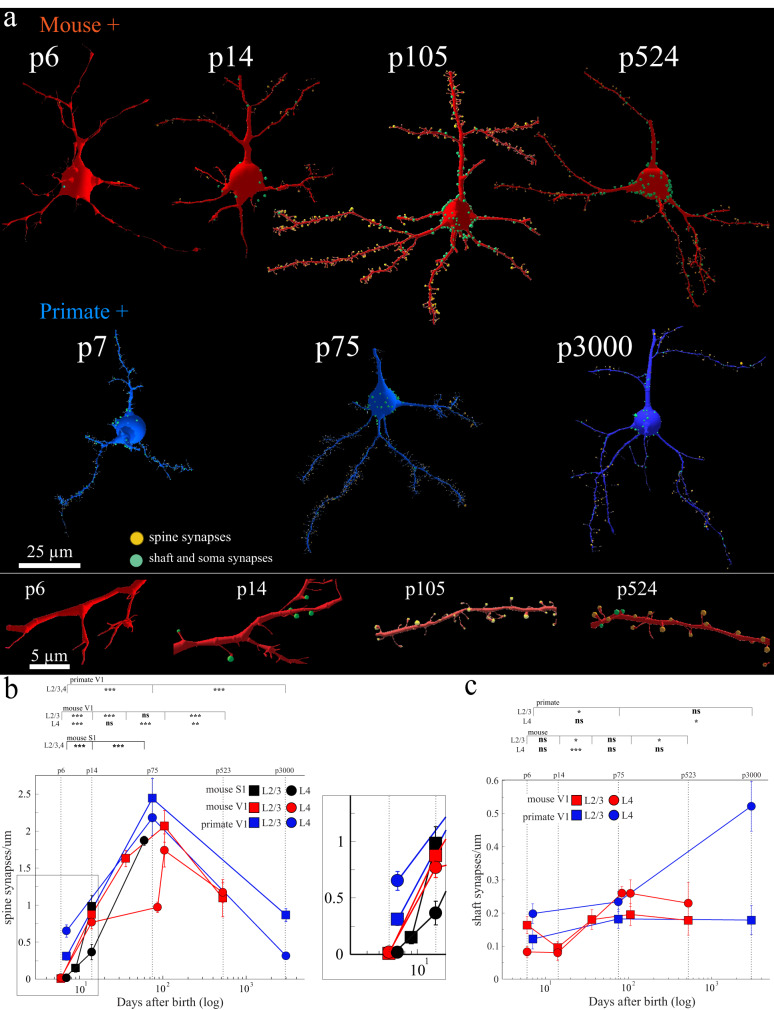
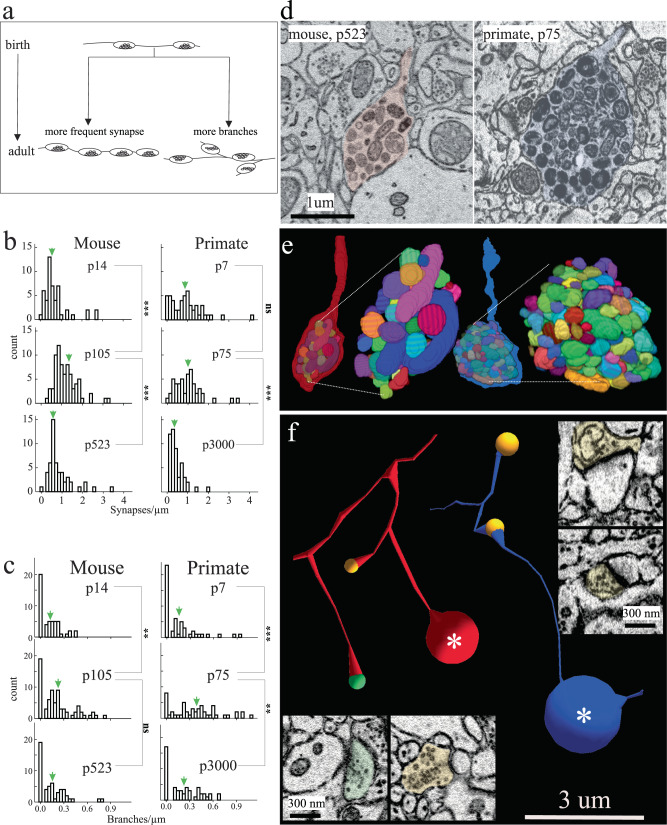
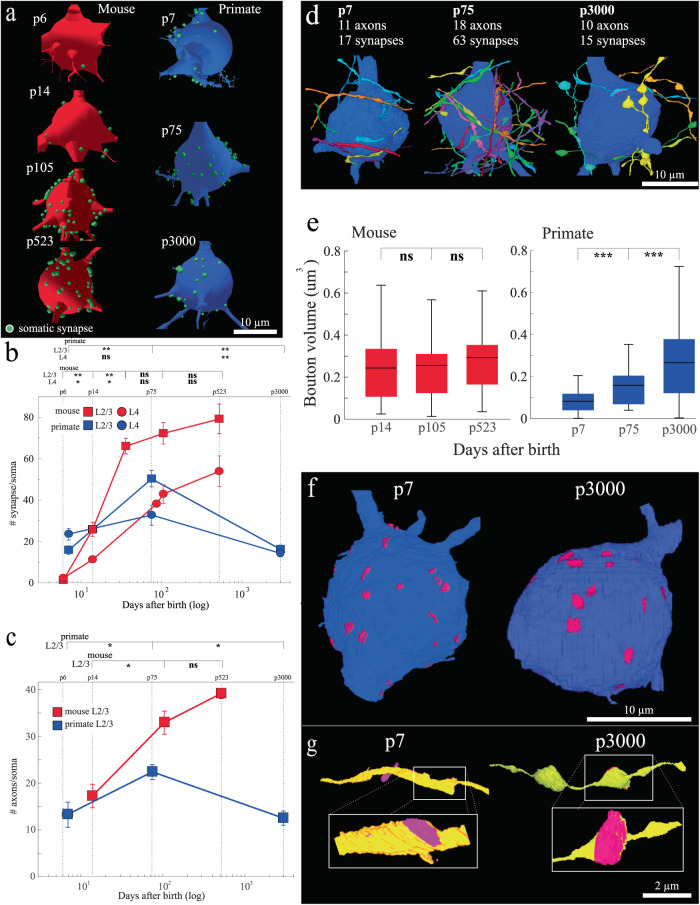
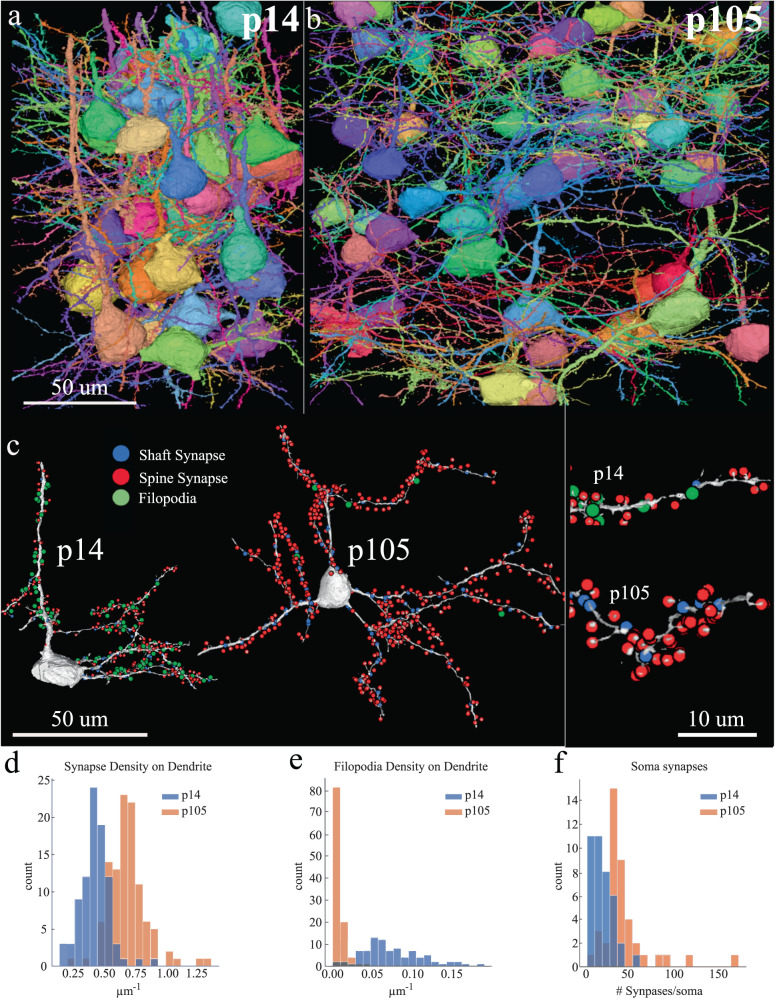
Verification
Claims the paper makes
The claims and statistics of this paper haven’t been checked yet.
Free: it reads the open-access text and checks the first 5 claims that cite a source we can check. Create a free account to check every claim.
Claims other papers make about this one
Each is checked against this paper’s own text: does it say what the citing paper says it does?
The source backs part of the claim, not all of it — or backs it for a different population, condition or comparison.
In the citing paper
“A salient feature of human brain development is the considerably prolonged, or neotenic, tempo of cortical neuronal maturation, taking months to years in humans instead of days to months observed in other mammals, including non-human primates.1,2,3,4,5,6”
From Synaptic neoteny of human cortical neurons requires species-specific balancing of SRGAP2-SYNGAP1 cross-inhibition (2024) · cites this paper as [5]
Experimental — accuracy not yet measuredThe source backs part of the claim, not all of it — or backs it for a different population, condition or comparison.
In the citing paper
“Thus, transplanted mouse PSC-derived CPNs follow the same timeline of dendritic spine and synatogenesis as described for native (non-transplanted) mouse CPNs.5,33,34”
From Synaptic neoteny of human cortical neurons requires species-specific balancing of SRGAP2-SYNGAP1 cross-inhibition (2024) · cites this paper as [5]
Experimental — accuracy not yet measured
Self-check
Percentages, sums and reported differences re-computed from the paper’s own numbers.
The self-check needs the paper’s full text.
Citations
Cites
U-Net: Convolutional Networks for Biomedical Image Segmentation
Ronneberger, O., Fischer, P., & Brox, T. (2015) · Lecture notes in computer science · doi:10.1007/978-3-319-24574-4_28 · Cited by 99,404
Shrestha, S., & Offer, S. M. (2016) · Medical Epigenetics · doi:10.1159/000444713 · Cited by 8,914
Critical period plasticity in local cortical circuits
Hensch, T. K. (2005) · Nature Reviews Neuroscience · doi:10.1038/nrn1787 · Cited by 2,323
Semple, B. D., Blomgren, K., Gimlin, K., Ferriero, D. M., & Noble-Haeusslein, L. J. (2013) · Progress in Neurobiology · doi:10.1016/j.pneurobio.2013.04.001 · Cited by 2,132
GABAergic Interneurons in the Neocortex: From Cellular Properties to Circuits
Tremblay, R., Lee, S., & Rudy, B. (2016) · Neuron · doi:10.1016/j.neuron.2016.06.033 · Cited by 2,033
Evolution of the neocortex: a perspective from developmental biology
Rakic, P. (2009) · Nature reviews. Neuroscience · doi:10.1038/nrn2719 · Cited by 1,565 · cited 1×
“There are also numerous reports of changes, potentially heterochronic changes, in gene transcription 3,86,87 , sometimes even of genes implicated in synapse formation and pruning 88 .”
DEVELOPMENT OF THE VERTEBRATE NEUROMUSCULAR JUNCTION
Sanes, J. R., & Lichtman, J. W. (1999) · Annual Review of Neuroscience · doi:10.1146/annurev.neuro.22.1.389 · Cited by 1,532
TimeTree 5: An Expanded Resource for Species Divergence Times
Kumar, S., Suleski, M., Craig, J. M., Kasprowicz, A. E., Sanderford, M., Li, M., Stecher, G., & Hedges, S. B. (2022) · Molecular Biology and Evolution · doi:10.1093/molbev/msac174 · Cited by 1,436 · cited 3×
“Given the minimal change in developmental programs across mice and macaques, with more than 87 million years of evolutionary divergence 75 , we argue that human neoteny seems to have emerged as a dramatic and potentially quantal evolutionary adaptation.”
InfluentialLinked Regularities in the Development and Evolution of Mammalian Brains
Finlay, B. L., & Darlington, R. B. (1995) · Science · doi:10.1126/science.7777856 · Cited by 1,217
Concurrent overproduction of synapses in diverse regions of the primate cerebral cortex
Rakic, P., Bourgeois, J.-P., Eckenhoff, M. F., Zecevic, N., & Goldman-Rakic, P. S. (1986) · Science · doi:10.1126/science.3952506 · Cited by 1,133 · cited 1×
“First, this is not the fi rst demonstration of isochronic synapse development, as synapses across different primate cortical areas (e.g., pre-frontal, motor, primary visual cortices, etc.) also seem to add and prune at similar rates and at similar times 72 .”
Research works printed but not linked: 3
- 2. Gould, S. J. Ontogeny and Phylogeny (Harvard University Press, 1977).
- 40. Theiler, K. The House Mouse. Development and Normal Stages from Fertilization to 4 Weeks of Age (Springer, 1972).
- 65. Portera Cailliau C, Yuste R, et al. On the function of dendritic filopodia. Rev. Neurol. 2001;33:1158–1166.
Cited by
Libé-Philippot, B., Iwata, R., Recupero, A. J., Wierda, K., Bernal Garcia, S., Hammond, L., van Benthem, A., Limame, R., Ditkowska, M., Beckers, S., et al. (2024) · Neuron · doi:10.1016/j.neuron.2024.08.021 · Cited by 38
“This further strengthens our finding that HS genes SRGAP2B/C promote neoteny by upregulating the synaptic levels of SYNGAP1 in human CPNs. Precocious brain development was previously associated with specific forms of NDD, including ASD, 11,61 and in vitro PSC models have recently suggested altered timing of neuronal dif…”
BackgroundInfluentialLinking mitochondria metabolism, developmental timing, and human brain evolution
Casimir, P., Iwata, R., & Vanderhaeghen, P. (2024) · Current Opinion in Genetics & Development · doi:10.1016/j.gde.2024.102182 · Cited by 27
Clustered synapses develop in distinct dendritic domains in visual cortex before eye opening
Leighton, A. H., Cheyne, J. E., & Löhmann, C. (2024) · eLife · doi:10.1101/2023.03.02.530772 · Cited by 18
Genomic, molecular, and cellular divergence of the human brain
Nehme, R., Pietiläinen, O. P. H., & Barrett, L. E. (2024) · Trends in Neurosciences · doi:10.1016/j.tins.2024.05.009 · Cited by 15
“…elegans is the only organism to date with a fully mapped connectome of its 302 neurons, housing ~7000 synapses [115]; while this has provided a valuable research framework, it has not fully elucidated how even a ‘ simple ’ nervous system produces the behavioral repertoire of the species.”
Dwivedi, D., Dumontier, D., Sherer, M., Lin, S., Mirow, A. M., Qiu, Y., Xu, Q., Liebman, S. A., Joseph, D., Datta, S. R., et al. (2024) · Nature Communications · doi:10.1038/s41467-024-49732-w · Cited by 11
“The dis-crepancybetween physiologicaland morphologicalsynapticassembly highlights the essential need to better understand these types of processesinagivencontext,transientconnectivityinparticular,which would warrant future high-resolution investigations using 3D electron microscopy 76 .”
Spatial dynamics of spontaneous activity in the developing and adult cortices
Murakami, T. (2024) · Neuroscience Research · doi:10.1016/j.neures.2024.12.002 · Cited by 8
Human-specific SRGAP2 paralogs synchronize neotenic microglial maturation and synaptic development
Diaz-Salazar, C., Kim, J., Krzisch, M., Yoo, J., Nano, P. R., Bhaduri, A., Jaenisch, R., Paredes, M., & Polleux, F. (2026) · Neuron · doi:10.1016/j.neuron.2026.07.007 · Cited by 7
“39,40,43 Given the prominent role of microglia in fine-tuning synaptic connectivity during postnatal brain development, it is likely that the same mechanisms are at play during human postnatal brain development, and our results argue that, in the human cortex, the expression of the human-specific genes SRGAP2B/C in mi…”
InfluentialAcetylcholine Neurons Become Cholinergic during Three Time Windows in the Developing Mouse Brain
Goral, R. O., Lamb, P. W., & Yakel, J. L. (2024) · eNeuro · doi:10.1523/eneuro.0542-23.2024 · Cited by 7
“…lifespan, and cranial complexity between mice and humans, ultimately other model organisms need to be studied to better assess the translatability of fi ndings from rodent research in brain development (Wallace and Pollen, 2023; Wildenberg et al., 2023; Moreno et al., 2009; Pauly et al., 2013).”
BackgroundDiaz-Salazar, C., Krzisch, M., Yoo, J., Nano, P. R., Bhaduri, A., Jaenisch, R., & Polleux, F. (2024) · bioRxiv (Cold Spring Harbor Laboratory) · doi:10.1101/2024.06.28.601266 · Cited by 8
“…and striking feature characterizing human neuron development is the slow, neotenic, timing of their morphological and functional maturation and, in particular, synaptic maturation taking weeks to months in most mammals from rodents to non-human primates versus decades after birth in humans 26-29 .”
BackgroundDavidson, A. M., Mejía-Gómez, H., Wooten, B. M., Marqués, S., Jacobowitz, M., Ugidos, I. F., & Mostany, R. (2024) · GeroScience · doi:10.1007/s11357-024-01350-6 · Cited by 4
Leighton, A. H., Cheyne, J. E., & Löhmann, C. (2024) · eLife · doi:10.7554/elife.93498.2.sa4 · Cited by 4
Plećaš, A., Kapuralin, K., Grandverger, L., Mitrečić, D., & Alić, I. (2025) · Cell Death Discovery · doi:10.1038/s41420-025-02297-z · Cited by 3
Synaptic Vesicle Recycling at the Developing Presynapse
Kim, N., & Cousin, M. A. (2025) · Journal of Neurochemistry · doi:10.1111/jnc.70206 · Cited by 2
“Rodents display a much earlier peak of synaptogenesis, which is typically maximal at the second to third postnatal week, although some recent publications report steady synapto-genesis until young adulthood (Semple et al. 2013; Wildenberg et al. 2023).”
Everix, L., Zajicek, F., Eetveldt, A. V., Liu, L., Bard, J., Staelens, S. G., & Bertoglio, D. (2025) · NeuroImage Clinical · doi:10.1016/j.nicl.2025.103800 · Cited by 2
“These observations align with the finding that inhibitory synapses in (nonhuman) primates are pruned in an isochronic fashion, contrary to inhibitory synapses in mice, which are added continuously throughout their lifespan (Wildenberg et al., 2023).”
Neuronal Synaptic Communication and Mitochondrial Energetics in Human Health and Disease
Glausier, J. R. (2025) · Advances in experimental medicine and biology · doi:10.1007/978-3-031-89525-8_5 · Cited by 3
Gutman-Wei, A. Y., Sudarsanam, S., Cabalinan, A. G., Shahid, N., Shi, A., Guzman-Clavel, L., Spindler-Krage, S. M., Agarwal, A., Kolodkin, A. L., & Brown, S. P. (2026) · Cell Reports · doi:10.1016/j.celrep.2025.116792 · Cited by 2
Medina, N. D., Gogola, J. V., Boergens, K. M., Yang, F., Meirovitch, Y., Lichtman, J. W., Kasthuri, N., & Wildenberg, G. A. (2026) · Cell Reports Methods · doi:10.1016/j.crmeth.2026.101429 · Cited by 2
Self-citationGogola, J. V., Joyce, M. K. P., Vijayraghavan, S., Barnum, G., & Wildenberg, G. A. (2025) · The Journal of Comparative Neurology · doi:10.1002/cne.70035 · Cited by 3
Self-citationData-driven synapse classification reveals a logic of glutamate receptor diversityPreprint
Micheva, K. D., Simhal, A. K., Schardt, J., Smith, S. J., Weinberg, R. J., & Owen, S. F. (2024) · bioRxiv (Cold Spring Harbor Laboratory) · doi:10.1101/2024.12.11.628056 · Cited by 1
“Recent technical improvements are driving rapid advances in connectomics based on structurally identified connections with volume electron microscopy 101,102,135–140 .”
Mechanistic basis of dynamic and heterogeneous divisive normalization in visual cortexPreprint
Rockwell, H., & MacLean, J. N. (2025) · bioRxiv (Cold Spring Harbor Laboratory) · doi:10.1101/2025.08.19.671076 · Cited by 1
“Neocortical computation arises from the integration of local recurrent excitation and inhibition, with each neuron receiving synapses from roughly a thousand excitatory and several hundred inhibitory cortical neurons 1 , as well as long-range intra-and subcortical projections.”
Clustered synapses develop in distinct dendritic domains in visual cortex before eye openingPreprint
Leighton, A. H., Cheyne, J. E., & Löhmann, C. (2024) · eLife · doi:10.7554/elife.93498.2 · Cited by 2
Leighton, A. H., Cheyne, J. E., & Löhmann, C. (2024) · eLife · doi:10.7554/elife.93498.3.sa4
Leighton, A. H., Cheyne, J. E., & Lohmann, C. (2024) · eLife · doi:10.7554/elife.93498.2.sa0
Leighton, A. H., Cheyne, J. E., & Lohmann, C. (2024) · eLife · doi:10.7554/elife.93498.2.sa1
Leighton, A. H., Cheyne, J. E., & Lohmann, C. (2024) · eLife · doi:10.7554/elife.93498.2.sa2
Rethinking how neural activity sculpts critical periods
Wildenberg, G. A. (2025) · The Transmitter · doi:10.53053/qpql1501
Self-citationConnectoFM: A Foundation Model for Learning the Language of the ConnectomePreprint
Abir, A. R., Saha, A., Naswan, R., & Bayzid, M. S. (2026) · bioRxiv (Cold Spring Harbor Laboratory) · doi:10.64898/2026.06.06.730367
“…nerve cord of Drosophila melanogaster [73, 74]; the cerebral cortex of humans ( H. sapiens ) [1]; the primary visual cortex and CA1 hippocampus of mice ( Mus musculus ) [75–78]; the visual cortex of the rhesus macaque ( Macaca mulatta ) [77]; and the whole brain of zebrafish ( Danio rerio ) [79].”
PRMT5-Cacna1d axis maintains calcium homeostasis to regulate postnatal motor development in mice
Cao, J., He, Z., Chai, W., Tian, M., Wei, T., Liu, X., Wang, Y., Liu, S., Liu, R., Yin, Y., et al. (2026) · Cellular and Molecular Life Sciences · doi:10.1007/s00018-026-06306-x
“This expression shift enables the rapid formation of synapses within the developing neurons at this period [60, 61].”
Adolescent development accelerates responses to input in human neocortical neuronsPreprint
Kendrick, R. M., Clark, J. K., Leonard, E. S. P., Ramasamy, N., DeLope, S. S., Phillips, H. W., Buch, V., Mahaney, K. B., Grant, G. A., Prolo, L. M., et al. (2026) · bioRxiv (Cold Spring Harbor Laboratory) · doi:10.64898/2026.09.16.746058 · Cited by 1
Metadata
- Authors
- Wildenberg, G., Li, H., Sampathkumar, V., Sorokina, A., & Kasthuri, N.
- Affiliations
- Argonne National Laboratory (US)
- Corresponding author
- Wildenberg, Gregg
- Kasthuri, Narayanan
- Venue
- Nature Communications
- Published
- 2023-12-04
- Volume
- 14
- Issue
- 1
- Pages
- 8018-8018
- ISSN
- 2041-1723 (ISSN-L)
- PMC
- PMC10695974
- OpenAlex
- W4389305055
- Cited by
- 31
- References
- 105
- Citations by year
- 2026: 5 · 2025: 7 · 2024: 16 · 2023: 3
- FWCI
- 3.76
- Type
- journal article
- Language
- en
- Open access
- gold
- doi.org
- Licence
- cc-by
- creativecommons.org/licenses/by/4.0 (tdm)
- creativecommons.org/licenses/by/4.0 (vor)
- Locations
- Nature Communications (publishedVersion, cc-by)
- PubMed Central (publishedVersion, cc-by)
- PubMed (publishedVersion)
- Knowledge@UChicago (University of Chicago) (submittedVersion, cc-by-nc-nd)
- RePEc: Research Papers in Economics (submittedVersion)
- DOAJ (DOAJ: Directory of Open Access Journals) (submittedVersion, cc-by-sa)
- University of Chicago (cc-by)
- Funders
- National Science Foundation (2014862)
- Topics
- Life Sciences › Neuroscience › Cellular and Molecular Neuroscience › Neuroscience and Neuropharmacology Research
- Life Sciences › Neuroscience › Developmental Neuroscience › Neurogenesis and neuroplasticity mechanisms
- Life Sciences › Biochemistry, Genetics and Molecular Biology › Genetics › Genetics and Neurodevelopmental Disorders
- Keywords
- synaptic development, cortical synapses, synaptic pruning, excitatory synapses, inhibitory synapses, neoteny, primate cognition, rhesus monkeys, mice, lifespan
- MeSH terms
- Animals, Cognition, Macaca mulatta, Male, Neurons, Synapses, Mice
About these checks
Registry, retraction, Cites and statistics results are computed, not judged, with one exception: a printed reference that no index lists is read once by a model before it counts as a citation error. Claims are extracted by a model and kept only when their quote appears verbatim in the text; each cited source is then checked, with a model’s help, for whether it says what the claim relies on. Those verdicts can be wrong — read the claim’s quote and the cited source before relying on one.
Statistics and arithmetic are recomputed, not judged.
Confidence bands are shown only for fields calibrated on our annotated test set. None is calibrated yet, so no band is shown.
What counts as a claim ›How we measure confidence ›How we check this ›
Are you an author, or do you see a problem with this page? Request a review
Data sources
Bibliographic data: Semantic Scholar, OpenAlex, Crossref.
Contains information from the Semantic Scholar Academic Graph Datasets, made available under the ODC Attribution License (ODC-BY 1.0).
Semantic Scholar’s data is described in: Kinney, R., et al. (2023). The Semantic Scholar Open Data Platform. arXiv:2301.10140.
