

The DOI matches its Crossref record; 53 of the 54 references it cites were found in a registry or an index.
UniKP: a unified framework for the prediction of enzyme kinetic parameters
Open accessPublished version of a preprint
Abstract
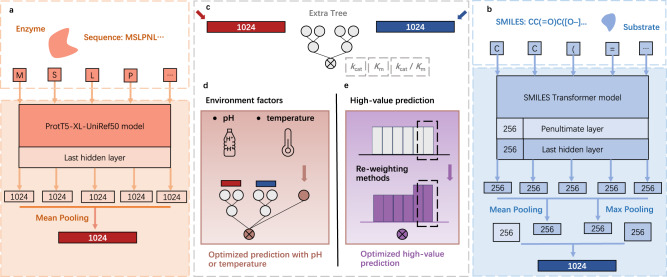
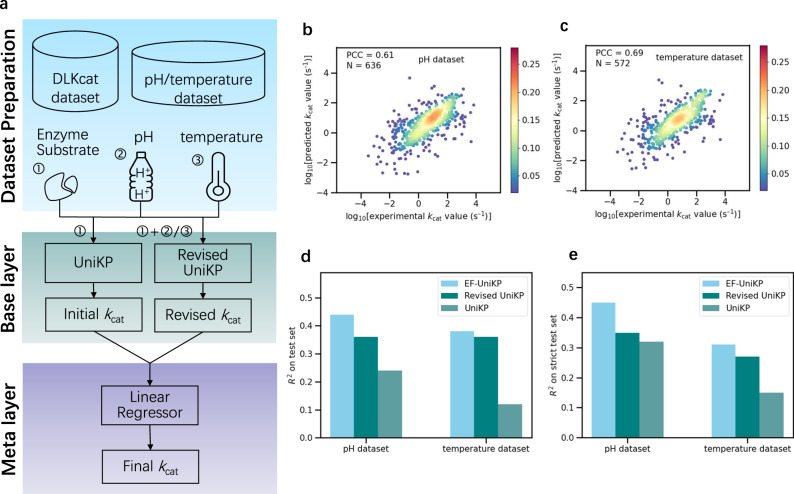
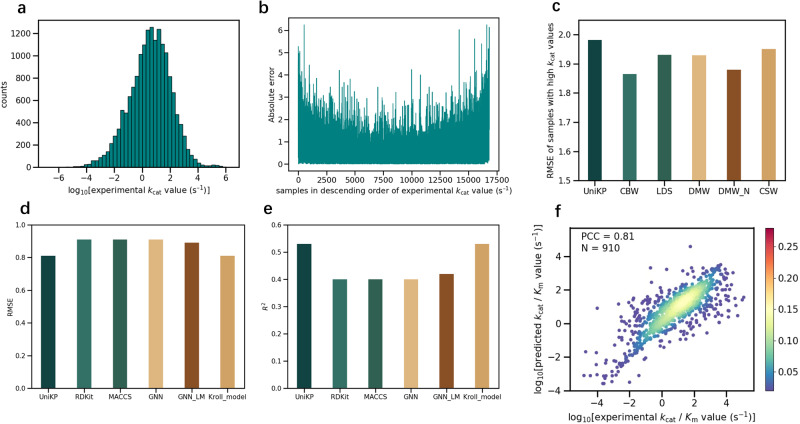
Prediction of enzyme kinetic parameters is essential for designing and optimizing enzymes for various biotechnological and industrial applications, but the limited performance of current prediction tools on diverse tasks hinders their practical applications. Here, we introduce UniKP, a unified framework based on pretrained language models for the prediction of enzyme kinetic parameters, including enzyme turnover number ( k cat ), Michaelis constant ( K m ), and catalytic efficiency ( k cat / K m ), from protein sequences and substrate structures. A two-layer framework derived from UniKP (EF-UniKP) has also been proposed to allow robust k cat prediction in considering environmental factors, including pH and temperature. In addition, four representative re-weighting methods are systematically explored to successfully reduce the prediction error in high-value prediction tasks. We have demonstrated the application of UniKP and EF-UniKP in several enzyme discovery and directed evolution tasks, leading to the identification of new enzymes and enzyme mutants with higher activity. UniKP is a valuable tool for deciphering the mechanisms of enzyme kinetics and enables novel insights into enzyme engineering and their industrial applications.
Overview
The claims and statistics of this paper haven’t been checked yet.
Run the check — free, no account needed. It reads the open-access text and checks the sources it cites.
Integrity signals
Registry
Cites
Statistics
Figures
Verification
Claims the paper makes
The claims and statistics of this paper haven’t been checked yet.
Run the check — free, no account needed. It reads the open-access text and checks the sources it cites.
Self-check
Percentages, sums and reported differences re-computed from the paper’s own numbers.
The self-check needs the paper’s full text.
Citations
Cites
Vaswani, A., Shazeer, N., Parmar, N., Uszkoreit, J., Jones, L., Gomez, A. N., Kaiser, L., & Polosukhin, I. (2017) · arXiv · doi:10.48550/arxiv.1706.03762 · Cited by 120,404
Basic local alignment search tool
Altschul, S. F., Gish, W., Miller, W., Myers, E. W., & Lipman, D. J. (1990) · Journal of Molecular Biology · doi:10.1006/jmbi.1990.9999 · Cited by 98,669
BERT: Pre-training of Deep Bidirectional Transformers for Language Understanding
Devlin, J., Chang, M.-W., Lee, K., & Toutanova, K. (2018) · arXiv · doi:10.48550/arxiv.1810.04805 · Cited by 73,173
ImageNet: A large-scale hierarchical image database
Deng, J., Dong, W., Socher, R., Li, L.-J., Li, K., & Fei-Fei, L. (2009) · 2009 IEEE Conference on Computer Vision and Pattern Recognition · doi:10.1109/cvpr.2009.5206848 · Cited by 65,333
SMOTE synthetic minority over-sampling technique
Chawla, N. V., Bowyer, K. W., Hall, L. O., & Kegelmeyer, W. P. (2002) · Journal of Artificial Intelligence Research · doi:10.1613/jair.953 · Cited by 32,865
UniProt: the Universal Protein Knowledgebase in 2023
The UniProt Consortium, Bateman, A., Martin, M.-J., Orchard, S., Magrane, M., Ahmad, S., Alpi, E., Bowler-Barnett, E. H., Britto, R., Bye-A-Jee, H., et al. (2023) · Nucleic Acids Research · doi:10.1093/nar/gkac1052 · Cited by 7,210
PubChem Substance and Compound databases
Kim, S., Thiessen, P. A., Bolton, E. E., Chen, J., Fu, G., Gindulyte, A., Han, L., He, J., He, S., Shoemaker, B. A., et al. (2016) · Nucleic Acids Research · doi:10.1093/nar/gkv951 · Cited by 5,436
Self-citationSupervised Machine Learning: A Review of Classification Techniques
Kotsiantis, S. B. (2007) · Informatica · Cited by 4,192
The class imbalance problem: A systematic study1
Japkowicz, N., & Stephen, S. (2002) · Intelligent Data Analysis · doi:10.3233/ida-2002-6504 · Cited by 3,295
Rives, A., Meier, J., Sercu, T., Goyal, S., Lin, Z., Liu, J., Guo, D., Ott, M., Zitnick, C. L., Ma, J., et al. (2021) · Proceedings of the National Academy of Sciences · doi:10.1073/pnas.2016239118 · Cited by 3,286
Research works printed but not linked: 4
- Honda, S. et al. Smiles transformer: Pre-trained molecular fingerprint for low data drug discovery. arXiv preprint arXiv:1911.04738 (2019). · arXiv
- Van der Maaten, L. & Hinton, G. Visualizing data using t-SNE. J. Mach. Learning Res. 9, 11 (2008).
- Kroll, A. and Lercher, M. J. Machine learning models for the prediction of enzyme properties should be tested on proteins not used for model training. bioRxiv https://doi.org/10.1101/2023.02.06.526991 (2023). · DOI
- Li, Y. Deep reinforcement learning: An overview. arXiv preprint arXiv:1701.07274 (2017). · arXiv
Cited by
Sorted by citations
Items 201–226 of 226
Raghuraman, P., & Park, S. (2026) · Frontiers in Plant Science · doi:10.3389/fpls.2026.1842722
Zhang, C., Lu, S., & Lu, H. (2026) · Current Opinion in Systems Biology · doi:10.1016/j.coisb.2026.100606
GAPEK: A General Framework for Multiparameter Enzyme Kinetic Prediction with Adaptive Learning
Zhu, C., Ding, W., Zhang, W., Jiang, S., Zhou, R., Deng, Z., Yu, D., & Liu, J. (2026) · Journal of Chemical Information and Modeling · doi:10.1021/acs.jcim.6c02546
Ying, J., Liu, C., Sun, P., Liu, S., Li, Z., Ren, J., Wang, Y., & Xin, F. (2026) · Journal of Agricultural and Food Chemistry · doi:10.1021/acs.jafc.6c08606
Wang, X., Li, W., Ding, S., Deng, Y., Zhang, H., Li, H., & Li, Y. (2026) · Journal of Chemical Information and Modeling · doi:10.1021/acs.jcim.6c02075
Liu, Y., Chang, Y., 关韵佳, Ma, X., & Ma, S. (2026) · Journal of Agricultural and Food Chemistry · doi:10.1021/acs.jafc.6c06672
CatESO: Differentiable Enzyme Sequence Optimization Guided by Substrate-Aware K cat Prediction
Gan, Z., Xu, Y., Xu, J., Wu, Z., Huang, J., Yin, J., Chen, G., & Zhang, J. Z. H. (2026) · Journal of the American Chemical Society · doi:10.1021/jacs.6c14365
Mechanistically Informed Open-World Enzyme Retrieval with a Dual-Tower Graph-Sequence Model
Wang, S., Wang, D., Ren, Y., & Chen, X. (2026) · Journal of Chemical Information and Modeling · doi:10.1021/acs.jcim.6c02414
Li, Z., Xu, K., Chen, Y., Hou, H., Sun, X., & Zhou, J. (2026) · Bioresource Technology · doi:10.1016/j.biortech.2026.135786
Lou, D., Cui, J., Duan, J., Zhou, B., Wang, Y., Wang, D., Tan, J., & Duan, H. (2026) · Applied and Environmental Microbiology · doi:10.1128/aem.01490-26
CatRange enables robust prediction of enzyme variant kinetic regimes
Sajeevan, K. A., Osinuga, A., Arunraj, B., Ferdous, S., Shahreen, N., Noor, M. S., Koneru, S., Santos-Correa, L. M., Salehi, R., Chowdhury, N. B., et al. (2026) · PNAS Nexus · doi:10.1093/pnasnexus/pgag309 · Cited by 16
Zhao, Y., Li, Z., Long, X., & Lu, Q. (2026) · Molecules · doi:10.3390/molecules31183290
High-throughput physics-based enzyme engineeringPreprint
Wang, X., Qiu, X., Wu, Y., Niu, T., Zhang, S., Gao, R., Cho, I., Tang, H., Hu, K., Lei, X., et al. (2026) · bioRxiv (Cold Spring Harbor Laboratory) · doi:10.64898/2026.09.15.751901
Recent Advances in the Production and Biosynthesis of Oleanane-Type Pentacyclic Triterpenoids
Yuan, F.-Y., Diao, D.-Y., Peng, S.-X., Ye, C., Cheng, C., Shi, T., & Guo, Q. (2026) · Journal of Agricultural and Food Chemistry · doi:10.1021/acs.jafc.6c11001
Wang, Q., Bao, T., Qiu, J.-H., Hu, M., Qin, Z., Wang, Y., Zhang, X., Chen, K.-W., & Rao, Z. (2026) · ACS Catalysis · doi:10.1021/acscatal.6c05381
Predicting Enzyme Turnover Numbers and Enabling Rational Enzyme Evolution
Ge, F., Ma, X., Li, J., Wang, M., 路福平, Liu, Y., & Wang, L. (2026) · Advanced Science · doi:10.1002/advs.77789
Li, R., Tang, S., Deng, J., 邱太兴, Guo, F., Tang, J., & Liu, X. (2026) · Bioinformatics · doi:10.1093/bioinformatics/btag709
Advances in directed evolution: Mutagenesis, sensing, screening, and in silico innovation
Liu, L.-H., Zhang, Y., Hu, Y., Zhang, X., Xu, B., Wang, S., Li, W., & Jiang, A. (2026) · Biotechnology Advances · doi:10.1016/j.biotechadv.2026.109070
Machine Learning Empowers Enzyme Discovery, Structure Prediction, Engineering, and Design
王木强, Jiang, L., Yu, H., Yu, J., Zheng, W., & Wu, J. (2026) · ACS Catalysis · doi:10.1021/acscatal.6c07060
Self-citationSAEKP: A Site Attention Enzyme Kinetics Prediction Method to Facilitate Enzyme Engineering
Qiu, J.-H., Lin, Z., Chen, K.-W., Wang, Q., Sun, T., Yuan, L., Zhang, X., Tian, Y., & Wu, Y. (2026) · Journal of Chemical Information and Modeling · doi:10.1021/acs.jcim.6c01516 · Cited by 2
Integrative machine learning approaches for enzyme kinetic parameter prediction
Zhou, R., Xi, W., Yin, P., Wang, S., Zhang, Y., & Wei, Y. (2026) · Briefings in Bioinformatics · doi:10.1093/bib/bbag533
CLEAN Database: providing enzyme function coverage for over 55 million sequences
Yuan, L., Li, J. C., Wen, M., Bianchi, D. M., Arneson, K., Guo, B., Lambert, S., Stephens, C., Yu, T., Fu, L., et al. (2026) · Nucleic Acids Research · doi:10.1093/nar/gkag1003
Multidimensional Engineering of β-Glucosidase Cel1A for Enhanced Sophorose Synthesis
Liu, J., Li, L., Cao, X., Bian, L., Hao, Z., Cai, Y., Xiong, P., & Liu, X. (2026) · Journal of Agricultural and Food Chemistry · doi:10.1021/acs.jafc.6c10094
Multienzyme cascades for non-grain carbon feedstocks valorization: Recent advances and perspectives
Wang, X., Chen, H., Chun-jiang, M., Zhang, J.-J., Cheng, F., Xue, Y.-P., & Yu-guo, Z. (2026) · Biotechnology Advances · doi:10.1016/j.biotechadv.2026.109082
Bai, R., Liu, D., & Luo, X. (2026) · Plasma Processes and Polymers · doi:10.1002/ppap.70268
Self-citationBenchmarking and Experimental Validation of Machine Learning Strategies for Enzyme Engineering
Zeng, Z., Jin, J., Xu, R., 武玉真, & Luo, X. (2026) · Journal of Chemical Information and Modeling · doi:10.1021/acs.jcim.6c01200
Self-citation
Metadata
- Authors
- Yu, H., Deng, H., He, J., Keasling, J. D., & Luo, X.
- Affiliations
- Chinese Academy of Sciences (CN)
- Lawrence Berkeley National Laboratory (US)
- Corresponding author
- Luo, Xiaozhou
- Venue
- Nature Communications
- Published
- 2023-12-11
- Volume
- 14
- Issue
- 1
- Pages
- 8211-8211
- ISSN
- 2041-1723 (ISSN-L)
- PMC
- PMC10713628
- OpenAlex
- W4389546039
- Cited by
- 226
- References
- 54
- Citations by year
- 2026: 96 · 2025: 88 · 2024: 39 · 2023: 3
- FWCI
- 20.23
- Type
- journal article
- Language
- en
- Open access
- gold
- doi.org
- Locations
- Nature Communications (publishedVersion, cc-by)
- Research Square (acceptedVersion, cc-by)
- PubMed Central (publishedVersion, cc-by)
- PubMed (publishedVersion)
- eScholarship (California Digital Library) (submittedVersion, cc-by)
- OSTI OAI (U.S. Department of Energy Office of Scientific and Technical Information) (submittedVersion, cc-by)
- Technical University of Denmark, DTU Orbit (Technical University of Denmark, DTU) (submittedVersion, other-oa)
- RePEc: Research Papers in Economics (submittedVersion)
- DOAJ (DOAJ: Directory of Open Access Journals) (submittedVersion, cc-by-sa)
- Funders
- National Natural Science Foundation of China (32071421)
- Topics
- Life Sciences › Biochemistry, Genetics and Molecular Biology › Molecular Biology › Machine Learning in Bioinformatics
- Life Sciences › Biochemistry, Genetics and Molecular Biology › Molecular Biology › Enzyme Catalysis and Immobilization
- Life Sciences › Biochemistry, Genetics and Molecular Biology › Molecular Biology › Protein Structure and Dynamics
- Keywords
- Michaelis constant, catalytic efficiency, protein sequences, substrate structure, pre-trained language models, environmental factors, pH and temperature effects, enzyme discovery, directed evolution, enzyme engineering
- MeSH terms
- Biotechnology, Catalysis, Kinetics, Temperature
About these checks
Registry, retraction, Cites and statistics results are computed, not judged, with one exception: a printed reference that no index lists is read once by a model before it counts as a citation error. Claims are extracted by a model and kept only when their quote appears verbatim in the text; each cited source is then checked, with a model’s help, for whether it says what the claim relies on. Those verdicts can be wrong — read the claim’s quote and the cited source before relying on one.
Statistics and arithmetic are recomputed, not judged.
Confidence bands are shown only for fields calibrated on our annotated test set. None is calibrated yet, so no band is shown.
What counts as a claim ›How we measure confidence ›How we check this ›
Are you an author, or do you see a problem with this page? Request a review
