

Navigating the 16-dimensional Hilbert space of a high-spin donor qudit with electric and magnetic fields
Open accessThe DOI matches its Crossref record; 60 of the 60 references it cites were found in a registry or an index.
Abstract
Efficient scaling and flexible control are key aspects of useful quantum computing hardware. Spins in semiconductors combine quantum information processing with electrons, holes or nuclei, control with electric or magnetic fields, and scalable coupling via exchange or dipole interaction. However, accessing large Hilbert space dimensions has remained challenging, due to the short-distance nature of the interactions. Here, we present an atom-based semiconductor platform where a 16-dimensional Hilbert space is built by the combined electron-nuclear states of a single antimony donor in silicon. We demonstrate the ability to navigate this large Hilbert space using both electric and magnetic fields, with gate fidelity exceeding 99.8% on the nuclear spin, and unveil fine details of the system Hamiltonian and its susceptibility to control and noise fields. These results establish high-spin donors as a rich platform for practical quantum information and to explore quantum foundations.
Overview
The claims and statistics of this paper haven’t been checked yet.
Free: it reads the open-access text and checks the first 5 claims that cite a source we can check. Create a free account to check every claim.
Integrity signals
Registry
Cites
Statistics
Figures
Verification
Claims the paper makes
The claims and statistics of this paper haven’t been checked yet.
Free: it reads the open-access text and checks the first 5 claims that cite a source we can check. Create a free account to check every claim.
Self-check
Percentages, sums and reported differences re-computed from the paper’s own numbers.
The self-check needs the paper’s full text.
Citations
Cites
Zwanenburg, F. A., Dzurak, A. S., Morello, A., Simmons, M. Y., Hollenberg, L. C. L., Klimeck, G., Rogge, S., Coppersmith, S. N., & Eriksson, M. A. (2013) · Reviews of Modern Physics · doi:10.1103/revmodphys.85.961 · Cited by 1,210
Self-citationAn addressable quantum dot qubit with fault-tolerant control-fidelity
Veldhorst, M., Hwang, J. C. C., Yang, C. H., Leenstra, A. W., de Ronde, B., Dehollain, J. P., Muhonen, J. T., Hudson, F. E., Itoh, K. M., Morello, A., et al. (2014) · Nature Nanotechnology · doi:10.1038/nnano.2014.216 · Cited by 940
Self-citationA single-atom electron spin qubit in silicon
Pla, J. J., Tan, K. Y., Dehollain, J. P., Lim, W. H., Morton, J. J. L., Jamieson, D. N., Dzurak, A. S., & Morello, A. (2012) · Nature · doi:10.1038/nature11449 · Cited by 808 · cited 14×
“Weknowthesignof f +q becauseweareable to deterministically initialise a speci fi c nuclear state ∣ m I (cid:4) through a combination of ESR and EDSR transitions (see Supplementary Materials, Section 3) and thus identify the ∣ 7 = 2 (cid:4) $ ∣ 5 = 2 (cid:4) transition as the one at the lowest frequency.”
InfluentialSelf-citationSingle-shot readout of an electron spin in silicon
Morello, A., Pla, J. J., Zwanenburg, F. A., Chan, K. W., Tan, K. Y., Huebl, H., Möttönen, M., Nugroho, C. D., Yang, C., van Donkelaar, J. A., et al. (2010) · Nature · doi:10.1038/nature09392 · Cited by 789 · cited 1×
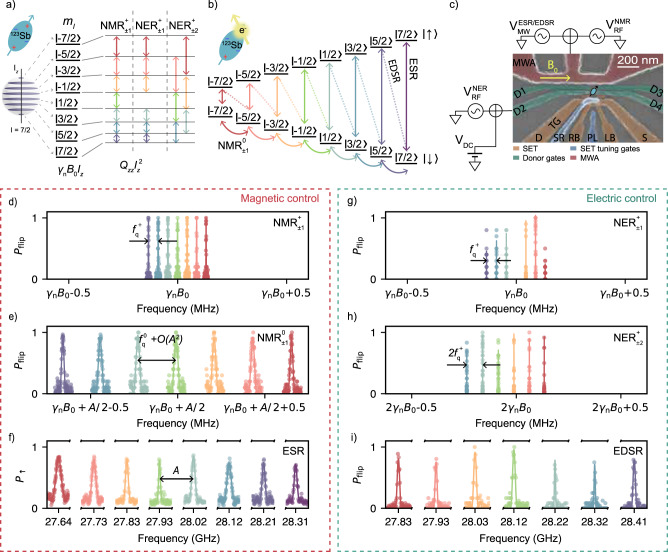
“The device features a single electron transistor (SET) to read out the spin of the donor-bound electron 40 , a set of gates to control the electrostatic potential of the donor or drive NER 24 , and a broadband short-circuited microwave antenna used to deliver the B 1 fi eld for ESR and NMR.”
Self-citationStoring quantum information for 30 seconds in a nanoelectronic device
Muhonen, J. T., Dehollain, J. P., Laucht, A., Hudson, F. E., Kalra, R., Sekiguchi, T., Itoh, K. M., Jamieson, D. N., McCallum, J. C., Dzurak, A. S., et al. (2014) · Nature Nanotechnology · doi:10.1038/nnano.2014.211 · Cited by 661
Self-citationHigh-fidelity readout and control of a nuclear spin qubit in silicon
Pla, J. J., Tan, K. Y., Dehollain, J. P., Lim, W. H., Morton, J. J. L., Zwanenburg, F. A., Jamieson, D. N., Dzurak, A. S., & Morello, A. (2013) · Nature · doi:10.1038/nature12011 · Cited by 530
Self-citationQuantum logic with spin qubits crossing the surface code threshold
Xue, X., Russ, M., Samkharadze, N., Undseth, B., Sammak, A., Scappucci, G., & Vandersypen, L. M. K. (2022) · Nature · doi:10.1038/s41586-021-04273-w · Cited by 524
Qudits and High-Dimensional Quantum Computing
Wang, Y., Hu, Z., Sanders, B. C., & Kais, S. (2020) · Frontiers in Physics · doi:10.3389/fphy.2020.589504 · Cited by 478
Fast universal quantum gate above the fault-tolerance threshold in silicon
Noiri, A., Takeda, K., Nakajima, T., Kobayashi, T., Sammak, A., Scappucci, G., & Tarucha, S. (2022) · Nature · doi:10.1038/s41586-021-04182-y · Cited by 471
Multivalued logic gates for quantum computation
Muthukrishnan, A., & Stroud, C. R. (2000) · Physical Review A · doi:10.1103/physreva.62.052309 · Cited by 399 · cited 1×
“Circuit complexity can be reduced even further; using two-qudit gates, an N -dimensional unitary operator U can be simulated using a factor ð log 2 d Þ 2 less gates as compared to its qubit-based counterpart 2 .”
Cited by
Quantum error correction of qudits beyond break-even
Brock, B. L., Singh, S., Eickbusch, A., Sivak, V. V., Ding, A. Z., Frunzio, L., Girvin, S. M., & Devoret, M. H. (2025) · Nature · doi:10.1038/s41586-025-08899-y · Cited by 64
“…considerable experimental effort has been spent in recent years on developing qudit-based platforms for quantum computing, using donor spins in silicon 8 , ultracold atoms and molecules 9,10 , optical photons 11,12 , superconducting circuits 13–15 , trapped ions 16,17 , and vacancy centers 18,19 .”
Schrödinger cat states of a nuclear spin qudit in silicon
Yu, X., Wilhelm, B., Holmes, D., Vaartjes, A., Schwienbacher, D., Nurizzo, M., Kringhøj, A., van Blankenstein, M. R., Jakob, A. M., Gupta, P., et al. (2025) · Nature Physics · doi:10.1038/s41567-024-02745-0 · Cited by 94
“In this work, we experimentally demonstrate the creation and manipulation of Schrödinger cat states of a single antimony-123 ( 123 Sb) nuclear spin qudit in silicon 20,21 .”
Self-citationMetalloporphyrins as Building Blocks for Quantum Information Science
Santanni, F., & Privitera, A. (2024) · Advanced Optical Materials · doi:10.1002/adom.202303036 · Cited by 33
Colloquium : Qudits for decomposing multiqubit gates and realizing quantum algorithms
Kiktenko, E. O., Nikolaeva, A. S., & Fedorov, A. K. (2025) · Reviews of Modern Physics · doi:10.1103/revmodphys.97.021003 · Cited by 62
Single-Electron Spin Qubits in Silicon for Quantum Computing
Hu, G., Huang, W., Cai, R., Wang, L., Yang, C. H., Cao, G., Xue, X., Huang, P., & He, Y. (2025) · Intelligent Computing · doi:10.34133/icomputing.0115 · Cited by 33
Metadata
- Authors
- Fernández de Fuentes, I., Botzem, T., Johnson, M. A. I., Vaartjes, A., Asaad, S., Mourik, V., Hudson, F. E., Itoh, K. M., Johnson, B. C., Jakob, A. M., McCallum, J. C., Jamieson, D. N., Dzurak, A. S., & Morello, A.
- Affiliations
- UNSW Sydney (AU)
- Keio University (JP)
- RMIT University (AU)
- The University of Melbourne (AU)
- Corresponding author
- Morello, Andrea
- ORCID
- Venue
- Nature Communications
- Published
- 2024-02-14
- Volume
- 15
- Issue
- 1
- Pages
- 1380-1380
- ISSN
- 2041-1723 (ISSN-L)
- PMC
- PMC11258329
- OpenAlex
- W4391805808
- Semantic Scholar
- c9b3f70df88bcf09f6a25134ffcb537c7ab4013e
- Cited by
- 46
- References
- 56
- Citations by year
- 2026: 18 · 2025: 23 · 2024: 5
- FWCI
- 7.29
- Type
- journal article
- Language
- en
- Open access
- gold
- doi.org
- Licence
- cc-by
- creativecommons.org/licenses/by/4.0 (tdm)
- creativecommons.org/licenses/by/4.0 (vor)
- Locations
- Nature Communications (publishedVersion, cc-by)
- PubMed Central (publishedVersion, cc-by)
- PubMed (publishedVersion)
- arXiv (Cornell University) (submittedVersion, cc-by-nc-nd)
- RePEc: Research Papers in Economics (submittedVersion)
- DOAJ (DOAJ: Directory of Open Access Journals) (submittedVersion)
- Minerva Access (University of Melbourne) (submittedVersion, cc-by)
- arXiv (Cornell University)
- Funders
- Australian National Fabrication Facility
- Australian Government
- University of New South Wales
- Department of Industry, Innovation and Science, Australian Government
- Multidisciplinary University Research Initiative
- Australian Research Council (DP210103769)
- Army Research Office (W911NF‐17‐1‐0200, W911NF)
- Topics
- Physical Sciences › Physics and Astronomy › Condensed Matter Physics › Quantum and electron transport phenomena
- Physical Sciences › Physics and Astronomy › Atomic and Molecular Physics, and Optics › Semiconductor Quantum Structures and Devices
- Physical Sciences › Materials Science › Materials Chemistry › Diamond and Carbon-based Materials Research
- Keywords
- qudits, antimony donors, silicon, nuclear spin, electron-nuclear coupling, electric field control, magnetic field control, gate fidelity, noise sensitivity, quantum computing hardware, quantum foundations
About these checks
Registry, retraction, Cites and statistics results are computed, not judged, with one exception: a printed reference that no index lists is read once by a model before it counts as a citation error. Claims are extracted by a model and kept only when their quote appears verbatim in the text; each cited source is then checked, with a model’s help, for whether it says what the claim relies on. Those verdicts can be wrong — read the claim’s quote and the cited source before relying on one.
Statistics and arithmetic are recomputed, not judged.
Confidence bands are shown only for fields calibrated on our annotated test set. None is calibrated yet, so no band is shown.
What counts as a claim ›How we measure confidence ›How we check this ›
Are you an author, or do you see a problem with this page? Request a review
Data sources
Bibliographic data: Semantic Scholar, OpenAlex, Crossref.
Contains information from the Semantic Scholar Academic Graph Datasets, made available under the ODC Attribution License (ODC-BY 1.0).
Semantic Scholar’s data is described in: Kinney, R., et al. (2023). The Semantic Scholar Open Data Platform. arXiv:2301.10140.
