

The DOI matches its Crossref record; 56 of the 56 references it cites were found in a registry or an index.
Large language models streamline automated machine learning for clinical studies
Open accessAbstract
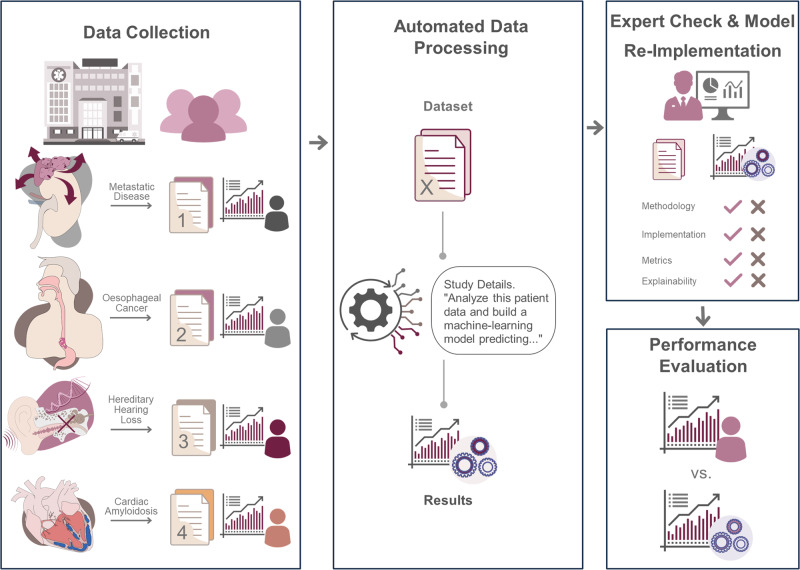
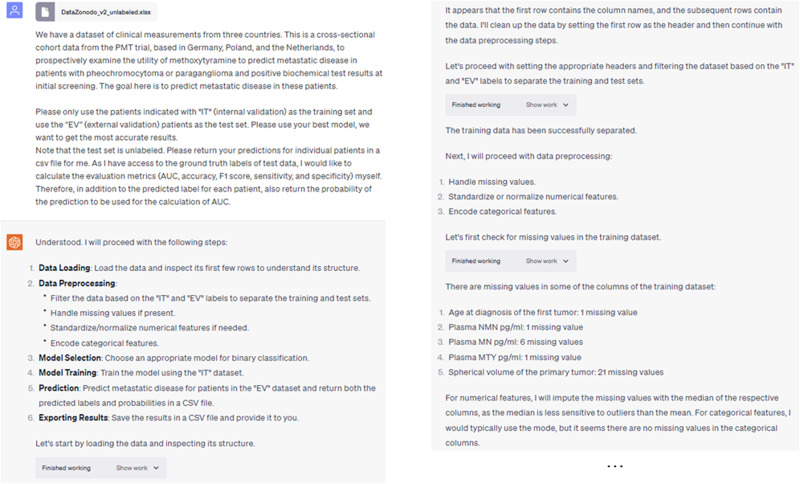
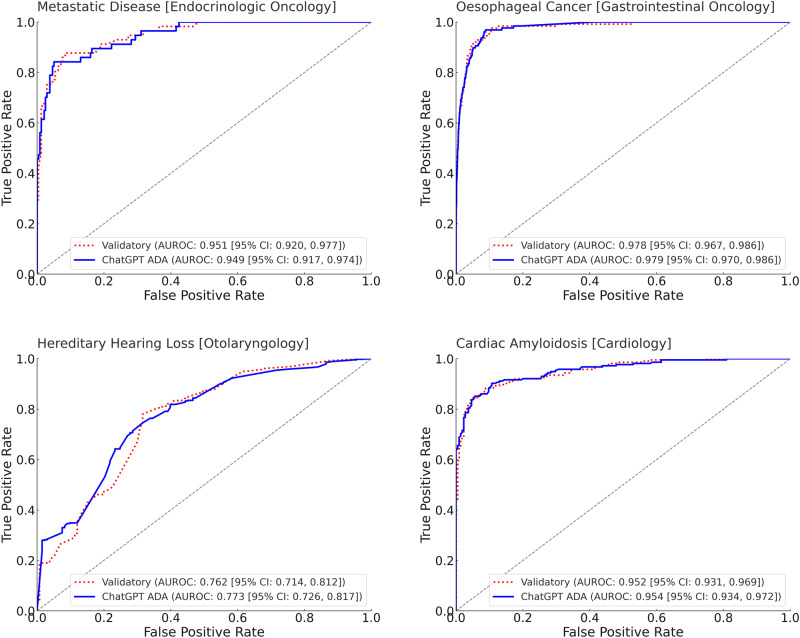
A knowledge gap persists between machine learning (ML) developers (e.g., data scientists) and practitioners (e.g., clinicians), hampering the full utilization of ML for clinical data analysis. We investigated the potential of the ChatGPT Advanced Data Analysis (ADA), an extension of GPT-4, to bridge this gap and perform ML analyses efficiently. Real-world clinical datasets and study details from large trials across various medical specialties were presented to ChatGPT ADA without specific guidance. ChatGPT ADA autonomously developed state-of-the-art ML models based on the original study’s training data to predict clinical outcomes such as cancer development, cancer progression, disease complications, or biomarkers such as pathogenic gene sequences. Following the re-implementation and optimization of the published models, the head-to-head comparison of the ChatGPT ADA-crafted ML models and their respective manually crafted counterparts revealed no significant differences in traditional performance metrics ( p ≥ 0.072). Strikingly, the ChatGPT ADA-crafted ML models often outperformed their counterparts. In conclusion, ChatGPT ADA offers a promising avenue to democratize ML in medicine by simplifying complex data analyses, yet should enhance, not replace, specialized training and resources, to promote broader applications in medical research and practice.
Overview
The claims and statistics of this paper haven’t been checked yet.
Run the check — free, no account needed. It reads the open-access text and checks the sources it cites.
Integrity signals
Registry
Cites
Statistics
Figures
Verification
Claims the paper makes
The claims and statistics of this paper haven’t been checked yet.
Run the check — free, no account needed. It reads the open-access text and checks the sources it cites.
Claims other papers make about this one
Each is checked against this paper’s own text: does it say what the citing paper says it does?
In the citing paper
“Arasteh et al. used the integrated data analysis tools of an LLM to analyze scientific data, achieving results on par with human researchers19.”
From Development and validation of an autonomous artificial intelligence agent for clinical decision-making in oncology (2025) · cites this paper as [19]
Self-check
Percentages, sums and reported differences re-computed from the paper’s own numbers.
The self-check needs the paper’s full text.
Citations
Cites
Breiman, L. (2001) · Machine Learning · doi:10.1023/a:1010933404324 · Cited by 133,538
Greedy function approximation: A gradient boosting machine
Friedman, J. H. (2001) · The Annals of Statistics · doi:10.1214/aos/1013203451 · Cited by 30,731
A decision-theoretic generalization of on-line learning and an application to boosting
Freund, Y., & Schapire, R. E. (1997) · Journal of Computer and System Sciences · doi:10.1006/jcss.1997.1504 · Cited by 20,466
A training algorithm for optimal margin classifiers
Boser, B. E., Guyon, I. M., & Vapnik, V. N. (1992) · Proceedings of the fifth annual workshop on Computational learning theory · doi:10.1145/130385.130401 · Cited by 11,992
Barredo Arrieta, A., Díaz-Rodríguez, N., Del Ser, J., Bennetot, A., Tabik, S., Barbado, A., Garcia, S., Gil-Lopez, S., Molina, D., Benjamins, R., et al. (2020) · Information Fusion · doi:10.1016/j.inffus.2019.12.012 · Cited by 10,423
Multivariate Adaptive Regression Splines
Friedman, J. H. (1991) · The Annals of Statistics · doi:10.1214/aos/1176347963 · Cited by 8,108
Kung, T. H., Cheatham, M., Medenilla, A., Sillos, C., De Leon, L., Elepaño, C., Madriaga, M., Aggabao, R., Diaz-Candido, G., Maningo, J., et al. (2023) · PLOS Digital Health · doi:10.1371/journal.pdig.0000198 · Cited by 4,115
Large language models encode clinical knowledge
Singhal, K., Azizi, S., Tu, T., Mahdavi, S. S., Wei, J., Chung, H. W., Scales, N., Tanwani, A., Cole-Lewis, H., Pfohl, S., et al. (2023) · Nature · doi:10.1038/s41586-023-06291-2 · Cited by 4,083
Large Language Models Encode Clinical Knowledge
Singhal, K., Azizi, S., Tu, T., Mahdavi, S. S., Wei, J., Chung, H. W., Scales, N., Tanwani, A., Cole-Lewis, H., Pfohl, S., et al. (2022) · arXiv · doi:10.48550/arxiv.2212.13138 · Cited by 4,083
Large language models in medicine
Thirunavukarasu, A. J., Ting, D. S. J., Elangovan, K., Gutierrez, L., Tan, T. F., & Ting, D. S. W. (2023) · Nature Medicine · doi:10.1038/s41591-023-02448-8 · Cited by 3,944
Rajpurkar, P., Chen, E., Banerjee, O., & Topol, E. J. (2022) · Nature Medicine · doi:10.1038/s41591-021-01614-0 · Cited by 3,212
Gilson, A., Safranek, C. W., Huang, T., Socrates, V., Chi, L., Taylor, R. A., & Chartash, D. (2023) · JMIR Medical Education · doi:10.2196/45312 · Cited by 2,078
Foundation models for generalist medical artificial intelligence
Moor, M., Banerjee, O., Abad, Z. S. H., Krumholz, H. M., Leskovec, J., Topol, E. J., & Rajpurkar, P. (2023) · Nature · doi:10.1038/s41586-023-05881-4 · Cited by 2,028
Benefits, Limits, and Risks of GPT-4 as an AI Chatbot for Medicine
Lee, P., Bubeck, S., & Petro, J. (2023) · New England Journal of Medicine · doi:10.1056/nejmsr2214184 · Cited by 1,738
Artificial hallucinations in ChatGPT: implications in scientific writing
Alkaissi, H., & McFarlane, S. I. (2023) · Cureus · doi:10.7759/cureus.35179 · Cited by 1,540
Artificial Intelligence and Machine Learning in Clinical Medicine, 2023
Haug, C. J., & Drazen, J. M. (2023) · New England Journal of Medicine · doi:10.1056/nejmra2302038 · Cited by 1,215
Dave, T., Athaluri, S. A., & Singh, S. (2023) · Frontiers in Artificial Intelligence · doi:10.3389/frai.2023.1169595 · Cited by 1,204
A Prompt Pattern Catalog to Enhance Prompt Engineering with ChatGPT
White, J., Fu, Q., Hays, S., Sandborn, M., Olea, C., Gilbert, H., Elnashar, A., Spencer-Smith, J., & Schmidt, D. C. (2023) · arXiv · doi:10.48550/arxiv.2302.11382 · Cited by 838
Automated machine learning: Review of the state-of-the-art and opportunities for healthcare
Waring, J., Lindvall, C., & Umeton, R. (2020) · Artificial Intelligence in Medicine · doi:10.1016/j.artmed.2020.101822 · Cited by 834
Machine learning for medical imaging: methodological failures and recommendations for the future
Varoquaux, G. P., & Cheplygina, V. (2022) · npj Digital Medicine · doi:10.1038/s41746-022-00592-y · Cited by 815
Defining an Optimal Cut-Point Value in ROC Analysis: An Alternative Approach
Unal, I. (2017) · Computational and Mathematical Methods in Medicine · doi:10.1155/2017/3762651 · Cited by 789
Ethical Considerations of Using ChatGPT in Health Care
Wang, C., Liu, S., Yang, H., Guo, J., Wu, Y., & Liu, J. (2023) · Journal of Medical Internet Research · doi:10.2196/48009 · Cited by 541
Aung, Y. Y. M., Wong, D. C. S., & Ting, D. S. W. (2021) · British Medical Bulletin · doi:10.1093/bmb/ldab016 · Cited by 511
Capabilities of GPT-4 on Medical Challenge Problems
Nori, H., King, N., McKinney, S. M., Carignan, D., & Horvitz, E. (2023) · arXiv · doi:10.48550/arxiv.2303.13375 · Cited by 509
Deep Learning in Medicine—Promise, Progress, and Challenges
Wang, F., Casalino, L. P., & Khullar, D. (2019) · JAMA Internal Medicine · doi:10.1001/jamainternmed.2018.7117 · Cited by 483
Revisiting the Time Needed to Provide Adult Primary Care
Porter, J., Boyd, C. M., Skandari, M. R., & Laiteerapong, N. (2022) · Journal of General Internal Medicine · doi:10.1007/s11606-022-07707-x · Cited by 364
Big Data for Healthcare Industry 4.0: Applications, challenges and future perspectives
Karataş, M., Erişkin, L., Deveci, M., Pamucar, D. S., & Garg, H. (2022) · Expert Systems with Applications · doi:10.1016/j.eswa.2022.116912 · Cited by 308
Ethics of large language models in medicine and medical research
Li, H., Moon, J. T., Purkayastha, S., Celi, L. A., Trivedi, H., & Gichoya, J. W. (2023) · The Lancet Digital Health · doi:10.1016/s2589-7500(23)00083-3 · Cited by 286
Will ChatGPT transform healthcare?
(2023) · Nature Medicine · doi:10.1038/s41591-023-02289-5 · Cited by 214
Unique functional responses differentially map onto genetic subtypes of dopamine neurons
Azcorra, M., Gaertner, Z. A., Davidson, C., He, Q., Kim, H., Nagappan, S., Hayes, C. K., Ramakrishnan, C., Fenno, L. E., Kim, Y. S., et al. (2023) · Nature Neuroscience · doi:10.1038/s41593-023-01401-9 · Cited by 172
Artificial Intelligence in mental health and the biases of language based models
Straw, I., & Callison-Burch, C. (2020) · PLOS ONE · doi:10.1371/journal.pone.0240376 · Cited by 164
Buitenwerf, E., Osinga, T. E., Timmers, H. J. L. M., Lenders, J. W. M., Feelders, R. A., Eekhoff, E. M. W., Haak, H. R., Corssmit, E. P. M., Bisschop, P. H. L. T., Valk, G. D., et al. (2019) · The Journal of Clinical Endocrinology & Metabolism · doi:10.1210/clinem/dgz188 · Cited by 161
On the Explainability of Natural Language Processing Deep Models
Zini, J. E., & Awad, M. (2022) · ACM Computing Surveys · doi:10.1145/3529755 · Cited by 153
The promise of large language models in health care
Arora, A., & Arora, A. (2023) · The Lancet · doi:10.1016/s0140-6736(23)00216-7 · Cited by 153
Huda, A., Castaño, A., Niyogi, A., Schumacher, J., Stewart, M., Bruno, M., Hu, M., Ahmad, F. S., Deo, R. C., & Shah, S. J. (2021) · Nature Communications · doi:10.1038/s41467-021-22876-9 · Cited by 122
Pfob, A., Lu, S.-C., & Sidey-Gibbons, C. J. (2022) · BMC Medical Research Methodology · doi:10.1186/s12874-022-01758-8 · Cited by 122
AutoML-GPT: Automatic Machine Learning with GPTPreprint
Zhang, S., Gong, C., Wu, L., Liu, X., & Zhou, M. (2023) · arXiv (Cornell University) · doi:10.48550/arxiv.2305.02499 · Cited by 120
GPUTreeShap: massively parallel exact calculation of SHAP scores for tree ensembles
Mitchell, R., Frank, E., & Holmes, G. (2022) · PeerJ Computer Science · doi:10.7717/peerj-cs.880 · Cited by 117
Tackling prediction uncertainty in machine learning for healthcare
Chua, M., Kim, D., Choi, J., Lee, N. G., Deshpande, V., Schwab, J., Lev, M. H., Gonzalez, R. G., Gee, M. S., & Do, S. (2022) · Nature Biomedical Engineering · doi:10.1038/s41551-022-00988-x · Cited by 114
Bootstrapping and permuting paired t-test type statistics
Konietschke, F., & Pauly, M. (2013) · Statistics and Computing · doi:10.1007/s11222-012-9370-4 · Cited by 111
How will generative AI disrupt data science in drug discovery?
Vert, J.-P. (2023) · Nature Biotechnology · doi:10.1038/s41587-023-01789-6 · Cited by 73
Pamporaki, C., Berends, A. M. A., Filippatos, A., Prodanov, T., Meuter, L., Prejbisz, A., Beuschlein, F., Faßnacht, M., Timmers, H. J. L. M., Nölting, S., et al. (2023) · The Lancet Digital Health · doi:10.1016/s2589-7500(23)00094-8 · Cited by 70
Lightman, H., Kosaraju, V., Burda, Y., Edwards, H., Baker, B., Lee, T., Leike, J., Schulman, J., Sutskever, I., & Cobbe, K. (2023) · arXiv · doi:10.48550/arxiv.2305.20050 · Cited by 65
Ito, Y., Unagami, M., Yamabe, F., Mitsui, Y., Nakajima, K., Nagao, K., & Kobayashi, H. (2021) · Scientific Reports · doi:10.1038/s41598-021-89369-z · Cited by 60
Gao, Y., Xin, L., Han, L., Yao, B., Zhang, T., Zhou, A.-J., Huang, S., Wang, J., Feng, Y., Yao, S.-H., et al. (2023) · The Lancet. Gastroenterology & hepatology · doi:10.1016/s2468-1253(23)00004-3 · Cited by 60
Parray, A. A., Inam, Z. M., Ramonfaur, D., Haider, S. S., Mistry, S. K., & Pandya, A. K. (2023) · Global Transitions · doi:10.1016/j.glt.2023.05.001 · Cited by 60
Darst, J. R., Newburger, J. W., Resch, S., Rathod, R. H., & Lock, J. E. (2010) · Congenital Heart Disease · doi:10.1111/j.1747-0803.2010.00433.x · Cited by 57
Code Interpreter for Bioinformatics: Are We There Yet?
Wang, L., Ge, X., Liu, L., & Hu, G. (2023) · Annals of Biomedical Engineering · doi:10.1007/s10439-023-03324-9 · Cited by 31
Association between the p.V37I variant of GJB2 and hearing loss: a pedigree and meta-analysis
Shen, N., Peng, J., Wang, X., Zhu, Y., Liu, W., Liu, A., & Lu, Y. (2017) · Oncotarget · doi:10.18632/oncotarget.17325 · Cited by 29
Chakraborty, C., Bhattacharya, M., & Lee, S.-S. (2024) · Annals of Biomedical Engineering · doi:10.1007/s10439-023-03297-9 · Cited by 27
Luo, X., Li, F., Xu, W., Hong, K., Yang, T., Chen, J., Chen, X., & Wu, H. (2021) · EBioMedicine · doi:10.1016/j.ebiom.2021.103322 · Cited by 18
Auto-ML Cyber Security Data Analysis Using Google, Azure and IBM Cloud Platforms
Opara, E., Wimmer, H., & Rebman, C. M. (2022) · International Conference on Electrical, Computer and Energy Technologies (ICECET) · doi:10.1109/icecet55527.2022.9872782 · Cited by 15
Automated machine learning as a partner in predictive modelling
Callender, T., & van der Schaar, M. (2023) · The Lancet Digital Health · doi:10.1016/s2589-7500(23)00054-7 · Cited by 13
Xia, H., Huang, X., Xu, H., Zhou, Y., Gong, L., Yang, Z., Lv, J., & Deng, H. (2019) · Genetics and Molecular Biology · doi:10.1590/1678-4685-gmb-2017-0318 · Cited by 9
LLMmed - Code for Nature Communications Publication
Arasteh, S. T., Han, T., Lotfinia, M., Kuhl, C., Kather, J. N., Truhn, D., & Nebelung, S. (2023) · Zenodo (CERN European Organization for Nuclear Research) · doi:10.5281/zenodo.10376160 · Cited by 1
Self-citationOpenAI, Achiam, J., Adler, S., Agarwal, S., Ahmad, L., Akkaya, I., Aleman, F. L., Almeida, D., Altenschmidt, J., Altman, S., et al. (2023) · arXiv · doi:10.48550/arxiv.2303.08774
Research works printed but not linked: 2
- Ke, G. et al. LightGBM: A highly efficient gradient boosting decision tree. in Advances in Neural Information Processing Systems 30. 3149–3157 (NIPS, 2017).
- Lundberg, S. & Lee, S.-I. A Unified Approach to Interpreting Model Predictions. in Proceedings of the 31st International Conference on Neural Information Processing Systems. 4768–4777. https://doi.org/10.5555/3295222.3295230 (NIPS, 2017). · DOI
Cited by
Sorted by citations
Ferber, D., El Nahhas, O. S. M., Wölflein, G., Wiest, I. C., Clusmann, J., Leßmann, M.-E., Foersch, S., Lammert, J., Tschochohei, M., Jäger, D., et al. (2025) · Nature Cancer · doi:10.1038/s43018-025-00991-6 · Cited by 175
Self-citationGenerative artificial intelligence in medicine
Teo, Z. L., Thirunavukarasu, A. J., Elangovan, K., Cheng, H., Moova, P., Soetikno, B., Nielsen, C., Pollreisz, A., Ting, D. S. J., Morris, R. J. T., et al. (2025) · Nature Medicine · doi:10.1038/s41591-025-03983-2 · Cited by 119
Chatlaw: A Multi-Agent Legal Assistant based on a Role-Aligned Mixture-of-Experts Architecture
Cui, J., Ning, M., Li, Z., Li, H., Yang, Y., Chen, B., Ling, B., Tian, Y., & Yuan, L. (2026) · Fundamental Research · doi:10.1016/j.fmre.2026.03.026 · Cited by 519
Zhang, C., Xu, Q., Yu, Y., Zhou, G., Zeng, K., Chang, F., & Ding, K. (2024) · Robotics and Computer-Integrated Manufacturing · doi:10.1016/j.rcim.2024.102883 · Cited by 101
Luo, X., Tham, Y. C., Giuffrè, M., Ranisch, R., Daher, M., Lam, K., Eriksen, A. V., Hsu, C.-W., Ozaki, A., de Moraes, F. Y., et al. (2025) · BMJ Evidence-Based Medicine · doi:10.1136/bmjebm-2025-113825 · Cited by 110
Metadata
- Authors
- Tayebi Arasteh, S., Han, T., Lotfinia, M., Kuhl, C., Kather, J. N., Truhn, D., & Nebelung, S.
- Affiliations
- Universitätsklinikum Aachen (DE)
- University Hospital Heidelberg (DE)
- Corresponding author
- Han, Tianyu
- ORCID
- Venue
- Nature Communications
- Published
- 2024-02-21
- Volume
- 15
- Issue
- 1
- Pages
- 1603-1603
- ISSN
- 2041-1723 (ISSN-L)
- PMC
- PMC10881983
- OpenAlex
- W4392016947
- Cited by
- 114
- References
- 53
- Citations by year
- 2026: 34 · 2025: 53 · 2024: 27
- FWCI
- 10.45
- Type
- journal article
- Language
- en
- Open access
- gold
- doi.org
- Locations
- Nature Communications (publishedVersion, cc-by)
- PubMed Central (publishedVersion, cc-by)
- PubMed (publishedVersion)
- arXiv (Cornell University) (submittedVersion, cc-by-sa)
- RePEc: Research Papers in Economics (submittedVersion)
- DOAJ (DOAJ: Directory of Open Access Journals) (submittedVersion)
- RWTH Publications (RWTH Aachen) (submittedVersion, other-oa)
- arXiv (Cornell University)
- RWTH Publications (RWTH Aachen)
- Funders
- European Commission (101057091)
- Deutsche Forschungsgemeinschaft (TR 1700/7‐1, NE2136/3-1, 2136/3-1)
- Bundesministerium für Bildung und Forschung (01KD2215B, 031L0312A, 01KX2021)
- HORIZON EUROPE Framework Programme (101057091)
- Topics
- Health Sciences › Medicine › Health Informatics › Artificial Intelligence in Healthcare and Education
- Physical Sciences › Computer Science › Artificial Intelligence › Machine Learning in Healthcare
- Health Sciences › Health Professions › Health Information Management › Artificial Intelligence in Healthcare
- Keywords
- large language models, ChatGPT, automated machine learning, clinical trials, medical data analysis, GPT-4, clinical outcome prediction, biomarker prediction, tumor progression, model performance comparison
- MeSH terms
- Machine Learning, Algorithms, Humans, Language, Neoplasms, Benchmarking
About these checks
Registry, retraction, Cites and statistics results are computed, not judged, with one exception: a printed reference that no index lists is read once by a model before it counts as a citation error. Claims are extracted by a model and kept only when their quote appears verbatim in the text; each cited source is then checked, with a model’s help, for whether it says what the claim relies on. Those verdicts can be wrong — read the claim’s quote and the cited source before relying on one.
Statistics and arithmetic are recomputed, not judged.
Confidence bands are shown only for fields calibrated on our annotated test set. None is calibrated yet, so no band is shown.
What counts as a claim ›How we measure confidence ›How we check this ›
Are you an author, or do you see a problem with this page? Request a review
