

Identifying proteomic risk factors for cancer using prospective and exome analyses of 1463 circulating proteins and risk of 19 cancers in the UK Biobank
Open accessThe DOI matches its Crossref record; 51 of the 51 references it cites were found in a registry or an index.
Abstract
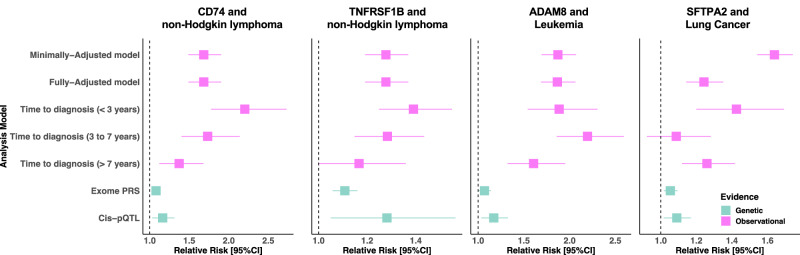
The availability of protein measurements and whole exome sequence data in the UK Biobank enables investigation of potential observational and genetic protein-cancer risk associations. We investigated associations of 1463 plasma proteins with incidence of 19 cancers and 9 cancer subsites in UK Biobank participants (average 12 years follow-up). Emerging protein-cancer associations were further explored using two genetic approaches, cis -pQTL and exome-wide protein genetic scores (exGS). We identify 618 protein-cancer associations, of which 107 persist for cases diagnosed more than seven years after blood draw, 29 of 618 were associated in genetic analyses, and four had support from long time-to-diagnosis ( > 7 years) and both cis -pQTL and exGS analyses: CD74 and TNFRSF1B with NHL, ADAM8 with leukemia, and SFTPA2 with lung cancer. We present multiple blood protein-cancer risk associations, including many detectable more than seven years before cancer diagnosis and that had concordant evidence from genetic analyses, suggesting a possible role in cancer development.
Overview
The claims and statistics of this paper haven’t been checked yet.
Free: it reads the open-access text and checks the first 5 claims that cite a source we can check. Create a free account to check every claim.
Integrity signals
Registry
Cites
Statistics
Figures
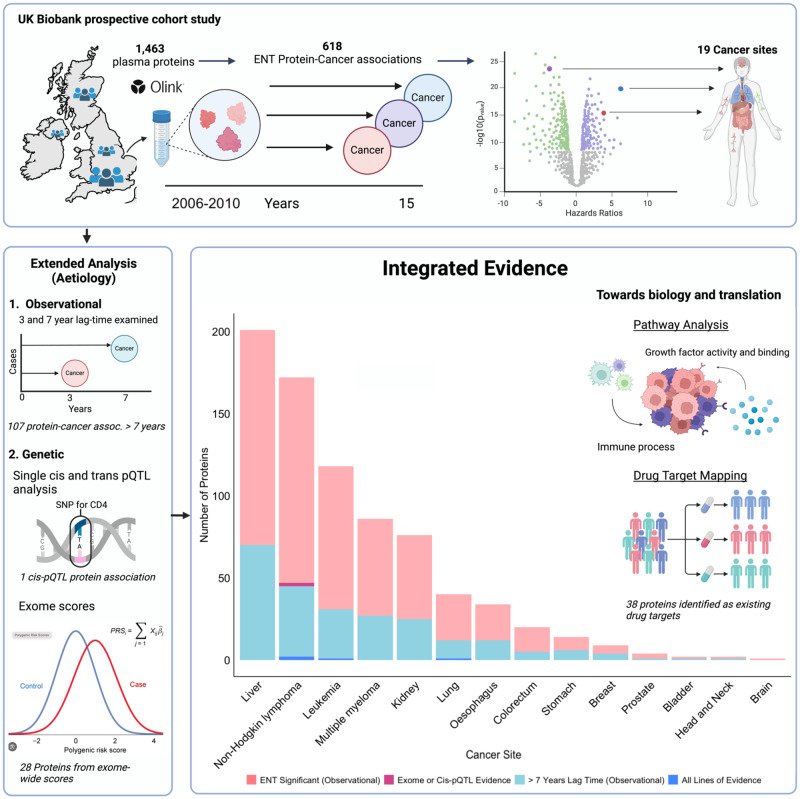
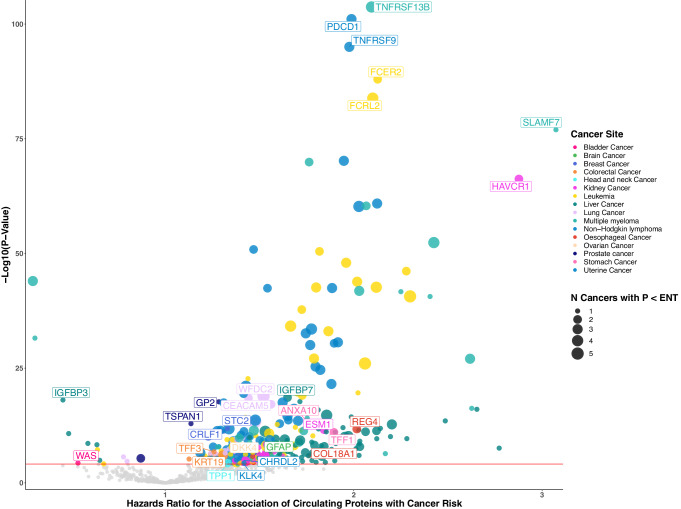
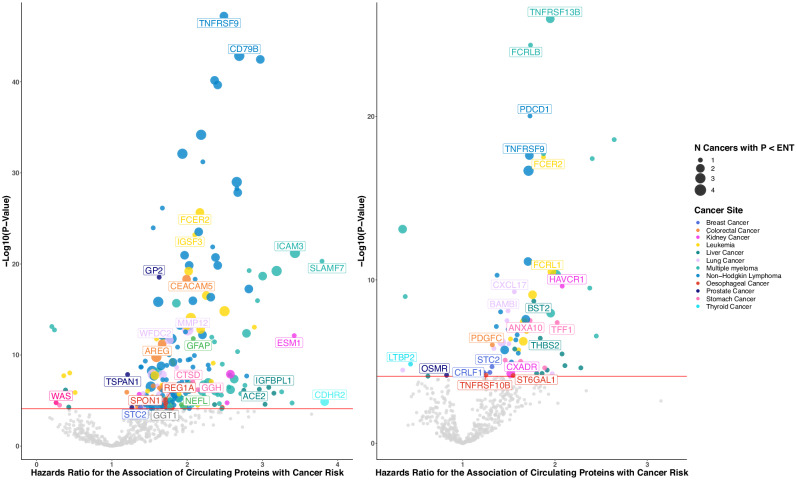
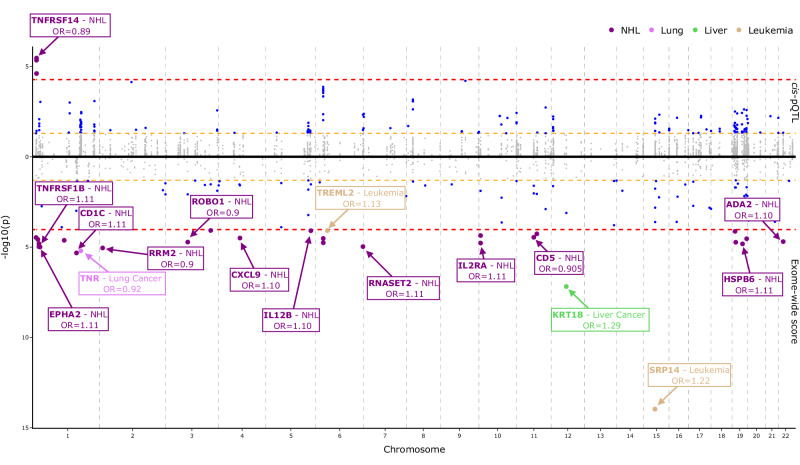
Verification
Claims the paper makes
The claims and statistics of this paper haven’t been checked yet.
Free: it reads the open-access text and checks the first 5 claims that cite a source we can check. Create a free account to check every claim.
Claims other papers make about this one
Each is checked against this paper’s own text: does it say what the citing paper says it does?
The source backs part of the claim, not all of it — or backs it for a different population, condition or comparison.
In the citing paper
“Key plasma protein databases, such as the UK Biobank Pharma Proteomics Project (UKB-PPP) and deCODE [12,13], offer valuable resources for identifying therapeutic targets and risk factors across various diseases, including cancer [14,15].”
From Identifying novel drug targets for calcific aortic valve disease through Mendelian randomization (2025) · cites this paper as [15]
Experimental — accuracy not yet measured
Self-check
Percentages, sums and reported differences re-computed from the paper’s own numbers.
The self-check needs the paper’s full text.
Citations
Cites
Sung, H., Ferlay, J., Siegel, R. L., Laversanne, M., Soerjomataram, I., Jemal, A., & Bray, F. (2021) · CA: A Cancer Journal for Clinicians · doi:10.3322/caac.21660 · Cited by 108,699 · cited 1×
“Proteomics holds signi fi cant promise for developing future cancer prevention initiatives that are needed to address the predicted increase in cancer burden among diverse populations, and so further studies into the proteomics of cancer risk including in non-White populations are necessary 35 .”
Cingolani, P., Platts, A., Wang, L. L., Coon, M., Nguyen, T., Wang, L., Land, S. J., Lu, X., & Ruden, D. M. (2012) · Fly · doi:10.4161/fly.19695 · Cited by 11,816 · cited 1×
“3 against Ensembl Build 38.92 45 .”
InfluentialThe mutational constraint spectrum quantified from variation in 141,456 humans
Karczewski, K. J., Francioli, L. C., Tiao, G., Cummings, B. B., Alföldi, J., Wang, Q., Collins, R. L., Laricchia, K. M., Ganna, A., Birnbaum, D. P., et al. (2020) · Nature · doi:10.1038/s41586-020-2308-7 · Cited by 9,434
Fry, A., Littlejohns, T. J., Sudlow, C., Doherty, N., Adamska, L., Sprosen, T., Collins, R., & Allen, N. E. (2017) · American Journal of Epidemiology · doi:10.1093/aje/kwx246 · Cited by 3,979 · cited 2×
“Finally,the UK Biobank predominantly consists of adults of White ethnicity and who have a more favourable risk pro fi le compared to the national UK population 34 .”
Defining a Cancer Dependency Map
Tsherniak, A., Vazquez, F., Montgomery, P. G., Weir, B. A., Kryukov, G., Cowley, G. S., Gill, S., Harrington, W. F., Pantel, S., Krill-Burger, J. M., et al. (2017) · Cell · doi:10.1016/j.cell.2017.06.010 · Cited by 3,276
ChEMBL: towards direct deposition of bioassay data
Mendez, D., Gaulton, A., Bento, A. P., Chambers, J., De Veij, M., Félix, E., Magariños, M. P., Mosquera, J. F., Mutowo, P., Nowotka, M., et al. (2019) · Nucleic Acids Research · doi:10.1093/nar/gky1075 · Cited by 2,372
Plasma proteomic associations with genetics and health in the UK Biobank
Sun, B. B., Chiou, J., Traylor, M., Benner, C., Hsu, Y.-H., Richardson, T. G., Surendran, P., Mahajan, A., Robins, C., Vasquez-Grinnell, S. G., et al. (2023) · Nature · doi:10.1038/s41586-023-06592-6 · Cited by 1,880 · cited 2×
“This is of particular interest given proteins are the target of 98% of all drugs and that 38 of our candidate aetiological proteins are the target of existing drugs, of whichninehadfurtherdirectionallyconcordantevidencefromgenetic analyses supporting their role in cancer development 40 .”
Genetic regulation of the human plasma proteome in 54,306 UK Biobank participants
Sun, B. B., Chiou, J., Traylor, M., Benner, C., Hsu, Y.-H., Richardson, T. G., Surendran, P., Mahajan, A., Robins, C., Vasquez-Grinnell, S. G., et al. (2022) · doi:10.1101/2022.06.17.496443 · Cited by 1,833 · cited 4×
“Non-fasting blood samples were collectedfromallparticipantsatrecruitmentandplasmawasprepared and stored at − 80°C. Protein measurements were generated using the Olink Proximity ExtensionAssay in54,306participantsselected as part of the UK Biobank Pharma Proteomics Project (UKB-PPP).”
BackgroundInfluentialThe mutational constraint spectrum quantified from variation in 141,456 humans
Karczewski, K. J., Francioli, L. C., Tiao, G., Cummings, B. B., Alföldi, J., Wang, Q., Collins, R. L., Laricchia, K. M., Ganna, A., Birnbaum, D. P., et al. (2019) · doi:10.1101/531210 · Cited by 1,662
The human protein atlas: a spatial map of the human proteome
Thul, P. J., & Lindskog, C. (2018) · Protein Science · doi:10.1002/pro.3307 · Cited by 1,299 · cited 1×
“…provide greater biological context for identi fi ed protein-cancer associations, we extracted single-cell RNA expression from the Human Protein Atlas to describe mRNA expression in cancer-free individuals for genes that code for the identi fi ed protein markers in our main observational analyses 47 .”
A compendium of mutational cancer driver genes
Martínez-Jiménez, F., Muiños, F., Sentís, I., Deu-Pons, J., Reyes-Salazar, I., Arnedo-Pac, C., Mularoni, L., Pich, O., Bonet, J., Kranas, H., et al. (2020) · Nature Reviews Cancer · doi:10.1038/s41568-020-0290-x · Cited by 1,296
Triangulation in aetiological epidemiology
Lawlor, D. A., Tilling, K., & Davey Smith, G. (2017) · International Journal of Epidemiology · doi:10.1093/ije/dyw314 · Cited by 1,129 · cited 1×
“Such genetic analyses complement traditional prospective epidemiology, and the combination of observational and genetic approaches can improve our ability to identify proteins most likely to have a causal role in cancer development and progression 14 .”
What makes UK Biobank special?
Collins, R. (2012) · The Lancet · doi:10.1016/s0140-6736(12)60404-8 · Cited by 1,128 · cited 1×
“The study design and rationale have been described elsewhere 34,41 .”
BackgroundMenon, U., Gentry-Maharaj, A., Burnell, M., Singh, N., Ryan, A., Karpinskyj, C., Carlino, G., Taylor, J., Massingham, S. K., Raikou, M., et al. (2021) · The Lancet · doi:10.1016/s0140-6736(21)00731-5 · Cited by 730
Ballehaninna, U. K., & Chamberlain, R. S. (2012) · PubMed · doi:10.3978/j.issn.2078-6891.2011.021 · Cited by 701
Robust research needs many lines of evidence
Munafò, M. R., & Davey Smith, G. (2018) · Nature · doi:10.1038/d41586-018-01023-3 · Cited by 666
Chen, Z.-L., Meng, J.-M., Cao, Y., Yin, J.-L., Fang, R.-Q., Fan, S.-B., Liu, C., Zeng, W.-F., Ding, Y.-H., Tan, D., et al. (2019) · Nature Communications · doi:10.1038/s41467-019-11337-z · Cited by 552
Genetics meets proteomics: perspectives for large population-based studies
Suhre, K., McCarthy, M. I., & Schwenk, J. M. (2021) · Nature Reviews Genetics · doi:10.1038/s41576-020-0268-2 · Cited by 478 · cited 14×
“Source data are provided as a Source Data fi le. complementary genetic analyses, which may suggest a role in aetiology.”
InfluentialWik, L., Nordberg, N., Broberg, J., Björkesten, J., Assarsson, E., Henriksson, S., Grundberg, I., Pettersson, E., Westerberg, C., Liljeroth, E., et al. (2021) · Molecular & Cellular Proteomics · doi:10.1016/j.mcpro.2021.100168 · Cited by 445
The next-generation Open Targets Platform: reimagined, redesigned, rebuilt
Ochoa, D., Hercules, A., Carmona, M., Suveges, D., Baker, J., Malangone, C., Lopez, I., Miranda, A., Cruz-Castillo, C., Fumis, L., et al. (2023) · Nucleic Acids Research · doi:10.1093/nar/gkac1046 · Cited by 432
Zhang, J., Dutta, D., Köttgen, A., Tin, A., Schlosser, P., Grams, M. E., Harvey, B., CKDGen Consortium, Yu, B., Boerwinkle, E., et al. (2022) · Nature Genetics · doi:10.1038/s41588-022-01051-w · Cited by 373
Two routes to leukemic transformation after a JAK2 mutation–positive myeloproliferative neoplasm
Beer, P. A., Delhommeau, F., LeCouédic, J.-P., Dawson, M. A., Chen, E., Bareford, D., Kušec, R., McMullin, M. F., Harrison, C. N., Vannucchi, A. M., et al. (2010) · Blood · doi:10.1182/blood-2009-08-236596 · Cited by 307
Gerhauser, C., Favero, F., Risch, T., Simon, R., Feuerbach, L., Assenov, Y., Heckmann, D., Sidiropoulos, N., Waszak, S. M., Hübschmann, D., et al. (2018) · Cancer Cell · doi:10.1016/j.ccell.2018.10.016 · Cited by 293
Rare variant associations with plasma protein levels in the UK Biobank
Dhindsa, R. S., Burren, O. S., Sun, B. B., Prins, B. P., Matelska, D., Wheeler, E., Mitchell, J., Oerton, E., Hristova, V. A., Smith, K. R., et al. (2023) · Nature · doi:10.1038/s41586-023-06547-x · Cited by 193 · cited 1×
“This is especially important as the limited observational and genetic evidence suggests that inherited determinants of proteins and the protein-cancer associations can vary between populations of different ancestry 27,36 – 39 .”
Assessment of Lung Cancer Risk on the Basis of a Biomarker Panel of Circulating Proteins
Integrative Analysis of Lung Cancer Etiology and Risk (INTEGRAL) Consortium for Early Detection of Lung Cancer, Guida, F., Sun, N., Bantis, L. E., Muller, D. C., Li, P., Taguchi, A., Dhillon, D., Kundnani, D. L., Patel, N. J., et al. (2018) · JAMA Oncology · doi:10.1001/jamaoncol.2018.2078 · Cited by 169
Self-citationBiological and functional multimorbidity—from mechanisms to management
Langenberg, C., Hingorani, A. D., & Whitty, C. W. M. (2023) · Nature Medicine · doi:10.1038/s41591-023-02420-6 · Cited by 166
Statistical methods for cis‐Mendelian randomization with two‐sample summary‐level data
Gkatzionis, A., Burgess, S., & Newcombe, P. J. (2023) · Genetic Epidemiology · doi:10.1002/gepi.22506 · Cited by 155
Lane, J. A., Hamdy, F. C., Martin, R. M., Turner, E. L., Neal, D. E., & Donovan, J. (2010) · European Journal of Cancer · doi:10.1016/j.ejca.2010.09.016 · Cited by 149
Medical relevance of protein-truncating variants across 337,205 individuals in the UK Biobank study
DeBoever, C., Tanigawa, Y., Lindholm, M. E., McInnes, G., Lavertu, A., Ingelsson, E., Chang, C., Ashley, E. A., Bustamante, C. D., Daly, M. J., et al. (2018) · Nature Communications · doi:10.1038/s41467-018-03910-9 · Cited by 126
The blood proteome of imminent lung cancer diagnosis
Albanes, D., Alcala, K., Alcala, N., Amos, C. I., Arslan, A. A., Bassett, J. K., Brennan, P., Cai, Q., Chen, C., Feng, X., et al. (2023) · Nature Communications · doi:10.1038/s41467-023-37979-8 · Cited by 110
Self-citationKnuppel, A., Fensom, G. K., Watts, E. L., Gunter, M. J., Murphy, N., Papier, K., Perez-Cornago, A., Schmidt, J. A., Smith Byrne, K., Travis, R. C., et al. (2020) · Cancer Research · doi:10.1158/0008-5472.can-20-1281 · Cited by 96
Self-citationNext generation pan-cancer blood proteome profiling using proximity extension assay
Álvez, M. B., Edfors, F., von Feilitzen, K., Zwahlen, M., Mardinoğlu, A., Edqvist, P.-H. D., Sjöblom, T., Lundin, E., Rameika, N., Enblad, G., et al. (2023) · Nature Communications · doi:10.1038/s41467-023-39765-y · Cited by 95
Kim, K. H., & Lee, M. (2020) · Biochimica et Biophysica Acta (BBA) - General Subjects · doi:10.1016/j.bbagen.2020.129834 · Cited by 84
Identification of genetic variants influencing the human plasma proteome
Johansson, Å., Enroth, S., Palmblad, M., Deelder, A. M., Bergquist, J., & Gyllensten, U. (2013) · Proceedings of the National Academy of Sciences · doi:10.1073/pnas.1217238110 · Cited by 82
Watts, E. L., Perez‐Cornago, A., Fensom, G. K., Smith‐Byrne, K., Noor, U., Andrews, C. D., Gunter, M. J., Holmes, M. V., Martin, R. M., Tsilidis, K. K., et al. (2022) · International Journal of Epidemiology · doi:10.1093/ije/dyac124 · Cited by 65
Self-citationDendritic cell Flt3 – regulation, roles and repercussions for immunotherapy
Wilson, K. R., Villadangos, J. A., & Mintern, J. D. (2021) · Immunology and Cell Biology · doi:10.1111/imcb.12484 · Cited by 65
Harlid, S., Myte, R., & Guelpen, B. R. V. (2017) · Mediators of Inflammation · doi:10.1155/2017/4803156 · Cited by 63
Floros, J., Thorenoor, N., Tsotakos, N., & Phelps, D. S. (2021) · Frontiers in Immunology · doi:10.3389/fimmu.2021.681639 · Cited by 52
Gnanasambandan, K., Magis, A. T., & Sayeski, P. P. (2010) · Biochemistry · doi:10.1021/bi1014858 · Cited by 51
Whole-genome sequence association analysis of blood proteins in a longitudinal wellness cohort
Zhong, W., Gummesson, A., Tebani, A., Karlsson, M., Hong, M., Schwenk, J. M., Edfors, F., Bergström, G. M. L., Fagerberg, L., & Uhlén, M. (2020) · Genome Medicine · doi:10.1186/s13073-020-00755-0 · Cited by 48
Dagnino, S., Bodinier, B., Guida, F., Smith-Byrne, K., Petrović, D., Whitaker, M. D., Nøst, T. H., Agnoli, C., Palli, D., Sacerdote, C., et al. (2021) · Cancer Research · doi:10.1158/0008-5472.can-20-3454 · Cited by 48
Self-citationKolijn, P. M., Hosnijeh, F. S., Späth, F., Hengeveld, P. J., Agathangelidis, A., Saleh, M. A., Casabonne, D., Benavente, Y., Jerkeman, M., Agudo, A., et al. (2021) · Blood · doi:10.1182/blood.2021012890 · Cited by 46
Benton, C. B., Boddu, P. C., Dinardo, C. D., Bose, P., Wang, F., Assi, R. E., Pemmaraju, N., Kc, D., Pierce, S. A., Patel, K. P., et al. (2019) · Cancer · doi:10.1002/cncr.31986 · Cited by 40
Robbins, H. A., Alcala, K., Moez, E. K., Guida, F., Thomas, S., Zahed, H., Warkentin, M. T., Smith‐Byrne, K., Brhane, Y., Muller, D. C., et al. (2022) · Annals of Epidemiology · doi:10.1016/j.annepidem.2022.10.014 · Cited by 38
Self-citationSmith-Byrne, K., Appleby, P. N., Key, T. J., Holmes, M. V., Fensom, G. K., Agudo, A., Ardanáz, E., Boeing, H., Bueno-de-Mesquita, H. B., Chirlaque, M. D., et al. (2019) · Annals of Oncology · doi:10.1093/annonc/mdz121 · Cited by 30
Self-citationCirculating proteins and risk of pancreatic cancer: a case-subcohort study among Chinese adults
Kartsonaki, C., Pang, Y., Millwood, I. Y., Yang, L., Guo, Y., Walters, R. G., Lv, J., Hill, M., Yu, C., Chen, Y., et al. (2022) · International Journal of Epidemiology · doi:10.1093/ije/dyab274 · Cited by 30
Self-citationSun, X., Shu, X., Lan, Q., Laszkowska, M., Cai, Q., Rothman, N., Wen, W., Zheng, W., & Shu, X. (2022) · Cancers · doi:10.3390/cancers14133261 · Cited by 23
Kaaks, R., Sookthai, D., Łuczyńska, A., Oakes, C. C., Becker, S., Johnson, T., Johansson, A., Melin, B. S., Sjöberg, K., Trichopoulos, D., et al. (2015) · Cancer Epidemiology Biomarkers & Prevention · doi:10.1158/1055-9965.epi-14-1107 · Cited by 16
Self-citationGenetic and Genomic Testing for Prostate Cancer: Beyond DNA Repair
Herberts, C., Wyatt, A. W., Nguyen, P. L., & Cheng, H. H. (2023) · American Society of Clinical Oncology Educational Book · doi:10.1200/edbk_390384 · Cited by 16
Pozarickij, A., Said, S., Lin, K., Morris, S., Edris, A., Iona, A., Kartsonaki, C., Wright, N., Yao, P., Fry, H., et al. (2023) · doi:10.1101/2023.11.13.23298365 · Cited by 16 · cited 1×
“This is especially important as the limited observational and genetic evidence suggests that inherited determinants of proteins and the protein-cancer associations can vary between populations of different ancestry 27,36 – 39 .”
BackgroundDhindsa, R. S., Burren, O. S., Sun, B. B., Prins, B. P., Matelska, D., Wheeler, E., Mitchell, J., Oerton, E., Hristova, V. A., Smith, K. R., et al. (2022) · bioRxiv (Cold Spring Harbor Laboratory) · doi:10.1101/2022.10.09.511476 · Cited by 11
Cited by
Circulating Liquid Biopsy Biomarkers in Glioblastoma: Advances and Challenges
Seyhan, A. A. (2024) · International Journal of Molecular Sciences · doi:10.3390/ijms25147974 · Cited by 100
A human pan-disease blood atlas of the circulating proteome
Álvez, M. B., Bergström, S., Kenrick, J., Johansson, E., Åberg, M., Akyıldız, M., Altay, Ö., Sköld, H., Antonopoulos, K., Apostolakis, E., et al. (2025) · Science · doi:10.1126/science.adx2678 · Cited by 94
Promises and pitfalls of multi-cancer early detection using liquid biopsy tests
Wan, J. C. M., Sasieni, P. D., & Rosenfeld, N. (2025) · Nature Reviews Clinical Oncology · doi:10.1038/s41571-025-01033-x · Cited by 82
Bettariga, F., Taaffe, D. R., Borsati, A., Avancini, A., Pilotto, S., Lazzarini, S. G., López, P., Maestroni, L., Crainich, U., Campbell, J. P., et al. (2025) · JNCI Journal of the National Cancer Institute · doi:10.1093/jnci/djaf062 · Cited by 36
Xu, Y., Zhu, S., Xia, C., Yu, H., Shi, S., Chen, K., He, Y., Deng, C., Jin, H., Liu, J., et al. (2025) · 中国科学通报:英文版 · doi:10.1016/j.scib.2025.06.030 · Cited by 32
Metadata
- Authors
- Papier, K., Atkins, J. R., Tong, T. Y. N., Gaitskell, K., Desai, T., Ogamba, C. F., Parsaeian, M., Reeves, G. K., Mills, I. G., Key, T. J., Smith-Byrne, K., & Travis, R. C.
- Affiliations
- University of Oxford (GB)
- Queen's University Belfast (GB)
- Corresponding author
- Papier, Keren
- ORCID
- Venue
- Nature Communications
- Published
- 2024-05-15
- Volume
- 15
- Issue
- 1
- Pages
- 4010-4010
- ISSN
- 2041-1723 (ISSN-L)
- PMC
- PMC11096312
- OpenAlex
- W4396929100
- Cited by
- 97
- References
- 49
- Citations by year
- 2026: 39 · 2025: 50 · 2024: 8
- FWCI
- 25.64
- Type
- journal article
- Language
- en
- Open access
- gold
- doi.org
- Licence
- cc-by
- creativecommons.org/licenses/by/4.0 (tdm)
- creativecommons.org/licenses/by/4.0 (vor)
- Locations
- Nature Communications (publishedVersion, cc-by)
- PubMed Central (publishedVersion, cc-by)
- PubMed (publishedVersion)
- Research Portal (Queen's University Belfast) (acceptedVersion, cc-by)
- DOAJ (DOAJ: Directory of Open Access Journals) (submittedVersion, cc-by-sa)
- Funders
- Cancer Research UK (C8221/A29017, C8221/A29186)
- Topics
- Life Sciences › Biochemistry, Genetics and Molecular Biology › Genetics › Genetic Associations and Epidemiology
- Life Sciences › Biochemistry, Genetics and Molecular Biology › Cancer Research › Cancer Genomics and Diagnostics
- Physical Sciences › Environmental Science › Health, Toxicology and Mutagenesis › Health, Environment, Cognitive Aging
- Keywords
- circulating proteins, plasma proteomics, cancer risk, cancer incidence, tumor subtypes, cis-pQTL, CD74, TNF receptor 2, ADAM8, SFTPA2, non-Hodgkin lymphoma, leukemia, lung cancer, early cancer detection, UK Biobank
- MeSH terms
- Exome Sequencing, UK Biobank, Aged, Blood Proteins, Female, United Kingdom, Humans, Male, Middle Aged, Neoplasms, Prospective Studies, Risk Factors, Incidence, Biological Specimen Banks, Genetic Predisposition to Disease, Proteomics, Exome
About these checks
Registry, retraction, Cites and statistics results are computed, not judged, with one exception: a printed reference that no index lists is read once by a model before it counts as a citation error. Claims are extracted by a model and kept only when their quote appears verbatim in the text; each cited source is then checked, with a model’s help, for whether it says what the claim relies on. Those verdicts can be wrong — read the claim’s quote and the cited source before relying on one.
Statistics and arithmetic are recomputed, not judged.
Confidence bands are shown only for fields calibrated on our annotated test set. None is calibrated yet, so no band is shown.
What counts as a claim ›How we measure confidence ›How we check this ›
Are you an author, or do you see a problem with this page? Request a review
Data sources
Bibliographic data: Semantic Scholar, OpenAlex, Crossref.
Contains information from the Semantic Scholar Academic Graph Datasets, made available under the ODC Attribution License (ODC-BY 1.0).
Semantic Scholar’s data is described in: Kinney, R., et al. (2023). The Semantic Scholar Open Data Platform. arXiv:2301.10140.
