

Physics-informed neural network for lithium-ion battery degradation stable modeling and prognosis
Open accessThe DOI matches its Crossref record; 55 of the 56 references it cites were found in a registry or an index.
Abstract
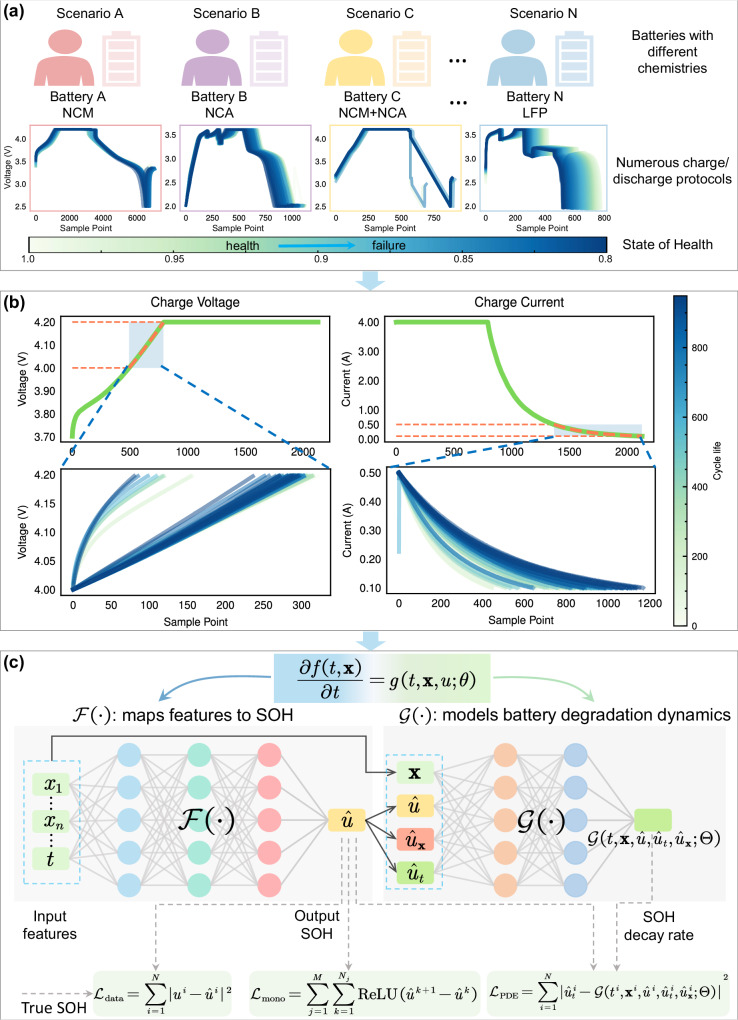
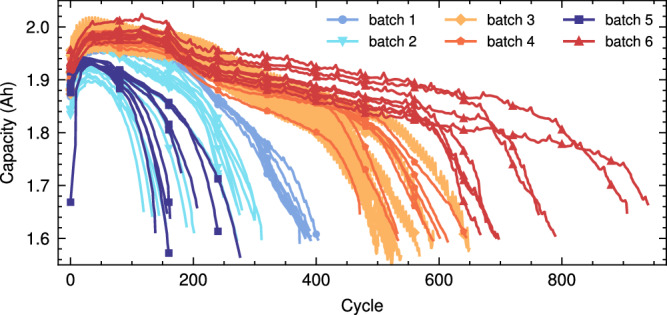
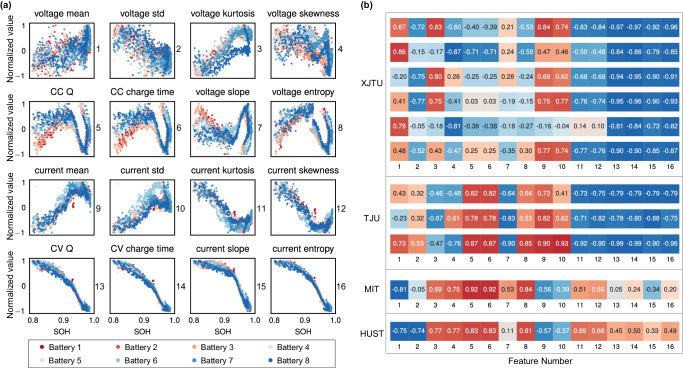
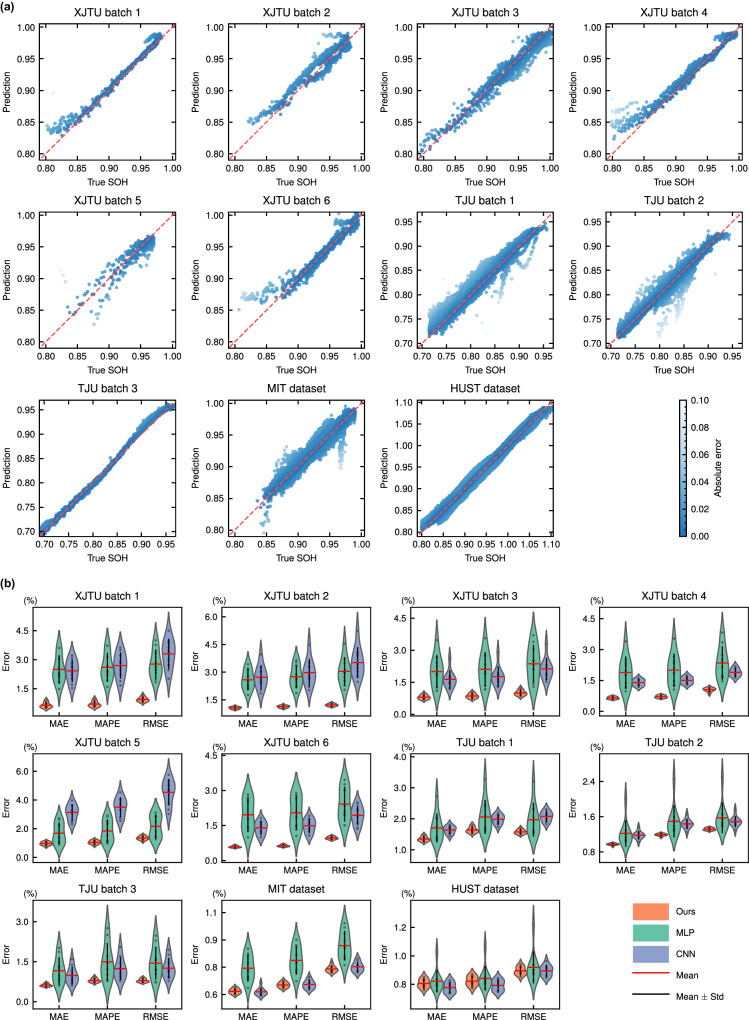
Accurate state-of-health (SOH) estimation is critical for reliable and safe operation of lithium-ion batteries. However, reliable and stable battery SOH estimation remains challenging due to diverse battery types and operating conditions. In this paper, we propose a physics-informed neural network (PINN) for accurate and stable estimation of battery SOH. Specifically, we model the attributes that affect the battery degradation from the perspective of empirical degradation and state space equations, and utilize neural networks to capture battery degradation dynamics. A general feature extraction method is designed to extract statistical features from a short period of data before the battery is fully charged, enabling our method applicable to different battery types and charge/discharge protocols. Additionally, we generate a comprehensive dataset consisting of 55 lithium-nickel-cobalt-manganese-oxide (NCM) batteries. Combined with three other datasets from different manufacturers, we use a total of 387 batteries with 310,705 samples to validate our method. The mean absolute percentage error (MAPE) is 0.87%. Our proposed PINN has demonstrated remarkable performance in regular experiments, small sample experiments, and transfer experiments when compared to alternative neural networks. This study highlights the promise of physics-informed machine learning for battery degradation modeling and SOH estimation.
Overview
The claims and statistics of this paper haven’t been checked yet.
Free: it reads the open-access text and checks the first 5 claims that cite a source we can check. Create a free account to check every claim.
Integrity signals
Registry
Cites
Statistics
Figures
Verification
Claims the paper makes
The claims and statistics of this paper haven’t been checked yet.
Free: it reads the open-access text and checks the first 5 claims that cite a source we can check. Create a free account to check every claim.
Claims other papers make about this one
Each is checked against this paper’s own text: does it say what the citing paper says it does?
The cited source says what the claim attributes to it.
In the citing paper
“Battery aging is a complex, multi-factor process involving the loss of active materials, lithium-ion depletion, increased internal resistance, and changes in the solid electrolyte interphase (SEI) layer [17-23]”
From The State of Health Estimation of Lithium-Ion Batteries: A Review of Health Indicators, Estimation Methods, Development Trends and Challenges (2025) · cites this paper as [17]
Self-check
Percentages, sums and reported differences re-computed from the paper’s own numbers.
The self-check needs the paper’s full text.
Citations
Cites
Raissi, M., Perdikaris, P., & Karniadakis, G. E. (2019) · Journal of Computational Physics · doi:10.1016/j.jcp.2018.10.045 · Cited by 20,384 · cited 2×
“Inspired by 54,55 , we propose to use a more generalized function approximator g 0 ð(cid:2)Þ with parameters θ 0 to represent the non-linear dynamics g ( ⋅ ).”
Physics-informed machine learning
Karniadakis, G. E., Kevrekidis, I. G., Lu, L., Perdikaris, P., Wang, S., & Yang, L. (2021) · Nature Reviews Physics · doi:10.1038/s42254-021-00314-5 · Cited by 8,718 · cited 2×
“The promising prospect of physics-informed neural network (PINN) 36,37 lies in amalgamating the strengths of physics-based and data-driven approaches, potentially addressing the aforementioned challenges.”
Recycling lithium-ion batteries from electric vehicles
Harper, G., Sommerville, R., Kendrick, E., Driscoll, L., Slater, P., Stolkin, R., Walton, A., Christensen, P., Heidrich, O., Lambert, S., et al. (2019) · Nature · doi:10.1038/s41586-019-1682-5 · Cited by 3,890 · cited 1×
“With the advantages of high energy density, low self-discharge rate, and long service life 1 , lithium-ion batteries have become the main energy storage devices in portable electronic devices, electric vehicles, aero-space, and many other fi elds 2 – 8 .”
Performance and cost of materials for lithium-based rechargeable automotive batteries
Schmuch, R., Wagner, R., Hörpel, G., Placke, T., & Winter, M. (2018) · Nature Energy · doi:10.1038/s41560-018-0107-2 · Cited by 3,233 · cited 1×
“With the advantages of high energy density, low self-discharge rate, and long service life 1 , lithium-ion batteries have become the main energy storage devices in portable electronic devices, electric vehicles, aero-space, and many other fi elds 2 – 8 .”
Data-driven prediction of battery cycle life before capacity degradation
Severson, K. A., Attia, P. M., Jin, N., Perkins, N., Jiang, B., Yang, Z., Chen, M. H., Aykol, M., Herring, P. K., Fraggedakis, D., et al. (2019) · Nature Energy · doi:10.1038/s41560-019-0356-8 · Cited by 3,228 · cited 3×
“For convenience, we refer to the four datasets as the XJTU battery dataset, TJU dataset 44 , HUST dataset 45 , and MIT dataset 25 .”
Simulation and Optimization of the Dual Lithium Ion Insertion Cell
Fuller, T. F., Doyle, M., & Newman, J. (1994) · Journal of The Electrochemical Society · doi:10.1149/1.2054684 · Cited by 2,057 · cited 1×
“Physics-based models are stable and accurate, but batteries with different chemical compositions require different model parameters, and the models have high computational costs 32 .”
Closed-loop optimization of fast-charging protocols for batteries with machine learning
Attia, P. M., Grover, A., Jin, N., Severson, K. A., Markov, T. M., Liao, Y.-H., Chen, M. H., Cheong, B., Perkins, N., Yang, Z., et al. (2020) · Nature · doi:10.1038/s41586-020-1994-5 · Cited by 1,180 · cited 1×
“Given the dif fi culty in establishing physical models and the dif fi - culty in obtaining complete discharge capacity, many studies have used data-driven methods 20 – 24 to estimate SOH based on current and voltage curves during charge and discharge.”
A review of rechargeable batteries for portable electronic devices
Liang, Y., Zhao, C., Yuan, H., Chen, Y., Zhang, W., Huang, J., Yu, D., Liu, Y., Titirici, M., Chueh, Y., et al. (2019) · InfoMat · doi:10.1002/inf2.12000 · Cited by 1,174
Modeling of Lithium-Ion Battery Degradation for Cell Life Assessment
Xu, B., Oudalov, A., Ulbig, A., Andersson, G., & Kirschen, D. S. (2018) · IEEE Transactions on Smart Grid · doi:10.1109/tsg.2016.2578950 · Cited by 1,162
Critical review of state of health estimation methods of Li-ion batteries for real applications
Berecibar, M., Gandiaga, I., Villarreal, I., Omar, N., Van Mierlo, J., & Van den Bossche, P. (2016) · Renewable and Sustainable Energy Reviews · doi:10.1016/j.rser.2015.11.042 · Cited by 1,126 · cited 1×
“In recent years, various SOH estimation methods of lithium-ion batterieshavebeenproposed,whichgreatlyadvancethedevelopment of this fi eld 12 – 15 .”
He, W., Williard, N., Osterman, M., & Pecht, M. (2011) · Journal of Power Sources · doi:10.1016/j.jpowsour.2011.08.040 · Cited by 1,105
Data-driven capacity estimation of commercial lithium-ion batteries from voltage relaxation
Zhu, J., Wang, Y., Huang, Y., Bhushan Gopaluni, R., Cao, Y., Heere, M., Mühlbauer, M. J., Mereacre, L., Dai, H., Liu, X., et al. (2022) · Nature Communications · doi:10.1038/s41467-022-29837-w · Cited by 815
Predicting the state of charge and health of batteries using data-driven machine learning
Ng, M.-F., Zhao, J., Yan, Q., Conduit, G. J., & Seh, Z. W. (2020) · Nature Machine Intelligence · doi:10.1038/s42256-020-0156-7 · Cited by 793
Electric Vehicles Batteries: Requirements and Challenges
Deng, J., Bae, C., Denlinger, A., & Miller, T. (2020) · Joule · doi:10.1016/j.joule.2020.01.013 · Cited by 761
Gaussian process regression for forecasting battery state of health
Richardson, R. R., Osborne, M. A., & Howey, D. A. (2017) · Journal of Power Sources · doi:10.1016/j.jpowsour.2017.05.004 · Cited by 732 · cited 1×
“Commonly used data-drivenmethodsincludelinearregression 25 ,support vectormachines 26 , Gaussian process regression 27 , deep neural networks 28,29 , etc. Xia et al. 30 extracted features from incremental capacity (IC) curves and differential voltage (DV) curves to estimate SOH.”
Nuhic, A., Terzimehic, T., Soczka-Guth, T., Buchholz, M., & Dietmayer, K. (2013) · Journal of Power Sources · doi:10.1016/j.jpowsour.2012.11.146 · Cited by 664 · cited 1×
“Commonly used data-drivenmethodsincludelinearregression 25 ,support vectormachines 26 , Gaussian process regression 27 , deep neural networks 28,29 , etc. Xia et al. 30 extracted features from incremental capacity (IC) curves and differential voltage (DV) curves to estimate SOH.”
Physics-informed learning of governing equations from scarce data
Chen, Z., Liu, Y., & Sun, H. (2021) · Nature Communications · doi:10.1038/s41467-021-26434-1 · Cited by 609 · cited 2×
“The promising prospect of physics-informed neural network (PINN) 36,37 lies in amalgamating the strengths of physics-based and data-driven approaches, potentially addressing the aforementioned challenges.”
Simulation of capacity fade in lithium-ion batteries
Spotnitz, R. (2003) · Journal of Power Sources · doi:10.1016/s0378-7753(02)00490-1 · Cited by 573 · cited 1×
“…describe the battery degradation trajectory, scholars have proposed various empirical models to describe the loss of battery capacity as a function of time or cycle numbers, including the linear model 48 , exponential model 49,50 , power-law model 51 , and failure forecast model (FFM) 52 , etc.”
Health prognostics for lithium-ion batteries: mechanisms, methods, and prospects
Che, Y., Hu, X., Lin, X., Guo, J., & Teodorescu, R. (2023) · Energy & Environmental Science · doi:10.1039/d2ee03019e · Cited by 413 · cited 2×
“However, challenges still stand in the way of developing reliable, accurate, and general SOH estimation methods 14,21 .”
An overview of global power lithium-ion batteries and associated critical metal recycling
Miao, Y., Liu, L., Zhang, Y., Tan, Q., & Li, J. (2022) · Journal of Hazardous Materials · doi:10.1016/j.jhazmat.2021.127900 · Cited by 379
Rauf, H., Khalid, M., & Arshad, N. (2022) · Renewable and Sustainable Energy Reviews · doi:10.1016/j.rser.2021.111903 · Cited by 326 · cited 1×
“However, challenges still stand in the way of developing reliable, accurate, and general SOH estimation methods 14,21 .”
Ma, G., Xu, S., Jiang, B., Cheng, C., Yang, X., Shen, Y., Yang, T., Huang, Y., Ding, H., & Yuan, Y. (2022) · Energy & Environmental Science · doi:10.1039/d2ee01676a · Cited by 309 · cited 2×
“For convenience, we refer to the four datasets as the XJTU battery dataset, TJU dataset 44 , HUST dataset 45 , and MIT dataset 25 .”
Prognostics and health management of Lithium-ion battery using deep learning methods: A review
Zhang, Y., & Li, Y.-F. (2022) · Renewable and Sustainable Energy Reviews · doi:10.1016/j.rser.2022.112282 · Cited by 295 · cited 1×
“The SOH ofa battery is de fi ned as the ratioofthe current available capacity to the initial capacity, which can be used as an indicator to measure battery degradation 11 .”
Luo, K., Chen, X., Zheng, H., & Shi, Z. (2022) · Journal of Energy Chemistry · doi:10.1016/j.jechem.2022.06.049 · Cited by 292 · cited 1×
“Commonly used data-drivenmethodsincludelinearregression 25 ,support vectormachines 26 , Gaussian process regression 27 , deep neural networks 28,29 , etc. Xia et al. 30 extracted features from incremental capacity (IC) curves and differential voltage (DV) curves to estimate SOH.”
Self-citationPerspective—Combining Physics and Machine Learning to Predict Battery Lifetime
Aykol, M., Gopal, C. B., Anapolsky, A., Herring, P. K., van Vlijmen, B., Berliner, M. D., Bazant, M. Z., Braatz, R. D., Chueh, W. C., & Storey, B. D. (2021) · Journal of The Electrochemical Society · doi:10.1149/1945-7111/abec55 · Cited by 264 · cited 4×
“According to the categories proposed by Aykol et al. 38 , these methods belong to the A2 40,41,43 and A3 39,42 categories.”
InfluentialLithium battery aging model based on Dakin’s degradation approach
Baghdadi, I., Briat, O., Delétage, J.-Y., Gyan, P., & Vinassa, J.-M. (2016) · Journal of Power Sources · doi:10.1016/j.jpowsour.2016.06.036 · Cited by 220 · cited 1×
“Baghdadi et al. 16 proposed a physics-based approach based on Dakin ’ s degradation method to simulate the linear degradation process of batteries.”
Parameter Estimation and Capacity Fade Analysis of Lithium-Ion Batteries Using Reformulated Models
Ramadesigan, V., Chen, K., Burns, N. A., Boovaragavan, V., Braatz, R. D., & Subramanian, V. R. (2011) · Journal of The Electrochemical Society · doi:10.1149/1.3609926 · Cited by 216 · cited 1×
“…describe the battery degradation trajectory, scholars have proposed various empirical models to describe the loss of battery capacity as a function of time or cycle numbers, including the linear model 48 , exponential model 49,50 , power-law model 51 , and failure forecast model (FFM) 52 , etc.”
Xu, X., Tang, S., Yu, C., Xie, J., Han, X., & Ouyang, M. (2021) · Reliability Engineering & System Safety · doi:10.1016/j.ress.2021.107675 · Cited by 193 · cited 1×
“…that time-varying temperature conditions have an important impact on the discharge capacity and aging law of lithium-ion batteries, Xu et al. 17 proposed a stochastic degradation rate model based on the Arrhenius temperature model and established an aging model of lithium-ion batteries…”
Shi, J., Rivera, A., & Wu, D. (2022) · Mechanical Systems and Signal Processing · doi:10.1016/j.ymssp.2022.109347 · Cited by 176 · cited 1×
“According to the categories proposed by Aykol et al. 38 , these methods belong to the A2 40,41,43 and A3 39,42 categories.”
Xia, F., Wang, K., & Chen, J. (2023) · Journal of Energy Storage · doi:10.1016/j.est.2023.107161 · Cited by 168
Explainability-driven model improvement for SOH estimation of lithium-ion battery
Wang, F., Zhao, Z., Zhai, Z., Shang, Z., Yan, R., & Chen, X. (2022) · Reliability Engineering & System Safety · doi:10.1016/j.ress.2022.109046 · Cited by 149
Self-citationThelen, A., Lui, Y. H., Shen, S., Laflamme, S., Hu, S., Ye, H., & Hu, C. (2022) · Energy storage materials · doi:10.1016/j.ensm.2022.05.047 · Cited by 148
Bayesian learning for rapid prediction of lithium-ion battery-cycling protocols
Jiang, B., Gent, W. E., Mohr, F., Das, S., Berliner, M. D., Forsuelo, M. A., Zhao, H., Attia, P. M., Grover, A., Herring, P. K., et al. (2021) · Joule · doi:10.1016/j.joule.2021.10.010 · Cited by 147 · cited 1×
“As batteries aging, various interface degradation processes occur, along with the loss of lithium inventory and active materials, leading to increased resistance in ion and electron transfer as well as intercalation reactions, thereby resulting in changes in their charging curves 46 .”
Lui, Y. H., Li, M., Downey, A., Shen, S., Nemani, V. P., Ye, H., VanElzen, C., Jain, G., Hu, S., Laflamme, S., et al. (2021) · Journal of Power Sources · doi:10.1016/j.jpowsour.2020.229327 · Cited by 142 · cited 1×
“Lui et al. 19 proposed a physics-based approach to predict the capacity of lithium-ion batteries by modeling degradation mechanisms such as losses of active materials of the positive and negative electrodes and the loss of lithium inventory.”
Lin, M., Yan, C., Wang, W., Dong, G., Meng, J., & Wu, J. (2023) · Energy · doi:10.1016/j.energy.2023.127675 · Cited by 134 · cited 1×
“For instance, due to the high usage variability, existing methods 30,34,35 need to extract speci fi c features for different datasets or different working conditions, leading to the fact that models are dataset-speci fi c, resulting in a waste of computing resources.”
Liu, X., Zhang, X., Chen, X., Zhu, G., Yan, C., Huang, J., & Peng, H. (2021) · Journal of Energy Chemistry · doi:10.1016/j.jechem.2021.12.004 · Cited by 131 · cited 1×
“The data-driven models have high accuracy and ef fi ciency, but its generalizability depends on the extracted features and have poor stability 14,33 .”
Self-citationForecasting battery capacity and power degradation with multi-task learning
Li, W., Zhang, H., van Vlijmen, B., Dechent, P., & Sauer, D. U. (2022) · Energy Storage Materials · doi:10.1016/j.ensm.2022.09.013 · Cited by 127
Dong, G., & Wei, J. (2021) · Electrochimica Acta · doi:10.1016/j.electacta.2021.139133 · Cited by 116 · cited 1×
“Dong et al. 18 proposed a physics-based model that combines chemical and mechanical degradation mechanisms to predict capacity fade by simulating the formation and growth of solid electrolyte interphase (SEI).”
Shen, L., Cheng, Q., Cheng, Y., Lin, W., & Wang, Y. (2019) · Electric Power Systems Research · doi:10.1016/j.epsr.2019.106079 · Cited by 109
Physics-Informed Neural Networks for State of Health Estimation in Lithium-Ion Batteries
Hofmann, T., Hamar, J., Rogge, M., Zoerr, C., Erhard, S., & Philipp Schmidt, J. (2023) · Journal of The Electrochemical Society · doi:10.1149/1945-7111/acf0ef · Cited by 106 · cited 3×
“According to the categories proposed by Aykol et al. 38 , these methods belong to the A2 40,41,43 and A3 39,42 categories.”
A framework for Li-ion battery prognosis based on hybrid Bayesian physics-informed neural networks
do Nascimento, R. G., Viana, F. A. C., Corbetta, M., & Kulkarni, C. S. (2023) · Scientific Reports · doi:10.1038/s41598-023-33018-0 · Cited by 105 · cited 3×
“According to the categories proposed by Aykol et al. 38 , these methods belong to the A2 40,41,43 and A3 39,42 categories.”
Inherently Interpretable Physics-Informed Neural Network for Battery Modeling and Prognosis
Wang, F., Zhi, Q., Zhao, Z., Zhai, Z., Liu, Y., Xi, H., Wang, S., & Chen, X. (2023) · IEEE Transactions on Neural Networks and Learning Systems · doi:10.1109/tnnls.2023.3329368 · Cited by 104 · cited 3×
“According to the categories proposed by Aykol et al. 38 , these methods belong to the A2 40,41,43 and A3 39,42 categories.”
Self-citationMachine-learning techniques used to accurately predict battery life
Berecibar, M. (2019) · Nature · doi:10.1038/d41586-019-01138-1 · Cited by 96 · cited 1×
“Given the dif fi culty in establishing physical models and the dif fi - culty in obtaining complete discharge capacity, many studies have used data-driven methods 20 – 24 to estimate SOH based on current and voltage curves during charge and discharge.”
Selecting the appropriate features in battery lifetime predictions
Geslin, A., van Vlijmen, B., Cui, X., Bhargava, A. K., Asinger, P. A., Braatz, R. D., & Chueh, W. C. (2023) · Joule · doi:10.1016/j.joule.2023.07.021 · Cited by 93
Wang, J., Zhao, R., Huang, Q., Wang, J., Fu, Y., Li, W., Bai, Y., Zhao, Y., Li, X., & Zhang, J. (2023) · Journal of Power Sources · doi:10.1016/j.jpowsour.2023.232737 · Cited by 91
A Physics-Constrained Bayesian neural network for battery remaining useful life prediction
Najera-Flores, D., Hu, Z. Y., Chadha, M., & Todd, M. D. (2023) · Applied Mathematical Modelling · doi:10.1016/j.apm.2023.05.038 · Cited by 91
Wang, F., Zhao, Z., Ren, J., Zhai, Z., Wang, S., & Chen, X. (2022) · Journal of Power Sources · doi:10.1016/j.jpowsour.2022.230975 · Cited by 90 · cited 1×
“In recent years, various SOH estimation methods of lithium-ion batterieshavebeenproposed,whichgreatlyadvancethedevelopment of this fi eld 12 – 15 .”
Self-citationPrognostics of lithium-ion batteries using model-based and data-driven methods
Chen, C., & Pecht, M. (2012) · Proceedings of the IEEE 2012 Prognostics and System Health Management Conference (PHM-2012 Beijing) · doi:10.1109/phm.2012.6228850 · Cited by 74 · cited 1×
“…describe the battery degradation trajectory, scholars have proposed various empirical models to describe the loss of battery capacity as a function of time or cycle numbers, including the linear model 48 , exponential model 49,50 , power-law model 51 , and failure forecast model (FFM) 52 , etc.”
Lithium-ion battery-packs for solar home systems: Layout, cost and implementation perspectives
Zubi, G., Adhikari, R. S., Sánchez, N. E., & Acuña-Bravo, W. (2020) · Journal of Energy Storage · doi:10.1016/j.est.2020.101985 · Cited by 74
Yun, S.-T., & Kong, S.-H. (2022) · IEEE Transactions on Aerospace and Electronic Systems · doi:10.1109/taes.2022.3167624 · Cited by 54
Wang, F., Zhao, Z., Zhai, Z., Guo, Y., Xi, H., Wang, S., & Chen, X. (2022) · Reliability Engineering & System Safety · doi:10.1016/j.ress.2022.108897 · Cited by 49 · cited 1×
“Commonly used data-drivenmethodsincludelinearregression 25 ,support vectormachines 26 , Gaussian process regression 27 , deep neural networks 28,29 , etc. Xia et al. 30 extracted features from incremental capacity (IC) curves and differential voltage (DV) curves to estimate SOH.”
Self-citationZhao, D., Zhou, Z., Tang, S., Cao, Y., Wang, J., Zhang, P., & Zhang, Y. (2022) · Energy · doi:10.1016/j.energy.2022.124632 · Cited by 44
Remaining Useful Life Prediction of Lithium-ion Battery Based on Cycle-consistency Learning
Wang, F., Zhao, Z., Zhai, Z., Wang, S., Ding, B., & Chen, X. (2021) · International Conference on Sensing, Measurement & Data Analytics in the era of Artificial Intelligence (ICSMD) · doi:10.1109/icsmd53520.2021.9670771 · Cited by 8 · cited 1×
“For instance, due to the high usage variability, existing methods 30,34,35 need to extract speci fi c features for different datasets or different working conditions, leading to the fact that models are dataset-speci fi c, resulting in a waste of computing resources.”
Self-citationWang, F. (2024) · Zenodo (CERN European Organization for Nuclear Research) · doi:10.5281/zenodo.10963338 · Cited by 2
Self-citationWang, F. (2024) · Zenodo (CERN European Organization for Nuclear Research) · doi:10.5281/zenodo.10963296 · Cited by 1
Self-citation
Research works printed but not linked: 1
- Raissi M Deep hidden physics models: deep learning of nonlinear partial differential equations J. Mach. Learn. Res. 2018 19 932 955
Cited by
Domain generalization for rotating machinery fault diagnosis: A survey
Xiao, Y., Shao, H., Yan, S., Wang, J., Peng, Y., & Liu, B. (2025) · Advanced Engineering Informatics · doi:10.1016/j.aei.2024.103063 · Cited by 230
Multi-modal framework for battery state of health evaluation using open-source electric vehicle data
Liu, H., Li, C., Hu, X., Li, J., Zhang, K., Xie, Y., Wu, R., & Song, Z. (2025) · Nature Communications · doi:10.1038/s41467-025-56485-7 · Cited by 209
“Wang et al. 41 proposed a physics-informed neural network for accurate estimation of battery SOH.”
Recent Advances in Machine Learning‐Assisted Multiscale Design of Energy Materials
Mortazavi, B. (2025) · Advanced Energy Materials · doi:10.1002/aenm.202403876 · Cited by 188
State of charge estimation of lithium batteries: Review for equivalent circuit model methods
Tao, Z., Zhao, Z., Wang, C., Huang, L., Jie, H., Li, H., Hao, Q., Zhou, Y., & See, K. Y. (2024) · Measurement · doi:10.1016/j.measurement.2024.115148 · Cited by 177
Self-citationMadani, S. S., Shabeer, Y., Fowler, M. W., Panchal, S., Chaoui, H., Mekhilef, S., Dou, S. X., & See, K. W. (2025) · Batteries · doi:10.3390/batteries11080298 · Cited by 148
Metadata
- Authors
- Wang, F., Zhai, Z., Zhao, Z., Di, Y., & Chen, X.
- Affiliations
- Xi'an Jiaotong University (CN)
- Corresponding author
- Zhao, Zhibin
- Chen, Xuefeng
- Venue
- Nature Communications
- Published
- 2024-05-21
- Volume
- 15
- Issue
- 1
- Pages
- 4332-4332
- ISSN
- 2041-1723 (ISSN-L)
- PMC
- PMC11109204
- OpenAlex
- W4398164319
- Cited by
- 897
- References
- 56
- Citations by year
- 2026: 532 · 2025: 322 · 2024: 43
- FWCI
- 96.71
- Type
- journal article
- Language
- en
- Open access
- gold
- doi.org
- Licence
- cc-by
- creativecommons.org/licenses/by/4.0 (tdm)
- creativecommons.org/licenses/by/4.0 (vor)
- Locations
- Nature Communications (publishedVersion, cc-by)
- PubMed Central (publishedVersion, cc-by)
- PubMed (publishedVersion)
- RePEc: Research Papers in Economics (submittedVersion)
- DOAJ (DOAJ: Directory of Open Access Journals) (submittedVersion, cc-by-sa)
- Funders
- Fundamental Research Funds for the Central Universities
- National Natural Science Foundation of China (52105113, U22B2013)
- China Postdoctoral Science Foundation (2021M692557, 2021TQ0263)
- Topics
- Physical Sciences › Engineering › Automotive Engineering › Battery Modeling and Management
- Physical Sciences › Engineering › Electrical and Electronic Engineering › Advancements in Battery Materials
- Physical Sciences › Engineering › Civil and Structural Engineering › Structural Health Monitoring Techniques
- Keywords
- lithium-ion batteries, state of health estimation, battery degradation modeling, physics-informed neural networks, NCM batteries, statistical feature extraction, transfer learning, small sample learning, battery datasets
About these checks
Registry, retraction, Cites and statistics results are computed, not judged, with one exception: a printed reference that no index lists is read once by a model before it counts as a citation error. Claims are extracted by a model and kept only when their quote appears verbatim in the text; each cited source is then checked, with a model’s help, for whether it says what the claim relies on. Those verdicts can be wrong — read the claim’s quote and the cited source before relying on one.
Statistics and arithmetic are recomputed, not judged.
Confidence bands are shown only for fields calibrated on our annotated test set. None is calibrated yet, so no band is shown.
What counts as a claim ›How we measure confidence ›How we check this ›
Are you an author, or do you see a problem with this page? Request a review
Data sources
Bibliographic data: Semantic Scholar, OpenAlex, Crossref.
Contains information from the Semantic Scholar Academic Graph Datasets, made available under the ODC Attribution License (ODC-BY 1.0).
Semantic Scholar’s data is described in: Kinney, R., et al. (2023). The Semantic Scholar Open Data Platform. arXiv:2301.10140.
