

Physics-informed neural network for lithium-ion battery degradation stable modeling and prognosis
Open accessThe DOI matches its Crossref record; 55 of the 56 references it cites were found in a registry or an index.
Abstract
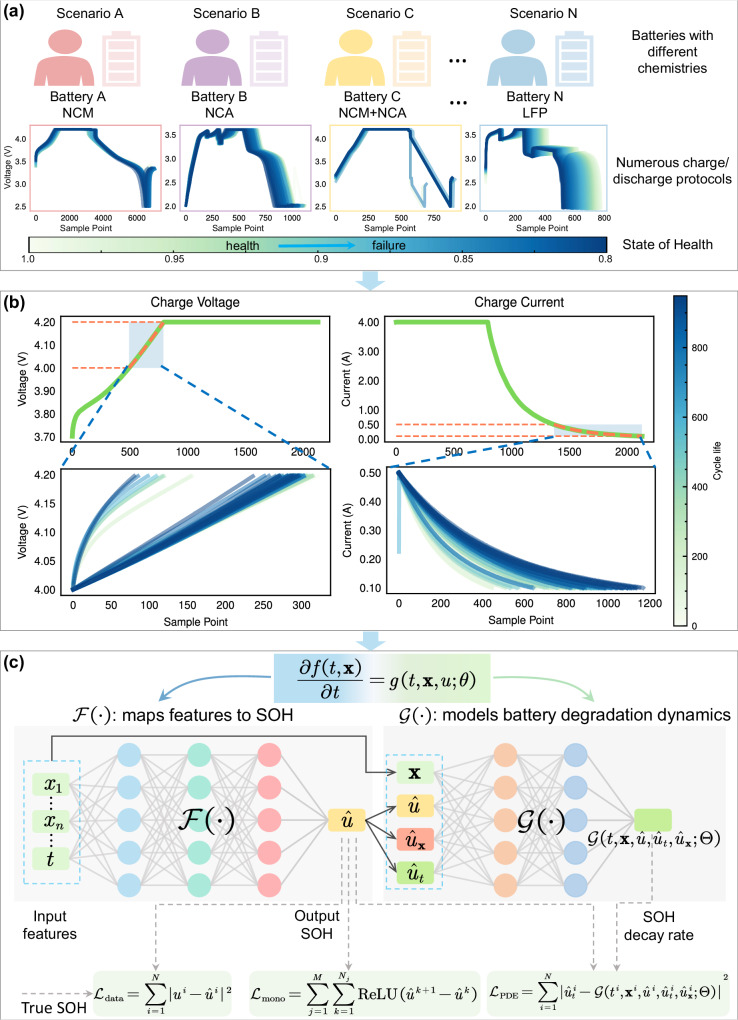
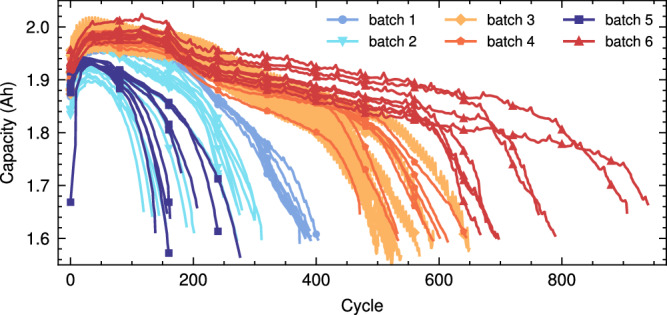
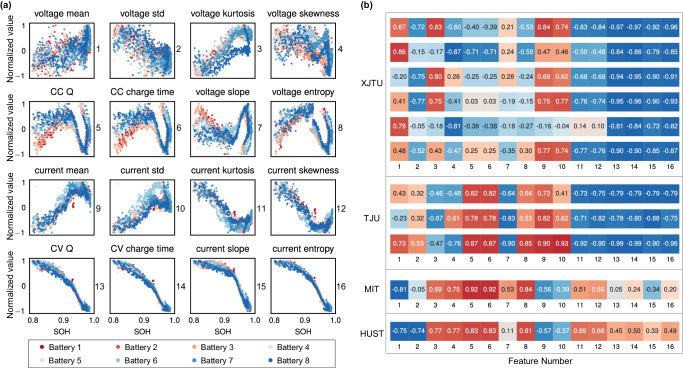
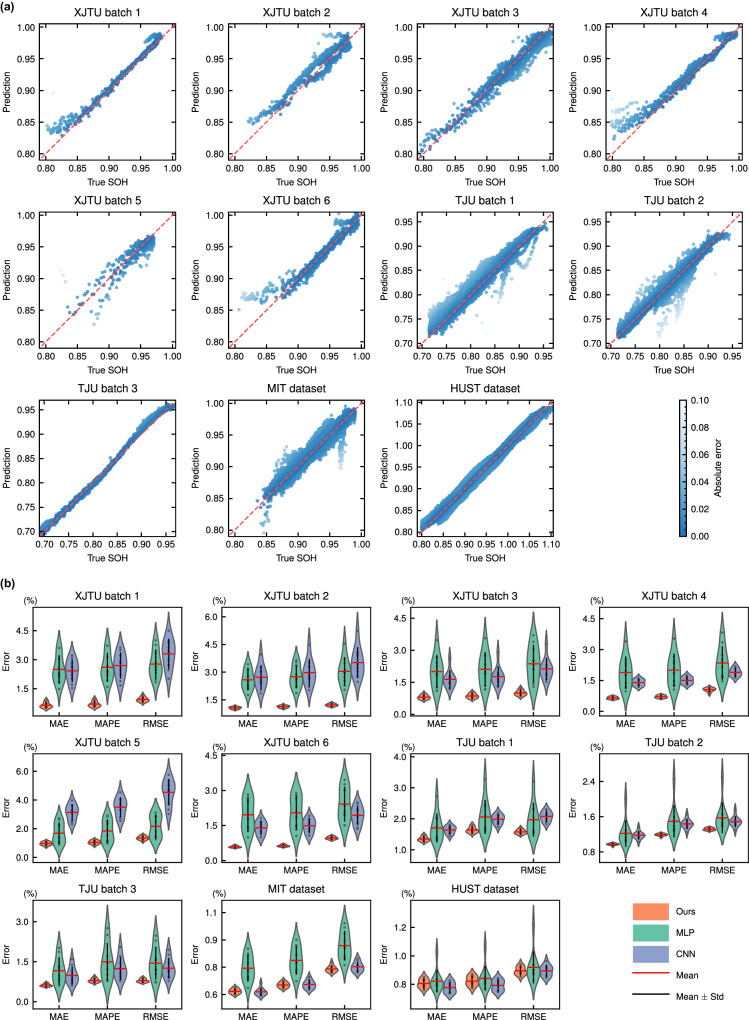
Accurate state-of-health (SOH) estimation is critical for reliable and safe operation of lithium-ion batteries. However, reliable and stable battery SOH estimation remains challenging due to diverse battery types and operating conditions. In this paper, we propose a physics-informed neural network (PINN) for accurate and stable estimation of battery SOH. Specifically, we model the attributes that affect the battery degradation from the perspective of empirical degradation and state space equations, and utilize neural networks to capture battery degradation dynamics. A general feature extraction method is designed to extract statistical features from a short period of data before the battery is fully charged, enabling our method applicable to different battery types and charge/discharge protocols. Additionally, we generate a comprehensive dataset consisting of 55 lithium-nickel-cobalt-manganese-oxide (NCM) batteries. Combined with three other datasets from different manufacturers, we use a total of 387 batteries with 310,705 samples to validate our method. The mean absolute percentage error (MAPE) is 0.87%. Our proposed PINN has demonstrated remarkable performance in regular experiments, small sample experiments, and transfer experiments when compared to alternative neural networks. This study highlights the promise of physics-informed machine learning for battery degradation modeling and SOH estimation.
Overview
The claims and statistics of this paper haven’t been checked yet.
Free: it reads the open-access text and checks the first 5 claims that cite a source we can check. Create a free account to check every claim.
Integrity signals
Registry
Cites
Statistics
Figures
Verification
Claims the paper makes
The claims and statistics of this paper haven’t been checked yet.
Free: it reads the open-access text and checks the first 5 claims that cite a source we can check. Create a free account to check every claim.
Claims other papers make about this one
Each is checked against this paper’s own text: does it say what the citing paper says it does?
The cited source says what the claim attributes to it.
In the citing paper
“Battery aging is a complex, multi-factor process involving the loss of active materials, lithium-ion depletion, increased internal resistance, and changes in the solid electrolyte interphase (SEI) layer [17-23]”
From The State of Health Estimation of Lithium-Ion Batteries: A Review of Health Indicators, Estimation Methods, Development Trends and Challenges (2025) · cites this paper as [17]
Self-check
Percentages, sums and reported differences re-computed from the paper’s own numbers.
The self-check needs the paper’s full text.
Citations
Cites
Raissi, M., Perdikaris, P., & Karniadakis, G. E. (2019) · Journal of Computational Physics · doi:10.1016/j.jcp.2018.10.045 · Cited by 20,384 · cited 2×
“Inspired by 54,55 , we propose to use a more generalized function approximator g 0 ð(cid:2)Þ with parameters θ 0 to represent the non-linear dynamics g ( ⋅ ).”
Physics-informed machine learning
Karniadakis, G. E., Kevrekidis, I. G., Lu, L., Perdikaris, P., Wang, S., & Yang, L. (2021) · Nature Reviews Physics · doi:10.1038/s42254-021-00314-5 · Cited by 8,718 · cited 2×
“The promising prospect of physics-informed neural network (PINN) 36,37 lies in amalgamating the strengths of physics-based and data-driven approaches, potentially addressing the aforementioned challenges.”
Recycling lithium-ion batteries from electric vehicles
Harper, G., Sommerville, R., Kendrick, E., Driscoll, L., Slater, P., Stolkin, R., Walton, A., Christensen, P., Heidrich, O., Lambert, S., et al. (2019) · Nature · doi:10.1038/s41586-019-1682-5 · Cited by 3,890 · cited 1×
“With the advantages of high energy density, low self-discharge rate, and long service life 1 , lithium-ion batteries have become the main energy storage devices in portable electronic devices, electric vehicles, aero-space, and many other fi elds 2 – 8 .”
Performance and cost of materials for lithium-based rechargeable automotive batteries
Schmuch, R., Wagner, R., Hörpel, G., Placke, T., & Winter, M. (2018) · Nature Energy · doi:10.1038/s41560-018-0107-2 · Cited by 3,233 · cited 1×
“With the advantages of high energy density, low self-discharge rate, and long service life 1 , lithium-ion batteries have become the main energy storage devices in portable electronic devices, electric vehicles, aero-space, and many other fi elds 2 – 8 .”
Data-driven prediction of battery cycle life before capacity degradation
Severson, K. A., Attia, P. M., Jin, N., Perkins, N., Jiang, B., Yang, Z., Chen, M. H., Aykol, M., Herring, P. K., Fraggedakis, D., et al. (2019) · Nature Energy · doi:10.1038/s41560-019-0356-8 · Cited by 3,228 · cited 3×
“For convenience, we refer to the four datasets as the XJTU battery dataset, TJU dataset 44 , HUST dataset 45 , and MIT dataset 25 .”
Simulation and Optimization of the Dual Lithium Ion Insertion Cell
Fuller, T. F., Doyle, M., & Newman, J. (1994) · Journal of The Electrochemical Society · doi:10.1149/1.2054684 · Cited by 2,057 · cited 1×
“Physics-based models are stable and accurate, but batteries with different chemical compositions require different model parameters, and the models have high computational costs 32 .”
Closed-loop optimization of fast-charging protocols for batteries with machine learning
Attia, P. M., Grover, A., Jin, N., Severson, K. A., Markov, T. M., Liao, Y.-H., Chen, M. H., Cheong, B., Perkins, N., Yang, Z., et al. (2020) · Nature · doi:10.1038/s41586-020-1994-5 · Cited by 1,180 · cited 1×
“Given the dif fi culty in establishing physical models and the dif fi - culty in obtaining complete discharge capacity, many studies have used data-driven methods 20 – 24 to estimate SOH based on current and voltage curves during charge and discharge.”
A review of rechargeable batteries for portable electronic devices
Liang, Y., Zhao, C., Yuan, H., Chen, Y., Zhang, W., Huang, J., Yu, D., Liu, Y., Titirici, M., Chueh, Y., et al. (2019) · InfoMat · doi:10.1002/inf2.12000 · Cited by 1,174
Modeling of Lithium-Ion Battery Degradation for Cell Life Assessment
Xu, B., Oudalov, A., Ulbig, A., Andersson, G., & Kirschen, D. S. (2018) · IEEE Transactions on Smart Grid · doi:10.1109/tsg.2016.2578950 · Cited by 1,162
Critical review of state of health estimation methods of Li-ion batteries for real applications
Berecibar, M., Gandiaga, I., Villarreal, I., Omar, N., Van Mierlo, J., & Van den Bossche, P. (2016) · Renewable and Sustainable Energy Reviews · doi:10.1016/j.rser.2015.11.042 · Cited by 1,126 · cited 1×
“In recent years, various SOH estimation methods of lithium-ion batterieshavebeenproposed,whichgreatlyadvancethedevelopment of this fi eld 12 – 15 .”
Research works printed but not linked: 1
- Raissi M Deep hidden physics models: deep learning of nonlinear partial differential equations J. Mach. Learn. Res. 2018 19 932 955
Cited by
Domain generalization for rotating machinery fault diagnosis: A survey
Xiao, Y., Shao, H., Yan, S., Wang, J., Peng, Y., & Liu, B. (2025) · Advanced Engineering Informatics · doi:10.1016/j.aei.2024.103063 · Cited by 230
Multi-modal framework for battery state of health evaluation using open-source electric vehicle data
Liu, H., Li, C., Hu, X., Li, J., Zhang, K., Xie, Y., Wu, R., & Song, Z. (2025) · Nature Communications · doi:10.1038/s41467-025-56485-7 · Cited by 209
“Wang et al. 41 proposed a physics-informed neural network for accurate estimation of battery SOH.”
Recent Advances in Machine Learning‐Assisted Multiscale Design of Energy Materials
Mortazavi, B. (2025) · Advanced Energy Materials · doi:10.1002/aenm.202403876 · Cited by 188
State of charge estimation of lithium batteries: Review for equivalent circuit model methods
Tao, Z., Zhao, Z., Wang, C., Huang, L., Jie, H., Li, H., Hao, Q., Zhou, Y., & See, K. Y. (2024) · Measurement · doi:10.1016/j.measurement.2024.115148 · Cited by 177
Self-citationMadani, S. S., Shabeer, Y., Fowler, M. W., Panchal, S., Chaoui, H., Mekhilef, S., Dou, S. X., & See, K. W. (2025) · Batteries · doi:10.3390/batteries11080298 · Cited by 148
Yang, L., He, M.-J., Ren, Y.-T., Gao, B.-H., & Qi, H. (2025) · Applied Energy · doi:10.1016/j.apenergy.2025.126427 · Cited by 131
Lin, C., Wu, L., Tuo, X., Liu, C., Zhang, W., Huang, Z., & Zhang, G. (2025) · Journal of Energy Chemistry · doi:10.1016/j.jechem.2025.01.057 · Cited by 116
Wang, Y., Guo, S., Cui, Y., Deng, L., Zhao, L., Li, J., & Wang, Z. (2025) · Renewable and Sustainable Energy Reviews · doi:10.1016/j.rser.2025.116125 · Cited by 107
Developing safe and high-performance lithium-ion batteries: Strategies and approaches
Chen, G., Tan, R., Zeng, C., Li, Y., Zou, Z., Wang, H., Ouyang, C., Wan, J., & Yang, J. (2025) · Progress in Materials Science · doi:10.1016/j.pmatsci.2025.101516 · Cited by 117
From Mining to Manufacturing: Scientific Challenges and Opportunities behind Battery Production
Xiao, J., Cao, X., Gridley, B., Golden, W., Ji, Y., Johnson, S., Lu, D., Lin, F., Liu, J., Liu, Y., et al. (2025) · Chemical Reviews · doi:10.1021/acs.chemrev.4c00980 · Cited by 106
Lin, C., Xu, J., Jiang, D., Hou, J., Liang, Y., Zou, Z., & Mei, X. (2024) · Journal of Energy Chemistry · doi:10.1016/j.jechem.2024.09.021 · Cited by 103
Wang, S., Zhou, R., Ren, Y., Jiao, M., Liu, H., & Lian, C. (2024) · Green Chemical Engineering · doi:10.1016/j.gce.2024.09.001 · Cited by 93
Kumar, R. S., Singh, A. R., Narayana, P. A., Chandrika, V. S., Bajaj, M., & ЗАЙЦЕВ, Є. О. (2025) · Scientific Reports · doi:10.1038/s41598-025-90810-w · Cited by 85
“4, 5, 6, 7, 8 and 9 jointly illustrate the advancement and efficacy of several models in assessing the State of Charge (SOC) and State of Health (SOH) of lithium-ion batteries.”
Zerrougui, I., Li, Z., & Hissel, D. (2025) · Energy and AI · doi:10.1016/j.egyai.2025.100474 · Cited by 82
Sun, G., Liu, Y., & Liu, X. (2024) · Journal of Power Sources · doi:10.1016/j.jpowsour.2024.235767 · Cited by 81
RetractedEarly warning of thermal runaway based on state of safety for lithium-ion batteries
Gu, X., Shang, Y., Li, J., Zhu, Y., Tao, X., Geng, H., Zhang, Z., & Zhang, C. (2025) · Communications Engineering · doi:10.1038/s44172-025-00442-1 · Cited by 88
“Lithium-ion batteries have become the dominant energy storage solution for electric vehicles owing to their superior energy densityandlongcyclelife 3 – 5 .”
Yu, H., Zhang, H., Zhang, Z., & Yang, S. (2025) · eTransportation · doi:10.1016/j.etran.2025.100420 · Cited by 86
Rongli, S., Chen, J., Li, B., & Piao, C. (2025) · Energy · doi:10.1016/j.energy.2025.134756 · Cited by 86
Moradian, J. M., Ali, A., Yan, X., Pei, G., Zhang, S., Naveed, A., Shehzad, K., Shahnavaz, Z., Ahmad, F., & Yousaf, B. (2025) · Nano-Micro Letters · doi:10.1007/s40820-025-01786-1 · Cited by 90
Tian, A., He, L., Ding, T., Dong, K., Wang, Y., & Jiang, J. (2025) · Energy · doi:10.1016/j.energy.2025.137215 · Cited by 75
Chen, L., Tao, S., Huang, X., Wang, Y., Xia, B., & Zhang, X. (2025) · Journal of Energy Chemistry · doi:10.1016/j.jechem.2025.02.030 · Cited by 79
Bayesian calibrated physics-informed neural networks for second-life battery SOH estimation
Zhu, R., Hu, J., & Peng, W. (2025) · Reliability Engineering & System Safety · doi:10.1016/j.ress.2025.111432 · Cited by 71
Tang, K., Luo, B., Chen, D., Wang, C., Chen, L., Li, F., Cao, Y., & Wang, C. (2025) · World Electric Vehicle Journal · doi:10.3390/wevj16080429 · Cited by 68
Huang, R., Chen, Y., & Liu, C. (2025) · IEEE Transactions on Consumer Electronics · doi:10.1109/tce.2025.3631954 · Cited by 71
“The experiments are conducted on the lithium-ion battery dataset recently published by Xi’an Jiaotong University [40], denoted as XJTU Dataset .”
Sun, D., Guo, D., Lu, Y., Chen, J., Lu, Y., Han, X., Feng, X., Lu, L., Wang, H., & Ouyang, M. (2024) · Energy & Environmental Science · doi:10.1039/d4ee03063j · Cited by 65
Tao, J., Wang, S., Cao, W., Fernández, C., & Blaabjerg, F. (2024) · Batteries · doi:10.3390/batteries10120442 · Cited by 73
Du, Z., & Lu, R. (2025) · Batteries · doi:10.3390/batteries11060204 · Cited by 58
“Uses for PINNs include state estimation [91], degradation [92,93], and aging estimation [93], thus proving the interest and potential of PINNs in battery systems.”
Hou, J., Jiang, Y., Liu, J., Li, P., Xiang, S., Chen, L., & Deng, Z. (2025) · IEEE Transactions on Power Electronics · doi:10.1109/tpel.2025.3588296 · Cited by 57
“The data for the third battery comes from the publicly available dataset released by Xi’an Jiaotong University [41].”
Luo, Y., Ju, S., Li, P., & Zhang, H. (2025) · Electrochimica Acta · doi:10.1016/j.electacta.2025.146110 · Cited by 59
Wang, F., Wu, Z., Zhao, Z., Zhai, Z., Wang, C., & Chen, X. (2024) · Reliability Engineering & System Safety · doi:10.1016/j.ress.2024.110325 · Cited by 55
Self-citationShu, X., Shen, J., Guo, F., Liu, Y., Zhang, Y., Chen, Z., & Zhao, H. (2025) · eTransportation · doi:10.1016/j.etran.2025.100509 · Cited by 70
Jarraya, I., Atitallah, S. B., Alahmed, F., Abdelkader, M., Driss, M., Abdelhadi, F., & Koubâa, A. (2025) · Journal of Energy Storage · doi:10.1016/j.est.2025.116541 · Cited by 62
“Moreover, Wang et al. (2024) [32] introduced Physics-Informed Neural Networks (PINN), which combine empirical degradation models and state-space equations for the estimation of SOH.”
Dineva, A. (2024) · Batteries · doi:10.3390/batteries10100356 · Cited by 52
“Notably, physics-informed Neural Networks (PINNs) have been proposed to combine empirical degradation models with Neural Networks for improved SOH estimation [38].”
Xiong, R., He, Y., Sun, Y., Jia, Y., & Shen, W. (2025) · Journal of Energy Chemistry · doi:10.1016/j.jechem.2025.01.019 · Cited by 52
RUL-Mamba: Mamba-based remaining useful life prediction for lithium-ion batteries
Huang, J., Liu, L., Zhao, H., Li, T., & Li, B. (2025) · Journal of Energy Storage · doi:10.1016/j.est.2025.116376 · Cited by 60
Kim, K. S. (2025) · Advanced Energy Materials · doi:10.1002/aenm.202503356 · Cited by 62
Wang, L., Qiu, Y., Yuan, W., Tian, Y., & Zhou, Z. (2025) · Journal of Energy Chemistry · doi:10.1016/j.jechem.2025.05.065 · Cited by 54
Li, P., Ao, Z., Hou, J., Xiang, S., & Wang, Z. (2025) · Journal of Energy Storage · doi:10.1016/j.est.2025.116546 · Cited by 62
A review of battery failure: classification, mechanisms, analysis, and management
Jia, X., Zhu, J., Knapp, M., Wang, X., Yu, C., Xu, W., Wu, H., Ehrenberg, H., Wei, X., & Dai, H. (2025) · Renewable and Sustainable Energy Reviews · doi:10.1016/j.rser.2025.116126 · Cited by 58
Lin, M., Hu, D., Meng, J., & Wu, J. (2025) · IEEE Transactions on Transportation Electrification · doi:10.1109/tte.2025.3533540 · Cited by 49
“Wang et al. [26] extracted statistical features from short-term data before the battery was fully charged, modeled the battery’s degradation dynamics using PDEs, and employed a neural network to capture the degradation dynamics.”
Liu, Y., Lai, X., Zheng, Y., Cheng, E., Zhu, J., & Qian, L. (2025) · Journal of Energy Storage · doi:10.1016/j.est.2025.116670 · Cited by 63
Garakani, S. S., & Chew, J. W. (2025) · Journal of Membrane Science · doi:10.1016/j.memsci.2025.124133 · Cited by 47
Amin, A. A., Mubarak, A., & Waseem, S. (2025) · Measurement · doi:10.1016/j.measurement.2025.116728 · Cited by 45
Ding, S., Wang, L., Dai, H., & He, X. (2024) · Energy storage materials · doi:10.1016/j.ensm.2024.103998 · Cited by 43
Kong, L., Luo, Y., Fang, S., Niu, T., Chen, G., Yang, L., & Liao, R. (2025) · Journal of Energy Storage · doi:10.1016/j.est.2025.116827 · Cited by 45
Chen, H., Chen, Y., Sun, C., Huo, L., Zhang, W., Shen, P., Huang, L., Luan, W., & Chen, H. (2025) · Journal of Energy Chemistry · doi:10.1016/j.jechem.2025.07.022 · Cited by 46
Sun, Y., Xie, H., Diao, Q., Xu, H., Tan, X., Fan, Y., & Wei, L. (2024) · IEEE Transactions on Instrumentation and Measurement · doi:10.1109/tim.2024.3476593 · Cited by 57
“Wang et al. [16] integrated model-based and data-driven methods to propose a PINN, which models the attributes influencing battery degradation and leverages neural networks to capture the dynamics of battery degradation.”
MethodZhang, S., Liu, Z., Xu, Y. H., Chen, G., & Su, H. (2025) · IEEE Transactions on Power Electronics · doi:10.1109/tpel.2025.3532588 · Cited by 48
“[22]establishedaPINNthatintegrates batteryempiricalagingandstate-spaceequationsforSOHesti-mation.”
Zhang, W., Zhang, H., & Bi, Z. (2025) · Journal of Energy Storage · doi:10.1016/j.est.2025.119549 · Cited by 42
Yu, Q., Wang, F., Zhai, Z., Zheng, S., Liu, B., Zhao, Z., & Chen, X. (2025) · Journal of Energy Storage · doi:10.1016/j.est.2025.116024 · Cited by 45
Self-citationBatteryLife: A Comprehensive Dataset and Benchmark for Battery Life Prediction
Tan, R., Hong, W., Tang, J., Lu, X., Ma, R., Zheng, X., Li, J., Huang, J., & Zhang, T. (2025) · ACM SIGKDD Conference on Knowledge Discovery and Data Mining (KDD) · doi:10.1145/3711896.3737372 · Cited by 61
“Let represent the voltage, current and capacity variables across 𝑇 time steps starting from the 𝑖 cycle to the 𝑁 cycle, where X ∈ R 3 × 𝑇 𝑖 is the cycling data of the 𝑖 cycle with 𝑇 𝑖 time steps.”
Lv, Z., & Zhao, J. (2024) · eTransportation · doi:10.1016/j.etran.2024.100383 · Cited by 42
Physics-informed battery degradation prediction: Forecasting charging curves using one-cycle data
Tang, A., Xu, Y., Tian, J., Shu, X., & Yu, Q. (2024) · Journal of Energy Chemistry · doi:10.1016/j.jechem.2024.10.018 · Cited by 39
Tang, A., Xu, Y., Liu, P., Tian, J., Wu, Z., Hu, Y., & Yu, Q. (2024) · eTransportation · doi:10.1016/j.etran.2024.100378 · Cited by 38
Wang, S., Zhou, R., Ren, Y., Liu, H., Lin, Y., & Lian, C. (2025) · Journal of Energy Chemistry · doi:10.1016/j.jechem.2025.08.093 · Cited by 44
AI‐Driven Big Data Frameworks for Electrode–Electrolyte Interphases in Batteries
Faheem, A. B., Han, Z., Wu, D., & Li, H. (2026) · Advanced Materials · doi:10.1002/adma.202521975 · Cited by 41
Physics-Based and Data-Driven Modeling of Degradation Mechanisms for Lithium-Ion Batteries—A Review
Ruiz, P. L., Damianakis, N., & Mouli, G. R. C. (2025) · IEEE Access · doi:10.1109/access.2025.3535918 · Cited by 48
Xian, Y., Li, C., Xu, Y., Zhou, Y., & Xue, D. (2025) · SusMat · doi:10.1002/sus2.70030 · Cited by 40
“[253] (Figure 9A).”
A physics-guided approach for accurate battery SOH estimation using RCMHCRE and BatteryPINN
Liu, Y., Chen, H., Yao, L., Ding, J., Chen, S., & Wang, Z. (2025) · Advanced Engineering Informatics · doi:10.1016/j.aei.2025.103211 · Cited by 41
Deciphering failure paths in lithium metal anodes by electrochemical curve fingerprints
Piao, Z., Han, Z., Tao, S., Zhang, M., Lu, G., Su, L., Wu, X., Song, Y., Xiao, X., Zhang, X., et al. (2025) · National Science Review · doi:10.1093/nsr/nwaf158 · Cited by 36
“Electrochemical curves reflect the dynamic electrochemical process, providing a more complete representation of the process than static characterization methods [26 ,27 ], while this valuable resource has often been overlooked.”
Beyond diagnosis: Why current fault diagnosis methods for power batteries fall short
Lin, N., Chen, K., Zhang, Z., Chen, S., & Wang, Z. (2025) · Journal of Energy Storage · doi:10.1016/j.est.2025.117225 · Cited by 44
Review on improved neural network algorithms for battery state of energy estimation in smart grids
Wang, S., Fu, Y., Zhang, W., Fernández, C., & Blaabjerg, F. (2026) · Renewable and Sustainable Energy Reviews · doi:10.1016/j.rser.2026.116797 · Cited by 43
Deng, Y., Du, C., & Ren, Z. (2025) · Batteries · doi:10.3390/batteries11020049 · Cited by 32
“For example, Wang et al. [20] extracted health factors solely from charging curves and utilized PINNs to model battery degradation attributes from the perspectives of empirical degradation and state-space equations.”
AI-augmented electrochemical model for lithium-ion battery: Recent advances and perspectives
Fu, J., Song, Z., Meng, J., Guo, J., Yang, K., Liu, W., & Huan, L. (2025) · Journal of Energy Chemistry · doi:10.1016/j.jechem.2025.10.008 · Cited by 37
Diagnostic-free onboard battery health assessment
Che, Y., Lam, V., Rhyu, J., Schaeffer, J., Kim, M., Bazant, M. Z., Chueh, W. C., & Braatz, R. D. (2025) · Joule · doi:10.1016/j.joule.2025.102010 · Cited by 38
Jing, H., Hu, J., Ou, S. (., Lv, Z., Lyu, R., & Zhao, J. (2025) · Journal of Energy Chemistry · doi:10.1016/j.jechem.2025.07.020 · Cited by 29
Wang, F., Zhai, Z., Di, Y., Zhao, Z., & Chen, X. (2025) · IEEE Transactions on Industrial Electronics · doi:10.1109/tie.2025.3546350 · Cited by 37
“Specifically, building upon our previous study [11], we established battery degradation properties from an empirical degradation and state-space perspective and employed neural networks to capture the degradation dynamics of the battery.”
Self-citationGuo, F., Xu, K., Zhang, Z., Zhou, H., Chen, G., Hu, J., Zhang, J., & Mo, H. (2025) · IEEE Open Journal of the Computer Society · doi:10.1109/ojcs.2025.3625209 · Cited by 36
“Additionally, Wang et al. [18] proposed a physics-informed neural network (PINN) framework, achieving stable modeling and high-precision prediction of battery SOH, and verified its transferability [19] and generalizability across various battery chemistries and operating conditions.”
Li, X., Zhao, M., Zhong, S., Li, J., Fu, S., & Yan, Z. (2024) · Energy · doi:10.1016/j.energy.2024.134030 · Cited by 33
Fu, S., Fan, H., Jin, Z., Ji, F., Tao, Y., Dong, Y., Chen, X. T., Shao, M., Yuan, S., Wang, Y., et al. (2025) · Renewable and Sustainable Energy Reviews · doi:10.1016/j.rser.2025.116323 · Cited by 38
Self-citationInterpretable Machine Learning for Battery Prognosis: Retrospect and Prospect
Wang, T., Liu, K., Peng, H., & Liu, X. (2025) · Advanced Energy Materials · doi:10.1002/aenm.202503067 · Cited by 31
Cross-domain battery SOH and RUL estimation via Domain-Adaptive Transformer
Zhu, B., Jia, L., Pan, Q.-K., & Zhang, H. (2025) · Energy · doi:10.1016/j.energy.2025.139288 · Cited by 34
Toward AI ecosystems for electrolyte and interface engineering in solid-state batteries
Wang, Z., Zeier, W. G., & You, F. (2025) · Science Advances · doi:10.1126/sciadv.aea0638 · Cited by 29
“To address this challenge, physics-informed neural networks directly incorporate embed physical constraints or prior knowledge ( 178 , 179 ), notably the Butler-Volmer electrochemical kinetics and mass conservation laws ( 180 ), into the neural architecture’s loss function, enabling…”
Wang, Y., Yu, Y., Sun, K., Lei, P., Zhang, Y., Zio, E., Xia, A., & Li, Y. (2025) · IEEE Internet of Things Journal · doi:10.1109/jiot.2025.3580823 · Cited by 31
“Prognostics and health management (PHM) encompasses a range of methodologies aimed at assessing and predicting the present and future health status of equipment [8], [9].”
Physics-informed hybrid reinforcement learning for estimating lithium-ion battery state of health
Salem, N. M., & Mohamed, A. (2025) · Scientific Reports · doi:10.1038/s41598-025-30602-4 · Cited by 27
“Wang et al. 16 employed a Physics-Informed Neural Network (PINN) framework for robust SOH estimation across various battery chemistries.”
Battery lifetime prediction using surface temperature features from early cycle data
Sugiarto, L., Huang, Z., & Lu, Y. (2025) · Energy & Environmental Science · doi:10.1039/d4ee05179c · Cited by 27
Gao, K., Li, Q., Hu, L., Huang, J., Li, H., & Wu, Y. (2025) · Energy · doi:10.1016/j.energy.2025.139753 · Cited by 39
Large language models enable semantic-guided hierarchical games for intelligent battery coordination
Zou, Y., Lin, Z., Zhang, Q., Liu, Z., & Xu, Z. (2026) · Advanced Engineering Informatics · doi:10.1016/j.aei.2026.104312 · Cited by 26
Hou, G., Zhang, F., Huang, C., & Huang, T. (2025) · Energy · doi:10.1016/j.energy.2025.138435 · Cited by 32
Huang, X., Tao, S., Liang, C., Tang, Y., Chen, J., Shi, J., Li, Y., Xia, B., Zhou, G., & Zhang, X. (2026) · Nature Communications · doi:10.1038/s41467-026-69369-1 · Cited by 39
“Meanwhile, purely data-driven methods struggle to capture internal physical information of retired batteries 36 .”
Artificial intelligence for battery reuse, recycling and remanufacturing
Tao, S., Moura, S. J., Brandell, D., Han, Z., Urréhman, S., Zou, C., Zhang, X. B., & Zhou, G. (2026) · Nature Reviews Clean Technology · doi:10.1038/s44359-026-00167-0 · Cited by 31
“Moreover, incorporating degradation mechanism-related features such as loss of lithium inventory 103 , solid electrolyte interphase growth 171 and capacity degradation monocity 172 into the loss functions can help AI models to learn interpretable degradation patterns.”
Wang, X., Yi, Y., Yuan, Y., & Li, X. (2025) · Energy · doi:10.1016/j.energy.2025.134722 · Cited by 24
Wang, L., Yang, T., & Hu, B. (2025) · IEEE Sensors Journal · doi:10.1109/jsen.2025.3549486 · Cited by 26
“(XGBoost), as well as deep learning models such as fully connected neural networks (FCNNs), hybrid deep neural networks (HDNNs) [14], PINN [16], and an integrated approach combining particle swarm optimization with CNNs and LSTM (PSO-CNN-LSTM) networks [31].”
Duan, C., Le, H., & Wu, D. (2025) · Journal of Energy Storage · doi:10.1016/j.est.2025.117601 · Cited by 27
Zhou, Y., Wang, C., Gu, T., Jie, H., Tao, Z., Gao, R. X., See, K. Y., & Zhao, Z. (2025) · Journal of Energy Storage · doi:10.1016/j.est.2025.119451 · Cited by 26
Self-citationZhang, Z., Zhu, Y., Zhang, Q., Cui, N., & Shang, Y. (2024) · Energy · doi:10.1016/j.energy.2024.133993 · Cited by 24
Liu, Y., Ding, J., Cai, Y., Luo, B., Yao, L., & Wang, Z. (2024) · Journal of Energy Storage · doi:10.1016/j.est.2024.114822 · Cited by 31
Wang, C., Bao, Z., Lin, H., He, Z., & Gao, M. (2025) · IEEE Transactions on Transportation Electrification · doi:10.1109/tte.2025.3534146 · Cited by 31
“Wang et al. [19] proposed a PINN for accurate and stable estimation of battery SOH, modeling the attributes that affect the battery degradation from the perspective of empirical degradation and state-space equations.”
Hu, Z., Wu, Z., Wang, X., Song, J., & Lu, S. (2026) · Journal of Energy Storage · doi:10.1016/j.est.2026.120587 · Cited by 23
Li, X., Zhao, M., Zhong, S., Li, J., Cui, Z., Fu, S., & Yan, Z. (2025) · Journal of Power Sources · doi:10.1016/j.jpowsour.2025.237503 · Cited by 24
Ezugwu, E. O., Bhattacharya, I., Ayomide, A. I., Dhason, M. V. A., Soyoye, B., & Banik, T. (2025) · World Electric Vehicle Journal · doi:10.3390/wevj16100573 · Cited by 30
Li, C., Feng, P., Meng, J., Catani, F., Hellevang, H., Tang, H., Sun, X., & Huang, D. (2025) · Geophysical Research Letters · doi:10.1029/2025gl117356 · Cited by 22
Fink, O., Nejjar, I., Sharma, V., Niresi, K. F., Sun, H., Dong, H., Xu, C., Wei, A., Bizzi, A. A. C., Theiler, R., et al. (2026) · Reliability Engineering & System Safety · doi:10.1016/j.ress.2026.112376 · Cited by 26
Zhu, W., Xu, B., Guo, B., Xie, C., & Xiong, R. (2026) · eTransportation · doi:10.1016/j.etran.2026.100615 · Cited by 21
Cao, H. Y., Yu, J., & Duan, F. (2025) · Machines · doi:10.3390/machines13080714 · Cited by 20
Borja‐Jaimes, V., Martínez, J. S. V., Beltrán-Escobar, M., Rojas, A. C., Gil-Velasco, A., & Coronel-Escamilla, A. (2025) · Mathematics · doi:10.3390/math13182920 · Cited by 20
Mechanistically guided residual learning for battery state monitoring throughout life
Che, Y., Zheng, Y., Rhyu, J., Guo, J., Wang, S., Teodorescu, R., & Braatz, R. D. (2026) · Nature Communications · doi:10.1038/s41467-025-67565-z · Cited by 26
“Additionally, physics-informed neuralnetworkmodelshave shown the potential to enhance physical interpretability and reduce data requirements in battery modeling 26,27 .”
Guo, C., Shang, Z., Ren, J., Zhao, Z., Ding, B., Wang, S., & Chen, X. (2024) · Reliability Engineering & System Safety · doi:10.1016/j.ress.2024.110381 · Cited by 22
Self-citationYang, Y., Yang, J., Wu, X., Fu, L., Gao, X., Xie, X., & Ouyang, Q. (2025) · Journal of Energy Chemistry · doi:10.1016/j.jechem.2025.02.058 · Cited by 21
Huang, X., Tao, S., Liang, C., Ma, R., Wang, X., Xia, B., & Zhang, X. (2025) · Journal of Power Sources · doi:10.1016/j.jpowsour.2025.236939 · Cited by 22
Metadata
- Authors
- Wang, F., Zhai, Z., Zhao, Z., Di, Y., & Chen, X.
- Affiliations
- Xi'an Jiaotong University (CN)
- Corresponding author
- Zhao, Zhibin
- Chen, Xuefeng
- Venue
- Nature Communications
- Published
- 2024-05-21
- Volume
- 15
- Issue
- 1
- Pages
- 4332-4332
- ISSN
- 2041-1723 (ISSN-L)
- PMC
- PMC11109204
- OpenAlex
- W4398164319
- Cited by
- 897
- References
- 56
- Citations by year
- 2026: 532 · 2025: 322 · 2024: 43
- FWCI
- 96.71
- Type
- journal article
- Language
- en
- Open access
- gold
- doi.org
- Licence
- cc-by
- creativecommons.org/licenses/by/4.0 (tdm)
- creativecommons.org/licenses/by/4.0 (vor)
- Locations
- Nature Communications (publishedVersion, cc-by)
- PubMed Central (publishedVersion, cc-by)
- PubMed (publishedVersion)
- RePEc: Research Papers in Economics (submittedVersion)
- DOAJ (DOAJ: Directory of Open Access Journals) (submittedVersion, cc-by-sa)
- Funders
- Fundamental Research Funds for the Central Universities
- National Natural Science Foundation of China (52105113, U22B2013)
- China Postdoctoral Science Foundation (2021M692557, 2021TQ0263)
- Topics
- Physical Sciences › Engineering › Automotive Engineering › Battery Modeling and Management
- Physical Sciences › Engineering › Electrical and Electronic Engineering › Advancements in Battery Materials
- Physical Sciences › Engineering › Civil and Structural Engineering › Structural Health Monitoring Techniques
- Keywords
- lithium-ion batteries, state of health estimation, battery degradation modeling, physics-informed neural networks, NCM batteries, statistical feature extraction, transfer learning, small sample learning, battery datasets
About these checks
Registry, retraction, Cites and statistics results are computed, not judged, with one exception: a printed reference that no index lists is read once by a model before it counts as a citation error. Claims are extracted by a model and kept only when their quote appears verbatim in the text; each cited source is then checked, with a model’s help, for whether it says what the claim relies on. Those verdicts can be wrong — read the claim’s quote and the cited source before relying on one.
Statistics and arithmetic are recomputed, not judged.
Confidence bands are shown only for fields calibrated on our annotated test set. None is calibrated yet, so no band is shown.
What counts as a claim ›How we measure confidence ›How we check this ›
Are you an author, or do you see a problem with this page? Request a review
Data sources
Bibliographic data: Semantic Scholar, OpenAlex, Crossref.
Contains information from the Semantic Scholar Academic Graph Datasets, made available under the ODC Attribution License (ODC-BY 1.0).
Semantic Scholar’s data is described in: Kinney, R., et al. (2023). The Semantic Scholar Open Data Platform. arXiv:2301.10140.
