

Structural basis for differential inhibition of eukaryotic ribosomes by tigecycline
Open accessThe DOI matches its Crossref record; 53 of the 53 references it cites were found in a registry or an index.
Abstract
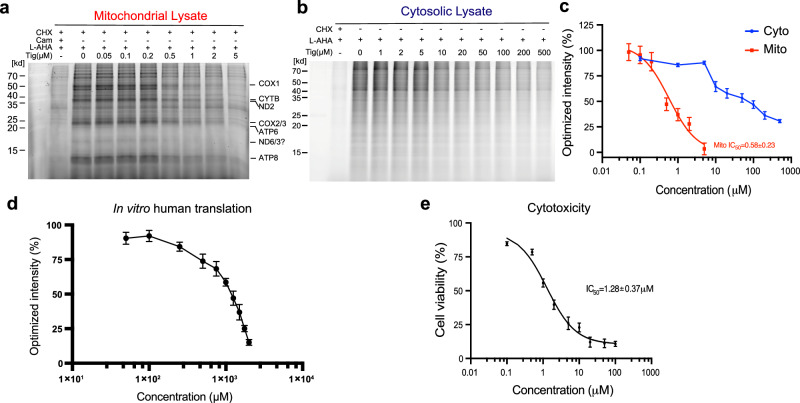
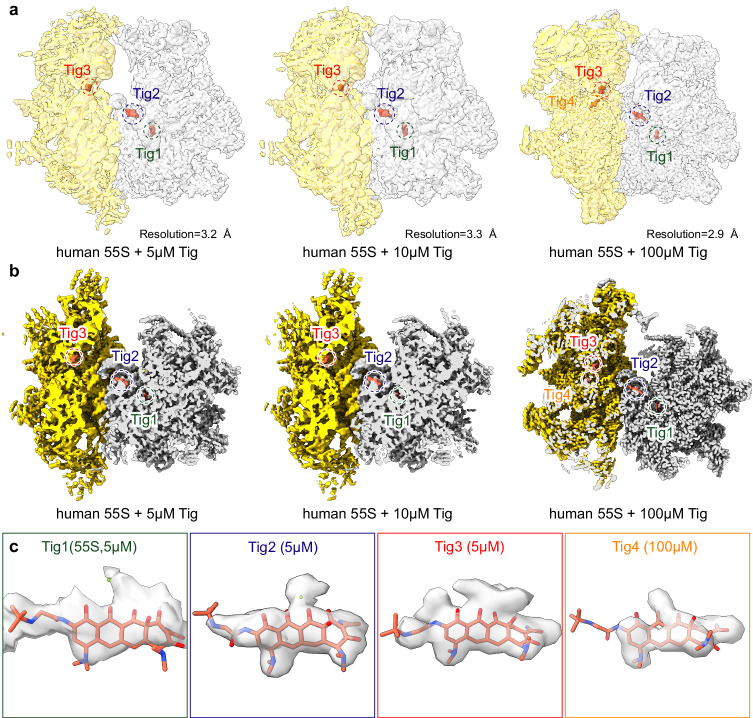
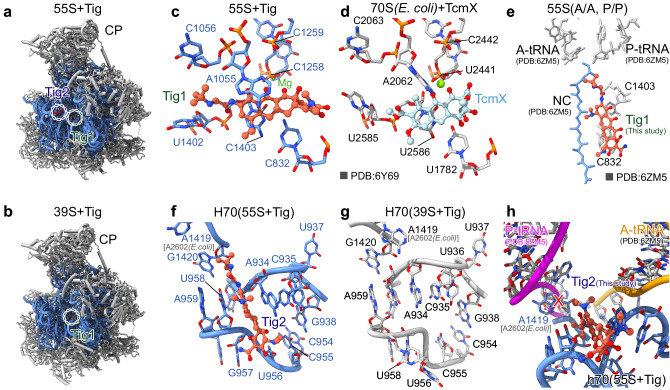
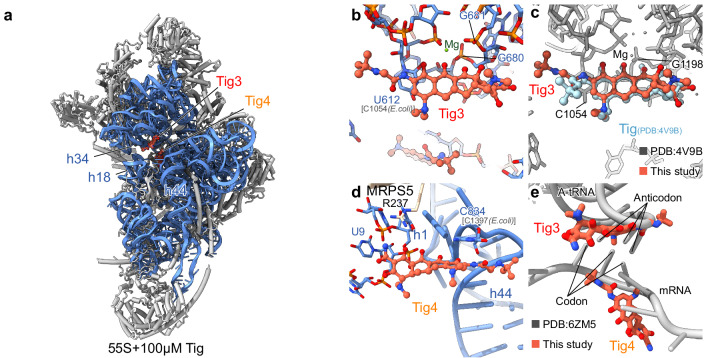
Tigecycline is widely used for treating complicated bacterial infections for which there are no effective drugs. It inhibits bacterial protein translation by blocking the ribosomal A-site. However, even though it is also cytotoxic for human cells, the molecular mechanism of its inhibition remains unclear. Here, we present cryo-EM structures of tigecycline-bound human mitochondrial 55S, 39S, cytoplasmic 80S and yeast cytoplasmic 80S ribosomes. We find that at clinically relevant concentrations, tigecycline effectively targets human 55S mitoribosomes, potentially, by hindering A-site tRNA accommodation and by blocking the peptidyl transfer center. In contrast, tigecycline does not bind to human 80S ribosomes under physiological concentrations. However, at high tigecycline concentrations, in addition to blocking the A-site, both human and yeast 80S ribosomes bind tigecycline at another conserved binding site restricting the movement of the L1 stalk. In conclusion, the observed distinct binding properties of tigecycline may guide new pathways for drug design and therapy.
Overview
The claims and statistics of this paper haven’t been checked yet.
Free: it reads the open-access text and checks the first 5 claims that cite a source we can check. Create a free account to check every claim.
Integrity signals
Registry
Cites
Statistics
Figures
Verification
Claims the paper makes
The claims and statistics of this paper haven’t been checked yet.
Free: it reads the open-access text and checks the first 5 claims that cite a source we can check. Create a free account to check every claim.
Claims other papers make about this one
Each is checked against this paper’s own text: does it say what the citing paper says it does?
The cited source says what the claim attributes to it.
In the citing paper
“Apart from bacterial ribosomes, a C:C non-canonical base pair is also found in the exact same location in the human 55S mitochondrial ribosome, and recent studies demonstrated that Tigecycline, a third-generation tetracycline, can bind at this site and potently inhibit mito-ribosomal protein translation31,32.”
From Dual site targeting of the bacterial 70S ribosome by tetracyclines (2026) · cites this paper as [31]
Self-check
Percentages, sums and reported differences re-computed from the paper’s own numbers.
The self-check needs the paper’s full text.
Citations
Cites
NIH Image to ImageJ: 25 years of image analysis
Schneider, C. A., Rasband, W. S., & Eliceiri, K. W. (2012) · Nature Methods · doi:10.1038/nmeth.2089 · Cited by 64,638
Coot : model-building tools for molecular graphics
Emsley, P., & Cowtan, K. (2004) · Acta Crystallographica Section D Biological Crystallography · doi:10.1107/s0907444904019158 · Cited by 30,571
PHENIX : a comprehensive Python-based system for macromolecular structure solution
Adams, P. D., Afonine, P. V., Bunkóczi, G., Chen, V. B., Davis, I. W., Echols, N., Headd, J. J., Hung, L.-W., Kapral, G. J., Grosse-Kunstleve, R. W., et al. (2010) · Acta Crystallographica Section D Biological Crystallography · doi:10.1107/s0907444909052925 · Cited by 23,716
MolProbity : all-atom structure validation for macromolecular crystallography
Chen, V. B., Arendall, W. B., Headd, J. J., Keedy, D. A., Immormino, R. M., Kapral, G. J., Murray, L. W., Richardson, J. S., & Richardson, D. C. (2010) · Acta Crystallographica Section D Biological Crystallography · doi:10.1107/s0907444909042073 · Cited by 14,115
cryoSPARC: algorithms for rapid unsupervised cryo-EM structure determination
Punjani, A., Rubinstein, J. L., Fleet, D. J., & Brubaker, M. A. (2017) · Nature Methods · doi:10.1038/nmeth.4169 · Cited by 11,626
MotionCor2: anisotropic correction of beam-induced motion for improved cryo-electron microscopy
Zheng, S. Q., Palovcak, E., Armache, J.-P., Verba, K. A., Cheng, Y., & Agard, D. A. (2017) · Nature Methods · doi:10.1038/nmeth.4193 · Cited by 7,777
UCSF ChimeraX: Meeting modern challenges in visualization and analysis
Goddard, T. D., Huang, C. C., Meng, E. C., Pettersen, E. F., Couch, G. S., Morris, J. H., & Ferrin, T. E. (2018) · Protein Science · doi:10.1002/pro.3235 · Cited by 5,267
CTFFIND4: Fast and accurate defocus estimation from electron micrographs
Rohou, A., & Grigorieff, N. (2015) · Journal of Structural Biology · doi:10.1016/j.jsb.2015.08.008 · Cited by 4,913
New tools for automated high-resolution cryo-EM structure determination in RELION-3
Zivanov, J., Nakane, T., Forsberg, B. O., Kimanius, D., Hagen, W. J., Lindahl, E., & Scheres, S. H. (2018) · eLife · doi:10.7554/elife.42166 · Cited by 4,621
Gctf: Real-time CTF determination and correction
Zhang, K. (2016) · Journal of Structural Biology · doi:10.1016/j.jsb.2015.11.003 · Cited by 3,537
Cited by
T cell toxicity induced by tigecycline binding to the mitochondrial ribosome
Shao, Q., Khawaja, A., Nguyen, M. D., Singh, V., Zhang, J., Liu, Y., Nordin, J., Adori, M., Axel Innis, C., Castro Dopico, X., et al. (2025) · Nature Communications · doi:10.1038/s41467-025-59388-9 · Cited by 16
“Together, these data provide a molecular mechanism to explain part of the anti-in fl ammatory effects of tetracyclines, informing antibiotic and OXPHOS inhibitor design 52 .”
Tang, H., Liu, Z., Hu, B., & Zhu, L. (2025) · Journal of Hazardous Materials · doi:10.1016/j.jhazmat.2025.138399 · Cited by 15
Mitochondrial ribosomal proteins: potential targets for cancer prognosis and therapy
Zhu, J., Wen, N., Chen, W., & Yu, H. (2025) · Frontiers in Oncology · doi:10.3389/fonc.2025.1586137 · Cited by 21
Doxycycline: An essential tool for Alzheimer’s disease
Forloni, G. (2025) · Biomedicine & Pharmacotherapy · doi:10.1016/j.biopha.2025.118159 · Cited by 12
Mechanisms and disease relevance of mitochondrial translation in humans
Richter‐Dennerlein, R., Dopico, X. C., & Rorbach, J. (2026) · Nature Reviews Molecular Cell Biology · doi:10.1038/s41580-026-00948-2 · Cited by 16
“For example, trials with repurposed antibiotics, including tetracyclines, that target mitochondrial translation, have shown promising results in therapy-resistant chronic myeloid leukaemia 104 and lymphoma 105 , for which a structural mechanism has also been shown 106,107 .”
Human ribosomes interactions reveal the binding landscape of neomycinPreprint
Wu, M., Zhu, L., Wu, K., Jia, C., Zhang, X., Zhao, Z., Liu, H., Yi, C., Sun, S., Liu, K., et al. (2025) · bioRxiv (Cold Spring Harbor Laboratory) · doi:10.1101/2025.07.22.666027 · Cited by 8
Emergence of tigecycline-resistant Escherichia coli from swine feces and fertilized soil
Xi, Z., Zhu, Y., Yue, X., Chen, S., Li, J., Yang, Y., Liu, S., Zhao, K., Han, X., & Zou, L. (2025) · Ecotoxicology and Environmental Safety · doi:10.1016/j.ecoenv.2025.119136 · Cited by 5
Mitochondrial metabolic vulnerabilities in high-grade serous ovarian cancer
Prasad, A., Kaufmann, S. H., & Kanakkanthara, A. (2026) · Biochimica et Biophysica Acta (BBA) - Reviews on Cancer · doi:10.1016/j.bbcan.2026.189570 · Cited by 4
Dual site targeting of the bacterial 70S ribosome by tetracyclines
Devarkar, S. C., Lomakin, I. B., Wang, J., Grada, A., & Bunick, C. G. (2026) · Nature Communications · doi:10.1038/s41467-026-72788-9 · Cited by 2
“…ribosomes, a C:C non-canonical base pair is also found in the exact same location in the human 55S mitochondrial ribosome, and recent studies demonstrated that Tigecycline, a third-generation tetracycline, can bind at this site and potently inhibit mito-ribosomal protein translation 31,32 .”
Ribosome remodeling drives translation adaptation during viral infection and cellular stress
Tsai, H.-Y., Liu, L., Fleming, R. H., Mintseris, J., Ekanayake, D., Guo, J., Gu, X., Gygi, S. P., & Lee, A. S. Y. (2026) · Molecular Cell · doi:10.1016/j.molcel.2026.09.008 · Cited by 2
Kim, H. W., Yoon, H. S., Whang, J., & Kim, J.-S. (2026) · Journal of Infection and Chemotherapy · doi:10.1016/j.jiac.2026.102908 · Cited by 1
Agarwal, N., Sharma, U., Shree, A., Kumar, R. R., Gorain, J. K., Vishwas, V., Jahan, F., Singh, A., Palanichamy, J. K., Pushpam, D., et al. (2026) · World Journal of Clinical Oncology · doi:10.5306/wjco.v17.i1.113600 · Cited by 1
Wang, N., Liu, Y., Liu, Y., Gong, J., Ge, H., Chen, H., & Li, X. (2026) · Infection and Drug Resistance · doi:10.2147/idr.s583185 · Cited by 2
Self-citationHow Medically Important Antimicrobials Bind to the 30S Ribosomal Subunit in a Bacterial Pathogen
(2026) · doi:10.1021/acs.biochem.6c00008 · Cited by 1
α-Thiocyanation of Enol Acetates and Sodium Thiocyanate under Electrochemical Conditions
Zhang, J., Qian, Y., Ning, M., Cai, T., Su-Zhang, J., Yu, Q., & Rong, L. (2025) · Chinese Journal of Organic Chemistry · doi:10.6023/cjoc202410007 · Cited by 1
How medically important antimicrobials bind to the 30S ribosomal subunit in a bacterial pathogen
Manjari, S. R., Mallery, C., & Banavali, N. K. (2025) · doi:10.64898/2025.12.24.696192 · Cited by 1
Usman, M., Alam, M. A., Su, K., Zhao, A., Mehmood, M. A., Zhang, B., Shahid, A., Solovchenko, A. E., & Xu, J. (2025) · Journal of environmental chemical engineering · doi:10.1016/j.jece.2025.120133
Tolerance to the antifungal drug fluconazole is mediated by tuning cytoplasmic fluidityPreprint
Plumb, E., Serrano, A., Chevalier, L., Elferich, J., Sinn, L. R., Grigorieff, N., Ralser, M., Berman, J. G., Bassilana, M., & Arkowitz, R. A. (2025) · bioRxiv (Cold Spring Harbor Laboratory) · doi:10.64898/2025.12.03.691994
“The best fitting structure for this class in PDB is 8K2D without eIF5a 79 .”
Kubistova, A., Horak, I. R., Bárta, T., Šulová, M., Marek, M., Štěrba, J., Borankova, K., & Skoda, J. (2026) · bioRxiv (Cold Spring Harbor Laboratory) · doi:10.64898/2026.05.25.725359
“5), which likewise inhibit mitochondrial ribosomes [48, 49].”
Li, H., Xia, S., Zhang, P., Li, M., Lv, L., Zhang, X., Li, X., Liu, Z., Wang, C., & Wang, P. (2026) · Journal of Medicinal Chemistry · doi:10.1021/acs.jmedchem.6c00686
Self-citationOff-target anti-leukemic effects of antibiotics: mechanisms and therapeutic insights
Charamis, J., Katzilakis, N., Stiakaki, E., & Kyriakidis, I. (2026) · Cancer Chemotherapy and Pharmacology · doi:10.1007/s00280-026-04916-7
“Tigecycline is the clearest proof-of-concept: it inhibits mitochondrial translation, produces mitonuclear protein imbalance, and selectively impairs AML stem/progenitor survival in preclinical models [ 20, 161–165].”
Conserved ribosomal protein N-termini show persistent and state-dependent partner contactsPreprint
Chang, Y. (2026) · Research Square · doi:10.21203/rs.3.rs-11447581/v1
Metadata
- Authors
- Li, X., Wang, M., Denk, T., Buschauer, R., Li, Y., Beckmann, R., & Cheng, J.
- Affiliations
- Shanghai Medical College of Fudan University (CN)
- Ludwig-Maximilians-Universität München (DE)
- Corresponding author
- Beckmann, Roland
- Cheng, Jingdong
- Venue
- Nature Communications
- Published
- 2024-06-28
- Volume
- 15
- Issue
- 1
- Pages
- 5481-5481
- ISSN
- 2041-1723 (ISSN-L)
- PMC
- PMC11213857
- OpenAlex
- W4400119210
- Cited by
- 21
- References
- 53
- Citations by year
- 2026: 11 · 2025: 10
- FWCI
- 2.86
- Type
- journal article
- Language
- en
- Open access
- gold
- doi.org
- Licence
- cc-by
- creativecommons.org/licenses/by/4.0 (tdm)
- creativecommons.org/licenses/by/4.0 (vor)
- Locations
- Nature Communications (publishedVersion, cc-by)
- PubMed Central (publishedVersion, cc-by)
- PubMed (publishedVersion)
- RePEc: Research Papers in Economics (submittedVersion)
- DOAJ (DOAJ: Directory of Open Access Journals) (submittedVersion)
- Funders
- Ministry of Science and Technology of the People’s Republic of China (2023YFC2413204)
- National Natural Science Foundation of China (32371350)
- Science and Technology Commission of Shanghai Municipality (22ZR1413600, 22410712400)
- Topics
- Life Sciences › Biochemistry, Genetics and Molecular Biology › Molecular Biology › RNA and protein synthesis mechanisms
- Life Sciences › Biochemistry, Genetics and Molecular Biology › Molecular Biology › RNA modifications and cancer
- Life Sciences › Immunology and Microbiology › Immunology › Toxin Mechanisms and Immunotoxins
- Keywords
- tigecycline, ribosome inhibition, 80S ribosome, mitochondrial ribosome, cryo-EM structure, drug binding sites, antibiotic mechanism of action
- MeSH terms
- Mitochondrial Ribosomes, Tigecycline, Anti-Bacterial Agents, Binding Sites, Humans, Models, Molecular, Ribosomes, RNA, Transfer, Saccharomyces cerevisiae, Protein Biosynthesis, Cryoelectron Microscopy
About these checks
Registry, retraction, Cites and statistics results are computed, not judged, with one exception: a printed reference that no index lists is read once by a model before it counts as a citation error. Claims are extracted by a model and kept only when their quote appears verbatim in the text; each cited source is then checked, with a model’s help, for whether it says what the claim relies on. Those verdicts can be wrong — read the claim’s quote and the cited source before relying on one.
Statistics and arithmetic are recomputed, not judged.
Confidence bands are shown only for fields calibrated on our annotated test set. None is calibrated yet, so no band is shown.
What counts as a claim ›How we measure confidence ›How we check this ›
Are you an author, or do you see a problem with this page? Request a review
Data sources
Bibliographic data: Semantic Scholar, OpenAlex, Crossref.
Contains information from the Semantic Scholar Academic Graph Datasets, made available under the ODC Attribution License (ODC-BY 1.0).
Semantic Scholar’s data is described in: Kinney, R., et al. (2023). The Semantic Scholar Open Data Platform. arXiv:2301.10140.
