

The DOI matches its Crossref record; 8 of the 8 references it cites were found in a registry or an index.
Machine learning on quantum experimental data toward solving quantum many-body problems
Open accessPublished version of a preprint
Abstract
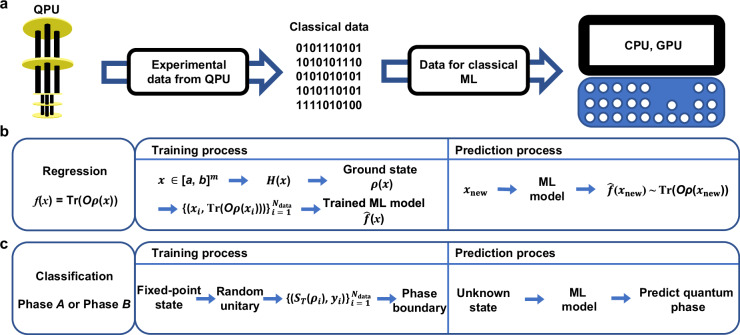
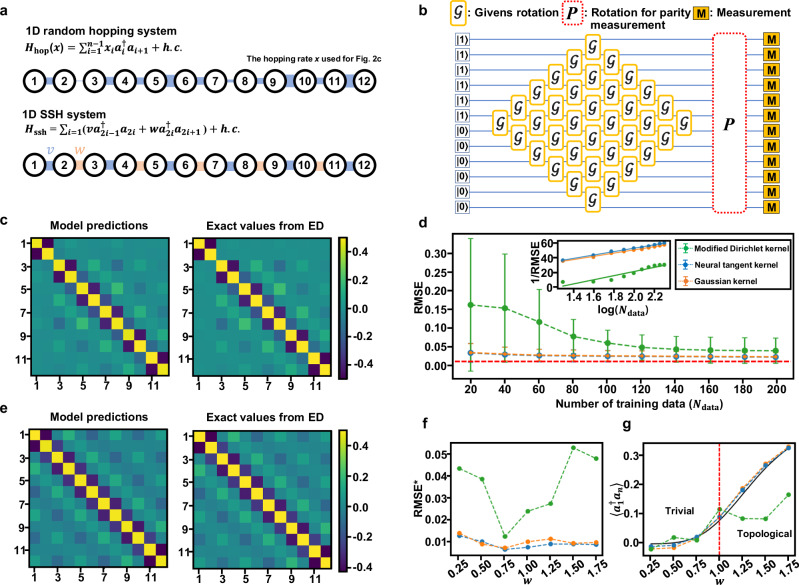
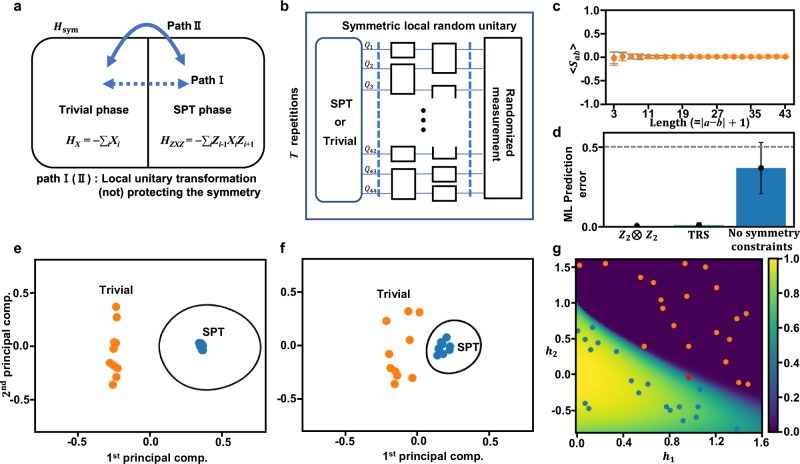
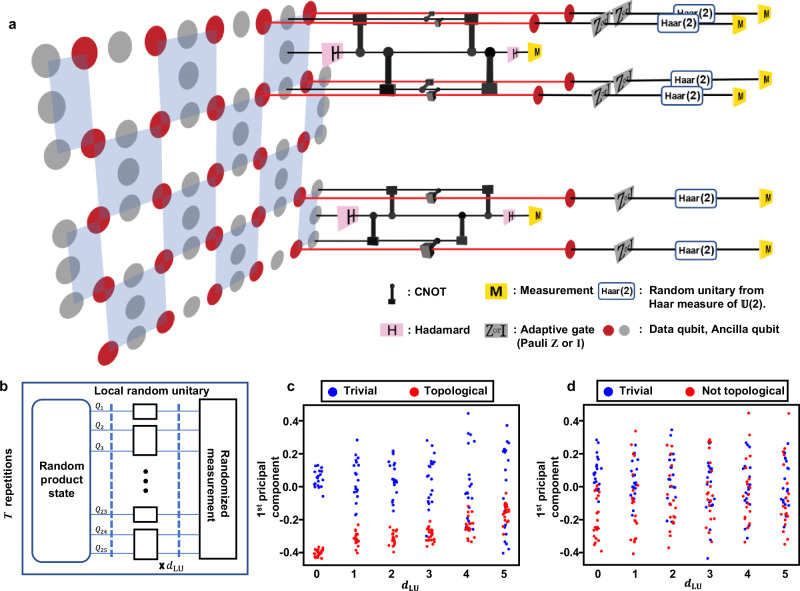
Abstract Advancements in the implementation of quantum hardware have enabled the acquisition of data that are intractable for emulation with classical computers. The integration of classical machine learning (ML) algorithms with these data holds potential for unveiling obscure patterns. Although this hybrid approach extends the class of efficiently solvable problems compared to using only classical computers, this approach has been realized for solving restricted problems because of the prevalence of noise in current quantum computers. Here, we extend the applicability of the hybrid approach to problems of interest in many-body physics, such as predicting the properties of the ground state of a given Hamiltonian and classifying quantum phases. By performing experiments with various error-reducing procedures on superconducting quantum hardware with 127 qubits, we managed to acquire refined data from the quantum computer. This enabled us to demonstrate the successful implementation of classical ML algorithms for systems with up to 44 qubits. Our results verify the scalability and effectiveness of the classical ML algorithms for processing quantum experimental data.
Overview
The claims and statistics of this paper haven’t been checked yet.
Run the check — free, no account needed. It reads the open-access text and checks the sources it cites.
Integrity signals
Registry
Cites
Statistics
Figures
Verification
Claims the paper makes
The claims and statistics of this paper haven’t been checked yet.
Run the check — free, no account needed. It reads the open-access text and checks the sources it cites.
Self-check
Percentages, sums and reported differences re-computed from the paper’s own numbers.
The self-check needs the paper’s full text.
Citations
Cites
Highly accurate protein structure prediction with AlphaFold
Jumper, J., Evans, R., Pritzel, A., Green, T., Figurnov, M., Ronneberger, O., Tunyasuvunakool, K., Bates, R., Žídek, A., Potapenko, A., et al. (2021) · Nature · doi:10.1038/s41586-021-03819-2 · Cited by 43,764
A variational eigenvalue solver on a photonic quantum processor
Peruzzo, A., McClean, J., Shadbolt, P., Yung, M.-H., Zhou, X.-Q., Love, P. J., Aspuru-Guzik, A., & O’Brien, J. L. (2014) · Nature Communications · doi:10.1038/ncomms5213 · Cited by 4,552 · cited 1×
“Hybrid approaches in which classical computers are combined with quantum computers as to circumvent this issue have been introduced 14 .”
BackgroundSolving the quantum many-body problem with artificial neural networks
Carleo, G., & Troyer, M. (2017) · Science · doi:10.1126/science.aag2302 · Cited by 2,215
Power of data in quantum machine learning
Huang, H.-Y., Broughton, M., Mohseni, M., Babbush, R., Boixo, S., Neven, H., & McClean, J. R. (2021) · Nature Communications · doi:10.1038/s41467-021-22539-9 · Cited by 896
Probing topological spin liquids on a programmable quantum simulator
Semeghini, G., Levine, H., Keesling, A., Ebadi, S., Wang, T. T., Bluvstein, D., Verresen, R., Pichler, H., Kalinowski, M., Samajdar, R., et al. (2021) · Science · doi:10.1126/science.abi8794 · Cited by 781
Quantum advantage in learning from experiments
Huang, H.-Y., Broughton, M., Cotler, J., Chen, S., Li, J., Mohseni, M., Neven, H., Babbush, R., Kueng, R., Preskill, J., et al. (2022) · Science · doi:10.1126/science.abn7293 · Cited by 519
Fault-Tolerant Quantum Computation with Constant Error Rate
Aharonov, D., & Ben-Or, M. (2008) · SIAM Journal on Computing · doi:10.1137/s0097539799359385 · Cited by 513
Measurement as a Shortcut to Long-Range Entangled Quantum Matter
Lu, T.-C., Lessa, L. A., Kim, I. H., & Hsieh, T. H. (2022) · PRX Quantum · doi:10.1103/prxquantum.3.040337 · Cited by 115
Research works printed but not linked: 55
- Philips, S. G. J. et al. Universal control of a six-qubit quantum processor in silicon. Nature 609, 919–924 (2022). · DOI · Paper page
- Moses, S. A. et al. A race-track trapped-ion quantum processor. Phys. Rev. X 13, 041052 (2023).
- Bravyi, S., Dial, O., Gambetta, J. M., Gil, D. & Nazario, Z. The future of quantum computing with superconducting qubits. J. Appl. Phys. 132, 160902 (2022). · DOI · Paper page
- Abobeih, M. H. et al. Fault-tolerant operation of a logical qubit in a diamond quantum processor. Nature 606, 884–889 (2022). · DOI
- Bluvstein, D. et al. A quantum processor based on coherent transport of entangled atom arrays. Nature 604, 451–456 (2022). · DOI · Paper page
- Alipanahi, B., Delong, A., Weirauch, M. T. & Frey, B. J. Predicting the sequence specificities of DNA- and RNA-binding proteins by deep learning. Nat. Biotechnol. 33, 831–838 (2015). · DOI · Paper page
- Hohenberg, P. & Kohn, W. Inhomogeneous Electron Gas. Phys. Rev. 136, B864–B871 (1964). · DOI · Paper page
- White, S. R. Density matrix formulation for quantum renormalization groups. Phys. Rev. Lett. 69, 2863–2866 (1992). · DOI · Paper page
- Knill, E., Laflamme, R. & Zurek, W. H. Resilient Quantum Computation. Science 279, 342–345 (1998). · DOI · Paper page
- Google Quantum, A. I. et al. Suppressing quantum errors by scaling a surface code logical qubit. Nature 614, 676–681 (2023). · DOI · Paper page
- Huang, H.-Y., Kueng, R. & Preskill, J. Predicting many properties of a quantum system from very few measurements. Nat. Phys. 16, 1050–1057 (2020). · DOI · Paper page
- Elben, A. et al. The randomized measurement toolbox. Nat. Rev. Phys. 5, 9–24 (2022). · DOI
- Zhang, T. et al. Experimental Quantum State Measurement with Classical Shadows. Phys. Rev. Lett. 127, 200501 (2021). · DOI
- Huang, H.-Y., Kueng, R., Torlai, G., Albert, V. V. & Preskill, J. Provably efficient machine learning for quantum many-body problems. Science 377, eabk3333 (2022). · DOI
- Lewis, L. et al. Improved machine learning algorithm for predicting ground state properties. Nat. Commun. 15, 895 (2024). · DOI
- Che, Y., Gneiting, C., & Nori, F. Exponentially improved efficient machine learning for quantum many-body states with provable guarantees. Phys. Rev. Res. 6, 033035 (2024). · DOI
- Onorati, E., Rouzé, C., França, D. S. & Watson, J. D. Efficient learning of ground & thermal states within phases of matter. Preprint at http://arxiv.org/abs/2301.12946 (2023). · arXiv
- Jung, K. et al. Deep learning enhanced individual nuclear-spin detection. npj Quantum Inf. 7, 41 (2021). · DOI
- Miles, C. et al. Machine learning discovery of new phases in programmable quantum simulator snapshots. Phys. Rev. Res. 5, 013026 (2023). · DOI
- Herrmann, J. et al. Realizing quantum convolutional neural networks on a superconducting quantum processor to recognize quantum phases. Nat. Commun. 13, 4144 (2022). · DOI
- Smith, A., Jobst, B., Green, A. G. & Pollmann, F. Crossing a topological phase transition with a quantum computer. Phys. Rev. Res. 4, L022020 (2022). · DOI
- Pollmann, F. & Turner, A. M. Detection of symmetry-protected topological phases in one dimension. Phys. Rev. B 86, 125441 (2012). · DOI
- Haah, J., Harrow, A. W., Ji, Z., Wu, X. & Yu, N. Sample-optimal tomography of quantum states. IEEE Trans. Inform. Theory 1–1 https://doi.org/10.1109/TIT.2017.2719044 (2017). · DOI
- Aaronson, S. Shadow tomography of quantum states. SIAM J. Comput. 49, STOC18-368–STOC18-394 (2020). · DOI
- Paini, M., Kalev, A., Padilha, D., & Ruck, B. Estimating expectation values using approximate quantum states. Quantum 5, 413 (2021). · DOI
- Bishop, C. M. Pattern recognition and machine learning (Springer, 2006).
- Google AI Quantum and Collaborators et al. Hartree-Fock on a superconducting qubit quantum computer. Science 369, 1084–1089 (2020). · DOI
- Jiang, Z., Sung, K. J., Kechedzhi, K., Smelyanskiy, V. N. & Boixo, S. Quantum Algorithms to Simulate Many-Body Physics of Correlated Fermions. Phys. Rev. Appl. 9, 044036 (2018). · DOI · Paper page
- Kim, Y. et al. Scalable error mitigation for noisy quantum circuits produces competitive expectation values. Nat. Phys. 19, 752–759 (2023). · DOI
- Sung, K. J., Rančić, M. J., Lanes, O. T. & Bronn, N. T. Simulating Majorana zero modes on a noisy quantum processor. Quantum Sci. Technol. 8, 025010 (2023). · DOI
- Zeng, B. & Wen, X.-G. Gapped quantum liquids and topological order, stochastic local transformations and emergence of unitarity. Phys. Rev. B 91, 125121 (2015). · DOI
- Liu, Y.-J., Smith, A., Knap, M. & Pollmann, F. Model-Independent Learning of Quantum Phases of Matter with Quantum Convolutional Neural Networks. Phys. Rev. Lett. 130, 220603 (2023). · DOI
- Chen, X., Zeng, B., Wen, X.-G., & Zhou, D.-L. (eds) Quantum Information Meets Quantum Matter: From Quantum Entanglement to Topological Phases of Many-Body Systems (Springer, 2019).
- Elben, A. et al. Many-body topological invariants from randomized measurements. Sci. Adv. 6, eaaz3666 (2020). · DOI
- Caro, M. C. et al. Generalization in quantum machine learning from few training data. Nat. Commun. 13, 4919 (2022). · DOI · Paper page
- Cong, I., Choi, S. & Lukin, M. D. Quantum convolutional neural networks. Nat. Phys. 15, 1273–1278 (2019). · DOI · Paper page
- Ferris, A. J. & Vidal, G. Perfect sampling with unitary tensor networks. Phys. Rev. B 85, 165146 (2012). · DOI
- Schollwöck, U. The density-matrix renormalization group in the age of matrix product states. Ann. Phys. 326, 96–192 (2011). · DOI · Paper page
- Levin, M. & Wen, X.-G. Detecting Topological Order in a Ground State Wave Function. Phys. Rev. Lett. 96, 110405 (2006). · DOI
- Kitaev, A. & Preskill, J. Topological Entanglement Entropy. Phys. Rev. Lett. 96, 110404 (2006). · DOI
- Satzinger, K. J. et al. Realizing topologically ordered states on a quantum processor. Science 374, 1237–1241 (2021). · DOI
- Perez, L. & Wang, J. The Effectiveness of Data Augmentation in Image Classification using Deep Learning. Preprint at http://arxiv.org/abs/1712.04621 (2017). · arXiv
- Kim, Y. et al. Evidence for the utility of quantum computing before fault tolerance. Nature 618, 500–505 (2023). · DOI · Paper page
- Chen, S., Yu, W., Zeng, P. & Flammia, S. T. Robust Shadow Estimation. PRX Quantum 2, 030348 (2021). · DOI
- Koh, D. E. & Grewal, S. Classical Shadows With Noise. Quantum 6, 776 (2022). · DOI
- Jnane, H., Steinberg, J., Cai, Z., Nguyen, H. C., & Koczor, B. Quantum error mitigated classical shadows. PRX Quantum 5, 010324 (2024). · DOI
- Brieger, R., Heinrich, M., Roth, I. & Kliesch, M. Stability of classical shadows under gate-dependent noise. Preprint at http://arxiv.org/abs/2310.19947 (2023). · arXiv
- Zhao, A. & Miyake, A. Group-theoretic error mitigation enabled by classical shadows and symmetries. npj Quantum Inf. 10, 57 (2024). · DOI
- Wu, B. & Koh, D. E. Error-mitigated fermionic classical shadows on noisy quantum devices. npj Quantum Inf. 10, 39 (2024). · DOI
- Huang, H.-Y., Kueng, R. & Preskill, J. Efficient estimation of Pauli observables by derandomization. Phys. Rev. Lett. 127, 030503 (2021). · DOI
- Hu, H.-Y. & You, Y.-Z. Hamiltonian-driven shadow tomography of quantum states. Phys. Rev. Res. 4, 013054 (2022). · DOI
- Bu, K., Koh, D. E., Garcia, R. J. & Jaffe, A. Classical shadows with Pauli-invariant unitary ensembles. npj Quantum Inf. 10, 6 (2024). · DOI
- Akhtar, A. A., Hu, H.-Y. & You, Y.-Z. Scalable and Flexible Classical Shadow Tomography with Tensor Networks. Quantum 7, 1026 (2023). · DOI
- Zhou, Y. & Liu, Q. Performance analysis of multi-shot shadow estimation. Quantum 7, 1044 (2023). · DOI
- Zhou, Y. & Liu, Z. A hybrid framework for estimating nonlinear functions of quantum states. npj Quantum Inf. 10, 62 (2024). · DOI
Metadata
- Authors
- Cho, G., & Kim, D.
- Affiliations
- Seoul National University (KR)
- Corresponding author
- Cho, Gyungmin
- Kim, Dohun
- Venue
- Nature Communications
- Published
- 2024-08-30
- Volume
- 15
- Issue
- 1
- Pages
- 7552-7552
- ISSN
- 2041-1723 (ISSN-L)
- PMC
- PMC11364692
- OpenAlex
- W4402039629
- Cited by
- 21
- References
- 8
- Citations by year
- 2026: 11 · 2025: 7 · 2024: 3
- FWCI
- 3.10
- Type
- journal article
- Language
- en
- Open access
- gold
- doi.org
- Licence
- Locations
- Nature Communications (publishedVersion, cc-by-nc-nd)
- Research Square (acceptedVersion, cc-by)
- PubMed Central (publishedVersion, cc-by-nc-nd)
- PubMed (publishedVersion)
- arXiv (Cornell University) (submittedVersion, cc-by)
- RePEc: Research Papers in Economics (submittedVersion)
- DOAJ (DOAJ: Directory of Open Access Journals) (submittedVersion, cc-by-sa)
- arXiv (Cornell University) (cc-by)
- Funders
- National Research Foundation of Korea (2019M3E4A1080145, 2019R1A5A1027055, RS-2023-00283291, RS-2023-00207732, 2020M3H3A1110365, 2023R1A2C2005809, 2019M3E4A1080144, RS-2024-00413957)
- Korea Basic Science Institute (2021R1A6C101B418)
- Topics
- Physical Sciences › Computer Science › Artificial Intelligence › Quantum Computing Algorithms and Architecture
- Physical Sciences › Physics and Astronomy › Atomic and Molecular Physics, and Optics › Quantum many-body systems
- Physical Sciences › Physics and Astronomy › Atomic and Molecular Physics, and Optics › Quantum Information and Cryptography
- Keywords
- hybrid quantum-classical machine learning, quantum many-body problem, superconducting quantum processors, error mitigation, scalability
About these checks
Registry, retraction, Cites and statistics results are computed, not judged, with one exception: a printed reference that no index lists is read once by a model before it counts as a citation error. Claims are extracted by a model and kept only when their quote appears verbatim in the text; each cited source is then checked, with a model’s help, for whether it says what the claim relies on. Those verdicts can be wrong — read the claim’s quote and the cited source before relying on one.
Statistics and arithmetic are recomputed, not judged.
Confidence bands are shown only for fields calibrated on our annotated test set. None is calibrated yet, so no band is shown.
What counts as a claim ›How we measure confidence ›How we check this ›
Are you an author, or do you see a problem with this page? Request a review
How to cite
Cite CoChat for the checks on this page, and the paper for its own findings.
- This page
- CoChat. (2026). Citation check: Machine learning on quantum experimental data toward solving quantum many-body problems. https://app.cochat.ai/papers/10.1038/s41467-024-51932-3
- The paper
- Cho, G., & Kim, D. (2024). Machine learning on quantum experimental data toward solving quantum many-body problems. Nature Communications. https://doi.org/10.1038/s41467-024-51932-3
