

RNA 3′end tailing safeguards cells against products of pervasive transcription termination
Open accessPublished version of a preprint
The DOI matches its Crossref record; 120 of the 120 references it cites were found in a registry or an index; 1 of the 47 sources its claims cite were checked for support.
Abstract
Premature transcription termination yields a wealth of unadenylated (pA−) RNA. Although this can be targeted for degradation by the Nuclear EXosome Targeting (NEXT) complex, possible backup pathways remain poorly understood. Here, we find increased levels of 3′ end uridylated and adenylated RNAs upon NEXT inactivation. U-tailed RNAs are mostly short and modified by the cytoplasmic tailing enzymes, TUT4/7, following their PHAX-dependent nuclear export and prior to their degradation by the cytoplasmic exosome or the exoribonuclease DIS3L2. Longer RNAs are instead adenylated redundantly by enzymes TENT2, PAPOLA and PAPOLG. These transcripts are either degraded via the nuclear Poly(A) tail eXosome Targeting (PAXT) connection or exported and removed by the cytoplasmic exosome in a translation-dependent manner. Failure to do so decreases global translation and induces cell death. We conclude that post-transcriptional 3′ end modification and removal of excess pA− RNA is achieved by tailing enzymes and export factors shared with productive RNA pathways. Pervasive transcription generates numerous unadenylated RNAs, usually degraded by the NEXT/nuclear exosome pathway. Here, the authors show that, upon NEXT inactivation, these RNAs are removed by compensatory RNA decay pathways relying on RNA 3′end A- or U-tailing.
Overview
CoChat Summary
TL;DR
The paper shows that when NEXT-mediated nuclear decay of pA− RNA is compromised, excess transcripts are 3′ end tailed and either degraded in the nucleus via PAXT or exported for cytoplasmic decay, with U-tailing by TUT4/7 and A-tailing by TENT2/PAPOLA/PAPOLG. Failure of these backup pathways decreases global translation and induces cell death.
Key findings
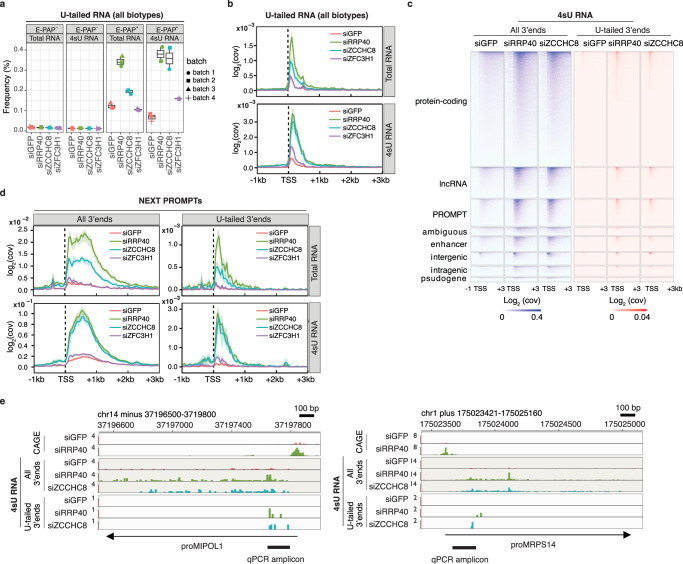
- Upon depletion of the exosome subunit RRP40 or the NEXT component ZCCHC8, U-tailed RNA frequencies (3–9 non-templated U residues) increased in total and 4sU RNA samples in an E-PAP-specific manner; depletion of the PAXT component ZFC3H1 only slightly affected 4sU RNA U-tail frequencies.
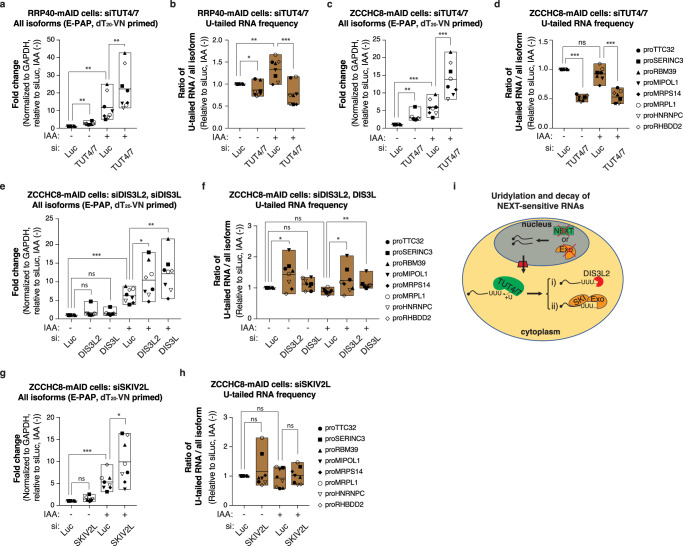
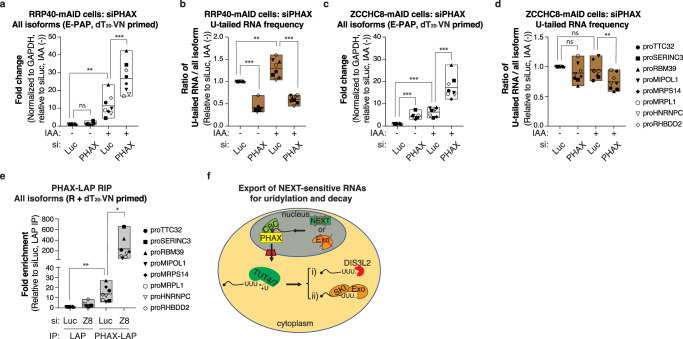
- Short excess NEXT substrates are exported by PHAX, uridylated by TUT4/7, and degraded by DIS3L2 or the cytoplasmic exosome (DIS3L/SKIV2L); TUT4/7 depletion decreased U-tailed RNA frequencies, while DIS3L2, DIS3L, or SKIV2L depletion increased transcript levels.
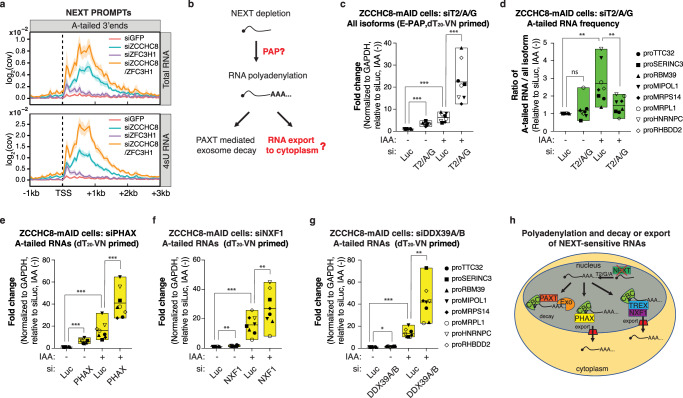
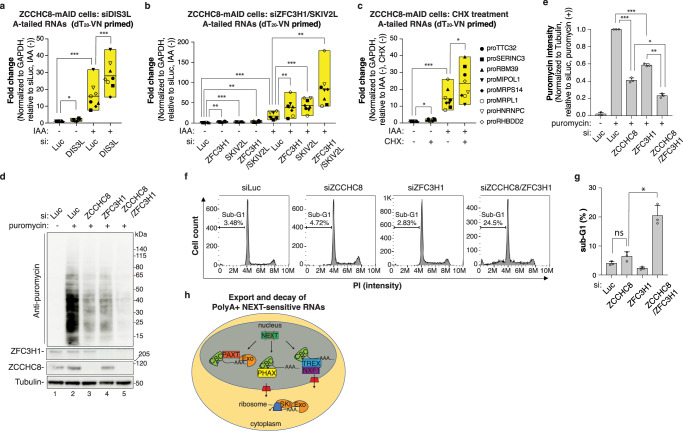
- Longer excess NEXT substrates are redundantly adenylated by TENT2, PAPOLA, and PAPOLG; co-depletion increased RNA accumulation and decreased A-tailing frequency. A-tailed RNAs can be degraded by nuclear PAXT or exported via PHAX/TREX-NXF1 and removed by cytoplasmic SKI/exosome in a translation-dependent manner (cycloheximide increased A-tailed RNA).
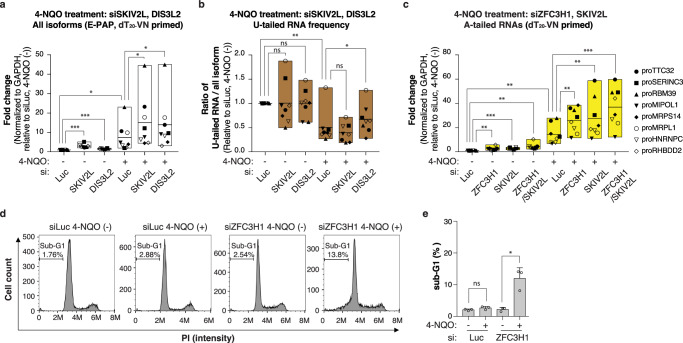
- Disrupting these pathways decreased global translation (puromycin incorporation) and increased sub-G1 cells; upon 4-NQO DNA damage, SKIV2L or DIS3L2 depletion further increased RNA levels, and siZFC3H1 plus 4-NQO increased sub-G1 populations.
Methods
- HeLa cells (wildtype, RRP40-mAID, ZCCHC8-mAID) with siRNA knockdowns (20 nM, 3 days; NXF1 and DDX39A/B 2 days), auxin (750 µM IAA, 6 h), 4-NQO (5 µM, 4 h), cycloheximide (10 µg/ml, 3 h), and puromycin (5 µg/ml, 30 min).
- Reanalysis of RNA 3′end sequencing data (GEO: GSE137612) with E-PAP treatment and spike-in RNAs; qRT-PCR using dT20-VN and dT20-A4 primers to measure all isoforms and U-tailed/A-tailed frequencies; PHAX-LAP RNA immunoprecipitation; western blotting; flow cytometry.
- Two-sided t-tests; boxplots; metagene and heatmap analyses; three biological replicates unless stated (RIP experiments used two biological replicates).
Limitations
- Stated: transcripts <100 nt were excluded by the RNA purification method, likely underestimating U-tail frequencies; 1–2 U detection was marginal and may include sequencing errors, so analysis focused on 3–9 U tails; some 3′ tailing could reflect increased availability of non-tailed RNA in compromised decay conditions, though considered minor; a strict cause–effect relationship between translation decrease/cell death and RNA accumulation remains to be established.
- Stated: mechanisms recruiting TUT4/7 and TENT2/PAPOLA/PAPOLG to these RNAs, and what determines nuclear decay versus export, remain unresolved.
- Evident: many conclusions rely on siRNA/mAID depletion in HeLa cells and qRT-PCR of 8 NEXT-sensitive PROMPTs; some RIP experiments used two biological replicates, and depletion can have indirect effects.
Model-written summary. Check it against the paper before relying on it.
Integrity signals
Registry
Cites
Statistics
Figures
Verification
Claims the paper makes
0 Valid · 0 Not valid · 21 Not checked · 93 Own results and interpretations
None of the sources cited for this claim have been checked yet.
In the paper
“Premature transcription termination yields a wealth of unadenylated (pA−) RNA.”
- Also stated in: § Introduction · plain
“mammalian transcription units (TUs) broadly are prone to premature transcription termination, giving rise to shortened transcripts with either pA+ or pA− 3′ends44–46.”
§ RNA 3′end tailing safeguards cells against products of pervasive transcription termination > Abstract
What the sources say
- Could not verifycites [44] Nechaev, S. et al. Global analysis of short RNAs reveals widespread promoter-proximal stalling and arrest of Pol II in Drosophila. Science 327, 335–338 (2010). 20007866 PMC3435875 sourceExperimental — accuracy not yet measured
Our copy of Nechaev et al. (2010) characterizes short (<100 nt), capped, nuclear RNAs derived from promoter-proximally stalled/arrested Pol II in Drosophila (Methods/Results, intro paragraph 'To overcome this obstacle...' and Discussion 'many rounds of pausing, backtracking and cleavage, or perhaps even termination, may ensue'), but it never addresses polyadenylation status or claims that premature termination produces abundant unadenylated (pA-) RNA. Searched: 'polyadenylation/poly(A)/adenylated', 'premature transcription termination', 'unstable transcripts/degradation' — the only termination mention is a hedged possibility within the stalling cycle, with no quantification of resulting RNA. Nothing in our copy supports or contradicts the attributed point. (LLM, conf=0.65)
- Not checked yetcites [45] Kamieniarz-Gdula, K. & Proudfoot, N. J. Transcriptional control by premature termination: a forgotten mechanism. Trends Genet 35, 553–564 (2019). 31213387 PMC7471841 source
Checked before — its earlier verdict is held back until a new check runs.
- Not checked yetcites [46] Tatomer, D. C. & Wilusz, J. E. Attenuation of eukaryotic protein-coding gene expression via premature transcription termination. Cold Spring Harb. Symp. Quant. Biol. 84, 83–93 (2019). 32086332 source
Checked before — its earlier verdict is held back until a new check runs.
plainstates a cause- Asserted: passes — The authors put it forward as true.
- Checkable: passes — It can be checked against evidence.
- Load-bearing: passes — The paper’s conclusions depend on it.
- Based: passes — The paper gives a reason why it holds.
- Also stated in: § Introduction · plain
A result the paper reports from its own data — it cites no other source for it, so there is none to check. The quote shows it is in the paper.
In the paper
“As expected, given the recruitment of PHAX to RNA via the CBC21, a specific interaction between PHAX-LAP and the CBP20 and CBP80 proteins could be confirmed, which was not affected by ZCCHC8-depletion (Supplementary Fig. 3b).”
§ RNA 3′end tailing safeguards cells against products of pervasive transcription termination > Results > PHAX exports shorter excess NEXT substrates for cytoplasmic uridylation
hedged- Asserted: passes — The authors put it forward as true.
- Checkable: passes — It can be checked against evidence.
- Load-bearing: unclear — It is unclear whether the paper’s conclusions depend on it.
- Based: passes — The paper gives a reason why it holds.
A result the paper reports from its own data — it cites no other source for it, so there is none to check. The quote shows it is in the paper.
In the paper
“These transcripts are either degraded via the nuclear Poly(A) tail eXosome Targeting (PAXT) connection or exported and removed by the cytoplasmic exosome in a translation-dependent manner.”
§ RNA 3′end tailing safeguards cells against products of pervasive transcription termination > Abstract
plainstates a cause- Asserted: passes — The authors put it forward as true.
- Checkable: passes — It can be checked against evidence.
- Load-bearing: passes — The paper’s conclusions depend on it.
- Based: passes — The paper gives a reason why it holds.
A result the paper reports from its own data — it cites no other source for it, so there is none to check. The quote shows it is in the paper.
In the paper
“Furthermore, a significant decrease of U-tailed RNA frequencies was detected upon TUT4/7 depletion, consistent with the uridylyltransferase activities of these enzymes (Fig. 2b).”
§ RNA 3′end tailing safeguards cells against products of pervasive transcription termination > Results > Relatively short excess NEXT substrates are uridylated by TUT4/7 and degraded by cytoplasmic exonucleases
plainstates a cause- Asserted: passes — The authors put it forward as true.
- Checkable: passes — It can be checked against evidence.
- Load-bearing: passes — The paper’s conclusions depend on it.
- Based: passes — The paper gives a reason why it holds.
A result the paper states — it cites no source for it, so there is none to check. The quote shows it is in the paper.
In the paper
“These transcripts are either degraded via the nuclear Poly(A) tail eXosome Targeting (PAXT) connection or exported and removed by the cytoplasmic exosome in a translation-dependent manner.”
§ RNA 3′end tailing safeguards cells against products of pervasive transcription termination > Abstract
plainstates a cause- Asserted: passes — The authors put it forward as true.
- Checkable: passes — It can be checked against evidence.
- Load-bearing: passes — The paper’s conclusions depend on it.
- Based: passes — The paper gives a reason why it holds.
63 more claims
Create a free account to see all 114 claims and to verify the 46 references still open.
- It may state two separate claims as one. 34
- Probably not a substantial claim. 18
Claims other papers make about this one
Each is checked against this paper’s own text: does it say what the citing paper says it does?
In the citing paper
“One context where exosome engagement during NMD is described is when a subset of RNA substrates are uridylated by TUT4/7 enzymes and degraded by DIS3L1-containing cytoplasmic exosome assemblies [143].”
From The RNA exosome: mechanisms of RNA surveillance, regulation, and disease (2026) · cites this paper as [143]
Self-check
Percentages, sums and reported differences re-computed from the paper’s own numbers.
Each contradiction between two passages listed here was confirmed by an independent check.
Rated minor: it would not touch a result — a value no result rests on, a p-value that stays on the same side of the significance level, or a conflict that is clerical, resolved elsewhere in the paper, or outside its own findings.
In the paper
§ RNA 3′end tailing safeguards cells against products of pervasive transcription termination > Results > Relatively short excess NEXT substrates are uridylated by TUT4/7 and degraded by cytoplasmic exonucleases
“cDNA was synthesized using a dT20-VN primer after E-PAP treatment of total RNA.”
§ RNA 3′end tailing safeguards cells against products of pervasive transcription termination > Results > Relatively short excess NEXT substrates are uridylated by TUT4/7 and degraded by cytoplasmic exonucleases
“Note that boxplots, which display measurements of all RNA isoform levels (“All isoforms”) after E-PAP treatment and dT20-NV priming condition, are consistently represented in white color.”
Rated minor: it would not touch a result — a value no result rests on, a p-value that stays on the same side of the significance level, or a conflict that is clerical, resolved elsewhere in the paper, or outside its own findings.
In the paper
§ RNA 3′end tailing safeguards cells against products of pervasive transcription termination > Methods > Statistical analysis
“siLuc −IAA and siLuc +IAA data from Figs. 2d, f, h and 3f;”
§ RNA 3′end tailing safeguards cells against products of pervasive transcription termination > Results > PHAX exports shorter excess NEXT substrates for cytoplasmic uridylation
“f Diagram summarizing the proposed RNA export, uridylation and decay pathways.”
Rated minor: it would not touch a result — a value no result rests on, a p-value that stays on the same side of the significance level, or a conflict that is clerical, resolved elsewhere in the paper, or outside its own findings.
In the paper
§ RNA 3′end tailing safeguards cells against products of pervasive transcription termination > Results > Relatively short 3′end uridylated RNAs accumulate upon NEXT- and exosome-depletions
“Mean values and 90% confidence intervals are shown.”
§ RNA 3′end tailing safeguards cells against products of pervasive transcription termination > Methods > Metagene profiles and heatmaps
“A 95% confidence interval of the mean coverage is displayed for each sample and was measured through 50 steps of bootstrap samplings with replacement.”
Citations
Cites
SUnSET, a nonradioactive method to monitor protein synthesis
Schmidt, E. K., Clavarino, G., Ceppi, M., & Pierre, P. (2009) · Nature Methods · doi:10.1038/nmeth.1314 · Cited by 1,706
A day in the life of the spliceosome
Matera, A. G., & Wang, Z. (2014) · Nature Reviews Molecular Cell Biology · doi:10.1038/nrm3742 · Cited by 1,074
Mitchell, P., Petfalski, E., Shevchenko, A., Mann, M., & Tollervey, D. (1997) · Cell · doi:10.1016/s0092-8674(00)80432-8 · Cited by 954
The cap and poly(A) tail function synergistically to regulate mRNA translational efficiency.
Gallie, D. R. (1991) · Genes & Development · doi:10.1101/gad.5.11.2108 · Cited by 868
TUT4 in Concert with Lin28 Suppresses MicroRNA Biogenesis through Pre-MicroRNA Uridylation
Heo, I., Joo, C., Kim, Y.-K., Ha, M., Yoon, M.-J., Cho, J., Yeom, K.-H., Han, J., & Kim, V. N. (2009) · Cell · doi:10.1016/j.cell.2009.08.002 · Cited by 798
Exporting RNA from the nucleus to the cytoplasm
Köhler, A., & Hurt, E. (2007) · Nature Reviews Molecular Cell Biology · doi:10.1038/nrm2255 · Cited by 775
Anderson, J. S. J. (1998) · The EMBO Journal · doi:10.1093/emboj/17.5.1497 · Cited by 650
BAC TransgeneOmics: a high-throughput method for exploration of protein function in mammals
Poser, I., Sarov, M., Hutchins, J. R. A., Hériché, J.-K., Toyoda, Y., Pozniakovsky, A., Weigl, D., Nitzsche, A., Hegemann, B., Bird, A. W., et al. (2008) · Nature Methods · doi:10.1038/nmeth.1199 · Cited by 603
Roles of mRNA poly(A) tails in regulation of eukaryotic gene expression
Passmore, L. A., & Coller, J. (2022) · Nature Reviews Molecular Cell Biology · doi:10.1038/s41580-021-00417-y · Cited by 569
TT-seq maps the human transient transcriptome
Schwalb, B., Michel, M., Zacher, B., Frühauf, K., Demel, C., Tresch, A., Gagneur, J., & Cramer, P. (2016) · Science · doi:10.1126/science.aad9841 · Cited by 564
Lin28 recruits the TUTase Zcchc11 to inhibit let-7 maturation in mouse embryonic stem cells
Hagan, J. P., Piskounova, E., & Gregory, R. I. (2009) · Nature Structural & Molecular Biology · doi:10.1038/nsmb.1676 · Cited by 491
PUROMYCIN INHIBITION OF PROTEIN SYNTHESIS: INCORPORATION OF PUROMYCIN INTO PEPTIDE CHAINS
Nathans, D. (1964) · Proceedings of the National Academy of Sciences · doi:10.1073/pnas.51.4.585 · Cited by 477
Interaction profiling identifies the human nuclear exosome targeting complex
Lubas, M., Christensen, M. S., Kristiansen, M. S., Domanski, M., Falkenby, L. G., Lykke-Andersen, S., Andersen, J. S., Dziembowski, A., & Jensen, T. H. (2011) · Molecular Cell · doi:10.1016/j.molcel.2011.06.028 · Cited by 460
The complex eukaryotic transcriptome: unexpected pervasive transcription and novel small RNAs
Jacquier, A. (2009) · Nature Reviews Genetics · doi:10.1038/nrg2683 · Cited by 429
Sequencing error profiles of Illumina sequencing instruments
Stoler, N., & Nekrutenko, A. (2021) · NAR Genomics and Bioinformatics · doi:10.1093/nargab/lqab019 · Cited by 425
Nechaev, S., Fargo, D. C., dos Santos, G., Liu, L., Gao, Y., & Adelman, K. (2010) · Science · doi:10.1126/science.1181421 · Cited by 424
Protein factors in pre-mRNA 3′-end processing
Mandel, C. R., Bai, Y., & Tong, L. (2008) · Cellular and Molecular Life Sciences · doi:10.1007/s00018-007-7474-3 · Cited by 416
Molecular mechanisms of eukaryotic pre-mRNA 3′ end processing regulation
Millevoi, S., & Vagner, S. (2010) · Nucleic Acids Research · doi:10.1093/nar/gkp1176 · Cited by 390
PHAX, a Mediator of U snRNA Nuclear Export Whose Activity Is Regulated by Phosphorylation
Ohno, M., Segref, A., Bachi, A., Wilm, M., & Mattaj, I. W. (2000) · Cell · doi:10.1016/s0092-8674(00)80829-6 · Cited by 374
RNA Degradation in Saccharomyces cerevisae
Parker, R. (2012) · Genetics · doi:10.1534/genetics.111.137265 · Cited by 366
RNA Quality Control in Eukaryotes
Doma, M. K., & Parker, R. (2007) · Cell · doi:10.1016/j.cell.2007.10.041 · Cited by 345
A role for the Perlman syndrome exonuclease Dis3l2 in the Lin28–let-7 pathway
Chang, H.-M., Triboulet, R., Thornton, J. E., & Gregory, R. I. (2013) · Nature · doi:10.1038/nature12119 · Cited by 341
Symplekin and xGLD-2 Are Required for CPEB-Mediated Cytoplasmic Polyadenylation
Barnard, D. C., Ryan, K., Manley, J. L., & Richter, J. D. (2004) · Cell · doi:10.1016/j.cell.2004.10.029 · Cited by 334
Analysis of error profiles in deep next-generation sequencing data
Ma, X., Shao, Y., Tian, L., Flasch, D. A., Mulder, H. L., Edmonson, M. N., Liu, Y., Chen, X., Newman, S., Nakitandwe, J., et al. (2019) · Genome Biology · doi:10.1186/s13059-019-1659-6 · Cited by 318
Mono-Uridylation of Pre-MicroRNA as a Key Step in the Biogenesis of Group II let-7 MicroRNAs
Heo, I., Ha, M., Lim, J., Yoon, M.-J., Park, J.-E., Kwon, S. C., Chang, H., & Kim, V. N. (2012) · Cell · doi:10.1016/j.cell.2012.09.022 · Cited by 305
Identification of a Nuclear Exosome Decay Pathway for Processed Transcripts
Meola, N., Domanski, M., Karadoulama, E., Chen, Y., Gentil, C., Pultz, D., Vitting-Seerup, K., Lykke-Andersen, S., Andersen, J. S., Sandelin, A., et al. (2016) · Molecular Cell · doi:10.1016/j.molcel.2016.09.025 · Cited by 290
Dealing with Pervasive Transcription
Jensen, T. H., Jacquier, A., & Libri, D. (2013) · Molecular Cell · doi:10.1016/j.molcel.2013.10.032 · Cited by 290
The human core exosome interacts with differentially localized processive RNases: hDIS3 and hDIS3L
Tomecki, R., Kristiansen, M. S., Lykke‐Andersen, S., Chlebowski, A., Larsen, K. M., Szczesny, R. J., Drazkowska, K., Pastula, A., Andersen, J. S., Stepien, P. P., et al. (2010) · The EMBO Journal · doi:10.1038/emboj.2010.121 · Cited by 271
Self-citationmRNA nuclear export at a glance
Carmody, S. R., & Wente, S. R. (2009) · Journal of Cell Science · doi:10.1242/jcs.041236 · Cited by 263
The human cap-binding complex is functionally connected to the nuclear RNA exosome
Andersen, P. R., Domanski, M., Kristiansen, M. S., Storvall, H., Ntini, E., Verheggen, C., Schein, A., Bunkenborg, J., Poser, I., Hallais, M., et al. (2013) · Nature Structural & Molecular Biology · doi:10.1038/nsmb.2703 · Cited by 229
Self-citationThe Integrator Complex Attenuates Promoter-Proximal Transcription at Protein-Coding Genes
Elrod, N. D., Henriques, T., Huang, K.-L., Tatomer, D. C., Wilusz, J. E., Wagner, E. J., & Adelman, K. (2019) · Molecular Cell · doi:10.1016/j.molcel.2019.10.034 · Cited by 225
TREX exposes the RNA-binding domain of Nxf1 to enable mRNA export
Viphakone, N., Hautbergue, G. M., Walsh, M., Chang, C.-T., Holland, A., Folco, E. G., Reed, R., & Wilson, S. A. (2012) · Nature Communications · doi:10.1038/ncomms2005 · Cited by 221
The Yeast Ski Complex: Crystal Structure and RNA Channeling to the Exosome Complex
Halbach, F., Reichelt, P., Rode, M., & Conti, E. (2013) · Cell · doi:10.1016/j.cell.2013.07.017 · Cited by 210
Lubas, M., Andersen, P. R., Schein, A., Dziembowski, A., Kudla, G., & Jensen, T. H. (2015) · Cell Reports · doi:10.1016/j.celrep.2014.12.026 · Cited by 207
Self-citationThe exoribonuclease Dis3L2 defines a novel eukaryotic RNA degradation pathway
Malecki, M., Viegas, S. C., Carneiro, T., Golik, P., Dressaire, C., Ferreira, M. G., & Arraiano, C. M. (2013) · The EMBO Journal · doi:10.1038/emboj.2013.63 · Cited by 205
hnRNP C Tetramer Measures RNA Length to Classify RNA Polymerase II Transcripts for Export
McCloskey, A., Taniguchi, I., Shinmyozu, K., & Ohno, M. (2012) · Science · doi:10.1126/science.1218469 · Cited by 191
Lubas, M., Damgaard, C. K., Tomecki, R., Cysewski, D., Jensen, T. H., & Dziembowski, A. (2013) · The EMBO Journal · doi:10.1038/emboj.2013.135 · Cited by 180
The Dynamics of Cytoplasmic mRNA Metabolism
Eisen, T. J., Eichhorn, S. W., Subtelny, A. O., Lin, K. S., McGeary, S. E., Gupta, S., & Bartel, D. P. (2020) · Molecular Cell · doi:10.1016/j.molcel.2019.12.005 · Cited by 177
Nuclear stability and transcriptional directionality separate functionally distinct RNA species
Andersson, R., Refsing Andersen, P., Valen, E., Core, L. J., Bornholdt, J., Boyd, M., Heick Jensen, T., & Sandelin, A. (2014) · Nature Communications · doi:10.1038/ncomms6336 · Cited by 171
The Integrator complex cleaves nascent mRNAs to attenuate transcription
Tatomer, D. C., Elrod, N. D., Liang, D., Xiao, M.-S., Jiang, J. Z., Jonathan, M., Huang, K.-L., Wagner, E. J., Cherry, S., & Wilusz, J. E. (2019) · Genes & Development · doi:10.1101/gad.330167.119 · Cited by 167
Mixed tailing by TENT4A and TENT4B shields mRNA from rapid deadenylation
Lim, J., Kim, D., Lee, Y.-S., Ha, M., Lee, M., Yeo, J., Chang, H., Song, J., Ahn, K., & Kim, V. N. (2018) · Science · doi:10.1126/science.aam5794 · Cited by 165
Controlling nuclear RNA levels
Schmid, M., & Jensen, T. H. (2018) · Nature Reviews Genetics · doi:10.1038/s41576-018-0013-2 · Cited by 164
Self-citationIntegrator is a genome-wide attenuator of non-productive transcription
Lykke-Andersen, S., Žumer, K., Molska, E. Š., Rouvière, J. O., Wu, G., Demel, C., Schwalb, B., Schmid, M., Cramer, P., & Jensen, T. H. (2021) · Molecular Cell · doi:10.1016/j.molcel.2020.12.014 · Cited by 162
Self-citationRNA Export through the NPC in Eukaryotes
Okamura, M., Inose, H., & Masuda, S. (2015) · Genes · doi:10.3390/genes6010124 · Cited by 159
Transcriptional Control by Premature Termination: A Forgotten Mechanism
Kamieniarz-Gdula, K., & Proudfoot, N. J. (2019) · Trends in Genetics · doi:10.1016/j.tig.2019.05.005 · Cited by 157
Polyadenylation and nuclear export of mRNAs
Stewart, M. (2019) · Journal of Biological Chemistry · doi:10.1074/jbc.rev118.005594 · Cited by 147
Dis3‐like 1: a novel exoribonuclease associated with the human exosome
Staals, R. H. J., Bronkhorst, A. W., Schilders, G., Slomovic, S., Schuster, G., Heck, A. J. R., Raijmakers, R., & Pruijn, G. J. (2010) · The EMBO Journal · doi:10.1038/emboj.2010.122 · Cited by 143
A tale of non-canonical tails: gene regulation by post-transcriptional RNA tailing
Yu, S., & Kim, V. N. (2020) · Nature Reviews Molecular Cell Biology · doi:10.1038/s41580-020-0246-8 · Cited by 142
Trippe, R., Guschina, E., Hossbach, M., Urlaub, H., Lührmann, R., & Benecke, B.-J. (2006) · RNA · doi:10.1261/rna.87706 · Cited by 142
Ogami, K., Richard, P., Chen, Y., Hoque, M., Li, W., Moresco, J. J., Yates, J. R., Tian, B., & Manley, J. L. (2017) · Genes & Development · doi:10.1101/gad.302604.117 · Cited by 141
Mechanism of Dis3l2 substrate recognition in the Lin28–let-7 pathway
Faehnle, C. R., Walleshauser, J., & Joshua-Tor, L. (2014) · Nature · doi:10.1038/nature13553 · Cited by 135
Quality control of transcription start site selection by nonsense-mediated-mRNA decay
Malabat, C., Feuerbach, F., Ma, L., Saveanu, C., & Jacquier, A. (2015) · eLife · doi:10.7554/elife.06722 · Cited by 134
Deciphering the assembly pathway of Sm‐class U snRNPs
Neuenkirchen, N., Chari, A., & Fischer, U. (2008) · FEBS Letters · doi:10.1016/j.febslet.2008.03.009 · Cited by 132
The Human Nuclear Poly(A)-Binding Protein Promotes RNA Hyperadenylation and Decay
Bresson, S. M., & Conrad, N. K. (2013) · PLoS Genetics · doi:10.1371/journal.pgen.1003893 · Cited by 128
Mammalian RNA Decay Pathways Are Highly Specialized and Widely Linked to Translation
Tuck, A. C., Rankova, A., Arpat, A. B., Liechti, L. A., Hess, D., Iesmantavicius, V., Castelo-Szekely, V., Gatfield, D., & Bühler, M. (2020) · Molecular Cell · doi:10.1016/j.molcel.2020.01.007 · Cited by 127
Beckedorff, F., Blumenthal, E., daSilva, L. F., Aoi, Y., Cingaram, P. R., Yue, J., Zhang, A., Dokaneheifard, S., Valencia, M. G., Gaidosh, G., et al. (2020) · Cell Reports · doi:10.1016/j.celrep.2020.107917 · Cited by 127
PUROMYCIN INHIBITION OF PROTEIN SYNTHESIS
Darken, M. A. (1964) · Pharmacological Reviews · doi:10.1016/s0031-6997(25)07046-2 · Cited by 122
Gable, D. L., Gaysinskaya, V., Atik, C. C., Talbot, C. C., Kang, B., Stanley, S. E., Pugh, E. W., Amat-Codina, N., Schenk, K. M., Arcasoy, M. O., et al. (2019) · Genes & Development · doi:10.1101/gad.326785.119 · Cited by 121
TUT‐DIS3L2 is a mammalian surveillance pathway for aberrant structured non‐coding RNAs
Ustianenko, D., Pasulka, J., Feketova, Z., Bednarik, L., Zigackova, D., Fortova, A., Zavolan, M., & Vanacova, S. (2016) · The EMBO Journal · doi:10.15252/embj.201694857 · Cited by 114
The exosome‐binding factors Rrp6 and Rrp47 form a composite surface for recruiting the Mtr4 helicase
Schuch, B., Feigenbutz, M., Makino, D. L., Falk, S., Basquin, C., Mitchell, P., & Conti, E. (2014) · The EMBO Journal · doi:10.15252/embj.201488757 · Cited by 113
Polyadenylation and degradation of incomplete RNA polymerase I transcripts in mammalian cells
Shcherbik, N., Wang, M., Lapik, Y. R., Srivastava, L., & Pestov, D. G. (2010) · EMBO reports · doi:10.1038/embor.2009.271 · Cited by 108
TUT 7 controls the fate of precursor micro RNA s by using three different uridylation mechanisms
Kim, B., Ha, M., Loeff, L., Chang, H., Simanshu, D. K., Li, S., Fareh, M., Patel, D. J., Joo, C., & Kim, V. N. (2015) · The EMBO Journal · doi:10.15252/embj.201590931 · Cited by 108
Canonical Poly(A) Polymerase Activity Promotes the Decay of a Wide Variety of Mammalian Nuclear RNAs
Bresson, S. M., Hunter, O. V., Hunter, A. C., & Conrad, N. K. (2015) · PLOS Genetics · doi:10.1371/journal.pgen.1005610 · Cited by 107
A highly specific terminal uridylyl transferase modifies the 3'-end of U6 small nuclear RNA
Trippe, R., Sandrock, B., & Benecke, B. J. (1998) · Nucleic Acids Research · doi:10.1093/nar/26.13.3119 · Cited by 95
Almeida, C. D., Scheer, H., Zuber, H., & Gagliardi, D. (2017) · Wiley Interdisciplinary Reviews - RNA · doi:10.1002/wrna.1440 · Cited by 94
Silla, T., Karadoulama, E., Mąkosa, D., Lubas, M., & Jensen, T. H. (2018) · Cell Reports · doi:10.1016/j.celrep.2018.04.061 · Cited by 94
Self-citationMutually Exclusive CBC-Containing Complexes Contribute to RNA Fate
Giacometti, S., Benbahouche, N. E. H., Domanski, M., Robert, M.-C., Meola, N., Lubas, M., Bukenborg, J., Andersen, J. S., Schulze, W. M., Verheggen, C., et al. (2017) · Cell Reports · doi:10.1016/j.celrep.2017.02.046 · Cited by 93
P-TEFb Activation by RBM7 Shapes a Pro-survival Transcriptional Response to Genotoxic Stress
Bugai, A., Quaresma, A. J. C., Friedel, C. C., Lenasi, T., Düster, R., Sibley, C. R., Fujinaga, K., Kukanja, P., Hennig, T., Blasius, M., et al. (2019) · Molecular Cell · doi:10.1016/j.molcel.2019.01.033 · Cited by 91
Garland, W., Müller, I., Wu, M., Schmid, M., Imamura, K., Rib, L., Sandelin, A., Helin, K., & Jensen, T. H. (2022) · Molecular Cell · doi:10.1016/j.molcel.2022.03.004 · Cited by 91
Self-citationCytoplasmic deadenylation: regulation of mRNA fate
Wiederhold, K., & Passmore, L. A. (2010) · Biochemical Society Transactions · doi:10.1042/bst0381531 · Cited by 89
Ikenaga, M., Takebe, H., & Ishii, Y. (1977) · Mutation research. Fundamental and molecular mechanisms of mutagenesis · doi:10.1016/0027-5107(77)90062-8 · Cited by 89
Uridylation by TUT4/7 Restricts Retrotransposition of Human LINE-1s
Warkocki, Z., Krawczyk, P. S., Adamska, D., Bijata, K., Garcia-Perez, J. L., & Dziembowski, A. (2018) · Cell · doi:10.1016/j.cell.2018.07.022 · Cited by 88
RNA length defines RNA export pathway
Masuyama, K., Taniguchi, I., Kataoka, N., & Ohno, M. (2004) · Genes & Development · doi:10.1101/gad.1216204 · Cited by 81
The human ZC3H3 and RBM26/27 proteins are critical for PAXT-mediated nuclear RNA decay
Silla, T., Schmid, M., Dou, Y., Garland, W., Milek, M., Imami, K., Johnsen, D., Polak, P., Andersen, J. S., Selbach, M., et al. (2020) · Nucleic Acids Research · doi:10.1093/nar/gkz1238 · Cited by 81
Self-citationViral hijacking of the TENT4–ZCCHC14 complex protects viral RNAs via mixed tailing
Kim, D., Lee, Y.-S., Jung, S.-J., Yeo, J., Seo, J. J., Lee, Y.-Y., Lim, J., Chang, H., Song, J., Yang, J., et al. (2020) · Nature Structural & Molecular Biology · doi:10.1038/s41594-020-0427-3 · Cited by 78
Terminal nucleotidyl transferases (TENTs) in mammalian RNA metabolism
Warkocki, Z., Liudkovska, V., Gewartowska, O., Mroczek, S., & Dziembowski, A. (2018) · Philosophical Transactions of the Royal Society B: Biological Sciences · doi:10.1098/rstb.2018.0162 · Cited by 74
A Two-Layered Targeting Mechanism Underlies Nuclear RNA Sorting by the Human Exosome
Wu, G., Schmid, M., Rib, L., Polak, P., Meola, N., Sandelin, A., & Jensen, T. H. (2020) · Cell Reports · doi:10.1016/j.celrep.2020.01.068 · Cited by 72
Self-citationMorgan, M., Kabayama, Y., Much, C., Ivanova, I., Di Giacomo, M., Auchynnikava, T., Monahan, J. M., Vitsios, D. M., Vasiliauskaitė, L., Comazzetto, S., et al. (2019) · Cell Research · doi:10.1038/s41422-018-0128-1 · Cited by 71
Hyrina, A., Jones, C., Chen, D., Clarkson, S., Cochran, N., Feucht, P., Hoffman, G., Lindeman, A., Russ, C., Sigoillot, F., et al. (2019) · Cell Reports · doi:10.1016/j.celrep.2019.10.113 · Cited by 69
Estell, C., Davidson, L., Eaton, J. D., Kimura, H., Gold, V. A. M., & West, S. (2023) · Molecular Cell · doi:10.1016/j.molcel.2023.05.029 · Cited by 68
Poly(A) polymerase (PAP) diversity in gene expression – Star‐PAP vs canonical PAP
Laishram, R. S. (2014) · FEBS Letters · doi:10.1016/j.febslet.2014.05.029 · Cited by 65
The multitasking polyA tail: nuclear RNA maturation, degradation and export
Tudek, A., Lloret-Llinares, M., & Jensen, T. H. (2018) · Philosophical Transactions of the Royal Society B Biological Sciences · doi:10.1098/rstb.2018.0169 · Cited by 64
Multi-domain utilization by TUT4 and TUT7 in control of let-7 biogenesis
Faehnle, C. R., Walleshauser, J., & Joshua‐Tor, L. (2017) · Nature Structural & Molecular Biology · doi:10.1038/nsmb.3428 · Cited by 63
Functions and mechanisms of RNA tailing by metazoan terminal nucleotidyltransferases
Liudkovska, V., & Dziembowski, A. (2021) · WIREs RNA · doi:10.1002/wrna.1622 · Cited by 62
The Great Escape: mRNA Export through the Nuclear Pore Complex
Magistris, P. D. (2021) · International Journal of Molecular Sciences · doi:10.3390/ijms222111767 · Cited by 62
Wasmuth, E. V., Zinder, J. C., Zattas, D., Das, M., & Lima, C. D. (2017) · eLife · doi:10.7554/elife.29062 · Cited by 60
Extraction of mRNA from Stalled Ribosomes by the Ski Complex
Zinoviev, A., Ayupov, R. K., Abaeva, I. S., Hellen, C. U. T., & Pestova, T. V. (2020) · Molecular Cell · doi:10.1016/j.molcel.2020.01.011 · Cited by 59
Structural basis for RNA surveillance by the human nuclear exosome targeting (NEXT) complex
Puno, M. R., & Lima, C. D. (2022) · Cell · doi:10.1016/j.cell.2022.04.016 · Cited by 57
Wu, Y., Liu, W., Chen, J., Liu, S., Wang, M., Yang, L., Chen, C., Qi, M., Xu, Y., Qiao, Z., et al. (2019) · Cell Reports · doi:10.1016/j.celrep.2019.10.055 · Cited by 57
Blasius, M., Wagner, S., Choudhary, C., Bártek, J., & Jackson, S. P. (2014) · Genes & Development · doi:10.1101/gad.246272.114 · Cited by 57
Rouvière, J. O., Salerno-Kochan, A., Lykke-Andersen, S., Garland, W., Dou, Y., Rathore, O., Molska, E. Š., Wu, G., Schmid, M., Bugai, A., et al. (2023) · Molecular Cell · doi:10.1016/j.molcel.2023.05.028 · Cited by 56
Self-citationGerlach, P., Garland, W., Lingaraju, M., Salerno-Kochan, A., Bonneau, F., Basquin, J., Jensen, T. H., & Conti, E. (2022) · Molecular Cell · doi:10.1016/j.molcel.2022.04.011 · Cited by 55
Biochemical characterization of a U6 small nuclear RNA‐specific terminal uridylyltransferase
Trippe, R., Richly, H., & Benecke, B. (2003) · European Journal of Biochemistry · doi:10.1046/j.1432-1033.2003.03466.x · Cited by 53
Mpp6 Incorporation in the Nuclear Exosome Contributes to RNA Channeling through the Mtr4 Helicase
Falk, S., Bonneau, F., Ebert, J., Kögel, A., & Conti, E. (2017) · Cell Reports · doi:10.1016/j.celrep.2017.08.033 · Cited by 52
Structure of the RBM7–ZCCHC8 core of the NEXT complex reveals connections to splicing factors
Falk, S., Finogenova, K., Melko, M., Benda, C., Lykke-Andersen, S., Jensen, T. H., & Conti, E. (2016) · Nature Communications · doi:10.1038/ncomms13573 · Cited by 52
Self-citationKögel, A., Keidel, A., Bonneau, F., Schäfer, I. B., & Conti, E. (2022) · Molecular Cell · doi:10.1016/j.molcel.2022.01.009 · Cited by 51
Yamagishi, R., Tsusaka, T., Mitsunaga, H., Maehata, T., & Hoshino, S.-I. (2016) · Nucleic Acids Research · doi:10.1093/nar/gkw118 · Cited by 47
The role of 3′ end uridylation in RNA metabolism and cellular physiology
Zigáčková, D., & Vaňáčová, Š. (2018) · Philosophical Transactions of the Royal Society B Biological Sciences · doi:10.1098/rstb.2018.0171 · Cited by 47
Uridylation Earmarks mRNAs for Degradation… and More
Scheer, H., Zuber, H., De Almeida, C., & Gagliardi, D. (2016) · Trends in Genetics · doi:10.1016/j.tig.2016.08.003 · Cited by 46
Rapid factor depletion highlights intricacies of nucleoplasmic RNA degradation
Gockert, M., Schmid, M., Jakobsen, L., Jens, M., Andersen, J. S., & Jensen, T. H. (2022) · Nucleic Acids Research · doi:10.1093/nar/gkac001 · Cited by 45
Self-citationNMD-degradome sequencing reveals ribosome-bound intermediates with 3′-end non-templated nucleotides
Kurosaki, T., Miyoshi, K., Myers, J. R., & Maquat, L. E. (2018) · Nature Structural & Molecular Biology · doi:10.1038/s41594-018-0132-7 · Cited by 42
p38 MAPK /MK2-mediated phosphorylation of RBM7 regulates the human nuclear exosome targeting complex
Tiedje, C., Lubas, M., Tehrani, M., Menon, M., Ronkina, N., Rousseau, S., Cohen, P., Kotlyarov, A., & Gaestel, M. (2014) · RNA · doi:10.1261/rna.048090.114 · Cited by 41
Lee, E. S., Smith, H. W., Wolf, E. J., Guvenek, A., Wang, Y. E., Emili, A., Tian, B., & Palazzo, A. F. (2022) · RNA · doi:10.1261/rna.079104.122 · Cited by 40
Targeting the nuclear RNA exosome: Poly(A) binding proteins enter the stage
Meola, N., & Jensen, T. H. (2017) · RNA Biology · doi:10.1080/15476286.2017.1312227 · Cited by 36
The polyA tail facilitates splicing of last introns with weak 3’ splice sites via PABPN1
Huang, L., Li, G., Du, C., Jia, Y., Yang, J., Fan, W., Xu, Y., Cheng, H., & Zhou, Y. (2023) · The EMBO Reports · doi:10.15252/embr.202357128 · Cited by 36
Hojo, H., Yashiro, Y., Noda, Y., Ogami, K., Yamagishi, R., Okada, S., Hoshino, S.-I., & Suzuki, T. (2019) · Journal of Biological Chemistry · doi:10.1074/jbc.ra119.011617 · Cited by 33
A defect in early myogenesis causes Otitis media in two mouse models of 22q11.2 Deletion Syndrome
Fuchs, J. C., Linden, J. F., Baldini, A., & Tucker, A. S. (2014) · Human Molecular Genetics · doi:10.1093/hmg/ddu604 · Cited by 32
Zhang, E., Khanna, V., Dacheux, E., Namane, A., Doyen, A., Gomard, M., Turcotte, B., Jacquier, A., & Fromont‐Racine, M. (2019) · The EMBO Journal · doi:10.15252/embj.2018100640 · Cited by 32
Function and Regulation of Human Terminal Uridylyltransferases
Yashiro, Y., & Tomita, K. (2018) · Frontiers in Genetics · doi:10.3389/fgene.2018.00538 · Cited by 29
PAPγ associates with PAXT nuclear exosome to control the abundance of PROMPT ncRNAs
Contreras, X., Depierre, D., Akkawi, C., Srbic, M., Helsmoortel, M., Nogaret, M., LeHars, M., Salifou, K., Heurteau, A., Cuvier, O., et al. (2023) · Nature Communications · doi:10.1038/s41467-023-42620-9 · Cited by 29
Polák, P., Garland, W., Rathore, O. S., Schmid, M., Salerno-Kochan, A., Jakobsen, L., Gockert, M., Gerlach, P., Silla, T., Andersen, J., et al. (2023) · Cell Reports · doi:10.1016/j.celrep.2023.113325 · Cited by 26
Self-citationTemporal-iCLIP captures co-transcriptional RNA-protein interactions
Cordiner, R. A., Dou, Y., Thomsen, R., Bugai, A., Granneman, S., & Jensen, T. H. (2023) · Nature Communications · doi:10.1038/s41467-023-36345-y · Cited by 25
Dubiez, E., Pellegrini, E., Finderup Brask, M., Garland, W., Foucher, A.-E., Huard, K., Heick Jensen, T., Cusack, S., & Kadlec, J. (2024) · Cell Reports · doi:10.1016/j.celrep.2023.113639 · Cited by 20
A shape-shifting nuclease unravels structured RNA
Meze, K., Axhemi, A. A., Thomas, D. R., Doymaz, A., & Joshua‐Tor, L. (2023) · Nature Structural & Molecular Biology · doi:10.1038/s41594-023-00923-x · Cited by 15
The RNA transport factor PHAX is required for proper histone H2AX expression and DNA damage response
Machitani, M., Taniguchi, I., McCloskey, A., Suzuki, T., & Ohno, M. (2020) · RNA · doi:10.1261/rna.074625.120 · Cited by 12
A functional connection between the Microprocessor and a variant NEXT complex
Imamura, K., Garland, W., Schmid, M., Jakobsen, L., Sato, K., Rouvière, J. O., Jakobsen, K. P., Burlacu, E., Lopez, M. L., Lykke-Andersen, S., et al. (2024) · Molecular Cell · doi:10.1016/j.molcel.2024.10.015 · Cited by 8
Self-citationHeng, J., Shi, B., Zhou, J., Zhang, Y., Ma, D., Yang, Y., & Liu, F. (2023) · Proceedings of the National Academy of Sciences · doi:10.1073/pnas.2212212120 · Cited by 7
Attenuation of Eukaryotic Protein-Coding Gene Expression via Premature Transcription Termination
Tatomer, D. C., & Wilusz, J. E. (2019) · Cold Spring Harbor Symposia on Quantitative Biology · doi:10.1101/sqb.2019.84.039644 · Cited by 6
THJlab/Wu_et_al_2024: Wu_et_al_2024
J-Rouviere-THJ (2024) · Zenodo (CERN European Organization for Nuclear Research) · doi:10.5281/zenodo.14001272 · Cited by 1
THJlab/Wu_et_al_2024: Wu_et_al_2024
J-Rouviere-THJ (2024) · Zenodo · doi:10.5281/zenodo.14001273
Cited by
Nuclear sorting of short RNA polymerase II transcripts
Garland, W., & Jensen, T. H. (2024) · Molecular Cell · doi:10.1016/j.molcel.2024.08.024 · Cited by 22
Molecular basis of polyadenylated RNA fate determination in the nucleus
Bugai, A., Hohmann, U., Lorenzo, A., Graf, M., Fin, L., Rouvière, J. O., Tirián, L., Dou, Y., Rest, M. L., Polák, P., et al. (2026) · Nature · doi:10.1038/s41586-026-10650-0 · Cited by 14
Self-citationRegulation of mRNA metabolism in immune cells
Negi, M. S., Soskic, B., & Legnini, I. (2025) · FEBS Letters · doi:10.1002/1873-3468.70132 · Cited by 2
The RNA exosome: mechanisms of RNA surveillance, regulation, and disease
Upadhyai, P., Quadri, N., & Chandran, D. (2026) · RNA Biology · doi:10.1080/15476286.2026.2685379 · Cited by 2
Mechanisms of transcription termination across the coding and noncoding loci of the genome
Song, A., Hu, M., & Chen, F. (2026) · Nature Reviews Molecular Cell Biology · doi:10.1038/s41580-026-01005-8 · Cited by 1
Metadata
- Authors
- Wu, G., Rouvière, J. O., Schmid, M., & Heick Jensen, T.
- Affiliations
- Aarhus University (DK)
- Venue
- Nature Communications
- Published
- 2024-12-01
- Volume
- 15
- Issue
- 1
- Pages
- 10446-10446
- ISSN
- 2041-1723 (ISSN-L)
- PMC
- PMC11609308
- OpenAlex
- W4404886855
- Cited by
- 8
- References
- 119
- Citations by year
- 2026: 6 · 2025: 1 · 2024: 1
- FWCI
- 0.76
- Type
- journal article
- Language
- en
- Open access
- gold
- doi.org
- Licence
- cc-by-nc-nd
- creativecommons.org/licenses/by-nc-nd/4.0 (tdm)
- creativecommons.org/licenses/by-nc-nd/4.0 (vor)
- Locations
- Nature Communications (publishedVersion, cc-by-nc-nd)
- bioRxiv (Cold Spring Harbor Laboratory) (submittedVersion, cc-by-nc-nd)
- PubMed Central (publishedVersion, cc-by-nc-nd)
- PubMed (publishedVersion)
- RePEc: Research Papers in Economics (submittedVersion)
- DOAJ (DOAJ: Directory of Open Access Journals) (submittedVersion)
- Funders
- Novo Nordisk Fonden (31199)
- Dansk Kræftforsknings Fond (R302-A17282)
- Lundbeckfonden (R347-2020-2224)
- Topics
- Life Sciences › Biochemistry, Genetics and Molecular Biology › Molecular Biology › RNA Research and Splicing
- Life Sciences › Biochemistry, Genetics and Molecular Biology › Molecular Biology › RNA regulation and disease
- Life Sciences › Biochemistry, Genetics and Molecular Biology › Molecular Biology › RNA modifications and cancer
- Keywords
- premature transcription termination, nuclear exosome, DIS3L2, RNA degradation, cell death
- MeSH terms
- Cell Nucleus, Exoribonucleases, HeLa Cells, Humans, RNA, RNA Nucleotidyltransferases, RNA Stability, RNA 3' End Processing, Exosomes, Transcription Termination, Genetic, Exosome Multienzyme Ribonuclease Complex
About these checks
Registry, retraction, Cites and statistics results are computed, not judged, with one exception: a printed reference that no index lists is read once by a model before it counts as a citation error. Claims are extracted by a model and kept only when their quote appears verbatim in the text; each cited source is then checked, with a model’s help, for whether it says what the claim relies on. Those verdicts can be wrong — read the claim’s quote and the cited source before relying on one.
The claim verdicts this report counts are experimental: their accuracy is not yet measured.
A language model drew the claims from the paper on 2026-11-22, under version 3 of the claim definition (model deepseek-v4.1-flash, prompt extract-v3).
A second model labelled each claim on 2026-11-22 (model jev-1.13-20260917, definition revision gold-guideline-v0.2).
Cited sources are checked with a language model’s help (qwen3.8-omni-flash).
Statistics and arithmetic are recomputed, not judged.
Confidence bands are shown only for fields calibrated on our annotated test set. None is calibrated yet, so no band is shown.
What counts as a claim ›How we measure confidence ›How we check this ›
Are you an author, or do you see a problem with this page? Request a review
Data sources
Bibliographic data: Semantic Scholar, OpenAlex, Crossref.
Contains information from the Semantic Scholar Academic Graph Datasets, made available under the ODC Attribution License (ODC-BY 1.0).
Semantic Scholar’s data is described in: Kinney, R., et al. (2023). The Semantic Scholar Open Data Platform. arXiv:2301.10140.
