

Amino acids catalyse RNA formation under ambient alkaline conditions
Open accessThe DOI matches its Crossref record; 64 of the 64 references it cites were found in a registry or an index.
Abstract
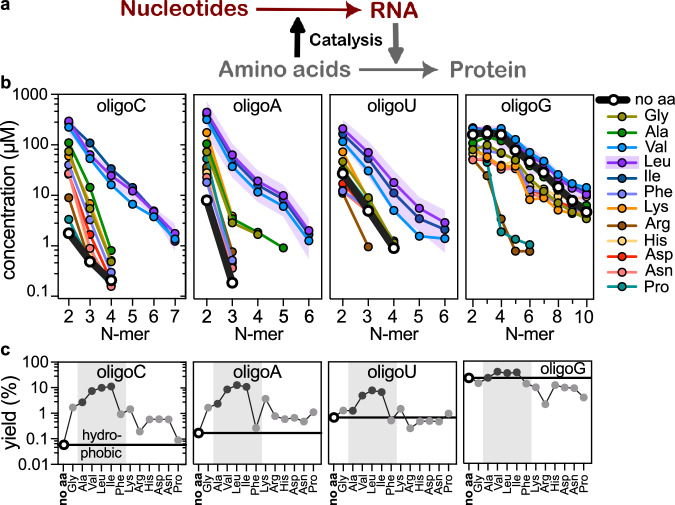
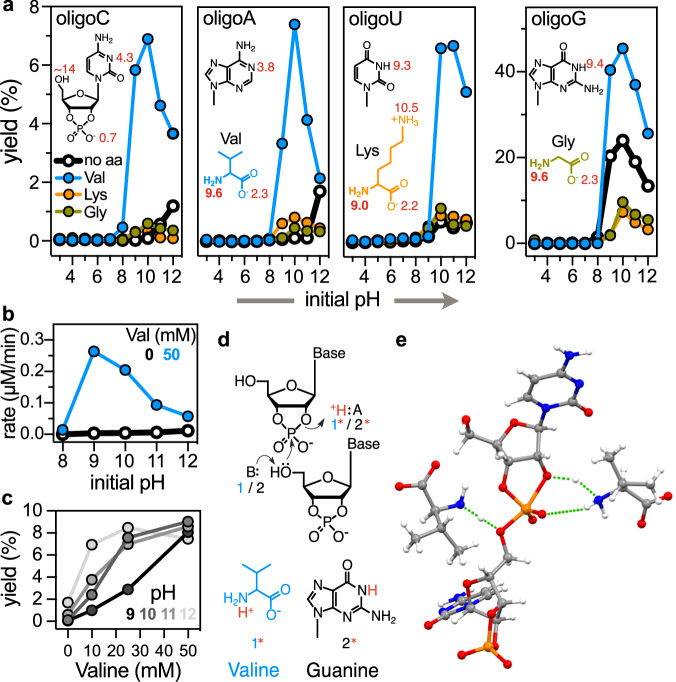
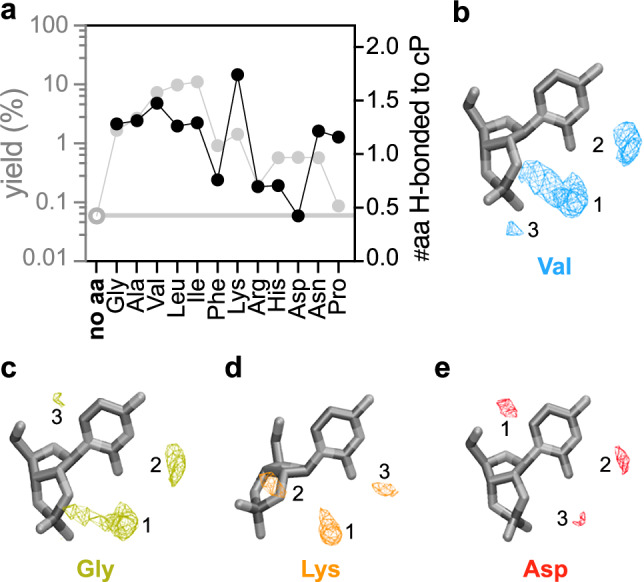
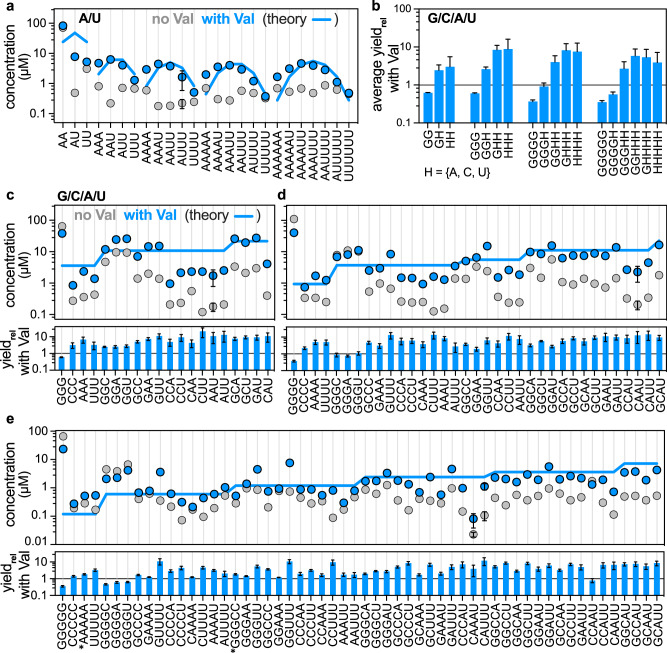
RNA and proteins are the foundation of life and a natural starting point to explore its origins. However, the prebiotic relationship between the two is asymmetric. While RNA evolved to assemble proteins from amino acids, a significant mirror-symmetric effect of amino acids to trigger the synthesis of RNA was missing. We describe ambient alkaline conditions where amino acids, without additional chemical activators, promote RNA copolymerisation more than 100-fold, starting from prebiotically plausible ribonucleoside-2′,3′-cyclic phosphates. The observed effect is explained by acid-base catalysis, with optimal efficiency at pH values near the amine p K aH. The fold-change in oligomerisation yield is nucleobase-selective, resulting in increased compositional diversity necessary for subsequent molecular evolution and favouring the formation of natural 3′−5′ linkages. The elevated pH offers recycling of oligonucleotide sequences back to 2′,3′-cyclic phosphates, providing conditions for high-fidelity replication by templated ligation. The findings reveal a clear functional role of amino acids in the evolution of RNA earlier than previously assumed.
Overview
The claims and statistics of this paper haven’t been checked yet.
Free: it reads the open-access text and checks the first 5 claims that cite a source we can check. Create a free account to check every claim.
Integrity signals
Registry
Cites
Statistics
Figures
Verification
Claims the paper makes
The claims and statistics of this paper haven’t been checked yet.
Free: it reads the open-access text and checks the first 5 claims that cite a source we can check. Create a free account to check every claim.
Claims other papers make about this one
Each is checked against this paper’s own text: does it say what the citing paper says it does?
The cited source says what the claim attributes to it.
In the citing paper
“The first strategy can rely on bottom-up or reconstitution SB approaches and transcription-translation systems, or on organocatalysis (Gorlero et al., 2009; Wieczorek et al., 2017; Rout et al., 2025)”
From Wetware network-based AI: a chemical approach to embodied cognition for robotics and artificial intelligence (2026) · cites this paper as Rout et al., 2025
Self-check
Percentages, sums and reported differences re-computed from the paper’s own numbers.
The self-check needs the paper’s full text.
Citations
Cites
Gilbert, W. (1986) · Nature · doi:10.1038/319618a0 · Cited by 2,721 · cited 1×
“At the very least they can consider if the “enhanced up to 100-fold” is really “enhanced by at least 100-fold”.”
Kruger, K., Grabowski, P. J., Zaug, A. J., Sands, J., Gottschling, D. E., & Cech, T. R. (1982) · Cell · doi:10.1016/0092-8674(82)90414-7 · Cited by 2,331
Nirenberg, M. W., & Matthaei, J. H. (1961) · Proceedings of the National Academy of Sciences · doi:10.1073/pnas.47.10.1588 · Cited by 1,630
Synthesis of activated pyrimidine ribonucleotides in prebiotically plausible conditions.
Powner, M. W., Gerland, B., & Sutherland, J. D. (2009) · Nature · doi:10.1038/nature08013 · Cited by 1,383
Self-citationThree-dimensional structure of a hammerhead ribozyme
Pley, H. W., Flaherty, K. M., & McKay, D. B. (1994) · Nature · doi:10.1038/372068a0 · Cited by 953
Common origins of RNA, protein and lipid precursors in a cyanosulfidic protometabolism
Patel, B. H., Percivalle, C., Ritson, D. J., Duffy, C. D., & Sutherland, J. D. (2015) · Nature Chemistry · doi:10.1038/nchem.2202 · Cited by 949
The chemical repertoire of natural ribozymes
Doudna, J. A., & Cech, T. R. (2002) · Nature · doi:10.1038/418222a · Cited by 745
Li, Y., & Breaker, R. R. (1999) · Journal of the American Chemical Society · doi:10.1021/ja990592p · Cited by 587
Ribozyme-catalyzed transcription of an active ribozyme
Wochner, A., Attwater, J., Coulson, A., & Holliger, P. (2011) · Science · doi:10.1126/science.1200752 · Cited by 399
Unified Prebiotically Plausible Synthesis of Pyrimidine and Purine RNA Ribonucleotides
Becker, S., Feldmann, J., Wiedemann, S., Okamura, H., Schneider, C., Iwan, K., Crisp, A., Rossa, M., Amatov, T., & Carell, T. (2019) · Science · doi:10.1126/science.aax2747 · Cited by 306
Lipid-assisted synthesis of RNA-like polymers from mononucleotides
Rajamani, S., Vlassov, A., Benner, S., Coombs, A., Olasagasti, F., & Deamer, D. (2008) · Origins of Life and Evolution of Biospheres · doi:10.1007/s11084-007-9113-2 · Cited by 272
Amplification of RNA by an RNA polymerase ribozyme
Horning, D. P., & Joyce, G. F. (2016) · Proceedings of the National Academy of Sciences · doi:10.1073/pnas.1610103113 · Cited by 261
More than the sum of their parts: On the evolution of proteins from peptides
Söding, J., & Lupas, A. N. (2003) · BioEssays · doi:10.1002/bies.10321 · Cited by 252
Two types of Archean continental crust: Plume and plate tectonics on early Earth
Van Kranendonk, M. J. (2010) · American Journal of Science · doi:10.2475/10.2010.01 · Cited by 238
Ferris, J. P., & Ertem, G. (1993) · Journal of the American Chemical Society · doi:10.1021/ja00079a006 · Cited by 207
A carbonate-rich lake solution to the phosphate problem of the origin of life
Toner, J. D., & Catling, D. C. (2020) · Proceedings of the National Academy of Sciences · doi:10.1073/pnas.1916109117 · Cited by 201
Peptide ligation by chemoselective aminonitrile coupling in water
Canavelli, P., Islam, S., & Powner, M. W. (2019) · Nature · doi:10.1038/s41586-019-1371-4 · Cited by 188
Self-citationJarvinen, P., Oivanen, M., & Lonnberg, H. (1991) · The Journal of Organic Chemistry · doi:10.1021/jo00018a037 · Cited by 180 · cited 1×
“A similar result has been shortly mentioned by Järvinen et al. (1991): “In contrast, the 2 '-O-ionized 3',5'-dinucleoside monophosphates are cleaved less readily than their 3'-O-ionized 2',5'- counterparts”.”
Nucleic Acid Catalysis: Metals, Nucleobases, and Other Cofactors
Ward, W. L., Plakos, K., & DeRose, V. J. (2014) · Chemical Reviews · doi:10.1021/cr400476k · Cited by 177
Enhanced Nonenzymatic RNA Copying with 2-Aminoimidazole Activated Nucleotides
Li, L., Prywes, N., Tam, C. P., O’Flaherty, D. K., Lelyveld, V. S., Izgu, E. C., Pal, A., & Szostak, J. W. (2017) · Journal of the American Chemical Society · doi:10.1021/jacs.6b13148 · Cited by 176
Selective prebiotic formation of RNA pyrimidine and DNA purine nucleosides
Xu, J., Chmela, V., Green, N. J., Russell, D. A., Janicki, M. J., Góra, R. W., Szabla, R., Bond, A. D., & Sutherland, J. D. (2020) · Nature · doi:10.1038/s41586-020-2330-9 · Cited by 176 · cited 1×
“Our responses to the raised concerns are highlighted in blue, and sections which show changed parts in the manuscript are in blue and bold .”
Multiple translational products from a five-nucleotide ribozyme
Turk, R. M., Chumachenko, N. V., & Yarus, M. (2010) · Proceedings of the National Academy of Sciences · doi:10.1073/pnas.0912895107 · Cited by 157
Efficient enzyme-free copying of all four nucleobases templated by immobilized RNA
Deck, C., Jauker, M., & Richert, C. (2011) · Nature Chemistry · doi:10.1038/nchem.1086 · Cited by 155
Catalysts for the self-polymerization of adenosine cyclic 2′,3′-phosphate
Verlander, M. S., Lohrmann, R., & Orgel, L. E. (1973) · Journal of Molecular Evolution · doi:10.1007/bf01654098 · Cited by 142 · cited 2×
“In several places in the manuscript (Abstract, line 277) the authors say that length dependent concentrations are enhanced up to 100-fold by amino acids, but it could be much more than this for the 6mer and 7mers.”
Mutually stabilizing interactions between proto-peptides and RNA
Frenkel-Pinter, M., Haynes, J. W., Mohyeldin, A. M., C, M., Sargon, A. B., Petrov, A. S., Krishnamurthy, R., Hud, N. V., Williams, L. D., & Leman, L. J. (2020) · Nature Communications · doi:10.1038/s41467-020-16891-5 · Cited by 118
Kinetic and Mechanistic Analysis of Nonenzymatic, Template-Directed Oligoribonucleotide Ligation
Rohatgi, R., Bartel, D. P., & Szostak, J. W. (1996) · Journal of the American Chemical Society · doi:10.1021/ja953712b · Cited by 115
Islam, S., Bučar, D.-K., & Powner, M. W. (2017) · Nature Chemistry · doi:10.1038/nchem.2703 · Cited by 115
Self-citationDirect p Ka Measurement of the Active-Site Cytosine in a Genomic Hepatitis Delta Virus Ribozyme
Lupták, A., Ferré-D'Amaré, A. R., Zhou, K., Zilm, K. W., & Doudna, J. A. (2001) · Journal of the American Chemical Society · doi:10.1021/ja016091x · Cited by 105
Harnessing chemical energy for the activation and joining of prebiotic building blocks
Liu, Z., Wu, L.-F., Xu, J., Bonfio, C., Russell, D. A., & Sutherland, J. D. (2020) · Nature Chemistry · doi:10.1038/s41557-020-00564-3 · Cited by 104 · cited 1×
“The “RNA world” simply means that at some point in time in the evolution of life RNA played the key role in storing and replicating information; it doesn’t mean that RNA didn’t have any help from amino acids or other metabolites.”
A Highly Reactive Imidazolium-Bridged Dinucleotide Intermediate in Nonenzymatic RNA Primer Extension
Walton, T., & Szostak, J. W. (2016) · Journal of the American Chemical Society · doi:10.1021/jacs.6b07977 · Cited by 102
Gong, B., Chen, J.-H., Chase, E., Chadalavada, D. M., Yajima, R., Golden, B. L., Bevilacqua, P. C., & Carey, P. R. (2007) · Journal of the American Chemical Society · doi:10.1021/ja0743893 · Cited by 99
Catalysts for the polymerization of adenosine cyclic 2′,3′-phosphate on a poly (U) template
Renz, M., Lohrmann, R., & Orgel, L. E. (1971) · Biochimica et Biophysica Acta (BBA) - Nucleic Acids and Protein Synthesis · doi:10.1016/0005-2787(71)90703-9 · Cited by 99
Amyloid Aggregates Arise from Amino Acid Condensations under Prebiotic Conditions
Greenwald, J., Friedmann, M. P., & Riek, R. (2016) · Angewandte Chemie International Edition · doi:10.1002/anie.201605321 · Cited by 99
Common and Potentially Prebiotic Origin for Precursors of Nucleotide Synthesis and Activation
Fahrenbach, A. C., Giurgiu, C., Tam, C. P., Li, L., Hongo, Y., Aono, M., & Szostak, J. W. (2017) · Journal of the American Chemical Society · doi:10.1021/jacs.7b01562 · Cited by 96
Heated gas bubbles enrich, crystallize, dry, phosphorylate and encapsulate prebiotic molecules
Morasch, M., Liu, J., Dirscherl, C. F., Ianeselli, A., Kühnlein, A., Le Vay, K., Schwintek, P., Islam, S., Corpinot, M. K., Scheu, B., et al. (2019) · Nature Chemistry · doi:10.1038/s41557-019-0299-5 · Cited by 96
Self-citationOrigin of life: protoribosome forms peptide bonds and links RNA and protein dominated worlds
Bose, T., Fridkin, G., Davidovich, C., Krupkin, M., Dinger, N., Falkovich, A. H., Peleg, Y., Agmon, I., Bashan, A., & Yonath, A. (2022) · Nucleic Acids Research · doi:10.1093/nar/gkac052 · Cited by 96
Prebiotically plausible mechanisms increase compositional diversity of nucleic acid sequences
Derr, J., Manapat, M. L., Rajamani, S., Leu, K., Xulvi-Brunet, R., Joseph, I., Nowak, M. A., & Chen, I. A. (2012) · Nucleic Acids Research · doi:10.1093/nar/gks065 · Cited by 74 · cited 1×
“More helpful would be to discuss how arginine, which inhibits G polymerization the most, can pair with the Hoogsteen face of G, or in the previous comment that Phe can stack with the bases and interfere with some kind of organization/alignment.”
Beyond DNA and RNA: The Expanding Toolbox of Synthetic Genetics
Taylor, A. I., Houlihan, G., & Holliger, P. (2019) · Cold Spring Harbor Perspectives in Biology · doi:10.1101/cshperspect.a032490 · Cited by 72 · cited 1×
“At the very least they can consider if the “enhanced up to 100-fold” is really “enhanced by at least 100-fold”.”
Geothermal systems in Iceland: Structure and conceptual models—II. Low-temperature areas
Arnórsson, S. (1995) · Geothermics · doi:10.1016/0375-6505(95)00026-7 · Cited by 66
Specificity of oligonucleotide synthesis directed by polyuridylic acid.
Sulston, J., Lohrmann, R., Orgel, L. E., & Miles, H. T. (1968) · Proceedings of the National Academy of Sciences · doi:10.1073/pnas.60.2.409 · Cited by 57
Verlander, M. S., & Orgel, L. E. (1974) · Journal of Molecular Evolution · doi:10.1007/bf01796557 · Cited by 56 · cited 1×
“In several places in the manuscript (Abstract, line 277) the authors say that length dependent concentrations are enhanced up to 100-fold by amino acids, but it could be much more than this for the 6mer and 7mers.”
Structured sequences emerge from random pool when replicated by templated ligation
Kudella, P. W., Tkachenko, A. V., Salditt, A., Maslov, S., & Braun, D. (2021) · Proceedings of the National Academy of Sciences · doi:10.1073/pnas.2018830118 · Cited by 54 · cited 1×
“More helpful would be to discuss how arginine, which inhibits G polymerization the most, can pair with the Hoogsteen face of G, or in the previous comment that Phe can stack with the bases and interfere with some kind of organization/alignment.”
Self-citationSingle nucleotide translation without ribosomes
Jash, B., Tremmel, P., Jovanovic, D., & Richert, C. (2021) · Nature Chemistry · doi:10.1038/s41557-021-00749-4 · Cited by 53
Yamagata, Y., Inoue, H., & INOMATA, K. (1995) · Origins of Life and Evolution of Biospheres · doi:10.1007/bf01581572 · Cited by 49 · cited 1×
“The “RNA world” simply means that at some point in time in the evolution of life RNA played the key role in storing and replicating information; it doesn’t mean that RNA didn’t have any help from amino acids or other metabolites.”
Heated gas bubbles enrich, crystallize, dry, phosphorylate and encapsulate prebiotic molecules
Morasch, M., Liu, J., Dirscherl, C., Ianeselli, A., Kühnlein, A., Le Vay, K., Schwintek, P., Islam, S., Corpinot, M., Scheu, B., et al. (2019) · UCL Discovery (University College London) · Cited by 49
Self-citationDass, A. V., Wunnava, S., Langlais, J., von der Esch, B., Krusche, M., Ufer, L., Chrisam, N., Dubini, R. C. A., Gartner, F. M., Angerpointner, S., et al. (2022) · ChemSystemsChem · doi:10.1002/syst.202200026 · Cited by 49 · cited 1×
“Is there any other possibility?”
Self-citationNon‐Enzymatic Assembly of a Minimized RNA Polymerase Ribozyme
Wachowius, F., & Holliger, P. (2019) · ChemSystemsChem · doi:10.1002/syst.201900004 · Cited by 46
Heat flows enrich prebiotic building blocks and enhance their reactivity
Matreux, T., Aikkila, P., Scheu, B., Braun, D., & Mast, C. B. (2024) · Nature · doi:10.1038/s41586-024-07193-7 · Cited by 46
Self-citationThermal Habitat for RNA Amplification and Accumulation
Salditt, A., Keil, L. M. R., Horning, D. P., Mast, C. B., Joyce, G. F., & Braun, D. (2020) · Physical Review Letters · doi:10.1103/physrevlett.125.048104 · Cited by 44
Self-citationWater cycles in a Hadean CO2 atmosphere drive the evolution of long DNA
Ianeselli, A., Atienza, M., Kudella, P. W., Gerland, U., Mast, C. B., & Braun, D. (2022) · Nature Physics · doi:10.1038/s41567-022-01516-z · Cited by 35
Self-citationHigh-Fidelity RNA Copying via 2′,3′-Cyclic Phosphate Ligation
Serrão, A. C., Wunnava, S., Dass, A. V., Ufer, L., Schwintek, P., Mast, C. B., & Braun, D. (2024) · Journal of the American Chemical Society · doi:10.1021/jacs.3c10813 · Cited by 30
Self-citationRibozyme-mediated RNA synthesis and replication in a model Hadean microenvironment
Salditt, A., Karr, L., Salibi, E., Vay, K. K. L., Braun, D., & Mutschler, H. (2023) · Nature Communications · doi:10.1038/s41467-023-37206-4 · Cited by 28
Self-citationAn Analysis of Nucleotide–Amyloid Interactions Reveals Selective Binding to Codon-Sized RNA
Rout, S. K., Cadalbert, R., Schröder, N., Wang, J., Zehnder, J., Gampp, O., Wiegand, T., Güntert, P., Klingler, D., Kreutz, C., et al. (2023) · Journal of the American Chemical Society · doi:10.1021/jacs.3c06287 · Cited by 28
Self-citationNonenzymatic assembly of active chimeric ribozymes from aminoacylated RNA oligonucleotides
Radakovic, A., DasGupta, S., Wright, T. H., Aitken, H. R. M., & Szostak, J. W. (2022) · Proceedings of the National Academy of Sciences · doi:10.1073/pnas.2116840119 · Cited by 23 · cited 1×
“The “RNA world” simply means that at some point in time in the evolution of life RNA played the key role in storing and replicating information; it doesn’t mean that RNA didn’t have any help from amino acids or other metabolites.”
Regioselective formation of RNA strands in the absence of magnesium ions
Motsch, S., Tremmel, P., & Richert, C. (2019) · Nucleic Acids Research · doi:10.1093/nar/gkz1125 · Cited by 21 · cited 2×
“For quantification, peaks were assigned by comparison with the details reported in Motsch et al. 2019 (Ref.”
Geochemical influences on nonenzymatic oligomerization of prebiotically relevant cyclic nucleotides
Dagar, S., Sarkar, S., & Rajamani, S. (2020) · RNA · doi:10.1261/rna.074302.119 · Cited by 20
A Potential Role for Aminoacylation in Primordial RNA Copying Chemistry
Radakovic, A., Wright, T. H., Lelyveld, V. S., & Szostak, J. W. (2021) · Biochemistry · doi:10.1021/acs.biochem.0c00943 · Cited by 19
High-Yield Prebiotic Polymerization of 2′,3′-Cyclic Nucleotides under Wet–Dry Cycling
Caimi, F., Langlais, J., Fontana, F., Wunnava, S., Bellini, T., Braun, D., & Fraccia, T. P. (2025) · ACS Central Science · doi:10.1021/acscentsci.5c00488 · Cited by 14
Self-citationProlinyl Nucleotides Drive Enzyme‐Free Genetic Copying of RNA
Welsch, F., Kervio, E., Tremmel, P., & Richert, C. (2023) · Angewandte Chemie International Edition · doi:10.1002/anie.202307591 · Cited by 13 · cited 1×
“This is a false argument / logical fallacy.”
Enzymatic Catalysis in Organic Media for Polymer Synthesis
Lalot, T., Brigodiot, M., & Maréchal, E. (1989) · Comprehensive Polymer Science and Supplements · doi:10.1016/b978-0-08-096701-1.00241-x · Cited by 4 · cited 1×
“…hydrolysis at this temperature led to preserving more 2', 3'-cyclic -cyclic phosphates In the same figure, (maybe it is a mistake) in the section c of the figure, OligoG it is visible some temperature of 60 C and some signals as a background (light green The manuscript entitled: “Amino acids…”
RNA auto-polymerisation from 2’,3’-cyclic nucleotides atair-water interfacesPreprint
Dass, A. V., Wunnava, S., Langlais, J., von der Esch, B., Krusche, M., Ufer, L., Chrisam, N., Dubini, R. C. A., Gartner, F. M., Angerpointner, S., et al. (2022) · ChemRxiv · doi:10.26434/chemrxiv-2022-zwh2t · Cited by 2
Self-citationRout, S. K., Wunnava, S., & Braun, D. (2025) · Universitätsbibliothek der LMU · doi:10.5282/ubm/data.588 · Cited by 1
Self-citationKrepl, M. (2025) · Zenodo (CERN European Organization for Nuclear Research) · doi:10.5281/zenodo.15307807 · Cited by 1
Self-citationKrepl, M. (2025) · Zenodo · doi:10.5281/zenodo.15307808
Self-citation
Cited by
High-Yield Prebiotic Polymerization of 2′,3′-Cyclic Nucleotides under Wet–Dry Cycling
Caimi, F., Langlais, J., Fontana, F., Wunnava, S., Bellini, T., Braun, D., & Fraccia, T. P. (2025) · ACS Central Science · doi:10.1021/acscentsci.5c00488 · Cited by 14
Self-citationIntermediate stages in the origin of metabolism at a phosphorylating hydrothermal vent
Mrnjavac, N., Hoffmann, N. K., Schlikker, M. L., Burmeister, M., Schwander, L., García, C. G., Brabender, M., Steel, M., Huson, D. H., Metzger, S. U., et al. (2026) · Science Advances · doi:10.1126/sciadv.aef3128 · Cited by 14
“As expected, amino acids arise first, followed by nucleotides, consistent with their inferred synergistic interactions at origins ( 92 ), with cofactors emerging last (Fig.”
A symbiotic origin of the ribosome?
Lynch, M., & Ellington, A. D. (2026) · PNAS Nexus · doi:10.1093/pnasnexus/pgag019 · Cited by 6
“It is relatively easy to select for small ribozymes capable of forming peptide bonds (56), and in some settings, single amino acids can facilitate RNA polymerization (57).”
Theory for sequence selection via phase separation and oligomerization
Haugerud, I. S., Bartolucci, G., Dieter, B., & Weber, C. A. (2026) · Proceedings of the National Academy of Sciences · doi:10.1073/pnas.2422829123 · Cited by 7
“…the addition of amino acids was reported to have a profound effect on the base composition, leading to a much more balanced sequence distribution, attributed mostly to a general base catalytic opening of the 2 ,3 -cyclic phosphate at the nucleotides by the amine group of the amino acids (81).”
Electrosynthesis of amino acids: Innovations, challenges, and future prospects
Ye, D., Zhao, R., Li, W., Lin, H., Nie, Y., Liu, L., & Xi, J. (2026) · eScience · doi:10.1016/j.esci.2026.100585 · Cited by 3
Metadata
- Authors
- Rout, S. K., Wunnava, S., Krepl, M., Cassone, G., Šponer, J. E., Mast, C. B., Powner, M. W., & Braun, D.
- Affiliations
- Center for NanoScience (DE)
- Czech Academy of Sciences, Institute of Biophysics (CZ)
- Institute for Chemical and Physical Processes (IT)
- University College London (GB)
- Corresponding author
- Braun, Dieter
- ORCID
- Venue
- Nature Communications
- Published
- 2025-06-04
- Volume
- 16
- Issue
- 1
- Pages
- 5193-5193
- ISSN
- 2041-1723 (ISSN-L)
- PMC
- PMC12137669
- OpenAlex
- W4411021128
- Cited by
- 15
- References
- 61
- Citations by year
- 2026: 12 · 2025: 3
- FWCI
- 6.64
- Type
- journal article
- Language
- en
- Open access
- gold
- doi.org
- Licence
- cc-by
- creativecommons.org/licenses/by/4.0 (tdm)
- creativecommons.org/licenses/by/4.0 (vor)
- Locations
- Nature Communications (publishedVersion, cc-by)
- Europe PMC (PubMed Central) (publishedVersion, cc-by)
- PubMed Central (publishedVersion, cc-by)
- PubMed (publishedVersion)
- DOAJ (DOAJ: Directory of Open Access Journals) (submittedVersion, cc-by-sa)
- Repository for Publications and Research Data (ETH Zurich) (submittedVersion, cc-by)
- ETH Zürich Research Collection
- Funders
- National Science Foundation
- Simons Foundation (327125)
- Deutsche Forschungsgemeinschaft (521256690, EXC 2094390783311, 364653263, CRC 235, CRC392, EXC 2094, 390783311)
- Volkswagen Foundation
- Schweizerischer Nationalfonds zur Förderung der Wissenschaftlichen Forschung (206871)
- Grantová Agentura České Republiky (GA22-25057S)
- H2020 European Research Council (787356)
- Topics
- Physical Sciences › Physics and Astronomy › Astronomy and Astrophysics › Origins and Evolution of Life
- Life Sciences › Biochemistry, Genetics and Molecular Biology › Molecular Biology › RNA and protein synthesis mechanisms
- Life Sciences › Biochemistry, Genetics and Molecular Biology › Molecular Biology › DNA and Nucleic Acid Chemistry
- Keywords
- amino acids, prebiotic chemistry, acid-base catalysis, alkaline conditions, RNA replication, prebiotic evolution
- MeSH terms
- Origin of Life, Amino Acids, Catalysis, Hydrogen-Ion Concentration, RNA, Evolution, Molecular, Polymerization
About these checks
Registry, retraction, Cites and statistics results are computed, not judged, with one exception: a printed reference that no index lists is read once by a model before it counts as a citation error. Claims are extracted by a model and kept only when their quote appears verbatim in the text; each cited source is then checked, with a model’s help, for whether it says what the claim relies on. Those verdicts can be wrong — read the claim’s quote and the cited source before relying on one.
Statistics and arithmetic are recomputed, not judged.
Confidence bands are shown only for fields calibrated on our annotated test set. None is calibrated yet, so no band is shown.
What counts as a claim ›How we measure confidence ›How we check this ›
Are you an author, or do you see a problem with this page? Request a review
Data sources
Bibliographic data: Semantic Scholar, OpenAlex, Crossref.
Contains information from the Semantic Scholar Academic Graph Datasets, made available under the ODC Attribution License (ODC-BY 1.0).
Semantic Scholar’s data is described in: Kinney, R., et al. (2023). The Semantic Scholar Open Data Platform. arXiv:2301.10140.
