

Effects of centrifugation and whole-body vibrations on blood–brain barrier permeability in mice
Open accessThe DOI matches its Crossref record; 43 of the 43 references it cites were found in a registry or an index.
Abstract
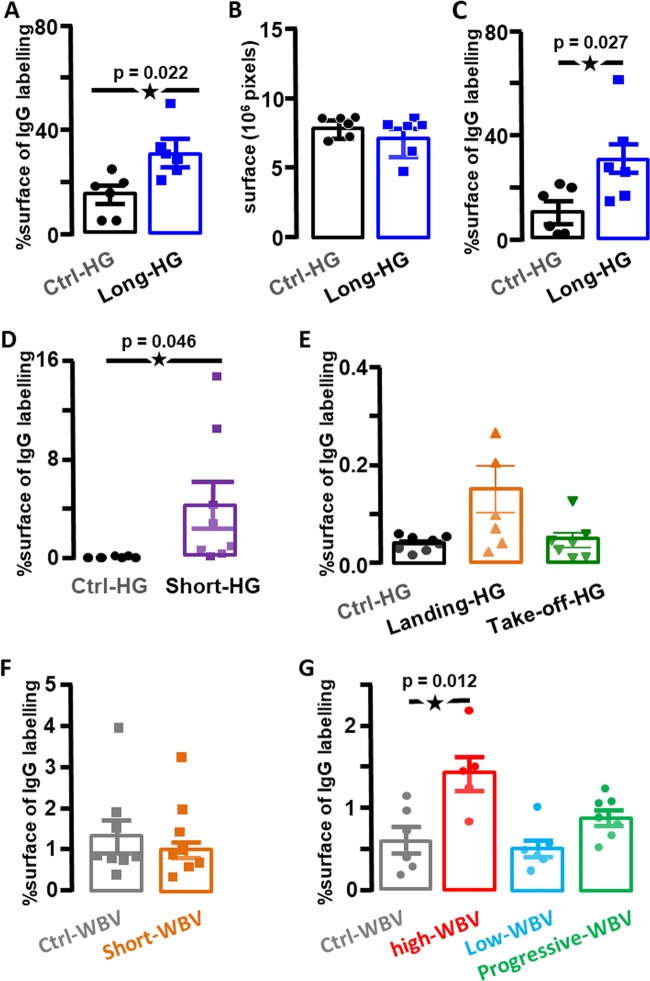
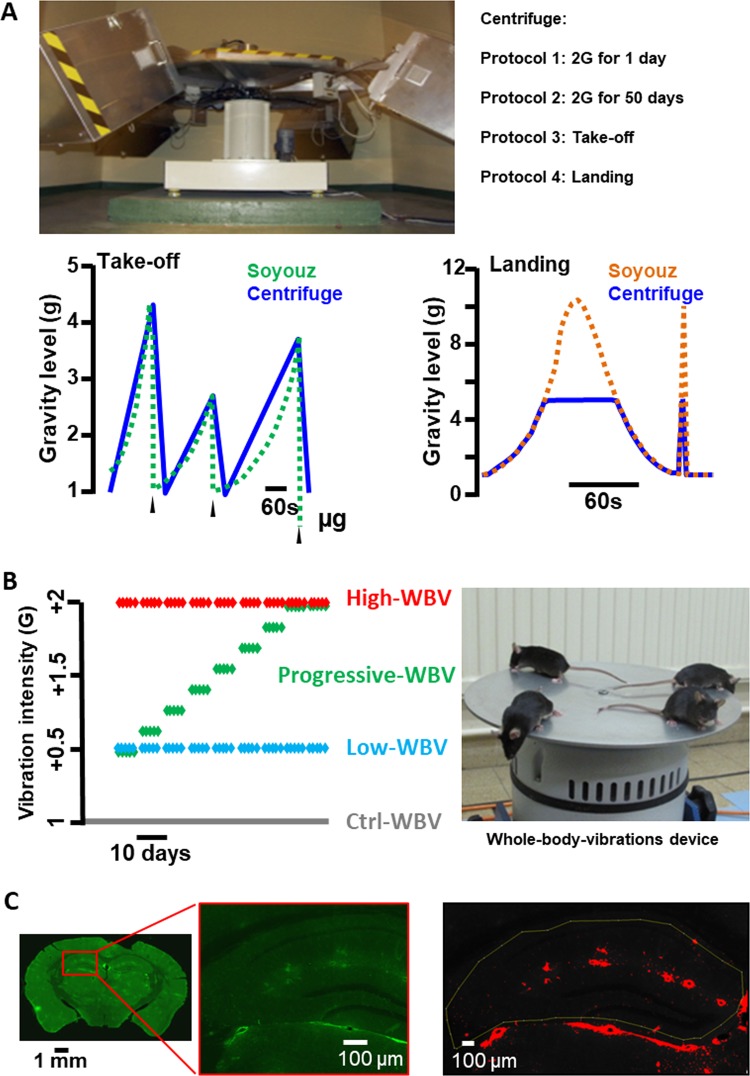
Modifications of gravity levels induce generalized adaptation of mammalian physiology, including vascular, brain, muscle, bone and immunity functions. As a crucial interface between the vascular system and the brain, the blood–brain barrier (BBB) acts as a filter to protect neurons from pathogens and inflammation. Here we compare the effects of several protocols of hypergravity induced by centrifugation and whole-body vibrations (WBV) on BBB integrity. The immunohistochemistry revealed immunoglobulin G (IgG) extravasation from blood to hippocampal parenchyma of mice centrifuged at 2 × g during 1 or 50 days, whereas short exposures to higher hypergravity mimicking the profiles of spaceflight landing and take-off (short exposures to 5 × g) had no effects. These results suggest prolonged centrifugation (>1 days) at 2 × g induced a BBB leakage. Moreover, WBV were similarly tested. The short exposure to +2 × g vibrations (900 s/day at 90 Hz) repeated for 63 days induced IgG extravasation in hippocampal parenchyma, whereas the progressive increase of vibrations from +0.5 to +2 × g for 63 days was not able to affect the IgG crossing through the BBB. Overall, these results suggest that the BBB permeability is sensitive to prolonged external accelerations. In conclusion, we advise that the protocols of WBV and centrifugation, proposed as countermeasure to spaceflight, should be designed with progressively increasing exposure to reduce potential side effects on the BBB.
Overview
The claims and statistics of this paper haven’t been checked yet.
Free: it reads the open-access text and checks the first 5 claims that cite a source we can check. Create a free account to check every claim.
Integrity signals
Registry
Cites
Statistics
Figures
Verification
Claims the paper makes
The claims and statistics of this paper haven’t been checked yet.
Free: it reads the open-access text and checks the first 5 claims that cite a source we can check. Create a free account to check every claim.
Claims other papers make about this one
Each is checked against this paper’s own text: does it say what the citing paper says it does?
The check wasn’t confident either way, so it gives no verdict — never disputed.
In the citing paper
“From a short-term perspective (e.g., a 6-month ISS deployment), SANS presents four main risks to crewmembers and their mission: optic disc edema (ODE), chorioretinal folds, shifts in refractive error, and globe flattening49.”
From Red risks for a journey to the red planet: The highest priority human health risks for a mission to Mars (2020) · cites this paper as [49]
Experimental — accuracy not yet measured
Self-check
Percentages, sums and reported differences re-computed from the paper’s own numbers.
The self-check needs the paper’s full text.
Citations
Cites
Blood-Brain Barrier: From Physiology to Disease and Back
Sweeney, M. D., Zhao, Z., Montagne, A., Nelson, A. R., & Zlokovic, B. V. (2019) · Physiological Reviews · doi:10.1152/physrev.00050.2017 · Cited by 2,312 · cited 2×
“As also proposed in the field of neurodegenerative disorders, an impairment of the BBB is suggested to induce or accelerate the processes of the memory impairments.(17) Our work participates to confirm the link between BBB dysfunction induced by gravity changes and putative memory impairments hypothesized recently,(15…”
BackgroundFriedman, A., Kaufer, D., Shemer, J., Hendler, I., Soreq, H., & Tur-Kaspa, I. (1996) · Nature Medicine · doi:10.1038/nm1296-1382 · Cited by 360
Delp, M. D., Charvat, J. M., Limoli, C. L., Globus, R. K., & Ghosh, P. (2016) · Scientific Reports · doi:10.1038/srep29901 · Cited by 216
The effect of spaceflight and microgravity on the human brain
Van Ombergen, A., Demertzi, A., Tomilovskaya, E., Jeurissen, B., Sijbers, J., Kozlovskaya, I. B., Parizel, P. M., Van de Heyning, P. H., Sunaert, S., Laureys, S., et al. (2017) · Journal of Neurology · doi:10.1007/s00415-017-8427-x · Cited by 175
Centrifugation as a countermeasure during actual and simulated microgravity: a review
Clement, G. R., & Traon, A. P. (2004) · European Journal of Applied Physiology · doi:10.1007/s00421-004-1118-1 · Cited by 154
Lee, J. K., Koppelmans, V., Riascos, R. F., Hasan, K. M., Pasternak, O., Mulavara, A. P., Bloomberg, J. J., & Seidler, R. D. (2019) · JAMA Neurology · doi:10.1001/jamaneurol.2018.4882 · Cited by 149
Brain ventricular volume changes induced by long-duration spaceflight
Van Ombergen, A., Jillings, S., Jeurissen, B., Tomilovskaya, E., Rumshiskaya, A., Litvinova, L., Nosikova, I., Pechenkova, E., Rukavishnikov, I., Manko, O., et al. (2019) · Proceedings of the National Academy of Sciences · doi:10.1073/pnas.1820354116 · Cited by 148
The Impact of Microgravity and Hypergravity on Endothelial Cells
Maier, J. A. M., Cialdai, F., Monici, M., & Morbidelli, L. (2015) · BioMed Research International · doi:10.1155/2015/434803 · Cited by 143
Brain Tissue–Volume Changes in Cosmonauts
Van Ombergen, A., Jillings, S., Jeurissen, B., Tomilovskaya, E., Rühl, R. M., Rumshiskaya, A., Nosikova, I., Litvinova, L., Annen, J., Pechenkova, E. V., et al. (2018) · New England Journal of Medicine · doi:10.1056/nejmc1809011 · Cited by 124
Increased permeability of blood–brain barrier on the hippocampus of a murine model of senescence
Pelegrí, C., Canudas, A. M., del Valle, J., Casadesús, G., Smith, M. A., Camins, A., Pallàs, M., & Vilaplana, J. (2007) · Mechanisms of Ageing and Development · doi:10.1016/j.mad.2007.07.002 · Cited by 108 · cited 1×
“Immunoglobulin G (IgG) extravasation is commonly used as an index of BBB disruption.(19) Because centrifugation and WBV are proposed as countermeasures to microgravity, we have tested several protocols of centrifugation and WBV on the BBB integrity by measuring the presence of immunoglobulins in the hippocampal parenc…”
Method
Cited by
Fundamental Biological Features of Spaceflight: Advancing the Field to Enable Deep-Space Exploration
Afshinnekoo, E., Scott, R. T., MacKay, M. J., Pariset, E., Cekanaviciute, E., Barker, R., Gilroy, S., Hassane, D., Smith, S. M., Zwart, S. R., et al. (2020) · Cell · doi:10.1016/j.cell.2020.10.050 · Cited by 478
Patel, Z. S., Brunstetter, T. J., Tarver, W. J., Whitmire, A. M., Zwart, S. R., Smith, S. M., & Huff, J. L. (2020) · npj Microgravity · doi:10.1038/s41526-020-00124-6 · Cited by 373
Microbial applications for sustainable space exploration beyond low Earth orbit
Koehle, A. P., Brumwell, S. L., Seto, E. P., Lynch, A. M., & Urbaniak, C. (2023) · npj Microgravity · doi:10.1038/s41526-023-00285-0 · Cited by 117
Janigro, D., Bailey, D. M., Lehmann, S., Badaut, J., O’flynn, R., Hirtz, C., & Marchi, N. (2021) · Frontiers in Neurology · doi:10.3389/fneur.2020.577312 · Cited by 106
“At the cellular level, microgravity has been associated with a loss of cytoskeletal integrity through dissociation of actin and tubulin bundles (227), and evidence obtained using animal models suggests that BBB disruption may occur during the early phases of unloading induced by suspension or microgravity (228) and du…”
BackgroundPhysiological and Pathological Factors Affecting Drug Delivery to the Brain by Nanoparticles
Islam, Y., Leach, A. G., Smith, J. A., Pluchino, S., Coxon, C. R., Sivakumaran, M., Downing, J. E., Fatokun, A. A., Teixidò, M., & Ehtezazi, T. (2021) · Advanced Science · doi:10.1002/advs.202002085 · Cited by 57
Longitudinal MRI-visible perivascular space (PVS) changes with long-duration spaceflight
Hupfeld, K. E., Richmond, S. B., McGregor, H. R., Schwartz, D. L., Luther, M. N., Beltran, N. E., Kofman, I. S., Dios, Y. E. D., Riascos, R., Wood, S. J., et al. (2022) · Scientific Reports · doi:10.1038/s41598-022-11593-y · Cited by 54
A Systematic Review of Animal Models of Disuse-Induced Bone Loss
Brent, M. B., Brüel, A., & Thomsen, J. S. (2021) · Calcified Tissue International · doi:10.1007/s00223-020-00799-9 · Cited by 50
Bailey, D. M., Lanéelle, D., Trihan, J.-E., Marchi, N., Stacey, B. S., Tamiya, K., Washio, T., Tuaillon, É., Hirtz, C., Lehmann, S., et al. (2020) · Neuroscience · doi:10.1016/j.neuroscience.2020.05.048 · Cited by 43
Ocular complaints and diagnoses in spaceflight
Meer, E. A., Grob, S., Lehnhardt, K. R., & Sawyer, A. (2024) · npj Microgravity · doi:10.1038/s41526-023-00335-7 · Cited by 29
Brains in space: impact of microgravity and cosmic radiation on the CNS during space exploration
Wuyts, F. L., Deblieck, C., Vandevoorde, C., & Durante, M. (2025) · Nature reviews. Neuroscience · doi:10.1038/s41583-025-00923-4 · Cited by 40
Iandolo, D., Strigini, M., Guignandon, A., & Vico, L. (2021) · Current Osteoporosis Reports · doi:10.1007/s11914-021-00713-8 · Cited by 30
Self-citationXiao, X., Brillo, J., Lee, J., HYERS, R. W., & Matson, D. M. (2021) · npj Microgravity · doi:10.1038/s41526-021-00166-4 · Cited by 26
Miniaturizing optical coherence tomography
Rank, E. A., Agneter, A., Schmoll, T., Leitgeb, R. A., & Drexler, W. (2021) · Translational Biophotonics · doi:10.1002/tbio.202100007 · Cited by 28
Zaman, N., Ong, J., Waisberg, E., Masalkhi, M., Lee, A. G., Tavakkoli, A., & Zuckerbrod, S. L. (2023) · Annals of Biomedical Engineering · doi:10.1007/s10439-023-03379-8 · Cited by 30
Mechanism for enhancing the growth of mung bean seedlings under simulated microgravity
Nakajima, S., NAGATA, M., & Ikehata, A. (2021) · npj Microgravity · doi:10.1038/s41526-021-00156-6 · Cited by 27
Yang, J., Barrila, J., Ott, C. M., King, O. G., Bruce, R. J., McLean, R. J. C., & Nickerson, C. A. (2021) · npj Biofilms and Microbiomes · doi:10.1038/s41522-021-00240-5 · Cited by 29
Microgravity × Radiation: A Space Mechanobiology Approach Toward Cardiovascular Function and Disease
Basirun, C., Ferlazzo, M. L., Howell, N. R., Liu, G.-J., Middleton, R. J., Martinac, B., Narayanan, S. A., Poole, K., Gentile, C., & Chou, J. (2021) · Frontiers in Cell and Developmental Biology · doi:10.3389/fcell.2021.750775 · Cited by 22
Ethical considerations for the age of non-governmental space exploration
Seylani, A., Galsinh, A. S., Tasoula, A., I, A. R., Camera, A., Calleja‐Agius, J., Borg, J., Goel, C., Kim, J., Clark, K. B., et al. (2024) · Nature Communications · doi:10.1038/s41467-023-44357-x · Cited by 22
Bonnefoy, J., Ghislin, S., Beyrend, J., Coste, F., Calcagno, G., Lartaud, I., Gauquelin‐Koch, G., Poussier, S., & Frippiat, J. (2021) · International Journal of Molecular Sciences · doi:10.3390/ijms22062961 · Cited by 23
Swamy, B. K., Hosamani, R., Sathasivam, M., Chandrashekhar, S. S., Reddy, U. G., & Moger, N. B. (2021) · Scientific Reports · doi:10.1038/s41598-021-94771-8 · Cited by 17
A magnetic levitation based low-gravity simulator with an unprecedented large functional volume
Sanavandi, H., & Guo, W. (2021) · npj Microgravity · doi:10.1038/s41526-021-00174-4 · Cited by 20
Dubayle, D., Vanden‐Bossche, A., Peixoto, T., & Morel, J. (2023) · Cells · doi:10.3390/cells12050734 · Cited by 12
“Nevertheless, as our data showed, after 24 h of weak exposure at 2 g, the corticosterone levels were not altered in the first hour following the stop of the centrifuge [65].”
BackgroundResultInfluentialSelf-citationFluidic shaping and in-situ measurement of liquid lenses in microgravity
Luria, O., Elgarisi, M., Frumkin, V., Razin, A., Ericson, J., Gommed, K., Widerker, D., Gabay, I., Belikov, R., Bookbinder, J. A., et al. (2023) · npj Microgravity · doi:10.1038/s41526-023-00309-9 · Cited by 10
Koschate, J., Hoffmann, U., Lysova, N. Y., Thieschäfer, L., Drescher, U., & Fomina, E. V. (2021) · Acta Astronautica · doi:10.1016/j.actaastro.2021.05.030 · Cited by 10
Yang, H., Gao, J., Wang, H., Ma, X.-M., Liu, B.-Y., Song, Q. Y., Cheng, H., Li, S., Long, Z.-Y., Lu, X., et al. (2024) · Brain Research · doi:10.1016/j.brainres.2024.149392 · Cited by 12
The Blood-Brain Barrier in Space: Implications for Space Travelers and for Human Health on Earth
Amselem, S., & Eyal, S. (2022) · Frontiers in Drug Delivery · doi:10.3389/fddev.2022.931221 · Cited by 9
Mao, X. W., Pecaut, M. J., Stanbouly, S., & Nelson, G. A. (2024) · Life Sciences in Space Research · doi:10.1016/j.lssr.2024.08.001 · Cited by 19
Masalkhi, M., Ong, J., Waisberg, E., & Lee, A. G. (2024) · Eye · doi:10.1038/s41433-024-03005-4 · Cited by 9
Novakovic, R., Giuranno, D., Mohr, M., & Fecht, H.-J. (2023) · Microgravity Science and Technology · doi:10.1007/s12217-023-10080-x · Cited by 4
Boschert, A. L., Gauger, P., Bach, A., Gerlach, D. A., Johannes, B. W., Jordan, J., Li, Z., Elmenhorst, D., Bauer, A., Marshall-Goebel, K. J., et al. (2023) · npj Microgravity · doi:10.1038/s41526-023-00267-2 · Cited by 5
Bonetto, V., Magnelli, V., Sabbatini, M., Caprì, F., van Loon, J. J. W. A., Tavella, S., & Masini, M. A. (2023) · PLoS ONE · doi:10.1371/journal.pone.0282625 · Cited by 4
Alani, F., Iranbakhsh, A., Ebadi, M., Hassanpour, H., & Hekmat, A. (2023) · Acta Physiologiae Plantarum · doi:10.1007/s11738-023-03596-7 · Cited by 3
Richmond, S. B., Seidler, R. D., Iliff, J. J., Schwartz, D. L., Luther, M. N., Silbert, L. C., Wood, S. J., Bloomberg, J. J., Mulder, E. R., Lee, J. K., et al. (2024) · npj Microgravity · doi:10.1038/s41526-024-00368-6 · Cited by 5
Transcriptomic analysis of DNA damage response in zebrafish embryos under simulated microgravityPreprint
Barua, S., Komissarov, A. S., Kaur, H., & Brodsky, E. (2021) · bioRxiv (Cold Spring Harbor Laboratory) · doi:10.1101/2021.09.30.462627 · Cited by 3
Effects of short-term −30° HDT on contrast sensitivity
Li, J., Shang, S., Zhang, M., Yue, P., Ren, W., Zhang, P., Wang, Z., & Wu, D. (2023) · Perception · doi:10.1177/03010066231175829 · Cited by 2
Bonetto, V., Magnelli, V., Sabbatini, M., Caprì, F., Tavella, S., & Masini, M. A. (2022) · Research Square · doi:10.21203/rs.3.rs-1697393/v1
Bonetto, V., Magnelli, V., Sabbatini, M., Caprì, F., Tavella, S., & Masini, M. A. (2022) · Research Square · doi:10.21203/rs.3.rs-1697393/v2
Cerebral Hemodynamics During Exposure to Hypergravity (+Gz) or Microgravity (0 G)
Sæhle, T. (2022) · Aerospace Medicine and Human Performance · doi:10.3357/amhp.6008.2022
Mathilde, W., Billard, J., & Bouët, V. (2025) · Research Square · doi:10.21203/rs.3.rs-6861935/v1
Mathilde, W., Bouët, V., Fréret, T., & Billard, J. (2025) · Cells · doi:10.3390/cells14151186
“Interestingly, impairment of BBB permeability after 24 h of 2G exposure has recently been characterized in male mice [52,53], which, therefore, closely correlates with the period of weaker synaptic availability of D-serine found in the present study.”
Blood-spinal cord barrier alterations in a mouse model of centrifugation-induced hypergravity
Dubayle, D., Morel, J., & Lemarchant, S. (2025) · Frontiers in Physiology · doi:10.3389/fphys.2025.1658389 · Cited by 1
Self-citationXu, Y., Ding, Y., Pei, W., Zhang, M., Wang, X., Zeng, Q., Hei, T. K., Hu, W., & Zhou, G. (2025) · npj Microgravity · doi:10.1038/s41526-025-00544-2
Selvam, P. P., Kumar, S. V., Biswas, A., Kumari, U., & Parasuraman, S. (2026) · Journal of Pharmacology and Pharmacotherapeutics · doi:10.1177/0976500x261463370
“45 While this model is not very useful in everyday clinical practice, it does help us understand how things work.”
YiTong, G. U. O., Liang, R., Yang, J., & Ming, D. (2026) · Acta Astronautica · doi:10.1016/j.actaastro.2026.10.020
Metadata
- Authors
- Dubayle, D., Vanden-Bossche, A., Beraneck, M., Vico, L., & Morel, J.-L.
- Affiliations
- Centre National de la Recherche Scientifique (FR)
- Inserm (FR)
- Corresponding author
- Morel, Jean-Luc
- Venue
- npj Microgravity
- Published
- 2020-01-07
- Volume
- 6
- Issue
- 1
- Pages
- 1-1
- ISSN
- 2373-8065 (ISSN-L)
- PMC
- PMC6946672
- OpenAlex
- W2999585543
- Semantic Scholar
- 2d794c9dd396647122fcd60ac13e62d0886a01c3
- Cited by
- 44
- References
- 43
- Citations by year
- 2026: 2 · 2025: 5 · 2024: 6 · 2023: 9 · 2022: 5 · 2021: 14 · 2020: 3
- FWCI
- 4.66
- Type
- journal article
- Language
- en
- Open access
- gold
- doi.org
- Licence
- cc-by
- creativecommons.org/licenses/by/4.0 (tdm)
- creativecommons.org/licenses/by/4.0 (vor)
- Locations
- npj Microgravity (publishedVersion, cc-by)
- Europe PMC (PubMed Central) (publishedVersion, cc-by)
- PubMed Central (publishedVersion, cc-by)
- PubMed (publishedVersion)
- HAL (submittedVersion)
- HAL (submittedVersion, other-oa)
- DOAJ (DOAJ: Directory of Open Access Journals) (submittedVersion)
- Funders
- Agence Nationale de la Recherche (ANR-09-BLAN-0148)
- Centre National d'Etudes Spatiales
- Centre National de la Recherche Scientifique
- Université de Bordeaux
- Université Paris Descartes
- Institut National de la Santé et de la Recherche Médicale
- Université de Lyon
- Topics
- Health Sciences › Medicine › Physiology (medical) › Spaceflight effects on biology
- Life Sciences › Neuroscience › Neurology › Barrier Structure and Function Studies
- Health Sciences › Medicine › Orthopedics and Sports Medicine › Effects of Vibration on Health
- Keywords
- blood-brain barrier permeability, hypergravity, centrifugation, whole-body vibration, hippocampus, spaceflight countermeasures, gravity adaptation, microgravity
About these checks
Registry, retraction, Cites and statistics results are computed, not judged, with one exception: a printed reference that no index lists is read once by a model before it counts as a citation error. Claims are extracted by a model and kept only when their quote appears verbatim in the text; each cited source is then checked, with a model’s help, for whether it says what the claim relies on. Those verdicts can be wrong — read the claim’s quote and the cited source before relying on one.
Statistics and arithmetic are recomputed, not judged.
Confidence bands are shown only for fields calibrated on our annotated test set. None is calibrated yet, so no band is shown.
What counts as a claim ›How we measure confidence ›How we check this ›
Are you an author, or do you see a problem with this page? Request a review
Data sources
Bibliographic data: Semantic Scholar, OpenAlex, Crossref.
Contains information from the Semantic Scholar Academic Graph Datasets, made available under the ODC Attribution License (ODC-BY 1.0).
Semantic Scholar’s data is described in: Kinney, R., et al. (2023). The Semantic Scholar Open Data Platform. arXiv:2301.10140.
